
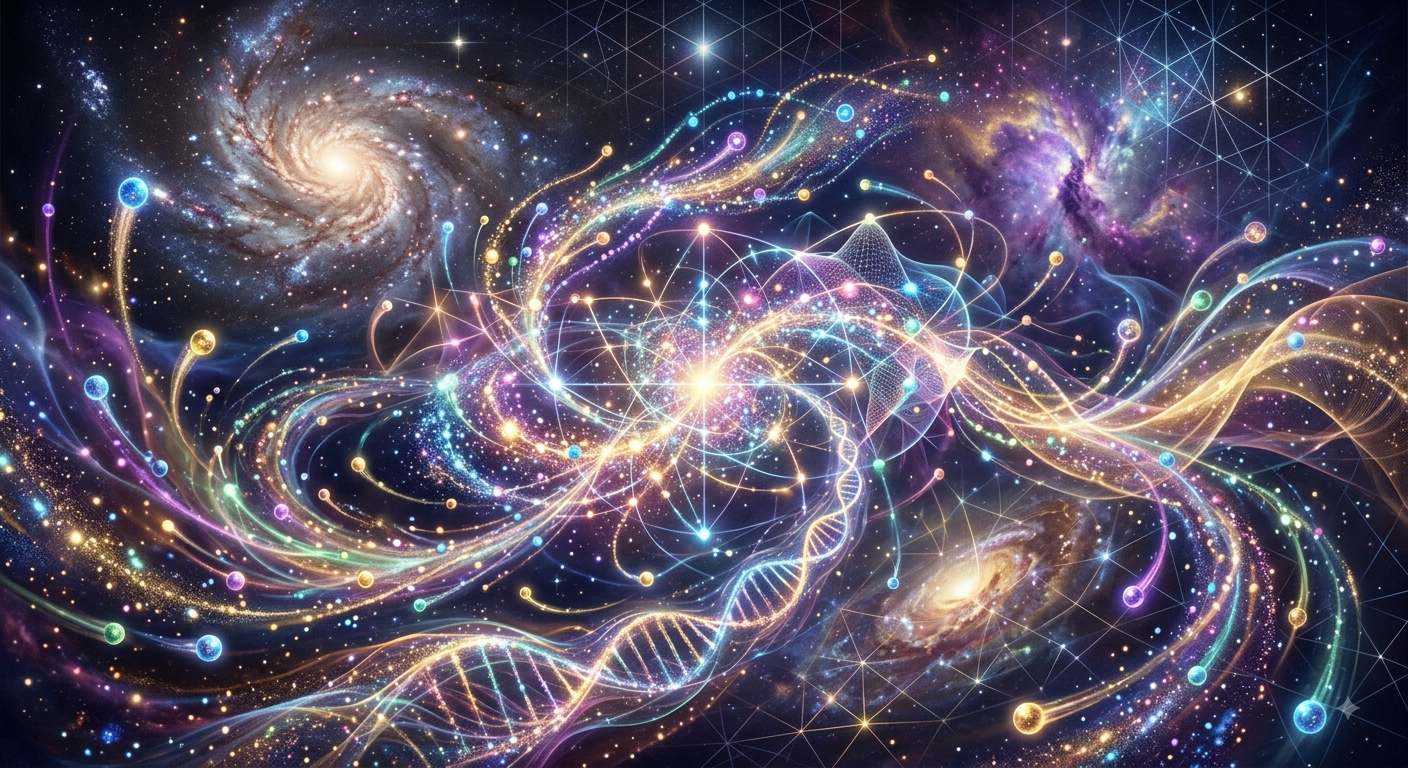
Proposed Subtitle
From the Quantum Vacuum and Fundamental Particles to Quantum Fields, Entanglement, Information, Matter, Energy and the Technological Future
Abstract
Quantum physics represents one of humanity’s deepest attempts to understand nature at its most fundamental level. Unlike classical physics, where objects possess relatively definite positions, velocities and properties, quantum theory describes physical systems through states, probabilities, amplitudes, operators and interactions. The modern picture goes further: in quantum field theory, particles are understood as excitations of underlying quantum fields. (CERN)
This thesis follows the “dance” of particles from the foundations of quantum mechanics through wave-particle duality, quantization, uncertainty, superposition, tunnelling, spin, antimatter, entanglement and measurement, ultimately reaching quantum fields, the Standard Model, the Higgs field and emerging quantum technologies.
PART I — ENTERING THE QUANTUM REALM
Chapter 1 — What Is Quantum Reality?
- Definition of quantum
- Classical versus quantum descriptions
- Scale of the quantum world
- Matter and energy
- The meaning of a physical state
- Probability in physics
- Why quantum mechanics was necessary
- Quantum physics and human civilization
Quantum theory is not simply a theory about tiny objects; it provides the framework needed to understand phenomena ranging from atomic structure to semiconductor electronics and modern quantum technologies. (CERN)
Chapter 2 — The Historical Revolution
Trace the development from:
- Ancient atomism
- Galileo Galilei
- Isaac Newton
- Michael Faraday
- James Clerk Maxwell
- Max Planck
- Albert Einstein
- Niels Bohr
- Louis de Broglie
- Werner Heisenberg
- Erwin Schrödinger
- Max Born
- Wolfgang Pauli
- Paul Dirac
- Enrico Fermi
- Richard Feynman
- Julian Schwinger
- Sin-Itiro Tomonaga
Explain how twentieth-century physics transformed the classical picture of nature.
PART II — THE QUANTUM LANGUAGE
Chapter 3 — Quantization
Explain:
- Energy quanta
- Planck’s constant
- Quantized energy levels
- Photons
- Atomic spectra
- Angular momentum
- Spin
- Quantized electromagnetic fields
Chapter 4 — Wave-Particle Duality
Explore how light exhibits both wave-like and particle-like characteristics and how matter can also demonstrate wave behaviour.
The de Broglie relationship,
[
\lambda = \frac{h}{p}
]
connects wavelength with momentum. CERN describes this development as a crucial extension of the particle-wave duality initiated through Einstein’s work on light quanta. (CERN)
Chapter 5 — The Quantum Wavefunction
Explain:
- Wavefunctions
- Probability amplitudes
- Complex numbers
- Probability density
- Normalization
- Superposition
- Schrödinger’s equation
- Stationary states
- Quantum measurement
PART III — THE STRANGE BEHAVIOUR OF QUANTUM MATTER
Chapter 6 — Superposition
Explain how a quantum system can be represented as a combination of possible states and why measurement produces definite outcomes.
Chapter 7 — Heisenberg’s Uncertainty Principle
Discuss:
[
\Delta x\Delta p \geq \frac{\hbar}{2}
]
and explain why this is not simply a limitation of imperfect instruments but a fundamental feature of quantum states.
Chapter 8 — Quantum Tunnelling
Explore how quantum systems can cross energy barriers that classical particles could not cross under the same conditions.
Applications include:
- Nuclear physics
- Scanning tunnelling microscopy
- Semiconductor devices
- Fusion physics
- Quantum electronics
Chapter 9 — Spin
Explain:
- Intrinsic angular momentum
- Fermions
- Bosons
- Spin-(\frac12)
- Pauli exclusion
- Magnetic moments
- Stern–Gerlach experiments
PART IV — THE ATOMIC AND SUBATOMIC WORLD
Chapter 10 — The Atom
Trace the structure from:
Atom → nucleus → proton/neutron → quarks
and explain why the classical planetary model of the atom is inadequate.
Chapter 11 — Electrons
Cover:
- Electron charge
- Electron mass
- Atomic orbitals
- Energy levels
- Electron spin
- Electron configurations
- Chemical bonding
- Semiconductor behaviour
Chapter 12 — Protons and Neutrons
Explain their composite structure and the role of quarks and gluons.
Chapter 13 — Quarks
Introduce:
- Up
- Down
- Charm
- Strange
- Top
- Bottom
and explain colour charge and the strong interaction.
Chapter 14 — Leptons
Examine:
- Electron
- Muon
- Tau
- Electron neutrino
- Muon neutrino
- Tau neutrino
Chapter 15 — Antimatter
Explain:
- Antiparticles
- Positrons
- Matter-antimatter annihilation
- Pair production
- Matter-antimatter asymmetry
PART V — THE FOUR FUNDAMENTAL INTERACTIONS
Chapter 16 — Electromagnetism
Explain photons, electric charge, electromagnetic fields and quantum electrodynamics.
Chapter 17 — The Strong Nuclear Force
Discuss:
- Quarks
- Gluons
- Colour charge
- Confinement
- Quantum chromodynamics
Chapter 18 — The Weak Nuclear Force
Explain:
- W bosons
- Z bosons
- Radioactive beta decay
- Neutrinos
- Flavour transformation
Chapter 19 — Gravity and the Quantum Problem
Explore why gravity remains difficult to incorporate into the same quantum framework.
The Standard Model successfully describes the electromagnetic, weak and strong interactions, but a complete quantum description of gravity remains an unresolved problem. (CERN)
PART VI — QUANTUM FIELD THEORY
Chapter 20 — From Particles to Fields
This chapter should represent the intellectual centre of the thesis.
Instead of imagining fundamental particles merely as tiny balls, introduce the modern field-based description:
Quantum field → excitation → particle
CERN explains that in quantum field theory, particles can be represented as waves or excitations in their corresponding fields. (CERN)
Chapter 21 — The Quantum Vacuum
Examine:
- Vacuum states
- Zero-point energy
- Quantum fluctuations
- Virtual particles
- Vacuum fields
Carefully distinguish established experimental physics from speculative interpretations.
Chapter 22 — The Standard Model
Build a complete conceptual map of:
Matter particles
- Quarks
- Leptons
Force carriers
- Photon
- Gluon
- W bosons
- Z boson
Higgs boson
The Standard Model provides the current framework for describing known elementary particles and their interactions. (CERN)
PART VII — THE HIGGS FIELD
Chapter 23 — The Higgs Mechanism
Explain:
- Higgs field
- Spontaneous symmetry breaking
- Electroweak theory
- W and Z masses
- Higgs boson
- 1964 theoretical proposals
- 2012 experimental discovery
The Higgs field is associated with the mechanism through which elementary particles acquire mass, while the Higgs boson is an excitation associated with that field. (CERN)
PART VIII — THE QUANTUM DANCE
Chapter 24 — Quantum Interactions
Present the conceptual sequence:
Field → excitation → interaction → exchange → measurement
Explain Feynman diagrams and interaction vertices without treating diagrams as literal photographs of particle trajectories.
Chapter 25 — Entanglement
Explain:
- Entangled states
- Correlations
- Bell’s theorem
- Bell inequalities
- Experimental tests
- Quantum information
Experiments associated with Alain Aspect, John Clauser and Anton Zeilinger established important experimental foundations for quantum information science and were recognized with the 2022 Nobel Prize in Physics. (CERN)
Chapter 26 — Measurement
Explore:
- Quantum states
- Observables
- Measurement probabilities
- Collapse interpretations
- Decoherence
- Observer versus measuring apparatus
- Interpretations of quantum mechanics
Importantly, distinguish what experiments establish from philosophical interpretations of what quantum mechanics means.
PART IX — QUANTUM INFORMATION
Chapter 27 — The Qubit
Compare:
Classical bit
[
0 \quad \text{or} \quad 1
]
with the quantum state:
[
|\psi\rangle=\alpha|0\rangle+\beta|1\rangle
]
Introduce:
- Superposition
- Phase
- Measurement
- Quantum gates
- Quantum circuits
Chapter 28 — Quantum Computing
Explain:
- Qubits
- Quantum gates
- Circuits
- Algorithms
- Quantum error correction
- Decoherence
- Quantum processors
- Quantum simulation
Quantum information science combines quantum mechanics with information processing and includes concepts such as qubits, superposition, entanglement, coherence and quantum communication. (quantum.gov)
Chapter 29 — Quantum Communication
Cover:
- Quantum channels
- Entanglement
- Quantum key distribution
- Quantum networks
- Quantum repeaters
- Quantum internet concepts
PART X — OBSERVING THE INVISIBLE
Chapter 30 — Particle Accelerators
Explain how scientists investigate subatomic particles through controlled high-energy collisions.
Discuss:
- Accelerators
- Particle beams
- Magnets
- Collision energies
- Detectors
- Data acquisition
- Statistical analysis
CERN describes its experimental programme as using accelerators and detectors to investigate the fundamental constituents of matter and their interactions. (CERN)
Chapter 31 — The Large Hadron Collider
Explain:
- Proton beams
- High-energy collisions
- ATLAS
- CMS
- ALICE
- LHCb
- Higgs discovery
- Searches beyond the Standard Model
Chapter 32 — Seeing Particles Through Their Signatures
Explain how physicists infer invisible particles from:
- Tracks
- Energy deposits
- Momentum
- Decay products
- Missing transverse momentum
- Statistical excesses
PART XI — QUANTUM REALITY AND THE UNIVERSE
Chapter 33 — Quantum Physics and the Early Universe
Connect quantum physics with:
- Big Bang cosmology
- Particle formation
- Symmetry breaking
- Matter-antimatter asymmetry
- Cosmic inflation
- Quantum fluctuations
Chapter 34 — Dark Matter
Explain what observations require and what remains unknown.
Distinguish between:
Observed gravitational effects
and
hypothetical particle explanations.
Chapter 35 — Dark Energy
Discuss the accelerating expansion of the universe and why its fundamental nature remains unresolved.
Chapter 36 — Quantum Gravity
Introduce:
- General relativity
- Quantum mechanics
- Quantum gravity
- String theory
- Loop quantum gravity
- Emergent spacetime
- Black-hole information
These should be presented as research programmes rather than established final theories.
PART XII — FROM QUANTUM PHYSICS TO TECHNOLOGY
Chapter 37 — The Quantum Foundation of Modern Electronics
Connect quantum mechanics to:
- Transistors
- Semiconductors
- Integrated circuits
- LEDs
- Lasers
- Solar cells
- Magnetic technologies
Quantum mechanics has already produced technologies including lasers, transistors, magnetic-resonance techniques and atomic clocks. (quantum.gov)
Chapter 38 — Quantum Sensors
Explore:
- Atomic clocks
- Magnetometers
- Gravimeters
- Navigation
- Medical sensing
- Fundamental physics
Chapter 39 — Quantum Simulation
Explain how controllable quantum systems can be used to investigate other quantum systems that are difficult to simulate classically.
Chapter 40 — Quantum Technologies of the Future
Examine potential developments in:
- Quantum computing
- Quantum networks
- Quantum sensing
- Quantum simulation
- Secure communications
- New materials
- Precision measurement
PART XIII — THE LIMITS OF HUMAN KNOWLEDGE
Chapter 41 — What Quantum Mechanics Explains
Summarize its extraordinary successes:
- Atomic structure
- Chemistry
- Particle physics
- Semiconductors
- Lasers
- Nuclear physics
- Quantum information
Chapter 42 — What Remains Unknown
Major questions include:
- What is dark matter?
- What is dark energy?
- Why is there more matter than antimatter?
- How can gravity be quantized?
- What is the true nature of the wavefunction?
- Why do physical constants have their observed values?
- Are there particles beyond the Standard Model?
- Is spacetime fundamental or emergent?
- What happens at the deepest quantum-gravitational scale?
PART XIV — THE GRAND SYNTHESIS
Chapter 43 — The Dance of Particles
The thesis should ultimately move from the intuitive picture:
Particles moving through space
to the deeper modern picture:
Quantum fields interacting throughout spacetime, with particles appearing as quantized excitations and interactions governed by fundamental symmetries.
This provides the central philosophical and scientific theme of the work.
Chapter 44 — From the Smallest Quantum to Civilization
Create a final chain:
Quantum fields
↓
Particles
↓
Atoms
↓
Molecules
↓
Materials
↓
Cells
↓
Life
↓
Brains
↓
Knowledge
↓
Computers
↓
Artificial intelligence
↓
Quantum technologies
↓
Future civilization
The central conclusion is that the quantum world is not an isolated microscopic curiosity. Its laws form part of the physical foundation from which chemistry, materials, electronics, information technology and much of modern civilization emerge.
Recommended Master Diagram
A particularly effective visual architecture for the thesis would be:
UNIVERSE
↓
Quantum Fields
↓
Fundamental Particles
↓
Four Fundamental Interactions
↓
Atoms & Molecules
↓
Matter & Energy
↓
Life & Information
↓
Computing & Technology
↓
Quantum Technology
↓
Future Scientific Civilization
Core scientific principle
The thesis should consistently distinguish three levels:
1. Established physics — experimentally supported quantum mechanics and the Standard Model.
2. Active research — areas such as quantum gravity, dark matter and physics beyond the Standard Model.
3. Philosophical interpretation — questions concerning what quantum mechanics ultimately says about reality.
That distinction will make the article scientifically rigorous rather than presenting speculative ideas as established facts. CERN notes that, despite quantum theory’s extraordinary predictive success, there is still no consensus on its ultimate interpretation. (CERN)


Be First to Comment