
Abstract
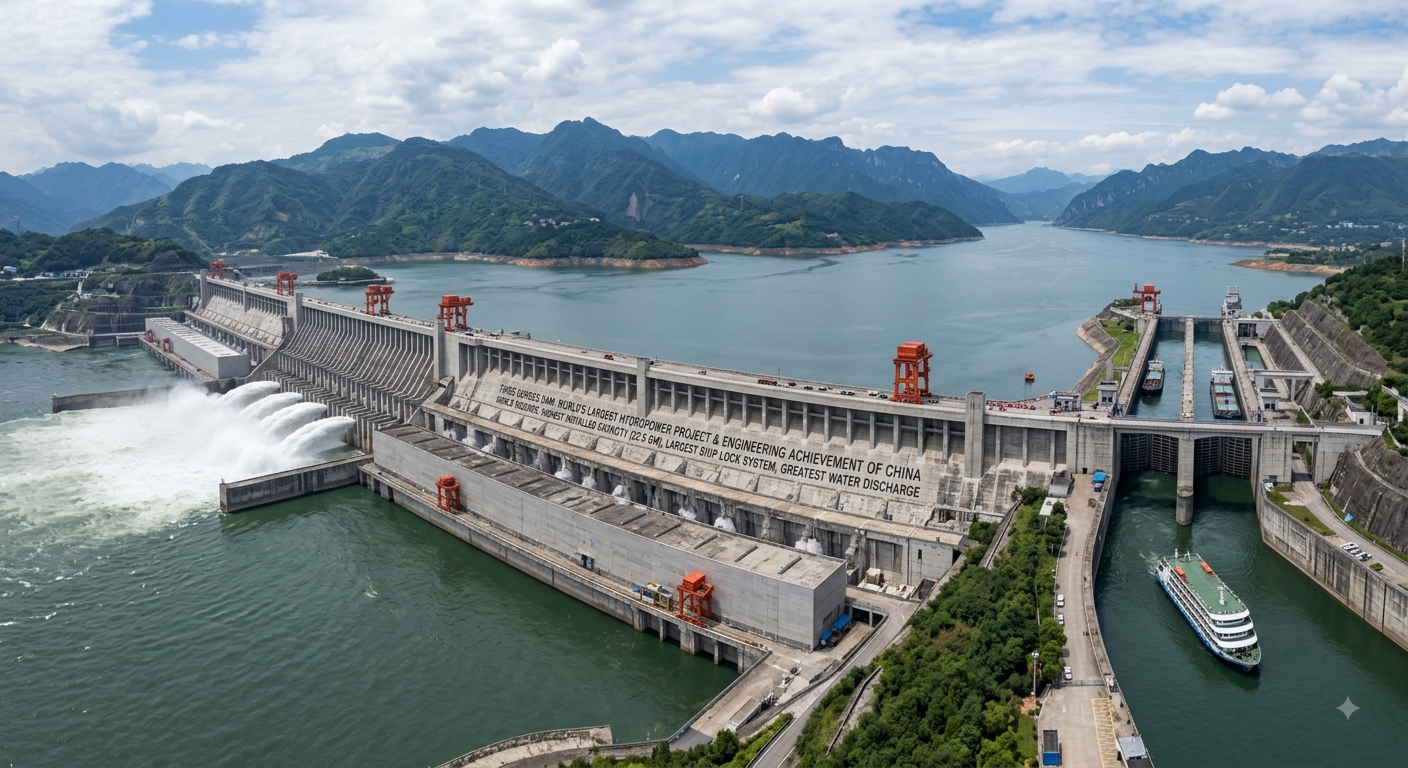
The Three Gorges Project (TGP) on China’s Yangtze River is one of the most consequential civil-engineering projects of the modern era. Located near Sandouping in Yichang, Hubei Province, the project combines a massive concrete gravity dam, a reservoir, hydroelectric generating system, flood-control infrastructure, navigation locks, a ship lift, transmission infrastructure, and extensive water-management systems into one integrated river-engineering complex.
The Three Gorges Hydropower Station has an installed capacity of 22,500 MW, making it the world’s largest hydropower station by installed capacity. Its 34 generating units consist of 32 units rated at 700 MW and two units rated at 50 MW.
Its importance extends far beyond the production of electricity. The project represents an attempt to integrate energy engineering, hydraulic engineering, structural engineering, electrical engineering, transportation engineering, flood management, large-scale construction management, environmental monitoring, and regional economic development into a single technological system.
The project also demonstrates an important principle of modern engineering: a megaproject should not be judged only by the size of its physical structures. Its deeper significance lies in the ability to coordinate millions of physical components, enormous flows of water and electricity, navigation systems, geological conditions, human settlements, environmental processes, and national infrastructure into one continuously operated system.
At the same time, the Three Gorges Project has involved major environmental and social consequences, including large-scale resettlement and changes to river ecosystems and sediment processes. A serious engineering thesis therefore has to examine both its achievements and its costs.
1. Introduction
Few infrastructure projects illustrate the relationship between engineering ambition and national development strategy as clearly as the Three Gorges Dam.
The Yangtze is China’s longest river and one of the world’s major river systems. Its enormous flow provides both an opportunity and a danger: water can generate electricity and support transportation, but floods can threaten densely populated agricultural and industrial regions.
The basic engineering concept was therefore not simply:
Build a dam and generate electricity.
Instead, the Three Gorges Project was conceived as a multi-function river-management system involving:
- Hydroelectric generation
- Flood control
- Navigation improvement
- Water-resource regulation
- Regional economic development
- Electricity transmission
- Large-scale infrastructure modernization
- Scientific and technological development
China Three Gorges Corporation describes the project as serving flood control, power generation, navigation and water-resource utilization simultaneously.
This makes the project particularly valuable as a subject of engineering study because it demonstrates systems engineering at continental scale.
2. Historical Development
The idea of exploiting the Three Gorges region for water management is considerably older than the modern dam.
China Three Gorges Corporation’s historical record identifies an early proposal by Sun Yat-sen in 1918 for development of the Three Gorges. The modern project formally began construction in December 1994. Major milestones followed:
- 1997: Yangtze main-channel diversion/closure was achieved.
- 2003: Initial reservoir operation, navigation and the first generating units became operational.
- 2006: Initial reservoir filling reached approximately 156 m.
- 2009: Major construction tasks were substantially completed.
- 2012: All 32 large 700-MW generating units were operational.
- 2017: Cumulative generation exceeded 1 trillion kWh.
- 2018: Annual generation exceeded 100 billion kWh.
- 2020: The project completed overall acceptance and recorded a world-record annual generation figure of approximately 111.8 billion kWh.
The project therefore evolved over decades rather than being a single construction event.
3. The Physical Architecture of the Three Gorges Project
The Three Gorges Project should be understood as a network of interconnected engineering subsystems.
3.1 Primary architectural structure
A simplified systems architecture is:
                    YANGTZE RIVER
                          │
                          ▼
                ┌───────────────────┐
                │ THREE GORGES      │
                │ RESERVOIR         │
                └─────────┬─────────┘
                          │
                          ▼
                ┌───────────────────┐
                │ CONCRETE GRAVITY  │
                │ DAM               │
                └─────┬─────┬───────┘
                      │     │
          ┌───────────┘     └────────────┐
          ▼                              ▼
 ┌─────────────────┐             ┌─────────────────┐
 │ HYDROPOWER      │             │ SPILLWAY /      │
 │ STATION          │             │ FLOOD CONTROL   │
 └────────┬────────┘             └─────────────────┘
          │
          ▼
 ┌─────────────────┐
 │ TRANSFORMERS &  │
 │ TRANSMISSION    │
 └────────┬────────┘
          │
          ▼
     CHINA'S GRID
Alongside this energy system exists another major subsystem:
Reservoir
   │
   ▼
Five-stage ship locks
   │
   ▼
Downstream Yangtze navigation
And a second navigation pathway:
Reservoir
   │
   ▼
Large ship lift
   │
   ▼
Downstream river
The remarkable characteristic is that these systems operate around the same hydraulic structure.
4. The Dam Structure
The main dam is approximately 2,335 metres long and about 181 metres high, with approximately 27.2 million cubic metres of concrete associated with the main construction and approximately 463,000 tonnes of steel reported in major project data.
It is fundamentally a concrete gravity dam.
A gravity dam resists the horizontal force of water primarily through its enormous mass.
Conceptually:
             RESERVOIR
~~~~~~~~~~~~~~~~~~~~~~~~~~~~~~~~~~~~
             WATER PRESSURE →
                     │
                     │
              ┌──────▼──────┐
              │             │
              │   DAM       │
              │             │
              │             │
              │             │
              └─────────────┘
                 FOUNDATION
The engineering problem is therefore one of transferring enormous hydraulic forces safely into the underlying geological foundation.
5. Reservoir Architecture
The reservoir has a total storage capacity of approximately 39.3 billion cubic metres, with a surface area of roughly 1,045 km² at the relevant high-water condition.
The reservoir performs several functions simultaneously.
Energy storage
Water stored at elevation represents gravitational potential energy:
[
E=mgh
]
where:
- (E) = potential energy
- (m) = mass of water
- (g) = gravitational acceleration
- (h) = hydraulic head
This stored energy becomes mechanical energy in the turbines and subsequently electrical energy in the generators.
Flood management
The reservoir provides storage volume during major flood events, allowing operators to regulate downstream discharge.
Dry-season water regulation
Stored water can also contribute to downstream flow during periods of lower natural discharge.
Thus the reservoir acts as a huge hydrological buffer.
6. Hydroelectric Architecture
The heart of the project is its generating system.
The Three Gorges Hydropower Station has:
- 34 generating units
- 32 × 700 MW units
- 2 × 50 MW units
- 22.5 GW total installed capacity
China Three Gorges Corporation identifies it as the world’s largest hydropower station by installed capacity.
The basic energy conversion chain is:
Sun
 ↓
Evaporation
 ↓
Atmospheric circulation
 ↓
Rainfall
 ↓
Yangtze River
 ↓
Reservoir
 ↓
Potential energy
 ↓
Water pressure/flow
 ↓
Turbine rotation
 ↓
Generator
 ↓
Electrical energy
 ↓
Transformer
 ↓
High-voltage transmission
 ↓
National electricity grid
This is one of the clearest examples of a natural energy cycle being converted into a highly engineered electrical system.
7. Turbine-Generator System
The turbines convert hydraulic energy into mechanical rotation.
The mechanical process can be represented as:
[
P_h=\rho gQH
]
where:
- (P_h) = hydraulic power
- (\rho) = density of water
- (g) = gravitational acceleration
- (Q) = water flow rate
- (H) = effective hydraulic head
Actual electrical output is lower because hydraulic, mechanical and electrical losses occur:
[
P_e=\eta\rho gQH
]
where (\eta) represents the combined efficiency of the system.
The engineering achievement is therefore not merely possessing a large quantity of water. The challenge is converting that water into electricity reliably, efficiently and continuously while maintaining hydraulic and structural safety.
8. Electricity Transmission Architecture
The Three Gorges project was developed as part of China’s large-scale electricity transmission strategy.
Its output supports major load centres away from the dam itself, including eastern and central regions.
This creates a second engineering network:
Hydroelectric generation
          │
          ▼
     Transformers
          │
          ▼
High-voltage transmission
          │
          ▼
Regional transmission networks
          │
          ▼
Urban / industrial demand
Consequently, the Three Gorges Project is not merely a power station.
It is a power-generation node inside a national electrical architecture.
9. Navigation Engineering
One of the most extraordinary aspects of the project is that the dam did not simply terminate river navigation.
Instead, engineers constructed navigation infrastructure around the enormous elevation difference.
Five-stage ship locks
The ship-lock system operates essentially as a hydraulic staircase.
UPSTREAM RESERVOIR
       │
       ▼
 ┌───────────────┐
 │ Lock Stage 1  │
 └───────┬───────┘
         ▼
 ┌───────────────┐
 │ Lock Stage 2  │
 └───────┬───────┘
         ▼
 ┌───────────────┐
 │ Lock Stage 3  │
 └───────┬───────┘
         ▼
 ┌───────────────┐
 │ Lock Stage 4  │
 └───────┬───────┘
         ▼
 ┌───────────────┐
 │ Lock Stage 5  │
 └───────┬───────┘
         ▼
DOWNSTREAM RIVER
Rather than moving a ship vertically in one step, the lock system changes the vessel’s water level progressively.
This is a magnificent example of hydraulic transportation engineering.
10. The World’s Largest Ship Lift
The Three Gorges ship lift adds another extraordinary engineering subsystem.
According to China Three Gorges Corporation, it is the world’s largest ship lift, capable of handling vessels of up to approximately 3,000 tonnes and lifting them through a vertical distance of approximately 113 metres. It uses 256 steel cables and a rack-and-pinion synchronization system.
Its operating concept is:
       RESERVOIR
          │
     ┌────▼────┐
     │  SHIP   │
     │  LIFT   │
     └────┬────┘
          │
       113 m
          │
     ┌────▼────┐
     │  LOWER  │
     │  RIVER   │
     └─────────┘
This is essentially an enormous mechanical elevator for vessels.
The engineering challenge involves:
- structural loads
- cable forces
- synchronization
- hydraulic conditions
- vessel stability
- precision control
- mechanical reliability
- emergency safety
By 2024, the ship lift had accumulated more than 40,500 safe operations and transported more than 16.8 million tonnes of cargo, according to CTG.
11. Concrete Engineering
The Three Gorges project required concrete placement on a scale rarely encountered in civil engineering.
A South African concrete-industry publication reports that nearly 30 million cubic metres of concrete were placed across the project and describes exceptional annual, monthly and daily concrete-placement records during construction.
This created major thermal and quality-control problems.
Concrete generates heat as cement hydrates.
For a conventional small structure, temperature management is relatively straightforward.
For a massive dam, however:
[
\text{Large concrete volume}
\rightarrow
\text{heat generation}
\rightarrow
\text{temperature gradients}
\rightarrow
\text{thermal stress}
\rightarrow
\text{cracking risk}
]
Therefore, construction required sophisticated:
- concrete mix design
- temperature management
- cooling systems
- quality monitoring
- placement sequencing
- computer-controlled batching
- construction logistics
The project thus became a major laboratory for mass-concrete engineering.
12. Construction Logistics
A project of this magnitude resembles a temporary industrial city.
Its construction system required:
Raw materials
     ↓
Quarries / suppliers
     ↓
Processing
     ↓
Concrete plants
     ↓
Transportation
     ↓
Placement
     ↓
Cooling / curing
     ↓
Inspection
     ↓
Structural integration
The project therefore required not just civil engineers but also:
- mechanical engineers
- electrical engineers
- geologists
- hydrologists
- materials scientists
- environmental scientists
- surveyors
- computer specialists
- construction managers
- transportation specialists
- safety engineers
This interdisciplinary character is one of its greatest technological lessons.
13. World-Breaking Records and Achievements
The phrase “world record” should be used carefully because different records measure different things.
Record 1 — World’s largest hydropower station by installed capacity
The Three Gorges Hydropower Station has 22.5 GW of installed capacity and remains identified by China Three Gorges Corporation as the world’s largest hydropower station by installed capacity.
Significance
This demonstrated China’s ability to design, manufacture, install and operate an enormous number of high-capacity generating units as an integrated system.
Record 2 — World’s highest annual generation by a single hydropower station
In 2020, Three Gorges generated approximately:
[
111.8\text{ billion kWh}
]
This exceeded the previous annual record of approximately 103.098 billion kWh set by the Itaipu hydroelectric complex in 2016.
This is an important distinction:
installed capacity measures maximum generating capability, whereas annual generation measures actual electricity produced over a year.
Record 3 — More than 100 billion kWh annual generation
The station exceeded 100 billion kWh again in 2021, generating approximately 103.649 billion kWh that year.
The ability to repeatedly exceed the 100-billion-kWh threshold demonstrates that the achievement was not simply a single exceptional operating year.
Record 4 — World’s largest ship lift
The Three Gorges ship lift is described by its operator as the world’s largest ship lift.
It can raise vessels approximately 113 metres and handle vessels up to around 3,000 tonnes.
This is an independent engineering achievement from the dam itself.
Record 5 — Exceptional cumulative electricity production
By July 2023, the Three Gorges Hydropower Station had generated more than 1.6 trillion kWh since its first generator began operation in 2003.
The operator estimated that this represented more than 480 million tonnes of standard-coal equivalent and approximately 1.32 billion tonnes of avoided CO₂ emissions relative to the stated comparison basis.
These figures should be interpreted as equivalent or avoided-emission estimates, rather than measurements of emissions literally eliminated from the atmosphere.
14. Flood-Control Achievement
The project is also fundamentally a hydraulic-management system.
During the major floods of 2020, the Three Gorges Reservoir retained a cumulative 30.5 billion cubic metres of floodwater, according to CTG.
The same year saw an inflow peak of approximately 75,000 cubic metres per second, identified by CTG as the largest flood peak since reservoir operation began.
The significance is enormous.
Instead of allowing the full incoming flood wave to propagate immediately downstream, reservoir storage can modify the timing and magnitude of discharge.
Conceptually:
[
Q_{in} – Q_{out} = \frac{dS}{dt}
]
where:
- (Q_{in}) = inflow
- (Q_{out}) = outflow
- (S) = stored water
This equation captures the fundamental principle of reservoir flood regulation.
15. Navigation Transformation
The project transformed the navigability of a major section of the Yangtze.
In 2020 alone, CTG reported approximately:
- 39,446 ships passing through the Three Gorges ship lock
- approximately 137 million tonnes of cargo
- 2,318 ship-lift operations
- more than 760,900 tonnes of freight moved through the lift.
Thus the project should also be understood as a transportation infrastructure system.
16. China’s Engineering Significance
The deepest significance of Three Gorges lies in what it demonstrates about Chinese engineering capability.
16.1 Megaproject management
The project required coordination across decades.
This means China developed capabilities in:
- long-term project planning
- procurement
- construction sequencing
- workforce organization
- quality control
- large-scale logistics
- risk management
- commissioning
Such capabilities are transferable to other infrastructure sectors.
17. Manufacturing Capability
A hydroelectric project of this scale requires advanced manufacturing.
The system involves:
- turbines
- generators
- transformers
- control systems
- electrical protection
- steel structures
- gates
- cranes
- cables
- navigation equipment
- monitoring systems
Therefore the Three Gorges Project is also evidence of China’s transition from primarily assembling infrastructure to developing increasingly sophisticated industrial engineering ecosystems.
18. Systems Engineering
Perhaps the greatest lesson is systems integration.
The project can be viewed as:
[
\text{River}
+
\text{Dam}
+
\text{Reservoir}
+
\text{Hydropower}
+
\text{Transmission}
+
\text{Navigation}
+
\text{Flood Control}
+
\text{Environmental Management}
\text{Integrated Infrastructure System}
]
This is systems engineering at extraordinary scale.
A failure in one subsystem can influence others.
For example:
Rainfall
  ↓
River inflow
  ↓
Reservoir level
  ↓
Flood-control decisions
  ↓
Turbine operation
  ↓
Electricity production
  ↓
Downstream discharge
  ↓
Navigation
  ↓
Ecological conditions
The project therefore illustrates why modern infrastructure cannot be understood as isolated structures.
19. Digital and Control Engineering
Modern dam operation increasingly depends upon information.
A conceptual control architecture is:
SENSORS
  │
  ├── Water level
  ├── Flow rate
  ├── Rainfall
  ├── Structural movement
  ├── Temperature
  ├── Vibration
  └── Equipment condition
          │
          ▼
   DATA ACQUISITION
          │
          ▼
   CONTROL SYSTEM
          │
          ▼
 ┌────────┼─────────┐
 ▼        ▼         ▼
Gates   Turbines   Navigation
 │        │         │
 └────────┼─────────┘
          ▼
     HUMAN OPERATORS
This represents the transition from traditional civil engineering toward cyber-physical infrastructure.
The modern megadam is therefore not simply concrete.
It is:
[
\text{Concrete + Steel + Water + Electricity + Sensors + Software + Human Decision-Making}
]
20. Environmental Dimension
A balanced thesis must acknowledge that enormous engineering achievements can also produce enormous environmental changes.
The reservoir fundamentally changed:
- river flow patterns
- sediment transport
- aquatic habitats
- shoreline environments
- local landscapes
- ecological connectivity
Scientific literature has examined concerns involving ecological change, sedimentation, habitat transformation and other environmental consequences.
The project therefore demonstrates an important principle:
Engineering success does not mean absence of environmental consequences.
Instead, modern engineering must increasingly measure both:
[
\text{Engineering Benefit}
]
and
[
\text{Environmental Cost}
]
21. Human Resettlement
One of the most significant social consequences was population displacement.
Academic research identifies the displacement of more than 1.13 million people as one of the most contentious aspects of the project.
The social impact illustrates a fundamental challenge of infrastructure:
New infrastructure
       ↓
Reservoir creation
       ↓
Land inundation
       ↓
Communities relocated
       ↓
New housing + infrastructure
       ↓
Economic adaptation
       ↓
Long-term social consequences
Research has found that resettlement outcomes changed over time, with later studies reporting improvements in income, food security and wellbeing among studied households after earlier difficulties.
The lesson is that resettlement should be considered a long-term development process, not simply a relocation operation.
22. Sediment Engineering
Rivers transport enormous quantities of sediment.
When a river enters a reservoir, its velocity decreases, causing some sediment to settle.
This produces a fundamental engineering problem:
[
\text{Sediment inflow}
\text{Sediment outflow}
\text{Sediment accumulation}
]
Over long periods, sediment accumulation can reduce useful reservoir capacity and alter downstream sediment supply.
Therefore reservoir engineering must include:
- sediment monitoring
- river morphology
- erosion studies
- sediment transport modelling
- reservoir management
This demonstrates that dams are not static structures.
They interact dynamically with rivers.
23. Geological and Structural Safety
A dam of this scale must continuously confront:
- foundation stability
- seepage
- concrete deformation
- temperature effects
- water pressure
- earthquakes
- slope stability
- equipment failure
- extreme floods
The engineering philosophy is therefore:
[
\text{Design}
+
\text{Monitoring}
+
\text{Inspection}
+
\text{Maintenance}
+
\text{Emergency Planning}
]
rather than merely:
[
\text{Design} \rightarrow \text{Build} \rightarrow \text{Forget}
]
China Three Gorges Corporation reports ongoing dam-safety inspections and online monitoring systems across its dam portfolio.
24. Economic Significance
The Three Gorges Project helped integrate electricity, transportation and regional development.
Its economic architecture can be represented as:
                  THREE GORGES
                       │
       ┌───────────────┼────────────────┐
       ▼               ▼                ▼
   ELECTRICITY      NAVIGATION       FLOOD CONTROL
       │               │                │
       ▼               ▼                ▼
   INDUSTRY          TRADE          LOWER RISK
       │               │                │
       └───────────────┼────────────────┘
                       ▼
               REGIONAL ECONOMY
Electricity supports industry.
Navigation reduces transportation friction.
Flood management can reduce economic losses.
Water regulation supports downstream users.
The result is a multi-dimensional infrastructure dividend.
25. Energy Significance
Hydropower provides electricity without directly burning fossil fuels during generation.
This makes the Three Gorges Project an important component of China’s broader clean-energy infrastructure.
Its long-term generation record illustrates another engineering principle:
Capacity is not enough.
A 22.5-GW facility only becomes economically meaningful if it can convert its hydraulic resource into large quantities of electricity over many years.
The project’s cumulative output demonstrates the importance of:
- reliability
- maintenance
- water management
- turbine availability
- grid integration
- operational optimization
26. Comparison With Itaipu
The historical competition between Three Gorges and Itaipu illustrates two different dimensions of hydroelectric achievement.
| Measure | Three Gorges | Itaipu |
|---|---|---|
| Location | China | Brazil/Paraguay |
| River | Yangtze | Paraná |
| Installed capacity | 22.5 GW | 14 GW |
| Previous annual-generation record | — | 103.098 billion kWh in 2016 |
| Three Gorges 2020 generation | 111.8 billion kWh | — |
| Major distinction | Largest installed hydropower capacity | Historic generation benchmark |
Three Gorges exceeded Itaipu’s 2016 annual generation record in 2020.
The comparison demonstrates why engineers distinguish between:
capacity, annual generation, efficiency, reliability and cumulative output.
27. Why the Three Gorges Dam Matters to Chinese Engineering
The Three Gorges Project symbolizes several stages of China’s technological transformation.
Stage 1 — Infrastructure ambition
China demonstrated that it could conceive infrastructure on enormous geographical and temporal scales.
Stage 2 — Construction capability
It demonstrated the ability to coordinate enormous volumes of materials, workers, machinery and engineering processes.
Stage 3 — Manufacturing capability
It required sophisticated turbines, generators, electrical systems and mechanical equipment.
Stage 4 — Systems integration
It integrated electricity, water, transportation and flood control.
Stage 5 — Operational engineering
The project became a continuously monitored and optimized infrastructure system.
Stage 6 — Global engineering capability
The knowledge accumulated through major Chinese hydropower projects contributes to China’s broader role in global infrastructure development.
28. The Three Gorges Project as a Chinese Engineering Philosophy
The project can be interpreted as an expression of several engineering principles:
Scale
China demonstrated that infrastructure could be designed at extraordinary physical scale.
Integration
Different infrastructure functions could be combined into one system.
Standardization
Large numbers of similar generating units could be manufactured and integrated.
Long-term planning
The project required decades of planning, construction and operation.
State capacity
The project demonstrates the ability of a large state to mobilize financial, industrial, scientific and administrative resources.
Continuous improvement
The engineering system did not end when construction finished; operation, monitoring and upgrading continued.
29. The Broader Chinese Hydropower System
The significance of Three Gorges becomes even clearer when viewed alongside other major Chinese hydropower projects.
China has developed a large cascade of major stations along river systems.
China Three Gorges Corporation identifies a major clean-energy corridor consisting of the Wudongde, Baihetan, Xiluodu, Xiangjiaba, Three Gorges and Gezhouba hydropower stations.
This changes the engineering paradigm from:
One dam → one power station
toward:
Multiple reservoirs → coordinated river management → integrated electricity generation → large transmission network
This is a much more advanced form of infrastructure systems engineering.
30. Three Gorges and Baihetan: Evolution of Chinese Hydropower
An important illustration of China’s technological progression is Baihetan.
The Baihetan project uses 16 × 1,000-MW generating units, which CTG describes as the world’s largest hydropower generating units by single-unit capacity.
This indicates that Chinese hydropower engineering did not stop at Three Gorges.
The technological trajectory continued:
Large hydro
     ↓
Three Gorges
     ↓
Experience accumulation
     ↓
Advanced turbine engineering
     ↓
Baihetan
     ↓
1-GW-class individual units
Thus Three Gorges should be understood as part of a long technological learning curve.
31. Engineering Lessons for the World
The Three Gorges Project provides several lessons for future infrastructure.
Lesson 1 — Think in systems
A dam should be integrated with:
- electricity
- transport
- water
- environment
- communities
- data
Lesson 2 — Scale requires standardization
Massive projects become possible when components and processes are standardized.
Lesson 3 — Construction and operation are connected
The design must anticipate decades of operation.
Lesson 4 — Data becomes increasingly important
Sensors, monitoring and computational modelling are essential to modern infrastructure.
Lesson 5 — Social engineering matters
Communities affected by infrastructure must be included in long-term planning.
Lesson 6 — Environmental management is part of engineering
Ecological consequences cannot be separated from the project.
32. A Future Engineering Architecture
The future evolution of projects like Three Gorges is likely to move toward increasingly intelligent infrastructure.
A future architecture can be represented as:
                RIVER BASIN
                    │
        ┌───────────┴───────────┐
        ▼                       ▼
   WEATHER DATA            HYDROLOGY
        │                       │
        └───────────┬───────────┘
                    ▼
             AI / DIGITAL TWIN
                    │
          ┌─────────┼─────────┐
          ▼         ▼         ▼
       FLOODS     ENERGY   NAVIGATION
          │         │         │
          └─────────┼─────────┘
                    ▼
              DAM CONTROL
                    │
       ┌────────────┼────────────┐
       ▼            ▼            ▼
     GATES       TURBINES      LOCKS
       │            │            │
       └────────────┼────────────┘
                    ▼
          NATIONAL INFRASTRUCTURE
The next generation of hydropower therefore will increasingly combine:
civil engineering + electrical engineering + artificial intelligence + sensors + digital twins + satellite observation + predictive maintenance.
33. The Ultimate Significance
The Three Gorges Dam is significant for three fundamentally different reasons.
First: physical achievement
It demonstrates that humanity can construct infrastructure of enormous dimensions.
Second: technological achievement
It demonstrates the integration of hydraulic, mechanical, electrical, structural and control engineering.
Third: national-development achievement
It demonstrates how infrastructure can be used simultaneously for energy, transportation, flood management and regional development.
But the project also teaches a fourth lesson:
Fourth: responsibility
The greater the scale of engineering, the greater the consequences of engineering decisions.
A structure capable of influencing a huge river system also has the capacity to transform ecosystems, landscapes, communities and economic patterns.
Therefore:
[
\boxed{
\text{Great Engineering}
\text{Capability}
+
\text{Reliability}
+
\text{Efficiency}
+
\text{Safety}
+
\text{Environmental Responsibility}
+
\text{Human Responsibility}
}
]
34. Conclusion
The Three Gorges Dam is much more than the world’s largest hydropower station by installed capacity.
It is a national-scale engineering system in which water, concrete, turbines, generators, electrical networks, navigation infrastructure, flood-control systems, data, people and geography interact continuously.
Its principal engineering achievements include:
- 22.5 GW installed hydropower capacity
- 34 generating units
- approximately 2,335 m dam length
- approximately 181 m structural height
- approximately 39.3 billion m³ reservoir storage
- the world’s largest hydropower station by installed capacity
- a 111.8-billion-kWh annual generation record in 2020
- repeated annual production above 100 billion kWh
- the world’s largest ship lift
- approximately 113 m vertical vessel lifting capability
- enormous flood-storage capability
- more than 1.6 trillion kWh generated during its first two decades of operation.
Its greatest significance to Chinese engineering, however, is not any single numerical record.
The deeper achievement is systems integration at unprecedented scale.
Three Gorges demonstrates how China developed the ability to coordinate civil engineering, hydrology, mechanical engineering, electrical engineering, manufacturing, transportation, construction management and long-term infrastructure operation.
It therefore occupies an important position in the history of modern engineering alongside the great infrastructure achievements of the industrial age.
Yet its legacy should be evaluated honestly. The same scale that produces extraordinary benefits also produces extraordinary environmental and social consequences. The displacement of more than a million people and the transformation of the Yangtze ecosystem demonstrate that engineering megaprojects cannot be evaluated solely by records and concrete volumes.
The ultimate lesson of Three Gorges is therefore not simply:
China built one of the world’s biggest dams.
It is:
China demonstrated the capacity to engineer, manufacture, construct, integrate and operate a vast physical system in which water management, electricity generation, navigation, flood control and national infrastructure function together.
That is the real engineering significance of the Three Gorges Project—and one of the clearest examples of how modern Chinese engineering moved from constructing individual structures toward designing integrated national-scale technological systems.




Be First to Comment