
Abstract
Ancient Egypt is one of the earliest civilizations for which there is extensive archaeological and written evidence of organized, state-supported extraction of minerals, metals, gemstones, and building stone. Mining was not a peripheral activity. It was integrated into the Egyptian economy, religion, military power, construction industry, craftsmanship, long-distance trade, and the authority of the pharaoh.
Egyptian mining developed from the exploitation of naturally accessible stone and mineral deposits into increasingly sophisticated expeditionary operations. By the Early Dynastic and Old Kingdom periods, Egyptian authorities were sending organized expeditions into the Sinai, Eastern Desert, Nubia, and other resource regions. These expeditions involved prospecting, surveying, quarrying, mining, processing, transportation, administration, security, food and water supply, and religious activity.
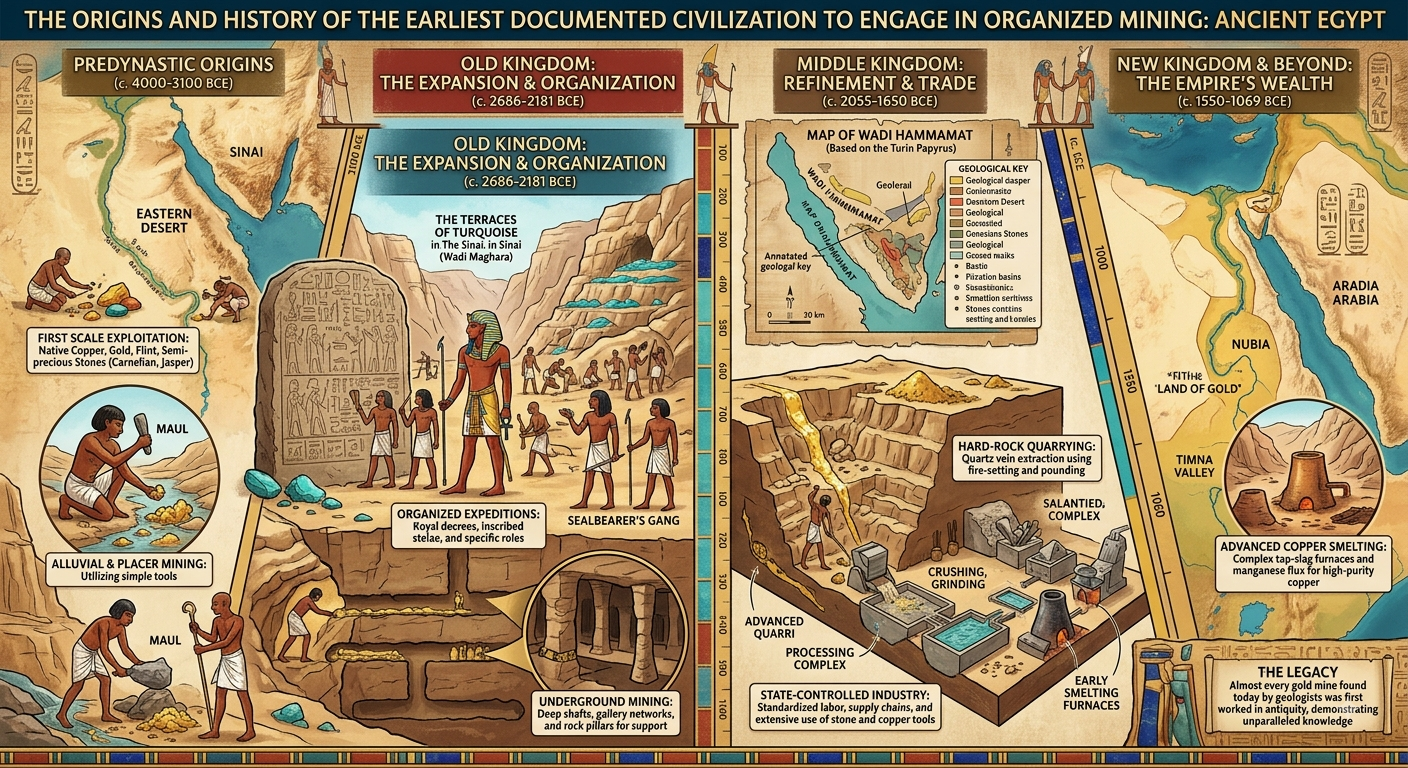
The historical record is particularly important because Egypt preserves both physical evidence of mining and written evidence describing its organization. Wadi Maghara and Serabit el-Khadim in Sinai provide evidence for ancient extraction of turquoise and copper, while the Eastern Desert contains extensive gold-mining landscapes. The Wadi Hammamat region provides evidence for quarrying, transportation, settlements and administrative organization. The famous Turin Papyrus, dating to approximately 1150 BCE, provides an extraordinary map of the Wadi Hammamat landscape and its mineral resources and is commonly described as the world’s oldest surviving geological map.
A necessary historical qualification is that Egypt should not automatically be called the world’s first mining civilization. Mining and metallurgy existed in several prehistoric societies before the formation of the Egyptian state. What distinguishes Egypt is the unusually early and extensive evidence for centralized, institutionalized and documented resource procurement at civilization scale.
1. Introduction: Mining as a Foundation of Civilization
Human civilization has always depended upon Earth’s geological resources.
Stone provided shelter, monuments and tools. Clay provided pottery and bricks. Copper enabled increasingly sophisticated tools and objects. Gold became a store of prestige and political power. Turquoise, lapis lazuli, carnelian and other minerals became components of jewelry and ritual objects.
Consequently, the history of mining is also part of the history of civilization.
Ancient Egypt provides one of the world’s most important early examples of this relationship because the civilization developed in a geographically unusual environment. The Nile Valley contained fertile agricultural land but much of the country’s mineral wealth lay beyond the immediate agricultural zone.
The Nile therefore became more than a river of agriculture. It became a transportation corridor connecting agricultural population centers with remote geological resources.
This created a fundamental economic system:
Agriculture → taxation/surplus → government organization → mining expeditions → mineral extraction → processing → transportation → manufacturing/construction → political and religious power
Mining consequently became part of the Egyptian state system.
2. The Geological Geography of Ancient Egypt
Ancient Egyptian mining cannot be understood without understanding Egypt’s geology.
The Nile Valley is surrounded by several resource-rich geological regions:
- Sinai Peninsula
- Eastern Desert
- Red Sea hills
- Nubia
- Western Desert
- Nile Valley quarries
- regions south of Egypt associated with ancient Nubia and Kush
These regions contained very different resources.
| Resource | Major ancient areas | Principal importance |
|---|---|---|
| Gold | Eastern Desert, Nubia/Kush | Royal wealth, jewelry, ritual objects |
| Copper | Sinai and other regions | Tools, implements and metallurgy |
| Turquoise | Sinai | Jewelry and religious symbolism |
| Stone | Nile Valley, Eastern Desert | Temples, statues, monuments |
| Granite | Aswan region | Obelisks, statues, architecture |
| Greywacke/bekhen stone | Wadi Hammamat | Statues and monumental construction |
| Amethyst | Eastern Desert | Jewelry and elite objects |
| Faience minerals | Various regions | Decorative and ritual production |
| Natron | Wadi Natrun | Mummification and industrial uses |
| Clay | Nile Valley | Pottery, bricks and ceramics |
The Egyptian mining system therefore represented not one mining industry but a portfolio of extractive industries.
3. Before the Pharaohs: The Prehistory of Egyptian Resource Extraction
Mining did not suddenly appear when the first pharaoh ruled Egypt.
Prehistoric communities already collected and used minerals, pigments, stone and other geological materials.
Early humans generally began with surface collection:
- identify useful stones or minerals;
- collect exposed material;
- transport it to settlements;
- shape or process it;
- exchange or use it.
Over time, exploitation became more deliberate.
The technological progression can be represented as:
Natural collection → surface extraction → shallow pits → trenches → underground workings → processing → specialized expeditions → state organization
The formation of the Egyptian state dramatically accelerated this process.
4. The Unification of Egypt and the Birth of State Mining
The political unification of Upper and Lower Egypt around the late 4th millennium BCE created a larger administrative system capable of mobilizing labor and resources.
This was crucial.
Mining remote deserts required more than miners.
A successful expedition needed:
- workers;
- supervisors;
- prospectors;
- stoneworkers;
- metalworkers;
- scribes;
- transport animals;
- food;
- water;
- tools;
- containers;
- camps;
- administrative personnel;
- routes;
- security;
- religious personnel;
- transportation back to the Nile Valley.
This is why Egyptian mining should be viewed as an integrated logistics system rather than simply people digging holes in the ground.
Research on Egyptian expeditions emphasizes that procurement of raw materials from the Eastern Desert and Sinai was organized on a sophisticated level from the Old Kingdom onward. During the New Kingdom, some expeditions could involve thousands of people.
5. Sinai: One of Egypt’s Most Important Early Mining Frontiers
The Sinai Peninsula became one of the earliest major Egyptian mining frontiers.
Two locations are particularly important:
- Wadi Maghara
- Serabit el-Khadim
Egyptian activity there included the extraction of copper and turquoise.
The Global Egyptian Museum notes that Egyptian exploitation of copper and turquoise in Sinai dates from as early as the Third Dynasty. Wadi Maghara and Serabit el-Khadim became particularly important mining centers.
This is historically significant because it demonstrates that Egyptian authorities were willing to send organized expeditions beyond the agricultural Nile Valley to obtain specific geological resources.
6. Wadi Maghara
Wadi Maghara became famous for both its mineral resources and its royal inscriptions.
The site contains evidence associated with Egyptian rulers, including representations of pharaohs asserting royal authority over the region. The British Museum’s collections contain numerous objects associated with Wadi Maghara and Serabit el-Khadim, demonstrating the archaeological importance of the region.
The royal inscriptions had an important political message.
Mining was not simply an economic activity.
It was an expression of state sovereignty.
The pharaoh’s presence at a remote mine communicated that the Egyptian state claimed authority over the resource territory and possessed the organizational capacity to exploit it.
7. Serabit el-Khadim and the Religious Dimension of Mining
Serabit el-Khadim is particularly fascinating because mining, religion and administration became interconnected.
The goddess Hathor was strongly associated with the region and was known as the “Lady of Turquoise.”
A temple was established near the mining area in her honor.
This demonstrates an important characteristic of ancient Egyptian economic life:
production was frequently integrated with religion.
Mining was dangerous and took place in remote environments. Religious institutions provided a framework through which the Egyptians understood the landscape, the minerals and the risks associated with extraction.
8. Gold: The Strategic Metal of Ancient Egypt
Gold became one of the most important mineral resources in Egyptian civilization.
The Eastern Desert contained extensive gold-bearing geological formations, while additional gold resources were located farther south in Nubia and Kush.
Gold possessed several characteristics that made it strategically important:
- it did not corrode easily;
- it was visually distinctive;
- it could be worked into thin sheets;
- it could be melted and recast;
- it was suitable for elite objects;
- it represented wealth and prestige;
- it was strongly associated with kingship and divine imagery.
Egyptian gold therefore served simultaneously as:
material + wealth + symbolism + political power + religious technology
Gold mining became a major component of Egypt’s relationship with the Eastern Desert and Nubia.
9. The Eastern Desert Mining System
The Eastern Desert lies between the Nile and the Red Sea.
It was an extremely challenging environment.
There were:
- extreme heat;
- limited surface water;
- rugged mountains;
- long distances;
- difficult transportation;
- seasonal constraints.
Yet the region contained valuable geological resources.
This forced Egyptians to develop an impressive logistical system.
An expedition could require:
Nile Valley base → river transportation → desert route → wells → mining settlement → extraction area → processing area → return route
The ability to move people and materials through such environments represented a major administrative achievement.
10. Wadi Hammamat: Quarrying, Mining and Administration
Wadi Hammamat was one of the most important resource corridors in the Eastern Desert.
It connected the Nile Valley with the Red Sea region and contained valuable stone, including bekhen stone, a type of greywacke used for statues and other prestigious objects.
The region also had evidence of gold exploitation.
Its importance is extraordinary because it preserves both archaeological and textual evidence of Egyptian expeditions.
11. The Turin Mining Papyrus
One of the most remarkable documents in the history of mining is the Turin Papyrus Map.
Created around 1150 BCE, during the reign of Ramesses IV, it depicts part of the Wadi Hammamat landscape.
It identifies geographical features and resource locations and is widely recognized as the oldest surviving geological or mining map.
The document demonstrates that Egyptian officials were not merely wandering through the desert searching for minerals.
They possessed:
- geographical knowledge;
- route knowledge;
- geological knowledge;
- surveying practices;
- administrative records;
- resource-location knowledge.
This is a major milestone in the history of applied geology and mining engineering.
12. Mining as an Early Form of Geological Science
Modern geology developed as a formal scientific discipline much later.
However, practical geological knowledge is ancient.
Egyptian miners needed to recognize:
- different rock types;
- mineral-bearing zones;
- veins;
- geological structures;
- useful stone;
- weathered material;
- surface indicators of deposits.
The Turin Papyrus is especially important because it demonstrates that geological and geographical information could be represented systematically for practical resource extraction.
This represents an early stage of what today would be called:
geological mapping + resource surveying + mine planning.
13. The Egyptian Mining Supply Chain
A sophisticated way to understand Egyptian mining is as a complete supply chain.
Stage 1 — Geological discovery
Prospectors identified promising mineral or stone locations.
↓
Stage 2 — Expedition planning
Officials determined:
- destination;
- workforce;
- food requirements;
- water requirements;
- equipment;
- transportation;
- security.
↓
Stage 3 — Transportation
People and supplies moved from the Nile Valley toward remote resource zones.
↓
Stage 4 — Extraction
Workers removed stone, ore or minerals.
↓
Stage 5 — Initial processing
Material could be sorted, broken, crushed or otherwise prepared.
↓
Stage 6 — Transportation
Valuable material was transported toward settlements and the Nile.
↓
Stage 7 — Manufacturing
Craft specialists transformed raw resources into:
- tools;
- jewelry;
- statues;
- vessels;
- architectural components;
- ritual objects.
↓
Stage 8 — State redistribution
Finished resources entered royal, religious, administrative or commercial systems.
This is essentially an ancient industrial supply chain.
14. Mining Technology
Egyptian miners worked with technologies appropriate to their period.
Tools could include:
- stone hammers;
- pounding stones;
- wooden implements;
- copper tools;
- later bronze and iron implements;
- baskets and containers;
- ropes;
- sledges;
- transport animals.
The technology was not equivalent to modern mining.
There were no:
- diesel excavators;
- explosives;
- electric drills;
- conveyor belts;
- hydraulic excavators;
- digital geological models.
Nevertheless, ancient miners achieved substantial extraction through labor organization, accumulated geological knowledge and engineering adaptation.
15. Quarrying as a Closely Related Industry
Mining and quarrying should be distinguished but studied together.
Mining normally concerns extraction of minerals or ores.
Quarrying concerns the extraction of large blocks of stone.
For Egypt, quarrying was enormously important.
The civilization’s monumental architecture depended on enormous quantities of:
- limestone;
- sandstone;
- granite;
- basalt;
- greywacke;
- other dimension stones.
The pyramids, temples, statues and obelisks therefore depended upon a vast geological extraction system.
Egypt’s monumental civilization was, in a fundamental sense, a stone-dependent civilization.
16. The Relationship Between Mining and Monumental Architecture
Consider the production chain behind a monumental Egyptian structure:
Geological deposit
↓
Survey
↓
Quarry
↓
Extraction
↓
Block shaping
↓
Transportation
↓
River logistics
↓
Construction site
↓
Masonry
↓
Monument
Therefore, a pyramid or temple should not be viewed simply as an architectural achievement.
It was also the final product of:
- geology;
- mining;
- quarrying;
- engineering;
- transportation;
- administration;
- agriculture;
- labor organization;
- accounting;
- craftsmanship.
17. Mining and the Egyptian Economy
Mining supported the Egyptian economy in multiple ways.
Direct economic value
Minerals could be transformed into valuable products.
State wealth
Gold and precious materials reinforced royal wealth.
Manufacturing
Copper and other metals enabled tool production.
Construction
Stone supplied monumental architecture.
Trade
Mineral resources could be exchanged with neighboring regions.
Diplomacy
Luxury materials contributed to elite exchange networks.
Military capability
Metalworking supported the production of tools and equipment.
Thus:
Mining → manufacturing → trade → state power
18. Mining and the Development of Specialized Labor
Large mining expeditions encouraged specialization.
Different workers performed different tasks.
A resource expedition could involve:
- miners;
- quarrymen;
- stonecutters;
- metalworkers;
- scribes;
- administrators;
- transport workers;
- cooks;
- water suppliers;
- supervisors;
- religious personnel.
This illustrates a fundamental principle of civilization:
As production systems become more complex, labor becomes increasingly specialized.
Mining therefore contributed indirectly to the development of administrative and technical professions.
19. Mining and the Ancient Egyptian Bureaucracy
The Egyptian state was highly dependent upon record keeping.
A mining expedition could generate administrative questions:
- How many workers were present?
- How much food was required?
- How many animals were available?
- Where were water sources?
- What materials were extracted?
- Where were they transported?
- Which official was responsible?
- What quantity reached the destination?
Scribes therefore became an essential component of the resource economy.
The history of Egyptian mining is consequently also a history of information management.
20. Mining and Ancient Logistics
The logistical challenge was enormous.
Imagine transporting a large expedition into a desert with no modern roads.
Officials had to anticipate:
food + water + tools + shelter + transport + security + return journey
The larger the expedition, the greater the logistical complexity.
Research on New Kingdom expeditions indicates that some large-scale resource enterprises could involve more than 8,000 people, demonstrating the extraordinary organizational capacity required for major Egyptian resource procurement.
21. The Role of Water
Water was one of the most important constraints.
Mining areas in the Eastern Desert were far removed from the Nile.
Consequently, access to wells and water sources could determine whether an expedition was feasible.
The desert route was therefore simultaneously:
transport corridor + geological corridor + hydrological problem
Ancient Egyptian mining represents an early example of infrastructure planning around scarce resources.
22. Mining Settlements
Mining did not always consist of temporary digging sites.
Some locations developed:
- worker housing;
- workshops;
- administrative buildings;
- religious structures;
- storage areas;
- processing facilities.
A particularly important modern archaeological discovery is the approximately 3,000-year-old mining complex at Jabal al-Sukkari, where excavations have revealed remains including a miners’ residential district, workshops, temples and administrative structures. Egypt’s Ministry of Tourism and Antiquities describes the discovery as providing new information about ancient mining activity.
This is important because it reveals mining as a settlement ecosystem.
23. Mining Communities as Industrial Communities
A mining settlement could contain a miniature economic system.
Extraction zone
Where resources were removed.
Processing zone
Where raw materials were prepared.
Residential zone
Where workers lived.
Administrative zone
Where production was controlled.
Religious zone
Where ritual activity occurred.
Transportation network
Connecting the settlement with the wider Egyptian economy.
This resembles the structure of later industrial mining towns.
24. The Human Dimension of Ancient Mining
Ancient mining was physically demanding.
Workers operated in environments very different from modern industrial workplaces.
Important historical questions include:
- Who performed the labor?
- How were workers recruited?
- How were they fed?
- What social status did they possess?
- How were expeditions organized?
- What happened to injured or exhausted workers?
It is important not to reduce all ancient Egyptian workers to the category of “slaves.” Egyptian labor systems were complex and varied across periods and activities. The historical evidence does not support the simplistic claim that all pyramid builders or miners were enslaved.
25. Mining and Religion
Egyptian religion influenced the interpretation of natural resources.
Minerals were not viewed exclusively as commodities.
Gold, turquoise and other materials could have religious significance.
The association of Hathor with turquoise at Sinai illustrates this connection particularly clearly.
Mining could therefore be interpreted through several overlapping dimensions:
economic + political + technological + religious + geographic
26. Mining and Kingship
The pharaoh occupied the center of the political system.
Mining expeditions therefore represented an extension of royal authority.
Royal inscriptions at resource sites could communicate:
The king controls the territory, the expedition and the resources extracted from it.
This made remote mining landscapes into expressions of state power.
27. Egypt’s Mining Frontier and Foreign Regions
Egyptian resource procurement extended beyond the immediate Nile Valley.
Important external or frontier regions included:
- Sinai;
- Nubia;
- Kush;
- Eastern Desert routes;
- Red Sea corridors.
These relationships were not purely economic.
They also involved:
- diplomacy;
- military power;
- trade;
- migration;
- cultural interaction;
- territorial competition.
Mining was consequently connected to the broader history of Egyptian foreign relations.
28. Mining and the Red Sea
The Red Sea provided access to important trading regions.
Egyptian expeditions moved through desert routes toward Red Sea ports and resource zones.
This produced an integrated system:
Nile Valley → Eastern Desert → Red Sea → foreign trade
The Red Sea therefore became an important component of Egypt’s wider resource and trade geography.
29. Mining and Technological Evolution
Egyptian mining technology evolved over thousands of years.
A simplified progression is:
Early period
Surface collection and simple stone extraction.
Early Dynastic period
Increasingly organized resource procurement.
Old Kingdom
Large state-supported quarrying and mining expeditions.
Middle Kingdom
Expansion and refinement of resource exploitation.
New Kingdom
Large-scale expeditionary organization and extensive documentation.
Late Period
Continued exploitation and interaction with wider Mediterranean and Near Eastern technological systems.
Greco-Roman period
New administrative, metallurgical and mining practices were introduced and expanded.
This illustrates that Egyptian mining was not a static technology.
30. The Greco-Roman Transformation
After Alexander the Great and the establishment of Ptolemaic rule, Egypt became increasingly integrated into the Hellenistic world.
Later Roman administration further integrated Egyptian resources into Mediterranean economic networks.
Mining operations consequently became connected to broader international markets.
Egypt’s mineral economy therefore evolved from a primarily pharaonic state system into a component of a much larger Mediterranean economic system.
31. The Importance of Archaeology
Much of what we know about ancient Egyptian mining comes from archaeology.
Researchers examine:
- mine shafts;
- tunnels;
- quarry faces;
- tools;
- slag;
- furnaces;
- settlement remains;
- pottery;
- inscriptions;
- papyri;
- roads;
- camps;
- religious structures;
- geological formations.
The combination of archaeological and textual evidence is particularly powerful.
A mine tells us:
what people physically did.
An inscription may tell us:
who ordered it.
A papyrus may tell us:
how it was organized.
A geological study tells us:
why the resource existed there.
Together these sources reconstruct an ancient industrial system.
32. Archaeometallurgy
Modern archaeometallurgy allows researchers to investigate ancient metal production scientifically.
Researchers can examine:
- ores;
- slag;
- furnace remains;
- metal composition;
- microscopic structures;
- isotopic signatures;
- residues.
This allows historians to reconstruct ancient production systems.
It also demonstrates an important continuity:
ancient mining → ancient metallurgy → modern archaeology → modern materials science
33. Egypt as an Early Resource Civilization
Ancient Egypt can therefore be understood as a resource civilization.
Its survival depended upon the successful integration of:
Agricultural resources
Food from the Nile Valley.
Geological resources
Stone, metals and minerals.
Human resources
Workers and specialists.
Information resources
Writing, maps and administrative records.
Transportation resources
Nile vessels, roads and desert routes.
Institutional resources
Royal government, temples and bureaucracy.
This combination produced one of the world’s most durable ancient civilizations.
34. Was Ancient Egypt Really the “First” Mining Civilization?
This question requires historical precision.
It would be misleading to state categorically:
“Ancient Egypt was the first civilization in the world to mine.”
Humans mined and extracted minerals long before dynastic Egypt.
Prehistoric mining is known from several parts of the world, and early metallurgy developed independently or through interconnected cultural networks.
The stronger and more defensible historical statement is:
Ancient Egypt was among the earliest civilizations to develop extensive, centralized and documented systems for organized mining and quarrying.
Egypt’s distinction lies particularly in the combination of:
early state formation + large-scale expeditions + written administration + geological knowledge + transportation + specialized labor + monumental demand.
35. The Ancient Egyptian Mining Industrial System
The entire system can be represented conceptually as:
GEOLOGY
↓
Mineral deposits
↓
PROSPECTING
↓
Identification of resources
↓
STATE PLANNING
↓
Expedition authorization
↓
LOGISTICS
↓
Food + water + tools + transport + workers
↓
EXTRACTION
↓
Mine / quarry
↓
PROCESSING
↓
Sorting + shaping + metallurgy
↓
TRANSPORT
↓
Desert route + Nile
↓
MANUFACTURING
↓
Tools + jewelry + statues + architecture
↓
DISTRIBUTION
↓
Palace + temples + workshops + trade
↓
CIVILIZATION
This is essentially an ancient version of an integrated industrial supply chain.
36. Mining as an Engine of Civilization
The Egyptian case demonstrates a broader historical principle:
Natural resources alone do not create civilization.
A civilization requires the ability to transform geological resources into useful products.
That requires:
knowledge + labor + organization + energy + transportation + technology + institutions
Egypt possessed these elements to an extraordinary degree for its time.
37. Lessons for Modern Resource Economies
The Egyptian experience remains relevant to modern economies.
A country possessing minerals does not automatically become prosperous.
It needs:
- geological knowledge;
- exploration;
- efficient extraction;
- infrastructure;
- skilled workers;
- engineering;
- processing capacity;
- logistics;
- markets;
- governance;
- environmental management;
- technological innovation.
The ancient Egyptian example therefore provides a historical demonstration of the difference between resource possession and resource capability.
38. From Ancient Mines to the Modern Mining Industry
There is a long technological chain between ancient and modern mining.
Ancient prospecting
↓
Ancient quarrying
↓
Ancient metallurgy
↓
Medieval mining
↓
Scientific geology
↓
Industrial Revolution
↓
Mechanical mining
↓
Explosives and drilling
↓
Electrification
↓
Large-scale open-pit mining
↓
Automation
↓
Remote sensing
↓
Digital geological modelling
↓
Artificial intelligence
↓
Autonomous mining
The modern mining industry is therefore the result of thousands of years of accumulated experimentation.
39. Ancient Egypt and the Origins of Resource Intelligence
One of the deepest lessons from Egyptian mining is that information itself became a resource.
Knowing:
- where a deposit was;
- how to reach it;
- how much water existed;
- which route was safest;
- what tools were required;
- what geological material could be extracted;
could be just as important as possessing the mineral itself.
The Turin Papyrus illustrates this principle exceptionally well.
A map transformed geographical knowledge into an operational tool.
This is an ancient precursor to today’s:
- geological databases;
- GIS systems;
- satellite imagery;
- digital twins;
- exploration models;
- mine-planning software;
- autonomous navigation.
40. Conclusion
Ancient Egypt occupies a central position in the history of organized mining because it transformed resource extraction into an institutionalized component of civilization.
Egyptians exploited:
- gold;
- copper;
- turquoise;
- precious and semi-precious minerals;
- limestone;
- sandstone;
- granite;
- greywacke and other stones.
They developed organized expeditions, specialized labor, desert routes, resource settlements, administrative systems, geological knowledge and transportation networks.
The archaeological record from places such as Wadi Maghara, Serabit el-Khadim, Wadi Hammamat and the Eastern Desert demonstrates that Egyptian resource extraction was considerably more sophisticated than the simple image of ancient people manually digging for minerals.
The Turin Papyrus is perhaps the clearest surviving symbol of this achievement: approximately 3,200 years ago, Egyptian administrators produced a detailed representation of a mineral-rich desert landscape for an organized expedition.
The deeper historical significance is that Egyptian civilization connected geology to government, technology, logistics, manufacturing, religion and economic power.
The resulting system can be summarized as:
Earth’s geology → human knowledge → organized labor → extraction → processing → transportation → manufacturing → wealth → state power → civilization.
That sequence remains fundamental to the modern world.
The smartphones, buildings, electric grids, transport systems, aircraft, computers, renewable-energy technologies and advanced manufacturing systems of the 21st century still depend upon the same fundamental relationship: civilization transforms geological resources through knowledge, technology and organization into useful capabilities.
Ancient Egypt was therefore not merely a civilization that used minerals. It was one of the earliest great civilizations to demonstrate how a state could organize the systematic procurement of geological resources at significant scale—and in doing so, it established an important chapter in the long history of the global mining and materials economy.
Selected Research References
- Thomas Hikade, Expeditions to the Wadi Hammamat during the New Kingdom, Journal of Egyptian Archaeology, 92(1), 153–168. The study documents the sophisticated organization and supply requirements of Egyptian resource expeditions.
- Global Egyptian Museum, Sinai — evidence concerning Egyptian copper and turquoise exploitation and the religious importance of Hathor at mining sites.
- British Museum, Wadi Maghara collections — archaeological material associated with Egyptian activity in Sinai.
- Egyptian Ministry of Tourism and Antiquities — recent archaeological work at Jabal al-Sukkari and the discovery of an approximately 3,000-year-old mining complex.
- National Geographic — discussion of the Turin Papyrus and its significance as an ancient geological/mining map.
Core Thesis
The history of ancient Egyptian mining is ultimately the history of how an early state converted geological knowledge into organized economic power. Egypt’s achievement was not simply discovering gold, copper, turquoise or stone; it was developing the institutional machinery required to locate, extract, process, transport, administer and transform those resources into the material foundations of one of history’s great civilizations.



Be First to Comment