
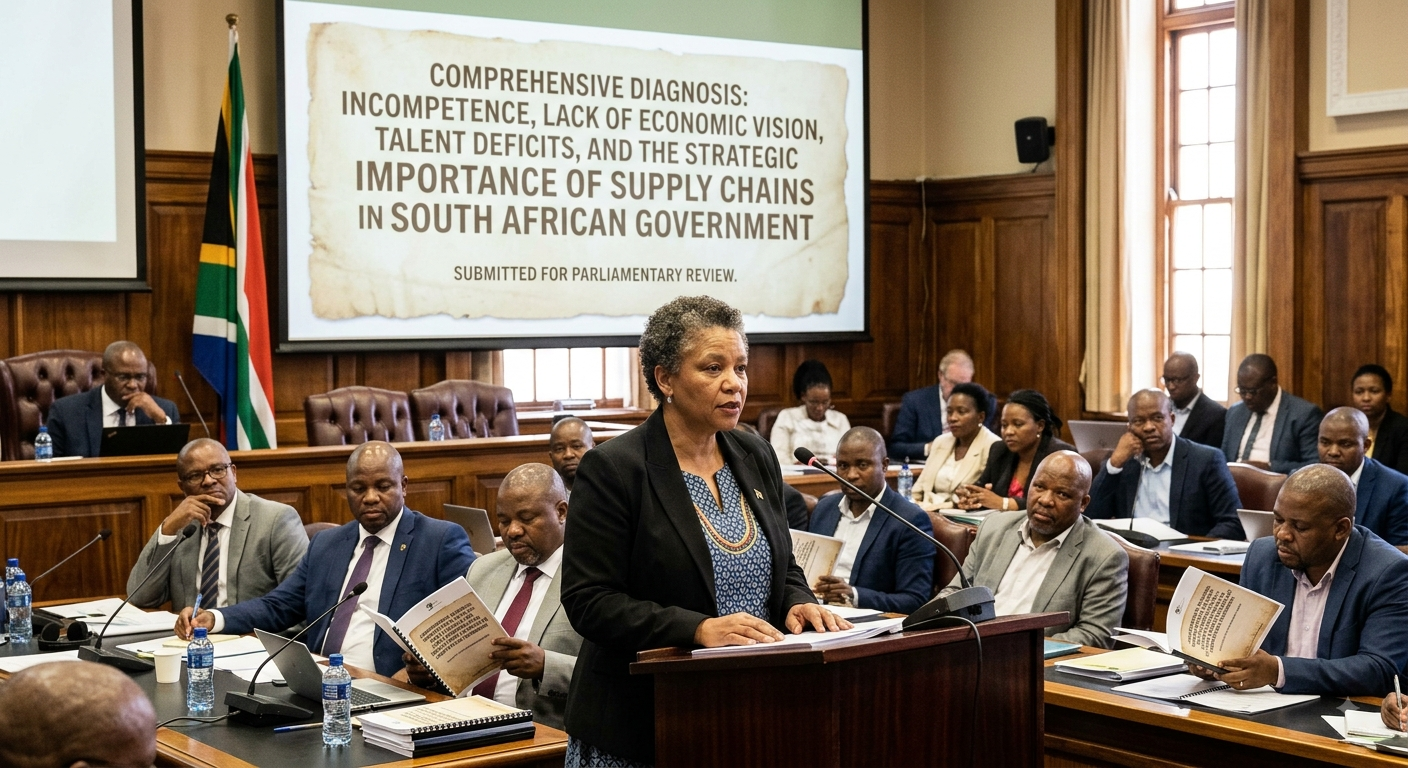
Executive Summary
South Africa’s economic difficulties cannot be explained by a single factor. They arise from the interaction of infrastructure constraints, institutional weakness, skills shortages, procurement failures, policy uncertainty, inadequate project execution, weak maintenance systems, fiscal pressure, logistics bottlenecks and insufficient coordination between government, business, universities and technical institutions.
A particularly important but sometimes underestimated issue is government’s capacity to convert public resources into productive economic outcomes.
Government does not merely consume resources. It is one of the largest economic purchasers and infrastructure investors in the country. Its procurement decisions influence construction, engineering, information technology, healthcare, transportation, energy, water, agriculture, manufacturing and thousands of small and medium-sized enterprises.
National Treasury’s own supply-chain review identified problems including insufficient skills and experience, high staff turnover, inadequate understanding of the strategic importance of supply-chain management, unclear responsibilities and weak consequences for poor performance.
This creates a fundamental proposition:
A government can possess substantial financial resources and still produce weak economic outcomes if it lacks the institutional capability to transform money into functioning infrastructure, reliable services, competitive industries and sustainable employment.
The solution is therefore not simply to spend more. South Africa needs to improve the quality, intelligence, speed, accountability and strategic purpose of public expenditure.
1. Introduction: Government as an Economic Production System
A modern government can be understood as a large socio-economic production system.
It receives:
- taxation;
- borrowing;
- natural-resource revenues;
- international financing;
- public-sector labour;
- private-sector expertise;
- technological knowledge;
- land and other assets.
It then converts these inputs into:
- roads;
- railways;
- ports;
- electricity;
- water systems;
- hospitals;
- schools;
- digital services;
- policing;
- housing;
- economic infrastructure;
- public administration.
The effectiveness of this transformation determines whether public expenditure produces economic value.
A useful conceptual model is:
Public Revenue → Planning → Procurement → Engineering → Construction → Operation → Maintenance → Economic Activity → Employment → Tax Revenue
If any major link fails, the entire chain becomes weaker.
This is why procurement and supply-chain management are not merely administrative functions.
They are part of the country’s economic infrastructure.
National Treasury has explicitly described supply-chain management as a mechanism through which government implements policy and has emphasised its economic and social significance.
2. The Meaning of Governmental Incompetence
The term “incompetence” should be used carefully.
It does not mean that South African public servants as a whole are incompetent. South Africa has many highly capable engineers, doctors, scientists, administrators, economists, technicians, teachers, managers and public officials.
The more useful concept is:
Institutional incapacity
Institutional incapacity occurs when an organisation does not consistently possess the:
- right people;
- right skills;
- right information;
- right technology;
- right incentives;
- right processes;
- right leadership;
- right accountability;
- right financial systems;
- right institutional memory.
A department can therefore contain excellent individuals while still producing poor organisational outcomes.
This distinction is extremely important.
Individual competence ≠ institutional competence
An engineer may be highly competent.
A procurement officer may be highly competent.
A municipal manager may be highly competent.
But if:
- procurement takes too long;
- budgets are fragmented;
- political and technical responsibilities overlap;
- maintenance is neglected;
- information systems are incompatible;
- project management is weak;
- skilled employees leave;
the institution can still fail.
3. The Talent Deficit
One of the most important foundations of economic development is human capital.
Modern government requires much more than general administration.
A technologically advanced state needs:
Engineering
- civil engineering;
- electrical engineering;
- mechanical engineering;
- chemical engineering;
- mining engineering;
- environmental engineering;
- transport engineering.
Digital capability
- software engineering;
- data engineering;
- cybersecurity;
- artificial intelligence;
- cloud computing;
- database administration;
- geographic information systems.
Economic capability
- economists;
- financial analysts;
- industrial-policy specialists;
- trade specialists;
- infrastructure economists;
- investment specialists.
Project capability
- programme managers;
- quantity surveyors;
- construction managers;
- contract specialists;
- risk managers;
- procurement specialists.
Scientific capability
- physicists;
- chemists;
- biologists;
- materials scientists;
- environmental scientists.
The modern state therefore needs a deep technical workforce, not simply a large administrative workforce.
National Treasury has identified the need to improve education and skills development and has highlighted infrastructure and industrial investment as major priorities.
4. The Difference Between Employment and Capability
A major policy mistake is to measure public-sector success primarily through the number of people employed.
The more important question is:
What productive capability does each employee add to the institution?
A department with 10,000 employees may perform worse than one with 3,000 highly skilled professionals if organisational design is poor.
The objective should therefore be:
Right Person + Right Skill + Right Position + Right Authority + Right Accountability
rather than simply:
More Employees = Better Government
5. The Economic Vision Problem
Economic vision means understanding how individual government decisions interact to produce national economic outcomes.
For example:
A transport department may think it is purchasing railway equipment.
An industrial-policy department may think about manufacturing.
A trade department may think about exports.
A skills department may think about training.
A finance department may think about expenditure.
A sophisticated economic strategy connects all five.
Example
Suppose South Africa needs railway equipment.
A purely procurement-oriented approach asks:
Who can supply the equipment at the required price?
A strategic industrial approach asks:
How can the procurement programme simultaneously improve logistics, develop domestic manufacturing, create engineering capability, train workers, support suppliers, develop technology and increase exports?
The second question represents economic vision.
6. Government Procurement as an Industrial Policy Instrument
Government procurement can function as an enormous economic-development mechanism.
When government buys:
- buses;
- trains;
- electricity equipment;
- hospital equipment;
- computers;
- telecommunications systems;
- water-treatment equipment;
- construction materials;
it creates demand.
That demand can either:
Model A — Consumption
Buy finished products from elsewhere and repeat the process indefinitely.
Or:
Model B — Capability development
Use procurement to encourage:
- local manufacturing;
- supplier development;
- technology transfer;
- engineering capability;
- apprenticeships;
- research;
- exports;
- SME development.
The second approach converts procurement into productive investment.
South Africa’s Treasury has historically recognised that public procurement can help provide services, build infrastructure and create opportunities for businesses supplying government.
7. The Supply Chain Is the Hidden Architecture of the Economy
A modern economy is essentially a network.
Consider a hospital.
It requires:
Electricity → Water → Buildings → Medical Equipment → Pharmaceuticals → IT → Food → Transport → Waste Management → Skilled Personnel
If one major component fails, the hospital’s performance deteriorates.
The same principle applies to:
Mining
Electricity → Rail → Ports → Machinery → Engineering → Finance → Export Markets
Manufacturing
Raw materials → Energy → Machinery → Components → Labour → Logistics → Distribution
Agriculture
Seeds → Fertiliser → Water → Machinery → Energy → Storage → Cold Chain → Transport → Markets
Digital economy
Electricity → Fibre → Data Centres → Servers → Software → Cloud → Cybersecurity → Users
Therefore:
Supply chains are not simply logistics systems. They are the physical nervous system of the economy.
8. Infrastructure and Supply-Chain Failure
Infrastructure failure has multiplicative effects.
Consider a port.
A port does not operate in isolation.
Its performance depends upon:
Factories → Trucks → Rail → Warehouses → Port → Ships → International Markets
If the railway becomes unreliable, exporters may move cargo to roads.
This increases:
- congestion;
- road deterioration;
- transport costs;
- emissions;
- delivery times.
If the port is also congested, the problem becomes larger.
The result can be:
Infrastructure Failure → Logistics Cost → Reduced Competitiveness → Lower Investment → Lower Production → Fewer Jobs
Recent financing initiatives underline the importance of addressing South Africa’s infrastructure bottlenecks; in July 2026, the World Bank approved a $1.5 billion financing package supporting infrastructure and related economic reforms.
9. Procurement Complexity
A procurement system can become so complicated that compliance consumes more institutional capacity than actual project delivery.
A strong procurement system needs:
- transparency;
- competition;
- fairness;
- value for money;
- technical evaluation;
- speed;
- accountability.
But excessive procedural complexity can create:
- delays;
- appeals;
- administrative costs;
- cancelled tenders;
- repeated procurement;
- project delays.
National Treasury’s procurement framework includes extensive legislation, regulations, guidelines and instructions under the public-finance framework.
The objective should therefore be:
Maximum integrity with minimum unnecessary friction.
10. The Difference Between Compliance and Performance
A department can be perfectly compliant with procedures while still failing citizens.
This creates two separate questions:
Compliance
Did officials follow the prescribed rules?
Performance
Did the project actually achieve its intended outcome?
A modern government must measure both.
For example:
A road project may have:
- proper tender documentation;
- approved expenditure;
- compliant procurement;
- signed contracts.
Yet the road may be:
- late;
- over budget;
- poorly constructed;
- inadequately maintained.
Therefore:
Compliance is necessary but insufficient.
11. The Consequence of Losing Institutional Memory
Large infrastructure systems require knowledge accumulated over decades.
When experienced employees leave, institutions can lose:
- technical knowledge;
- project history;
- supplier knowledge;
- engineering standards;
- maintenance knowledge;
- contract-management expertise.
This creates an invisible form of economic depreciation.
A country may still possess the physical infrastructure but lose the human knowledge required to operate it.
Therefore governments should maintain:
Institutional knowledge repositories
These should contain:
- engineering drawings;
- project histories;
- maintenance records;
- contracts;
- asset registers;
- technical standards;
- lessons learned;
- supplier performance;
- risk registers.
Digital government makes this increasingly achievable.
12. Consultants Cannot Permanently Replace State Capability
External consultants can be extremely valuable.
They can provide:
- specialist knowledge;
- independent assessment;
- temporary expertise;
- project support;
- advanced technology.
But there is a major strategic risk when the state becomes permanently dependent on external consultants for its core functions.
A sustainable model is:
Government Expertise + Private Expertise + Universities + Research Institutions
rather than:
Government Dependency → Permanent External Expertise
Every major consultancy engagement should therefore include:
Knowledge transfer
Consultants should leave behind:
- documentation;
- trained employees;
- digital systems;
- methodologies;
- institutional knowledge.
The goal should be to increase internal capability over time.
13. Political Leadership and Technical Administration
Government requires both democratic leadership and professional administration.
Political leaders determine:
- priorities;
- public policy;
- national objectives;
- democratic mandates.
Professional officials provide:
- technical analysis;
- implementation;
- procurement;
- engineering;
- administration;
- monitoring.
Problems arise when these roles become confused.
A healthy architecture is:
Political Leadership
↓
Policy Direction
↓
Professional Administration
↓
Technical Execution
↓
Performance Measurement
↓
Public Accountability
This separation strengthens democracy rather than weakening it.
14. Consequences of Weak Capability
Weak institutional capability can produce a cascade.
Stage 1
Poor planning.
↓
Stage 2
Weak procurement.
↓
Stage 3
Project delays.
↓
Stage 4
Cost escalation.
↓
Stage 5
Infrastructure deterioration.
↓
Stage 6
Higher business costs.
↓
Stage 7
Lower investment.
↓
Stage 8
Reduced economic growth.
↓
Stage 9
Lower employment creation.
↓
Stage 10
Reduced tax revenue.
↓
Stage 11
Greater fiscal pressure.
This is why administrative weakness can eventually become a macroeconomic problem.
15. The Cost of Poor Supply-Chain Management
Poor supply-chain management can produce:
- inflated procurement costs;
- unreliable suppliers;
- poor-quality goods;
- delayed projects;
- duplicated contracts;
- emergency procurement;
- stock shortages;
- excessive inventories;
- infrastructure failures;
- corruption opportunities.
Treasury’s 2015 review explicitly identified excessive pricing, poor-quality or unreliable delivery, corruption and waste among the consequences associated with inefficient public-sector supply-chain management.
The important point is that procurement inefficiency does not remain inside the procurement department.
It propagates throughout the economy.
16. Corruption Versus Incompetence
These should not be treated as identical.
There are at least four different failure categories:
1. Corruption
Deliberate misuse of public resources for private benefit.
2. Incompetence
Inadequate ability to perform assigned responsibilities.
3. Institutional incapacity
The organisation lacks the systems, skills or resources required.
4. Poor management
Resources and people exist, but leadership fails to organise them effectively.
These problems can overlap, but each requires a different solution.
Corruption requires:
- investigation;
- enforcement;
- transparency;
- auditing;
- consequence management.
Skills shortages require:
- recruitment;
- training;
- professional development;
- retention.
Poor management requires:
- leadership reform;
- performance management;
- organisational redesign.
17. The Talent-Retention Problem
Government competes with:
- multinational corporations;
- banks;
- technology companies;
- engineering firms;
- mining companies;
- consulting firms;
- international organisations;
- universities.
Highly skilled professionals therefore have alternatives.
Government must become attractive through:
- meaningful work;
- professional autonomy;
- career development;
- modern equipment;
- competent leadership;
- competitive remuneration;
- professional recognition.
Retention is often cheaper than repeatedly rebuilding capability.
18. A National Skills Architecture
South Africa could develop a national public-sector technical capability programme.
Tier 1 — Foundational Skills
- mathematics;
- literacy;
- digital literacy;
- accounting;
- communication.
Tier 2 — Technical Skills
- engineering;
- ICT;
- construction;
- logistics;
- finance;
- procurement.
Tier 3 — Advanced Skills
- AI;
- data science;
- cybersecurity;
- advanced manufacturing;
- energy systems;
- infrastructure modelling.
Tier 4 — Strategic Skills
- economic modelling;
- industrial strategy;
- international trade;
- infrastructure finance;
- systems engineering;
- national supply-chain strategy.
This produces a workforce capable of managing increasingly sophisticated economic systems.
19. Universities as National Capability Engines
Universities should not exist separately from the national economy.
Government can create stronger connections between:
Universities ↔ Government ↔ Industry ↔ Research Institutes
This ecosystem can produce:
- engineering research;
- industrial innovation;
- AI applications;
- materials research;
- energy technologies;
- logistics optimisation;
- agricultural technology;
- public-sector digital systems.
The objective should be to convert academic knowledge into productive national capability.
20. Digital Transformation of Government Procurement
A modern procurement architecture should be digital from end to end.
Digital procurement chain
Needs Identification
↓
Budget Allocation
↓
Tender Publication
↓
Supplier Registration
↓
Technical Evaluation
↓
Financial Evaluation
↓
Contract Award
↓
Purchase Order
↓
Delivery
↓
Inspection
↓
Payment
↓
Performance Evaluation
↓
Supplier Scorecard
Each step can generate data.
Artificial intelligence and analytics can subsequently identify:
- unusual pricing;
- repeated suppliers;
- abnormal tender patterns;
- delivery delays;
- geographic concentration;
- contract duplication;
- procurement risks.
This does not eliminate human judgement, but it gives decision-makers much better information.
21. Building a National Supply-Chain Observatory
South Africa could establish an integrated analytical platform monitoring strategic supply chains.
Potential sectors:
- electricity;
- water;
- rail;
- ports;
- roads;
- telecommunications;
- food;
- healthcare;
- fuel;
- mining;
- manufacturing;
- construction;
- digital infrastructure.
The system could identify:
- critical suppliers;
- single points of failure;
- import dependence;
- strategic inventories;
- infrastructure bottlenecks;
- supplier concentration;
- geographic vulnerabilities.
This would transform supply-chain management from reactive administration into strategic national planning.
22. Supply-Chain Resilience
Modern economies must prepare for shocks.
Possible disruptions include:
- pandemics;
- extreme weather;
- geopolitical conflicts;
- cyber incidents;
- shipping disruptions;
- energy shortages;
- commodity shocks;
- financial crises.
A resilient system needs:
Redundancy
Multiple suppliers.
Visibility
Real-time information.
Substitution
Alternative products and suppliers.
Strategic reserves
Stocks of critical materials where appropriate.
Domestic capability
Local capacity for strategically important goods.
International diversification
Avoiding excessive dependence on a single country or supplier.
Research into national production networks has demonstrated that seemingly small numbers of highly connected firms can carry disproportionately large systemic importance, illustrating why supply-chain concentration deserves attention.
23. Government as a Platform for SME Development
Government procurement can become a pathway through which small companies mature.
A strong supplier-development pipeline could be:
Training → Certification → Small Contract → Performance → Larger Contract → Financing → Technology → Export
This is more powerful than simply providing grants.
A business that successfully supplies a demanding customer gains:
- revenue;
- experience;
- references;
- systems;
- employees;
- financial history;
- production capability.
Government procurement can therefore become a market-development mechanism.
24. From Tender Culture to Production Culture
A major conceptual transformation is required.
A weak procurement culture asks:
“How do we award the tender?”
A stronger economic-development culture asks:
“What economic capability will this procurement create?”
For example, a major infrastructure contract should be evaluated according to:
- cost;
- quality;
- delivery time;
- employment;
- skills transfer;
- local supplier development;
- technological capability;
- maintenance;
- environmental impact;
- export potential.
This creates a broader definition of value for money.
25. Infrastructure Should Be Treated as an Asset
Government frequently focuses on constructing infrastructure.
But infrastructure has a lifecycle:
Design → Finance → Build → Commission → Operate → Maintain → Upgrade → Renew
Maintenance is therefore not a secondary activity.
A R1 billion asset that is poorly maintained can become a financial liability.
A good infrastructure strategy therefore requires:
Asset registers
Know what exists.
Condition monitoring
Know what condition it is in.
Maintenance schedules
Know when intervention is required.
Lifecycle costing
Know the long-term cost.
Renewal planning
Know when replacement will be necessary.
26. The Economics of Maintenance
Preventive maintenance can often be economically superior to emergency repair.
The basic principle is:
Preventive Maintenance Cost < Failure Cost + Emergency Repair Cost + Economic Disruption
If a water system fails, the cost is not merely repairing a pipe.
There may also be:
- business interruption;
- health consequences;
- lost productivity;
- emergency transport;
- political costs;
- reputational damage.
Therefore asset maintenance should be incorporated into economic planning.
27. Performance Management
Government departments should have measurable economic-performance indicators.
Instead of measuring only:
- money spent;
- meetings held;
- reports submitted;
measure:
- kilometres of railway restored;
- electricity capacity added;
- water losses reduced;
- port turnaround improved;
- construction projects completed;
- supplier-payment times;
- infrastructure condition;
- jobs supported;
- exports enabled.
The principle is:
Measure outputs and outcomes, not merely administrative activity.
28. Consequence Management
A sophisticated public institution needs consequences for:
- fraud;
- persistent negligence;
- project failure;
- repeated non-performance;
- deliberate obstruction;
- inaccurate reporting.
At the same time, officials who successfully deliver difficult projects should receive:
- recognition;
- career advancement;
- professional development;
- leadership opportunities.
Accountability must therefore be symmetrical:
Failure → Consequence
Excellence → Recognition
Without this relationship, organisational incentives become distorted.
29. The Economic Vision Should Be Long-Term
Infrastructure often has a useful life of:
- 20 years;
- 30 years;
- 50 years;
- sometimes longer.
Therefore governments should avoid designing major systems solely around election cycles.
A national infrastructure strategy should ask:
What infrastructure does South Africa need in 2035, 2050 and 2075?
This includes:
- electricity;
- water;
- rail;
- ports;
- roads;
- cities;
- telecommunications;
- digital infrastructure;
- industrial zones;
- housing.
Long-term planning reduces reactive decision-making.
30. A South African Industrial-Supply-Chain Strategy
A future strategy could focus on strategic sectors.
Energy
Develop:
- generation;
- transmission;
- storage;
- grid equipment;
- renewable-energy manufacturing.
Transport
Develop:
- rail equipment;
- locomotives;
- signalling;
- logistics technology;
- port equipment.
Water
Develop:
- pumps;
- treatment systems;
- sensors;
- pipelines;
- desalination capability where appropriate.
Digital
Develop:
- data centres;
- fibre;
- cloud infrastructure;
- cybersecurity;
- software;
- AI.
Agriculture
Develop:
- irrigation;
- agricultural machinery;
- cold chains;
- food processing;
- logistics.
Mining
Develop:
- mining technology;
- automation;
- equipment manufacturing;
- mineral processing.
The objective is to move progressively from:
Resource Extraction → Processing → Manufacturing → Technology → Export
31. From Commodity Economy to Knowledge Economy
South Africa possesses considerable natural resources.
But natural resources alone do not guarantee prosperity.
The strategic ladder should be:
Minerals
↓
Processing
↓
Manufacturing
↓
Engineering
↓
Technology
↓
Intellectual Property
↓
Global Products
The higher the economy moves up this ladder, the greater the potential for knowledge-intensive employment and technological capability.
32. Infrastructure as an Investment Multiplier
Infrastructure should not be regarded simply as expenditure.
A productive road can reduce logistics costs.
A reliable railway can increase exports.
A reliable electricity grid can improve industrial utilisation.
A high-quality digital network can enable businesses.
A functioning water system can support cities and manufacturing.
Therefore:
Infrastructure → Productivity → Investment → Production → Employment → Tax Revenue
This creates a positive economic feedback loop.
33. The Negative Feedback Loop
The opposite can also occur.
Infrastructure Failure
↓
Higher Business Costs
↓
Lower Competitiveness
↓
Lower Investment
↓
Lower Growth
↓
Lower Employment
↓
Lower Tax Base
↓
Fiscal Pressure
↓
Reduced Infrastructure Investment
↓
Further Infrastructure Deterioration
This is a development trap.
Breaking this cycle requires targeted investment in high-economic-return infrastructure.
34. A New Public-Sector Operating Model
A modern South African state could be organised around five capabilities.
Capability 1 — Strategic Planning
What does the country need?
Capability 2 — Technical Expertise
How should it be built?
Capability 3 — Procurement
Who can deliver it?
Capability 4 — Project Management
How do we ensure delivery?
Capability 5 — Measurement
Did it create the expected value?
Together:
Strategy + Expertise + Procurement + Execution + Measurement
= State Capability
35. The 10-Point Reform Programme
1. Professionalise critical government functions
Recruit according to competence and technical requirements.
2. Build national technical cadres
Develop specialist engineers, scientists, economists, ICT professionals and project managers.
3. Digitise procurement
Create transparent, data-rich procurement systems.
4. Introduce supplier-performance databases
Measure suppliers based on actual delivery.
5. Strengthen project management
Treat major infrastructure as professional programmes rather than administrative projects.
6. Protect institutional memory
Create digital knowledge repositories.
7. Link procurement to industrial development
Use large government demand to develop domestic capability where economically justified.
8. Strengthen maintenance
Treat maintenance as a core investment function.
9. Establish measurable accountability
Connect responsibility to outcomes.
10. Build government-business-university partnerships
Create an integrated national innovation ecosystem.
36. A 2030–2050 Capability Roadmap
Phase I: Stabilisation
2026–2030
Focus on:
- fixing critical infrastructure;
- improving procurement;
- retaining technical personnel;
- digitising government;
- improving project execution;
- reducing supply-chain bottlenecks.
Phase II: Capability Building
2030–2040
Focus on:
- domestic manufacturing;
- advanced engineering;
- AI;
- robotics;
- industrial research;
- logistics modernisation;
- export development.
Phase III: Global Competitiveness
2040–2050
Focus on:
- advanced manufacturing;
- intellectual property;
- global technology companies;
- sophisticated infrastructure;
- high-value exports;
- regional African supply chains.
The objective is not simply to repair today’s problems.
It is to create institutions capable of preventing tomorrow’s problems.
37. A New Definition of Government Success
Government success should ultimately be measured by whether society becomes:
- more productive;
- healthier;
- safer;
- better educated;
- more technologically capable;
- more economically competitive;
- more resilient;
- more prosperous.
This means moving beyond:
“How much money did government spend?”
toward:
“What productive national capability did that expenditure create?”
38. The Central Thesis
The fundamental issue is therefore not simply that South Africa needs “more money.”
The country needs greater institutional productivity.
The national equation can be expressed conceptually as:
Economic Development = Capital × Human Capability × Infrastructure × Institutions × Technology × Execution
If one factor approaches zero, the overall result can deteriorate dramatically.
South Africa possesses substantial:
- natural resources;
- financial institutions;
- universities;
- entrepreneurs;
- industrial companies;
- scientific expertise;
- infrastructure;
- geographic advantages;
- access to African markets.
The challenge is to coordinate these assets more effectively.
39. Final Conclusion
South Africa’s future economic performance will depend heavily on whether it can transform government from a predominantly administrative structure into a high-capability economic institution.
The central challenge is not simply the size of government.
It is the quality of government capability.
A modern state requires:
Competent People
Strategic Vision
Technical Expertise
Efficient Procurement
Reliable Infrastructure
Resilient Supply Chains
Digital Government
Professional Project Management
Accountability
Long-Term Planning
=
High-Performance State
The strategic importance of supply chains should consequently be elevated to the level of national economic policy.
Electricity, water, railways, ports, roads, telecommunications, healthcare, agriculture, manufacturing and digital infrastructure are interconnected. Failure in one part can propagate through the rest of the economy.
National Treasury has itself recognised that procurement and supply-chain management are central to government policy implementation and has identified capability, skills, accountability and institutional design as important challenges.
The future therefore requires a shift from:
Administration → Execution
Compliance → Performance
Procurement → Strategic Procurement
Employment → Capability
Consumption → Investment
Resource Extraction → Value Addition
Short-Term Politics → Long-Term National Strategy
Government Dependency → Institutional Capability
The ultimate objective should be the construction of a South African state that can reliably transform public resources into infrastructure, knowledge, technology, productive businesses, competitive supply chains, employment and sustainable economic growth.
That is the deeper meaning of economic state capacity.
A capable government does not merely spend money.
It converts national resources into national capability.
And national capability is one of the foundations upon which long-term economic prosperity is built.





Be First to Comment