
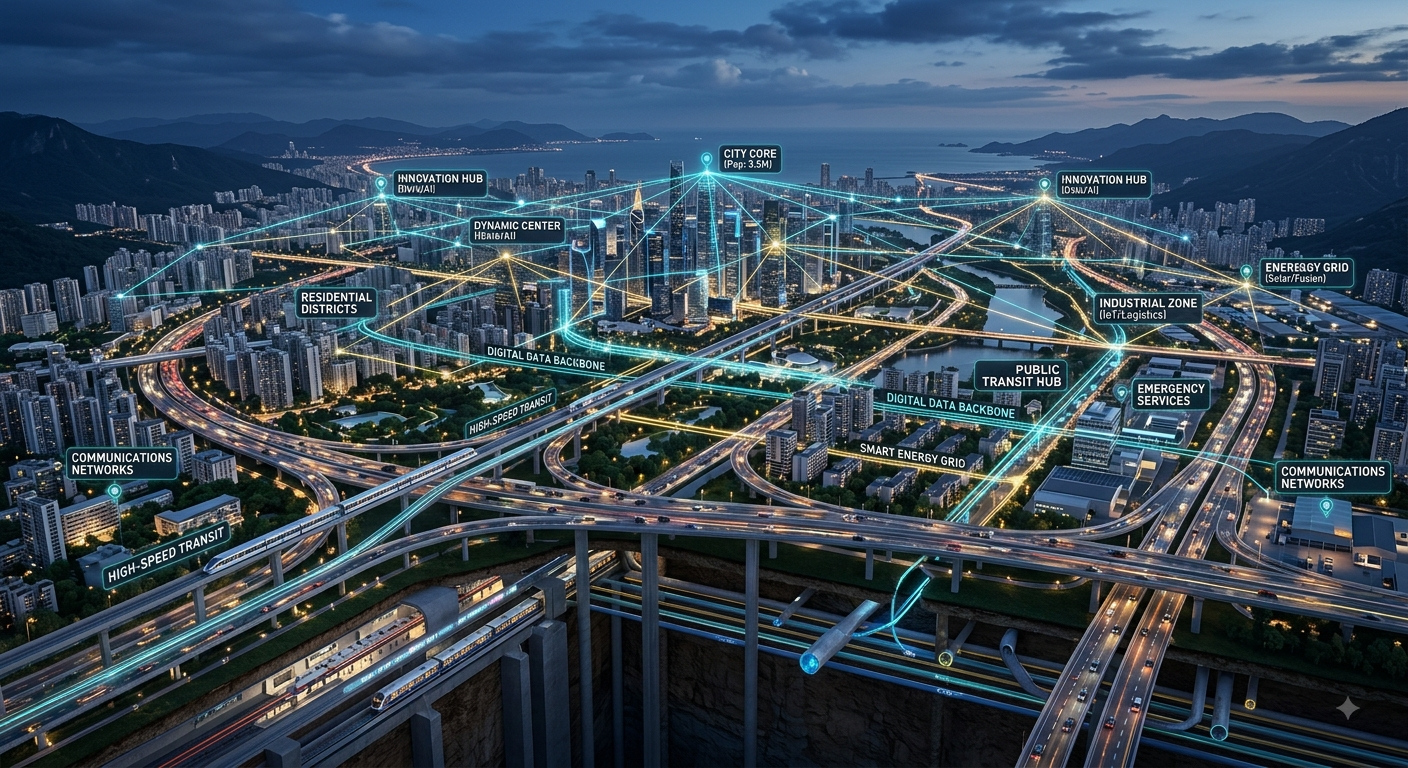
A city of 12 million residents should not be understood simply as a very large collection of buildings, roads and households. It is a complex socio-technical ecosystem in which water, electricity, transport, telecommunications, housing, food, healthcare, education, sanitation, waste, finance, public administration and emergency services continuously interact.
The central idea of a Sequence Infrastructure Ecosystem Network is therefore to design the city as an interconnected chain:
Natural resources → infrastructure → utilities → mobility → digital networks → economic activity → public services → households → waste/recycling → environmental regeneration
This systems approach is particularly important at metropolitan scale. São Paulo, for example, has around 12 million people within the city and illustrates how population growth can simultaneously place pressure on transport, drainage, sanitation, waste management and settlement patterns. (UNEP – UN Environment Programme)
1. The fundamental principle
The infrastructure of a 12-million-person city should operate as one coordinated ecosystem rather than dozens of independent departments.
A simplified architecture is:
                 ┌──────────────────────────┐
                 │   GOVERNANCE & PLANNING  │
                 └────────────┬─────────────┘
                              │
                  ┌───────────▼───────────┐
                  │  CITY DIGITAL TWIN   │
                  │ GIS + DATA + AI + IoT │
                  └───────────┬───────────┘
                              │
     ┌────────────────────────┼────────────────────────┐
     │                        │                        │
┌────▼────┐              ┌────▼────┐              ┌────▼────┐
│ ENERGY  │              │  WATER  │              │TRANSPORT│
└────┬────┘              └────┬────┘              └────┬────┘
     │                        │                        │
     └──────────────┬─────────┴──────────────┬─────────┘
                    │                        │
              ┌─────▼─────┐            ┌─────▼─────┐
              │ HOUSING & │            │  DIGITAL  │
              │ BUILDINGS │            │ NETWORKS  │
              └─────┬─────┘            └─────┬─────┘
                    │                        │
          ┌─────────▼──────────┐    ┌────────▼────────┐
          │ HEALTH + EDUCATION │    │ BUSINESS + JOBS │
          └─────────┬──────────┘    └────────┬────────┘
                    │                        │
                    └───────────┬────────────┘
                                │
                       ┌────────▼────────┐
                       │ WASTE / CIRCULAR │
                       │    ECONOMY       │
                       └────────┬────────┘
                                │
                       ┌────────▼────────┐
                       │ ENVIRONMENTAL   │
                       │ REGENERATION    │
                       └─────────────────┘
The objective is not merely connectivity. The objective is dependency management: understanding what happens to the entire city when one infrastructure layer fails.
2. Population architecture
For planning purposes, assume:
Population = 12,000,000 residents
A useful planning model could divide the metropolitan area into approximately:
- 1 metropolitan core
- 8–15 major urban districts
- 50–100 planning zones
- hundreds of neighbourhoods
- thousands of smaller service catchments
The precise numbers would depend on geography, density and administrative structure.
The key principle is polycentric development.
Instead of forcing millions of people to travel toward one central business district every morning, the city should contain multiple economic and service centres:
                 METROPOLITAN REGION
                         │
       ┌─────────────────┼─────────────────┐
       │                 │                 │
   CITY CENTRE       EASTERN HUB       WESTERN HUB
       │                 │                 │
   FINANCE          INDUSTRY          TECHNOLOGY
       │                 │                 │
       ├──────────────┬──┴──┬──────────────┤
       │              │     │              │
   HEALTH          EDUCATION RETAIL     LOGISTICS
       │              │     │              │
       └──────────────┴─────┴──────────────┘
This reduces unnecessary commuting and creates more resilient local economies.
3. The infrastructure sequence
The word sequence is important.
Infrastructure should be developed according to dependencies rather than political visibility.
A logical sequence is:
Layer 1 — Land and natural systems
Before construction:
- topography
- geology
- rivers
- groundwater
- floodplains
- wetlands
- agricultural land
- ecological corridors
- climate
- prevailing winds
- seismic risks
- heat exposure
The city should first understand the physical environment on which everything else depends.
4. Layer 2 — Water infrastructure
Water is one of the most fundamental infrastructure systems.
A 12-million-person city requires:
source → treatment → transmission → storage → distribution → household/business use → wastewater collection → treatment → reuse/discharge
The system should include:
- reservoirs
- rivers where appropriate
- groundwater
- desalination where economically/environmentally justified
- water-treatment plants
- pumping stations
- trunk pipelines
- local distribution networks
- reservoirs and elevated storage
- wastewater networks
- wastewater-treatment plants
- recycled-water networks
Water recycling can become an important component of urban resilience. Experience from China has demonstrated that reclaimed wastewater can reduce pressure on conventional water sources while also creating economic value. (World Bank)
Future architecture
WATER SOURCE
     ↓
RAW WATER STORAGE
     ↓
WATER TREATMENT
     ↓
REGIONAL RESERVOIRS
     ↓
TRUNK NETWORK
     ↓
DISTRICT STORAGE
     ↓
LOCAL NETWORK
     ↓
HOUSEHOLDS / INDUSTRY
     ↓
SEWER NETWORK
     ↓
WASTEWATER TREATMENT
     ↓
┌────┴───────────────┐
↓                    ↓
REUSE             ENVIRONMENT
5. Layer 3 — Energy ecosystem
A city of 12 million cannot function without extremely reliable energy.
The energy ecosystem should combine:
- national grid connections
- regional transmission
- substations
- distribution networks
- renewable generation
- battery storage
- gas or other dispatchable generation where appropriate
- rooftop solar
- microgrids
- energy-management systems
- electric-vehicle charging
- industrial energy systems
The future city should progressively move from a purely centralized electricity model toward a hybrid centralized-distributed architecture.
              NATIONAL GRID
                    │
             TRANSMISSION
                    │
              SUBSTATIONS
                    │
        ┌───────────┼───────────┐
        │           │           │
     DISTRICT     SOLAR       STORAGE
       GRID        │           │
        │       MICROGRID      │
        └──────────┼───────────┘
                   │
          HOMES / INDUSTRY /
          TRANSPORT / SERVICES
This makes the system more resilient because a local failure does not necessarily have to become a metropolitan failure.
6. Layer 4 — Transportation network
Transportation should be treated as a network of networks.
A 12-million-person city requires integration between:
- walking
- cycling
- buses
- rapid buses
- commuter rail
- metro
- regional rail
- taxis
- shared mobility
- freight
- airports
- ports where applicable
- logistics centres
The objective is not simply to build more roads.
It is to create high-capacity movement corridors and connect them with local networks.
Hierarchical structure
REGIONAL TRANSPORT
       ↓
METRO / RAIL
       ↓
BUS RAPID TRANSIT
       ↓
DISTRICT BUS NETWORK
       ↓
LOCAL STREETS
       ↓
WALKING + CYCLING
São Paulo provides an important real-world example of the scale at which public transport and sustainable mobility become strategic metropolitan infrastructure. (Smart Cities Dive)
7. Layer 5 — Roads and logistics
Roads remain essential even in a public-transport-oriented city.
However, roads should be classified by function:
- International/regional corridors
- Metropolitan expressways
- Arterial roads
- District roads
- Local streets
- Service roads
- Emergency routes
- Freight corridors
Freight should be separated strategically from residential movement.
A major metropolitan logistics architecture could contain:
port/airport/rail terminal → logistics hub → distribution centre → district warehouse → local delivery
This dramatically improves supply-chain efficiency.
8. Layer 6 — Telecommunications
The digital network is now effectively another utility.
A modern 12-million-person city requires:
- fibre-optic backbone
- mobile networks
- 5G/advanced mobile infrastructure
- data centres
- cloud connectivity
- Internet exchange infrastructure
- municipal networks
- satellite connectivity where useful
- cybersecurity systems
- emergency communications
The physical infrastructure should be designed so that telecommunications routes remain operational even when individual network segments fail.
Cities increasingly generate enormous quantities of infrastructure and service data. The OECD notes that urban data can support better public-service delivery, transport management, environmental management, water services and energy efficiency. (OECD)
9. Layer 7 — Digital twin of the city
One of the most powerful concepts for a future city is a metropolitan digital twin.
It would digitally represent:
- roads
- buildings
- pipes
- electrical infrastructure
- rail
- water
- drainage
- telecommunications
- hospitals
- schools
- population distribution
- environmental conditions
- traffic
- energy demand
Sensors continuously update the model.
PHYSICAL CITY
     │
     ▼
SENSORS + GIS + CAMERAS + METERS
     │
     ▼
CITY DATA PLATFORM
     │
     ▼
DIGITAL TWIN
     │
     ├── AI ANALYTICS
     ├── PREDICTION
     ├── SIMULATION
     └── DECISION SUPPORT
             │
             ▼
       PHYSICAL CITY
This transforms infrastructure management from reactive maintenance into increasingly predictive maintenance.
10. Layer 8 — Housing
Housing must be integrated with infrastructure.
A common mistake is to construct housing first and attempt to provide infrastructure later.
The correct sequence is:
land → infrastructure capacity → transport → utilities → housing → schools → healthcare → commercial services
Housing districts should be connected to employment and transportation rather than isolated at the metropolitan edge.
A 12-million-person city should also contain a mixture of:
- affordable housing
- middle-income housing
- higher-income housing
- rental housing
- student accommodation
- elderly accommodation
- social housing
- mixed-use developments
The principle is social and spatial integration.
11. Layer 9 — Healthcare
Healthcare infrastructure should operate through several levels:
HOME
 ↓
PRIMARY CLINIC
 ↓
COMMUNITY HEALTH CENTRE
 ↓
DISTRICT HOSPITAL
 ↓
SPECIALIST HOSPITAL
 ↓
TERTIARY / RESEARCH CENTRE
Digital health systems can connect the network through:
- electronic health records
- appointment systems
- diagnostic networks
- laboratory systems
- emergency coordination
- telemedicine
- pharmaceutical supply chains
Healthcare resilience also requires backup electricity, water, communications and emergency transportation.
12. Layer 10 — Education
Education infrastructure should similarly follow a hierarchy:
early childhood → primary → secondary → vocational/technical → university/research
The city should deliberately connect educational institutions to its economic infrastructure.
For example:
- engineering schools ↔ industrial districts
- medical universities ↔ hospitals
- technology institutions ↔ technology parks
- agricultural institutions ↔ food systems
- construction colleges ↔ infrastructure programmes
This creates a knowledge-production ecosystem rather than simply a school network.
13. Layer 11 — Food infrastructure
A 12-million-person city requires a sophisticated food supply chain.
The sequence is:
agriculture → processing → cold storage → regional logistics → wholesale → district distribution → retail → household
Food infrastructure should include:
- agricultural production regions
- food-processing plants
- refrigerated logistics
- warehouses
- wholesale markets
- supermarkets
- local markets
- emergency food reserves
- urban agriculture where practical
Food security therefore becomes an infrastructure issue, not merely an agricultural issue.
14. Layer 12 — Waste and circular economy
Waste should be treated as a resource-flow system.
Instead of:
consume → collect → landfill
the future model becomes:
produce → consume → collect → separate → recycle → recover → reuse → regenerate
Potential streams include:
- organic waste
- plastics
- metals
- glass
- paper
- construction materials
- wastewater
- electronic waste
The city can therefore develop a circular-material economy.
15. Layer 13 — Stormwater and flood management
Drainage is frequently underestimated.
The infrastructure sequence should include:
rainfall → streets → drainage → retention → treatment/reuse → rivers
A resilient system can combine:
- storm drains
- retention basins
- wetlands
- permeable surfaces
- green corridors
- urban forests
- detention infrastructure
- flood-control channels
Green infrastructure can reduce pressure on conventional drainage.
16. Layer 14 — Public safety and emergency response
A 12-million-person metropolitan region requires a coordinated emergency architecture.
It should integrate:
- fire services
- ambulance services
- disaster management
- emergency communications
- hospitals
- evacuation routes
- emergency shelters
- water reserves
- energy backup
- food reserves
- transport control
The critical principle is interoperability.
During a major disaster, the electricity authority, water authority, hospitals, transport operators and emergency services must be able to communicate and coordinate.
17. Layer 15 — Economic infrastructure
Infrastructure ultimately supports economic production.
The city should deliberately develop:
- financial districts
- technology clusters
- industrial zones
- logistics centres
- commercial districts
- research parks
- universities
- creative industries
- manufacturing
- small-business districts
Infrastructure becomes economically productive when it reduces:
travel time + energy waste + water losses + logistics costs + information delays + infrastructure downtime.
18. The network dependency matrix
One of the most important concepts in the proposed ecosystem is dependency.
| System | Depends heavily on | Supports |
|---|---|---|
| Electricity | Fuel, transmission, water, digital control | Almost every sector |
| Water | Energy, pipes, treatment | Households, industry, health |
| Transport | Energy, roads, communications | Labour, commerce, emergency services |
| Telecommunications | Electricity, fibre, data centres | Government and economy |
| Healthcare | Electricity, water, transport, communications | Population |
| Food | Transport, energy, water, logistics | Population |
| Waste | Transport, energy, processing | Environment |
| Finance | Electricity, telecommunications, data | Economy |
| Government | All major networks | All residents |
This demonstrates why infrastructure cannot be planned in departmental isolation.
19. The “failure cascade” problem
Suppose electricity fails.
The immediate problem is not merely darkness.
The cascade could be:
electricity failure
↓
water pumps affected
↓
water pressure falls
↓
hospitals activate backup systems
↓
telecommunications infrastructure loses selected sites
↓
traffic signals fail
↓
transport becomes slower
↓
fuel distribution is disrupted
↓
business operations decline
↓
emergency services become overloaded
This is why infrastructure planning must include redundancy and backup capacity.
20. Three levels of resilience
Every critical infrastructure system should ideally have:
Level 1 — Normal operation
The system works efficiently.
Level 2 — Degraded operation
A component fails, but the network continues operating at reduced capacity.
Level 3 — Emergency operation
Multiple failures occur, but essential services remain available.
For example:
100% CAPACITY
     │
     ▼
NORMAL SYSTEM
     │
     ↓ failure
70–90% CAPACITY
     │
     ▼
REDUNDANT SYSTEM
     │
     ↓ major disaster
ESSENTIAL SERVICES
     │
     ▼
EMERGENCY MODE
21. Infrastructure command centre
A metropolitan infrastructure operations centre could provide a unified view.
              METROPOLITAN CONTROL CENTRE
                         │
 ┌─────────────┬─────────┼─────────┬──────────────┐
 │             │         │         │              │
ENERGY       WATER    TRANSPORT  HEALTH        SECURITY
 │             │         │         │              │
 └─────────────┴─────────┼─────────┴──────────────┘
                         │
                   CITY DATA PLATFORM
                         │
                   GIS + DIGITAL TWIN
                         │
                   DECISION SUPPORT
This does not mean that every service must be controlled by one organisation. Rather, independent operators should have agreed standards for data exchange, emergency coordination and infrastructure planning.
22. Physical infrastructure + digital infrastructure
The future city therefore has two major infrastructures.
Physical city
- roads
- bridges
- rail
- pipes
- buildings
- power lines
- hospitals
- schools
- treatment plants
Digital city
- fibre
- sensors
- cloud
- data centres
- GIS
- AI
- digital identity
- cybersecurity
- digital twins
- command platforms
The second increasingly governs the performance of the first.
This is why a modern city should be viewed as a cyber-physical system.
23. Governance architecture
The infrastructure ecosystem requires governance at several levels:
NATIONAL GOVERNMENT
        ↓
METROPOLITAN GOVERNMENT
        ↓
DISTRICT GOVERNMENTS
        ↓
MUNICIPAL SERVICE OPERATORS
        ↓
COMMUNITIES / NEIGHBOURHOODS
        ↓
HOUSEHOLDS + BUSINESSES
But governance should also be horizontal:
WATER ─── ENERGY ─── TRANSPORT
  │          │           │
  └──── DIGITAL PLATFORM┘
             │
       PUBLIC SERVICES
             │
          ECONOMY
This is where many infrastructure systems fail: organisations may possess individual technical competence but lack system-level coordination.
24. Financing the ecosystem
A 12-million-person city requires long-term infrastructure finance.
Possible mechanisms include:
- municipal revenue
- national government funding
- infrastructure banks
- development-finance institutions
- municipal bonds
- public-private partnerships
- land-value capture
- user charges
- infrastructure levies
- institutional investment
- green bonds
- climate finance
The financial model should distinguish between:
capital expenditure (CAPEX)
and
operations and maintenance expenditure (OPEX).
Building infrastructure without funding its maintenance creates an infrastructure-depreciation cycle.
25. Maintenance is infrastructure
A major strategic mistake is to think:
“Infrastructure is complete when construction ends.”
It is not.
The true lifecycle is:
plan → design → finance → construct → commission → operate → inspect → maintain → upgrade → replace
Every bridge, water pipe, electrical transformer, railway, hospital and data centre has a lifecycle.
Therefore, the city should maintain a digital asset register containing:
- asset location
- age
- condition
- capacity
- maintenance history
- expected remaining life
- replacement cost
- criticality
- failure probability
26. Infrastructure hierarchy
The entire 12-million-person city can be conceptualised as a five-level system:
Level 1 — Regional infrastructure
- electricity generation
- major water sources
- airports
- ports
- national rail
- major highways
- telecommunications backbone
Level 2 — Metropolitan infrastructure
- metro
- major reservoirs
- treatment plants
- major hospitals
- regional logistics
- transmission infrastructure
Level 3 — District infrastructure
- district roads
- schools
- hospitals
- substations
- water reservoirs
- waste facilities
Level 4 — Neighbourhood infrastructure
- streets
- clinics
- local schools
- local shops
- local parks
- local drainage
Level 5 — Building infrastructure
- electricity
- water
- sanitation
- internet
- waste separation
- energy management
27. The economic multiplier
Infrastructure has a deeper economic role than simply providing services.
Good infrastructure reduces transaction costs.
For example:
Reliable electricity
→ factories operate longer
→ production increases
→ employment increases
→ household incomes rise
→ consumption increases
→ tax revenues increase
→ government can reinvest
The same principle applies to:
- transport
- broadband
- water
- logistics
- education
- healthcare
Infrastructure is therefore part of the productive capital of a city.
28. The African-city perspective
For rapidly growing African cities, this framework is especially important.
The challenge is not simply copying infrastructure models from wealthy countries.
African metropolitan planning must account for:
- rapid population growth
- informal settlements
- infrastructure backlogs
- constrained municipal finances
- electricity reliability
- water scarcity
- unemployment
- spatial inequality
- informal economic activity
- climate vulnerability
- limited technical capacity
Recent South African urban research similarly emphasizes that smart-city technology should serve residents and communities rather than becoming technology for its own sake. (Wits University)
Therefore, a human-centred infrastructure ecosystem is more appropriate than a purely technology-centred smart city.
29. The 12-million-person city as a living organism
A useful conceptual analogy is the human body.
| Human body | City |
|---|---|
| Blood | Water/fuel/material flows |
| Heart | Energy generation/distribution |
| Arteries | Major transport networks |
| Nerves | Telecommunications |
| Brain | Governance/data systems |
| Lungs | Environmental systems |
| Digestive system | Food/logistics system |
| Kidneys | Water/waste treatment |
| Immune system | Emergency/security systems |
| Cells | Buildings/households/businesses |
The analogy is not literal engineering, but it illustrates the central principle:
A city is healthy when its systems interact effectively.
30. The ultimate infrastructure sequence
The complete architecture can therefore be represented as:
NATURAL ENVIRONMENT
        ↓
LAND-USE PLANNING
        ↓
REGIONAL RESOURCE SYSTEMS
        ↓
ENERGY + WATER
        ↓
TRANSPORT + LOGISTICS
        ↓
TELECOMMUNICATIONS
        ↓
HOUSING + BUILDINGS
        ↓
HEALTH + EDUCATION
        ↓
BUSINESS + INDUSTRY
        ↓
FOOD + COMMERCE
        ↓
WASTE + RECYCLING
        ↓
ENVIRONMENTAL REGENERATION
        ↓
DATA + MEASUREMENT
        ↓
AI + DIGITAL TWIN
        ↓
PREDICTIVE GOVERNANCE
        ↓
CONTINUOUS INFRASTRUCTURE UPGRADE
This creates a closed-loop urban ecosystem rather than a linear infrastructure model.
31. Strategic principles for the 12-million-resident city
A high-performance metropolitan infrastructure strategy should follow at least 15 principles:
- Plan infrastructure before uncontrolled settlement expansion.
- Integrate water, energy and transport planning.
- Build multiple economic centres rather than one dominant centre.
- Design for redundancy.
- Protect natural drainage and ecological systems.
- Prioritise maintenance as much as construction.
- Integrate public transport with land use.
- Build universal digital connectivity.
- Use data for infrastructure management.
- Develop circular waste systems.
- Protect critical infrastructure against climate risks.
- Develop local technical and engineering capacity.
- Use transparent infrastructure financing.
- Include communities in infrastructure planning.
- Measure infrastructure performance continuously.
32. Final thesis
The Sequence Infrastructure Ecosystem Network for a City of 12 Million Residents should ultimately be understood as a systems-engineering framework for civilisation at metropolitan scale.
The city is not merely:
buildings + roads + people.
It is:
resources + infrastructure + energy + water + transport + communications + housing + institutions + knowledge + economic production + environmental systems + data.
The greatest strategic transformation occurs when these systems cease operating as isolated silos and become an interdependent metropolitan network.
The World Bank’s urban programmes illustrate this integrated approach by bringing together urban transport, water, wastewater, solid waste, stormwater, governance, GIS and municipal finance rather than treating each as an entirely separate problem. (World Bank)
The future 12-million-person city should therefore be designed around five fundamental objectives:
CONNECT — PROVIDE — PROTECT — OPTIMISE — REGENERATE
Connect people, infrastructure and economic activity.
Provide reliable water, energy, mobility, housing, healthcare, education and digital services.
Protect residents and critical infrastructure against disasters, climate risks and system failures.
Optimise infrastructure through data, engineering, automation and predictive maintenance.
Regenerate natural resources through recycling, water reuse, renewable energy, ecological restoration and circular economic systems.
That is the difference between a large city and a genuinely integrated metropolitan civilisation.



Be First to Comment