
Abstract
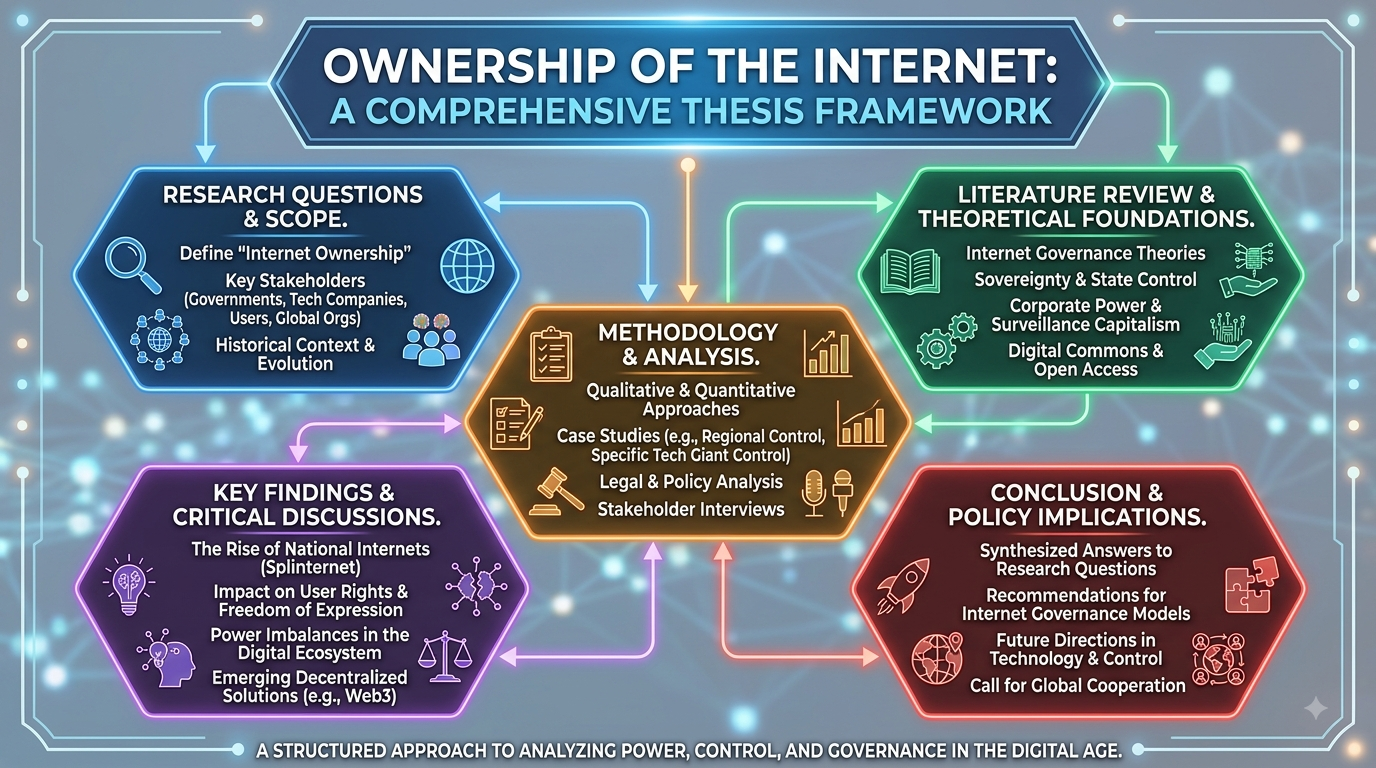
The phrase “ownership of the Internet” is deceptively simple. The Internet is not a single machine, corporation, government asset, or physical network that can be owned by one institution. Rather, it is a vast ecosystem of independently owned networks, data centres, submarine cables, satellites, fibre-optic systems, mobile networks, routers, servers, software platforms, domain-name systems, standards, and digital services that interconnect through common technical protocols.
The Internet Society describes the global Internet as tens of thousands of interconnected networks operated by service providers, companies, universities, governments and other organizations. No single actor manages or controls the Internet as a whole.
Consequently, Internet “ownership” must be analysed through several dimensions: physical ownership, network ownership, address-resource coordination, domain-name administration, standards governance, platform ownership, data ownership, national sovereignty, economic power and user participation.
This thesis develops a framework for understanding these layers and explains why the Internet is better described as a globally interconnected infrastructure ecosystem governed through distributed and multistakeholder arrangements than as a single asset with one owner.
1. Introduction: The Fundamental Question
A fundamental question of the digital age is:
Who owns the Internet?
The short answer is:
Nobody owns the Internet as a whole.
But that answer requires qualification.
Companies own data centres, fibre networks, cellular infrastructure, cloud platforms and content platforms. Governments control telecommunications regulation within their jurisdictions. Universities and organizations operate networks. Internet service providers connect customers. Domain registries operate top-level-domain infrastructure. Regional Internet Registries coordinate IP address resources. Technical organizations develop standards.
At the global coordination level, ICANN coordinates critical Internet identifiers, including domain names and IP-number resources, while the IANA functions are performed by Public Technical Identifiers on behalf of ICANN.
Therefore, “ownership” should be replaced with a more sophisticated question:
Who owns, operates, controls, regulates, coordinates and influences each layer of the Internet?
2. A Five-Layer Ownership Model
A useful analytical model divides the Internet into five major layers:
| Layer | Main components | Typical ownership/control |
|---|---|---|
| Physical layer | Cables, towers, satellites, data centres, routers | Governments and private organizations |
| Network layer | ISPs, backbone networks, IXPs, routing infrastructure | Telecom operators, enterprises, institutions |
| Logical layer | IP addresses, DNS, protocols | Distributed technical institutions |
| Application layer | Websites, cloud services, social networks, apps | Companies, governments, organizations, individuals |
| Content/data layer | Documents, databases, videos, software, personal data | Creators, organizations, users and institutions |
This layered approach is consistent with the Internet governance ecosystem described by ICANN, which distinguishes physical infrastructure, logical infrastructure and economic/social layers.
The critical insight is that ownership changes from layer to layer.
3. Physical Ownership of the Internet
The Internet ultimately depends upon physical infrastructure.
This includes:
- submarine fibre-optic cables;
- terrestrial fibre networks;
- telecommunications towers;
- mobile networks;
- satellites;
- routers;
- switches;
- data centres;
- servers;
- electricity systems;
- Internet exchange points;
- landing stations;
- cloud infrastructure;
- local access networks.
A telecommunications company may own a fibre network, while another company may lease capacity on that network.
A government may own strategic telecommunications infrastructure while private operators provide services over it.
A cloud company may own enormous data-centre infrastructure but does not therefore own the Internet.
Important distinction
Owning Internet infrastructure is not the same as owning the Internet.
Owning one road does not mean owning the entire global transportation system.
Similarly, owning a major fibre network does not mean owning the global Internet.
4. Submarine Cables: The Hidden Foundation
A particularly important component of Internet infrastructure is the global submarine cable system.
Modern international communications depend heavily on fibre-optic cables crossing oceans.
They connect:
Africa → Europe → Asia → Middle East → North America → South America → Oceania
These cables carry enormous volumes of:
- Internet traffic;
- cloud traffic;
- financial transactions;
- video;
- telecommunications;
- enterprise communications;
- government communications.
Ownership can involve telecommunications operators, technology companies, infrastructure investors, governments and consortiums.
This creates an important geopolitical dimension:
The physical geography of the Internet influences economic and strategic power.
Countries without sufficient international cable capacity can become more dependent on foreign infrastructure.
5. Data Centres and Cloud Infrastructure
The modern Internet increasingly depends on enormous data-centre ecosystems.
Data centres contain:
- computing systems;
- storage;
- networking equipment;
- cooling systems;
- power systems;
- security infrastructure;
- backup systems;
- AI accelerators;
- databases.
Cloud providers operate large-scale infrastructure that hosts websites, applications, databases, artificial intelligence systems and enterprise workloads.
However, cloud ownership is still only one component of the broader Internet.
A cloud provider may control enormous computational infrastructure while depending upon:
electricity → fibre → backbone networks → DNS → Internet protocols → telecommunications operators → end users.
Thus, the Internet is an ecosystem of dependencies rather than a single corporate asset.
6. Internet Service Providers
For ordinary users, the most visible “owner” of Internet access is often the ISP.
ISPs provide:
- broadband;
- fibre;
- mobile Internet;
- fixed wireless;
- enterprise connectivity;
- routing;
- DNS services;
- customer authentication;
- network security.
The ISP controls the customer’s immediate connection to the wider Internet.
However, an ISP normally connects to other networks.
This creates the fundamental architecture of interconnection.
One network connects to another.
Another connects to another.
The result is the global Internet.
7. Autonomous Systems and Network Interconnection
The Internet can be understood as a network of networks.
Large networks operate as autonomous systems and exchange routing information using protocols such as BGP.
Conceptually:
User → Access Network → ISP → Regional/International Network → Backbone → Destination Network → Server
No single company needs to operate every section.
This distributed architecture is one of the reasons the Internet can continue functioning even when individual networks experience failures.
The Internet Society emphasizes that thousands of independently operated networks cooperate to form the global Internet.
8. Who Owns IP Addresses?
IP addresses require another distinction.
An IP address is not equivalent to a physical piece of property.
Global IP-number coordination is organized through the IANA functions and the five Regional Internet Registries (RIRs).
The five RIRs serve different geographical regions:
- AFRINIC — Africa
- APNIC — Asia-Pacific
- ARIN — North America and parts of the Caribbean
- LACNIC — Latin America and the Caribbean
- RIPE NCC — Europe, the Middle East and parts of Central Asia
The IANA functions coordinate globally unique numbering resources, while the RIRs participate in regional policy and allocation arrangements.
Therefore:
ICANN ≠ owner of every IP address
and
RIRs ≠ owners of the Internet.
They coordinate essential Internet-number resources.
9. AFRINIC and Africa
For Africa, the Regional Internet Registry is AFRINIC.
Its role is particularly important because Africa requires reliable allocation and management of Internet number resources as its digital economy expands.
This has strategic implications for:
- African ISPs;
- cloud computing;
- data centres;
- universities;
- governments;
- financial technology;
- telecommunications;
- Internet-of-Things systems;
- AI infrastructure.
The health and stability of regional Internet-number administration therefore has implications far beyond technical administration.
10. Who Owns Domain Names?
Domain names create another layer.
For example:
example.com
contains a hierarchical naming structure.
The DNS translates human-readable names into information that computers can use to locate network resources.
At the global coordination level, ICANN coordinates the DNS root zone and the Internet’s unique identifiers.
However, ICANN does not personally own every website.
A domain can be:
coordinated → registered → administered → leased to a registrant → used for a website
These are different relationships.
11. ICANN’s Role
ICANN is often incorrectly described as “the owner of the Internet.”
That is inaccurate.
Its role is much narrower.
ICANN describes its mission as ensuring the stable and secure operation of the Internet’s unique identifier systems. Its responsibilities include coordination of domain names and number resources.
ICANN therefore sits primarily within the logical coordination layer.
It does not own:
- all fibre cables;
- all routers;
- all data centres;
- all websites;
- all mobile networks;
- all cloud computing systems;
- all Internet users;
- all Internet content.
12. IANA and the Global Identifier System
The IANA functions are grouped into three principal areas:
12.1 Domain names
Management of the global DNS root-related information.
12.2 Number resources
Coordination of global IP-number resources.
12.3 Protocol parameters
Maintenance of registries associated with Internet protocols.
IANA’s governance model distributes responsibility among different communities: naming, numbering and protocol communities.
This illustrates a fundamental principle:
The Internet’s critical identifiers are coordinated, not simply “owned” by a single organization.
13. Who Owns Internet Protocols?
Protocols such as:
- TCP/IP;
- BGP;
- DNS;
- HTTP;
- TLS;
- SMTP;
are not ordinary corporate property in the same sense as a factory or building.
Technical standards are developed through communities and standards organizations.
Important institutions include:
- Internet Engineering Task Force;
- World Wide Web Consortium;
- Institute of Electrical and Electronics Engineers;
- Internet Corporation for Assigned Names and Numbers;
- Regional Internet Registries.
The Internet Society identifies these technical organizations as important parts of the broader governance ecosystem.
14. The Internet Engineering Task Force
The IETF develops and maintains many of the technical standards underlying Internet interoperability.
Its philosophy is essentially:
open technical development → consensus → published standards → implementation → global interoperability
This is one reason an Internet device manufactured in one country can communicate with a server located on another continent.
The Internet’s greatest achievement is therefore not merely connectivity.
It is interoperability.
15. Who Owns the World Wide Web?
The Internet and the World Wide Web are not identical.
Internet
The Internet is the underlying global network infrastructure.
World Wide Web
The Web is a major application system operating on top of the Internet.
The Web includes:
- websites;
- browsers;
- web servers;
- URLs;
- HTTP/HTTPS;
- web applications.
This distinction is essential.
Internet ≠ Web
The Internet can exist without the Web.
Other Internet applications include:
- email;
- messaging;
- VoIP;
- cloud computing;
- gaming;
- file transfer;
- streaming;
- IoT;
- machine-to-machine communication.
16. Ownership of Websites
A website can be owned or controlled by:
- an individual;
- a company;
- a government;
- a university;
- a nonprofit;
- a community;
- another organization.
The owner may control:
- domain registration;
- web hosting;
- software;
- databases;
- content;
- branding;
- user accounts.
But the website still depends upon broader Internet infrastructure.
17. Platform Power
A major transformation of the Internet economy has occurred through the rise of large digital platforms.
Platforms can control enormous portions of:
- search;
- social networking;
- online advertising;
- cloud computing;
- app distribution;
- digital commerce;
- video;
- communications;
- artificial intelligence.
This creates an important distinction:
No company owns the Internet, but some companies possess enormous influence over particular layers of the Internet economy.
This is one of the central economic questions of modern Internet governance.
18. Data Ownership
Data introduces another complicated dimension.
Different legal systems treat data differently.
Potential stakeholders include:
- individuals;
- companies;
- governments;
- researchers;
- institutions;
- creators;
- platform operators.
A person may create information while a platform stores and processes it.
A company may own a database while the database contains information about millions of users.
Therefore, questions of:
ownership → access → control → processing → privacy → portability
must be distinguished.
19. Governments and Internet Sovereignty
Governments do not own the global Internet.
However, governments exercise significant authority over Internet activity within their territories.
They can regulate:
- telecommunications;
- spectrum;
- cybersecurity;
- privacy;
- consumer protection;
- competition;
- taxation;
- digital services;
- critical infrastructure;
- lawful access;
- data protection.
This produces an important tension:
Global Internet
versus
National sovereignty
The Internet is technically global, while laws are generally territorial.
This creates some of the most difficult governance questions of the digital age.
20. The Multistakeholder Model
Modern Internet governance is heavily influenced by a multistakeholder approach.
Participants include:
- governments;
- businesses;
- technical experts;
- civil society;
- academia;
- users;
- infrastructure operators.
The Internet Society describes Internet governance as an open and collaborative system involving multiple stakeholders rather than a system controlled by a single institution.
This model attempts to balance:
technical efficiency + economic interests + public policy + individual rights + global interoperability.
21. Why No Single Entity Can Easily Own the Internet
There are several structural reasons.
21.1 Geographic distribution
Internet infrastructure exists throughout the world.
21.2 Multiple owners
Thousands of organizations own different components.
21.3 Interdependence
Networks depend upon other networks.
21.4 Open standards
Common standards allow independent systems to communicate.
21.5 Decentralized routing
Traffic can move across many independent networks.
21.6 Multistakeholder governance
Critical technical resources are coordinated through institutions and communities rather than a single global government.
22. The Internet as a Global Commons
The Internet is sometimes described as a global commons.
However, this phrase requires caution.
The Internet contains:
- privately owned infrastructure;
- public infrastructure;
- commercial platforms;
- government systems;
- academic networks;
- community networks;
- open standards;
- privately controlled data.
It is therefore more accurate to describe the Internet as a hybrid global infrastructure ecosystem.
23. The Internet Ownership Pyramid
A useful conceptual model is:
LEVEL 1 — Physical Infrastructure
Cables
Towers
Satellites
Routers
Data centres
Power systems
↓
LEVEL 2 — Network Infrastructure
ISPs
Backbones
IXPs
Autonomous systems
↓
LEVEL 3 — Logical Infrastructure
IP addresses
DNS
Routing
Protocols
Standards
↓
LEVEL 4 — Computing and Cloud
Servers
Cloud platforms
AI infrastructure
Databases
↓
LEVEL 5 — Applications
Websites
Apps
Search
Social media
Streaming
E-commerce
↓
LEVEL 6 — Data and Content
Documents
Images
Video
Software
Scientific information
User-generated content
↓
LEVEL 7 — Human Society
Users
Businesses
Governments
Education
Culture
Economy
No single entity owns all seven levels.
24. The Economic Ownership Question
The deeper question is not merely:
“Who owns the Internet?”
It is:
Who captures economic value from the Internet?
Value is generated through:
- telecommunications;
- cloud computing;
- advertising;
- e-commerce;
- software;
- cybersecurity;
- data services;
- digital payments;
- artificial intelligence;
- content creation;
- online education;
- digital entertainment.
This means Internet power increasingly involves control of economic bottlenecks.
25. Strategic Bottlenecks
Some infrastructure components have disproportionate strategic importance.
Examples include:
International fibre
Controls high-capacity international connectivity.
Data centres
Provide computation and storage.
Cloud platforms
Provide scalable computing services.
DNS infrastructure
Supports global naming.
IP-number coordination
Supports global network addressing.
Undersea cables
Connect continents.
Internet exchanges
Improve local interconnection.
Mobile networks
Connect billions of users.
Semiconductor infrastructure
Provides the processors and networking chips underlying digital systems.
Thus, Internet power is distributed but not necessarily evenly distributed.
26. The Geopolitics of Internet Infrastructure
Internet infrastructure has become strategically important to nations.
Countries increasingly consider:
- submarine cables;
- cloud sovereignty;
- data centres;
- semiconductor supply;
- cybersecurity;
- satellite communications;
- 5G/6G;
- AI infrastructure;
- Internet exchange points;
- digital identity;
- data protection.
Consequently, the Internet has evolved from a communications technology into critical national infrastructure.
27. Africa’s Position
Africa’s Internet future depends upon investment across the entire ecosystem.
Key priorities include:
- international cable connectivity;
- national fibre networks;
- rural broadband;
- Internet exchange points;
- regional connectivity;
- data centres;
- cloud services;
- cybersecurity;
- digital skills;
- affordable devices;
- reliable electricity;
- IPv6 deployment;
- local digital content;
- AI infrastructure.
The goal should not simply be:
“More Internet users.”
The larger objective should be:
“More African ownership of digital infrastructure, technology, skills, data and economic value.”
28. South Africa’s Strategic Opportunity
For South Africa, Internet infrastructure intersects with:
- telecommunications;
- financial services;
- mining;
- manufacturing;
- universities;
- government;
- logistics;
- healthcare;
- education;
- artificial intelligence;
- cloud computing;
- digital entrepreneurship.
South Africa can potentially serve as a regional digital hub if it continues developing:
fibre + data centres + renewable/secure electricity + cloud + IXPs + cybersecurity + skilled workforce + AI infrastructure.
This is particularly important for the Southern African regional economy.
29. Internet Governance Versus Internet Ownership
These terms should never be treated as synonyms.
Ownership
Who legally owns a particular asset?
Operation
Who operates the infrastructure?
Administration
Who maintains the system?
Governance
Who develops rules and policies?
Regulation
Who has legal authority?
Coordination
Who ensures that independently operated systems remain interoperable?
Influence
Who has economic or political power?
A comprehensive Internet thesis must examine all seven.
30. The Internet Power Matrix
| Actor | Infrastructure | Governance | Regulation | Economic power |
|---|---|---|---|---|
| Governments | High | High | Very high | High |
| Telecom operators | Very high | Medium | Low/medium | Very high |
| Cloud companies | Very high | Medium | Low | Very high |
| ICANN | Low physical ownership | High in identifiers | Limited | Indirect |
| RIRs | Low physical ownership | High in numbering policy | Limited | Indirect |
| Standards bodies | Low | High technical influence | Limited | Indirect |
| Platform companies | High | Medium | Low | Very high |
| Users | Low individually | Participatory | Low | Collectively high |
The table demonstrates why a single-word answer such as “ICANN” or “the United States” is inadequate.
31. The United States and Internet Power
Historically, the United States played an exceptionally important role in the development of the Internet.
Important historical foundations included:
- ARPANET;
- American universities;
- US government research;
- development of TCP/IP;
- early Internet institutions;
- technology companies;
- major cloud platforms.
However, historical leadership does not mean that the United States owns the entire modern Internet.
The 2016 IANA stewardship transition further changed the relationship between the US government and global Internet identifier administration. Today, IANA functions are performed by PTI, an ICANN affiliate, under the post-transition governance arrangements.
32. Can a Government Shut Down the Internet?
A government can potentially disrupt or restrict Internet access within its jurisdiction through measures affecting:
- telecommunications providers;
- international gateways;
- domestic networks;
- DNS;
- mobile networks;
- Internet exchange points;
- regulation.
But that is different from owning the global Internet.
This distinction illustrates the difference between:
territorial control
and
global ownership.
33. Can a Company Own the Internet?
No single company owns the global Internet.
However, companies can possess enormous strategic influence.
A company may dominate:
- search;
- cloud computing;
- social media;
- mobile operating systems;
- online advertising;
- content distribution;
- data centres;
- AI infrastructure.
Therefore, the future policy challenge is increasingly about concentration of digital power rather than literal ownership of the Internet.
34. The Internet as an Ecosystem
The most accurate conceptual model is:
Internet = networks + infrastructure + protocols + identifiers + applications + data + users + institutions + governance
Every component interacts with the others.
For example:
Electricity
↓
Data centre
↓
Server
↓
Router
↓
Fibre network
↓
ISP
↓
DNS
↓
IP addressing
↓
Internet routing
↓
Application
↓
User
The apparent simplicity of opening a website therefore hides an enormous global infrastructure system.
35. Major Risks to the Internet Ecosystem
The Internet faces several structural risks.
35.1 Infrastructure concentration
Too much dependence on a small number of infrastructure providers.
35.2 Cybersecurity threats
Attacks can affect networks, databases and critical infrastructure.
35.3 Undersea cable vulnerability
International connectivity depends heavily on physical cable infrastructure.
35.4 Digital monopolization
Large platforms can accumulate substantial market power.
35.5 Digital inequality
Poorer communities can remain disconnected or underserved.
35.6 Fragmentation
Different national rules can create incompatible digital environments.
35.7 Data concentration
Large organizations may accumulate enormous quantities of information.
35.8 Energy dependency
Cloud computing and AI increasingly require significant electricity and cooling capacity.
36. Internet Fragmentation
One of the greatest strategic risks is the emergence of a fragmented Internet.
Instead of:
One globally interoperable Internet
the world could move toward:
multiple partially separated digital ecosystems.
Potential causes include:
- geopolitical competition;
- national Internet regulation;
- incompatible technical standards;
- censorship;
- trade restrictions;
- cybersecurity conflicts;
- data-localization requirements;
- technology export controls.
The preservation of global interoperability is therefore one of the most important objectives of Internet governance.
37. The Future Internet: 2030–3001
A long-term perspective requires consideration of technologies beyond today’s Internet.
The future could include:
- 6G;
- massive satellite networks;
- quantum communications;
- edge computing;
- autonomous networks;
- AI agents;
- machine-to-machine Internet;
- Internet of Things;
- digital twins;
- immersive environments;
- advanced robotics;
- planetary communications;
- autonomous infrastructure.
The ownership question will consequently become even more complicated.
Instead of asking:
Who owns the Internet?
future societies may need to ask:
Who controls the computational, communications and intelligence infrastructure upon which civilization depends?
38. Internet Ownership in the AI Era
Artificial intelligence changes the equation.
AI requires:
data + algorithms + chips + electricity + data centres + networks + talent + capital.
Consequently, digital power increasingly depends upon the ability to control:
- semiconductor supply chains;
- computing infrastructure;
- cloud platforms;
- datasets;
- AI models;
- telecommunications;
- energy;
- distribution platforms.
The Internet is therefore becoming the communications layer of a much larger global computational ecosystem.
39. A New Concept: Digital Sovereignty
Digital sovereignty refers broadly to the ability of a country, organization or community to maintain meaningful control over its digital infrastructure, technology, data and strategic capabilities.
It does not necessarily mean disconnecting from the global Internet.
A more constructive model is:
Global interoperability + national resilience + local capability
rather than:
total dependence or total isolation.
40. Policy Framework for a Healthy Global Internet
A sustainable Internet governance architecture should prioritize:
Principle 1 — Interoperability
Different networks must continue communicating.
Principle 2 — Openness
Technical standards should remain broadly accessible.
Principle 3 — Security
Infrastructure must be resilient.
Principle 4 — Accountability
Organizations exercising significant influence should be accountable.
Principle 5 — Competition
Digital markets should avoid excessive concentration.
Principle 6 — Inclusion
Internet access should expand across underserved populations.
Principle 7 — Innovation
New technologies should be able to develop.
Principle 8 — Privacy
Users require meaningful protection of personal information.
Principle 9 — Resilience
Countries and organizations should avoid unnecessary single points of failure.
Principle 10 — Global cooperation
The Internet must remain capable of functioning across borders.
41. A Comprehensive Governance Architecture
A mature global Internet governance system can be visualized as:
GLOBAL LEVEL
ICANN / IANA
Technical standards communities
Global policy institutions
↓
REGIONAL LEVEL
Regional Internet Registries
Regional networks
Regional policy organizations
↓
NATIONAL LEVEL
Governments
Regulators
National backbone operators
National cybersecurity institutions
↓
INFRASTRUCTURE LEVEL
Telecom operators
Data centres
IXPs
Cloud providers
Cable systems
↓
APPLICATION LEVEL
Platforms
Websites
Cloud applications
AI systems
↓
USER LEVEL
Individuals
Businesses
Universities
Communities
This is not a single hierarchy.
It is a networked governance ecosystem.
42. The Central Thesis
The central thesis of Internet ownership can therefore be stated as follows:
The Internet is not a single property that belongs to one owner. It is a globally interconnected ecosystem in which physical infrastructure is owned by numerous organizations, logical identifiers are coordinated through specialized institutions, technical standards are developed through open communities, governments exercise territorial regulatory authority, private companies operate major infrastructure and platforms, and billions of users participate in creating economic and social value.
This distinction is essential for understanding modern digital civilization.
43. Final Conclusion
The question “Who owns the Internet?” has no single corporate or governmental answer.
The Internet is better understood as a distributed global infrastructure system.
Its physical assets are separately owned.
Its networks are independently operated.
Its identifiers are globally coordinated.
Its protocols are developed through technical communities.
Its domain-name system depends upon coordinated administration.
Its applications are operated by companies, governments, institutions and individuals.
Its content is created by humanity.
Its economic value is distributed across a massive digital ecosystem.
Its regulation is increasingly shaped by national governments and international cooperation.
ICANN plays an important but limited role in coordinating unique Internet identifiers; it does not own the physical Internet or control every Internet service. The Internet Society likewise emphasizes that no single actor manages or controls the Internet as a whole.
The deepest lesson is therefore:
The Internet is not an object with one owner. It is a civilization-scale system of shared protocols, independently owned infrastructure, interconnected networks, institutions, markets, governments and users.
Its future will depend on preserving the balance between:
ownership + openness + competition + security + sovereignty + innovation + accessibility + global interoperability.
That balance may become one of the defining governance challenges of the twenty-first century—and potentially of the technological civilization envisioned toward the year 3001.


Be First to Comment