
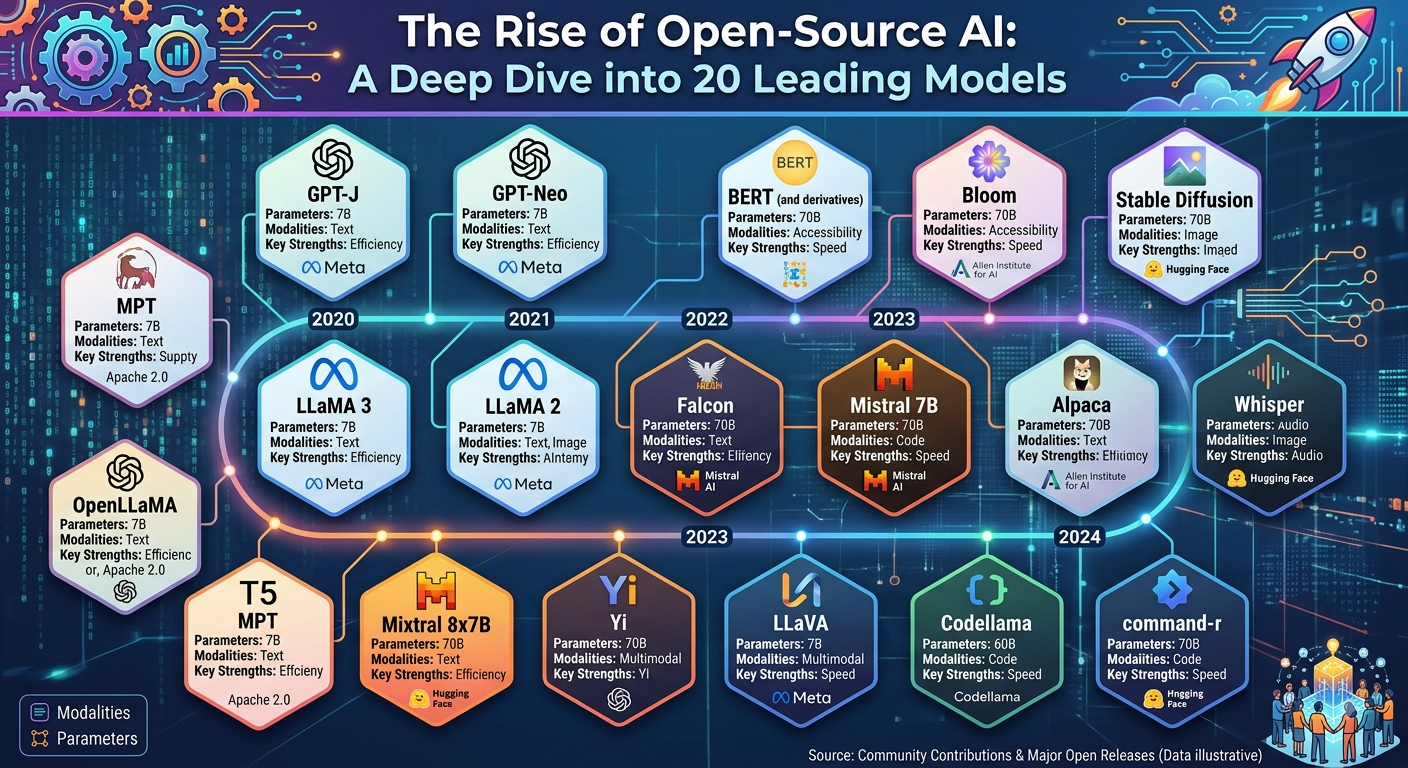
The rise of open-source and open-weight artificial intelligence is one of the most important technological developments of the 2020s. What began largely as an academic and developer movement has evolved into a global AI ecosystem involving companies, universities, governments, independent researchers, startups and millions of developers.
A major development is that the frontier is no longer defined exclusively by closed systems. Models such as Llama, Qwen, DeepSeek, Kimi, GLM, Mistral, Gemma, OLMo, GPT-OSS and others have demonstrated that powerful AI can increasingly be distributed outside the traditional API-only model.
However, an important distinction must be made: “open-source AI” and “open-weight AI” are not always the same thing. Many prominent models release their trained weights while withholding some combination of training data, complete training code, data-processing pipelines or other components. The distinction has become increasingly important in 2026. (The Wall Street Journal)
1. What is Open-Source AI?
At its broadest, open AI means that important components of an AI system are made available for inspection, research, modification or redistribution.
A fully open AI project could potentially provide:
- model architecture;
- model weights;
- training code;
- datasets or sufficiently detailed information about them;
- preprocessing procedures;
- evaluation methodology;
- training configuration;
- documentation;
- inference software;
- licensing information.
This is considerably more transparent than simply providing access through an online API.
Open-weight AI
Open-weight systems are slightly different.
A company may release the trained parameters—the weights—but not release the complete training dataset or training process.
This means a developer may be able to:
Download → run → fine-tune → integrate → deploy
without having the ability to reproduce the original model from scratch.
This distinction is central to understanding today’s AI industry. Some models marketed as “open source” are more accurately described as open-weight models. (The Wall Street Journal)
2. Why Open AI Has Become So Important
The traditional generative-AI model looks like this:
User → Internet → AI company’s servers → proprietary model → response
Open models create another possibility:
User → Local computer/server → downloaded model → response
Or:
Company → Private cloud → Open model → Enterprise application
This changes the economics and architecture of AI.
Major advantages include:
- Lower dependence on a single AI provider
- Greater customization
- Private deployment
- Potentially lower inference costs
- Research accessibility
- Local/offline AI
- Fine-tuning
- Greater competition
- National AI sovereignty
- Development of local-language AI
The result is an increasingly decentralized AI ecosystem.
3. The 20 Important Open/Open-Weight Model Families
The following list is best understood as a strategic map rather than a permanent ranking. The frontier changes extremely rapidly.
| # | Model/family | Organisation | Major significance |
|---|---|---|---|
| 1 | Llama | Meta | Huge open-model ecosystem |
| 2 | Qwen | Alibaba | Multilingual and general-purpose strength |
| 3 | DeepSeek | DeepSeek | Efficient reasoning and MoE innovation |
| 4 | Kimi | Moonshot AI | Long-context and agentic capabilities |
| 5 | GLM | Z.ai | Reasoning and multilingual AI |
| 6 | Mistral | Mistral AI | European open-model leadership |
| 7 | Gemma | Efficient models for developers | |
| 8 | GPT-OSS | OpenAI | Open-weight reasoning models |
| 9 | OLMo | Ai2 | Research transparency |
| 10 | Phi | Microsoft | Small-model efficiency |
| 11 | Granite | IBM | Enterprise/open AI ecosystem |
| 12 | Falcon | TII | Important early open-model movement |
| 13 | MiniMax | MiniMax | Large-scale open-weight models |
| 14 | InternLM | Shanghai AI Lab | Chinese research ecosystem |
| 15 | Yi | 01.AI | Chinese open-model development |
| 16 | SmolLM | Hugging Face | Small/local AI |
| 17 | Nemotron | NVIDIA | AI reasoning and enterprise ecosystem |
| 18 | Aya | Cohere for AI | Multilingual AI |
| 19 | BLOOM | BigScience | International open research |
| 20 | Moondream | Moondream | Compact vision-language AI |
The relative performance of these families changes frequently, so a “top 20” list should not be interpreted as a fixed leaderboard.
4. Llama — The Open AI Ecosystem Giant
Meta’s Llama family has been one of the most influential developments in open-weight AI.
The significance of Llama extends beyond the individual model.
It created an enormous ecosystem of:
- fine-tunes;
- quantized models;
- research projects;
- developer frameworks;
- AI assistants;
- enterprise applications;
- local inference tools;
- educational projects.
Llama demonstrated that releasing a powerful model can create an ecosystem around the model itself.
Strategic importance
Llama’s importance is therefore partly technological and partly economic.
Instead of Meta having to build every AI application itself, thousands of external developers can build on the model.
This produces a powerful network effect:
Model → Developers → Applications → Users → More developers → Larger ecosystem
Meta’s newer open-weight strategy continues to be a major component of its AI positioning. (Reuters)
5. Qwen — The Multilingual and Enterprise Challenger
Alibaba’s Qwen family has become one of the most important open-model ecosystems.
Qwen’s importance comes from its broad capabilities:
- general language;
- programming;
- mathematics;
- reasoning;
- multilingual applications;
- multimodal processing;
- enterprise applications;
- tool use.
The Qwen ecosystem is particularly important because it demonstrates that China is not merely consuming AI technology—it is becoming a major producer of globally distributed foundation models.
Recent 2026 developments have included increasingly sophisticated Qwen generations and new commercial strategies around their use. (Reuters)
6. DeepSeek — The Efficiency Revolution
DeepSeek has arguably had one of the greatest strategic impacts on the economics of AI.
Its importance is not simply that it created powerful models.
It demonstrated how architectural and training innovations can change the relationship between:
AI capability ↔ computational resources ↔ cost
DeepSeek’s research has included work involving:
- mixture-of-experts architectures;
- reinforcement learning;
- reasoning;
- efficient training;
- efficient inference;
- large-scale datasets.
Earlier DeepSeek research showed that its models could compete strongly with larger established models in mathematics, coding and reasoning. (arXiv)
Why DeepSeek matters
The traditional assumption was:
Better AI requires dramatically more computation.
DeepSeek helped strengthen an alternative proposition:
Better algorithms and training techniques can sometimes extract substantially more capability from available computation.
That is strategically important for countries and companies that cannot afford the largest AI infrastructure.
7. Kimi — The Long-Context and Agentic Direction
Moonshot AI’s Kimi family has become another significant force in open-weight AI.
The strategic importance of Kimi is associated with:
- long context;
- coding;
- reasoning;
- agentic workflows;
- document processing;
- complex task execution.
The development of Kimi illustrates how open models are increasingly moving beyond simple chatbot behaviour.
The new generation of AI is increasingly expected to:
read → reason → plan → use tools → execute → verify
rather than merely:
read → generate text.
8. GLM — China’s Research-Oriented AI Ecosystem
GLM, associated with Z.ai, is another important family.
Its development demonstrates the growing diversity of the Chinese AI ecosystem.
Rather than having one dominant Chinese AI company, China has multiple research and commercial organisations developing foundation models.
This creates competition among:
- Alibaba;
- DeepSeek;
- Moonshot;
- Z.ai;
- MiniMax;
- Shanghai AI Lab;
- 01.AI;
- other research institutions.
This competitive environment has helped accelerate open-weight model development.
9. Mistral — Europe’s Major Open-AI Champion
Mistral AI has played an especially important role in Europe’s AI strategy.
Its significance goes beyond model performance.
Mistral represents an attempt to create:
European AI capability + technological independence + open distribution
Its models have been particularly important for:
- enterprise AI;
- coding;
- multilingual applications;
- private deployment;
- European AI sovereignty.
This matters because AI infrastructure is increasingly viewed as strategic infrastructure in the same way that:
- telecommunications;
- semiconductor manufacturing;
- electricity;
- cloud computing;
- data centres
are strategically important.
10. Gemma — Small Models Become Powerful
Google’s Gemma family was designed around the idea that powerful AI does not necessarily have to mean enormous models.
Gemma originated from research and technology associated with Google’s Gemini work and was released in lightweight configurations suitable for broader developer use. (arXiv)
This creates an important architectural trend:
AI is moving in two directions simultaneously
Direction A — Giant foundation models
Hundreds of billions or even trillions of parameters.
Direction B — Compact specialised models
Models capable of operating on:
- laptops;
- workstations;
- phones;
- edge devices;
- private servers.
This second direction is extremely important for the future of AI.
11. GPT-OSS — OpenAI Enters the Open-Weight Ecosystem
OpenAI’s release of open-weight models represents another major development in the competitive landscape.
The strategic significance is substantial because OpenAI historically became strongly associated with frontier closed models.
An open-weight strategy provides developers with another pathway:
OpenAI research → downloadable model → developer ecosystem
This illustrates how the boundary between “closed AI company” and “open AI company” is becoming more complicated.
12. OLMo — The Transparency Experiment
The Allen Institute for AI’s OLMo project is particularly important from a research perspective.
OLMo’s philosophy places greater emphasis on transparency than simply releasing weights.
The broader open-science objective is:
Data + code + weights + training information + evaluation
rather than only:
Weights
This distinction is crucial for scientific reproducibility.
Research into fully transparent LLMs has argued that releasing only model weights leaves researchers unable to completely reproduce or investigate the original training process. (arXiv)
13. Phi — The Small-Model Revolution
Microsoft’s Phi family demonstrates another major trend:
Small models can be surprisingly capable when trained efficiently.
The strategic advantage of small AI is enormous.
A smaller model can potentially require:
- less memory;
- less electricity;
- cheaper hardware;
- lower latency;
- easier deployment;
- greater privacy.
This is particularly important for developing countries and small companies.
Instead of requiring a hyperscale data centre, a specialised AI system could potentially operate within a much smaller infrastructure footprint.
14. Granite — Enterprise AI
IBM’s Granite family represents another direction: enterprise-oriented open AI.
Enterprise AI requires more than impressive benchmark results.
Businesses need:
- security;
- governance;
- documentation;
- predictable licensing;
- integration;
- data privacy;
- monitoring;
- lifecycle management.
Therefore, the future AI market will not simply be:
“Which model is smartest?”
It will increasingly be:
“Which model is safest, cheapest, most controllable and most useful for this specific organisation?”
15. Falcon — An Important Early Open Model
Falcon, developed by the Technology Innovation Institute, became one of the important early demonstrations that high-quality foundation models could emerge outside the traditional US technology giants.
Its significance is therefore partly historical.
It helped demonstrate the internationalisation of AI development.
AI foundation-model development is no longer restricted to:
Silicon Valley → rest of world
Instead, the emerging architecture is:
US + China + Europe + Middle East + Asia + international research institutions + independent developers
16. MiniMax — Scaling Open AI
MiniMax has become another important participant in the open-weight ecosystem.
Its development demonstrates the increasingly competitive Chinese AI environment.
MiniMax’s importance lies in the broader movement toward:
- large reasoning models;
- coding;
- agents;
- multimodal AI;
- efficient inference.
The competitive pressure generated by these companies has accelerated the rate at which models are being released.
17. InternLM — Research Ecosystem Development
InternLM represents the role of Chinese academic and research institutions in the foundation-model ecosystem.
This is important because AI leadership depends upon more than companies.
A complete AI ecosystem requires:
Universities + researchers + semiconductor infrastructure + cloud computing + data + capital + developers + companies
The development of models such as InternLM reflects this broader ecosystem.
18. Yi — Another Chinese Open-Model Family
The Yi family, associated with 01.AI, illustrates the diversity of China’s open-model landscape.
Rather than relying on one national model, China’s ecosystem contains multiple competing approaches.
This competition encourages:
- architectural experimentation;
- multilingual development;
- coding capability;
- reasoning;
- efficiency;
- deployment innovation.
19. SmolLM — AI at the Smallest Scale
Hugging Face’s SmolLM initiative represents an especially interesting direction.
The objective is to push capable language models toward smaller computational footprints.
This has major implications for:
- education;
- robotics;
- IoT;
- embedded systems;
- smartphones;
- personal computers;
- edge computing.
Imagine a future in which a school computer can run a capable educational AI locally without constantly sending every question to a remote data centre.
That is one of the potential societal impacts of small open models.
20. NVIDIA Nemotron — AI Infrastructure Meets Open Models
NVIDIA’s Nemotron family is strategically important because NVIDIA occupies a unique position across the AI infrastructure stack.
The company participates in:
GPU → networking → software → model optimisation → AI infrastructure
Open models such as Nemotron demonstrate that the semiconductor and AI-model ecosystems are increasingly interconnected.
The modern AI stack is therefore no longer simply a software stack.
It is a full technological ecosystem.
21. Aya — Multilingual AI
Cohere for AI’s Aya work is particularly important for multilingual AI.
This is strategically important because most of the world’s population does not communicate primarily in English.
A genuinely global AI system needs strong representation of:
- African languages;
- Asian languages;
- Middle Eastern languages;
- European languages;
- indigenous languages;
- regional dialects.
This creates a major opportunity for countries such as South Africa.
AI should not merely understand English and translate everything else into English.
The long-term objective should be:
AI that understands societies in their own languages and cultural contexts.
22. BLOOM — The International Open-AI Experiment
BLOOM is historically important because it represented a large international collaboration around open language-model research.
The BigScience project demonstrated that foundation-model research could be organised as a broad international scientific effort rather than being controlled entirely by a single commercial laboratory.
This idea remains important for the future of open AI.
23. Moondream — Compact Vision AI
Not every important open model needs to be a giant language model.
Moondream represents the development of compact vision-language models capable of combining:
visual perception + language
Such models can support applications involving:
- image understanding;
- robotics;
- industrial inspection;
- accessibility;
- education;
- edge devices.
This highlights another major trend:
The future of AI is multimodal.
24. The Most Important Architectural Revolution: Mixture of Experts
One of the most important developments behind modern open models is Mixture of Experts (MoE).
A traditional dense model might conceptually work like:
Input → entire neural network → output
An MoE system can work more like:
Input → routing mechanism → selected experts → output
Suppose a model contains 100 specialised components.
A particular request might activate only a subset.
For example:
Mathematics question → mathematics experts
Programming question → coding experts
Language translation → language experts
This can improve computational efficiency.
The important concept is:
Total parameters ≠ parameters used for every token
A model might contain enormous total parameter capacity while activating a much smaller number of parameters for an individual calculation.
This has become one of the major architectural ideas behind the new generation of open models.
25. The Second Revolution: Reasoning Models
Earlier LLMs primarily focused on predicting the next token.
Modern reasoning-oriented models increasingly attempt to perform more structured internal computation.
Conceptually:
Question
↓
Problem decomposition
↓
Reasoning
↓
Verification
↓
Answer
This is particularly important for:
- mathematics;
- programming;
- scientific analysis;
- engineering;
- planning;
- complex research.
DeepSeek’s reasoning work helped make this direction particularly influential in the open-model ecosystem.
26. The Third Revolution: AI Agents
The next stage is not simply better chatbots.
It is AI agents.
An agent can potentially operate as:
Model + memory + tools + planning + execution + feedback
For example:
User:
Analyse this business.
Agent:
Collect data → analyse financial information → compare competitors → calculate indicators → produce report → identify risks
This is much closer to an automated digital worker than a traditional chatbot.
Open models are particularly important here because organisations can potentially construct their own private agent infrastructure.
27. The Fourth Revolution: Local AI
Cloud AI requires:
Device → Internet → Data centre → Model → Internet → Device
Local AI can instead operate:
Device → Local model → Result
This has several potential advantages:
Privacy
Sensitive information can remain on the device.
Latency
There is less dependence on network communication.
Availability
Some applications can function without continuous Internet access.
Cost
Repeated API calls can potentially be reduced.
Sovereignty
Organisations have greater control over their AI infrastructure.
28. The Fifth Revolution: AI Sovereignty
This is particularly important for governments.
A country increasingly needs to consider:
Who controls our AI infrastructure?
If every important AI service depends upon foreign companies, foreign cloud infrastructure and foreign models, the country may become technologically dependent.
AI sovereignty therefore involves:
Compute
Models
Data
Talent
Energy
Semiconductors
Cloud/data centres
Cybersecurity
Research
Applications
Open models can reduce one part of this dependency because organisations can obtain and customise model weights rather than relying exclusively on external APIs.
29. Open AI and the Developing World
Open AI could be particularly transformative for developing economies.
Consider a country such as South Africa.
A local AI ecosystem could potentially develop:
Education AI
AI tutors for mathematics, science, accounting and programming.
Agricultural AI
Crop monitoring, irrigation optimisation and agricultural advisory systems.
Mining AI
Predictive maintenance, geological analysis and safety systems.
Healthcare AI
Administrative assistance, medical information systems and workflow optimisation—subject to appropriate professional oversight.
Government AI
Document processing, service-delivery analysis and administrative automation.
SME AI
Small businesses could deploy specialised AI without building a foundation model from scratch.
30. Why Open AI Could Change the Economics of Software
Traditional software development requires:
Human programmer → software → user
AI changes this into:
Foundation model → AI agent → software generation → user
Open models make the foundation-model layer increasingly accessible.
This could create an explosion of specialised applications.
For example:
Open model
↓
South African legal-language fine-tune
↓
Local legal assistant
or:
Open model
↓
Agricultural dataset
↓
Agricultural AI
or:
Open model
↓
School curriculum
↓
Educational tutor
This is the fundamental economic power of open models.
31. The AI Value Chain
The modern AI economy can be represented as a layered architecture:
                AI APPLICATIONS
        ┌───────────────────────────┐
        │ Education │ Finance       │
        │ Healthcare│ Agriculture   │
        │ Robotics  │ Government    │
        └─────────────┬─────────────┘
                      │
                AI AGENTS
                      │
                FOUNDATION MODELS
                      │
       ┌──────────────┼──────────────┐
       │              │              │
     Llama          Qwen          DeepSeek
     Kimi           GLM           Mistral
     Gemma          GPT-OSS       OLMo
       │              │              │
       └──────────────┼──────────────┘
                      │
              AI SOFTWARE STACK
                      │
          CUDA / Frameworks / APIs
                      │
                  COMPUTE
                      │
           GPUs / CPUs / NPUs
                      │
                DATA CENTRES
                      │
                 ELECTRICITY
                      │
             TELECOMMUNICATIONS
This illustrates an important principle:
AI is not merely a model. AI is an ecosystem.
32. Open AI vs Closed AI
The debate should not be simplified into:
Open = good
Closed = bad
Both approaches have advantages.
| Dimension | Open/Open-weight | Closed |
|---|---|---|
| Transparency | Usually higher | Usually lower |
| Customisation | High | Often limited |
| Local deployment | Often possible | Often unavailable |
| Model control | Higher | Provider-controlled |
| Ease of use | Variable | Usually high |
| Infrastructure burden | User may bear more | Provider bears more |
| Fine-tuning | Often available | Depends on provider |
| Reproducibility | Potentially higher | Usually lower |
| Ecosystem | Community-driven | Provider-driven |
| Security responsibility | Shared heavily with user | Provider manages more |
Therefore, the future will probably contain both open and closed AI ecosystems.
33. The Hidden Cost of Open AI
Open AI is not automatically free.
A company downloading a large model may still need:
- GPUs;
- electricity;
- cooling;
- storage;
- networking;
- engineers;
- security;
- monitoring;
- model evaluation;
- deployment infrastructure.
For a very large model, the hardware requirements can be substantial.
Therefore:
Open weights reduce software access barriers, but they do not eliminate infrastructure costs.
This distinction is critical for business planning.
34. Licensing Is Extremely Important
Before deploying an open model commercially, organisations should examine:
- licence type;
- commercial-use permissions;
- redistribution requirements;
- attribution requirements;
- acceptable-use restrictions;
- model-specific conditions;
- patent provisions;
- derivative-model requirements.
Apache 2.0, MIT, custom licences and model-specific licences do not necessarily provide identical rights.
This is why calling every downloadable model “open source” can be misleading.
35. The New Competitive Battlefield
The AI competition is increasingly occurring across several dimensions.
1. Model quality
How intelligent is the model?
2. Efficiency
How much computation is required?
3. Context
How much information can it process?
4. Reasoning
Can it solve complicated problems?
5. Multimodality
Can it understand:
- text;
- images;
- audio;
- video?
6. Agents
Can it use tools and perform multi-step tasks?
7. Local deployment
Can it operate on affordable hardware?
8. Licensing
Can companies legally commercialise it?
9. Ecosystem
How many developers support it?
10. Cost
How much does deployment actually cost?
36. The Rise of China in Open AI
One of the most significant developments in 2026 is the growing strength of Chinese open-weight models.
DeepSeek, Qwen, Kimi, GLM, MiniMax and other Chinese organisations have become major contributors to the open-model ecosystem.
This has transformed AI competition from primarily:
US companies vs US companies
into:
US + China + Europe + Asia + Middle East + global research communities
Recent community and industry assessments have highlighted the unusually strong representation of Chinese models among high-performing open-weight systems. (Reddit)
This has enormous geopolitical implications.
37. The Economics of Open AI
Open models can potentially reduce the cost of AI experimentation.
A startup can:
Download model
↓
Fine-tune
↓
Add proprietary data
↓
Build application
↓
Deploy
Instead of:
Build foundation model from zero
Building a frontier model from scratch requires enormous:
- capital;
- compute;
- data;
- engineering;
- research expertise.
Open models therefore create a new economic division of labour.
Foundation-model companies
Build the underlying intelligence.
Application companies
Build specialised products.
This resembles the evolution of the software industry.
38. Open AI and Education
Education may become one of the greatest beneficiaries.
Imagine an open educational AI system trained around:
- mathematics;
- physics;
- chemistry;
- biology;
- economics;
- accounting;
- programming;
- history;
- engineering.
A school could potentially customise the system around its curriculum.
A university could develop its own academic assistant.
A country could create AI educational systems supporting local languages.
This could dramatically reduce the cost of personalised educational assistance.
39. Open AI and Scientific Research
Scientists could use open models for:
- literature analysis;
- coding;
- mathematical reasoning;
- simulations;
- experiment planning;
- data interpretation;
- documentation.
More importantly, researchers can inspect and modify models rather than treating them as black boxes.
This makes open AI especially attractive to scientific communities.
40. Open AI and Robotics
The convergence of:
Vision AI + language AI + reasoning AI + robotics
could produce increasingly capable machines.
The conceptual architecture is:
Sensors
   ↓
Vision Model
   ↓
Multimodal Foundation Model
   ↓
Reasoning
   ↓
Planning
   ↓
Robot Controller
   ↓
Physical Action
   ↓
Sensors
   ↓
Feedback
Open models can accelerate experimentation across this entire ecosystem.
41. Open AI and the Future of Software Engineering
Software developers increasingly have access to AI coding models.
The development process can evolve from:
Human writes every line
toward:
Human architect + AI coding agent + automated testing + human verification
Open coding models can therefore become development infrastructure.
This does not eliminate the need for programmers.
Instead, the programmer’s role increasingly shifts toward:
- architecture;
- requirements;
- verification;
- security;
- testing;
- system integration;
- decision-making.
42. The Biggest Challenge: Reliability
Open models still have serious weaknesses.
They can:
- hallucinate;
- produce incorrect information;
- misunderstand instructions;
- generate insecure code;
- reflect biases;
- fail on unusual problems;
- perform inconsistently.
Therefore:
Open AI should not be confused with automatically trustworthy AI.
A model being downloadable does not mean its output is correct.
43. The Bigger Challenge: AI Safety
Open models also create difficult safety questions.
Once model weights are widely distributed, the original developer has less direct control over how downstream users modify or deploy the model.
This creates a fundamental tension:
Openness
versus
centralised control
Neither extreme provides a complete solution.
The future will likely require:
- transparent evaluations;
- responsible licensing;
- security testing;
- provenance systems;
- monitoring;
- human oversight;
- responsible deployment standards.
44. What the Next AI Architecture Looks Like
The future AI computer may resemble this:
                    HUMAN
                      │
                      ▼
                AI INTERFACE
                      │
                      ▼
                 AI AGENT
                      │
          ┌───────────┼───────────┐
          ▼           ▼           ▼
       REASONING    MEMORY       TOOLS
          │           │           │
          └───────────┼───────────┘
                      ▼
              FOUNDATION MODEL
                      │
        ┌─────────────┼─────────────┐
        ▼             ▼             ▼
       TEXT          VISION        AUDIO
        │             │             │
        └─────────────┼─────────────┘
                      ▼
                  COMPUTE
                      │
              GPU / CPU / NPU
                      │
                 DATA CENTRE
                      │
                ELECTRICITY
This is much larger than the traditional concept of a chatbot.
45. The Strategic Meaning of the Open-Source AI Revolution
The most important consequence of open AI is not simply that developers can download models.
The deeper consequence is the democratisation of AI infrastructure.
Historically:
Computer revolution
put computing into businesses and homes.
Then:
Internet revolution
connected computers globally.
Then:
Cloud revolution
centralised enormous computational resources.
Now:
Open AI revolution
is beginning to distribute sophisticated machine intelligence across organisations, developers and devices.
The potential trajectory is:
Personal computer → Internet → Cloud → AI → Personal AI
46. A New AI Industrial Revolution
The first Industrial Revolution mechanised physical production.
The digital revolution mechanised information processing.
The AI revolution is beginning to mechanise parts of:
- reasoning;
- communication;
- programming;
- research;
- planning;
- administration;
- design;
- knowledge work.
Open models accelerate this process because they allow more organisations to participate.
The resulting economic structure could therefore become:
Human intelligence
Machine intelligence
Robotics
Automation
Digital infrastructure
=
AI-enabled economy
47. Implications for South Africa
For South Africa, the open-model revolution presents a particularly important strategic opportunity.
The country does not necessarily need to compete by building the world’s largest foundation model.
Instead, South Africa could concentrate on specialisation.
For example:
South African AI stack
Open foundation model
↓
South African data
↓
Local languages
↓
Local regulations
↓
Industry knowledge
↓
Specialised AI
Potential sectors include:
- mining;
- agriculture;
- logistics;
- education;
- manufacturing;
- telecommunications;
- financial services;
- public administration;
- energy;
- water management.
This is a potentially much more realistic strategy than trying to replicate the entire infrastructure of the largest global AI laboratories.
48. The Opportunity for African Languages
Africa contains enormous linguistic diversity.
Open models provide an opportunity to develop AI systems that understand languages that receive relatively little representation in mainstream commercial AI.
For South Africa, potential areas include:
- isiZulu;
- isiXhosa;
- Sesotho;
- Setswana;
- Sepedi;
- Xitsonga;
- siSwati;
- Tshivenda;
- Afrikaans;
- English.
A long-term African AI strategy could therefore focus on:
Language data → open models → local fine-tuning → local applications
This could become one of the continent’s most valuable AI research opportunities.
49. Twenty Models, One Larger Revolution
The most important lesson from these 20 model families is that there is no single definition of an AI winner.
Different models may dominate different dimensions:
- one may be strongest in reasoning;
- another in coding;
- another in multilingual AI;
- another in long context;
- another in local deployment;
- another in transparency;
- another in enterprise applications;
- another in multimodal processing.
The AI industry is therefore becoming more like the semiconductor industry.
There may not be one universal chip.
There may not be one universal AI model.
Instead, there will be a portfolio of specialised intelligence engines.
50. Final Strategic Conclusion
The rise of open-source and open-weight AI represents a structural transformation of the global technology economy.
The first phase of generative AI was dominated by a relatively small number of companies possessing enormous:
- datasets;
- computing clusters;
- research teams;
- capital;
- proprietary models.
The second phase is increasingly characterised by distributed intelligence.
Models from Meta, Alibaba, DeepSeek, Moonshot, Z.ai, Mistral, Google, OpenAI, Microsoft, IBM, Ai2, NVIDIA and other organisations are contributing to a rapidly expanding ecosystem.
The most important development is therefore not any single model.
It is the emergence of an AI ecosystem in which intelligence itself is becoming a programmable infrastructure layer.
The long-term architecture can be summarised as:
Open models → developers → fine-tuning → specialised AI → agents → automation → robotics → intelligent infrastructure → new economic systems.
And this is why open AI may become one of the defining technological forces of the Millennium-era economy.
The competitive question is no longer simply:
“Who has the smartest AI?”
It is increasingly:
“Who can build the most capable, affordable, secure, efficient and locally relevant AI ecosystem?”
That shift—from individual models to complete AI ecosystems—may ultimately be the most important story behind the rise of open-source AI.
Important 2026 note: the frontier is moving exceptionally quickly. Industry reporting in August 2026 already shows new open-weight releases and changing commercial licensing strategies, including Meta’s latest open-weight developments and Alibaba’s evolving Qwen commercial model. Consequently, a “top 20” list should be periodically updated rather than treated as a permanent ranking. (Reuters)





Be First to Comment