
Comprehensive Academic Thesis
Abstract
Machine Learning (ML) has evolved from a specialised branch of computer science into one of the foundational technologies of the modern digital economy. By enabling computer systems to identify patterns in data, make predictions, classify information, optimise decisions and continuously improve their performance, ML is changing how organisations produce goods, deliver services, allocate capital, manage infrastructure and interact with customers.
The economic significance of ML extends far beyond automation. Its deeper importance lies in its ability to convert enormous quantities of data into economically useful intelligence. This creates a new production factor: machine-mediated decision intelligence. Traditional economic systems have depended heavily on human labour, physical capital, natural resources and organisational knowledge. Increasingly, data, computing infrastructure, algorithms and AI-enabled decision systems are becoming complementary economic assets.
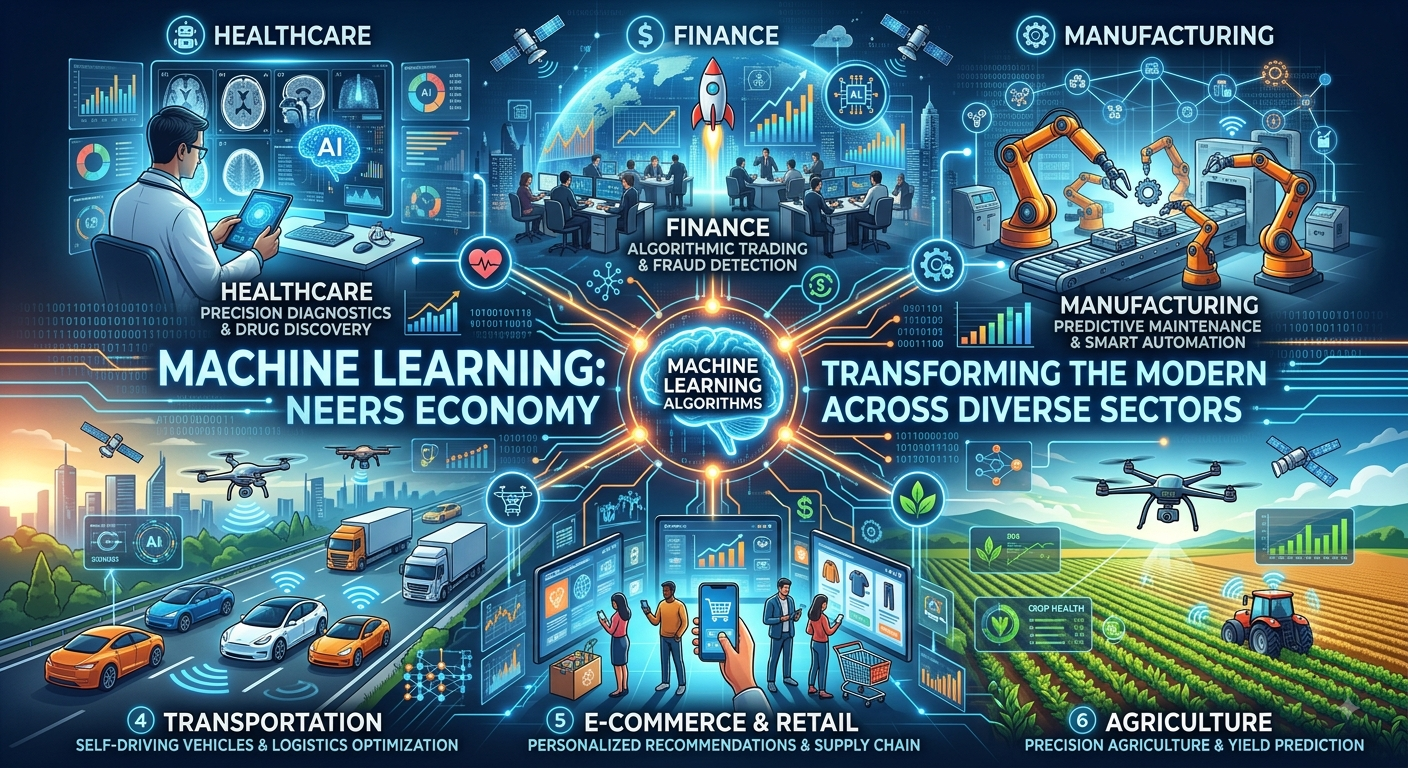
The transformation is occurring across finance, manufacturing, agriculture, healthcare, transportation, logistics, telecommunications, energy, mining, retail, education, government, construction and professional services. However, the economic consequences are neither automatically positive nor evenly distributed. Productivity gains depend upon data quality, computing infrastructure, skills, management capability, cybersecurity, regulation and the ability of organisations to redesign workflows around ML.
Recent international research supports this broader interpretation. The OECD estimates that AI could generate meaningful additional productivity growth, although the magnitude differs substantially according to sectoral composition and adoption. (OECD) The World Bank similarly identifies connectivity, compute, context and competency as fundamental foundations for developing economies seeking to participate in the AI economy. (World Bank)
This thesis therefore examines ML not merely as a software technology, but as an emerging economic infrastructure layer capable of transforming production, markets, labour, investment, government and global competitiveness.
1. Introduction
Every major technological revolution has changed the relationship between humans, machines, information and economic production.
The agricultural revolution transformed societies from predominantly hunting and gathering into organised food-producing economies. The Industrial Revolution introduced mechanised production. Electrification reorganised factories and cities. Telecommunications accelerated the movement of information. Computing automated calculation and information processing. The internet connected billions of people and businesses.
Machine Learning represents another stage in this long technological evolution.
The distinctive characteristic of ML is that computers are no longer limited to executing explicitly programmed instructions. Instead, they can learn statistical relationships from data and use those relationships to perform predictions, classifications, recommendations, anomaly detection, optimisation and increasingly sophisticated forms of decision support.
The economic implication is profound:
Machine Learning transforms data from a passive record of economic activity into an active input into economic decision-making.
A company can use ML to forecast demand before producing goods. A bank can identify unusual transaction patterns. A farm can predict crop requirements. A factory can identify equipment deterioration before failure. A telecommunications operator can forecast network congestion. A logistics company can optimise delivery routes. A government can identify infrastructure priorities from large datasets.
The technology therefore operates across the entire economic cycle:
Data → Learning → Prediction → Decision → Action → Measurement → New Data → Improved Learning
This creates a feedback loop that can continuously improve economic processes.
2. Research Problem
The central research problem is that conventional economic systems were designed around human decision-making and relatively limited information-processing capacity.
Modern organisations, however, generate enormous quantities of data through:
- sensors;
- smartphones;
- financial transactions;
- satellites;
- industrial machines;
- vehicles;
- medical equipment;
- telecommunications networks;
- online transactions;
- enterprise software;
- public infrastructure;
- scientific instruments; and
- digital platforms.
Human beings cannot manually analyse all of this information at the speed required by modern economies.
ML addresses this information-processing constraint.
The fundamental research question therefore becomes:
How is Machine Learning transforming the structure, productivity, competitiveness and organisation of the modern economy across different sectors?
Secondary questions include:
- How does ML increase productivity?
- How does ML change labour demand?
- Which sectors are most susceptible to ML transformation?
- How does ML affect small and large businesses differently?
- What infrastructure is required for successful ML adoption?
- How does ML influence investment and competitiveness?
- What are the risks of excessive dependence on algorithms?
- How can developing economies avoid being excluded from the ML economy?
- What skills will workers require?
- What policy architecture is necessary for responsible adoption?
3. Understanding Machine Learning
Machine Learning is a computational methodology in which algorithms learn patterns or relationships from data and use those learned patterns to perform tasks.
A simplified ML architecture can be represented as:
DATA → ALGORITHM → TRAINING → MODEL → VALIDATION → DEPLOYMENT → PREDICTION → FEEDBACK
For example, suppose a supermarket possesses several years of sales information.
The dataset may contain:
- product;
- price;
- location;
- season;
- weather;
- promotions;
- customer behaviour;
- inventory;
- sales volume.
An ML model can discover relationships among these variables and produce demand forecasts.
Instead of asking:
“What happened?”
the organisation can increasingly ask:
“What is likely to happen?”
And eventually:
“What should we do?”
This progression is economically significant.
4. Machine Learning Compared With Traditional Software
Traditional software generally follows:
Human rules → computer execution → output
Machine Learning increasingly follows:
Data → learning algorithm → statistical model → prediction → decision
Traditional programming requires developers to specify many rules explicitly.
ML is particularly useful when the rules are difficult to express manually but patterns exist within large datasets.
For example, writing explicit rules for recognising thousands of different objects in photographs would be extremely difficult.
An ML system can instead learn statistical representations from many examples.
This makes ML particularly powerful for:
- pattern recognition;
- forecasting;
- classification;
- anomaly detection;
- recommendation;
- optimisation;
- natural-language processing;
- computer vision;
- predictive maintenance;
- fraud detection.
5. The Economic Architecture of Machine Learning
The economic value of ML does not originate from algorithms alone.
It emerges from an ecosystem consisting of several layers.
Layer 1: Data
Data is the raw material.
Sources include:
- transactions;
- sensors;
- satellite imagery;
- customer interactions;
- production systems;
- medical records;
- financial information;
- logistics systems;
- scientific observations.
Layer 2: Connectivity
Networks transport data.
Examples include:
- fibre;
- 4G;
- 5G;
- Wi-Fi;
- satellite communications;
- industrial networks.
Layer 3: Computing
ML requires computational infrastructure.
This includes:
- CPUs;
- GPUs;
- AI accelerators;
- cloud infrastructure;
- data centres;
- edge computing.
Layer 4: Algorithms
Algorithms transform data into mathematical representations.
Layer 5: Models
Trained models provide predictions or classifications.
Layer 6: Applications
Models become economically useful when incorporated into real applications.
Layer 7: Human Decision-Making
Humans interpret outputs and determine appropriate action.
Layer 8: Governance
Governance establishes:
- accountability;
- privacy;
- security;
- transparency;
- fairness;
- regulatory compliance.
Therefore:
AI/ML Economy = Data + Connectivity + Compute + Algorithms + Skills + Applications + Governance
The World Bank’s research similarly emphasises the importance of connectivity, compute, context and competency as foundational requirements for developing countries. (World Bank)
6. Machine Learning and Productivity
Productivity measures how effectively an economy converts inputs into outputs.
ML can increase productivity through several mechanisms.
6.1 Automation
Machines perform repetitive cognitive tasks.
6.2 Augmentation
ML assists workers rather than replacing them.
6.3 Prediction
Better forecasts reduce uncertainty.
6.4 Optimisation
Algorithms identify more efficient resource allocations.
6.5 Quality improvement
ML can detect defects and anomalies.
6.6 Maintenance
Predictive systems identify potential failures before they become expensive breakdowns.
6.7 Personalisation
Businesses can tailor products and services to individual customers.
6.8 Faster decision-making
Large datasets can be analysed rapidly.
The OECD’s research estimates that AI could contribute approximately 0.4–1.3 percentage points to annual labour-productivity growth in highly exposed G7 economies under its scenarios, although gains vary according to adoption and economic structure. (OECD)
This illustrates an important principle:
Technology does not automatically produce productivity.
Productivity requires technology plus organisational transformation.
7. Machine Learning in Manufacturing
Manufacturing is one of the most important environments for ML because factories generate extensive operational data.
ML applications include:
- predictive maintenance;
- quality inspection;
- demand forecasting;
- production optimisation;
- inventory management;
- robotics;
- energy optimisation;
- supply-chain forecasting;
- defect detection.
Predictive Maintenance
Traditional maintenance often follows:
Failure → repair
Preventive maintenance follows:
Schedule → inspect → replace
ML enables:
Monitor → predict failure → intervene
Sensors can monitor:
- temperature;
- vibration;
- pressure;
- electrical current;
- acoustic signals;
- operating speed.
ML models can detect patterns associated with equipment deterioration.
The economic benefit is potentially enormous because unexpected downtime can interrupt entire production systems.
8. Machine Learning in Agriculture
Agriculture is transitioning from experience-driven production toward increasingly data-driven production.
ML can analyse:
- satellite imagery;
- weather;
- soil conditions;
- crop images;
- irrigation information;
- fertiliser usage;
- pest patterns;
- historical yields;
- market prices.
Applications include:
Precision Agriculture
Instead of treating an entire field identically, farmers can increasingly make decisions according to local conditions.
Yield Prediction
ML models can estimate expected harvests.
Disease Detection
Computer vision can identify abnormal crop characteristics.
Irrigation Optimisation
Models can estimate water requirements.
Livestock Management
ML can assist with monitoring animal behaviour, health indicators and production patterns.
This is especially important for developing economies because improved productivity can increase food security while reducing unnecessary resource consumption.
9. Machine Learning in Mining
Mining represents an important application area because mines contain complex industrial environments and large quantities of operational data.
ML can support:
- geological analysis;
- exploration;
- ore-body modelling;
- equipment maintenance;
- fleet optimisation;
- safety monitoring;
- mineral processing;
- energy management;
- logistics;
- environmental monitoring.
A modern mining ecosystem can therefore evolve toward:
Exploration → Geological Data → ML Analysis → Extraction Planning → Autonomous/Assisted Operations → Processing Optimisation → Logistics → Market Forecasting
ML does not eliminate the geological and engineering foundations of mining. Instead, it adds an intelligence layer to them.
10. Machine Learning in Finance
Finance is particularly suitable for ML because financial institutions generate vast quantities of structured data.
Applications include:
- fraud detection;
- credit assessment;
- market analysis;
- customer segmentation;
- risk modelling;
- transaction monitoring;
- portfolio analytics;
- insurance pricing;
- financial forecasting.
A fraud-detection system, for example, can analyse transaction characteristics and identify patterns that differ significantly from normal behaviour.
ML therefore transforms financial institutions from systems that primarily record transactions into systems that continuously analyse them.
However, financial ML also creates risks involving:
- model errors;
- biased training data;
- cybersecurity;
- privacy;
- systemic risk;
- lack of explainability.
11. Machine Learning in Healthcare
Healthcare is increasingly data-intensive.
Potential ML applications include:
- medical image analysis;
- disease-risk prediction;
- drug discovery;
- patient monitoring;
- hospital resource planning;
- personalised treatment support;
- medical research;
- administrative automation.
A healthcare ML system might combine:
Patient Data + Medical Knowledge + Imaging + Laboratory Results + Historical Patterns → Risk Prediction
ML should generally be viewed as decision support rather than a substitute for appropriate professional judgment.
The economic benefit can arise from:
- earlier detection;
- improved resource allocation;
- reduced administrative workload;
- accelerated research;
- better hospital logistics.
12. Machine Learning in Telecommunications
Telecommunications networks generate enormous streams of operational data.
ML can analyse:
- network traffic;
- signal quality;
- equipment performance;
- customer behaviour;
- congestion;
- outages.
Applications include:
Network Optimisation
Predicting congestion allows operators to allocate resources proactively.
Predictive Maintenance
Network equipment can be monitored for abnormal behaviour.
Customer Service
ML can classify customer requests and identify recurring problems.
Fraud Detection
Unusual usage patterns can trigger investigation.
The telecommunications network consequently becomes not merely a communication infrastructure but an intelligent economic platform.
13. Machine Learning in Energy
Modern energy systems are becoming increasingly complex because of:
- renewable energy;
- distributed generation;
- batteries;
- electric vehicles;
- variable demand;
- smart meters.
ML can forecast:
- electricity demand;
- renewable generation;
- equipment failure;
- energy consumption;
- grid congestion.
A simplified intelligent energy architecture is:
Generation → Sensors → Data → ML Forecast → Grid Optimisation → Consumer
ML can therefore help coordinate increasingly decentralised energy systems.
14. Machine Learning in Transportation
Transportation is another major ML application.
ML can improve:
- traffic forecasting;
- route optimisation;
- fleet management;
- predictive maintenance;
- logistics;
- demand forecasting;
- public transport planning.
For logistics companies, the objective is not simply to move goods.
It is to optimise:
time + distance + fuel/energy + vehicle utilisation + inventory + customer demand
ML can evaluate these variables simultaneously.
15. Machine Learning and Supply Chains
Global supply chains are complex networks rather than simple linear sequences.
A modern supply chain can be represented as:
Raw Materials → Suppliers → Manufacturing → Warehousing → Transport → Distribution → Retail → Consumer
Each stage produces data.
ML can analyse this data to identify:
- demand changes;
- supplier risks;
- inventory problems;
- transportation delays;
- price changes;
- capacity constraints.
This creates the possibility of moving from reactive supply chains toward predictive supply chains.
The difference is fundamental.
Reactive:
“The shipment is late. What happened?”
Predictive:
“The data indicates a high probability that the shipment will be delayed. What should we do now?”
16. Machine Learning in Retail
Retail businesses can use ML for:
- demand forecasting;
- recommendation systems;
- inventory optimisation;
- pricing analysis;
- customer segmentation;
- fraud detection;
- supply-chain management.
The recommendation engine is one of the most familiar examples.
The system learns from:
Customer → Behaviour → Products → Interactions → Preferences
and produces:
Predicted Preference → Recommendation
This can increase the efficiency of matching consumers with products.
17. Machine Learning in Education
Education can also become increasingly data-driven.
ML applications include:
- adaptive learning;
- learning analytics;
- early identification of students requiring additional support;
- automated administrative processes;
- personalised educational content;
- curriculum analysis.
The important principle is that ML should support teachers and learners rather than reduce education to algorithmic scoring.
Human development involves creativity, social interaction, ethics, curiosity and judgment—dimensions that cannot be reduced entirely to statistical prediction.
18. Machine Learning in Government
Government institutions manage enormous datasets.
ML can assist with:
- tax administration;
- infrastructure planning;
- public transport;
- healthcare planning;
- education planning;
- agricultural support;
- environmental monitoring;
- fraud detection;
- public-service optimisation.
A data-driven government can move from:
Historical reporting
toward:
Real-time monitoring → prediction → intervention → evaluation
This can potentially improve public-sector efficiency.
However, government ML systems require especially strong safeguards because incorrect predictions can affect people’s access to public services.
19. Machine Learning and Small Businesses
ML is not exclusively a technology for multinational corporations.
Cloud platforms and software-as-a-service products increasingly allow smaller businesses to access advanced analytical capabilities without owning large computing infrastructures.
A small company can potentially use ML for:
- customer analysis;
- inventory;
- accounting;
- marketing;
- demand forecasting;
- customer service;
- cybersecurity;
- logistics.
This creates an important economic possibility:
ML can reduce some information disadvantages traditionally experienced by smaller enterprises.
However, SMEs still face barriers involving:
- cost;
- skills;
- data quality;
- integration;
- cybersecurity;
- organisational capacity.
20. Machine Learning and Employment
One of the most important debates concerns employment.
The simplistic question is:
“Will ML take people’s jobs?”
The more economically useful question is:
Which tasks will ML automate, which tasks will it augment, and which new tasks will emerge?
A job consists of multiple tasks.
For example, an accountant may perform:
- data collection;
- reconciliation;
- analysis;
- communication;
- interpretation;
- strategic advice.
ML might automate some tasks while increasing the value of others.
This means technological transformation frequently occurs at the task level, not simply at the occupation level.
Recent IMF research emphasises that new skills and tasks are emerging alongside automation, while labour-market outcomes depend heavily on whether workers and firms can adapt. (IMF)
21. The Emerging Human–Machine Economy
The future economic system is unlikely to be simply:
Humans versus machines
A more realistic architecture is:
Human Intelligence + Machine Intelligence + Organisational Intelligence
Humans contribute:
- judgment;
- ethics;
- creativity;
- leadership;
- social understanding;
- contextual knowledge;
- accountability.
ML contributes:
- scale;
- speed;
- statistical analysis;
- pattern detection;
- prediction;
- continuous monitoring.
The strongest organisations will therefore learn how to combine the two.
22. Skills Transformation
The ML economy creates demand for several categories of skills.
Technical Skills
- mathematics;
- statistics;
- programming;
- data engineering;
- ML engineering;
- cloud computing;
- cybersecurity.
Business Skills
- strategy;
- process design;
- financial analysis;
- operations management;
- project management.
Human Skills
- communication;
- creativity;
- critical thinking;
- leadership;
- collaboration;
- ethical reasoning.
The IMF reports that new-skill requirements are appearing in job vacancies across advanced and emerging economies, strengthening the case for education and reskilling. (IMF)
Therefore, the most valuable worker may increasingly be neither a purely technical specialist nor a purely traditional professional, but a person capable of working effectively across human, business and technological systems.
23. Machine Learning and Investment
ML changes investment decisions in two ways.
First, companies invest directly in ML infrastructure:
- software;
- computing;
- data centres;
- AI accelerators;
- cloud services;
- data platforms;
- talent.
Second, ML changes how investors analyse businesses.
Investors can increasingly examine:
- operational data;
- market signals;
- customer behaviour;
- financial indicators;
- supply-chain conditions;
- technological capabilities.
This creates a new competitive distinction:
Capital + Technology + Data + Talent
rather than capital alone.
24. The New Importance of Data
In the industrial economy, physical assets were central.
In the digital economy, intangible assets have become increasingly important.
Examples include:
- software;
- algorithms;
- databases;
- intellectual property;
- digital platforms;
- organisational knowledge.
ML makes data particularly valuable because data can be transformed into predictive models.
The economic chain becomes:
Data → Information → Knowledge → Prediction → Decision → Economic Value
However, data is not automatically valuable.
Poor-quality data can generate poor models.
Therefore:
Data quality is an economic productivity variable.
25. The Machine Learning Infrastructure Stack
A national ML economy requires a layered infrastructure.
Physical Layer
- electricity;
- fibre;
- telecommunications;
- data centres;
- cloud infrastructure.
Computing Layer
- CPUs;
- GPUs;
- AI accelerators;
- storage.
Data Layer
- databases;
- data platforms;
- standards;
- interoperability.
Intelligence Layer
- ML models;
- AI systems;
- analytics.
Application Layer
- finance;
- agriculture;
- healthcare;
- manufacturing;
- government;
- logistics.
Human Layer
- engineers;
- scientists;
- managers;
- entrepreneurs;
- technicians;
- teachers.
Governance Layer
- laws;
- standards;
- cybersecurity;
- privacy;
- accountability.
A weakness in one layer can limit the entire ecosystem.
26. The Global ML Divide
The benefits of ML are not distributed equally.
High-income economies currently possess substantial advantages in:
- computing infrastructure;
- research institutions;
- venture capital;
- specialised talent;
- advanced digital infrastructure;
- technology companies.
The World Bank reports that high-income countries dominate AI innovation, computing infrastructure and startup funding, while adoption remains more limited in low-income economies. (World Bank)
This creates a potential Machine Learning Productivity Divide.
Countries with:
Data + Compute + Skills + Capital + Infrastructure
can accelerate.
Countries lacking these foundations may remain consumers of technology rather than producers.
27. The African Opportunity
Africa should not approach ML simply as a consumer of imported technology.
The continent has opportunities in:
- agriculture;
- financial technology;
- healthcare;
- mining;
- telecommunications;
- logistics;
- energy;
- education;
- public administration.
Africa’s large and relatively young population also creates opportunities for digital entrepreneurship and new services.
However, the continent must address:
- electricity reliability;
- connectivity;
- computing access;
- education;
- research capacity;
- financing;
- data governance;
- digital skills.
The OECD warns that developing economies can benefit less from AI when they have inadequate digital infrastructure, skills, financing and regulatory capacity. (OECD)
28. South Africa and Machine Learning
For South Africa, ML should be considered within the country’s existing economic architecture.
High-value application areas include:
Mining
- exploration;
- fleet optimisation;
- predictive maintenance;
- mineral processing.
Agriculture
- precision farming;
- weather analysis;
- crop monitoring;
- livestock management.
Financial Services
- fraud detection;
- risk management;
- customer analytics.
Energy
- demand forecasting;
- renewable-energy optimisation;
- infrastructure maintenance.
Ports and Logistics
- cargo forecasting;
- equipment maintenance;
- congestion management;
- route optimisation.
Government
- infrastructure planning;
- public-service optimisation;
- revenue administration.
This means ML could become a cross-sector productivity technology rather than an isolated IT industry.
29. Machine Learning and Infrastructure Modernisation
ML becomes much more valuable when physical infrastructure becomes digitally observable.
Consider a water network.
Traditional infrastructure:
Pipes → Pumps → Manual Monitoring
Intelligent infrastructure:
Pipes → Sensors → Connectivity → Data Platform → ML → Leak Prediction → Maintenance
The same architecture applies to:
- electricity;
- roads;
- rail;
- ports;
- factories;
- telecommunications;
- water;
- buildings.
This suggests a broader concept:
Intelligent Infrastructure
Infrastructure increasingly becomes:
Physical Asset + Sensors + Connectivity + Data + ML + Human Management
30. Machine Learning and the Circular Economy
ML can also contribute to resource efficiency.
It can help organisations predict:
- material demand;
- equipment life;
- waste generation;
- recycling flows;
- energy consumption;
- transportation requirements.
Instead of:
Extract → Produce → Consume → Discard
the objective becomes:
Design → Produce → Use → Monitor → Recover → Reuse → Recycle
ML can provide the information required to coordinate this more efficiently.
31. Environmental Applications
ML can support environmental monitoring through:
- satellite analysis;
- climate modelling;
- biodiversity monitoring;
- pollution detection;
- water management;
- energy optimisation;
- agricultural monitoring.
The economic significance is that environmental information can increasingly become operational information.
For example:
Environmental Change → Data → Prediction → Economic Decision
This enables businesses and governments to incorporate environmental conditions more directly into planning.
32. Machine Learning and Innovation
ML accelerates innovation by reducing the cost of experimentation.
Researchers can use computational systems to:
- analyse scientific literature;
- identify patterns;
- simulate systems;
- discover relationships;
- optimise designs.
Businesses can use ML to test:
- products;
- prices;
- marketing strategies;
- production processes.
Innovation therefore becomes increasingly data-driven.
33. The Economics of Network Effects
ML systems can generate powerful network effects.
More users can produce more data.
More data can improve models.
Better models can attract more users.
This can produce:
Users → Data → Better Models → Better Products → More Users
Such feedback loops can create substantial competitive advantages.
However, they can also increase market concentration if a small number of organisations control critical data, computing resources or platforms.
34. Risks of Machine Learning
The economic transformation created by ML is accompanied by significant risks.
34.1 Algorithmic Bias
Models can reproduce biases contained within their training data.
34.2 Privacy
Large-scale data collection can create privacy risks.
34.3 Cybersecurity
ML systems can become targets for cyberattacks.
34.4 Model Errors
Predictions can be wrong.
34.5 Over-Automation
Organisations may place excessive trust in algorithms.
34.6 Market Concentration
Companies controlling data and computing infrastructure may gain disproportionate economic power.
34.7 Labour Displacement
Some tasks and occupations may experience declining demand.
34.8 Digital Inequality
Countries and communities without infrastructure may fall further behind.
The IMF’s literature review stresses that the economic effects of AI involve both opportunities and difficult policy questions around employment, productivity, inequality, competition, privacy and financial stability. (IMF)
35. Machine Learning Governance
Responsible ML requires governance across the entire lifecycle:
Data Collection → Training → Testing → Deployment → Monitoring → Updating → Retirement
Governance should address:
- data protection;
- transparency;
- accountability;
- cybersecurity;
- fairness;
- human oversight;
- model validation;
- auditability.
The objective should not be to stop technological development.
It should be to create an environment where innovation can occur while economic and social risks remain manageable.
36. The Economics of Adoption
The mere existence of ML technology does not guarantee adoption.
A company must consider:
Expected Benefit > Total Cost of Adoption
Costs may include:
- software;
- computing;
- integration;
- training;
- data preparation;
- cybersecurity;
- maintenance;
- regulatory compliance.
Benefits may include:
- productivity;
- revenue;
- reduced waste;
- improved quality;
- lower downtime;
- faster decisions.
This explains why large companies may adopt advanced ML faster than small organisations.
37. Why Some Countries Will Advance Faster
National ML competitiveness can be represented as:
ML Competitiveness = Infrastructure × Skills × Capital × Data × Innovation × Governance × Adoption
This is multiplicative rather than simply additive.
If one major component is extremely weak, the entire system may underperform.
For example:
Excellent universities + poor electricity infrastructure
can still produce limited industrial deployment.
Likewise:
Excellent infrastructure + weak skills
can result in dependence on foreign expertise.
Therefore, ML development requires an ecosystem approach.
38. The Emerging AI/ML Industrial Complex
The ML economy is producing new industries around:
- semiconductors;
- AI accelerators;
- cloud computing;
- data centres;
- networking;
- data engineering;
- cybersecurity;
- model development;
- robotics;
- AI applications.
This creates a technological value chain:
Semiconductor → Computing → Data Centre → Cloud → ML Model → Application → Business → Consumer
Countries that participate in multiple layers can capture more economic value than countries that only import finished applications.
39. Machine Learning as a General-Purpose Technology
ML increasingly resembles earlier general-purpose technologies such as electricity and computing because it can be integrated into many sectors.
Its economic importance therefore comes less from one application and more from its ability to improve thousands of processes.
The technology can become embedded into:
- factories;
- banks;
- farms;
- hospitals;
- schools;
- governments;
- transport networks;
- energy systems;
- communication networks.
This is why its long-term economic impact may be substantially larger than the value of the ML software market itself.
40. From Automation to Autonomous Economic Systems
The technological trajectory can be viewed in stages.
Stage 1 — Digitisation
Paper becomes digital.
Stage 2 — Automation
Software performs repetitive processes.
Stage 3 — Analytics
Organisations analyse historical data.
Stage 4 — Machine Learning
Systems predict future outcomes.
Stage 5 — AI Decision Support
Systems recommend actions.
Stage 6 — Agentic Systems
Systems can coordinate multiple tasks under defined objectives.
Stage 7 — Intelligent Economic Ecosystems
Multiple intelligent systems interact across organisations and infrastructure.
The long-term significance is therefore not simply “machines replacing workers.”
It is the emergence of increasingly intelligent economic systems.
41. Productivity Versus Employment
The central economic challenge is distribution.
Suppose ML increases output while reducing the labour required for certain tasks.
Society could experience:
Higher productivity + lower unit costs + new products
but potentially also:
Job displacement + skill disruption + income inequality
The outcome depends on how the economy redistributes productivity gains.
Possible mechanisms include:
- education;
- reskilling;
- entrepreneurship;
- new industries;
- worker mobility;
- social protection;
- investment;
- broader ownership of productive assets.
Therefore:
The technological question is not simply how much productivity ML creates, but who receives the benefits.
42. Education as National ML Infrastructure
Education should increasingly be regarded as infrastructure for the digital economy.
A modern ML-oriented curriculum should progressively introduce:
Foundation
- mathematics;
- logic;
- science;
- communication.
Digital Literacy
- computing;
- data;
- internet systems;
- cybersecurity.
Advanced Skills
- statistics;
- programming;
- data science;
- ML;
- AI.
Human Capabilities
- ethics;
- creativity;
- critical thinking;
- collaboration;
- entrepreneurship.
This creates a workforce capable of both using technology and creating new technology.
43. Research and Development
Countries that wish to become ML producers rather than consumers require strong research ecosystems.
These include:
- universities;
- laboratories;
- technology companies;
- startups;
- government research institutions;
- semiconductor industries;
- cloud infrastructure;
- venture capital.
Research should focus not only on frontier models but also on local economic problems.
For South Africa and Africa, this could include:
- mining;
- agriculture;
- water;
- energy;
- logistics;
- healthcare;
- education;
- local languages.
44. A Strategic Framework for ML Adoption
A practical national or corporate framework can follow ten stages.
Stage 1: Identify the economic problem
Do not begin with technology.
Begin with the problem.
Stage 2: Identify available data
Determine whether sufficient data exists.
Stage 3: Evaluate data quality
Poor data produces unreliable models.
Stage 4: Select an ML approach
Choose the simplest appropriate technology.
Stage 5: Build a prototype
Test the economic hypothesis.
Stage 6: Measure results
Evaluate:
- cost;
- accuracy;
- productivity;
- revenue;
- quality.
Stage 7: Integrate into workflows
Technology must become part of actual operations.
Stage 8: Train people
Employees need to understand the new system.
Stage 9: Establish governance
Create controls for privacy, security and accountability.
Stage 10: Continuously improve
ML systems must be monitored and updated.
45. Measuring Economic Value
ML projects should not be evaluated solely by model accuracy.
A model with 95% accuracy may have little economic value if it does not improve a business process.
A better framework measures:
Technical Performance + Operational Performance + Economic Performance
For example:
Technical
- accuracy;
- precision;
- recall;
- latency.
Operational
- processing time;
- downtime;
- error rate;
- productivity.
Economic
- revenue;
- cost reduction;
- return on investment;
- capital efficiency.
The final question should always be:
Did the ML system create measurable economic value?
46. Future Economic Architecture
The future economy is likely to become increasingly interconnected.
A simplified model is:
People
↓
Devices and Sensors
↓
Connectivity
↓
Data
↓
Cloud / Edge Computing
↓
Machine Learning Models
↓
AI Systems
↓
Business Applications
↓
Automated or Human Decisions
↓
Economic Activity
↓
New Data
↓
Continuous Learning
This creates a self-reinforcing digital economic cycle.
47. The 2030–2040 Perspective
Over the next decades, the most important transformation may not be the appearance of isolated ML applications.
It may be the embedding of ML into ordinary infrastructure.
Examples could include:
Intelligent Factory
Machines continuously monitor themselves.
Intelligent Farm
Fields continuously measure environmental conditions.
Intelligent Mine
Equipment and geological systems continuously generate operational intelligence.
Intelligent Grid
Energy supply and demand are continuously forecast.
Intelligent Port
Cargo, equipment and transport flows are continuously optimised.
Intelligent City
Infrastructure is continuously monitored.
The economy consequently becomes increasingly observable, predictive and adaptive.
48. Strategic Recommendations
Recommendation 1: Invest in Digital Infrastructure
Countries require reliable:
- electricity;
- broadband;
- fibre;
- cloud;
- data centres.
Recommendation 2: Build Human Capital
Education and lifelong learning should become central economic policies.
Recommendation 3: Develop Local ML Applications
Countries should solve domestic problems with ML rather than simply importing foreign solutions.
Recommendation 4: Strengthen Research
Universities and companies should collaborate.
Recommendation 5: Support SMEs
Smaller firms need access to affordable digital tools and expertise.
Recommendation 6: Develop Responsible Governance
Innovation must be accompanied by appropriate safeguards.
Recommendation 7: Encourage Competition
Economic policy should prevent excessive concentration of technological power.
Recommendation 8: Measure Productivity
ML investment should be connected to measurable economic outcomes.
Recommendation 9: Build Regional Digital Ecosystems
African countries can benefit from cooperation in:
- cloud;
- connectivity;
- research;
- skills;
- digital trade;
- data infrastructure.
Recommendation 10: Treat ML as Economic Infrastructure
ML should not be regarded simply as an IT project.
It should be integrated into national industrial, infrastructure, education and economic strategies.
49. Central Thesis
The central argument of this thesis is:
Machine Learning is transforming the modern economy because it enables economic organisations to convert data into prediction, prediction into decisions, and decisions into increasingly automated and optimised economic activity.
Its importance therefore extends beyond computer science.
ML is simultaneously:
- a productivity technology;
- an information technology;
- an automation technology;
- a decision technology;
- an innovation technology;
- an infrastructure technology;
- a competitiveness technology.
The countries and organisations that understand this broader architecture will be better positioned to capture its economic benefits.
50. Conclusion
Machine Learning represents one of the most important technological transformations of the modern economy.
Its significance does not arise simply because computers can perform sophisticated calculations. Its deeper significance lies in the transformation of economic intelligence.
Historically, organisations relied heavily on human observation, experience and relatively limited datasets. ML enables organisations to analyse enormous quantities of information, identify patterns, predict outcomes and increasingly optimise decisions at unprecedented speed and scale.
The transformation reaches virtually every major sector:
Agriculture → Precision production
Mining → Intelligent extraction
Manufacturing → Predictive production
Finance → Intelligent risk management
Healthcare → Data-driven decision support
Energy → Predictive grids
Telecommunications → Intelligent networks
Transportation → Optimised mobility
Retail → Personalised commerce
Government → Data-driven administration
Education → Adaptive learning
Infrastructure → Predictive maintenance
The OECD’s research indicates that productivity gains from AI can be substantial but uneven, while the IMF emphasises that labour-market outcomes will depend heavily on adoption, skills and economic adjustment. (OECD)
For developing economies, the challenge is even greater. The World Bank’s analysis demonstrates that access to connectivity, computing capacity, relevant data and skills is fundamental to participating in the AI economy. (World Bank)
The future therefore belongs neither exclusively to humans nor exclusively to machines.
It belongs to well-designed human–machine economic systems.
The winning economic architecture will combine:
Human intelligence
Machine Learning
Data
Computing
Infrastructure
Capital
Education
Entrepreneurship
Governance
=
A More Intelligent Productive Economy
The fundamental strategic lesson is consequently clear:
Machine Learning should not be understood merely as software that predicts outcomes. It should be understood as an emerging intelligence layer of the modern economy—one capable of connecting data, infrastructure, people, machines and institutions into continuously learning economic systems.
Its ultimate economic value will depend not on how advanced the algorithms become in isolation, but on how effectively societies transform those algorithms into higher productivity, better services, stronger businesses, new industries, better infrastructure, improved human capabilities and broadly shared prosperity.
Selected Research Base
- OECD, Macroeconomic Productivity Gains from Artificial Intelligence in G7 Economies (2025). (OECD)
- OECD, AI and the Global Productivity Divide (2025). (OECD)
- OECD, Miracle or Myth? Assessing the Macroeconomic Productivity Gains from Artificial Intelligence (2024). (OECD)
- IMF, The Economic Impacts and the Regulation of AI: A Review of the Academic Literature and Policy Actions (2024). (IMF)
- IMF, Bridging Skill Gaps for the Future: New Jobs Creation in the AI Age (2026). (IMF)
- IMF, Aggregate Gains from AI and Their Distribution: Global Evidence from Usage Data (2026). (IMF)
- World Bank, Digital Progress and Trends Report 2025: Strengthening AI Foundations. (World Bank)



Be First to Comment