
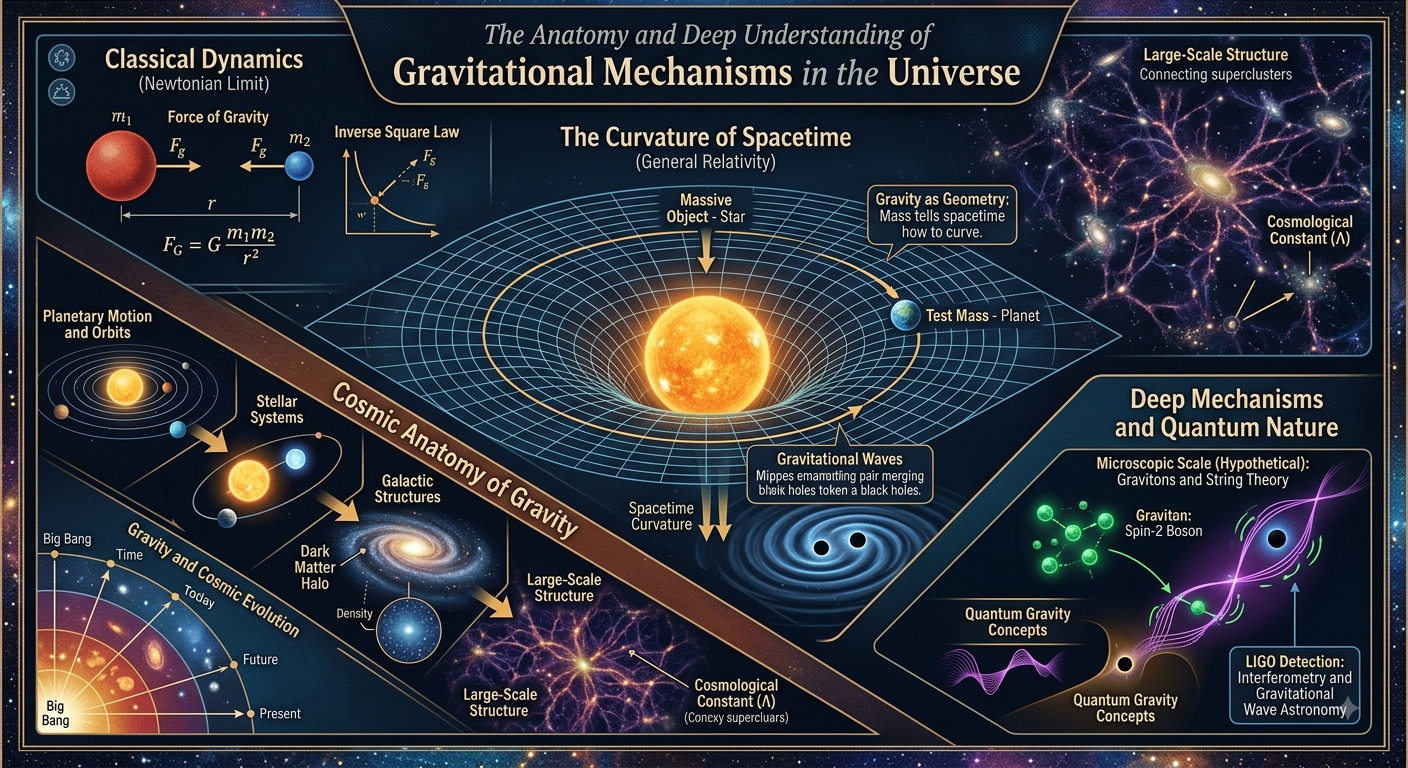
Gravity is the fundamental force that structures the large-scale geometry and evolution of the cosmos. Across the history of physics, human understanding of gravitational mechanisms has evolved from a simple attraction between masses to the geometric deformation of spacetime, and currently toward a unified quantum description of space itself.
| Theoretical Framework | Underlying Mechanism | Key Equation | Scope & Limits |
| Newtonian Gravity | Instantaneous force acting at a distance between point masses. | $F = G \frac{m_1 m_2}{r^2}$ | Accurate for weak gravitational fields and low speeds ($v \ll c$). Fails near dense masses or at relativistic speeds. |
| General Relativity | Curvature of 4D spacetime continuum caused by mass-energy distribution. | $G_{\mu\nu} + \Lambda g_{\mu\nu} = \frac{8\pi G}{c^4} T_{\mu\nu}$ | Explains strong fields, black holes, time dilation, and gravitational waves. Fails at subatomic scales (singularities). |
| Quantum Gravity (Theoretical) | Exchange of hypothetical spin-2 particles (gravitons) or discrete quantum geometric spin networks. | Planck length $l_P = \sqrt{\frac{\hbar G}{c^3}}$ | Aims to unite gravity with quantum field theory at extreme densities ($>10^{94} \text{ g/cm}^3$). |
1. Classical Mechanism: Newtonian Mechanics
In the classical view formulated by Sir Isaac Newton (1687), gravity operates as an attractive force exerted between all objects possessing mass. The force acts directly along the line connecting their centers of mass and decreases with the square of the distance between them:
$$F = G \frac{m_1 m_2}{r^2}$$
where $G \approx 6.674 \times 10^{-11} \text{ N}\cdot\text{m}^2/\text{kg}^2$ is the universal gravitational constant.
Key Conceptual Features:
- Gravitational Potential ($\Phi$): A scalar field defined such that the gravitational acceleration $\vec{g} = -\nabla \Phi$. For a spherical body, $\Phi(r) = -\frac{GM}{r}$.
- Superposition Principle: The net gravitational force on a body is the vector sum of individual forces exerted by all surrounding masses.
Theoretical Breakdowns:
- Action at a Distance: Newton’s model assumes gravitational influence propagates instantaneously across space, violating the principle of Special Relativity (where nothing travels faster than the speed of light $c$).
- Anomalous Perihelion Precession: It fails to account for minute orbital shifts, such as the extra 43 arcseconds per century in Mercury’s orbit.
2. Relativistic Mechanism: General Relativity
Einstein’s General Relativity (1915) fundamentally redefined gravity not as a “force” pulling through space, but as an intrinsic warping of four-dimensional spacetime caused by energy, momentum, and mass.
The Principle of Equivalence
The foundational postulate of General Relativity states that the local physical effects of a uniform gravitational field are completely indistinguishable from an accelerated frame of reference:
$$m_{\text{inertial}} \equiv m_{\text{gravitational}}$$
An observer inside a sealed elevator cannot tell whether they are stationary on Earth’s surface or accelerating through deep space at $9.8 \text{ m/s}^2$.
The Einstein Field Equations
The mathematical engine governing general relativity relates the curvature of space and time directly to the distribution of matter and energy:
$$G_{\mu\nu} + \Lambda g_{\mu\nu} = \frac{8\pi G}{c^4} T_{\mu\nu}$$
- $G_{\mu\nu}$ (Einstein Tensor): Represents the curvature of spacetime.
- $g_{\mu\nu}$ (Metric Tensor): Defines distances and geometry in 4D space.
- $T_{\mu\nu}$ (Stress-Energy Tensor): Quantifies mass, energy density, pressure, and momentum flux.
- $\Lambda$: The cosmological constant, representing the energy density of empty vacuum space.
In the words of theoretical physicist John Archibald Wheeler: “Spacetime tells matter how to move; matter tells spacetime how to curve.”
Manifestations of Spacetime Curvature
- Geodesics: Free-falling objects (and photons) follow the shortest path through curved 4D spacetime, known as a geodesic. Orbits are not objects being pulled in a circle, but objects moving in a straight line through bent geometry.
- Gravitational Time Dilation: Time passes slower closer to a strong gravitational source due to the stretching of spacetime intervals:
$$\Delta t’ = \frac{\Delta t}{\sqrt{1 – \frac{2GM}{r c^2}}}$$ - Gravitational Waves: Accelerating asymmetric masses (e.g., merging binary black holes) create propagating ripples in spacetime geometry itself, travelling at the speed of light.
3. Quantum Mechanics & Cosmic Unsolved Frontiers
While General Relativity excels at cosmological scales, it encounters severe mathematical infinities (singularities) when applied to subatomic scales inside black holes or at the Big Bang.
The Problem of Quantum Gravity
Quantum Field Theory models forces (electromagnetism, strong, and weak interactions) through the exchange of virtual gauge bosons. Merging gravity into this framework requires a quantum mediator:
- The Graviton: A hypothetical massless, spin-2 gauge boson that carries gravitational interaction at the quantum scale.
Prominent Quantum Gravity Candidates
- String Theory: Proposes that fundamental particles are not zero-dimensional points, but tiny vibrating one-dimensional strings. Gravity arises naturally as a specific vibrational state of a closed string (the graviton) oscillating in 10 or 11 dimensions.
- Loop Quantum Gravity (LQG): Rejects continuous spacetime entirely. It predicts that space is quantized into discrete units (“grains”) of volume and area on the order of the Planck scale ($l_P \approx 1.6 \times 10^{-35} \text{ m}$), connected through dynamic networks called spin networks.
Modern Cosmic Anomaly: Missing Gravitational Mass
Observational astronomy reveals two major gravitational puzzles driving modern physics:
- Dark Matter: Galaxies rotate much faster than their visible mass should allow under both Newton’s laws and General Relativity. An unseen mass component—accounting for ~85% of total matter in the universe—is required to provide the extra gravitational pull.
- Dark Energy: On universal scales, space is expanding at an accelerated rate. This expansion acts like a negative gravitational pressure across cosmological distances, accounted for by the cosmological constant $\Lambda$.


Be First to Comment