
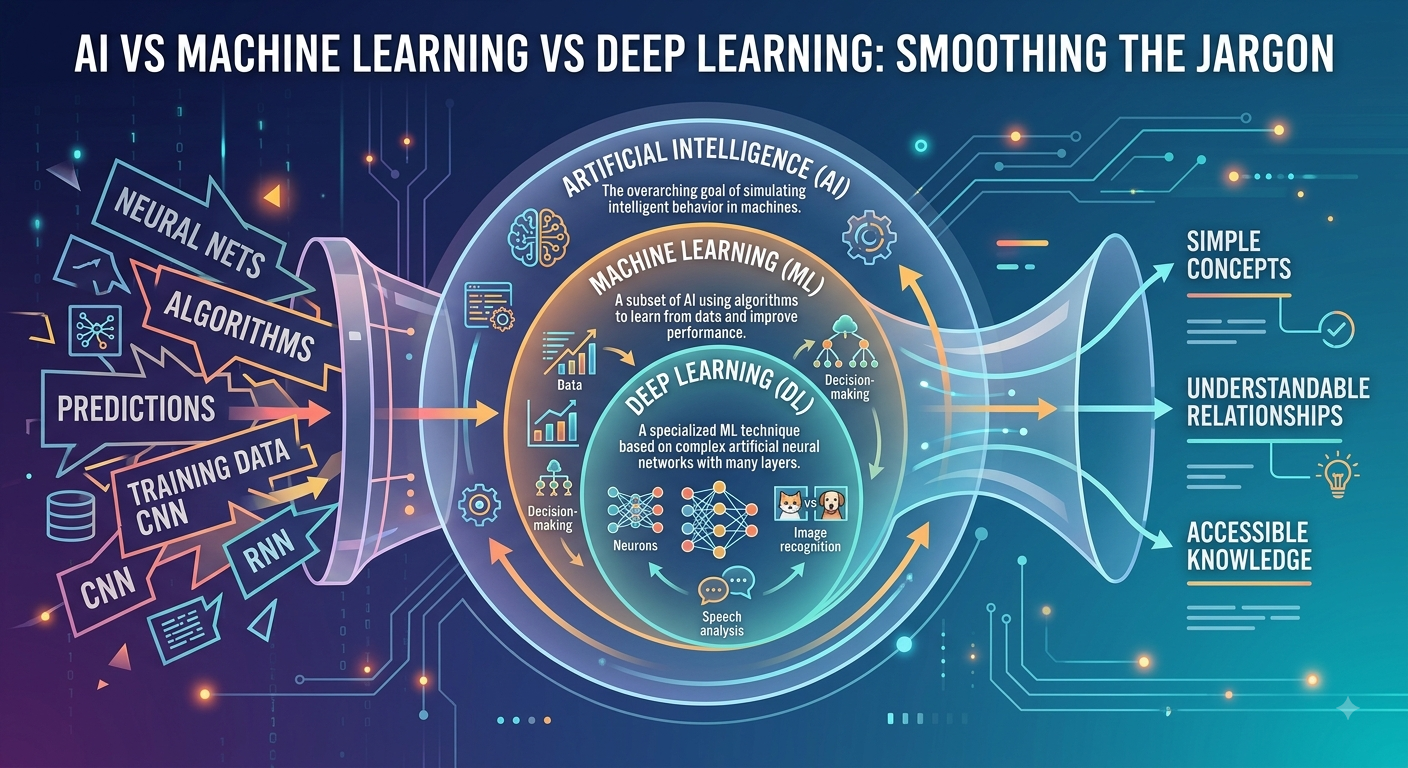
The easiest way to understand the relationship is:
Artificial Intelligence (AI) → Machine Learning (ML) → Deep Learning (DL)
Think of these as three nested layers of technology, rather than three completely separate technologies. AI is the broadest field; machine learning is one major approach within AI; and deep learning is a specialized approach within machine learning. (Google Cloud)
1. Artificial Intelligence — the broadest concept
Artificial intelligence is the overall discipline of creating computer systems capable of performing tasks associated with intelligent behavior.
Those tasks can include:
- reasoning
- recognizing patterns
- understanding language
- planning
- problem-solving
- making predictions
- perception
- decision-making
- interacting with humans
- controlling machines
AI does not necessarily have to learn from data.
For example, a traditional rule-based expert system could contain:
IF temperature > threshold
THEN activate cooling system.
That is an AI-style system, but it does not necessarily use machine learning.
Modern AI, however, increasingly relies on ML and DL because these approaches allow systems to learn patterns from large quantities of data. (Google Cloud)
2. Machine Learning — AI that learns from data
Machine learning is a subset of AI in which algorithms learn patterns from data and use those patterns to make predictions, classifications or decisions. (Google Cloud)
Traditional programming generally looks like:
Rules + Data → Output
Machine learning changes this relationship:
Data + Desired outcomes → Learned model
Then:
New data + Learned model → Prediction
Simple example
Suppose you want a computer to identify whether a transaction might be fraudulent.
Instead of manually writing thousands of rules, you could provide historical examples:
| Transaction information | Known result |
|---|---|
| Transaction A | Normal |
| Transaction B | Fraud |
| Transaction C | Normal |
| Transaction D | Fraud |
The ML algorithm searches for statistical patterns.
After training, it receives a new transaction and estimates:
Probability of fraud = X%
The important point is that the system has learned a mathematical representation from examples rather than having every individual decision explicitly programmed.
3. Deep Learning — a specialized form of machine learning
Deep learning is a subset of machine learning based primarily on multilayer artificial neural networks. (Google Cloud)
The basic hierarchy is therefore:
ARTIFICIAL INTELLIGENCE
│
├── Rule-based AI
├── Search and planning
├── Expert systems
├── Machine Learning
│   │
│   ├── Supervised Learning
│   ├── Unsupervised Learning
│   ├── Reinforcement Learning
│   └── Deep Learning
│       │
│       └── Deep Neural Networks
│
└── Other AI approaches
Deep learning became particularly powerful for complex, unstructured information such as:
- images
- speech
- video
- natural language
- audio
- sensor data
because deep neural networks can learn increasingly complex representations through multiple layers. (IBM)
4. What is a neural network?
A neural network is a mathematical model composed of interconnected computational units, often called artificial neurons or nodes.
A simplified architecture looks like:
INPUT
  ↓
Input Layer
  ↓
Hidden Layer 1
  ↓
Hidden Layer 2
  ↓
Hidden Layer 3
  ↓
Output Layer
  ↓
RESULT
Each connection has numerical parameters called weights.
During training, the system adjusts those parameters so that its predictions become more accurate.
IBM describes neural networks as having input, hidden and output layers, with weights and thresholds helping determine how information moves through the network. (IBM)
5. Why is it called “deep” learning?
The word deep refers primarily to the use of multiple computational layers.
Imagine an image-recognition system.
A simplified conceptual progression could be:
Raw image
   ↓
Edges
   ↓
Shapes
   ↓
Parts
   ↓
Objects
   ↓
Classification
For example, a vision model might progressively construct representations that allow it to distinguish increasingly complex structures.
This is one reason deep learning is so effective for perception problems.
However, the layers are not literally thinking like human brain regions. The “neural” terminology is inspired by biological neurons, but artificial neural networks are mathematical and computational systems.
6. AI vs ML vs DL — the central difference
| Technology | Main idea | Typical question |
|---|---|---|
| AI | Build systems that perform intelligent tasks | “How can a machine perform an intelligent task?” |
| ML | Learn patterns from data | “What can the system learn from examples?” |
| DL | Learn complex representations using deep neural networks | “Can a neural network learn complicated patterns directly from large datasets?” |
So:
AI is the objective/field.
ML is one major method for achieving AI.
DL is a powerful specialized method within ML.
7. Traditional programming vs Machine Learning
This distinction is extremely important.
Traditional software
A programmer might explicitly specify:
INPUT
  ↓
RULE 1
RULE 2
RULE 3
RULE 4
  ↓
OUTPUT
The programmer determines the rules.
Machine learning
The process becomes:
DATA
  +
EXAMPLES
  ↓
LEARNING ALGORITHM
  ↓
MODEL
  ↓
NEW DATA
  ↓
PREDICTION
The programmer still designs the system, chooses algorithms, prepares data and evaluates results—but the model learns many of the useful statistical relationships from the training data.
8. Machine learning has several major learning approaches
A. Supervised learning
The model receives examples containing known answers.
For example:
Image → "Cat"
Image → "Dog"
Image → "Cat"
Image → "Dog"
The model learns the relationship between input and label.
Common applications include:
- classification
- prediction
- forecasting
- regression
- fraud detection
- medical-image analysis
Google Cloud describes supervised learning as using labeled training data to map inputs to known outputs. (Google Cloud)
B. Unsupervised learning
Here, the system receives data without predefined labels and searches for structure.
Conceptually:
DATA
 ↓
ML ALGORITHM
 ↓
PATTERNS / GROUPS
For example, a company could analyze customers and discover groups with similar purchasing behavior without first telling the algorithm what the groups should be.
Techniques include clustering and dimensionality-reduction methods.
C. Reinforcement learning
Reinforcement learning works through an interaction between an agent and an environment.
        ACTION
Agent ───────────→ Environment
  ↑                    │
  │                    ↓
  └──── Reward ◄───────┘
The agent learns which actions tend to produce better outcomes.
It is particularly useful for sequential decision problems and control systems.
9. Why deep learning changed AI
Earlier machine-learning systems often depended heavily on feature engineering.
Suppose engineers wanted a computer to recognize an object.
They might manually determine useful characteristics such as:
- shape
- edges
- dimensions
- texture
- color
- geometric relationships
Deep learning can learn many useful representations automatically from raw or relatively minimally processed data.
This became particularly important as three technological resources expanded simultaneously:
Data + Computing Power + Neural-Network Techniques
Together they created a powerful modern AI ecosystem.
10. The importance of data
A useful conceptual equation is:
AI capability ≈ Data + Algorithms + Compute + Engineering + Evaluation
This isn’t a literal scientific equation, but it is a useful way of understanding the architecture.
Data
Provides examples from which models can learn.
Algorithms
Define how learning occurs.
Compute
Provides the processing capacity needed for training and inference.
Models
Contain the learned mathematical parameters.
Engineering
Connects models to useful software and infrastructure.
Evaluation
Determines whether the system actually performs its intended task reliably.
This is why AI is much larger than simply “having an algorithm.”
11. Training vs inference
Another important distinction is between training and inference.
Training
The model learns its parameters.
Large dataset
     ↓
Training algorithm
     ↓
Neural network
     ↓
Parameter adjustment
     ↓
Trained model
Training can require substantial computing resources, particularly for large deep-learning systems.
Inference
The trained model is used.
New input
   ↓
Trained model
   ↓
Prediction / generation
   ↓
Output
For example, when an AI application receives your question and generates an answer, that is an inference operation.
12. Where Generative AI fits
This is where modern terminology can become confusing.
Generative AI is not synonymous with AI, ML or DL.
It is better understood as an application category within modern AI that focuses on generating new content.
Conceptually:
Artificial Intelligence
        ↓
Machine Learning
        ↓
Deep Learning
        ↓
Large / Foundation Models
        ↓
Generative AI
        ↓
Text / Images / Audio / Video / Code
Modern generative systems commonly use deep neural networks and large-scale training.
Large language models, for example, use neural-network architectures to process and generate language.
13. Large Language Models
An LLM is a model designed primarily for working with language.
A simplified architecture is:
Human language
      ↓
Tokenization
      ↓
Numerical representations
      ↓
Neural network
      ↓
Learned representations
      ↓
Prediction
      ↓
Generated language
The important connection is:
AI → ML → DL → modern neural-network models → LLMs → generative applications
Not every AI system is an LLM, and not every ML system is deep learning.
14. Computer vision
Computer vision demonstrates the progression particularly well.
Traditional computer vision
Engineers may explicitly design algorithms for:
- edges
- corners
- shapes
- textures
- motion
Machine learning vision
A model learns relationships between engineered features and desired outputs.
Deep-learning vision
A deep neural network can learn hierarchical representations from images.
The result can support:
- object recognition
- image classification
- object detection
- image segmentation
- facial recognition
- industrial inspection
- agricultural monitoring
Deep learning has become especially important for image, speech and language processing. (Google Cloud)
15. A practical example: smart chicken farming
Consider a technologically advanced free-range chicken farm.
AI
The overall intelligent agricultural system could coordinate:
- environmental monitoring
- animal monitoring
- feed management
- disease-risk alerts
- production forecasting
- logistics
- automated equipment
Machine learning
ML could analyze historical farm data to predict:
- feed requirements
- production levels
- equipment failures
- environmental patterns
- abnormal behavior
Deep learning
DL could process:
- camera images
- video
- audio
- complex sensor streams
For example:
Farm Camera
     ↓
Video Data
     ↓
Deep Learning Model
     ↓
Animal Detection
     ↓
Behavior Analysis
     ↓
Alert / Recommendation
     ↓
Farm Management System
This demonstrates the difference beautifully:
AI = intelligent farm ecosystem
ML = learning from farm data
DL = sophisticated neural-network perception and pattern recognition
16. The role of hardware
AI software cannot operate independently of computing infrastructure.
A modern AI architecture may look like:
                    AI APPLICATION
                         ↓
                 AI / ML MODEL
                         ↓
                INFERENCE ENGINE
                         ↓
              CPU / GPU / NPU / TPU
                         ↓
                  MEMORY SYSTEM
                         ↓
                  STORAGE SYSTEM
                         ↓
                  NETWORK SYSTEM
                         ↓
                  DATA CENTER
                         ↓
                 ELECTRICITY + COOLING
This is why AI has become an infrastructure industry as well as a software industry.
Large-scale deep learning can require substantial computational resources, including accelerators such as GPUs and distributed computing systems. Research on deep-learning infrastructure has specifically examined scaling across computing nodes and the use of CPUs and GPUs. (arXiv)
17. Why AI sometimes gets confused with ML
People frequently say:
“AI learned this.”
Technically, several different things may be happening.
For example:
AI Application
      ↓
Machine Learning Model
      ↓
Deep Neural Network
      ↓
Training Data
      ↓
Prediction
The application is AI.
The learning technique may be ML.
The underlying model may be deep learning.
The terms describe different levels of the same technological stack.
18. The biggest misconception
One of the most important distinctions is:
AI does not automatically mean consciousness.
An AI system can produce impressive outputs without possessing human consciousness, emotions, biological experiences or human understanding in the ordinary sense.
Likewise:
Machine learning does not mean the computer learns exactly like a human.
And:
Deep learning does not mean a computer has a digital brain equivalent to the human brain.
These are mathematical and computational systems inspired partly by concepts from intelligence and neuroscience.
19. Advantages and limitations
AI
Advantages
- broad problem-solving framework
- supports automation
- can combine multiple technologies
- applicable across many industries
Limitations
- AI systems can be unreliable
- rule-based systems can become difficult to maintain
- complex AI requires significant engineering
- outputs depend heavily on system design and data
Machine Learning
Advantages
- learns patterns from data
- useful for prediction
- adaptable to changing datasets
- can automate analytical tasks
Limitations
- depends on data quality
- can reproduce biases in data
- may overfit
- predictions are not guaranteed to be correct
Deep Learning
Advantages
- excellent for complex unstructured data
- powerful image and speech capabilities
- can learn hierarchical representations
- highly scalable with sufficient data and computing resources
Limitations
- often computationally expensive
- can require large datasets
- models can be difficult to interpret
- training can require substantial infrastructure
Academic literature similarly distinguishes ML as data-driven analytical learning and DL as an ML approach based on artificial neural networks. (arXiv)
20. The simplest mental model
If you remember only one diagram, remember this:
                 ARTIFICIAL INTELLIGENCE
              ┌───────────────────────────┐
              │                           │
              │      MACHINE LEARNING     │
              │    ┌───────────────────┐  │
              │    │                   │  │
              │    │   DEEP LEARNING   │  │
              │    │  ┌─────────────┐  │  │
              │    │  │   NEURAL    │  │  │
              │    │  │   NETWORKS  │  │  │
              │    │  └─────────────┘  │  │
              │    └───────────────────┘  │
              │                           │
              └───────────────────────────┘
AI is the umbrella.
ML is a major branch of AI.
DL is a major branch of ML.
21. The evolution toward the modern AI ecosystem
The terminology becomes much easier when viewed historically:
Early Computing
      ↓
Rule-Based Programming
      ↓
Artificial Intelligence
      ↓
Statistical Methods
      ↓
Machine Learning
      ↓
Artificial Neural Networks
      ↓
Deep Learning
      ↓
Large-Scale Neural Networks
      ↓
Foundation Models
      ↓
Generative AI
      ↓
AI Agents
      ↓
Multi-Agent / Autonomous Systems
This is not a perfectly linear historical sequence—many approaches developed simultaneously—but it is a useful conceptual map.
22. The deeper economic significance
The distinction matters because the technologies require different resources.
A simple rule-based AI application may primarily require:
software + rules + computing
A conventional ML system may require:
data + algorithms + model training + computing
A large deep-learning system may require:
massive datasets + neural-network architectures + accelerators + high-bandwidth networking + storage + electricity + cooling + software infrastructure
Therefore, the rise of AI is simultaneously driving development in:
- semiconductor manufacturing
- GPUs and AI accelerators
- memory
- networking
- cloud computing
- data centers
- electricity generation
- cooling infrastructure
- telecommunications
- software engineering
- data engineering
- cybersecurity
- robotics
This is why AI should be understood not merely as a chatbot or software application, but as an entire technological ecosystem.
Final summary
The jargon can ultimately be reduced to three questions:
AI:
“How can we make machines perform tasks associated with intelligence?”
Machine Learning:
“How can machines learn useful patterns from data rather than receiving every rule explicitly?”
Deep Learning:
“How can multilayer neural networks learn increasingly complex representations from large and complicated datasets?”
So the relationship is:
AI = the broad field
ML = learning from data
DL = neural-network-based machine learning
And modern systems increasingly combine these with foundation models, generative AI, robotics, computer vision, language models, agents and large-scale computing infrastructure. (Google Cloud)
For your theme, this distinction is particularly useful because it provides the foundation for explaining the next technological layers: AI → ML → DL → neural networks → transformers → foundation models → generative AI → AI agents → robotics → autonomous ecosystems.


Be First to Comment