
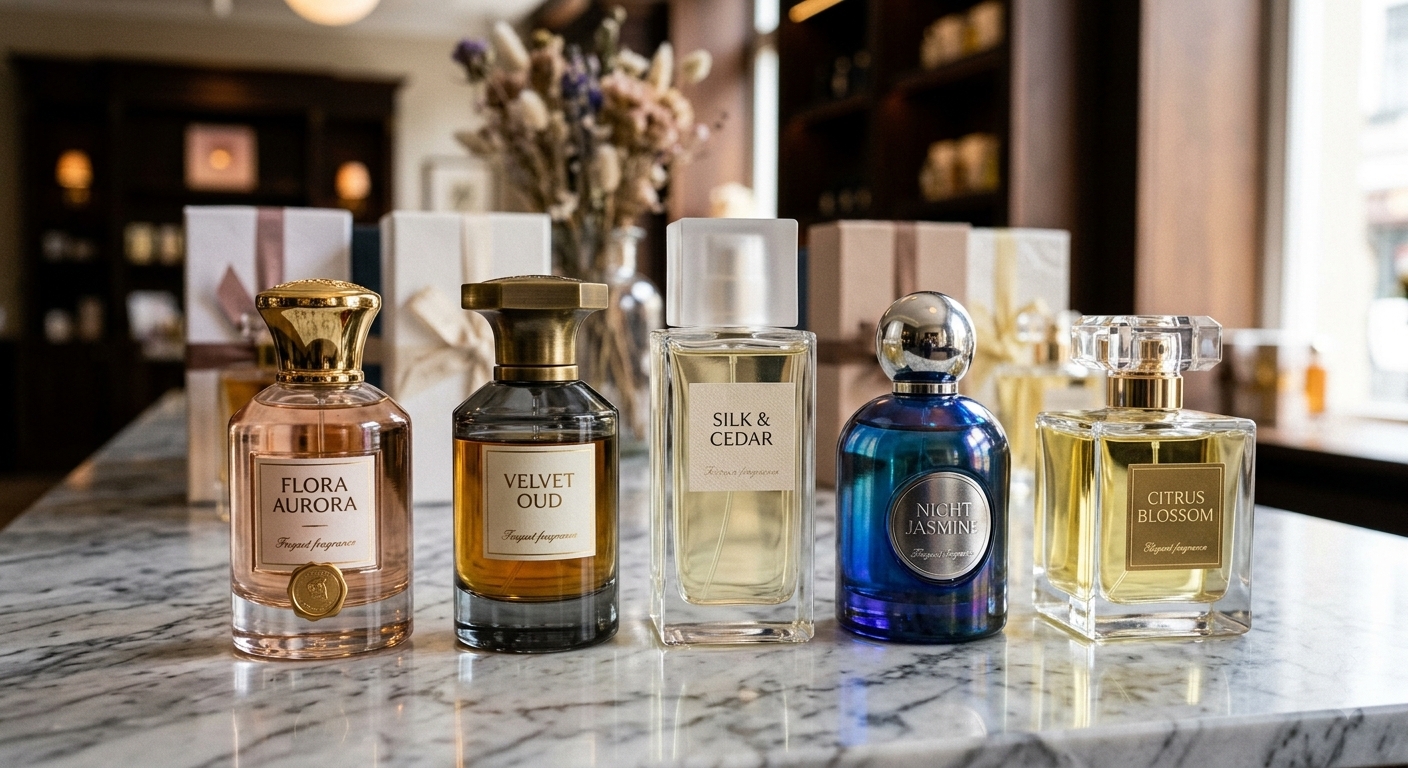
1. What is a perfume?
A perfume is a carefully engineered mixture of aromatic materials, solvents, and stabilising ingredients designed to create a controlled olfactory experience.
At its simplest:
Perfume = aromatic materials + solvent + formulation + maturation + packaging + human perception
Modern perfumery combines:
- Organic chemistry
- Natural raw materials
- Synthetic aroma molecules
- Botany
- Sensory science
- Design
- Art
- Marketing
- Luxury manufacturing
- Cultural history
Research into the historical development of perfumes shows that fragrance is not merely a cosmetic product; it functions as a cultural artifact whose compositions evolve over time.
2. What makes a perfume “top notch”?
Price alone does not determine quality.
A truly exceptional perfume generally combines several dimensions:
| Dimension | What it means |
|---|---|
| Composition | How beautifully the ingredients work together |
| Materials | Quality and character of aromatic ingredients |
| Balance | No individual component overwhelms unnecessarily |
| Evolution | The fragrance develops over time |
| Originality | Distinctive creative identity |
| Performance | Longevity and projection appropriate to its design |
| Craftsmanship | Precision of formulation and production |
| Brand heritage | Historical and creative reputation |
| Presentation | Bottle, packaging and overall experience |
| Emotional impact | Ability to create memories and moods |
This is why a very expensive perfume isn’t automatically better than a moderately priced one.
3. The architecture of perfume
One of the most important concepts is the fragrance pyramid.
A perfume normally develops through three broad stages.
A. Top notes
These are perceived first.
Typical examples include:
- Bergamot
- Lemon
- Mandarin
- Grapefruit
- Neroli
- Lavender
- Mint
- Green accords
They generally create the initial impression.
B. Heart notes
These form the central personality of the fragrance.
Common materials include:
- Rose
- Jasmine
- Iris
- Orange blossom
- Ylang-ylang
- Geranium
- Spices
- Fruity accords
C. Base notes
These provide depth and the longer-lasting foundation.
Examples include:
- Sandalwood
- Cedar
- Vetiver
- Patchouli
- Vanilla
- Tonka
- Amber accords
- Musk
- Oud
- Resins
The important point is that the pyramid is a useful conceptual model, not necessarily a literal timetable in which every ingredient appears and disappears separately.
4. Major fragrance families
Understanding fragrance families is more useful than memorising hundreds of individual perfumes.
4.1 Fresh
Characteristics:
- Clean
- Bright
- Airy
- Citrus-like
- Aquatic
- Green
Typical materials:
Lemon → bergamot → grapefruit → mint → marine accords
Good for:
- Daytime
- Warm environments
- Casual settings
- People who prefer lighter fragrances
4.2 Floral
The floral family is one of the largest areas of perfumery.
Important flowers include:
- Rose
- Jasmine
- Iris
- Violet
- Tuberose
- Gardenia
- Orange blossom
- Ylang-ylang
Floral perfumes can be:
- Fresh
- Powdery
- Creamy
- Sweet
- Green
- Spicy
- Dark
4.3 Woody
Woody perfumes emphasize the character of trees and woody materials.
Important examples:
- Sandalwood
- Cedar
- Vetiver
- Guaiac wood
- Cashmeran
- Patchouli
They can communicate:
dryness + warmth + earthiness + sophistication
4.4 Amber
Historically, what many fragrance descriptions call “oriental” is increasingly described as amber or ambery.
Common characteristics:
- Warm
- Sweet
- Resinous
- Spicy
- Rich
- Deep
Typical components include:
- Vanilla
- Benzoin
- Labdanum
- Amber accords
- Cinnamon
- Cardamom
- Tonka
4.5 Gourmand
Gourmand perfumes imitate or evoke edible sensations.
Examples:
- Vanilla
- Caramel
- Chocolate
- Coffee
- Praline
- Honey
- Almond
- Sugar
An interesting modern development is the use of unusual food-inspired materials. In 2026, for example, rice-inspired fragrances have attracted attention as a softer alternative to extremely sweet gourmand styles.
4.6 Chypre
Chypre is a historically important perfume structure.
Traditional chypre architecture often revolves around:
Citrus opening → floral heart → mossy/woody base
It can produce a sophisticated, dry and elegant character.
4.7 Fougère
Fougère means “fern” in French.
The classic structure often combines:
- Lavender
- Coumarin
- Oakmoss-like effects
- Herbs
- Woods
It became particularly influential in masculine perfumery.
5. Natural versus synthetic materials
This is one of the biggest misconceptions in perfume.
Natural does not automatically mean better.
And:
Synthetic does not automatically mean inferior.
Modern perfumery uses both.
Natural materials
Examples:
- Rose oil
- Jasmine absolute
- Sandalwood
- Vetiver
- Bergamot oil
- Patchouli
- Vanilla extracts
Advantages can include:
- Complexity
- Natural variation
- Richness
- Historical authenticity
But natural materials can also vary by:
- Climate
- Soil
- Harvest
- Extraction method
- Age
- Geographic origin
Synthetic molecules
Synthetic chemistry allows perfumers to create:
- New smells
- More stable materials
- Consistent quality
- Sustainable alternatives
- Molecules that don’t occur naturally
Some modern perfumes would simply be impossible without synthetic chemistry.
6. The concentration hierarchy
Perfumes are frequently divided according to concentration, although exact percentages vary by product and manufacturer.
A simplified framework is:
| Type | General character |
|---|---|
| Eau Fraîche | Very light |
| Eau de Cologne | Light and refreshing |
| Eau de Toilette | Light-to-moderate |
| Eau de Parfum | Richer and generally longer-lasting |
| Parfum | More concentrated and often richer |
| Extrait | Often among the most concentrated forms |
Some contemporary guides place Eau de Parfum around 15–20% fragrance concentrate and parfum/extrait around 20–40%, but these are approximate ranges rather than universal technical standards.
Importantly:
Higher concentration ≠ automatically better perfume.
An EDT can be more beautiful than an extrait.
7. Longevity, projection and sillage
These three concepts should not be confused.
Longevity
How long the fragrance remains perceptible.
Projection
How far the fragrance radiates from the wearer.
Sillage
The scented trail perceived after the wearer has moved through an environment.
A sophisticated perfume does not necessarily need enormous projection.
Sometimes the objective is:
close → intimate → elegant → gradually evolving
rather than:
extremely powerful → room-filling → overwhelming
8. Why perfume smells different on different people
Perfume interacts with the wearer’s environment and skin.
Important variables include:
- Skin characteristics
- Temperature
- Humidity
- Natural skin oils
- Clothing
- Climate
- Application method
- Individual perception
Consequently:
A perfume should ultimately be evaluated on the person who will wear it.
A fragrance that smells excellent on a paper strip may smell substantially different on skin.
9. Designer versus niche perfumery
The luxury fragrance world can broadly be divided into two overlapping sectors.
Designer
Usually associated with major fashion and beauty houses.
Examples include:
- Chanel
- Dior
- Hermès
- Gucci
- Prada
- Tom Ford
- Yves Saint Laurent
Niche
Niche houses are generally more focused on perfumery itself and often experiment more aggressively with unusual compositions.
Examples include:
- Amouage
- Maison Francis Kurkdjian
- Xerjoff
- Parfums de Marly
- Byredo
- Diptyque
- Le Labo
The distinction is not absolute. Some designer houses produce highly sophisticated niche-like collections, while some niche brands have become major global luxury businesses. Current luxury-fragrance coverage commonly separates premium designer collections from perfume-first niche houses.
10. Important top-tier perfume houses to study
Rather than saying one brand is universally “the best,” it is more useful to study houses representing different traditions.
Chanel
Important for:
- Historic French perfumery
- Elegant aldehydic structures
- Floral compositions
- Modern luxury
A central historical reference is Chanel No. 5.
Dior
Important for:
- French couture-perfumery integration
- Floral traditions
- Modern masculine and feminine compositions
Guerlain
One of the great historic perfume houses.
Particularly important for:
- Vanilla
- Amber
- Guerlinade
- French perfumery heritage
Hermès
Known for:
- Sophisticated citrus
- Leather
- Woods
- Mineral and earthy compositions
Tom Ford
Particularly important for modern luxury positioning and its Private Blend universe.
Maison Francis Kurkdjian
Important in contemporary luxury perfumery, particularly for highly recognizable modern compositions.
Amouage
Known for elaborate, powerful compositions and a strong connection with Middle Eastern and Western perfumery traditions.
Xerjoff
Known for luxurious presentation and elaborate compositions.
Parfums de Marly
Known for a modern interpretation of historical European aristocratic perfumery.
11. The importance of oud
Oud is one of the most prestigious materials associated with Middle Eastern perfumery.
It comes from agarwood-producing trees and can have an exceptionally complex smell.
Depending on origin and processing, oud can smell:
- Woody
- Smoky
- Resinous
- Earthy
- Animalic
- Sweet
- Medicinal
- Spicy
This makes oud particularly interesting scientifically: “oud” is not one single smell.
Its character varies enormously.
12. Rose
Rose is one of perfumery’s foundational materials.
Two historically important species used in perfumery include:
- Rosa damascena
- Rosa centifolia
Rose can create:
- Freshness
- Romance
- Powder
- Honey-like sweetness
- Green facets
- Spicy facets
Rose is particularly important in both European and Middle Eastern perfume traditions.
13. Vanilla
Vanilla is among the most influential materials in modern fragrance.
It contributes:
- Sweetness
- Warmth
- Creaminess
- Comfort
- Gourmand character
Vanilla can also soften sharper materials and connect different parts of a composition.
14. Musk
Musk is enormously important in modern perfumery.
Historically, natural musk came from animal sources, but modern perfumery predominantly uses synthetic musk materials for ethical, regulatory and practical reasons.
Musk can provide:
- Softness
- Cleanliness
- Skin-like warmth
- Diffusion
- Longevity
Musk is one of the materials that demonstrates why synthetic chemistry transformed modern perfumery.
15. The economics of luxury perfume
A $500 perfume is not necessarily five times better than a $100 perfume.
The final price can include:
**Raw materials
- formulation
- perfumer expertise
- laboratory development
- maturation/testing
- bottle
- packaging
- distribution
- marketing
- retail margin
- brand prestige**
Therefore:
Perfume price ≠ purely ingredient cost.
Luxury is partly a physical product and partly a brand experience.
16. Perfume as an engineering system
A useful way to understand high-end perfumery is to think of it as an engineered system.
Input
Raw materials.
↓
Formulation
Precise proportions.
↓
Chemical interaction
Materials influence one another.
↓
Evaporation
More volatile components become perceptible first.
↓
Diffusion
Aromatic molecules move through the surrounding air.
↓
Skin interaction
The composition develops differently depending on conditions.
↓
Human olfactory system
Odour molecules interact with receptors.
↓
Brain
The brain interprets the resulting sensory information.
↓
Emotion + memory
The fragrance can become associated with people, locations and experiences.
This makes perfume a fascinating intersection of chemistry, biology, neuroscience and culture.
17. Perfume and memory
Smell has an unusually strong connection with memory and emotion.
A fragrance can become associated with:
- Childhood
- Family
- Travel
- Places
- Seasons
- Celebrations
- Important personal events
Consequently, perfume is not merely an “odour.”
It can become a memory technology.
18. Modern perfume trends in 2026
Current fragrance culture shows several important directions.
1. Gourmand evolution
Vanilla and sweet fragrances remain influential, but increasingly sophisticated versions are appearing.
2. Rice and comfort accords
Rice-inspired fragrances are emerging as a notable 2026 trend, emphasizing subtle warmth and comfort rather than extreme sweetness.
3. Discovery sets
Consumers increasingly explore several fragrances before purchasing full bottles.
4. Gender-fluid fragrance
The traditional division between “men’s” and “women’s” perfume continues to become less important.
5. Niche expansion
Consumers increasingly explore independent and specialist perfume houses.
6. Personalisation
Fragrance selection is increasingly being treated as an individual sensory profile rather than simply a gender category.
19. The future of perfume
The next generation of perfumery may combine:
**Artificial intelligence
- chemistry
- biotechnology
- neuroscience
- sustainable agriculture
- personalised recommendation systems**
AI could eventually help analyse:
- Consumer preferences
- Fragrance notes
- Chemical structures
- Historical formulas
- Climate
- Skin characteristics
- Market trends
Researchers have already explored computational approaches to understanding perfume composition, note combinations and the evolution of perfumery culture.
20. A “top-notch perfume” evaluation framework
If you want to evaluate a fragrance scientifically rather than simply by brand reputation, use this framework:
| Category | Score |
|---|---|
| Opening | /10 |
| Heart development | /10 |
| Base | /10 |
| Balance | /10 |
| Originality | /10 |
| Complexity | /10 |
| Longevity | /10 |
| Projection | /10 |
| Sillage | /10 |
| Versatility | /10 |
| Materials | /10 |
| Bottle/presentation | /10 |
| Emotional character | /10 |
| Value | /10 |
This produces a much more meaningful assessment than simply asking:
“Is it expensive?”
21. The ideal perfume wardrobe
A sophisticated collection does not need dozens of bottles.
A useful conceptual collection could contain:
1. Fresh
For hot days and daytime.
2. Clean
For school/work/social environments.
3. Woody
For sophisticated everyday use.
4. Floral
For a different emotional character.
5. Amber/vanilla
For colder weather and evenings.
6. Oud
For a deeper, more distinctive style.
7. Signature fragrance
The fragrance that becomes strongly associated with the wearer.
This “fragrance wardrobe” approach is increasingly recommended instead of expecting one perfume to work perfectly in every situation.
22. The most important lesson
The hierarchy of perfume quality can be thought of as:
Raw materials
↓
Chemistry
↓
Formulation
↓
Balance
↓
Evolution
↓
Performance
↓
Human perception
↓
Memory
↓
Culture
↓
Luxury
Therefore, the greatest perfume is not necessarily the most expensive, the strongest, or the most popular.
A truly top-tier fragrance is one in which materials, chemistry, artistry, performance, identity and human experience are integrated into one coherent composition.






Be First to Comment