
Modernisation, Technological Transformation, and Its Effects on the Civilised World Economy
Abstract
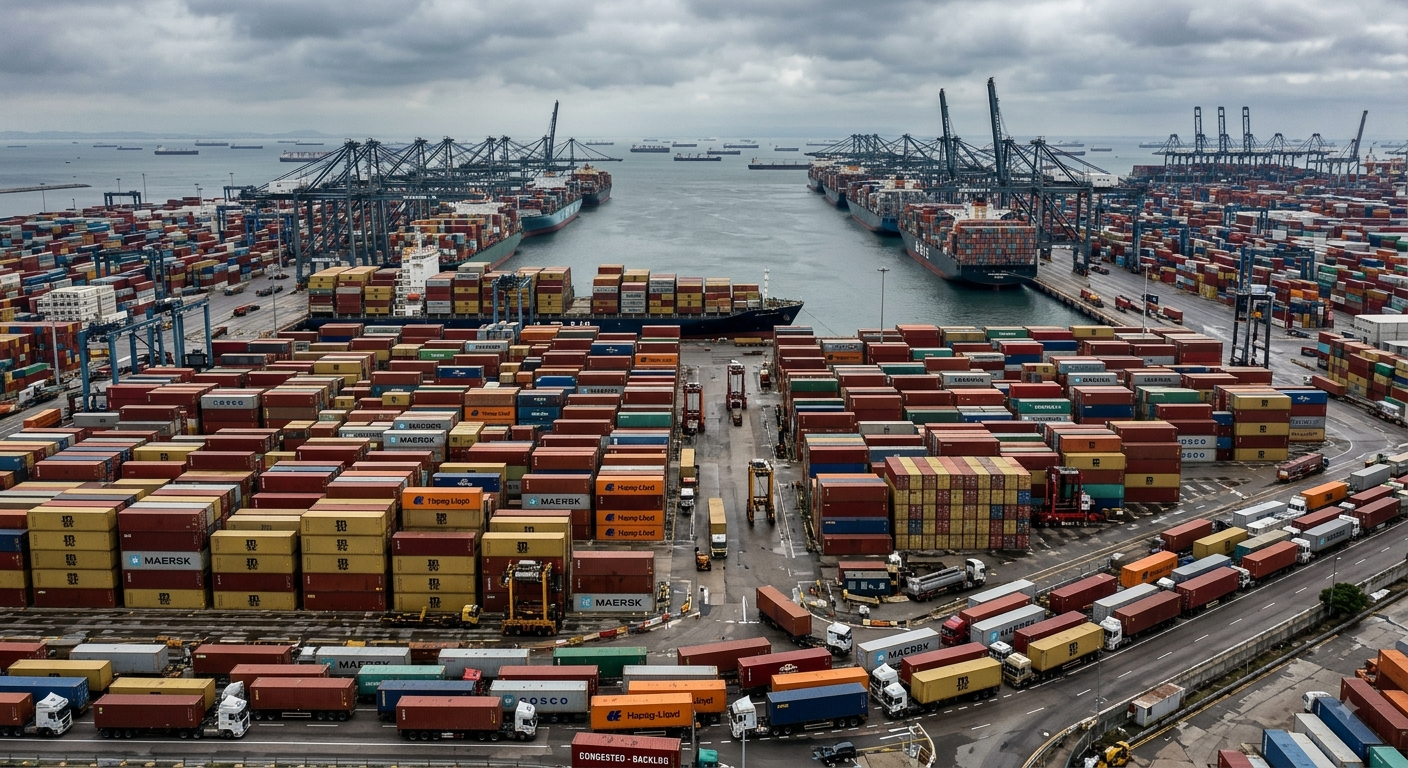
Ports and harbours are among the most strategically important pieces of infrastructure in the global economy. They connect oceans to cities, factories to consumers, mines to international markets, farms to food systems, and national economies to global supply chains. Yet a significant portion of the world’s port infrastructure is ageing, congested, technologically fragmented, environmentally stressed, or inadequately connected to modern road, rail, energy, digital and industrial systems.
The global port infrastructure backlog is therefore not simply a construction problem. It is a broader economic systems problem involving physical infrastructure, logistics, technology, energy, cybersecurity, environmental sustainability, workforce capability, financing, governance and geopolitical resilience.
Modernisation of ports is increasingly moving from traditional cargo-handling facilities toward intelligent logistics ecosystems incorporating automation, artificial intelligence, digital twins, sensors, robotics, autonomous equipment, smart grids, satellite connectivity, advanced telecommunications, predictive maintenance and low-carbon energy systems.
The central argument of this thesis is that the competitiveness of a modern nation increasingly depends not merely on possessing a port, but on possessing a highly integrated port ecosystem capable of moving physical goods, information, energy and capital efficiently.
1. Introduction
For thousands of years, harbours have been gateways between human civilizations.
Ancient ports enabled:
- trade;
- migration;
- fishing;
- military operations;
- cultural exchange;
- resource distribution;
- agricultural expansion;
- technological diffusion.
The modern port has become something much larger.
A contemporary commercial port is effectively a multilayer economic machine connecting:
Ocean → Port → Terminal → Rail/Road → Warehouse → Factory → Distribution Centre → Consumer
At the same time, information travels in the opposite and parallel directions:
Ship data → Port systems → Customs → Logistics companies → Banks → Manufacturers → Retailers
This makes ports part of the nervous system of the global economy.
2. What Is a Port Infrastructure Backlog?
A port infrastructure backlog is the accumulated gap between:
what a modern economy requires from its maritime infrastructure
and
what existing port infrastructure can actually provide.
The backlog can exist in several dimensions.
Physical backlog
Examples include:
- ageing quays;
- insufficient berths;
- shallow navigation channels;
- inadequate cranes;
- deteriorating breakwaters;
- inadequate storage yards;
- insufficient warehouses;
- poor road connections;
- inadequate railway capacity;
- outdated pipelines;
- inadequate electrical infrastructure.
Technological backlog
Examples include:
- manual cargo processes;
- outdated terminal operating systems;
- weak data integration;
- limited automation;
- insufficient sensors;
- poor telecommunications;
- fragmented databases;
- inadequate cybersecurity;
- limited artificial-intelligence deployment.
Capacity backlog
A port may physically exist but still be unable to handle modern trade volumes.
For example:
Port capacity < Cargo demand
creates:
congestion → delays → higher logistics costs → inventory shortages → higher prices.
Environmental backlog
Ports increasingly need:
- shore-side electricity;
- renewable energy;
- cleaner cargo-handling equipment;
- electrification;
- emissions monitoring;
- waste-management systems;
- climate-resilient infrastructure.
3. The Port as an Economic Ecosystem
A modern port should not be viewed as a collection of cranes and ships.
It is an ecosystem.
A sophisticated port ecosystem contains:
1. Maritime infrastructure
- navigation channels;
- breakwaters;
- berths;
- docks;
- pilotage systems;
- vessel traffic management.
2. Cargo infrastructure
- container terminals;
- bulk terminals;
- liquid terminals;
- Ro-Ro terminals;
- refrigerated facilities.
3. Transportation infrastructure
- highways;
- railways;
- inland waterways;
- pipelines;
- logistics hubs.
4. Digital infrastructure
- fibre-optic networks;
- 5G/private wireless networks;
- cloud platforms;
- data centres;
- Internet of Things sensors;
- artificial intelligence.
5. Energy infrastructure
- electricity substations;
- renewable generation;
- batteries;
- charging infrastructure;
- shore power.
6. Human infrastructure
Ports also require:
- engineers;
- logistics specialists;
- marine professionals;
- software developers;
- cybersecurity specialists;
- equipment technicians;
- data scientists;
- planners;
- financial specialists.
4. Why the Global Backlog Has Become More Serious
The global economy has changed dramatically.
The traditional port was designed around relatively straightforward cargo movement.
The modern economy demands:
- faster delivery;
- larger vessels;
- greater container volumes;
- real-time tracking;
- just-in-time manufacturing;
- e-commerce;
- global supply chains;
- temperature-controlled logistics;
- energy transition;
- automated operations.
Consequently, infrastructure designed decades ago can struggle to satisfy twenty-first-century requirements.
The problem can be represented as:
Population growth + industrialisation + urbanisation + global trade + larger vessels + e-commerce
↓
Higher logistics demand
↓
Port capacity pressure
↓
Infrastructure backlog
5. The Ship Size Problem
One major technological transformation has been the enormous increase in vessel capacity.
Modern container vessels can carry many thousands of containers.
This creates a fundamental infrastructure challenge.
A port designed for smaller ships may require:
- deeper channels;
- stronger quays;
- larger cranes;
- longer berths;
- larger storage yards;
- stronger roads;
- stronger railways;
- faster customs systems.
Thus:
Bigger ships require bigger ecosystems, not merely bigger docks.
6. Dredging and Navigation Infrastructure
One of the oldest port technologies remains strategically important:
dredging.
Ports must maintain appropriate channel depth because sediment accumulates naturally.
Without adequate dredging:
sedimentation → reduced draft → vessel restrictions → reduced capacity → higher costs.
Modern dredging therefore involves:
- hydrographic surveying;
- satellite positioning;
- digital bathymetry;
- automated dredging equipment;
- environmental monitoring;
- sediment management.
The future port will increasingly use continuous digital monitoring of its seabed.
7. Crane and Cargo-Handling Modernisation
Traditional cargo handling depended heavily on human-operated equipment.
Modern terminals increasingly use:
- automated stacking cranes;
- remote-controlled cranes;
- automated guided vehicles;
- autonomous yard equipment;
- computer vision;
- robotic systems;
- predictive maintenance.
The transformation is:
Manual terminal
↓
Mechanised terminal
↓
Automated terminal
↓
Intelligent terminal
↓
Autonomous logistics ecosystem
This transformation can improve:
- productivity;
- safety;
- consistency;
- equipment utilisation;
- energy efficiency;
- operational visibility.
8. Artificial Intelligence and Smart Ports
Artificial intelligence is becoming one of the most important technologies in port modernisation.
AI can analyse:
- vessel arrival patterns;
- cargo volumes;
- crane productivity;
- equipment failures;
- weather;
- traffic congestion;
- energy consumption;
- berth availability.
Instead of simply reacting to problems, a smart port can attempt to predict them.
For example:
Sensor data
→ AI analysis
→ predicted crane failure
→ maintenance scheduled
→ failure avoided
→ terminal disruption reduced.
This is the principle of predictive maintenance.
9. Digital Twins
One of the most powerful emerging technologies is the digital twin.
A digital twin creates a digital representation of a physical port.
It can represent:
- ships;
- cranes;
- containers;
- warehouses;
- roads;
- railway tracks;
- energy systems;
- weather;
- traffic.
Managers can use simulations to ask:
“What happens if cargo volume increases by 20%?”
or:
“What happens if a major crane fails?”
or:
“Where will congestion occur tomorrow?”
This converts port management from predominantly reactive management into increasingly simulation-driven management.
10. Internet of Things
The Internet of Things can connect enormous numbers of physical assets.
Sensors can monitor:
- cranes;
- containers;
- vehicles;
- refrigeration;
- fuel;
- electricity;
- structural conditions;
- water levels;
- weather.
The port therefore becomes a network of:
Sensors → Data → Analytics → Decisions → Automated Actions
This is the technological foundation of the smart port.
11. Telecommunications Infrastructure
Modern ports cannot function effectively without advanced communications.
Infrastructure increasingly requires:
- fibre optics;
- private wireless networks;
- 5G;
- satellite communications;
- edge computing;
- cloud platforms.
Communication latency matters.
A remotely operated crane cannot depend upon an unreliable communications system.
Therefore:
Telecommunications infrastructure is now part of physical port infrastructure.
This is a major conceptual change.
12. Port Cybersecurity
As ports become digital, cybersecurity becomes an infrastructure requirement.
A modern port may have thousands of connected systems.
These can include:
- terminal operating systems;
- customs platforms;
- navigation systems;
- cranes;
- automated vehicles;
- gates;
- databases;
- financial systems;
- energy networks.
Therefore:
Digitalisation creates efficiency
but also:
Digitalisation creates new vulnerabilities.
Port modernisation must therefore include:
- network segmentation;
- authentication;
- encryption;
- monitoring;
- incident response;
- backup systems;
- cyber-resilience;
- workforce training.
13. Port-Rail Integration
One of the world’s most important infrastructure problems is that ports can be modern while their hinterland infrastructure remains outdated.
Imagine:
Port capacity = 100
but:
Rail capacity = 40
and:
Road capacity = 50.
The port cannot effectively operate at 100.
This creates a critical principle:
Port capacity is constrained by the weakest major link in the logistics chain.
Consequently, port modernisation must include:
Port + Rail + Road + Warehouse + Customs + Digital systems.
14. The Port-City Relationship
Ports historically developed near cities.
Today, however, this creates competing pressures.
Ports need:
- land;
- truck access;
- rail;
- warehouses;
- industrial areas.
Cities need:
- housing;
- clean air;
- public transportation;
- recreational areas;
- environmental protection.
Therefore, port planning increasingly requires integrated:
Port + City + Industrial Zone + Transport Network
planning.
15. The Energy Transformation
Ports are also becoming major energy systems.
Traditional ports consumed:
- diesel;
- marine fuel;
- grid electricity;
- industrial fuels.
The future port will increasingly incorporate:
- solar power;
- wind power;
- battery storage;
- electrified cranes;
- electric trucks;
- shore power;
- alternative marine fuels;
- smart energy management.
The port could eventually become a multi-energy hub.
16. Green Port Infrastructure
Climate change introduces another infrastructure requirement.
Ports are exposed to:
- sea-level rise;
- storm surges;
- flooding;
- extreme weather;
- coastal erosion;
- changing weather patterns.
Therefore modernisation must include climate resilience.
Infrastructure may require:
- stronger seawalls;
- elevated electrical systems;
- flood protection;
- improved drainage;
- resilient warehouses;
- emergency power;
- climate monitoring.
The future port therefore has two simultaneous objectives:
Decarbonisation + Climate adaptation.
17. Cold-Chain Infrastructure
Food and pharmaceuticals increasingly require temperature-controlled logistics.
This creates demand for:
- refrigerated containers;
- cold warehouses;
- reliable electricity;
- temperature sensors;
- automated monitoring;
- rapid customs clearance.
A failure in cold-chain infrastructure can transform a transportation problem into a:
food-security or pharmaceutical-supply problem.
18. Ports and Global Manufacturing
Ports are deeply connected to manufacturing.
Consider a modern automobile factory.
It may require:
- semiconductors;
- batteries;
- steel;
- aluminium;
- plastics;
- electronic components;
- machinery.
Many of these components cross international borders.
Therefore:
Port disruption
→ factory component shortage
→ production slowdown
→ reduced output
→ higher costs
→ consumer price pressure.
Ports therefore influence industrial productivity far beyond the coastline.
19. Ports and Food Security
The same principle applies to food.
International trade moves:
- grain;
- fertiliser;
- edible oils;
- agricultural machinery;
- animal feed;
- refrigerated food.
A port bottleneck can therefore influence food availability and prices.
Ports are consequently part of national food-security infrastructure.
20. Ports and Mineral Economies
For mineral-producing economies, ports are especially important.
Consider:
Mine → Processing Plant → Railway → Port → Ship → International Customer
If the port cannot handle the mineral efficiently, the entire value chain becomes constrained.
For countries rich in:
- iron ore;
- copper;
- manganese;
- platinum-group metals;
- lithium;
- cobalt;
- coal;
- agricultural products,
port efficiency can strongly influence export competitiveness.
21. The African Port Infrastructure Challenge
Africa has enormous maritime potential but faces substantial infrastructure constraints.
Many African economies require stronger integration among:
- ports;
- railways;
- highways;
- border posts;
- industrial zones;
- warehouses;
- digital customs systems.
The problem is not simply:
“Build more ports.”
It is:
Build integrated continental logistics corridors.
For example:
Mining region
→ railway
→ logistics hub
→ port
→ international shipping
→ global market.
This approach can transform infrastructure from isolated projects into economic corridors.
22. South Africa’s Strategic Port Question
For South Africa, ports are particularly important because the country connects:
- mining;
- agriculture;
- manufacturing;
- automotive production;
- energy;
- imports;
- exports;
- regional African trade.
Modernisation therefore needs to be considered as an integrated system involving:
Ports + rail freight + roads + industrial zones + customs + digital logistics.
The strategic objective should not merely be to increase port activity.
It should be to reduce the total logistics cost of the South African economy.
23. Port Congestion as an Economic Tax
Congestion effectively acts like an invisible tax.
Suppose a container experiences:
- vessel waiting;
- berth delays;
- crane delays;
- customs delays;
- truck queues;
- railway delays;
- warehouse delays.
Each delay adds cost.
The final consumer may never see the port.
Yet the consumer can experience the consequences through:
- higher prices;
- shortages;
- delayed products;
- lower business competitiveness.
Therefore:
Every hour of unnecessary logistics delay can represent an economic cost somewhere in the supply chain.
24. The Global Economic Multiplier
Ports have multiplier effects.
A modern port can support:
- shipping;
- trucking;
- rail;
- warehousing;
- insurance;
- banking;
- manufacturing;
- tourism;
- construction;
- engineering;
- software;
- telecommunications;
- energy.
Therefore port infrastructure investment can stimulate an entire economic ecosystem.
25. The Cost of Doing Nothing
Failure to modernise creates cumulative consequences.
Stage 1
Infrastructure deteriorates.
Stage 2
Maintenance costs increase.
Stage 3
Operational efficiency falls.
Stage 4
Congestion increases.
Stage 5
Logistics costs rise.
Stage 6
Industries become less competitive.
Stage 7
Investment shifts toward better-connected economies.
Stage 8
Employment and economic opportunities weaken.
This demonstrates why infrastructure backlog is not merely an engineering issue.
It becomes a national competitiveness issue.
26. Financing the Global Port Modernisation Backlog
Modernisation requires enormous capital.
Potential financing sources include:
- government budgets;
- development banks;
- infrastructure funds;
- pension funds;
- sovereign wealth funds;
- public-private partnerships;
- port revenues;
- green bonds;
- infrastructure bonds;
- private equity;
- institutional investors.
The financing challenge is therefore:
How can governments attract long-term capital while maintaining public interest and strategic control?
27. Public-Private Partnerships
Public-private partnerships can combine:
Government
- land;
- regulation;
- strategic planning;
- public infrastructure.
with:
Private sector
- capital;
- technology;
- management;
- operational expertise.
However, successful PPPs require:
- transparent contracts;
- competent regulators;
- measurable performance targets;
- appropriate risk allocation;
- long-term accountability.
28. Modular Modernisation
Not every port needs to be rebuilt simultaneously.
A more practical strategy can be modular.
Phase 1
Repair critical infrastructure.
Phase 2
Remove bottlenecks.
Phase 3
Digitise operations.
Phase 4
Automate high-value processes.
Phase 5
Electrify equipment.
Phase 6
Integrate AI and digital twins.
Phase 7
Create autonomous logistics capabilities.
This allows modernisation to occur progressively.
29. The Future Autonomous Port
The port of the future could increasingly resemble a large-scale automated industrial system.
Imagine:
Ship arrives
↓
AI predicts arrival and berth requirements
↓
Automated berth allocation
↓
Smart cranes begin unloading
↓
Autonomous vehicles transport containers
↓
Automated yard stores containers
↓
AI optimises container positioning
↓
Customs systems process digital documentation
↓
Automated gates release cargo
↓
Rail/truck system receives cargo
↓
Digital tracking follows cargo to destination.
The human role does not disappear.
Instead, human work increasingly shifts toward:
- supervision;
- engineering;
- planning;
- exception management;
- cybersecurity;
- system design;
- strategic decision-making.
30. Blockchain and Digital Documentation
International shipping involves enormous amounts of documentation.
Digital systems can reduce:
- paperwork;
- duplication;
- fraud;
- processing time;
- administrative costs.
Distributed ledger technologies may have applications where multiple organisations need trusted records.
However, technology alone does not solve organisational fragmentation.
The greater requirement is:
interoperability between institutions.
31. Artificial Intelligence as the Port’s Decision Layer
A useful conceptual model is:
Layer 1 — Physical
Ships, cranes, roads, railways, warehouses.
Layer 2 — Sensors
Cameras, IoT devices, GPS, equipment sensors.
Layer 3 — Connectivity
Fibre, 5G, satellite and wireless networks.
Layer 4 — Data
Operational databases and cloud platforms.
Layer 5 — AI
Prediction, optimisation and anomaly detection.
Layer 6 — Automation
Robotics and autonomous equipment.
Layer 7 — Governance
Human decision-making, regulation and accountability.
Together:
Physical Infrastructure + Digital Infrastructure + Intelligence + Governance = Smart Port
32. Port Infrastructure and Geopolitics
Ports are also strategic geopolitical assets.
Control of major maritime gateways can influence:
- trade routes;
- energy security;
- mineral supply;
- military logistics;
- regional economic power;
- international influence.
This means port infrastructure increasingly intersects with:
economics + technology + security + geopolitics.
33. Supply-Chain Resilience
The global economy learned that efficiency alone is insufficient.
A highly optimised system can become vulnerable if it has no redundancy.
Modern port planning should therefore consider:
- alternative ports;
- alternative rail routes;
- alternative energy supplies;
- backup digital systems;
- emergency operating capacity;
- diversified suppliers.
The objective becomes:
Efficiency + Resilience
rather than efficiency alone.
34. The New Definition of Port Competitiveness
Traditional port competitiveness was often measured by:
- cargo volume;
- vessel calls;
- container throughput.
Modern competitiveness should additionally consider:
- turnaround time;
- reliability;
- digital integration;
- customs speed;
- rail connectivity;
- energy efficiency;
- cybersecurity;
- resilience;
- environmental performance;
- total logistics cost.
A smaller but highly efficient port may therefore outperform a much larger but inefficient port.
35. A Global Port Modernisation Framework
A comprehensive strategy can be organised into 10 pillars:
| Pillar | Modernisation Priority |
|---|---|
| 1 | Marine infrastructure |
| 2 | Cargo-handling systems |
| 3 | Road and rail connectivity |
| 4 | Digital infrastructure |
| 5 | AI and automation |
| 6 | Energy transition |
| 7 | Cybersecurity |
| 8 | Climate resilience |
| 9 | Skills and institutions |
| 10 | Finance and governance |
The most important principle is that these pillars must operate as a single ecosystem.
36. Measuring the Backlog
Governments should create a national and global Port Infrastructure Backlog Index.
Possible indicators include:
Physical condition
- berth condition;
- channel depth;
- crane age;
- storage capacity.
Performance
- vessel turnaround time;
- container dwell time;
- truck waiting time;
- rail turnaround.
Digital maturity
- automation level;
- system interoperability;
- sensor coverage;
- AI utilisation.
Environmental maturity
- emissions;
- electrification;
- renewable energy;
- waste management.
Resilience
- cyber resilience;
- disaster preparedness;
- backup capacity.
This converts an invisible infrastructure problem into measurable data.
37. A Port Infrastructure Hierarchy
The future port can be understood as a hierarchy:
Level 1 — Basic Port
Physical cargo handling.
Level 2 — Modern Port
Mechanised equipment.
Level 3 — Digital Port
Integrated information systems.
Level 4 — Smart Port
AI + IoT + analytics.
Level 5 — Automated Port
Robotics + autonomous equipment.
Level 6 — Intelligent Logistics Ecosystem
Port + railway + road + warehouse + customs + energy + AI.
Level 7 — Resilient Global Trade Platform
Integrated physical, digital, financial, environmental and geopolitical resilience.
38. The Civilisation-Level Importance
At the deepest level, ports are part of humanity’s infrastructure for organising civilisation.
Civilisation requires the movement of:
- food;
- energy;
- minerals;
- machinery;
- knowledge;
- technology;
- manufactured goods.
Ports connect these systems.
Thus:
The global port network is effectively one of civilisation’s largest distributed infrastructure systems.
It operates continuously across oceans and continents.
39. The Economic Equation
A simplified model can be expressed as:
Economic Competitiveness
≈
Production Capability
× Logistics Efficiency
× Infrastructure Reliability
× Technology
× Human Capital
× Institutional Quality
A country can have excellent natural resources and factories, but poor logistics can substantially reduce its economic potential.
40. The Strategic Remedy
The solution to the global port backlog should therefore not be:
“Build more docks.”
It should be:
Build intelligent, integrated, resilient logistics ecosystems.
That requires simultaneous investment in:
Physical infrastructure
Ports, berths, cranes, channels and storage.
Connectivity
Railways, highways and inland logistics.
Digital infrastructure
Fibre, 5G, cloud, IoT and data centres.
Intelligence
AI, analytics and digital twins.
Energy
Electrification, renewables and resilient power.
People
Engineering, logistics, technology and management skills.
Governance
Transparent planning, regulation and accountability.
41. 2026–2050 Modernisation Roadmap
2026–2030: Stabilisation
Priority:
- repair deteriorating infrastructure;
- remove critical bottlenecks;
- improve maintenance;
- digitise documentation;
- improve rail and road connections.
2030–2035: Digital Transformation
Deploy:
- IoT;
- advanced telecommunications;
- digital twins;
- AI;
- predictive maintenance;
- integrated customs platforms.
2035–2040: Automation
Expand:
- automated cranes;
- autonomous yard vehicles;
- intelligent gates;
- robotic inspection;
- automated warehouses.
2040–2050: Intelligent Port Ecosystems
Move toward:
- autonomous logistics;
- integrated renewable energy;
- highly automated terminals;
- AI-driven planning;
- climate-resilient infrastructure;
- continental logistics integration.
42. The Ultimate Transformation
The greatest transformation is conceptual.
Old model
Port = place where ships load and unload cargo.
Modern model
Port = logistics centre.
Future model
Port = intelligent economic operating system.
This is perhaps the most important idea in modern port infrastructure.
The port becomes a platform through which:
physical goods + information + energy + finance + technology
move together.
43. Conclusion
The global backlog in port and harbour infrastructure represents one of the major infrastructure challenges of the modern millennium.
It is simultaneously:
- an engineering challenge;
- an economic challenge;
- a technological challenge;
- a logistics challenge;
- an environmental challenge;
- a skills challenge;
- a governance challenge;
- a cybersecurity challenge;
- a geopolitical challenge.
The future competitiveness of nations will increasingly depend upon the quality of their entire logistics ecosystems, rather than isolated infrastructure projects.
The most successful economies will therefore be those that connect:
Port → Railway → Road → Warehouse → Factory → Digital Network → Energy System → Financial System → Global Market
into one coordinated architecture.
The fundamental lesson is simple:
A modern port is no longer merely a gateway to the sea. It is a gateway to economic civilisation.
And the infrastructure backlog should consequently be understood not merely as a shortage of concrete, cranes and berths, but as a gap between the technological capabilities required by twenty-first-century civilisation and the infrastructure systems inherited from previous generations.
Closing that gap can produce enormous benefits: lower logistics costs, stronger industrial competitiveness, greater food and energy security, improved trade, higher resilience, technological development, employment opportunities and deeper integration of national economies into global value chains.
The strategic objective for the coming decades should therefore be:
From congested ports to intelligent ports; from isolated ports to integrated corridors; from manual logistics to AI-enabled logistics; and from fragile supply chains to resilient global infrastructure ecosystems.


Be First to Comment