
Economy
Abstract
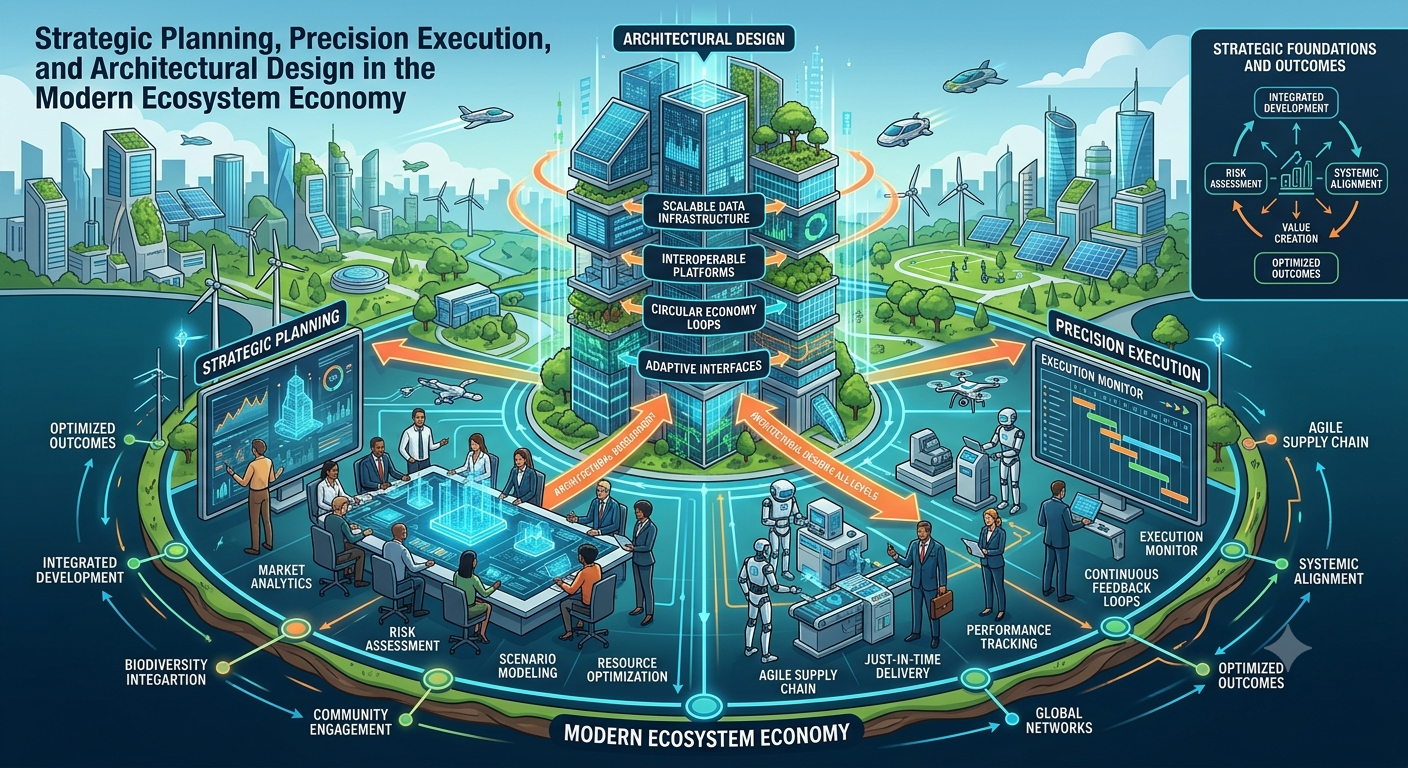
The modern ecosystem economy is no longer driven by isolated companies operating independently. Instead, economic value is increasingly created through interconnected ecosystems consisting of governments, businesses, universities, investors, digital platforms, research institutions, supply chains, artificial intelligence (AI), cloud infrastructure, and consumers. Within these ecosystems, strategic planning serves as the brain, precision execution functions as the nervous system, and architecture provides the structural skeleton that enables all participants to collaborate efficiently.
The organizations and nations that achieve long-term success are those capable of transforming strategy into disciplined execution while continuously adapting to technological disruption, geopolitical change, climate challenges, demographic shifts, and evolving consumer expectations.
Chapter 1: Introduction
The 21st-century economy has entered an era where intelligence has become the primary factor of production. Traditional factors such as land, labor, and capital remain important, but they are increasingly enhanced by:
- Artificial intelligence
- Big data
- Cloud computing
- Advanced manufacturing
- Semiconductor technologies
- Robotics
- Biotechnology
- Renewable energy
- Global digital connectivity
Modern organizations now compete not only through products but through ecosystems that integrate suppliers, customers, developers, logistics partners, regulators, financial institutions, and knowledge networks.
Success depends upon three fundamental pillars:
- Strategic Planning
- Precision Execution
- Systems Architecture
Together they create sustainable competitive advantage.
Chapter 2: Understanding Strategic Planning
Strategic planning is the systematic process of determining where an organization intends to go and how it will achieve its objectives.
It answers five essential questions:
- Where are we today?
- Where do we want to go?
- Why do we want to go there?
- How will we get there?
- How will we measure success?
Strategic planning reduces uncertainty while improving coordination across the organization.
Chapter 3: Core Components of Strategic Planning
Vision
The long-term destination.
Example:
“Become Africa’s leading AI-powered industrial ecosystem by 2045.”
Mission
The organization’s reason for existence.
Example:
“Deliver intelligent solutions that improve productivity across industries.”
Core Values
Examples include:
- Integrity
- Innovation
- Excellence
- Sustainability
- Collaboration
- Continuous learning
- Customer focus
Strategic Objectives
Objectives should be:
- Specific
- Measurable
- Achievable
- Relevant
- Time-bound (SMART)
Examples include:
- Increase productivity by 25%.
- Reduce operational costs by 15%.
- Expand into five new markets.
- Launch three AI-powered products.
Chapter 4: Strategic Analysis
Organizations analyze both internal and external environments.
Internal Analysis
Evaluate:
- Skills
- Technology
- Financial resources
- Leadership
- Organizational culture
- Infrastructure
External Analysis
Study:
- Market trends
- Competitors
- Regulations
- Technological innovation
- Consumer behavior
- Global economic conditions
Common frameworks include SWOT, PESTLE, and Porter’s Five Forces.
Chapter 5: Ecosystem Thinking
Unlike traditional business models, ecosystem thinking recognizes that organizations create value through networks rather than operating alone.
A modern ecosystem includes:
- Customers
- Suppliers
- Research institutions
- Governments
- Financial institutions
- Technology providers
- Logistics companies
- Universities
- Startups
- AI systems
Each participant strengthens the ecosystem through collaboration.
Chapter 6: Strategic Architecture
Architecture refers to the structural design of how an organization operates.
It defines:
- Processes
- Information flow
- Decision-making
- Technology platforms
- Organizational hierarchy
- Governance
- Communication systems
Well-designed architecture minimizes complexity while maximizing coordination.
Chapter 7: Enterprise Architecture Layers
A comprehensive enterprise architecture includes:
Business Architecture
Defines:
- Strategy
- Services
- Business capabilities
- Operating model
Information Architecture
Organizes:
- Data
- Knowledge
- Databases
- Analytics
- Reporting
Application Architecture
Coordinates:
- Enterprise software
- AI agents
- Automation systems
- Customer applications
- Business applications
Technology Architecture
Includes:
- Networks
- Cloud computing
- Cybersecurity
- Data centers
- Edge computing
- Hardware infrastructure
Chapter 8: Precision Execution
Execution converts strategic plans into measurable outcomes.
Successful execution requires:
- Clear objectives
- Defined responsibilities
- Performance monitoring
- Continuous communication
- Rapid problem-solving
- Accountability
Without disciplined execution, even excellent strategies fail.
Chapter 9: The Precision Execution Cycle
- Plan
- Organize
- Assign resources
- Execute
- Measure
- Analyze
- Improve
- Repeat
This creates a continuous improvement loop.
Chapter 10: Operational Excellence
Operational excellence emphasizes:
- Efficiency
- Consistency
- Standardization
- Waste reduction
- Quality improvement
- Customer satisfaction
Common methodologies include Lean, Six Sigma, and Kaizen.
Chapter 11: Artificial Intelligence in Strategic Execution
AI enhances execution through:
- Predictive analytics
- Demand forecasting
- Supply chain optimization
- Fraud detection
- Intelligent automation
- Decision support
- Customer personalization
Organizations increasingly integrate AI into strategic and operational workflows.
Chapter 12: Data-Driven Decision Making
Modern decisions rely on:
- Real-time dashboards
- Business intelligence
- Predictive models
- Scenario analysis
- Performance indicators
Quality decisions depend on accurate, timely, and trustworthy data.
Chapter 13: Performance Measurement
Key Performance Indicators (KPIs) include:
Financial
- Revenue growth
- Profit margins
- Cash flow
- Return on investment
Operational
- Productivity
- Quality
- Cycle time
- Equipment utilization
Customer
- Satisfaction
- Retention
- Market share
- Net Promoter Score (NPS)
Innovation
- Research investment
- Patents
- New product launches
- Time-to-market
Sustainability
- Energy efficiency
- Carbon emissions
- Resource utilization
- Recycling rates
Chapter 14: Risk Management
Strategic planning must address:
- Cybersecurity risks
- Economic volatility
- Geopolitical instability
- Climate-related disruptions
- Supply chain interruptions
- Regulatory changes
- Technological obsolescence
Risk management should be proactive rather than reactive.
Chapter 15: Leadership Architecture
Effective leadership involves:
- Strategic thinking
- Systems thinking
- Emotional intelligence
- Ethical governance
- Talent development
- Change management
- Innovation leadership
Leadership aligns people, resources, and strategy toward common objectives.
Chapter 16: Human Capital Development
High-performing ecosystems invest in:
- Education
- Technical skills
- Digital literacy
- Leadership development
- Lifelong learning
- Knowledge sharing
Human capability remains a key source of competitive advantage.
Chapter 17: Innovation Architecture
Innovation systems typically include:
- Research laboratories
- Universities
- Startup incubators
- Venture capital
- Corporate R&D
- Government support
- Intellectual property protection
Strong innovation ecosystems accelerate scientific and industrial progress.
Chapter 18: Supply Chain Architecture
Modern supply chains are:
- Digitally connected
- AI-assisted
- Automated
- Resilient
- Transparent
- Sustainable
Technologies such as IoT, robotics, blockchain, and digital twins improve visibility and responsiveness.
Chapter 19: Sustainability Integration
Long-term strategies increasingly incorporate:
- Renewable energy
- Circular economy principles
- Responsible resource management
- Waste reduction
- Biodiversity protection
- Social responsibility
Sustainability can reduce costs, improve resilience, and strengthen stakeholder trust.
Chapter 20: National Ecosystem Strategy
Countries seeking long-term competitiveness often prioritize:
- High-quality education
- Scientific research
- Digital infrastructure
- Reliable energy
- Efficient logistics
- Strong institutions
- Industrial policy
- Public-private collaboration
These foundations support innovation, productivity, and inclusive growth.
Chapter 21: Digital Transformation Architecture
Digital transformation integrates:
- Cloud computing
- AI
- Automation
- Data analytics
- Mobile technologies
- Cybersecurity
- Digital platforms
Its goal is to improve efficiency, customer experience, and organizational agility.
Chapter 22: Future Trends
Emerging developments likely to shape ecosystem economies include:
- Autonomous AI agents
- Quantum computing
- Advanced robotics
- Synthetic biology
- Smart manufacturing
- Digital twins
- Next-generation semiconductor technologies
- Edge AI
- Green hydrogen
- Space-based communications
Organizations that prepare for these trends are better positioned to adapt to future disruptions.
Chapter 23: Integrated Strategic Framework
An effective ecosystem can be viewed as a coordinated system:
Vision
      │
Mission
      │
Strategic Objectives
      │
Business Architecture
      │
Technology Architecture
      │
Data Architecture
      │
AI & Automation
      │
Operational Processes
      │
Precision Execution
      │
Performance Measurement
      │
Continuous Improvement
      │
Innovation
      │
Long-Term Sustainable Growth
Conclusion
Strategic planning, precision execution, and architectural design form the foundation of high-performing organizations and resilient economies. In an ecosystem economy, success depends on aligning vision, governance, technology, data, people, and partnerships into a coordinated whole. Organizations that embrace systems thinking, invest in innovation, leverage AI responsibly, and continuously measure and improve their performance are better equipped to create lasting value for customers, shareholders, employees, and society.
Rather than viewing planning, execution, and architecture as separate disciplines, leading enterprises integrate them into a unified management system. This integrated approach enhances adaptability, strengthens resilience against uncertainty, and supports sustainable economic development in an increasingly interconnected world.



Be First to Comment