
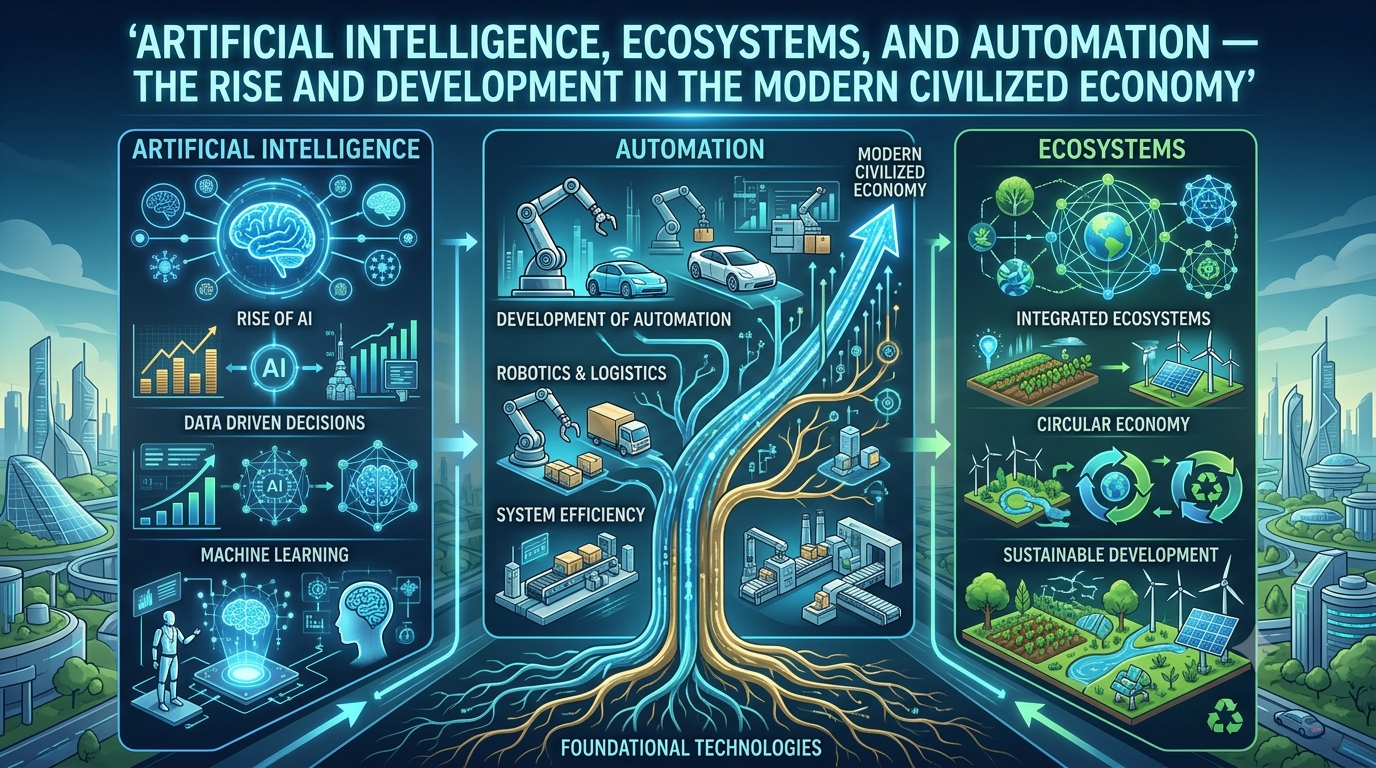
Civilized Economy
Abstract
The twenty-first century has witnessed the emergence of Artificial Intelligence (AI), digital ecosystems, and automation as the three foundational pillars of the Fourth Industrial Revolution. These technologies are reshaping how governments govern, businesses compete, industries manufacture, scientists discover, and citizens interact with society. Rather than operating independently, AI, automation, and digital ecosystems function as an integrated intelligence infrastructure that powers the modern economy.
The transition from mechanization to intelligent automation represents one of the most significant technological transformations in human history. Earlier industrial revolutions amplified human physical labor through steam power, electricity, and computers. Today’s AI revolution amplifies human intelligence, enabling machines to perceive, reason, predict, learn, and increasingly collaborate with people.
This thesis examines the historical development, architecture, economic significance, industrial applications, opportunities, challenges, and future trajectory of AI-driven ecosystems in a modern civilization.
Chapter 1: Introduction
Artificial Intelligence is no longer merely a computer science discipline; it has become the operational brain of the global economy.
Modern economies now depend upon:
- Intelligent decision-making
- Data-driven operations
- Autonomous systems
- Robotics
- Cloud computing
- Edge computing
- Digital platforms
- Human-AI collaboration
Together these create an interconnected AI ecosystem.
Unlike previous technologies that automated individual tasks, AI automates entire decision-making processes.
Examples include:
- Medical diagnosis
- Financial investment
- Logistics optimization
- Fraud detection
- Manufacturing
- Education
- Agriculture
- Scientific research
Chapter 2: Historical Evolution
Phase 1 (1940–1960): Foundations
Key developments included:
- Electronic computers
- Mathematical logic
- Early neural network concepts
- Machine reasoning
Major objective:
Can machines think?
Phase 2 (1960–1980): Expert Systems
Researchers developed:
- Rule-based reasoning
- Knowledge representation
- Decision support systems
Applications:
- Medical diagnosis
- Engineering
- Military planning
Phase 3 (1980–2005): Digital Computing Era
Growth of:
- Personal computers
- Internet
- Databases
- Enterprise software
Businesses began digitizing operations.
Phase 4 (2005–2015): Big Data Revolution
Key technologies:
- Smartphones
- Cloud computing
- Social media
- Massive digital datasets
These provided the “fuel” needed for AI learning.
Phase 5 (2015–2026): Deep Learning Revolution
Breakthroughs included:
- Large Language Models (LLMs)
- Computer vision
- Speech recognition
- Generative AI
- AI agents
- Robotics
- Autonomous vehicles
AI became commercially scalable.
Chapter 3: Understanding the AI Ecosystem
An AI ecosystem is a coordinated network of technologies, organizations, infrastructure, people, and governance systems that collectively develop and deploy intelligent solutions.
Its core layers include:
- Energy infrastructure
- Semiconductor hardware
- Data centers
- Networking
- Cloud computing
- Data platforms
- AI models
- AI applications
- Human users
- Regulatory frameworks
Each layer depends on the others, creating a highly interconnected technological ecosystem.
Chapter 4: Core Components of AI
1. Data
Data serves as the raw material for AI systems.
Sources include:
- Sensors
- Cameras
- Mobile devices
- Satellites
- Industrial equipment
- Scientific instruments
- Financial transactions
- Medical records
Without data, AI cannot learn effectively.
2. Algorithms
Algorithms define how AI processes information.
Examples:
- Decision trees
- Neural networks
- Reinforcement learning
- Bayesian models
- Transformers
Algorithms transform raw data into actionable intelligence.
3. Computing Infrastructure
Modern AI relies on high-performance computing, including:
- CPUs
- GPUs
- AI accelerators
- High-bandwidth memory
- Specialized networking
- Distributed computing clusters
These systems enable large-scale model training and deployment.
4. Machine Learning
Machine Learning enables systems to improve performance through experience rather than explicit programming.
Categories include:
- Supervised learning
- Unsupervised learning
- Reinforcement learning
- Self-supervised learning
5. Large Language Models
Modern LLMs perform:
- Translation
- Coding
- Writing
- Reasoning
- Summarization
- Knowledge retrieval
- Conversational assistance
They have become general-purpose cognitive tools for many industries.
Chapter 5: Automation
Automation is the use of technology to perform tasks with minimal human intervention.
Levels include:
Level 1
Manual assistance
Example:
Digital calculators
Level 2
Process automation
Example:
Payroll systems
Level 3
Robotic automation
Example:
Factory robots
Level 4
Intelligent automation
AI makes decisions based on real-time information.
Level 5
Autonomous systems
Machines coordinate operations with minimal human oversight.
Examples:
- Autonomous vehicles
- Warehouse robotics
- Industrial inspection drones
Chapter 6: Economic Transformation
AI is reshaping major sectors of the economy.
Manufacturing
Benefits include:
- Predictive maintenance
- Quality inspection
- Production optimization
- Supply chain management
Agriculture
AI supports:
- Precision farming
- Crop monitoring
- Irrigation optimization
- Pest detection
- Yield forecasting
Healthcare
Applications include:
- Diagnostic imaging
- Drug discovery
- Personalized treatment planning
- Administrative automation
Finance
AI enables:
- Fraud detection
- Credit scoring
- Algorithmic trading
- Risk management
- Customer support
Education
AI supports:
- Personalized learning
- Intelligent tutoring
- Automated assessment
- Learning analytics
Transportation
AI improves:
- Traffic management
- Fleet optimization
- Route planning
- Predictive maintenance
- Driver assistance
Chapter 7: AI Ecosystem Architecture
A simplified architecture can be represented as:
Electricity
      │
Semiconductors
      │
Hardware Systems
      │
Data Centers
      │
Cloud Infrastructure
      │
Networking
      │
Data Collection
      │
Machine Learning Models
      │
AI Applications
      │
Businesses
      │
Consumers
      │
Economic Growth
Each layer depends on the reliability and performance of the preceding layers.
Chapter 8: Productivity and Economic Value
AI contributes to economic development by:
- Increasing labor productivity
- Improving decision quality
- Reducing operational costs
- Accelerating innovation
- Enhancing customer experiences
- Optimizing resource allocation
These gains can strengthen long-term competitiveness when combined with investment in skills and governance.
Chapter 9: Human–AI Collaboration
The future of work is likely to emphasize collaboration rather than simple replacement.
Humans contribute:
- Creativity
- Ethical judgment
- Strategic thinking
- Empathy
- Leadership
AI contributes:
- Pattern recognition
- Speed
- Data analysis
- Prediction
- Continuous monitoring
Together they form “augmented intelligence,” where technology enhances human capability.
Chapter 10: Challenges
Important challenges include:
- Data privacy
- Cybersecurity
- Algorithmic bias
- Workforce transitions
- Digital inequality
- Energy consumption of AI infrastructure
- Regulatory compliance
- Intellectual property questions
- Trust and transparency
Addressing these issues requires coordinated action by governments, industry, academia, and civil society.
Chapter 11: Future Trends (2026–2050)
Likely developments include:
- More capable multimodal AI systems
- Greater use of autonomous robots in logistics, manufacturing, and healthcare
- AI-assisted scientific discovery
- Expansion of edge AI on connected devices
- Digital twins for cities, factories, and infrastructure
- Increased use of renewable energy to power AI infrastructure
- Wider adoption of AI copilots across professions
- Stronger international standards for AI safety and governance
Chapter 12: Strategic Recommendations
To build a resilient AI ecosystem, nations and organizations should:
- Invest in digital infrastructure, including reliable electricity, broadband, and data centers.
- Strengthen STEM education while expanding AI literacy across all sectors.
- Support research and innovation through public–private partnerships.
- Encourage responsible data governance and cybersecurity practices.
- Develop regulatory frameworks that promote innovation while protecting rights and safety.
- Help workers adapt through lifelong learning and reskilling programs.
- Foster entrepreneurship and startup ecosystems that can apply AI to local challenges.
- Promote international collaboration on standards, ethics, and interoperability.
Conclusion
Artificial Intelligence, automation, and digital ecosystems are reshaping the architecture of the modern economy in much the same way that electricity transformed the industrial world in the twentieth century. Their true value lies not only in automating tasks, but in creating connected systems that can learn, adapt, and improve over time.
The countries and organizations most likely to prosper will be those that combine technological investment with education, sound governance, ethical oversight, and resilient infrastructure. In this vision, AI is not simply a replacement for human effort; it is a powerful partner that can augment human intelligence, accelerate scientific discovery, improve public services, and support more productive and sustainable economic development.


Be First to Comment