
Abstract
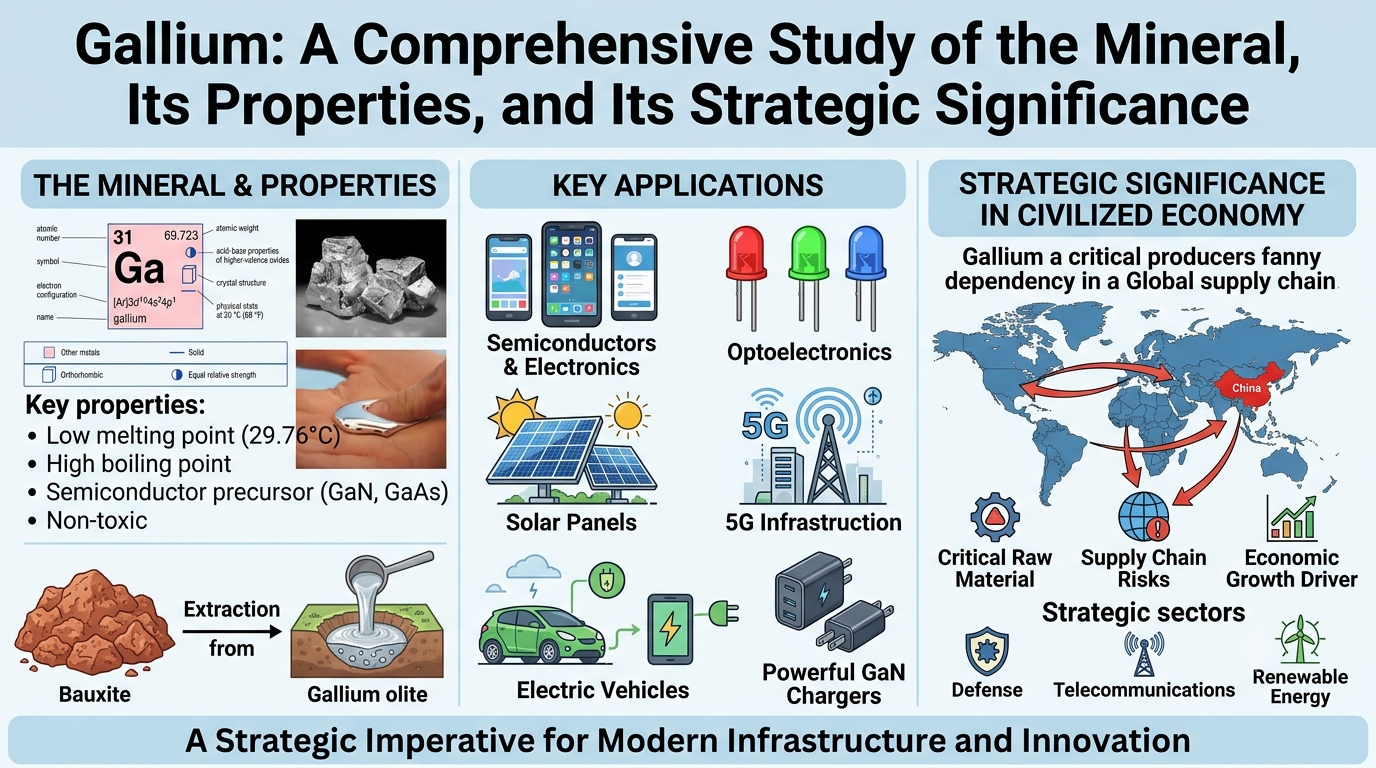
Gallium (Ga) is one of the world’s most strategically important technology metals. Although relatively unknown to the general public, it is indispensable to modern electronics, telecommunications, renewable energy, aerospace, defense, medical technology, and artificial intelligence infrastructure. Without gallium, many of today’s fastest electronic devices, LED lighting, satellite communication systems, radar systems, and next-generation electric vehicles would not exist.
Unlike metals such as iron, copper, or aluminum, gallium is rarely mined directly. Instead, it is primarily recovered as a by-product during the refining of bauxite (for aluminum) and zinc ores, making its supply closely tied to those industries.
Chapter 1: Discovery and History
Paul-Émile Lecoq de Boisbaudran discovered gallium in 1875 using spectroscopy.
The name “Gallium” comes from the Latin word Gallia, meaning France.
The discovery was historically significant because it confirmed predictions made by Dmitri Mendeleev, who had predicted the existence and properties of an unknown element he called eka-aluminium before it was discovered.
Chapter 2: Basic Properties
| Property | Value |
|---|---|
| Symbol | Ga |
| Atomic Number | 31 |
| Atomic Weight | 69.723 |
| Group | 13 |
| Period | 4 |
| State | Soft Metal |
| Color | Silver-white |
| Melting Point | 29.76°C |
| Boiling Point | 2,204°C |
| Density | 5.91 g/cm³ |
One remarkable characteristic is that gallium melts in your hand because its melting point is just below normal human body temperature. Despite this, it has a very high boiling point, giving it one of the widest liquid temperature ranges of any metal.
Chapter 3: Where Gallium Comes From
Gallium is not found in concentrated deposits suitable for direct mining. Instead, it occurs in trace amounts within other ores.
Major sources include:
- Bauxite (aluminum ore)
- Zinc ores
- Coal ash (small quantities)
- Certain industrial waste streams
Gallium production depends heavily on aluminum refining, so its availability is influenced by broader mining and refining activity.
Chapter 4: Major Producing Countries
Historically and currently, the largest producers and refiners include:
- China
- Germany
- Japan
- South Korea
- Russia
China has dominated global primary gallium production in recent years due to its extensive aluminum industry and refining capacity.
Chapter 5: Gallium in Semiconductor Technology
Gallium has transformed electronics through advanced semiconductor compounds.
Gallium Arsenide (GaAs)
Applications include:
- Smartphones
- Satellite communications
- GPS
- Military radar
- Fiber-optic communications
- High-frequency amplifiers
- Wireless base stations
Advantages over silicon:
- Higher electron mobility
- Faster signal transmission
- Better high-frequency performance
- Lower electrical noise
Gallium Nitride (GaN)
GaN is one of today’s most important semiconductor materials.
Applications:
- AI servers
- Fast chargers
- Electric vehicles
- 5G and emerging 6G communications
- Power converters
- Data centers
- Renewable energy inverters
- Aerospace systems
Benefits:
- Higher efficiency
- Lower heat generation
- Smaller components
- Faster switching speeds
- High-voltage operation
Chapter 6: Electronics Industry
Gallium is essential in:
- LEDs
- Laser diodes
- Blu-ray technology
- Smartphones
- Tablets
- Laptops
- Satellite systems
- Internet infrastructure
- Optical communication
- Quantum technologies
Modern digital economies rely on gallium-containing components for high-speed communication and energy-efficient electronics.
Chapter 7: Artificial Intelligence
AI infrastructure depends on efficient power electronics.
Gallium nitride enables:
- Higher-density power supplies
- Reduced electricity losses
- Lower cooling requirements
- Compact server designs
- Faster data transmission
- Improved efficiency in AI data centers
Chapter 8: Renewable Energy
Gallium is used in high-performance solar cells.
Applications include:
- Spacecraft solar panels
- Satellites
- Military solar systems
- High-efficiency terrestrial photovoltaic technologies
Gallium-based solar cells can achieve very high efficiencies, making them valuable where performance outweighs cost.
Chapter 9: Telecommunications
Gallium supports:
- 5G base stations
- Fiber-optic networks
- Satellite internet
- Radar
- Microwave communications
- Wireless infrastructure
Because of its ability to operate efficiently at high frequencies, gallium-based devices are central to modern communications.
Chapter 10: Defense and Aerospace
Strategic applications include:
- Missile guidance
- Electronic warfare
- Military radar
- Satellite communications
- Space exploration
- Advanced aircraft electronics
- Secure communications
Its importance has made gallium a strategically sensitive material in many countries.
Chapter 11: Medical Applications
Gallium compounds have uses in:
- Nuclear medicine imaging
- Certain cancer diagnostics
- Infection detection
- Medical research
- Pharmaceutical development
Chapter 12: Economic Importance
Gallium enables industries worth trillions of dollars, including:
- Consumer electronics
- Telecommunications
- Artificial intelligence
- Renewable energy
- Electric vehicles
- Aerospace
- Defense
- Medical technology
- Semiconductor manufacturing
Although global gallium production is measured in hundreds of tonnes rather than millions, its economic impact is disproportionately large because it is embedded in high-value technologies.
Chapter 13: Supply Chain Challenges
Key issues include:
- Production concentrated in a few countries
- Dependence on aluminum refining
- Limited primary extraction
- Growing demand from AI, EVs, and telecommunications
- Strategic trade restrictions in some regions
These factors have encouraged investment in recycling, diversification of supply, and development of alternative refining capacity.
Chapter 14: Recycling
Gallium can be recovered from:
- Electronic waste
- Semiconductor fabrication scrap
- LED manufacturing waste
- Solar panels (where feasible)
Improved recycling can reduce pressure on primary production and enhance supply security.
Chapter 15: Future Outlook (2026–2045)
Demand for gallium is expected to grow as industries expand in:
- Artificial intelligence infrastructure
- Electric mobility
- Renewable energy
- Advanced communications
- Robotics
- Quantum technologies
- Space exploration
- High-performance computing
Continued advances in gallium nitride power electronics and high-frequency devices are likely to increase its importance.
Advantages of Gallium
- Excellent semiconductor properties
- High-speed electronic performance
- High-frequency capability
- Energy-efficient power conversion
- Compact device design
- Strong performance at elevated temperatures
- Critical for modern communications and power electronics
Limitations
- Scarce as a primary resource
- Supply depends on other mining industries
- Refining is technically demanding
- Strategic supply concentration can create market risks
Conclusion
Gallium is one of the foundational strategic materials of the 21st century. While produced in relatively small quantities, it underpins technologies that power the global digital economy—from smartphones and fiber-optic networks to AI data centers, electric vehicles, satellites, advanced radar, and renewable energy systems. As nations pursue digital transformation, clean energy, and advanced manufacturing, securing reliable gallium supplies, expanding recycling, and investing in new refining capabilities will remain essential for technological competitiveness and economic resilience.






Be First to Comment