
Abstract
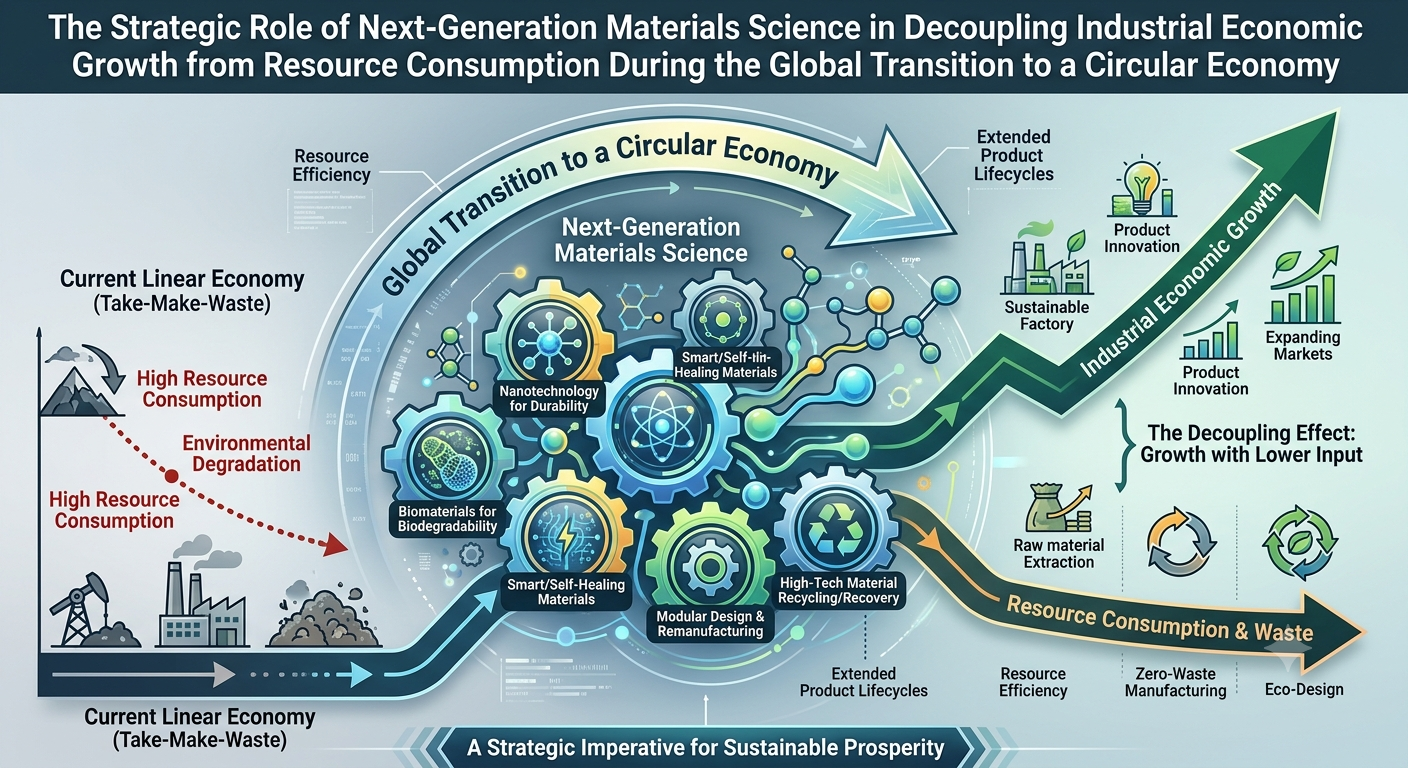
Next-generation materials science is emerging as one of the most important scientific foundations for achieving economic growth without proportionally increasing the consumption of natural resources. Historically, industrial development has relied on a linear economic model—extract, manufacture, consume, and discard—which has generated unprecedented economic prosperity but has also accelerated resource depletion, environmental degradation, carbon emissions, and waste accumulation.
The transition toward a circular economy seeks to fundamentally transform this relationship by ensuring that materials remain in productive use for as long as possible through reuse, repair, remanufacturing, recycling, and regeneration. Advanced materials science is central to this transformation because it enables products that are lighter, stronger, longer-lasting, recyclable, repairable, biodegradable, and digitally traceable.
Rather than relying solely on extracting more raw materials, future economic growth will increasingly depend on knowledge, innovation, intelligent material design, and efficient resource circulation.
1. Introduction
Economic history has largely followed a simple equation:
More production = More raw materials = More economic growth
This relationship powered the Industrial Revolution, globalization, and the modern digital economy. However, finite mineral reserves, climate change, biodiversity loss, and waste pollution demonstrate that this model is increasingly unsustainable.
Materials science provides a pathway toward a different equation:
More innovation = More economic value with fewer physical resources
This is known as absolute decoupling, where GDP grows while total resource use and environmental impacts remain stable or decline.
2. Understanding Resource Decoupling
Resource decoupling refers to separating economic growth from increases in material and energy consumption.
Two forms exist:
Relative Decoupling
- GDP grows faster than resource use.
- Resources continue increasing, but more slowly.
Example:
- GDP increases by 6%
- Material consumption increases by 2%
Absolute Decoupling
GDP continues growing while resource consumption decreases.
Example:
- GDP increases by 5%
- Steel consumption decreases by 3%
- Energy demand decreases by 2%
This represents the long-term objective of a circular economy.
3. Why Materials Science Is Strategic
Materials determine nearly every industrial sector.
Examples include:
- Buildings
- Roads
- Vehicles
- Aircraft
- Smartphones
- Medical devices
- Wind turbines
- Solar panels
- Batteries
- Electronics
- Robotics
- Data centers
Improving material performance improves the efficiency of every downstream industry.
4. Next-Generation Materials
A. High-Performance Alloys
Examples include:
- Titanium alloys
- Nickel superalloys
- Advanced aluminum alloys
- High-entropy alloys
Advantages:
- Higher strength
- Lower weight
- Longer lifespan
- Better corrosion resistance
Economic effect:
Less material is required over a product’s lifetime.
B. Advanced Composites
Examples:
- Carbon fiber composites
- Glass fiber composites
- Ceramic composites
Applications:
- Aircraft
- Electric vehicles
- Satellites
- Wind turbine blades
Benefits:
- Reduced fuel consumption
- Lower maintenance
- Longer service life
C. Nanomaterials
Examples:
- Graphene
- Carbon nanotubes
- Nanocellulose
Potential benefits:
- Higher electrical conductivity
- Stronger yet lighter structures
- Improved thermal management
- Enhanced sensors and electronics
D. Smart Materials
Smart materials can respond to changes in:
- Temperature
- Pressure
- Electricity
- Magnetic fields
- Light
Examples include:
- Shape-memory alloys
- Self-healing polymers
- Piezoelectric materials
These reduce maintenance and extend product lifetimes.
E. Bio-Based Materials
Examples:
- Bioplastics
- Mycelium composites
- Cellulose-based materials
- Bamboo composites
Benefits:
- Renewable feedstocks
- Lower fossil fuel dependence
- Potential biodegradability
5. Materials Designed for Circularity
Traditional products were optimized primarily for performance and cost.
Future products are increasingly designed for:
- Easy disassembly
- Repairability
- Component replacement
- Material recovery
- Closed-loop recycling
This design philosophy enables materials to circulate through multiple life cycles rather than becoming waste after a single use.
6. Lightweighting
One of the largest opportunities is reducing material mass while maintaining or improving performance.
Examples include:
- Electric vehicles with lightweight chassis
- Aircraft using composites
- Aluminum beverage cans using less metal
- High-strength steel in construction
Benefits:
- Less mining
- Lower transport costs
- Reduced fuel consumption
- Lower emissions
7. Extending Product Lifetimes
The most sustainable material is often the one that does not need to be replaced.
Advanced materials improve durability through:
- Corrosion resistance
- Wear resistance
- Heat resistance
- Fatigue resistance
- UV resistance
Longer-lasting infrastructure and products reduce demand for new raw materials.
8. Self-Healing Materials
An emerging field involves materials that can repair small cracks or damage automatically.
Potential applications include:
- Bridges
- Concrete
- Pipelines
- Aircraft
- Protective coatings
Benefits include reduced maintenance costs and extended service life.
9. Recyclable-by-Design Materials
Many current products combine materials in ways that make recycling difficult.
Future materials aim to:
- Separate cleanly
- Avoid hazardous additives
- Maintain quality through multiple recycling cycles
- Enable high-value material recovery
This helps preserve material value over time.
10. Digital Material Passports
Digital technologies can accompany physical materials through their life cycle.
A digital material passport may record:
- Material composition
- Manufacturing details
- Repair history
- Recycled content
- Environmental footprint
- Disassembly instructions
Such traceability improves maintenance, reuse, and recycling.
11. Industrial Symbiosis
In a circular economy, one industry’s waste can become another industry’s raw material.
Examples include:
- Steel slag used in cement
- Waste heat reused by neighboring facilities
- Plastic waste converted into new feedstocks
- Industrial gases captured for chemical production
Materials science enables these exchanges by developing suitable processing and compatibility technologies.
12. Strategic Economic Benefits
Next-generation materials science supports:
- Higher industrial productivity
- Reduced dependence on imported raw materials
- Lower production costs over product lifetimes
- Improved supply chain resilience
- Greater competitiveness in advanced manufacturing
- Growth of repair, refurbishment, and remanufacturing industries
These shifts create value from knowledge and efficient resource use rather than simply increasing extraction.
13. National Competitiveness
Countries investing heavily in advanced materials research are positioning themselves for leadership in sectors such as:
- Semiconductor manufacturing
- Aerospace
- Electric vehicles
- Renewable energy
- Robotics
- Quantum technologies
- Biomedical engineering
Materials innovation often underpins technological leadership across these industries.
14. Challenges
Several obstacles remain:
- High research and development costs
- Scaling laboratory discoveries to mass production
- Limited recycling infrastructure for some advanced materials
- Critical mineral supply risks
- Need for common standards and certification
- Workforce training in new manufacturing methods
Addressing these challenges requires coordinated investment in science, engineering, policy, and education.
15. Future Directions
Promising research areas include:
- Self-healing structural materials
- Fully recyclable polymers
- Low-carbon cement and steel
- High-performance battery materials
- Sustainable semiconductor materials
- Biomimetic materials inspired by nature
- AI-assisted materials discovery
- Additive manufacturing with circular feedstocks
Artificial intelligence, high-performance computing, and automation are accelerating the discovery and optimization of new materials.
Conclusion
Next-generation materials science is a strategic enabler of the transition from a linear, resource-intensive economy to a circular, knowledge-driven industrial system. By designing materials that are stronger, lighter, more durable, repairable, recyclable, and renewable, societies can increase economic output while reducing dependence on virgin resource extraction.
This transformation supports environmental sustainability, strengthens industrial resilience, and enhances long-term competitiveness. As global demand for infrastructure, clean energy, advanced electronics, and sustainable manufacturing continues to grow, the countries and industries that lead in materials innovation will be better positioned to achieve sustained prosperity with a smaller environmental footprint.
In this sense, the future of economic growth is likely to depend not only on how much material humanity extracts, but increasingly on how intelligently materials are designed, used, recovered, and circulated throughout the economy.






Be First to Comment