
Title
The Origins of Organized Mining: A Comprehensive Academic Study of the Earliest Mining Civilizations, Their Technological Evolution, Socio-Economic Systems, and Historical Legacy
Abstract
Mining is among humanity’s oldest organized economic activities, forming the foundation of civilization by supplying stone, metals, pigments, gemstones, and construction materials. Long before written history, prehistoric societies extracted flint, obsidian, ochre, and other minerals. As civilizations emerged, mining became increasingly organized under governments, temples, and royal administrations.
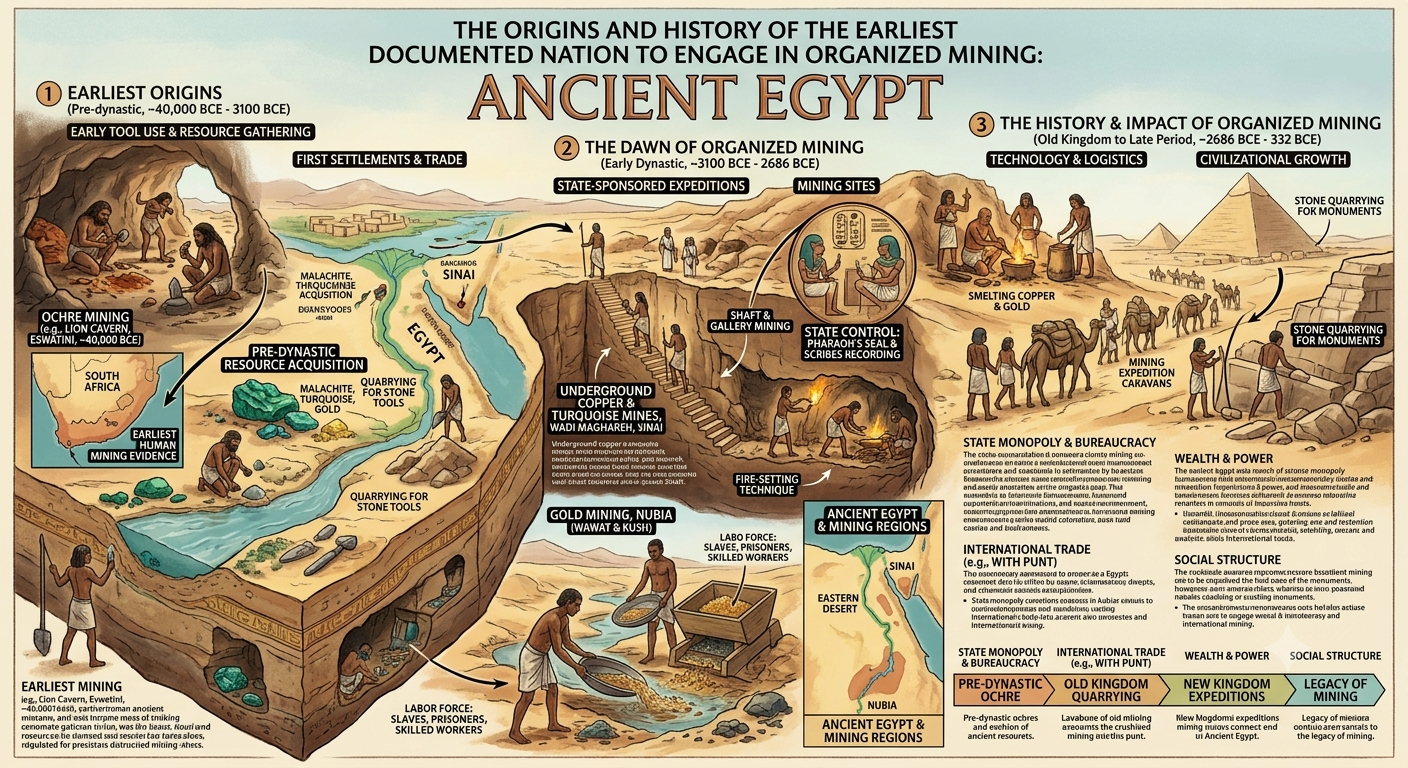
Among the earliest documented civilizations known to practice large-scale organized mining is Ancient Egypt, particularly from the Early Dynastic Period (c. 3100 BCE) onward. Egyptian rulers developed state-controlled expeditions into the Eastern Desert, Sinai Peninsula, and Nubia to extract gold, copper, turquoise, malachite, and precious stones. However, archaeological evidence also demonstrates sophisticated prehistoric mining in regions such as present-day Israel, Jordan, Serbia, Bulgaria, and Anatolia before Egypt’s dynastic era.
This thesis examines the evolution from prehistoric extraction to organized state mining, analyzes technological innovations, explores mining’s economic and political roles, and evaluates its enduring legacy in modern civilization.
Table of Contents
- Introduction
- Defining Organized Mining
- Mining Before Civilization
- The Rise of Ancient Egypt as the Earliest Documented Organized Mining State
- Other Early Mining Civilizations
- Evolution of Mining Technology
- Government Organization and Administration
- Labor Systems
- Economic Importance
- Mining and Military Power
- Environmental Impact
- Religious and Cultural Significance
- Historical Legacy
- Lessons for Modern Mining
- Conclusion
Chapter 1 – Introduction
Mining represents humanity’s first systematic interaction with Earth’s geological resources. Every civilization depended on minerals for survival.
These resources enabled:
- Agriculture
- Architecture
- Transportation
- Warfare
- Currency
- Jewelry
- Scientific instruments
- Religious objects
Without mining there would have been:
- No Bronze Age
- No Iron Age
- No Industrial Revolution
- No Digital Age
Mining therefore forms one of the foundations of civilization itself.
Chapter 2 – What Is Organized Mining?
Organized mining differs fundamentally from simple gathering.
It involves:
- Planned exploration
- Geological knowledge
- Permanent mining sites
- Specialized labor
- Transportation systems
- Government oversight
- Taxation
- Resource distribution
- Skilled metallurgy
Unlike opportunistic collection of surface stones, organized mining requires coordinated labor and long-term planning.
Chapter 3 – Mining Before Civilization
Long before kingdoms emerged, prehistoric communities mined valuable materials.
Flint Mining (c. 9000–4000 BCE)
Communities excavated shafts reaching many meters underground.
Uses included:
- Arrowheads
- Axes
- Knives
- Spears
Important prehistoric flint mines include sites in England, France, Belgium, and Poland.
Obsidian Mining
Obsidian was prized because of its extremely sharp edges.
Major prehistoric centers existed in:
- Anatolia (Turkey)
- Armenia
- Ethiopia
- Mexico
Trade networks transported obsidian hundreds of kilometers.
Ochre Mining
Ochre served as:
- Paint
- Cosmetics
- Religious pigment
- Burial decoration
Some ochre mines date back over 40,000 years.
Chapter 4 – Ancient Egypt: The Earliest Documented Organized Mining Nation
While prehistoric mining predates written history, Ancient Egypt provides the earliest extensive written and archaeological evidence of organized, state-directed mining.
Why Egypt?
Egypt possessed:
- Written records
- Royal inscriptions
- Administrative documents
- Expedition reports
- Mine maps
- Archaeological mining settlements
These sources distinguish Egypt as the earliest documented mining state.
Major Mining Regions
Eastern Desert
Produced:
- Gold
- Quartz
- Granite
- Basalt
Sinai Peninsula
Produced:
- Copper
- Turquoise
- Malachite
Nubia
Produced:
- Gold
- Precious stones
Egypt’s wealth depended heavily on Nubian gold.
Chapter 5 – Organization of Egyptian Mining
Mining expeditions included:
- Soldiers
- Engineers
- Surveyors
- Stone masons
- Metalworkers
- Scribes
- Physicians
- Priests
- Laborers
- Water carriers
Some expeditions involved thousands of workers.
Administration
The Pharaoh controlled mining through officials.
Responsibilities included:
- Planning
- Food supply
- Security
- Labor allocation
- Record keeping
- Resource transportation
Mining was a state enterprise.
Chapter 6 – Mining Technologies
Stone Hammers
Workers used dolerite hammerstones to fracture rock.
Fire-Setting
Rock was heated using fire.
Cold water was then applied.
Rapid cooling caused the rock to crack, making excavation easier.
Copper Tools
Tools included:
- Chisels
- Picks
- Adzes
- Saws
These gradually replaced purely stone implements.
Bronze Tools
Bronze increased:
- Durability
- Efficiency
- Precision
Underground Mining
Engineers developed:
- Shafts
- Ventilation
- Support pillars
- Drainage channels
These innovations enabled deeper mining.
Chapter 7 – Transportation Systems
Extracted materials moved by:
- Human porters
- Donkeys
- Boats on the Nile
- Wooden sledges
The Nile functioned as Egypt’s primary transport corridor.
Chapter 8 – Gold Mining
Gold symbolized divine kingship.
Sources included:
- Quartz veins
- River sediments
- Open pits
Processing involved:
- Crushing
- Grinding
- Washing
- Smelting
- Refining
Gold financed temples, armies, diplomacy, and monumental construction.
Chapter 9 – Copper Mining
Copper was essential for:
- Weapons
- Farming tools
- Construction
- Household goods
The Sinai became one of the world’s earliest major copper-producing regions.
Chapter 10 – Precious Stones
Egypt also extracted:
- Emerald
- Amethyst
- Carnelian
- Jasper
- Diorite
- Granite
- Alabaster
These materials adorned royal tombs and temples.
Chapter 11 – Mining Labor
Labor consisted of:
- Skilled craftsmen
- Seasonal workers
- Military personnel
- Administrators
- Captives and, in some periods, forced labor
Conditions varied across periods and sites, and evidence indicates that some expeditions included paid or provisioned workers while others relied on compulsory labor.
Workers faced:
- Extreme heat
- Dust
- Dehydration
- Accidents
- Disease
Chapter 12 – Economic Importance
Mining enabled:
- National wealth
- International trade
- Monumental architecture
- Military expansion
- Diplomatic gifts
- Religious offerings
Gold was central to Egypt’s international prestige during the New Kingdom.
Chapter 13 – Mining and Warfare
Mining supported military strength through the production of:
- Bronze weapons
- Arrowheads
- Spears
- Chariots (using metal components)
- Armor fittings
Control over mineral resources often influenced regional power.
Chapter 14 – Religious Importance
Minerals possessed symbolic value.
Examples include:
- Gold represented the flesh of the gods.
- Turquoise symbolized joy and protection.
- Precious stones decorated temples and funerary objects.
Mining expeditions frequently included rituals seeking divine protection.
Chapter 15 – Other Early Mining Civilizations
Although Egypt is the earliest well-documented organized mining state, several other societies made major contributions:
- Sumer imported and processed copper, relying on extensive trade because southern Mesopotamia lacked many mineral resources.
- Anatolia became an important center for early copper extraction and metallurgy.
- Minoan Crete participated in Mediterranean metal trade.
- Nubia was renowned for rich gold deposits that supplied Egypt and later kingdoms.
- Bronze Age communities in southeastern Europe developed early copper mining and metallurgy, with archaeological sites in present-day Serbia and Bulgaria among the oldest known.
These civilizations collectively advanced mining technology and long-distance trade.
Chapter 16 – Technological Evolution Timeline
| Era | Major Development |
|---|---|
| Stone Age | Flint and obsidian mining |
| Chalcolithic | Native copper extraction |
| Bronze Age | Bronze tools and organized metallurgy |
| Iron Age | Iron mining and smelting |
| Roman Era | Large-scale underground mining and hydraulic methods |
| Medieval Period | Improved shafts, drainage, and ventilation |
| Industrial Revolution | Steam-powered mining |
| Twentieth Century | Mechanization and electrification |
| Twenty-first Century | Automation, remote operation, AI, and robotics |
Chapter 17 – Environmental Impacts
Ancient mining altered landscapes through:
- Quarry excavation
- Deforestation for fuel
- Soil erosion
- Waste rock accumulation
- Water consumption
Compared with modern industrial mining, however, the scale of environmental disturbance was generally much smaller.
Chapter 18 – Historical Legacy
The organizational principles pioneered by early mining states continue to influence modern practice:
- Geological surveying
- Resource planning
- Specialized labor
- Infrastructure development
- Government regulation
- Record keeping
- Mineral taxation
- Long-distance logistics
Mining also stimulated advances in engineering, metallurgy, administration, and international commerce.
Chapter 19 – Lessons for Modern Society
Early mining civilizations illustrate several enduring principles:
- Natural resources can accelerate national development when managed effectively.
- Technical innovation often emerges from practical economic needs.
- Strong administrative systems are essential for large-scale industrial activity.
- Resource wealth should be balanced with environmental stewardship and worker welfare.
- Mining is most valuable when it supports broader economic diversification rather than dependence on a single commodity.
Conclusion
The archaeological record demonstrates that humans engaged in mining thousands of years before the rise of written civilization. Prehistoric communities extracted flint, obsidian, and ochre using surprisingly sophisticated methods. However, Ancient Egypt stands as the earliest civilization for which extensive written and archaeological evidence documents a state-organized mining industry. Through carefully planned expeditions, administrative oversight, specialized labor, and technological innovation, Egypt transformed mineral extraction into a strategic pillar of national power.
This legacy extended beyond Egypt. Subsequent civilizations—including Mesopotamian, Anatolian, Nubian, Greek, Roman, and later industrial societies—expanded mining techniques, enabling advances in metallurgy, trade, engineering, and manufacturing. Today, the same fundamental principles of exploration, extraction, logistics, and resource management remain central to the global mining industry, linking modern technological civilization to practices first organized more than five millennia ago.



Be First to Comment