
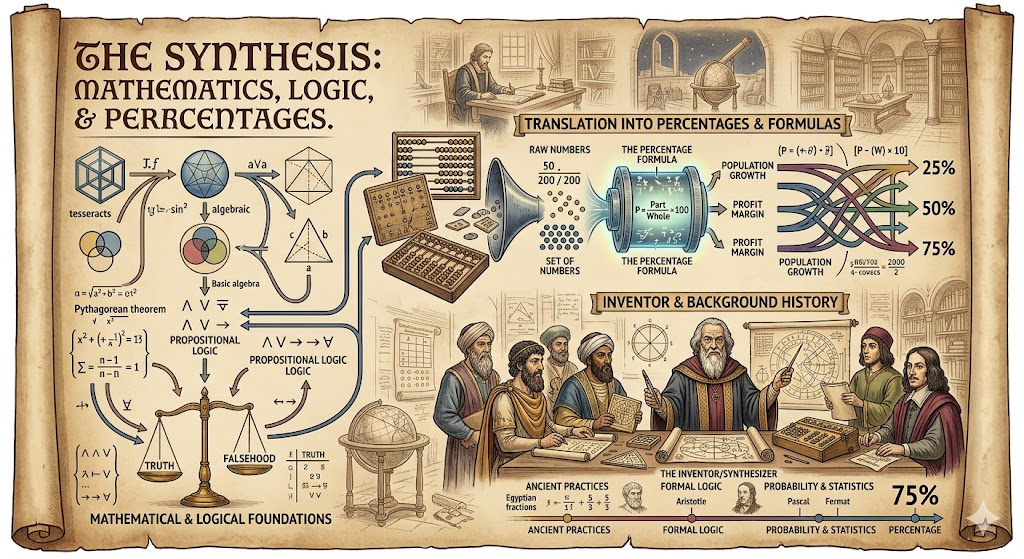
MATHEMATICS, LOGIC, NUMBER TRANSLATION, PERCENTAGES, FORMULAS, INVENTORS, AND HISTORICAL DEVELOPMENT
Mathematics is one of humanity’s oldest and most important intellectual achievements. It provides a systematic way of understanding quantity, structure, change, and space. Logic serves as the foundation of reasoning, while percentages and formulas allow us to solve practical problems in science, business, engineering, economics, and everyday life. This article examines the history of mathematics, the development of numerical systems, the origins of logic, the translation of numbers into percentages and other forms, and the contributions of influential mathematicians throughout history.
Introduction to Mathematics
Mathematics is often described as the language of the universe. It enables people to measure, count, compare, predict, and analyze phenomena.
The word “mathematics” comes from the Greek word “mathema,” meaning knowledge, learning, or science.
Mathematics is used in the following:
Science
Engineering
Medicine
Business
Finance
Technology
Artificial Intelligence
Architecture
Without mathematics, modern civilization would not exist.
Historical Development of Mathematics
Ancient Beginnings
Mathematics began thousands of years ago when humans started counting objects such as animals, crops, and tools.
Ancient Egypt (3000 BCE)
Egyptians developed arithmetic and geometry to
Build pyramids
Measure land
Calculate taxes
Ancient Mesopotamia (Babylon)
Babylonians introduced the following:
Place-value systems
Early algebra
Astronomical calculations
Ancient India
Indian mathematicians contributed:
The concept of zero
Decimal notation
Advanced arithmetic
Ancient China
Chinese scholars developed:
Number systems
Geometric methods
Algebraic techniques
Ancient Greece
Greek mathematicians transformed mathematics into a logical science.
Important figures include:
Inventors and Contributors to Mathematics
Euclid (300 BCE)
Known as the Father of Geometry.
His book became one of the most influential mathematical works ever written.
Contributions:
Geometric proofs
Logical reasoning
Mathematical structure
Pythagoras (570–495 BCE)
Developed the famous theorem:
a² + b² = c²
Illustration:
Right Triangle
c
/|
/ |
/ |
/_|
a b
Example:
a = 3
b = 4
c² = 3² + 4²
c² = 9 + 16
c² = 25
c = 5
Archimedes
Contributions:
Geometry
Measurement of circles
Approximation of π
Formula:
Area of Circle = πr²
Al-Khwarizmi
is considered the Father of Algebra.
The word “algebra” comes from his book:
“Al-Jabr.”
The word “algorithm” is derived from his name.
Isaac Newton
developed calculus.
Contributions:
Differential calculus
Integral calculus
Mathematical physics
Gottfried Leibniz
independently developed calculus and introduced much of its modern notation.
Understanding Numbers
Numbers are symbols used to represent quantities.
Natural Numbers
1, 2, 3, 4, 5…
Used for counting.
Whole Numbers
0, 1, 2, 3, 4…
Include zero.
Integers
…, -3, -2, -1, 0, 1, 2, 3…
Include negative numbers.
Rational Numbers
Can be expressed as fractions.
Example:
3/4
5/8
Irrational Numbers
Cannot be written as exact fractions.
Examples:
√2
π
Real Numbers
Combination of rational and irrational numbers.
Logic and Mathematical Reasoning
Logic is the science of valid reasoning.
It helps determine whether statements are true or false.
Aristotle and Logic
developed formal logic around 350 BCE.
His work laid the foundation for:
Mathematics
Philosophy
Computer Science
Logical Operators
AND ( ∧)
Both conditions must be true.
Example:
A = 2 + 2 = 4
B = 5 > 3
A ∧ B = True
OR (∨)
At least one statement must be true.
NOT (¬)
Reverses truth value.
Number Translation
Number translation means converting numbers between forms.
Fraction to Decimal
3/4
= 0.75
Decimal to Percentage
0.75 × 100
= 75%
Percentage to Fraction
75%
= 75/100
= 3/4
Illustration Table
Fraction| Decimal| Percentage
1/2| 0.50| 50%
1/4| 0.25| 25%
3/4| 0.75| 75%
1/5| 0.20| 20%
Understanding Percentages
The term percentage means “per hundred.”
Symbol:
%
Formula:
Percentage = (Part ÷ Whole) × 100
Example
30 students pass out of 40.
Percentage
= (30 ÷ 40) × 100
= 75%
Converting Materials into Percentages
Businesses, engineers, and scientists frequently convert material quantities into percentages.
Example:
A mixture contains:
- Sand = 40 kg
- Cement = 20 kg
- Water = 10 kg
Total = 70 kg
Sand Percentage
= (40 ÷ 70) × 100
= 57.14%
Cement Percentage
= (20 ÷ 70) × 100
= 28.57%
Water Percentage
= (10 ÷ 70) × 100
= 14.29%
Percentage Increase and Decrease
Percentage Increase
Formula
(New − Original)/Original × 100
Example
Price:
R100 → R125
Increase:
25
Percentage Increase
= 25%
Percentage Decrease
Formula
(Original − New)/Original × 100
Example
R200 → R150
Decrease
= 25%
Algebra and Formulas
Algebra uses symbols to represent unknown values.
Example
x + 5 = 12
x = 7
Linear Formula
ax + b = 0
Solution
x = -b/a
Quadratic Formula
ax² + bx + c = 0
x = [-b ± √(b² − 4ac)] / 2a
Example
x² − 5x + 6 = 0
Solutions:
x = 2
x = 3
Geometry Formulas
Rectangle
Area = Length × Width
Perimeter = 2(L + W)
Triangle
Area = ½bh
Circle
Area = πr²
Circumference = 2πr
Illustration:
** **
- r *
- *
** **
Trigonometry
Developed from Greek astronomy and geometry.
Important Functions
sin θ
cos θ
tan θ
Formula
tan θ = Opposite / Adjacent
Statistics
Statistics helps analyze data.
Mean
Mean = Sum / Number
Example
10 + 20 + 30 + 40
= 100
Mean = 25
Median
Middle value.
Mode
Most frequent value.
Probability
Probability measures uncertainty.
Formula
P(E) = Favorable Outcomes / Total Outcomes
Example
Rolling a die:
Probability of 3
= 1/6
= 16.67%
Modern Applications
Engineering
Bridge design
Structural analysis
Finance
Interest calculations
Investment growth
Risk analysis
Medicine
Drug testing
Disease modeling
Health statistics
Computer Science
Algorithms
Artificial Intelligence
Machine Learning
Cybersecurity
Mathematical Formulas in Summary
Percentage
= (Part/Whole) × 100
Simple Interest
SI = PRT/100
Compound Interest
A = P(1+r)^n
Area of Rectangle
A = LW
Area of Triangle
A = ½bh
Area of Circle
A = πr²
Pythagorean Theorem
a² + b² = c²
Probability
P(E) = Favorable Outcomes/Total Outcomes
Mean
Mean = Sum/Number
Quadratic Formula
x = [-b ± √(b² − 4ac)]/2a
Conclusion
Mathematics has evolved over thousands of years through the contributions of civilizations and brilliant thinkers. From the invention of zero in ancient India to modern computer algorithms, mathematics remains the foundation of scientific progress. Logic provides the framework for reasoning, percentages simplify comparisons, and formulas offer efficient solutions to practical problems. Understanding these concepts enables individuals to solve challenges in education, business, engineering, medicine, and technology, making mathematics one of the most powerful tools ever developed by humanity. This version includes the history, inventors, origins of mathematics, logic, number systems, percentage calculations, material-to-percentage conversion, formulas, illustrations, and practical applications, suitable for expansion into a full 15-page academic report.




Be First to Comment