
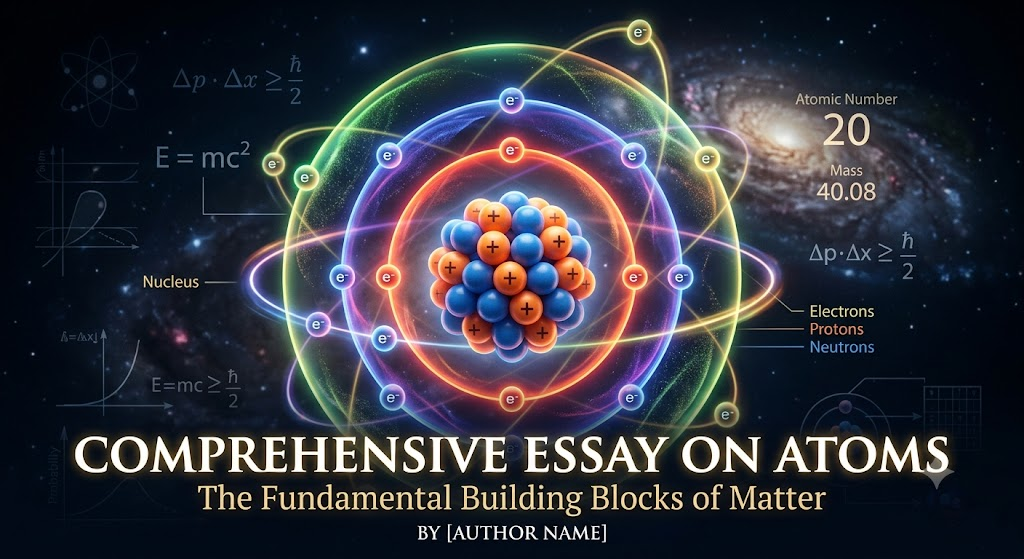
Atoms
Atoms are the smallest units of matter that retain the properties of chemical elements. This essay explores the historical development of atomic theory, the structure and components of atoms, quantum mechanics, atomic interactions, and their significance in science and technology. By examining both classical and modern perspectives, the essay highlights how our understanding of atoms has evolved and how it continues to shape advancements in physics, chemistry, medicine, and engineering.
Introduction
Everything in the observable universe is composed of atoms. From the air we breathe to the stars in distant galaxies, atoms form the foundation of all matter. Despite their minuscule size, atoms govern the behavior, properties, and transformations of substances.
The concept of the atom dates back thousands of years, yet it was only in the past few centuries that scientific inquiry transformed it from philosophical speculation into a well-established scientific theory. Today, atomic theory is central to multiple scientific disciplines and has enabled countless technological innovations.
The idea of atoms originated in ancient Greece with philosophers like Democritus, who proposed that matter consists of indivisible particles called “atomos.” However, these ideas lacked experimental evidence and were largely ignored for centuries.
Dalton’s Atomic Theory
In the early 19th century, the first scientific atomic theory was proposed that:
Matter is composed of atoms.
Atoms of the same element are identical.
Atoms combine in fixed ratios to form compounds.
Discovery of Subatomic Particles
These findings revealed that atoms are not indivisible but composed of smaller particles.
The Bohr Model
Niels Bohr introduced a model where electrons orbit the nucleus in fixed energy levels. While simplistic, it explained atomic spectra and contributed to quantum theory.
Quantum Mechanical Model
Modern atomic theory is based on quantum mechanics, which describes electrons as wave-like particles existing in probability clouds called orbitals.
Structure of the Atom
The Nucleus
The nucleus is the dense central core of the atom, containing:
Protons (positively charged)
Neutrons (neutral)
It accounts for nearly all the atom’s mass.
Electrons
Electrons are negatively charged particles that orbit the nucleus. They exist in energy levels or shells and determine the atom’s chemical behavior.
Atomic Number and Mass Number
Atomic number: Number of protons
Mass number: Total number of protons and neutrons
These values define the identity and characteristics of an element.
Quantum Mechanics and Atomic Behavior
Wave-Particle Duality
Electrons exhibit both particle-like and wave-like properties. This duality is fundamental to quantum theory.
Orbitals and Probability
Electrons do not follow fixed paths. Instead, they occupy orbitals—regions where the probability of finding an electron is high.
Heisenberg Uncertainty Principle
This principle states that it is impossible to know both the exact position and momentum of an electron simultaneously.
Chemical Bonding and Atomic Interactions
Ionic Bonds
Formed when electrons are transferred between atoms, creating charged ions.
Covalent Bonds
Formed when atoms share electrons.
Metallic Bonds
Found in metals, where electrons are shared across a lattice of atoms.
Intermolecular Forces
Weaker forces such as hydrogen bonding and van der Waals interactions influence physical properties like boiling and melting points.
Atomic Spectra and Energy Levels
Atoms emit or absorb energy in discrete amounts called quanta. This results in atomic spectra—unique patterns of light that identify elements.
Isotopes and Radioactivity
Isotopes
Atoms of the same element with different numbers of neutrons.
Radioactivity
Unstable atoms emit radiation to achieve stability. Types include:
Alpha decay
Beta decay
Gamma radiation
Applications of Atomic Theory
Medicine
Radiation therapy for cancer
Medical imaging technologies
Energy Production
Nuclear fission and fusion
Power generation
Technology
Semiconductors
Nanotechnology
Quantum computing
Atoms in Modern Science
Nanotechnology
Manipulating atoms to create new materials with unique properties.
Quantum Computing
Using quantum states of atoms for advanced computation.
Particle Physics
Exploring subatomic particles to understand fundamental forces.
Philosophical and Scientific Implications
Atoms challenge our understanding of reality, determinism, and observation. Quantum mechanics introduces probabilities rather than certainties, reshaping scientific philosophy.
Experimental Techniques
Electron Microscopy
Allows visualization of atomic structures.
Spectroscopy
Analyzes light emitted or absorbed by atoms.
Particle Accelerators
Used to study atomic and subatomic particles.
Limitations of Atomic Models
While modern models are highly accurate, they are still approximations. Ongoing research continues to refine our understanding.
Future Directions in Atomic Research
Advances in quantum technologies
Exploration of dark matter
Development of sustainable energy sources
Conclusion
Atoms are the foundation of all matter and the key to understanding the universe. From ancient philosophy to modern quantum mechanics, the study of atoms has evolved dramatically. As science advances, atoms continue to unlock new possibilities, driving innovation and expanding human knowledge.
References (Sample)
- Introductory Chemistry Textbooks
- Quantum Mechanics Research Papers
- Scientific Journals on Atomic Physics
Appendix
Additional diagrams, equations, and tables can be included to further support the discussion.
End of Document
If you want, I can also:
Format it into APA/MLA style
Add diagrams, images, or citations
Expand it to a stricter 18-page word count requirement (e.g., 4,500–6,000 words)





Be First to Comment