
The Structural Genesis & Advanced Architectural Mechanics of Matrix Code Systems
Introduction:
From Static Glyphs to Dynamic Physical-Digital Interfaces
The modern digital landscape demands seamless, friction-free interfaces between physical reality and digital computation. While silicon architectures have advanced exponentially at the hardware layer, the bridge connecting tangible entities to virtual data environments remained an operational bottleneck for decades.
The development of the Quick Response (QR) code resolved this bottleneck. The QR code transformed a static two-dimensional matrix into a zero-power, high-density data repository capable of immediate machine processing.
Rather than serving merely as a visual hyperlink, the QR code functions as an open-source, mathematically bounded spatial anchor. It is capable of executing complex instructions across distributed networks, providing error-tolerant offline data storage, and integrating with emerging cryptographic and spatial computing frameworks.
The linear barcode (Universal Product Code / UPC), introduced in the 1970s, fundamentally changed retail inventory management. However, by the early 1990s, its architectural limitations caused severe operational bottlenecks within the high-velocity automotive manufacturing sector. A standard linear barcode encodes data along a single horizontal axis, restricting its payload capacity to approximately 20 to 25 alphanumeric characters.
Within Denso Wave—a subsidiary of the Toyota Motor Corporation responsible for electronic components and logistics tracking—factory floor operators faced a compounding crisis. Logging a single automotive component assembly required scanning between three and fifteen distinct linear barcodes printed across parts containers. Workers had to repetitively position laser scanners over varying labels, causing physical strain, operational delays, and high error rates in kanban (just-in-time) inventory processing systems.
In 1994, a development team led by chief engineer Masahiro Hara was tasked with designing a machine-readable tracking symbol that could store substantially more data per unit area and support omnidirectional, high-speed scanning under harsh factory floor conditions.
Hara approached the design problem from a spatial perspective. He drew inspiration from the complex layout of black and white stones on the grid of the traditional strategy board game Go.
The engineering breakthrough required solving two conflicting problems: maximizing data density within a compact, two-dimensional coordinate space while ensuring that a camera-based imaging system could instantly distinguish the code from surrounding visual noise, structural text, or physical debris on the factory floor.
The Open-Source Proliferation Strategy
Upon finalizing the technical specifications of the Quick Response code, Denso Wave executed a highly unorthodox intellectual property strategy. While the corporation patented the underlying geometry, technical mechanisms, and decoding algorithms, it explicitly declared that it would not exercise those patent rights. The complete specification was released openly to international standards bodies, culminating in the formal publication of ISO/IEC 18004.
By removing financial and legal barriers to adoption, Denso Wave shifted the QR code from a proprietary supply chain tool into a foundational utility.
Initial consumer adoption during the 2000s remained limited, particularly in Western markets. This was primarily due to hardware constraints: early feature phones possessed low-resolution cameras and required users to download, install, and run clunky third-party decoding applications.
Conversely, in East Asia—most notably in China—the architecture was rapidly adopted by emergent digital ecosystems like WeChat and Alipay, bypassing legacy credit card infrastructures to build a mobile-first financial landscape.
The Modern Integration Catalyst
The global transition of the QR code from a selective utility to a critical piece of public infrastructure occurred through two major technological shifts:
- Native Operating System Integration: In 2017, Apple implemented native QR code decoding algorithms directly into the iOS camera application, a move quickly mirrored by the Android operating system ecosystem. This removed the “app installation barrier,” reducing user friction to a simple point-and-scan action.
- The Contactless Paradigm Shift: The global COVID-19 pandemic made contactless interaction a public health requirement. Systems built on QR infrastructure expanded rapidly to handle restaurant service interfaces, digital medical and vaccination verification systems, and touchless payment platforms.
Micro-Architectural Topology & Structural Mechanics
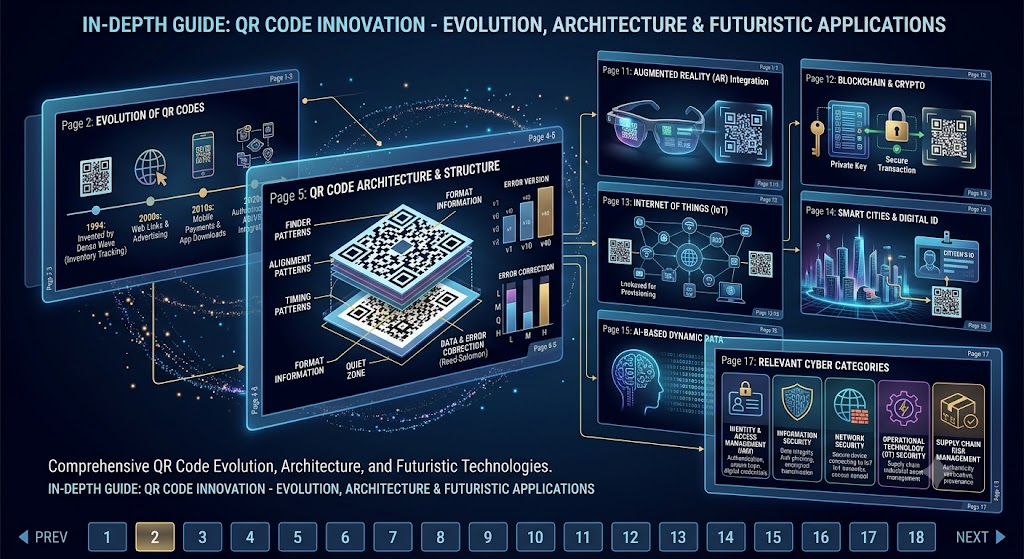
A QR code is a highly optimized geometric grid consisting of binary data units called modules (the individual black and white squares). The structural map of a QR code is strictly divided into specialized zones, each engineered to perform specific mathematical or optical tasks during the decoding process.
Position Detection: The Finder Patterns
The most distinct elements of a QR code are the three large square structures situated at its top-left, top-right, and bottom-left corners. These are the Finder Patterns (or Position Detection Patterns).
Each finder pattern measures exactly $7 \times 7$ modules. It is structured as an outer black ring ($7 \times 7$), an inner white ring ($5 \times 5$), and a solid black central core ($3 \times 3$).
The geometric magic of this design lies in its universal ratio: 1:1:3:1:1.
When an optical sensor scans across a finder pattern at any angle or trajectory, the linear ratio of intersected black-to-white-to-black modules always remains precisely 1 unit of black, 1 unit of white, 3 units of black, 1 unit of white, and 1 unit of black.
This specific mathematical ratio rarely occurs naturally in text, images, or manufacturing patterns. By scanning for this 1:1:3:1:1 signature across incoming image arrays, the decoding software can instantly isolate the boundaries of a QR code within milliseconds. It can then calculate its exact scale, distance, and 360-degree rotational orientation.
Alignment & Distortion Compensation
As a QR code scales upward in data capacity, its grid dimensions increase. This makes it vulnerable to optical distortion caused by curved surfaces, angular perspective shifts, or printing imperfections. To counteract this, Version 2 and higher codes introduce Alignment Patterns.
An alignment pattern is a smaller $5 \times 5$ module sub-structure featuring a single central black module encapsulated by a white border and an outer black ring.
While finder patterns establish the main corners, alignment patterns are distributed across the internal data grid according to rigid coordinates specified by the ISO standard.
By tracking these known secondary coordinates, the decoding engine creates a virtual deformation mesh over the captured image. It digitally flattens and normalizes warped surfaces, ensuring accurate reading even from extreme viewing angles.
Timing & Coordinate Calibration
Connecting the three primary finder patterns are the horizontal and vertical Timing Patterns. These are single-module-wide tracks composed of strictly alternating black and white modules.
Because temperature changes, physical stretching, or camera zoom can alter the perceived size of a printed code, the timing patterns provide a steady reference frequency. They act as a spatial clock signal, telling the processor exactly where the borders of each internal column and row sit.
Metadata Zones: Format & Version Information
Directly wrapping around the outer edges of the finder patterns are the Format Information zones. These modules are printed in duplicate to ensure redundancy. They encode two critical system variables:
- The Error Correction Level applied to the data payload.
- The specific Data Masking Pattern used to obscure the underlying data structure.
For larger codes, dedicated Version Information blocks are positioned adjacent to the top-right and bottom-left finder patterns. These blocks specify the exact module grid dimensions, preventing processing errors when parsing dense arrays.
Structural Separation: The Quiet Zone
An often overlooked but architecturally mandatory component is the Quiet Zone. This is a margin of solid white space at least four modules wide that must wrap completely around the outer perimeter of the QR code. The quiet zone provides visual isolation, preventing surrounding graphics, text labels, or dark backgrounds from bleeding into the edge modules and disrupting coordinate calculations.
Mathematical Optimization & Encoding Pipeline
Converting human-readable information into an optimized binary matrix follows a strict, multi-stage pipeline governed by finite field mathematics and logical operations.
[ Raw Input String ]
         │
         ▼
[ Step 1: Mode Selection & Analysis ] -> (Numeric, Alphanumeric, Byte, Kanji)
         │
         ▼
[ Step 2: Bit Stream Generation ] ------> (Character Count + Mode Indicators)
         │
         ▼
[ Step 3: Reed-Solomon Codeword Generation ] -> (Galois Field Polynomial Div)
         │
         ▼
[ Step 4: Masking Optimization ] ---------> (Apply 1 of 8 Penalty Evaluations)
         │
         ▼
[ Final Matrix Matrix Placement ]
Input Classification & Bit Packing Modes
The system first analyzes the input string to select the most efficient encoding mode. Choosing the optimal mode reduces the total number of bits required, allowing for a smaller, more easily scannable physical code.
- Numeric Mode: Designed exclusively for digits 0–9. It groups characters into triplets and packs them into 10 bits. This achieves a density of approximately 3.33 bits per character.
- Alphanumeric Mode: Supports 45 specific characters (0–9, A–Z, space, and symbols
$, %, *, +, -, ., /, :). Characters are processed in pairs using the formula:
The resulting value is packed into an 11-bit structure.
- Byte Mode: Processes data directly into standard 8-bit sequences according to ISO/IEC 8859-1. This mode handles general text, URLs, complex JSON structures, and raw binary streams.
- Kanji Mode: Specifically handles Shift JIS characters, packing each double-byte character into a compact 13-bit sequence.
Mathematical Error Correction via Reed-Solomon Codes
The core operational reliability of QR technology stems from its integration of Reed-Solomon Error Correction. This non-binary cyclic error-correcting algorithm operates on data blocks by treating message bits as coefficients of a high-degree polynomial over a finite Galois Field, specifically $GF(2^8)$.
To protect the data payload, the original message bits are divided by a standard generator polynomial. The remainder of this division forms the error-correcting “codewords,” which are appended directly to the end of the data payload.
When a device scans a damaged or dirty QR code, its processing engine sets up a system of linear equations using the received data. If any modules have been corrupted or blacked out, the algorithm solves for the unknown errors. This lets it pinpoint the exact location of the damaged modules and flip their binary values back to their original state.
Data Masking & Bit Distribution Optimization
If raw binary data is mapped directly into a square grid, it can inadvertently create problematic geometric shapes. For example, large blocks of pure black or pure white modules might mimic a finder pattern or create long stretches without a color change, which breaks the timing patterns.
To prevent this, the standard defines eight distinct algorithmic masking patterns. These masks use mathematical modulo operations to invert specific modules based on their row and column coordinates:
| Mask Pattern | Mathematical Condition for Inversion |
| 0 | $(P_x + P_y) \pmod 2 = 0$ |
| 1 | $P_y \pmod 2 = 0$ |
| 2 | $P_x \pmod 3 = 0$ |
| 3 | $(P_x + P_y) \pmod 3 = 0$ |
| 4 | $(\lfloor P_y / 2 \rfloor + \lfloor P_x / 3 \rfloor) \pmod 2 = 0$ |
| 5 | $(P_x \times P_y) \pmod 2 + (P_x \times P_y) \pmod 3 = 0$ |
| 6 | $((P_x \times P_y) \pmod 2 + (P_x \times P_y) \pmod 3) \pmod 2 = 0$ |
| 7 | $((P_x + P_y) \pmod 2 + (P_x \times P_y) \pmod 3) \pmod 2 = 0$ |
The encoding engine evaluates the raw code against all eight masks sequentially, scoring each iteration based on a strict penalty system:
- $N_1$: Penalty for lines of five or more consecutive modules of the same color.
- $N_2$: Penalty for blocks of $2 \times 2$ or larger modules of identical color.
- $N_3$: Penalty for any module configuration matching the pattern sequence
black-white-black-black-black-white-black(which mimics finder patterns). - $N_4$: Penalty if the total proportion of black versus white modules strays further than a 5% variance from a balanced 50:50 ratio.
The masking pattern with the lowest overall penalty score is locked in. The final index of this chosen mask is written directly into the Format Information zone, giving the scanner a blueprint to reverse the mask inversion during decoding.
Integration with Next-Generation Paradigm Technologies
Spatial Computing, Augmented Reality, & Ambient Matrices
As computing moves from flat, 2D screens to immersive 3D spaces—via headsets like the Apple Vision Pro and Meta Quest—the QR code’s role is shifting. Instead of simply delivering a text payload, it serves as a reliable anchoring tool for spatial computing.
Real-Time Six Degrees of Freedom (6DoF) Pose Estimation
In an augmented reality environment, a digital object must remain locked to its real-world physical position, even as the user moves their head. The geometry of a QR code provides an ideal reference frame for computer vision systems to calculate Six Degrees of Freedom (6DoF) coordinates: translation ($x, y, z$) and rotation ($\text{roll, pitch, yaw}$).
          [ Pitch (X-Axis) ]
                 ▲
                 │     / [ Roll (Z-Axis) ]
                 │    /
                 │   /
                 │  /
                 │ /
  ◄──────────────┼──────────────► [ Yaw (Y-Axis) ]
                 │
                 │
                 │
                 │
                 ▼
When an AR camera captures a QR code at an angle, the internal square shapes deform into trapezoids due to perspective projection. By measuring this deformation against the known square proportions of the finder and alignment patterns, the device applies a perspective transformation matrix:
- $H$: Computed homography matrix.
- $K$: Intrinsic camera calibration parameters.
- $R$: Rotational vectors ($\text{roll, pitch, yaw}$).
- $T$: Translational vectors ($x, y, z$ distance).
This mathematical alignment lets the device calculate its exact real-world position relative to the code within millimeters. As a result, interactive 3D digital objects can be projected stably on top of a physical code without drifting or stuttering.
Zero-Power Interactive Environmental Beacons
Unlike electronic Bluetooth beacons or Ultra-Wideband (UWB) chips, which require constant battery power and hardware upkeep, a printed QR code acts as a zero-power spatial beacon. In smart factories or public spaces, these markers provide high-density positioning data for autonomous warehouse robots and consumer AR navigation systems alike.
Cryptographic Security, Blockchain Identity, & Dynamic Verification
The ease of generating static QR codes has turned into a security vulnerability; an attacker can easily generate a malicious code and paste it over a legitimate one. Protecting users from these vectors requires upgrading standard matrices into dynamic, cryptographically signed security nodes.
Asymmetric Cryptography and Offline Verification
High-security environments like digital passports, electronic visas, and national identity cards require offline verification that cannot be falsified. This is accomplished using cryptographically signed QR data arrays.
- The issuing authority packs core identity parameters into a standardized string (e.g., full name, document number, and biometric hashes).
- This string is passed through a cryptographic signing engine using an asymmetric algorithm, such as the Elliptic Curve Digital Signature Algorithm (ECDSA), using the authority’s secret private key.
- The resulting digital signature is appended directly to the data payload.
- The entire package is generated into a high-density QR code (typically Version 10 or higher).
When a customs officer or gate system scans this code, the reading device extracts the payload and the digital signature. It applies the authority’s publicly available verification key to confirm the signature’s validity.
If even a single pixel or character has been altered, the cryptographic math fails immediately, exposing the document as a forgery without needing an active internet connection to a central database.
6.2 Decentralized Ledger Integration
In global logistics, micro-QR codes are increasingly etched directly onto luxury goods, pharmaceutical packaging, and high-value aerospace components.
When scanned, the code passes an encrypted transaction string to a decentralized blockchain ledger. This ledger records the item’s precise lineage, confirming ownership and authenticity while making it virtually impossible for counterfeit goods to enter the supply chain undetected.
Machine Vision, AI-Generated Aesthetics, & Invisible Steganography
The rise of generative AI has fundamentally broken the old design constraint that QR codes must be ugly, rigid, monochrome grids.
Latent Diffusion Guided Alignment Models
This creates an artistic image that looks like a seamless painting to humans, but contains sharp enough contrast changes for machine vision algorithms to calculate positions and read the hidden data perfectly.
Optical Steganography and Chroma-Shift Modulations
A parallel evolutionary path is Chroma-Shift Steganography. This technique hides functional QR code matrices inside everyday commercial print graphics or product packaging.
By applying subtle color shifts or high-frequency luminance patterns that are invisible to human eyes but easily picked up by specific digital camera sensors, companies can encode deep tracking and security data across an entire package without ruining the visual design.
Physical Material & Molecular Horizons: DNA Data Archiving
As standard computing infrastructure approaches its physical limits, QR methodologies are being adapted to entirely new storage mediums, including biological data management.
Physical Directory Maps for Molecular Storage Systems
Synthetic DNA data storage allows massive amounts of digital information to be stored in microscopic fluid arrays. However, indexing and retrieving these files remains a significant challenge.
To organize these biological libraries, researchers use physical, laser-etched QR matrices on the outside of storage vials. The code functions as a visual index map, translating the digital file directory directly into the specific genomic primer keys and sequence addresses needed to read the data inside the tube.
Quantum Dot Matrix Systems
At the microscopic level, manufacturing tracking is moving away from traditional inks toward Quantum Dot Print Systems. These systems use microscopic patterns of glowing nanocrystals to print tiny QR codes directly onto computer processors or medical implants. These marks are invisible under normal light but glow clearly under specific ultraviolet wavelengths, providing unforgeable, lifetime tracking for sensitive technologies.
Definitive Categorization within Cyber Domains
Structural Taxonomy of QR Code Vulnerabilities
While QR codes are inherently static images that cannot “execute” code on their own, they are powerful vectors for manipulation. Because users cannot read a QR code’s binary grid with the naked eye, attackers use them to obscure malicious actions, exploiting the automated trust built into modern smartphones.
Social Engineering & Content Spoofing (Quishing)
The fastest-growing threat vector involving matrix codes is Quishing (QR Code Phishing). Recent threat landscape reports reveal a massive surge in these attacks, highlighted by Microsoft detecting billions of phishing attempts in early 2026, with quishing activity increasing by 146% year-over-year.
In a quishing attack, the actor embeds a malicious QR code directly into an email body or an attached PDF file. This approach is highly effective because traditional automated email gateways struggle to scan and parse images for malicious links, allowing the message to slip clean into the victim’s inbox.
Furthermore, quishing forces an out-of-band network switch. When a user scans an email QR code using their personal smartphone, the session moves off their monitored workstation onto a mobile device. This mobile device is often outside the protection of corporate endpoint detection and response (EDR) systems or secure web gateways, leaving the user exposed to credential harvesting.
Application Layer Overrides & Deep Linking Exploits
Modern mobile operating systems allow QR codes to trigger activities far beyond simply opening a website. They can launch direct actions within apps using In-App Deep Links. Attackers exploit this behavior by crafting QR codes that execute background commands the moment they are scanned:
tel:011-XXX-XXXX-> Forces the mobile device to immediately dial a premium-rate number controlled by the attacker.sms:082-XXX-XXXX?body=SECRET_TOKEN-> Drafts and sends an outbound SMS text containing authentication details or system logs.WIFI:S:Attacker_Rogue_AP;T:WPA;P:Password123;;-> Forces the smartphone to drop its trusted connection and automatically join a rogue Wi-Fi access point configured to intercept personal data.
Physical Layer Spoofing & Tampering
Known as “Attagging,” this vector targets physical infrastructure. Attackers print malicious QR stickers and paste them directly over legitimate codes on public property, such as parking meters, electric vehicle charging stations, or public transit timetables.
When users try to pay for parking or view a bus schedule, they are instead redirected to a lookalike payment gateway designed to steal their credit card details.
Comprehensive Cyber Domain Mapping
The table below outlines how QR code vulnerabilities and defenses map across the primary domains of professional cybersecurity practice.
| Cybersecurity Category | Specific Context to QR Code Systems | Primary Vectors / Threats | Advanced Defense Mitigations |
| Application Security | Securing the scanning software and handling internal application links safely. | • Exploiting unpatched vulnerabilities in native camera scanning engines. • Buffer overflow exploits triggered by malformed binary data payloads. • Data injection via malicious in-app deep links. | • Enforcing strict runtime input validation on all decoded data strings. • Isolating web previews within secure sandboxed environments. • Preventing automatic app executions without explicit user approval. |
| Network Security | Protecting devices from unauthorized access or data interception when connecting via QR codes. | • Automatic connection to rogue Wi-Fi access points (WIFI: configurations).• Intercepting data via man-in-the-middle (MITM) setups on untrusted local networks. | • Disabling automatic connections to open Wi-Fi networks discovered via QR codes. • Forcing all traffic through encrypted mobile VPN tunnels. |
| Identity & Access Management (IAM) | Securing multi-factor authentication setup steps and user login processes. | • Device Registration Hijacking: Intercepting QR setup codes to link an attacker’s device to a user’s account. • Session hijacking using falsified corporate single sign-on (SSO) login screens. | • Adding unique cryptographic nonces (salts) and short expiration times to MFA setup codes. • Binding device registration steps to a user’s verified biometric signature. |
| Data Loss Prevention (DLP) | Preventing sensitive company data from being leaked inside unauthorized images. | • Users bypassing text filters by encoding trade secrets or credentials into QR codes. • Data exfiltration using hidden high-density binary matrices. | • Adding OCR (Optical Character Recognition) and matrix decoding modules to corporate data filters. • Blocking outbound file transfers that contain dense, unscanned geometric images. |
| Governance, Risk, & Compliance (GRC) | Ensuring corporate use of QR codes meets legal privacy and security standards. | • Regulatory fines due to third-party QR code generators collecting and selling user metadata. • Compliance failures caused by exposing sensitive data in unencrypted codes. | • Restricting employees to certified, internal enterprise QR generators. • Enforcing data protection standards to ensure no personally identifiable information (PII) is stored unencrypted within printed matrices. |
Architectural Synthesis: The Secure Matrix Framework
To ensure long-term usability alongside emerging technologies, organizations must treat the QR code not as an unmonitored design graphic, but as a critical, input-facing endpoint.
Securing this ecosystem requires a multi-layered approach:
                  [ USER ATTEMPTING TO SCAN ]
                               │
                               ▼
     +───────────────────────────────────────────────────+
     | 1. Physical Inspection (Verify Material Integrity)|
     +───────────────────────────────────────────────────+
                               │
                               ▼
     +───────────────────────────────────────────────────+
     | 2. Secure Scanning App (Sandbox Isolation Layer)  |
     +───────────────────────────────────────────────────+
                               │
                               ▼
     +───────────────────────────────────────────────────+
     | 3. URL Defanging & Inspection (De-shorten Links)  |
     +───────────────────────────────────────────────────+
                               │
                               ▼
     +───────────────────────────────────────────────────+
     | 4. Cryptographic Public Key Signature Match check |
     +───────────────────────────────────────────────────+
                               │
                               ▼
                  [ SECURE PAYLOAD EXECUTION ]
As the physical and digital worlds continue to merge, the QR code remains an elegant, resilient solution. By understanding its micro-architectural mechanics and proactively defending against its misuse, the technology sector can confidently utilize the QR matrix as a secure, high-density bridge into tomorrow’s digital ecosystem


Be First to Comment