
Introduction
The realization of the African Union’s Agenda 2063 and the United Nations Sustainable Development Goals hinges fundamentally on a robust physical and digital foundation. Across all 54 African nations, a persistent infrastructure deficit operates as a primary binding constraint on economic growth, structural transformation, and societal equity. While infrastructure investments accounted for over half of Africa’s growth acceleration in recent decades, the continent—particularly Sub-Saharan Africa—consistently falls behind other developing regions in core metrics.
Historically engineered around colonial extraction routes or early post-independence choices, contemporary networks are heavily fragmented and structurally misaligned with local developmental priorities. Infrastructure – African Futures. Addressing this issue requires navigating a complex environment shaped by rapid population growth, changing global financial conditions, and an urgent need for climate resilience.
Quantifying the Macro-Economic Burden
Recent econometric data underscores the massive toll that the infrastructure backlog extracts from the continent’s macroeconomic potential.
- Economic Growth Friction: The accumulated infrastructure deficit reduces Africa’s annual GDP growth by approximately two percentage points.
- Firm Productivity Loss: Weak energy grids and inefficient logistics raise transaction costs, dropping overall business productivity across the continent by up to 40%.
- Welfare and Health Costs: Deficiencies specifically in water and sanitation systems drain approximately 5% of the continent’s aggregate GDP annually due to healthcare burdens and lost economic hours Infrastructure.
Currently, Africa’s real GDP growth forecasts sit between 3.8% and 4.2% Trends. While these rates outpace global averages, they remain far below the 7% minimum annual growth required to meaningfully lift expanding populations out of poverty and achieve structural transformation. Recent economic modeling highlights how deeply integrated infrastructure is with economic performance: a 10% improvement in transportation networks alone triggers a 0.26% expansion in overall trade and a 2.2% spike in labor-intensive employment Gap in Africa. .
Sectoral Backlogs Across the 54 Nations
The Energy Crisis
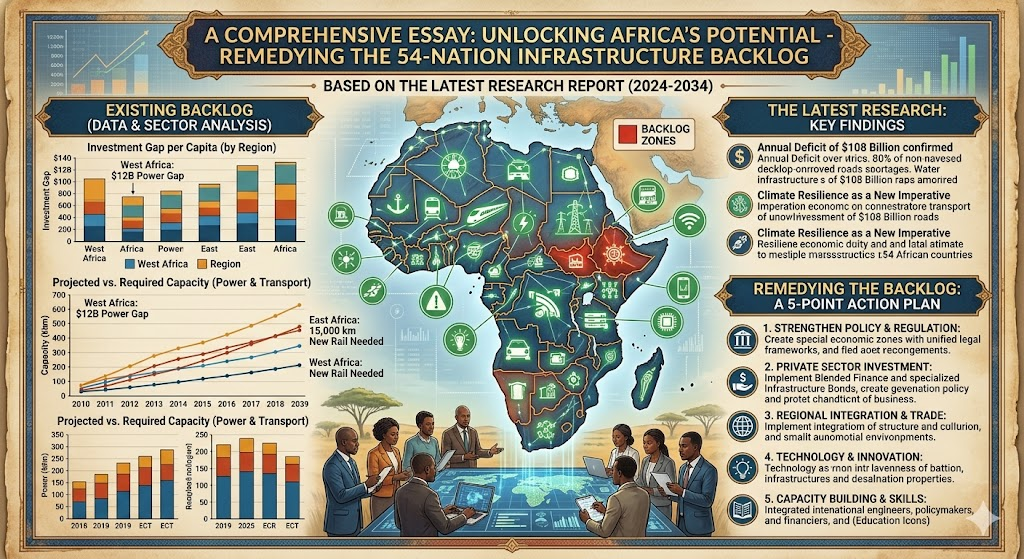
Energy is the single most restrictive bottle-neck to continental development and Opportunities. As of recent estimates, roughly 58% of Africa’s population has electricity access, leaving approximately 600 million people entirely disconnected from the grid. The distribution of power is heavily polarized: universal access is a reality only in a few outlier nations, such as Egypt, Mauritius, Seychelles, Morocco, Algeria, and Tunisia Infrastructure. Per capita electricity generation across the rest of the continent is less than one-third of the levels seen in South America. Under status quo spending trajectories, more than 540 million Africans will still lack electricity access by 2050.
Transport, Ports, and Logistics
Transportation networks struggle under a severe deficit of both scale and uniformity. Roads act as the absolute lifeblood of local commerce, carrying 80% of freight and 90% of all passenger traffic. Yet, Africa maintains the lowest road density worldwide; its cumulative length of paved roads is less than one-fourth of South Asia’s road footprint.
The rail network is deeply fragmented, constrained by a historical mix of different track configurations. which demands costly, time-consuming transshipment processes at national borders (“Infrastructure Gap in Africa: Trends and Opportunities. Furthermore, port capacity is highly unequal. Northern African states host dense, highly modern international maritime gateways, while South Africa, Nigeria, and Angola dominate the remaining coastal logistics landscape, leaving many regional economies structurally isolated.
Water and Urban Sanitation
Rapid urbanization is creating immense stress across Africa’s major urban centers. As millions migrate to expanding hubs like Lagos, Kinshasa, Cairo, and Nairobi, city systems face unprecedented demand for clean water, modern mass transit, and waste management. Decades of deferred maintenance have created a critical issue where aging municipal networks lose between 40% and 60% of their water supply entirely to leaks and theft before it ever reaches a consumer.
The Financial Anatomy of the Deficit
The infrastructure financing gap—the divide between required capital investment and actual execution—is currently estimated between $68 billion and $108 billion annually, within a broader total required investment envelope of $130 billion to $170 billion per year.
+-------------------------------------------------------+
|  Total Annual Investment Required: $130B - $170B       |
+-------------------------------------------------------+
                         |
      +------------------+------------------+
      |                                     |
      v                                     v
+------------------------+        +------------------------+
| Current Annual Spend   |        | Annual Financing Gap   |
| ~ $62B - $102B         |        | $68B - $108B           |
+------------------------+        +------------------------+
This target continues to move further away because demographic shifts and the escalating costs of climate-resilient engineering outpace current spending increases.
Compounding this gap is a challenging global financial environment. The era of low-cost Eurobond financing has largely ended due to global inflationary pressures and high interest rates in advanced economies (“Infrastructure Gap in Africa: Trends and Opportunities. This shift has placed many governments in a fiscal bind; eight African countries are currently in debt distress, and another fifteen face high risk. This debt burden forces states to redirect scarce domestic revenues away from long-term capital expenditure (CAPEX) to service immediate debt obligations.
Furthermore, capital allocation is hindered by a project preparation bottleneck: roughly 80% of infrastructure designs fail at the initial feasibility stage. This is rarely due to a lack of true economic value, but rather stems from poor project preparation and a wide gap between perceived investment risk and actual operating reality.
Strategic Remedies to Close the Backlog
To systematically dismantle the infrastructure backlog by 2050, the African Development Bank, the OECD, and leading policy groups suggest a multi-layered approach centered on five structural interventions (“African Development Bank launches 54 Country Focus Reports.
Technical Leapfrogging via Decentralization
African nations can bypass the centralized, capital-heavy infrastructure models of the 20th century, mirroring how the continent skipped landline telecom networks in favor of mobile technology.
- Modular Rollouts: Deploying localized mini-solar grids, modular water treatment systems, and satellite broadband allows infrastructure to scale incrementally with actual localized demand. This avoids massive, upfront capital investments that risk outrunning near-term revenues.
- Smart Maintenance: Integrating Internet-of-Things (IoT) sensors, predictive data analytics, and digital twin monitoring can help transition operations away from reactive crisis-management, extending the functional life of existing physical assets.
Comprehensive Global Financial Architecture Reform
Bridging the gap requires updating how international capital interacts with developing economies.
- MDB Business Models: Multilateral Development Banks (MDBs) need to scale up long-term, low-interest concessional financing, expand their core capital positions, and rechannel the International Monetary Fund’s Special Drawing Rights (SDRs) directly to the countries in greatest need.
- Debt Workouts: Replacing slow, unresponsive frameworks with fast market-based debt resolutions, sovereign debt authority systems, and debt-for-climate-action swaps can free up domestic capital for infrastructure investment.
De-Risking and Private Sector Integration
Private investment remains crucial for supporting public capital in high-return social and economic areas.
- Blended Finance: Utilizing targeted risk-mitigation tools, first-loss guarantees, and political risk insurance can compress the risk premium that deters international pension and institutional funds.
- Standardized Preparation: Streamlining and standardizing project preparation toolkits across municipal and national agencies can help reduce the 80% failure rate seen during early feasibility stages.
4. Maximizing Domestic Resource Mobilization
Sustainable long-term development relies on strengthening internal financial systems.
- Tax and Revenue Efficiency: Modernizing tax administration, plugging systemic leaks, and curbing illicit financial flows can reclaim substantial local revenue.
- Sovereign Wealth Maximization: Strategically leveraging the continent’s extensive natural resource bases to capitalize domestic infrastructure funds can help insulate long-term projects from volatile external currency fluctuations.
5. Cross-Border Harmonization
To unlock the full benefits of the African Continental Free Trade Area (AfCFTA), infrastructure must be integrated regionally rather than managed solely within national borders.
- Logistics Corridors: Prioritizing trans-continental highways, standardized rail gauges, and co-managed regional power pools can eliminate border friction and maximize the economic returns on infrastructure investments.
Conclusion
The infrastructure backlog across Africa’s 54 countries presents a significant developmental challenge, but it also offers an unprecedented investment opportunity. Closing this gap requires moving past outdated, centralized paradigms and inefficient project preparation. By blending domestic capital, reforming global financial frameworks, and adopting decentralized, smart technologies, the continent can build a resilient foundation for sustainable economic growth and long-term industrialization.
References
- 11 Large Infrastructure. (2026). African Futures. https://futures.issafrica.org/thematic/11-large-infrastructure/
Cited by: 0 - African Development Bank Group. (2025). African Development Bank launches 54 Country Focus Reports. https://www.afdb.org/en/news-and-events/events/african-development-bank-launches-54-country-focus-reports-73052
Cited by: 0 - African Development Bank Group. (n.d.). Infrastructure Development. Retrieved May 24, 2026, from https://www.afdb.org/en/knowledge/publications/tracking-africa%E2%80%99s-progress-in-figures/infrastructure-development
Cited by: 0 - MOHAC Africa. (2026). Infrastructure Gap in Africa: Trends and Opportunities (2026 Report). https://mohacafrica.org/infrastructure-gap-in-africa/
Cited by: 0 - PwC South Africa. (2026). South African Infrastructure Outlook 2025–50





Be First to Comment