
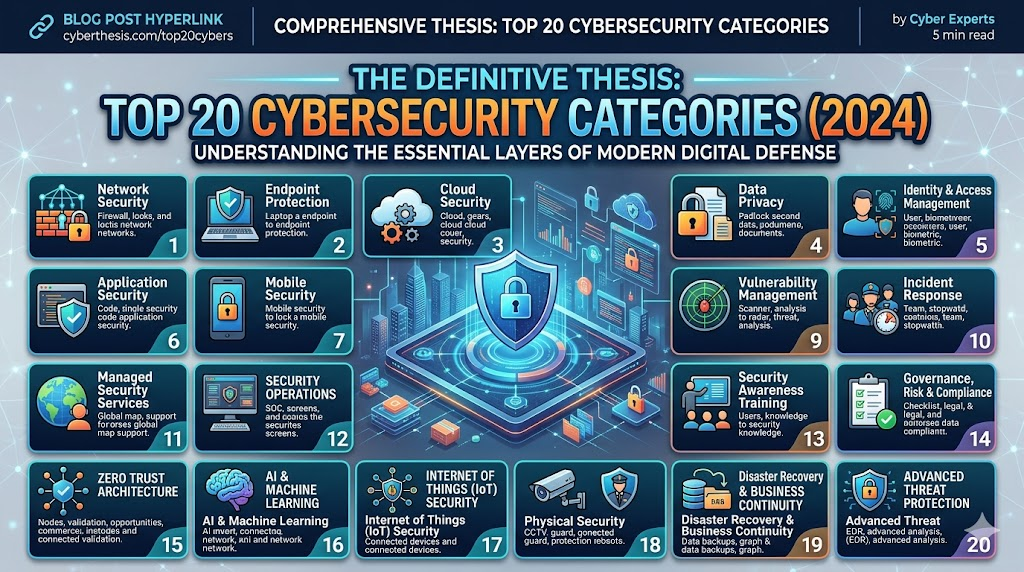
Modern enterprise architecture has evolved past the traditional “castle-and-moat” perimeter paradigm. The ubiquity of distributed cloud topologies, hyper-automated CI/CD pipelines, and the integration of artificial intelligence have expanded the corporate attack surface. This thesis establishes a comprehensive taxonomy of twenty distinct cybersecurity disciplines, analyzing their mathematical foundations, operational mechanics, and contemporary points of vulnerability.
| Category | NIST Alignment | Mathematical / Operational Engine |
| 1. Network Security | Protect / Detect | Deep Packet Inspection & State Checking |
| 2. Cloud Security | Identify / Protect | Immutable Infrastructure Enforcement & IAM |
| 3. Endpoint Security | Detect / Respond | Behavioral Heuristics & EDR Telemetry Loop |
| 4. Application Security | Protect | DAST, SAST, & Abstract Syntax Tree Analysis |
| 5. Identity & Access Management (IAM) | Identify / Protect | Cryptographic Tokens & RBAC / ABAC Policies |
| 6. Data Security & Cryptography | Protect | $AES-GCM$, $RSA$, & Lattice-Based Schemes |
| 7. Mobile Security | Protect / Detect | MDM Sandbox Isolation & App Code Signing |
| 8. IoT & OT Security | Identify / Protect | Protocol Parsing (Modbus/BACnet) & Air-Gaps |
| 9. Zero Trust Architecture (ZTA) | Protect | Micro-segmentation & Continuous Policy Engines |
| 10. AI & Machine Learning Security | Protect / Detect | Adversarial Hardening & LLM Guardrailing |
| 11. Infrastructure Security | Protect | Edge Firewalls, CASB, & SASE Topologies |
| 12. Operations Security (SecOps) | Detect / Respond | SIEM Ingestion Pipelines & SOAR Playbooks |
| 13. Incident Response & Forensics | Respond / Recover | Volatile Memory Capture & Timeline Reconstruction |
| 14. Vulnerability Management | Identify | CVSS v4.0 Scoring & Automated Scanning |
| 15. Risk Management & Governance | Identify | Quantitative Risk Modeling & ISO/IEC 27001 |
| 16. Business Continuity & DR | Recover | RTO/RPO Metrics & Immutable Air-Gapped Backups |
| 17. Supply Chain & Third-Party Risk | Identify | Software Bill of Materials (SBOM) Verification |
| 18. Human Factors & Social Engineering | Protect | Phishing Simulation & Behavioral Baseline Telemetry |
| 19. Threat Intelligence | Identify / Detect | STIX/TAXII Feeds & Indicator of Compromise |
| 20. Physical & Environmental Security | Protect | Biometric Access Control & Layered Zone Defenses |
In-Depth Analytical Treatise of the Top 20 Categories
1. Network Security
Safeguarding infrastructure from unauthorized access, misuse, or modification via protocol analysis and traffic isolation.
Deep-Dive Mechanics: Modern network security relies on a mix of Stateful Packet Inspection and Deep Packet Inspection. DPI moves past looking at just the header and parses the actual payload to find hidden malware, protocol violations, and data exfiltration. Next-Generation Firewalls pair this with inline SSL/TLS decryption mirrors to read encrypted traffic without introducing significant latency.
Vulnerability/Mitigation: Attackers can bypass detection using domain fronting, high-entropy encryption obfuscation, or fragmented packet delivery. Mitigation requires deploying automated TLS 1.3 decryption rings alongside machine-learning-driven network traffic analysis to catch anomalies in payload entropy.
Cloud Security
Managing security risks across Shared Responsibility Models in IaaS, PaaS, and SaaS environments.
Deep-Dive Mechanics: Cloud environments exchange physical perimeters for software-defined APIs. Security is maintained through Cloud Security Posture Management tools, which scan infrastructure-as-code templates for misconfigurations, and Cloud Workload Protection Platforms (CWPP), which protect active containers and serverless functions.
Vulnerability/Mitigation: Principal risks stem from overly permissive IAM roles and API vulnerabilities. Securing these environments requires using automated Just-In-Time access methods, enforcing Least Privilege policies via automated CI/CD checks, and wrapping all external API endpoints with OAuth 2.0 mutual TLS
Endpoint Security
Securing devices like laptops, desktops, and servers that connect directly to the corporate network.
Deep-Dive Mechanics: Traditional signature-based antivirus solutions struggle against modern, fileless malware. Endpoint Detection and Response (EDR) and Extended Detection and Response tools use kernel-level agents to track system behavior in real-time. They look for anomalous process trees like Microsoft Word spawning a PowerShell child process and intercept system calls before malicious code can run in memory.
Vulnerability/Mitigation: Advanced attacks use techniques like Living-off-the-Land , utilizing trusted OS binaries to hide their activity. Defense relies on enforcing strict Application Whitelisting and using behavioral heuristic engines that flag unusual execution patterns, regardless of the binary’s trust status.
Application Security
Ensuring software integrity throughout the entire Software Development Lifecycle
Deep-Dive Mechanics: Modern AppSec embeds automated scanning tools directly into developer pipelines. This includes Static Application Security Testing, which analyzes source code by building Abstract Syntax Trees to flag flaws before compilation, and Dynamic Application Security Testing, which tests running applications from an outside perspective to identify vulnerabilities like SQL injection and Cross-Site Scripting
Vulnerability/Mitigation: The rise of continuous, rapid deployment pipelines often leaves code unvetted. Organizations address this by implementing DevSecOps, shifting security left by running real-time SAST/DAST checks directly on every code commit, and blocking web-layer attacks using Software-Defined Web Application Firewalls.
Identity & Access Management
Ensuring the right identities have access to the right resources, under the right conditions.
Deep-Dive Mechanics: Centralized IAM shifts security from static firewalls to identity controls. It uses Role-Based Access Control and Attribute-Based Access Control to evaluate real-time access requests based on user role, device health, IP location, and time of day. Authentication relies on cryptographically signed tokens generated by Single Sign-On systems using protocols like SAML 2.0 or OpenID Connect.
Vulnerability/Mitigation: Session hijacking and SIM-swapping can compromise traditional MFA. Mitigate this threat by shifting to phishing-resistant FIDO2/WebAuthn passkeys, which tie cryptographic authentication tokens directly to the specific origin URL of the requesting site.
Data Security & Cryptography
Protecting the confidentiality, integrity, and availability of data both at rest and in transit.
Deep-Dive Mechanics: Data protection relies on mathematical cryptographic primitives. Data at rest is typically secured using symmetric Advanced Encryption Standard in Galois/Counter Mode, which provides both encryption and integrity verification. Data in transit uses asymmetric algorithms like RSA or Elliptic Curve Cryptography during TLS handshakes to establish secure keys.
Vulnerability/Mitigation: The potential rise of quantum computing threatens standard RSA and ECC algorithms. To future-proof infrastructure, organizations must transition to Post-Quantum Cryptography, implementing lattice-based cryptographic standards like CRYSTALS-Kyber for key encapsulation.
Mobile Security
Theoretic Foundation: Protecting mobile operating systems and cellular devices from application exploits and unsecured network connections.
Deep-Dive Mechanics: Mobile ecosystems rely heavily on OS-level isolation. Unified Endpoint Management and Mobile Device Management architectures enforce containerization, keeping personal information completely separate from corporate data. These tools check app signatures, block sideloading, and verify system integrity to ensure the device hasn’t been rooted or jailbroken.
Vulnerability/Mitigation: Malicious mobile applications can exploit zero-day flaws to break out of software sandboxes. Mitigate this by wrapping applications in secure containers, using Mobile Threat Defense tools to analyze app behavior in real-time, and enforcing strict per-app VPN connections.
IoT & Operational Technology Security
Protecting networked physical objects and Industrial Control Systems from digital disruption.
Deep-Dive Mechanics: Unlike enterprise IT, OT environments prioritize system availability over data confidentiality. These legacy networks use specialized industrial protocols like Modbus, DNP3, and BACnet, which often lack native encryption or authentication. Security relies on deep protocol inspection and passive monitoring networks to map assets without disrupting sensitive timing cycles.
- Vulnerability/Mitigation: Connecting legacy industrial controllers to the internet exposes critical physical machinery to cyberattacks. Protection requires creating strict network segmentations using the Purdue Model architecture, isolating operational networks from IT systems with physical unidirectional data diodes.
Zero Trust Architecture
Operating under the assumption that threats exist everywhere, meaning all access requests must be continuously verified.
Deep-Dive Mechanics: Zero Trust replaces old perimeter-based security model with a dynamic enforcement model. A central Policy Decision Point evaluates every access request by looking at identity context, device health, and environmental variables. Once verified, a Policy Enforcement Point grants narrow access through micro-segmentation, using Software-Defined Perimeters to keep unauthorized resources hidden from the user.
Vulnerability/Mitigation: If an attacker compromises the central PDP controller, they can gain wide access across the network. Protect the PDP by wrapping it in highly resilient clusters, enforcing hardware-backed MFA for all administrator accounts, and auditing policy adjustments continuously.
AI & Machine Learning Security
Protecting AI models from exploitation while using machine learning to detect incoming cyber threats.
Deep-Dive Mechanics: This category focuses on securing Large Language Models and predictive engines against unique attack vectors like prompt injection, data poisoning, and model inversion. Security teams use input validation layers and specialized guardrail frameworks to sanitize incoming prompts before they reach the core transformer architecture.
Vulnerability/Mitigation: Data poisoning can compromise a model’s integrity during training. To counter this, implement robust data-lineage verification, train models on curated, high-integrity datasets, and deploy adversarial testing strategies to surface vulnerabilities before production.
Infrastructure Security
Protecting the foundational hardware, virtualization layers, and edge routing equipment that host core applications.
Deep-Dive Mechanics: Modern edge security combines traditional on-prem firewalls with cloud-hosted options like Secure Access Service Edge and Cloud Access Security Brokers. These systems sit directly between users and cloud applications, monitoring data flows, enforcing corporate security policies, and stripping out malware before it reaches internal infrastructure.
Vulnerability/Mitigation: Outdated network infrastructure can contain vulnerabilities that open the door to remote code execution. Mitigate this by establishing automated patch cycles for firmware, using infrastructure-as-code to enforce uniform configurations, and keeping administration interfaces entirely off the public internet.
Operations Security
Managing daily threat detection, log aggregation, and real-time alert analysis.
Deep-Dive Mechanics: SecOps serves as the nervous system of an organization’s defense, built around a Security Information and Event Management platform. The SIEM ingests vast amounts of log data from endpoints, firewalls, and applications, normalizing the information and parsing it through correlation rules. High-priority alerts trigger automated playbooks within a Security Orchestration, Automation, and Response platform to contain threats quickly.
Vulnerability/Mitigation: High volumes of log data can cause alert fatigue, leading analysts to overlook real threats. Address this by fine-tuning correlation logic, applying machine learning models to group related alerts into unified incidents, and automating low-risk containment steps.
13. Incident Response & Digital Forensics
Triaging security breaches, containing active threats, and analyzing digital evidence to understand the root cause.
Deep-Dive Mechanics: When a breach occurs, incident responders isolate affected hosts to stop lateral movement. Forensics teams capture volatile RAM and generate bit-stream images of non-volatile storage. They trace event logs, Master File Table records, and registry hives to build a comprehensive timeline of the attack.
Vulnerability/Mitigation: Sophisticated attackers can use anti-forensic techniques, such as clearing event logs and timestamps, to hide their tracks. Counter this by streaming all system logs off-host to a write-once, read-many storage destination in real-time.
Vulnerability Management
Continuously identifying, classifying, prioritizing, and remediating software flaws.
Deep-Dive Mechanics: Security teams use automated network scanners to identify unpatched software and configuration drift. Vulnerabilities are logged and categorized using the Common Vulnerabilities and Exposures ( index, and scored using the Common Vulnerability Scoring System. The score helps teams prioritize remediation based on attack complexity and potential operational impact.
Vulnerability/Mitigation: Prioritizing vulnerabilities based purely on CVSS scores can lead teams to spend time on flaws that aren’t actually being actively exploited. Optimize remediation by pairing CVSS data with the Exploit Prediction Scoring System to prioritize patches for vulnerabilities currently being leveraged in the wild.
Risk Management & Governance
Aligning security strategies with business goals, managing risk, and meeting regulatory compliance requirements.
Deep-Dive Mechanics: Governance programs establish security controls based on industry frameworks like ISO/IEC 27001, NIST SP 800-53, or SOC 2. Risk management teams shift away from vague qualitative labels (like “High/Medium/Low”) toward quantitative risk assessments, using frameworks like the Factor Analysis of Information Risk model to calculate potential financial losses:
Vulnerability/Mitigation: Compliance-driven programs can sometimes become checking-the-box exercises that fail to address actual technical risks. Align compliance goals with real-world security metrics by tracking control effectiveness through continuous technical auditing and automated configuration checks.
Business Continuity & Disaster Recovery
Maintaining operational resilience and restoring core IT services following a major security incident or system outage.Deep-Dive Mechanics: BC/DR programs are guided by two main metrics: the Recovery Time Objective , which defines the maximum acceptable downtime, and the Recovery Point Objective, which defines acceptable data loss limits. Technical architectures use automated storage replication across distinct regions to maintain high availability Vulnerability/Mitigation: Modern ransomware often targets backup systems to prevent organizations from restoring their data without paying. Protect backups by storing copies in immutable, air-gapped locations that require multi-user authorization to modify or delete.
Supply Chain & Third-Party Risk Management
Minimizing security risks introduced by external software vendors, open-source libraries, and service providers Deep-Dive Mechanics: Organizations use automated tools to generate and verify a Software Bill of Materials for all deployment packages. An SBOM acts as an ingredient list, cataloging every open-source dependency, component version, and licensing detail within an application to quickly catch known vulnerabilities Vulnerability/Mitigation: Compromised third-party update channels can pull malicious code directly into production environments. To defend against this, validate all software update signatures, test updates in isolated staging sandboxes, and run continuous dependency analyses across code repositories.
Human Factors & Social Engineering
Strengthening an organization’s security posture by addressing human behaviors, psychological manipulation, and user actions Deep-Dive Mechanics: Attackers use psychological triggers such as urgency, fear, or authority to bypass technical controls via phishing, vishing, or credential harvesting. Defenses rely on pairing traditional security awareness training with real-time behavioral guidance embedded directly within email clients and web browsers Vulnerability/Mitigation: Standard, predictable phishing tests can feel like gotcha exercises without driving lasting behavioral change. Focus training on realistic simulations, reward users who proactively report suspicious activity, and implement system-level guardrails that reduce the impact of human error.
Threat Intelligence
Gathering, analyzing, and sharing actionable insights regarding active threat actors, their motivations, and tactical methodologies Deep-Dive Mechanics: Threat intelligence converts raw data into actionable insights across tactical, operational, and strategic levels. Tactical feeds stream technical indicatorssuch as IP addresses and file hashes directly into SIEM platforms using protocols like STIX/TAXII, while operational intelligence documents the specific Tactics, Techniques, and Procedures used by threat groups, mapped to frameworks like MITRE ATT&CK Vulnerability/Mitigation: Static Indicators of Compromise (IoCs) like file hashes change rapidly and can quickly lose relevance. Shift focus toward behavioral tracking, prioritizing the detection of underlying attacker TTPs that are more difficult for threat actors to modify.
Physical & Environmental Security
Protecting physical facilities, data centers, and hardware assets from unauthorized access, theft, or environmental hazards Deep-Dive Mechanics: Physical security relies on nested, layered defense zones. Facilities use automated access control systems with cryptographic badges, biometric verification, and AI-driven CCTV systems to flag unauthorized entry or tailgating at access points Vulnerability/Mitigation: Intruders can exploit social behaviors to bypass physical security checkpoints, such as tailgating employees through secure doors. Mitigate this by installing floor-to-ceiling turnstiles, implementing strict visitor escort policies, and running regular physical security audits.
Synthesis and Strategic Conclusion
The Convergence Frontier
True organizational security cannot exist within isolated technical silos. As shown across these twenty categories, vulnerabilities in one discipline can quickly undermine defenses in another. A compromised third-party code library can bypass application firewalls, exploit a container misconfiguration, gain access to an open industrial controller, and lead to physical equipment downtime.
Key Framework Pillars
To manage these intersections effectively, modern security strategies build on three foundational pillars:
Pervasive Cryptographic Validation: Shifting from old perimeter-based models to validating every access request and data transfer using modern cryptographic passkeys and post-quantum algorithms.
Algorithmic Automation: Leveraging machine learning and automated orchestration tools to process large volumes of security telemetry, allowing teams to contain threats in seconds rather than days.
Continuous Behavioral Auditing: Moving past point-in-time compliance checks to continuously monitor the behavior of users, applications, endpoints, and cloud infrastructure.
By integrating these twenty disciplines into a unified, layered defense model, organizations can build resilient architectures capable of adapting to an evolving threat landscape





Be First to Comment