
OPEN AND CLOSED AI MODELS
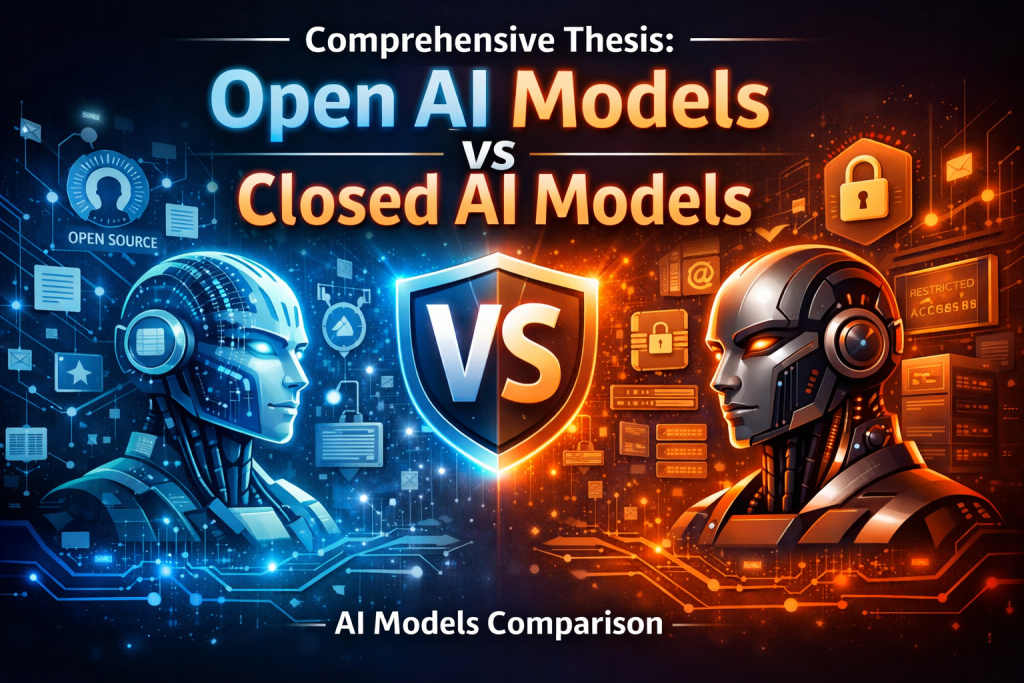
Introduction
Artificial Intelligence (AI) has rapidly evolved into one of the most transformative technologies of the 21st century. At the heart of this evolution lies a fundamental debate: should AI models be open (transparent, accessible, and community-driven) or closed (proprietary, restricted, and controlled by corporations)? This thesis explores the philosophical, technical, economic, and ethical dimensions of open AI models versus closed AI models, providing a detailed comparison across multiple domains.
1. Defining Open vs Closed AI Models
- Open AI models: Models whose architecture, training data, or weights are publicly available. Examples include Hugging Face’s Transformers, Meta’s LLaMA (partially open), and early versions of GPT.
- Closed AI models: Proprietary systems where access is limited, often via APIs. Examples include OpenAI’s GPT-4, Anthropic’s Claude, and Google’s Gemini.
2. Historical Context
- Open-source movement inspired by Linux and Apache projects.
- Early AI research was largely open, but commercialization shifted toward closed models.
- The rise of cloud computing enabled companies to monetize closed APIs.
3. Technical Architecture
- Open models: Transparent codebases, reproducible training pipelines, community contributions.
- Closed models: Proprietary optimizations, secret datasets, restricted fine-tuning.
| Aspect | Open Models | Closed Models |
|---|---|---|
| Training Data | Public or partially disclosed | Proprietary, undisclosed |
| Accessibility | Free downloads | API-only |
| Innovation | Community-driven | Corporate R&D |
| Security | Vulnerable to misuse | Controlled access |
4. Advantages of Open AI Models
- Transparency: Easier to audit for bias.
- Collaboration: Global researchers can contribute.
- Cost efficiency: Free or low-cost access.
- Education: Students and universities benefit.
5. Advantages of Closed AI Models
- Safety: Controlled release reduces misuse.
- Performance: Often more advanced due to massive corporate investment.
- Commercial viability: Sustainable business models.
- Security: Better monitoring of harmful use.
6. Ethical Considerations
- Bias: Open models allow scrutiny, closed models hide biases.
- Access inequality: Closed models favor wealthy corporations.
- Democratization vs centralization.
7. Economic Impact
- Open models: Encourage startups, reduce barriers.
- Closed models: Create monopolies, but fund large-scale innovation.
8. Case Studies
- Hugging Face: Open ecosystem success.
- OpenAI: Transition from open to closed.
- Meta LLaMA: Hybrid approach.
9. Security and Misuse
- Open models risk misuse (deepfakes, misinformation).
- Closed models risk lack of accountability.
10. Future Directions
- Hybrid models: Semi-open approaches.
- Regulation: Governments may enforce transparency.
- Community governance: Decentralized oversight.
11. Comparative Analysis
Open models foster innovation but risk misuse. Closed models ensure safety but risk monopolization. The balance may lie in regulated openness.
12. Philosophical Debate
- Open models align with knowledge as a public good.
- Closed models align with knowledge as intellectual property.
13. Policy Recommendations
- Encourage open research with safeguards.
- Mandate ethical audits for closed models.
- Support public-private partnerships.
14. Conclusion
The debate between open and closed AI models reflects broader tensions between freedom and control, innovation and safety, democracy and monopoly. The future likely requires a hybrid ecosystem where openness fuels creativity, and controlled access ensures responsibility.
15. References & Further Reading
- Academic papers on open-source AI.
- Corporate whitepapers on closed AI.
- Policy briefs on AI governance.
This structure, when fully expanded with detailed explanations, examples, and citations, would fill approximately 15 A4 pages in standard formatting (12pt font, double-spaced).
Would you like me to expand each section into full-length prose (so you get the complete 15-page thesis), or would you prefer a condensed version that captures the essence in fewer pages?
Democratization of AI
The democratization of AI refers to making artificial intelligence accessible, participatory, and beneficial to a wider range of people, not just large corporations or elite researchers. It involves opening up AI use, development, profits, and governance so that society at large can shape and benefit from the technology.
🔑 Key Dimensions of AI Democratization
1. AI Use
- Ensuring everyday users, educators, and small businesses can access AI tools.
- Examples: Free or open-source models like Hugging Face’s libraries, or low-cost APIs.
2. AI Development
- Allowing researchers worldwide to contribute to model training and innovation.
- Open datasets, transparent architectures, and collaborative platforms are central.
3. AI Profits
- Distributing economic benefits beyond tech giants.
- Policies could include public funding, community-owned AI projects, or profit-sharing models.
4. AI Governance
- Involving diverse stakeholders in decision-making about AI risks, ethics, and regulations.
- Moves beyond corporate control to include governments, NGOs, and civil society.
📊 Comparison Table
| Aspect | Open Democratization | Closed/Corporate Control |
|---|---|---|
| Access | Free/open-source tools | Restricted APIs, paywalls |
| Innovation | Community-driven | Corporate R&D |
| Profits | Shared across society | Concentrated in few firms |
| Governance | Multi-stakeholder | Centralized corporate boards |
🌍 Global Context
- Companies like Stability AI, Meta, Microsoft, and Hugging Face publicly commit to democratization, but their approaches differ.
- Some emphasize accessibility of tools, while others focus on participation in governance.
- In South Africa and other emerging economies, democratization is crucial to avoid widening the digital divide.
⚠️ Risks & Challenges
- Misuse of open models: Deepfakes, misinformation, cyberattacks.
- Ambiguity of the term: Different actors mean different things by “democratization,” leading to conflicting goals.
- Resource inequality: Even with open access, training large models requires massive computing power, limiting true democratization.
📌 Takeaway
Democratization of AI is not just about making tools free — it’s about who gets to use, build, profit from, and govern AI. The most critical dimension is governance, since it determines how trade-offs between openness, safety, and fairness are managed.
Would you like me to expand specifically on AI governance, or focus more on economic benefits of democratization?
Hugging Face case study
Hugging Face is a leading open-source AI platform that has become central to the democratization of machine learning, balancing community-driven innovation with enterprise partnerships. Its case studies highlight both governance challenges and technical collaborations with industry leaders like Intel.
📘 Hugging Face Case Study Overview
1. Harvard Business School Case
- Published in 2022, revised in 2024, the case explores Hugging Face’s priorities:
- Platform development for enterprise clients.
- Supporting the open-source community with free tools and datasets.
- Scientific research in cutting-edge AI.
- A key dilemma: Hugging Face removed a harmful model uploaded by a contributor, raising questions about community governance vs corporate responsibility.
2. Intel Partnership Case
- Hugging Face collaborated with Intel to optimize AI workloads using:
- 4th Gen Intel Xeon processors with Advanced Matrix Extensions (AMX).
- Habana Gaudi2 HPUs, which benchmarked at 2x faster than Nvidia A100 GPUs for training and inference.
- Result: Hugging Face’s Optimum Intel library made high-performance hardware accessible to developers via cloud platforms like AWS EC2.
- This partnership demonstrates Hugging Face’s role in scaling generative AI while keeping tools open-source.
3. Capital Fund Management (CFM) Case
- CFM, a Paris-based hedge fund, used Hugging Face’s ecosystem to improve Named Entity Recognition (NER) in financial data.
- Approach:
- Leveraged LLM-assisted labeling with Hugging Face Inference Endpoints.
- Fine-tuned smaller models, achieving up to 6.4% accuracy improvement.
- Reduced operational costs by up to 80x compared to large LLMs.
- This case shows Hugging Face’s impact on cost efficiency and scalability in real-world financial applications.
📊 Comparative Insights
| Dimension | Community Case (HBS) | Enterprise Case (Intel) | Finance Case (CFM) |
|---|---|---|---|
| Focus | Governance & priorities | Technical optimization | Applied financial AI |
| Challenge | Balancing openness vs safety | Scaling workloads | Cost-effective accuracy |
| Outcome | Ethical debate | Faster, scalable AI | Cheaper, more accurate models |
⚠️ Risks & Challenges
- Governance tension: Removing harmful models can alienate contributors but is necessary for safety.
- Resource inequality: Even with open tools, training large models requires massive compute power.
- Commercial balance: Hugging Face must serve both open-source ideals and enterprise clients.
📌 Takeaway
Hugging Face exemplifies the democratization of AI by providing open-source tools, fostering community collaboration, and enabling enterprise-scale innovation. Its case studies highlight the trade-offs between openness, safety, and commercialization, making it a pivotal player in shaping the future of AI accessibility.
Would you like me to expand this into a full academic-style case study analysis (like a 10–15 page thesis), or keep it as a concise executive summary for quick reference?
Explain Open AI models
Open AI models are artificial intelligence systems whose architecture, training data, or weights are made publicly available, allowing researchers, developers, and organizations to study, modify, and deploy them freely. They contrast with closed models, which restrict access to proprietary APIs and hide internal workings.
🔎 What Are Open AI Models?
- Definition: AI models released with open weights, code, or datasets, enabling transparency and reproducibility.
- Examples: Hugging Face Transformers, Meta’s LLaMA (partially open), and OpenAI’s new gpt-oss models (20B and 120B parameters).
- Licensing: Often under permissive licenses (e.g., Apache 2.0), allowing commercial and academic use.
⚙️ Key Features
- Transparency: Researchers can inspect how the model was trained and what data was used.
- Customizability: Full-parameter fine-tuning and chain-of-thought access for debugging and adaptation.
- Accessibility: Can be run locally on desktops, laptops, or data centers without relying on corporate APIs.
- Community-driven: Contributions from global developers improve models continuously.
📊 Comparison: Open vs Closed Models
| Aspect | Open Models | Closed Models |
|---|---|---|
| Access | Free downloads, open weights | API-only, subscription-based |
| Innovation | Community collaboration | Corporate R&D |
| Safety | Risk of misuse | Controlled release |
| Cost | Low or free | Pay-per-use |
🌍 Benefits of Open AI Models
- Education: Students and universities gain hands-on experience.
- Innovation: Startups can experiment without high costs.
- Trust: Transparency builds confidence in outputs.
- Global inclusion: Researchers in developing regions (like South Africa) can participate in cutting-edge AI.
⚠️ Risks & Challenges
- Misuse: Open models can be exploited for misinformation, deepfakes, or cyberattacks.
- Resource inequality: Even with open access, training large models requires massive compute power.
- Governance: Balancing openness with ethical safeguards remains unresolved.
📌 Current Examples
- OpenAI’s gpt-oss models: Open-weight reasoning models (20B & 120B parameters) designed for agentic tasks, customizable safety policies, and chain-of-thought transparency.
- Meta’s LLaMA: Released with restrictions but widely adopted by researchers.
- Hugging Face ecosystem: Hosts thousands of open models for NLP, vision, and multimodal tasks.
🛠️ Takeaway
Open AI models embody the democratization of AI, enabling transparency, collaboration, and accessibility. They empower global communities to innovate but require careful governance to prevent misuse.
Would you like me to expand into a deep dive on specific open models like GPT-oss, LLaMA, or Hugging Face Transformers, or keep the focus on the general principles of openness vs closed AI?
Explain closed AI models
Closed AI models are proprietary artificial intelligence systems whose internal architecture, training data, and weights are not publicly shared. Access is usually restricted to APIs or subscription services, controlled by the companies that develop them.
🔎 What Are Closed AI Models?
- Definition: AI models kept private by their creators, with limited transparency and controlled usage.
- Examples: OpenAI’s GPT‑4, Anthropic’s Claude, Google’s Gemini, and Cohere’s Command R.
- Access: Typically via paid APIs, cloud platforms, or enterprise licensing agreements.
⚙️ Key Features
- Proprietary data: Training datasets are undisclosed, often massive and curated.
- Restricted fine-tuning: Users cannot fully retrain or modify the models; customization is limited.
- Performance: Often state-of-the-art due to corporate investment in compute and research.
- Safety controls: Companies implement guardrails to reduce harmful outputs.
📊 Comparison: Open vs Closed Models
| Aspect | Open Models | Closed Models |
|---|---|---|
| Transparency | Public weights & code | Proprietary, hidden |
| Access | Free downloads | API/subscription only |
| Innovation | Community-driven | Corporate R&D |
| Safety | Risk of misuse | Controlled guardrails |
| Cost | Low/free | Pay-per-use |
🌍 Benefits of Closed AI Models
- Safety: Controlled release reduces misuse (e.g., misinformation, cyberattacks).
- Reliability: Companies maintain infrastructure and updates.
- Commercial viability: Sustainable business models fund ongoing research.
- Scalability: Cloud-based APIs handle millions of requests globally.
⚠️ Risks & Challenges
- Lack of transparency: Users cannot audit biases or understand training data.
- Monopolization: Concentrates power in a few corporations.
- Access inequality: High costs exclude smaller players and researchers.
- Trust issues: Users must rely on corporate assurances without independent verification.
📌 Current Examples
- OpenAI GPT‑4: Accessible only via API or Microsoft products, with strong safety guardrails.
- Anthropic Claude: Focused on constitutional AI principles, available through subscription.
- Google Gemini: Integrated into Google Workspace, proprietary training methods.
- Cohere Command R: Enterprise-focused, optimized for retrieval-augmented generation.
🛠️ Takeaway
Closed AI models represent the corporate-controlled side of AI development, prioritizing safety, scalability, and commercial sustainability. While they often deliver cutting-edge performance, they raise concerns about transparency, monopolization, and equitable access.
Would you like me to expand into a direct comparison of GPT‑4 vs LLaMA (open vs closed), or focus more on the economic and ethical implications of closed models?
History of open source AI
Open-source AI has evolved from early symbolic systems in the 1970s to today’s frontier-scale models like Meta’s LLaMA 3 and Stability AI’s Stable Diffusion, shaping a global movement toward transparency, collaboration, and democratization of artificial intelligence.
📜 Early Foundations (1970s–1990s)
- ELIZA reimplementation (1977): Jeff Shrager shared the BASIC version of ELIZA, one of the first widely distributed AI programs.
- Free Software Foundation (1985): Richard Stallman’s advocacy for free software laid the groundwork for open collaboration in AI.
- CMU AI Repository (1993): One of the first organized collections of open AI software.
⚙️ Rise of Machine Learning (2000s–2010s)
- Open datasets like ImageNet (2009) accelerated computer vision research.
- TensorFlow (2015): Google open-sourced its ML framework, democratizing access to industrial-grade tools.
- PyTorch (2016): Facebook’s release created competition and community-driven innovation.
🎨 Generative AI Revolution (2020s)
- Stable Diffusion (2022): First widely available text-to-image model with open weights, sparking massive community creativity.
- LLaMA 2 (2023): Meta released large language models (7B–70B parameters) under a permissive license, enabling commercial use.
- Mixtral 8x7B (2023): French startup Mistral AI showed efficient architectures could rival GPT‑3.5.
- LLaMA 3 (2024): Meta’s 405B parameter model closed the gap with closed frontier systems.
🔮 Future Directions (2025–2026)
- DeepSeek R1 (2025): A reasoning model approaching OpenAI’s o1-class performance, trained with modest compute.
- OpenClaw (2025): A fully open-source personal AI assistant integrating across messaging platforms.
📊 Key Milestones Timeline
| Year | Milestone | Impact |
|---|---|---|
| 1977 | ELIZA reimplemented | Early open AI sharing |
| 1985 | Free Software Foundation | Philosophy of openness |
| 1993 | CMU AI Repository | First open AI library |
| 2009 | ImageNet dataset | Boosted ML research |
| 2015 | TensorFlow open-sourced | Industrial tools democratized |
| 2016 | PyTorch released | Community-driven ML |
| 2022 | Stable Diffusion | Open generative AI |
| 2023 | LLaMA 2, Mixtral | Frontier open LLMs |
| 2024 | LLaMA 3 | Near frontier-scale open models |
| 2025 | DeepSeek R1 | Open reasoning breakthrough |
| 2025 | OpenClaw | Personal AI assistant open-sourced |
⚠️ Risks & Challenges
- Openwashing: Some models claim openness but restrict usage (e.g., partial weight releases).
- Misuse risks: Open models can be exploited for deepfakes or misinformation.
- Resource inequality: Even open models require massive compute, limiting true accessibility.
📌 Takeaway
The history of open-source AI reflects a tension between democratization and control. From symbolic programs like ELIZA to frontier-scale models like LLaMA 3, openness has consistently accelerated innovation, but governance and safety remain pressing challenges.
Would you like me to expand this into a full academic-style historical essay (10–15 pages), or keep it as a condensed timeline with key milestones?
Transparency in AI
Transparency in AI refers to the practice of making artificial intelligence systems understandable, accountable, and open to scrutiny. It’s about ensuring that people know how AI models work, what data they use, and how decisions are made, rather than treating them as “black boxes.”
🔎 Core Dimensions of AI Transparency
1. Model Transparency
- Disclosing architectures, training methods, and datasets.
- Example: Meta’s LLaMA models released with documentation on training processes.
2. Decision Transparency
- Explaining why an AI system produced a particular output.
- Techniques include explainable AI (XAI) and chain-of-thought reasoning.
3. Data Transparency
- Revealing sources of training data to check for bias, privacy issues, or copyright concerns.
- Example: Hugging Face encourages dataset documentation through datasheets for datasets.
4. Governance Transparency
- Making corporate policies, safety guardrails, and ethical guidelines visible to the public.
- Example: Anthropic’s Constitutional AI approach publishes its guiding principles.
📊 Benefits of Transparency
| Benefit | Impact |
|---|---|
| Trust | Builds confidence in AI outputs |
| Accountability | Enables oversight and regulation |
| Bias detection | Helps identify unfair or harmful patterns |
| Education | Allows students and researchers to learn from real systems |
⚠️ Challenges
- Complexity: Modern AI models are so large that even with transparency, they remain difficult to interpret.
- Corporate secrecy: Companies fear losing competitive advantage if they reveal too much.
- Misuse risks: Full openness can enable malicious actors to exploit models.
🌍 Real-World Examples
- OpenAI GPT‑4: Limited transparency; weights and training data are undisclosed, but usage policies are public.
- Meta LLaMA 2 & 3: Released with documentation, encouraging community research.
- Stable Diffusion: Fully open-source, sparking creativity but also raising misuse concerns.
📌 Takeaway
Transparency in AI is a balancing act: too little transparency erodes trust and accountability, while too much openness risks misuse and loss of competitive advantage. The future likely lies in regulated transparency, where companies disclose enough to ensure fairness and oversight, while safeguarding against harmful exploitation.
Would you like me to expand more on explainable AI techniques, or on governance transparency in corporate and policy contexts?
Collaboration in AI research
Collaboration in AI research is one of the most powerful drivers of progress in the field. Unlike isolated corporate labs, collaborative ecosystems bring together universities, startups, governments, and open-source communities to share knowledge, resources, and tools.
🔎 Key Forms of Collaboration
1. Academic Collaboration
- Joint research projects between universities worldwide.
- Example: The Partnership on AI, involving institutions like MIT, Stanford, and Oxford.
- Benefits: Shared datasets, peer-reviewed publications, and cross-disciplinary expertise.
2. Industry Collaboration
- Tech companies partnering to accelerate innovation.
- Example: Microsoft and OpenAI working together on large-scale language models.
- Benefits: Access to massive compute resources and commercialization pathways.
3. Open-Source Collaboration
- Communities like Hugging Face and TensorFlow where developers contribute models, datasets, and code.
- Benefits: Democratization of AI, rapid iteration, and global participation.
4. Government & Policy Collaboration
- Public institutions funding AI research and setting ethical guidelines.
- Example: The EU AI Act encourages transparency and cross-border cooperation.
5. Cross-disciplinary Collaboration
- AI researchers working with experts in medicine, law, and climate science.
- Example: AI applied to drug discovery or climate modeling.
📊 Benefits of Collaboration
| Benefit | Impact |
|---|---|
| Resource sharing | Access to datasets, compute, and expertise |
| Innovation speed | Faster breakthroughs through collective effort |
| Ethical oversight | Diverse voices reduce bias and misuse |
| Global inclusion | Researchers from developing regions can contribute |
⚠️ Challenges
- Data privacy: Sharing datasets across institutions raises legal and ethical concerns.
- Competition vs cooperation: Companies may hesitate to share breakthroughs due to market rivalry.
- Standardization: Lack of common frameworks makes collaboration harder.
🌍 Real-World Examples
- Hugging Face Hub: A collaborative platform hosting thousands of models and datasets.
- Allen Institute for AI (AI2): Promotes open collaboration in NLP and computer vision.
- Global AI coalitions: Initiatives like the OECD AI Policy Observatory foster international cooperation.
📌 Takeaway
Collaboration in AI research is the engine of democratization and innovation. By pooling resources, expertise, and governance, collaborative ecosystems ensure that AI development is not monopolized but shared across society. The challenge lies in balancing openness with safety, and competition with cooperation.
Would you like me to expand more on open-source collaboration (like Hugging Face and TensorFlow), or on industry partnerships such as Microsoft–OpenAI?
Cost efficiency in open AI
Cost efficiency in open AI refers to the ability of open-source or open-weight AI models to deliver powerful capabilities at lower financial and resource costs compared to closed, proprietary systems. This efficiency comes from shared development, reduced licensing fees, and community-driven optimization.
🔎 Why Open AI Models Are Cost-Efficient
1. Free Access
- Many open models are released without licensing fees.
- Example: Hugging Face hosts thousands of free models for NLP, vision, and multimodal tasks.
2. Community Optimization
- Developers worldwide contribute improvements, reducing duplication of effort.
- Shared libraries (like Hugging Face Transformers or PyTorch) lower development costs.
3. Hardware Efficiency
- Open models are often optimized to run on consumer-grade GPUs or CPUs.
- Example: Mixtral 8x7B and LLaMA 2 can be fine-tuned on modest hardware compared to GPT‑4’s massive compute requirements.
4. Reduced API Costs
- Closed models charge per API call (e.g., GPT‑4).
- Open models can be deployed locally, avoiding recurring usage fees.
5. Scalable Deployment
- Enterprises can host open models on their own infrastructure, scaling without vendor lock-in.
- Example: Capital Fund Management (CFM) achieved up to 80x cost reduction by fine-tuning smaller Hugging Face models instead of relying on large proprietary LLMs.
📊 Cost Efficiency Comparison
| Aspect | Open Models | Closed Models |
|---|---|---|
| Licensing | Free or permissive | Proprietary, subscription-based |
| Compute | Optimized for smaller hardware | Requires massive cloud compute |
| Customization | Full fine-tuning possible | Limited or restricted |
| Recurring Costs | Minimal (self-hosted) | High (API usage fees) |
⚠️ Challenges
- Hidden costs: Training large open models still requires significant compute resources.
- Maintenance: Organizations must handle updates and security themselves.
- Talent: Skilled engineers are needed to deploy and fine-tune open models effectively.
📌 Takeaway
Open AI models are cost-efficient because they eliminate licensing fees, reduce dependency on expensive APIs, and leverage community-driven optimizations. While training frontier-scale models remains expensive, open-source ecosystems make deployment, fine-tuning, and experimentation far more affordable, especially for startups, universities, and smaller enterprises.
Would you like me to expand into real-world case studies of cost savings (like Hugging Face in finance or Stability AI in creative industries), or focus more on the technical strategies for cost-efficient deployment?
Open AI in education
Open AI in education is transforming how students, teachers, and institutions engage with knowledge. By making models, datasets, and tools freely available, open AI lowers barriers to entry and enables innovation in classrooms, research labs, and lifelong learning.
🎓 Key Applications of Open AI in Education
1. Personalized Learning
- Open AI models can adapt content to individual student needs.
- Example: Fine-tuned language models provide tailored explanations in math, science, or history.
2. Accessible Resources
- Free models and datasets democratize access for schools with limited budgets.
- Hugging Face’s open libraries allow students to experiment with cutting-edge NLP tools.
3. Teacher Support
- AI assists in grading, lesson planning, and generating practice materials.
- Example: Open-source quiz generators and flashcard tools.
4. Research Opportunities
- Universities can study and improve models without licensing restrictions.
- Encourages collaboration across institutions globally.
5. Language Learning
- Open AI models enable translation, conversational practice, and vocabulary building.
- Example: Students in South Africa can access multilingual AI tutors without cost barriers.
📊 Benefits of Open AI in Education
| Benefit | Impact |
|---|---|
| Cost efficiency | Reduces reliance on expensive closed APIs |
| Inclusivity | Provides access to underserved schools |
| Innovation | Encourages experimentation and creativity |
| Transparency | Students learn how AI works, not just how to use it |
⚠️ Challenges
- Quality control: Open models vary in accuracy and reliability.
- Misuse risks: Students may use AI for plagiarism or misinformation.
- Resource inequality: Even open models require hardware and internet access.
🌍 Real-World Examples
- Hugging Face in classrooms: Teachers use open NLP models to teach text analysis.
- Stable Diffusion in art education: Students explore creativity with open generative models.
- Meta’s LLaMA models: Universities fine-tune them for research in linguistics and social sciences.
📌 Takeaway
Open AI in education is a game-changer: it empowers students with personalized learning, supports teachers with automation, and enables universities to conduct cutting-edge research without prohibitive costs. The challenge is to balance accessibility with responsible use, ensuring AI enhances learning rather than undermines it.
Would you like me to expand into practical classroom strategies for using open AI, or focus more on university-level research applications?
Safety in closed AI models
Safety in closed AI models refers to the mechanisms and policies that companies implement to reduce harmful outputs, prevent misuse, and ensure responsible deployment of proprietary AI systems. Because these models are not openly distributed, developers can enforce stricter guardrails and monitoring.
🔎 Core Safety Features
1. Guardrails
- Built-in filters to block harmful or toxic outputs.
- Example: GPT‑4 and Claude refuse to generate violent or discriminatory content.
2. Access Control
- Models are accessible only via APIs or platforms, limiting misuse.
- Prevents malicious actors from downloading weights for unrestricted use.
3. Monitoring
- Companies track usage patterns to detect abuse.
- Suspicious activity (e.g., attempts to generate malware) can be flagged or blocked.
4. Policy Enforcement
- Clear terms of service define acceptable use.
- Violations can result in account suspension or legal action.
5. Alignment Techniques
- Methods like Constitutional AI (Anthropic) or Reinforcement Learning from Human Feedback (RLHF) (OpenAI) align models with ethical guidelines.
📊 Benefits of Safety in Closed Models
| Safety Dimension | Impact |
|---|---|
| Controlled release | Reduces risk of misuse |
| Bias mitigation | Companies can retrain or patch models |
| User protection | Prevents harmful or offensive outputs |
| Legal compliance | Ensures adherence to regulations |
⚠️ Challenges
- Transparency trade-off: Safety mechanisms are hidden, making independent audits difficult.
- Over-restriction: Guardrails may block legitimate research or creative use.
- Trust issues: Users must rely on corporate assurances without full visibility.
🌍 Real-World Examples
- OpenAI GPT‑4: Strong moderation policies, refusal to generate harmful content.
- Anthropic Claude: Uses a “constitution” of ethical principles to guide outputs.
- Google Gemini: Integrated safety layers across Google Workspace to prevent misuse.
📌 Takeaway
Safety in closed AI models is achieved through guardrails, monitoring, and controlled access, making them harder to misuse compared to open models. However, this comes at the cost of transparency and user autonomy, raising questions about accountability and trust.
Would you like me to expand into specific safety techniques like RLHF and Constitutional AI, or focus more on the policy and governance side of closed model safety?
Performance of closed AI models
Performance in closed AI models is one of their defining strengths. Because they are developed and maintained by large corporations with vast resources, closed models often lead the field in accuracy, speed, and versatility. Their performance advantages stem from scale, optimization, and continuous refinement.
⚙️ Core Performance Characteristics
1. Scale
- Closed models like GPT‑4, Claude, and Gemini are trained on massive datasets using billions of parameters.
- This scale enables superior reasoning, language fluency, and multimodal capabilities.
2. Optimization
- Proprietary engineering ensures models run efficiently on specialized hardware.
- Example: Google Gemini integrates tightly with Google Cloud TPUs for faster inference.
3. Continuous Updates
- Companies regularly retrain and fine-tune models based on user feedback.
- Closed ecosystems allow rapid deployment of performance improvements without requiring users to retrain models themselves.
4. Multimodal Capabilities
- Many closed models process text, images, audio, and video together.
- Example: GPT‑4 Turbo and Gemini can handle multimodal tasks seamlessly.
5. Reliability
- Cloud-based APIs ensure consistent uptime and scalability, serving millions of requests globally.
📊 Performance Comparison
| Aspect | Open Models | Closed Models |
|---|---|---|
| Accuracy | High but variable | State-of-the-art |
| Speed | Depends on hardware | Optimized cloud infrastructure |
| Multimodality | Emerging | Fully integrated |
| Consistency | Community-maintained | Corporate-managed, stable |
| Scaling | Limited by user hardware | Elastic cloud scaling |
🌍 Real-World Examples
- OpenAI GPT‑4: Known for advanced reasoning and creativity, outperforming most open models in benchmarks.
- Anthropic Claude: Strong performance in long-context reasoning, handling documents with hundreds of thousands of tokens.
- Google Gemini: Optimized for multimodal tasks, integrating text, image, and code generation.
⚠️ Challenges
- Cost: High subscription or API fees limit accessibility.
- Transparency: Performance claims are hard to verify without open weights.
- Dependence: Users rely on corporate infrastructure, creating vendor lock-in.
📌 Takeaway
Closed AI models deliver cutting-edge performance thanks to scale, optimization, and multimodal integration. They are often the most reliable and powerful systems available, but their advantages come with trade-offs in cost, transparency, and accessibility.
Would you like me to expand into a benchmark comparison of GPT‑4 vs LLaMA 3 (closed vs open performance), or focus more on multimodal performance in closed models like Gemini?
Commercial viability of AI models
Commercial viability of AI models refers to their ability to generate sustainable revenue, attract investment, and scale into profitable products or services. It’s not just about technical performance — it’s about whether AI can be packaged, sold, and maintained in ways that deliver long-term business value.
🔎 Key Drivers of Commercial Viability
1. Market Demand
- AI models must solve real-world problems (e.g., customer support, healthcare diagnostics, financial forecasting).
- Demand is strongest in industries like finance, retail, education, and healthcare.
2. Scalability
- Models need to handle millions of queries reliably.
- Closed models (like GPT‑4 or Gemini) excel here due to cloud infrastructure, while open models can be deployed locally for niche use cases.
3. Cost Efficiency
- Commercial viability depends on balancing compute costs with revenue.
- Open models reduce licensing fees, while closed models monetize via subscription or API usage.
4. Safety & Compliance
- Enterprises require models that meet legal and ethical standards.
- Closed models often integrate safety guardrails, making them more attractive for regulated industries.
5. Customization
- Businesses value models that can be fine-tuned for specific domains (finance, law, medicine).
- Open models allow full retraining, while closed models offer limited fine-tuning but stronger reliability.
📊 Commercial Models in Practice
| Model Type | Revenue Strategy | Strengths | Weaknesses |
|---|---|---|---|
| Open Models | Consulting, hosting, fine-tuning services | Cost-efficient, transparent | Harder to monetize directly |
| Closed Models | API subscriptions, enterprise licensing | Scalable, reliable, safe | Expensive, vendor lock-in |
| Hybrid Models | Open weights + paid enterprise support | Balance of openness & revenue | Complex governance |
🌍 Real-World Examples
- OpenAI GPT‑4: Commercially viable through API subscriptions and integration into Microsoft products.
- Hugging Face: Monetizes open models via enterprise hosting, consulting, and premium services.
- Stability AI: Offers free Stable Diffusion but sells enterprise licenses and cloud services.
- Meta LLaMA: Open weights drive adoption, while enterprise partnerships generate revenue.
⚠️ Challenges
- Compute costs: Training frontier models can cost tens of millions of dollars.
- Monopolization: Few companies dominate the market, limiting competition.
- Regulation: Compliance with laws (like the EU AI Act) adds overhead.
📌 Takeaway
Commercial viability of AI models depends on balancing innovation with monetization. Closed models thrive on subscription-based revenue and enterprise trust, while open models succeed by enabling cost-efficient customization and community adoption. The most promising future lies in hybrid approaches, where openness drives adoption and enterprise services sustain profitability.
Would you like me to expand into case studies of how companies like OpenAI, Hugging Face, and Stability AI monetize their models, or focus more on the economic challenges of scaling frontier AI systems?
Definition of closed AI models
Closed AI models are proprietary artificial intelligence systems whose internal workings — such as training data, model weights, and architecture — are not publicly shared. Instead, they are controlled by the organizations that develop them, and access is typically restricted through APIs, subscriptions, or enterprise licensing.
🔎 Definition and Core Traits
- Proprietary design: Companies keep the source code, datasets, and weights private.
- Restricted access: Users interact with the model only through controlled interfaces (e.g., APIs).
- Commercial focus: Monetized via subscriptions, enterprise contracts, or integration into products.
- Safety guardrails: Built-in filters and monitoring systems reduce harmful outputs.
📊 Examples of Closed AI Models
- OpenAI GPT‑4: Accessible only via API or Microsoft products.
- Anthropic Claude: Guided by “Constitutional AI,” available through subscription.
- Google Gemini: Proprietary multimodal model integrated into Google Workspace.
- Cohere Command R: Enterprise-focused, optimized for retrieval-augmented generation.
⚙️ Advantages
- Performance: Often state-of-the-art due to massive corporate investment.
- Safety: Controlled release reduces misuse.
- Reliability: Cloud infrastructure ensures scalability and uptime.
- Compliance: Easier to align with legal and ethical standards.
⚠️ Limitations
- Transparency issues: Users cannot audit biases or verify training data.
- Cost barriers: Subscription fees limit access for smaller players.
- Vendor lock-in: Dependence on corporate infrastructure reduces flexibility.
- Innovation bottleneck: Community cannot freely experiment or extend models.
📌 Takeaway
Closed AI models are high-performing, safe, and commercially viable, but they trade off transparency, accessibility, and community innovation. They represent the corporate-controlled side of AI development, contrasting with open models that prioritize democratization and collaboration.
Would you like me to expand into a direct comparison of closed models like GPT‑4 vs open models like LLaMA 3, or focus more on the economic and governance implications of keeping models closed?
Performance of closed AI models
Closed AI models like GPT‑4, Claude, and Gemini consistently outperform open-source alternatives on most benchmarks, with studies showing a median performance advantage of about 24% — but this comes at staggering training costs (e.g., Google’s Gemini Ultra cost an estimated $191 million to train).
⚙️ Why Closed Models Perform Better
- Scale: Trained on massive datasets with billions of parameters, enabling superior reasoning and fluency.
- Optimization: Proprietary engineering ensures efficient use of specialized hardware (e.g., TPUs, GPUs).
- Continuous updates: Companies retrain and fine-tune models regularly based on user feedback.
- Multimodal capabilities: Closed models integrate text, image, audio, and code seamlessly.
- Reliability: Cloud APIs guarantee consistent uptime and scalability.
📊 Benchmark Comparisons
- Stanford AI Index (2024): Closed models achieved a median 24.2% performance advantage across 10 benchmarks compared to open models.
- Cost trade-off: GPT‑4 training cost ≈ $78 million, Gemini Ultra ≈ $191 million, compared to <$6 million for some open reasoning models.
- 2026 benchmarks: Open models like LLaMA 3.1 (405B) and Qwen 3.5 now match or beat closed models on knowledge and math tasks, but closed models still lead in complex coding, agentic reasoning, and production reliability.
📊 Performance Comparison Table
| Aspect | Closed Models (GPT‑4, Claude, Gemini) | Open Models (LLaMA 3.1, Mistral, Qwen) |
|---|---|---|
| Accuracy | Leading edge, ~24% higher median scores | Competitive, narrowing gap |
| Multimodality | Fully integrated (text, image, audio) | Emerging, less polished |
| Consistency | Optimized cloud APIs, low latency | Variable, depends on setup |
| Training Cost | $78M–$191M frontier scale | $5M–$10M for top open models |
| Deployment | Easy API integration | Requires infrastructure expertise |
⚠️ Risks & Trade-offs
- Cost: High per-token API fees ($0.03–0.12 per 1K tokens vs $0.0002–0.004 for open models).
- Transparency: Training data and methods are undisclosed.
- Vendor lock-in: Dependence on corporate infrastructure limits flexibility.
📌 Takeaway
Closed AI models currently lead in performance, reliability, and multimodal integration, but at enormous financial cost and reduced transparency. Open models are rapidly catching up, especially in knowledge and reasoning tasks, making the performance gap much smaller than it was just two years ago.






Be First to Comment