
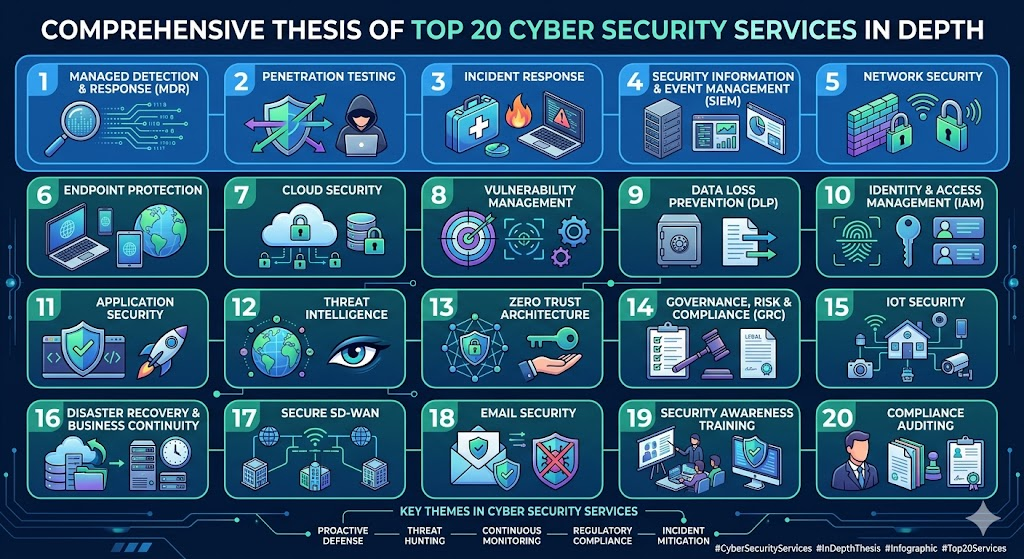
The cybersecurity services landscape in 2026 is defined by three macro trends: AI-driven autonomous defense, cloud-native zero-trust architectures, and consolidated platform economics. Organizations are moving away from point solutions toward integrated platforms that combine endpoint, network, cloud, and identity security into unified operational frameworks. The following analysis categorizes the 20 most influential service providers by their core strategic functions, examining their technological differentiators, market positioning, and operational realities
Tier I: Cloud-Native Endpoint & Extended Detection and Response (EDR/XDR)
1. CrowdStrike — Falcon Platform
Strategic Position: The gold standard for cloud-native endpoint protection.
CrowdStrike’s Falcon platform operates on a lightweight agent architecture that delivers endpoint detection and response (EDR), extended detection and response (XDR), and managed threat hunting (Falcon OverWatch) through a unified cloud console. The platform leverages machine learning and behavioral analytics to detect both known malware and fileless attacks in real time. Its threat intelligence capabilities, derived from monitoring adversary activity globally, provide contextual enrichment that distinguishes commodity malware from targeted intrusions.
Critical Assessment: While CrowdStrike markets itself as preventing breaches before they occur, no single endpoint solution is a silver bullet. The platform requires skilled security teams to operationalize its advanced features, and its per-endpoint pricing model becomes expensive at scale. The 2024 global outage incident also highlighted single-vendor dependency risks. Best suited for: Mid-to-large enterprises with dedicated security operations centers and budgets for premium endpoint protection.
2. SentinelOne Singularity Platform
Strategic Position: The autonomous response alternative to CrowdStrike.
SentinelOne differentiates through AI-driven autonomous response capabilities that can automatically isolate compromised endpoints without human intervention. The Singularity platform correlates data across endpoints, cloud workloads, and identity systems, often at a 20-30% lower price point than CrowdStrike for comparable coverage. Its Storyline technology automatically reconstructs attack timelines, reducing analyst investigation time.
Critical Assessment: The autonomous response feature reduces manual workload but requires careful policy tuning to avoid business disruption from false positives. Best suited for: Organizations with limited security staffing who benefit from automation, or those seeking CrowdStrike-tier EDR at reduced cost.
3. Sophos Intercept X & Central Platform
Strategic Position: The integrated SMB champion.
Sophos delivers synchronized security where endpoint agents and firewalls share real-time threat intelligence. Managed through Sophos Central, the platform provides endpoint protection, XDR, next-generation firewalls, and managed detection and response (MDR) services. Its “Heartbeat” technology enables cross-product communication, allowing the firewall to automatically isolate an endpoint when the endpoint agent detects compromise.
Critical Assessment: Sophos excels in the 10-500 employee segment but may require additional configuration in complex enterprise environments. Some advanced features are tier-locked. Best suited for: Small-to-mid businesses and MSPs managing multiple clients without dedicated security teams.
4. Bitdefender GravityZone
Strategic Position: AI-driven global endpoint intelligence.
Bitdefender’s GravityZone platform combines endpoint protection, EDR, XDR, and MDR through machine learning and multi-layered detection. With strong global presence and recognition, it provides comprehensive threat protection across devices, networks, and cloud environments. The platform is particularly strong in ransomware defense and exploit prevention.
Critical Assessment: The broad product portfolio can create complexity for smaller organizations, and some advanced capabilities require higher-tier licensing. Best suited for: Organizations requiring strong endpoint intelligence with global support infrastructure.
Tier II: Network Security & Perimeter Defense
5. Palo Alto Networks NGFW, Cortex XDR, Prisma Cloud
Strategic Position: The enterprise network security gold standard.
Palo Alto Networks essentially created the next-generation firewall (NGFW) category and has extended leadership into endpoint (Cortex XDR) and cloud security (Prisma Cloud). Their NGFWs perform deep packet inspection with application-level visibility, while Cortex XDR correlates network and endpoint telemetry. Prisma Cloud delivers cloud-native application protection (CNAPP) capabilities.
Critical Assessment: Palo Alto is genuinely excellent but built for large enterprises. Minimum viable deployments often exceed $150K annually, and the platforms require skilled staff to operate effectively. Long contract terms (typically 3 years) create vendor lock-in. Best suited for: Enterprises with 1000+ employees, dedicated security teams, and substantial IT budgets.
6. Fortinet FortiGate & Security Fabric
Strategic Position: The value leader in enterprise network security.
Fortinet’s FortiGate firewalls deliver Palo Alto-comparable capabilities at significantly lower price points, making enterprise-grade network security accessible to mid-market companies. The Security Fabric architecture integrates firewalls, SD-WAN, endpoint protection (FortiEDR), SIEM (FortiSIEM), and email security under unified management.
Critical Assessment: Fortinet’s licensing model is notoriously complex—many advanced features require separate subscriptions. The platform realizes full value only when multiple products are deployed together. Best suited for: Mid-market companies (100-2000 employees) seeking to consolidate multiple point solutions onto one integrated platform.
7. Check Point Infinity Architecture
Strategic Position: The threat prevention veteran.
Check Point invented the commercial firewall and maintains strong enterprise presence through SandBlast zero-day prevention technology and CloudGuard cloud security. The Infinity architecture attempts to unify network, cloud, endpoint, and mobile security under one management plane.
Critical Assessment: Check Point prioritizes threat prevention over detection-and-response compared to newer competitors. Organizations must evaluate whether prevention-first or detection-first aligns with their risk model. Best suited for: Enterprises prioritizing advanced threat prevention, particularly those with existing Check Point infrastructure.
8. Cisco Security SecureX, Umbrella, Duo, Talos
Strategic Position: The integrated infrastructure play.
Cisco leverages its networking dominance to deliver security integrated directly into infrastructure. The portfolio includes Secure Firewall, Secure Access (zero trust), Umbrella (DNS-layer security), Duo (MFA), and XDR capabilities augmented by the Splunk acquisition. The Talos threat intelligence organization provides global visibility.
Critical Assessment: Cisco security makes sense primarily for existing Cisco networking customers. For organizations not invested in Cisco infrastructure, there is little compelling reason to start here. The broad portfolio creates complexity in large deployments. Best suited for: Existing Cisco shops seeking unified network-security integration.
Tier III: Cloud Security & Zero Trust Architecture
9. Zscaler — Zero Trust Exchange
Strategic Position: The cloud-native zero trust leader.
Zscaler eliminates traditional network perimeters through the Zero Trust Exchange, a globally distributed cloud architecture connecting users to applications via policy-based access controls rather than VPNs. Zscaler Internet Access (ZIA) secures internet traffic, while Zscaler Private Access (ZPA) provides zero-trust application access. The platform operates on a SASE (Secure Access Service Edge) framework.
Critical Assessment: Transitioning from traditional hub-and-spoke architectures requires significant planning and change management. Pricing scales aggressively as additional services are added. Best suited for: Cloud-first organizations with distributed workforces seeking to replace legacy VPNs and on-premise security stacks.
10. Wiz Cloud-Native Application Protection (CNAPP)
Strategic Position: The agentless cloud visibility disruptor.
Wiz delivers agentless cloud security by connecting directly to AWS, Azure, and Google Cloud APIs to analyze configurations, identities, network exposure, and vulnerabilities without deploying software on workloads. Its attack path analysis correlates misconfigurations, exposed secrets, and vulnerable resources to identify exploitable risk chains.
Critical Assessment: Wiz is exclusively cloud-focused and designed to integrate with broader security stacks rather than replace them. Large cloud environments require tuning to prioritize remediation effectively. Best suited for: Multi-cloud and hybrid organizations requiring rapid, comprehensive cloud visibility without agent deployment overhead.
11. Netskope Security Cloud & CASB
Strategic Position: The SaaS visibility and control specialist.
Netskope provides cloud access security broker (CASB), secure web gateway, and data loss prevention (DLP) capabilities specifically designed for cloud-first companies. The platform delivers visibility into sanctioned and unsanctioned SaaS applications, enabling granular policy enforcement for data movement in cloud environments.
Critical Assessment: Netskope competes directly with Zscaler in the SSE/SASE space but with stronger emphasis on SaaS application control. Best suited for: Organizations heavily dependent on SaaS applications requiring deep visibility into cloud data flows.
Tier IV: Identity Security & Privileged Access Management
12. Okta Identity Cloud
Strategic Position: The modern identity standard.
Okta provides unified identity and access management through single sign-on (SSO), multi-factor authentication (MFA), and lifecycle management. The Identity Cloud integrates with thousands of applications, enabling centralized identity governance for SaaS-heavy environments.
Critical Assessment: Okta is essential for SaaS-centric organizations but represents only one layer of identity security. It must be paired with privileged access management for administrative accounts. Best suited for: Organizations of any size with heavy SaaS adoption needing centralized identity federation.
13. CyberArk Privileged Access Management
Strategic Position: The enterprise PAM leader.
CyberArk secures privileged accounts—the credentials that grant administrative access to critical infrastructure. The platform provides credential vaulting, session isolation, and privilege elevation controls that prevent credential theft and lateral movement.
Critical Assessment: CyberArk is expensive and complex to deploy, typically requiring professional services for initial implementation. Best suited for: Large enterprises where privileged account compromise represents existential risk.
14. BeyondTrust PAM & Identity Security
Strategic Position: The comprehensive privilege control platform.
BeyondTrust delivers privileged access management, endpoint privilege control (enforcing least privilege on standard user devices), and secure remote access for vendors and administrators. The platform monitors privileged sessions continuously for risk detection.
Critical Assessment: BeyondTrust is focused specifically on privileged access and must be complemented by broader threat detection platforms. Deployment in large enterprises requires careful architecture planning. Best suited for: Organizations prioritizing least-privilege models and vendor remote access security.
15. Semperis Active Directory & Identity Threat Detection
Strategic Position: The identity infrastructure protector.
Semperis specializes in protecting Active Directory (AD) and hybrid identity environments—the backbone of enterprise authentication. Because AD compromise enables attackers to control access across all systems, Semperis monitors directory activity for privilege escalation, unauthorized changes, and malicious persistence. It also provides AD forest recovery capabilities for post-ransomware restoration.
Critical Assessment: Semperis is highly specialized for identity infrastructure and is typically deployed alongside endpoint and network security tools. Best suited for: Organizations where Active Directory represents critical dependency and identity-based attacks are a primary concern.
Tier V: Security Operations, Analytics & Managed Services
16. Arctic Wolf — Concierge Security MDR
Strategic Position: The human-led MDR service leader.
Arctic Wolf delivers managed detection and response through a “Concierge Security” model assigning dedicated analyst teams to customer accounts. Unlike automated-only MDR, Arctic Wolf provides 24/7 monitoring with human investigation and response guidance, making enterprise-grade SOC capabilities accessible to organizations without internal security teams.
Critical Assessment: Arctic Wolf fills the SOC gap for mid-market companies but may not provide the customization that large enterprises with mature security programs require. Best suited for: Companies without internal SOC capability seeking dedicated analyst relationships rather than automated alerting.
17. Huntress MDR for SMBs/MSPs
Strategic Position: The SMB-focused managed defense platform.
Huntress combines endpoint detection technology with human threat hunters to identify persistent threats, ransomware precursors, and attacker footholds that bypass traditional antivirus. The platform specifically targets managed service providers (MSPs) enabling them to deliver enterprise-grade security to small and mid-sized business clients.
Critical Assessment: Huntress is designed for SMB and MSP environments rather than large enterprises with complex hybrid infrastructure. Organizations may need additional tools for full security coverage. Best suited for: SMBs and MSPs requiring affordable, human-augmented threat detection without building internal SOCs.
18. Splunk (Cisco) Security Analytics & SIEM
Strategic Position: The data-centric security operations platform.
Splunk defined the modern SIEM category through powerful log analytics and correlation capabilities. The platform ingests massive volumes of security telemetry to enable threat detection, investigation, and compliance reporting. The Cisco acquisition may reshape product direction but currently maintains Splunk’s core analytics strength.
Critical Assessment: Splunk is powerful but expensive—licensing by data volume creates unpredictable costs that escalate rapidly at scale. The platform requires specialized expertise to query and maintain. Best suited for: Large enterprises with substantial data volumes and skilled security analytics teams.
19. Rapid7 Insight Platform & Professional Services
Strategic Position: The hybrid product-service security partner.
Rapid7 uniquely combines vulnerability management (InsightVM), detection and response (InsightIDR), and penetration testing/incident response professional services. The Metasploit framework provides industry-standard offensive security testing capabilities. Their professional services teams are regarded as excellent for both proactive testing and reactive incident response.
Critical Assessment: Rapid7 is one of few vendors that genuinely excels at both products and services, though the breadth can create portfolio complexity. Best suited for: Organizations wanting unified vulnerability management and professional testing services from one vendor.
20. Mandiant (Google Cloud) Incident Response & Threat Intelligence
Strategic Position: The elite breach response and intelligence organization.
Mandiant (now Google Cloud Mandiant) represents the industry benchmark for incident response, advanced threat hunting, and adversary intelligence. Their consultants are the team organizations call when facing active, sophisticated breaches. Mandiant also provides red team services and continuous threat intelligence on advanced persistent threats (APTs).
Critical Assessment: Mandiant is expensive and represents overkill for ongoing security operations. It is specifically designed for crisis response rather than day-to-day defense. Best suited for: Organizations experiencing active breaches requiring world-class response, or those needing advanced adversary simulation and intelligence.
Strategic Synthesis: Market Architecture 2026
The Consolidation Imperative
The cybersecurity market is experiencing aggressive consolidation. Cisco’s acquisition of Splunk, Broadcom’s consolidation of Symantec, and Google’s integration of Mandiant demonstrate that platform breadth is becoming more valuable than point-solution depth. Organizations are reducing vendor sprawl by selecting platforms that cover multiple domains endpoint, network, cloud, and identity—through unified management consoles.
The AI Inflection Point
AI is bifurcating the market into autonomous response (SentinelOne, CrowdStrike) and AI-augmented analyst workflows (Tines, Splunk). The 2026 threat landscape features AI-powered attacks requiring AI-powered defenses, but human expertise remains the scarce resource. Managed services (Arctic Wolf, Huntress) bridge this gap by making human analysts available to organizations that cannot hire them directly.
The Zero Trust Reality
Zero trust has evolved from marketing concept to architectural mandate. Zscaler and Cisco are competing to define whether zero trust is delivered through cloud-native replacement (Zscaler) or infrastructure integration (Cisco). Most organizations will operate hybrid models for years, requiring identity (Okta), network segmentation (Palo Alto/Fortinet), and cloud access control (Zscaler/Netskope) to work in concert.
The SMB-Enterprise Divide
A clear bifurcation exists between enterprise platforms (Palo Alto, CrowdStrike, CyberArk, Splunk) requiring $500K+ annual investments and skilled operational teams, and SMB-accessible solutions (Sophos, Huntress, Bitdefender) that prioritize simplicity and managed services. The mid-market (100-2000 employees) is the primary battleground where Fortinet, SentinelOne, and Arctic Wolf compete for dominance.
Conclusion
The top 20 cybersecurity services of 2026 represent a mature market where technological differentiation is narrowing and operational execution—deployment speed, analyst quality, platform integration, and transparent pricing—is becoming the primary competitive vector. No single vendor provides comprehensive protection; effective security architectures combine endpoint defense (CrowdStrike/SentinelOne), network control (Palo Alto/Fortinet), cloud visibility (Wiz/Zscaler), identity governance (Okta/CyberArk), and human expertise (Arctic Wolf/Mandiant) into layered, resilient defense ecosystems. The organizations that succeed in 2026 will be those that match their actual risk profiles, internal capabilities, and budget realities to this diverse vendor landscape rather than pursuing theoretical perfection






Be First to Comment