
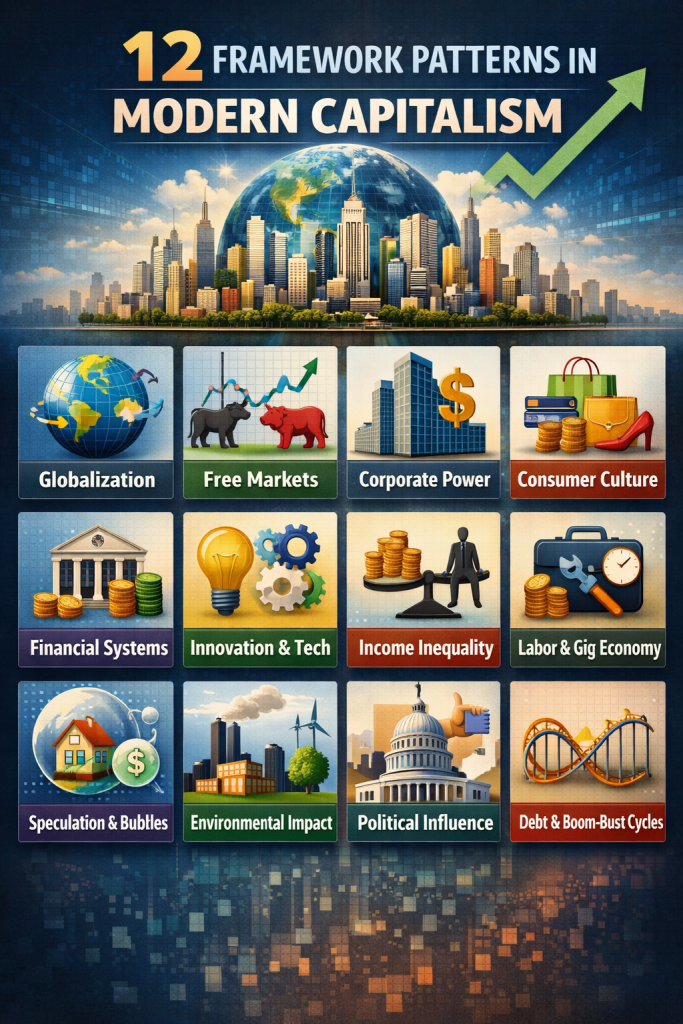
Below are twelve interconnected patterns that define how modern capitalist economies function in our world:
🌍 Global Supply Chains
Production is fragmented across continents: a smartphone might use rare earths from Africa, be assembled in Asia, and sold in Europe or the U.S. This maximizes efficiency but creates fragility — a single port closure or geopolitical conflict can ripple through the entire system. COVID-19 exposed how dependent economies are on these chains, sparking debates about reshoring and resilience.
💹 Financialization
Capitalism has shifted from producing goods to trading financial instruments. Derivatives, hedge funds, and speculative markets often generate more profit than factories. While this accelerates wealth creation, it also magnifies inequality and systemic risk — as seen in the 2008 financial crisis.
🛍️ Consumer Culture
Consumption is no longer about survival but identity. Brands sell lifestyles, not just products. Social media amplifies this by turning consumption into a performance — “influencer culture” thrives on showcasing what you buy, not just who you are.
🤖 Technological Innovation
Innovation drives growth but also disruption. AI, biotech, and automation create new industries while eliminating traditional jobs. This constant churn forces workers and businesses to adapt quickly, raising questions about education, retraining, and ethical boundaries.
👩💻 Gig Economy
Platforms like Uber, Fiverr, and DoorDash redefine labor. Flexibility appeals to workers, but lack of benefits and job security creates precarity. It blurs the line between entrepreneurship and exploitation, challenging traditional labor laws.
🏢 Corporate Power
Multinational corporations rival states in influence. They lobby governments, shape regulations, and even dictate cultural norms. Tech giants, for example, control digital infrastructure in ways that governments struggle to regulate.
💰 Inequality
Wealth concentration is sharper than ever. The richest 1% hold more wealth than billions combined. This sparks debates about taxation, universal basic income, and whether capitalism can survive without addressing fairness.
🌱 Environmental Externalities
Economic growth often ignores ecological costs. Pollution, deforestation, and carbon emissions are “externalized” — borne by society rather than companies. Climate change forces capitalism to confront sustainability, with green finance and ESG investing emerging as partial solutions.
🚶 Global Migration
Labor mobility fuels growth but stirs political tension. Migrants often fill essential roles in economies, yet face resistance tied to nationalism, identity, and cultural integration. Migration highlights capitalism’s reliance on human movement across borders.
📱 Digital Platforms
Platforms like Amazon, Google, and Meta dominate commerce and communication. They create ecosystems where users are both consumers and data sources. This raises concerns about monopoly power.
Absolutely — let’s dive deeper into each of the twelve defining patterns of modern capitalism, showing how they operate and overlap in today’s global economy.
🌍 Global Supply Chains
Modern production networks stretch across continents. A single product may involve dozens of countries: raw materials mined in Africa, components manufactured in Asia, design in Europe, and marketing in the U.S. This interconnectedness boosts efficiency and lowers costs but also creates fragility. Events like pandemics, wars, or shipping bottlenecks can halt entire industries overnight.
💹 Financialization
Finance has become the beating heart of capitalism. Instead of profits coming mainly from producing goods, they increasingly come from trading stocks, bonds, derivatives, and other financial instruments. This shift fuels speculative bubbles, widens inequality, and makes economies more volatile — as seen in the 2008 crash and crypto market swings.
🛍️ Consumer Culture
Consumption is now about identity, not just utility. Advertising, branding, and influencer marketing encourage people to buy not only for need but for self-expression. Fast fashion, luxury goods, and tech gadgets thrive on this culture, while social media amplifies the pressure to display consumption as a lifestyle.
🤖 Technological Innovation
Innovation is capitalism’s growth engine but also its disruptor. AI, biotech, and automation create new opportunities while destroying old jobs and industries. This relentless churn forces societies to rethink education, retraining, and ethics — for example, how to balance automation with human employment.
👩💻 Gig Economy
Platforms like Uber, Upwork, and DoorDash redefine work. They offer flexibility and independence but often strip away traditional protections like healthcare, pensions, and job security. This creates a new class of workers — free yet precarious — challenging labor laws and social safety nets.
🏢 Corporate Power
Multinational corporations rival governments in influence. They shape tax policy, environmental regulation, and even geopolitics. Tech giants, for example, control digital infrastructure and data flows, giving them power over communication, commerce, and culture.
💰 Inequality
Wealth is increasingly concentrated at the top. The richest 1% control vast resources, while middle and lower classes struggle with stagnant wages and rising costs. This sparks debates about taxation, universal basic income, and whether capitalism can remain stable without addressing fairness.
🌱 Environmental Externalities
Economic growth often ignores ecological costs. Pollution, deforestation, and carbon emissions are “externalized” — borne by society rather than companies. Climate change forces capitalism to confront sustainability, with green finance, carbon markets, and ESG investing emerging as partial solutions.
🚶 Global Migration
Labor mobility fuels growth but stirs political tension. Migrants often fill essential roles in healthcare, agriculture, and construction, yet face resistance tied to nationalism and cultural identity. Migration highlights capitalism’s reliance on human movement across borders, even as politics resists it.
📱 Digital Platforms
Platforms like Amazon, Google, and Meta dominate commerce and communication. They create ecosystems where users are both consumers and data sources. This raises concerns about monopoly power, privacy, and the commodification of human attention.
🏛️ State Intervention
Governments remain central to capitalism. They regulate markets, subsidize industries, and bail out failing firms during crises. The balance between free enterprise and state control shifts constantly — from neoliberal deregulation to pandemic-era stimulus packages.
🎨 Cultural Capital
Ideas, art, and social influence are now commodities. Streaming platforms monetize creativity, while social media turns cultural trends into profit. Even “influence” itself is bought and sold, with followers, likes, and viral content becoming economic assets.
Together, these twelve patterns show capitalism as a dynamic, adaptive system — efficient yet fragile, innovative yet unequal, global yet deeply local in its impacts.
Would you like me to illustrate how these patterns interconnect — for example, how technological innovation fuels both inequality and consumer culture, or how corporate power shapes state intervention?branding, and intellectual property.
Closing Thought
Modern capitalism is a mosaic of these patterns, constantly evolving and adapting. Understanding them helps us see not just how wealth is created, but how societies are shaped. Would you like me to expand this into a long-form essay with deeper analysis of each pattern, or keep it as a short blog post for quick reading?




Be First to Comment