
Introduction
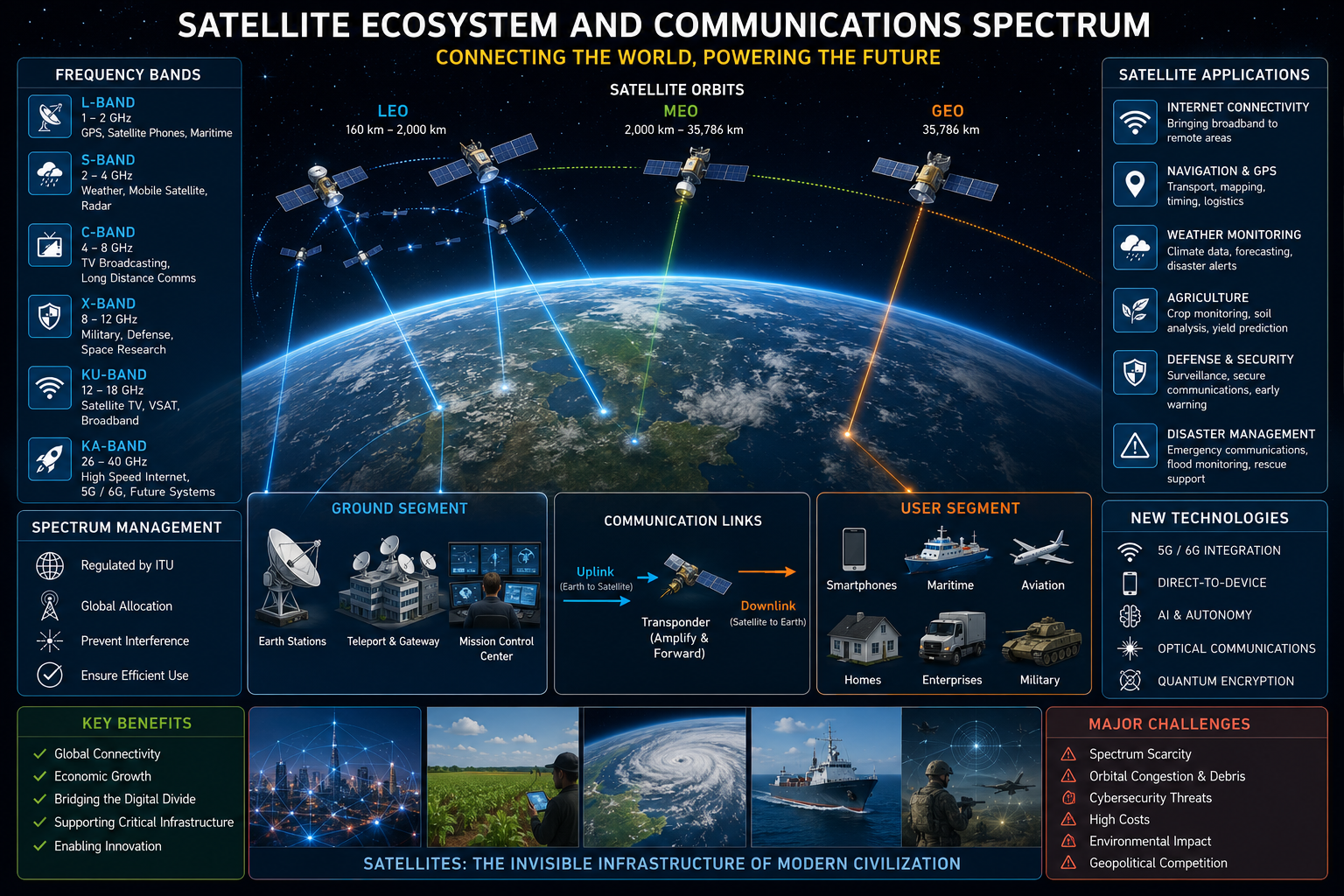
Satellite technology has become one of the most important pillars of the modern global economy. From mobile communications and internet connectivity to banking systems, climate monitoring, navigation, defense, agriculture, and financial markets, satellites operate as invisible infrastructure supporting modern civilization. Without satellites, many aspects of today’s digital economy would collapse within hours.
The satellite ecosystem combines space engineering, telecommunications, electronics, physics, software systems, artificial intelligence, cybersecurity, energy systems, and spectrum management into one integrated technological environment. At the center of this ecosystem lies communications spectrum technology — the organized use of radio frequencies that allows satellites to communicate with Earth stations, smartphones, aircraft, ships, military systems, and other satellites.
Modern satellite systems now form part of the broader global “space economy,” which is rapidly expanding due to private companies, government investments, 5G and 6G development, cloud computing, artificial intelligence, autonomous systems, and worldwide demand for broadband internet.
1. Historical Evolution of Satellite Communications
1.1 Early Foundations
The theoretical foundation of satellite communication emerged from radio wave discoveries by scientists such as:
- James Clerk Maxwell
- Heinrich Hertz
- Nikola Tesla
- Guglielmo Marconi
These pioneers demonstrated that electromagnetic waves could carry information across long distances.
1.2 Space Age and Artificial Satellites
The first artificial satellite was:
- Sputnik 1 launched by the Soviet Space Program in 1957.
This marked the beginning of the Space Age.
The first communications satellite followed shortly afterward:
- Telstar 1 in 1962.
Satellite communication later evolved through:
- Analog broadcasting
- Digital transmission
- Broadband internet
- GPS navigation
- High-throughput satellites
- Low Earth Orbit (LEO) mega-constellations
2. Understanding the Satellite Ecosystem
The satellite ecosystem is a network of interconnected systems that enable communication, observation, navigation, and data processing.
Main Components
2.1 Space Segment
The space segment includes:
- Satellites
- Payload systems
- Solar power systems
- Antennas
- Transponders
- Onboard processors
- Propulsion systems
A satellite functions like a relay station in space. It receives radio signals, amplifies them, and retransmits them to another location on Earth.
2.2 Ground Segment
Ground infrastructure includes:
- Earth stations
- Satellite dishes
- Teleports
- Tracking systems
- Mission control centers
- User terminals
These systems connect space networks with terrestrial internet and telecommunications infrastructure.
2.3 User Segment
End users include:
- Smartphones
- GPS receivers
- Internet terminals
- Military communication systems
- Aviation navigation systems
- Maritime communication systems
3. Satellite Orbit Classifications
Satellites operate in different orbital regions depending on their mission requirements.
3.1 Low Earth Orbit (LEO)
Altitude:
- 160 km to 2,000 km
Characteristics:
- Low latency
- Fast communication
- High-speed internet
- Requires many satellites for coverage
Applications:
- Broadband internet
- Earth observation
- IoT connectivity
- Military reconnaissance
Examples:
- SpaceX Starlink
- OneWeb
LEO systems are transforming global internet access.
3.2 Medium Earth Orbit (MEO)
Altitude:
- 2,000 km to 35,786 km
Applications:
- Navigation systems
- GPS services
- Timing synchronization
Examples:
- Global Positioning System
- Galileo
3.3 Geostationary Orbit (GEO)
Altitude:
- 35,786 km
Characteristics:
- Appears fixed over Earth
- Large coverage area
- Suitable for broadcasting
Applications:
- Television broadcasting
- Weather monitoring
- Long-distance telecommunications
GEO satellites dominate traditional satellite broadcasting and enterprise communication systems.
4. Communications Spectrum Technology
4.1 Definition of Spectrum
The radio spectrum is part of the electromagnetic spectrum used for wireless communications.
Satellite communication depends on carefully allocated frequency bands regulated internationally.
The spectrum is finite and highly valuable because modern civilization depends on wireless connectivity.
5. Major Satellite Frequency Bands
Satellite communication uses frequencies mainly between 1 GHz and 50 GHz.
5.1 L-Band (1–2 GHz)
Applications:
- GPS
- Satellite phones
- Maritime communication
Advantages:
- Excellent weather penetration
- Reliable in rain
5.2 S-Band (2–4 GHz)
Applications:
- Weather satellites
- Mobile satellite systems
- Radar systems
5.3 C-Band (4–8 GHz)
Applications:
- Television broadcasting
- Long-distance communication
Advantages:
- Resistant to rain fade
- Reliable in tropical regions
This band is particularly important in Africa due to heavy rainfall conditions.
5.4 X-Band (8–12 GHz)
Applications:
- Military systems
- Defense communications
- Space research
5.5 Ku-Band (12–18 GHz)
Applications:
- Satellite television
- VSAT internet
- Broadband services
Advantages:
- Smaller antennas
- Higher data rates
5.6 Ka-Band (26–40 GHz)
Applications:
- High-speed broadband
- Modern internet constellations
- Future 5G and 6G systems
Ka-band enables very high-capacity data transmission.
6. Spectrum Allocation and Regulation
6.1 International Telecommunication Union (ITU)
The International Telecommunication Union regulates global spectrum allocation and orbital positioning.
The ITU prevents:
- Signal interference
- Frequency conflicts
- Orbital congestion
The World Radiocommunication Conference (WRC) coordinates international frequency usage.
7. Satellite Communication Architecture
7.1 Uplink
The uplink is the transmission from Earth to satellite.
7.2 Transponder
The transponder:
- Receives signals
- Amplifies them
- Changes frequency
- Rebroadcasts them
7.3 Downlink
The downlink sends signals from satellite back to Earth.
This architecture forms the backbone of global communications networks.
8. Modern Satellite Applications
8.1 Internet Connectivity
Satellite broadband connects:
- Rural areas
- Ships
- Aircraft
- Remote industries
LEO mega-constellations are reducing the digital divide globally.
8.2 Navigation and GPS
Satellite timing systems support:
- Banking systems
- Financial markets
- Air traffic
- Logistics
- Ride-sharing apps
8.3 Weather Forecasting
Meteorological satellites monitor:
- Hurricanes
- Climate patterns
- Rainfall systems
- Ocean temperatures
8.4 Agriculture
Precision agriculture uses satellites for:
- Soil analysis
- Irrigation management
- Crop health monitoring
- Yield prediction
8.5 Defense and National Security
Military satellites provide:
- Surveillance
- Missile detection
- Encrypted communications
- Battlefield intelligence
8.6 Disaster Management
Satellites support:
- Emergency communication
- Flood monitoring
- Wildfire tracking
- Search and rescue
9. The Economics of Satellite Systems
The satellite industry is a major contributor to the global space economy.
Economic Drivers
9.1 Telecommunications
Satellite systems generate billions through:
- Internet services
- TV broadcasting
- Enterprise networking
9.2 Financial Infrastructure
Global banking depends heavily on satellite timing synchronization.
9.3 Aviation and Maritime
Aircraft and ships rely on satellite systems for:
- Navigation
- Internet access
- Safety systems
9.4 Data Economy
Satellite Earth observation data powers:
- Insurance
- Mining
- Agriculture
- Urban planning
The space economy is increasingly considered critical infrastructure for modern civilization.
10. 5G, 6G and Satellite Integration
Modern telecommunications are integrating terrestrial and satellite systems.
10.1 Non-Terrestrial Networks (NTN)
NTNs combine:
- Satellites
- Drones
- Aircraft systems
- Ground cellular networks
10.2 Direct-to-Device Connectivity
Future smartphones may communicate directly with satellites without traditional towers.
This technology is central to:
- 6G systems
- Global emergency connectivity
- Remote communications
11. Artificial Intelligence in Satellite Communications
AI is revolutionizing satellite operations through:
- Autonomous control systems
- Traffic optimization
- Signal processing
- Spectrum management
- Predictive maintenance
Intelligent spectrum management is becoming essential because of growing congestion in orbital communication systems.
12. Cybersecurity and Satellite Vulnerabilities
Satellites face increasing cyber threats:
- Signal jamming
- Spoofing
- Hacking
- Data interception
Cybersecurity has become a strategic national priority.
13. Space Debris and Orbital Congestion
Thousands of inactive satellites and debris fragments threaten modern space infrastructure.
Risks include:
- Satellite collisions
- Service disruptions
- Cascading debris events
The rapid growth of mega-constellations increases congestion concerns.
14. Environmental and Energy Challenges
Satellite systems require:
- Massive launch energy
- Ground station power
- Cooling systems
- Rare earth materials
Future sustainable solutions include:
- Reusable rockets
- Green propulsion systems
- Solar-powered satellites
15. Africa and Emerging Markets
Satellite systems are highly important in Africa because many rural areas lack fiber infrastructure.
Applications include:
- Remote education
- Telemedicine
- Mobile banking
- Agricultural monitoring
- Rural internet access
C-band and lower frequency systems are especially valuable in African climates with high rainfall.
16. Future Technologies
16.1 Quantum Satellite Communications
Quantum systems may provide:
- Ultra-secure encryption
- Quantum internet
- Advanced cybersecurity
16.2 Optical Satellite Communications
Laser communication systems can deliver:
- Higher bandwidth
- Faster speeds
- Lower interference
16.3 Integrated Space-Terrestrial Networks
Future communication systems will combine:
- Satellites
- Fiber networks
- 6G towers
- AI routing systems
- Edge computing
17. Challenges Facing the Industry
Major challenges include:
- Spectrum scarcity
- Orbital congestion
- Space debris
- High launch costs
- Cybersecurity risks
- Regulatory conflicts
- Geopolitical competition
Spectrum competition between satellite and terrestrial wireless operators is intensifying globally.
18. Strategic Importance to Civilization
Satellite systems now function as:
- Digital infrastructure
- Economic infrastructure
- National security infrastructure
- Scientific infrastructure
Modern civilization depends on satellites for:
- Communication
- Commerce
- Transportation
- Energy systems
- Climate monitoring
- Defense
- Scientific research
Conclusion
The satellite ecosystem and communications spectrum technology represent one of the most transformative technological achievements in human history. Satellites have evolved from experimental scientific tools into foundational infrastructure supporting the global economy and modern civilization.
The future of communications will increasingly depend on integrated satellite-terrestrial systems powered by artificial intelligence, advanced spectrum management, and next-generation wireless technologies such as 6G. As humanity expands its digital economy and global connectivity demands rise, satellites will continue to play a central role in bridging communication gaps, supporting national security, enabling scientific discovery, and driving economic development.
However, the future also brings serious challenges involving spectrum scarcity, orbital congestion, cybersecurity threats, and sustainability concerns. International cooperation, innovation, and responsible governance will therefore be essential for ensuring that satellite communications remain reliable, secure, and accessible for future generations.
The satellite economy is no longer merely part of the space industry; it has become one of the invisible operating systems of modern civilization itself.




Be First to Comment