
Abstract
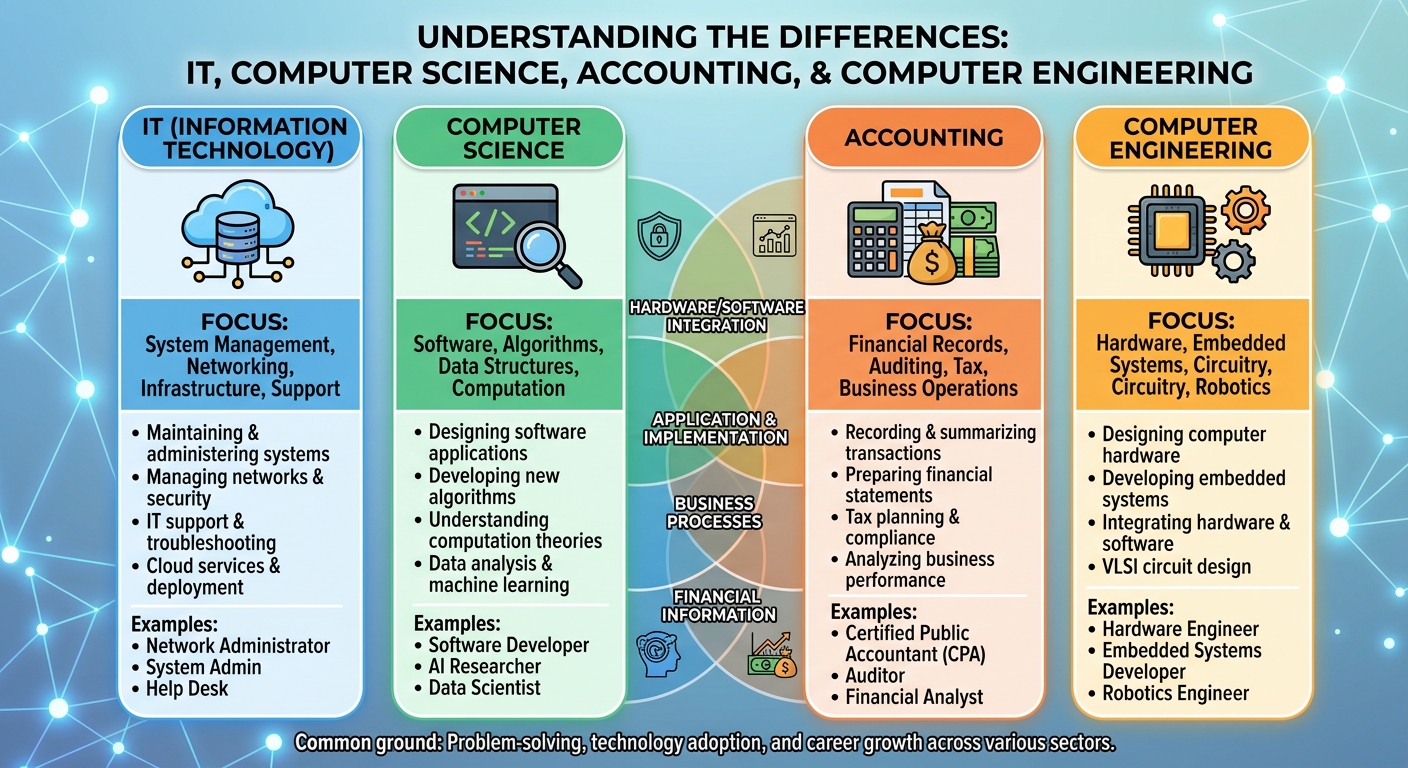
Information Technology (IT), Computer Science (CS), Accounting, and Computer Engineering (CE) are four distinct but increasingly interconnected disciplines. They all contribute to the modern digital economy, but they answer fundamentally different questions.
- Computer Science: What can computation do, and how can we design algorithms and software to do it?
- Computer Engineering: How do we design and build the computing machines and electronic systems that perform computation?
- Information Technology: How do we deploy, operate, secure, integrate, and support technology so that organisations can use it effectively?
- Accounting: How do we measure, record, analyse, control, and report the economic activities and financial position of an organisation?
The important modern development is that these disciplines are no longer isolated. A bank, hospital, manufacturing company, government department, AI laboratory or technology company may require all four.
1. The Big Picture
A useful way to understand the four disciplines is to imagine a modern digital company.
                    MODERN ORGANISATION
                           │
          ┌────────────────┼────────────────┐
          │                │                │
     COMPUTING          TECHNOLOGY       ECONOMICS
          │                │                │
    ┌─────┴─────┐      IT OPERATIONS     ACCOUNTING
    │           │          │                │
Computer     Computer    Networks       Financial
Science      Engineering Cloud          records
    │           │        Cybersecurity   Reporting
    │           │        Databases       Tax
Algorithms   Hardware   Support         Auditing
Software     Chips      Integration     Analysis
AI           Embedded   Infrastructure  Controls
Computer Science and Computer Engineering create the underlying computing capabilities.
IT turns technology into an operational organisational capability.
Accounting measures the economic consequences of what the organisation does.
2. What Is Information Technology?
2.1 Definition
Information Technology (IT) is the discipline concerned with the use, deployment, management, integration, maintenance and protection of computing and information systems.
IT is therefore strongly oriented toward using technology to solve organisational and operational problems.
A simplified equation is:\[ IT = Hardware + Software + Networks + Data + People + Processes \]
IT is not simply “working with computers.”
It involves an entire technological environment.
3. Major Areas of Information Technology
3.1 IT Infrastructure
Infrastructure includes:
- computers
- servers
- storage
- networking equipment
- Wi-Fi
- routers
- switches
- firewalls
- cloud infrastructure
- data centres
- backup systems.
3.2 Networking
IT professionals may design and manage:
User
 ↓
PC / Smartphone
 ↓
Wi-Fi / Ethernet
 ↓
Switch
 ↓
Router
 ↓
Firewall
 ↓
Internet
 ↓
Cloud/Data Centre
3.3 Systems Administration
Systems administrators manage:
- operating systems
- user accounts
- permissions
- servers
- storage
- updates
- backups
- monitoring
- availability.
3.4 Cybersecurity
IT security includes:
- identity management
- authentication
- access control
- endpoint security
- network security
- vulnerability management
- security monitoring
- incident response.
3.5 Cloud Computing
Modern IT increasingly involves:
- Infrastructure as a Service
- Platform as a Service
- Software as a Service
- virtual machines
- containers
- cloud databases
- cloud networking.
3.6 IT Support
IT support connects humans with technology.
For example:
A company employee cannot access the accounting system.
An IT professional investigates:
User
 ↓
Device
 ↓
Network
 ↓
Authentication
 ↓
Application
 ↓
Database
 ↓
Server / Cloud
The objective is restoring reliable operation.
4. What Is Computer Science?
4.1 Definition
Computer Science is the study of computation, algorithms, information, computational systems and the principles underlying software and computer-based problem solving.
Computer Science is therefore more concerned with the theory and mechanisms of computation.
Its central question is:
What problems can computers solve, and how can we solve them efficiently?
5. Computer Science Is More Than Programming
Programming is one tool within Computer Science.
The discipline includes:
- algorithms
- data structures
- computational theory
- programming languages
- operating systems
- databases
- artificial intelligence
- machine learning
- computer graphics
- distributed systems
- computer networks
- cryptography
- human-computer interaction
- software engineering.
6. Algorithms: The Heart of Computer Science
An algorithm is a systematic procedure for solving a problem.
For example:
INPUT
  ↓
Problem
  ↓
Algorithm
  ↓
Computation
  ↓
OUTPUT
Suppose we need to search one million records.
A Computer Scientist asks:
How can we search the information efficiently?
Different algorithms can have dramatically different performance.
This introduces computational complexity.
For example:\[ O(1) \]
means approximately constant-time behaviour.\[ O(\log n) \]
represents logarithmic growth.\[ O(n) \]
represents linear growth.\[ O(n^2) \]
represents quadratic growth.
Understanding such relationships is fundamental to Computer Science.
7. Artificial Intelligence and Computer Science
AI is heavily connected to Computer Science.
A simplified AI architecture is:
DATA
 ↓
Representation
 ↓
Algorithm
 ↓
Model
 ↓
Training
 ↓
Inference
 ↓
Prediction / Decision
Computer Science investigates questions such as:
- How should information be represented?
- How should algorithms learn?
- How should models search solution spaces?
- How can computation be made efficient?
- How can AI systems reason?
- How can systems process enormous datasets?
8. What Is Computer Engineering?
8.1 Definition
Computer Engineering combines electrical/electronic engineering with computer science to design and develop computing hardware and hardware-software systems.
Its fundamental question is:
How do we physically build machines that perform computation?
Computer Engineering therefore operates much closer to the physical layer.
9. Computer Engineering Architecture
Consider a smartphone.
Inside it are:
Application
     ↓
Operating System
     ↓
CPU / GPU / NPU
     ↓
Instruction Set Architecture
     ↓
Digital Logic
     ↓
Transistors
     ↓
Semiconductor
     ↓
Silicon
Computer Engineering connects many of these layers.
10. Digital Logic
Computer engineers work with fundamental digital components such as:
- logic gates
- flip-flops
- registers
- multiplexers
- counters
- arithmetic logic units
- memory circuits.
A basic computer can be conceptually represented as:
             ┌───────────────┐
             │      CPU      │
             │               │
             │ Control Unit  │
             │      +        │
             │      ALU      │
             └───────┬───────┘
                     │
          ┌──────────┼──────────┐
          ↓          ↓          ↓
       Memory      Storage     I/O
11. Semiconductor Engineering
At a deeper level, Computer Engineering connects to semiconductor technology.
A modern processor consists of enormous numbers of transistors.
Conceptually:\[ Transistors \rightarrow Logic\ Gates \rightarrow Circuits \rightarrow Processor\ Units \rightarrow CPU \]
Modern processors may contain billions of transistors.
The engineer must consider:
- transistor design
- power consumption
- heat
- clock frequency
- signal integrity
- memory bandwidth
- fabrication technology
- physical layout
- reliability.
12. Embedded Systems
Computer Engineering is particularly important in embedded systems.
Examples include:
- cars
- medical devices
- industrial robots
- aircraft systems
- washing machines
- drones
- satellites
- telecommunications equipment
- IoT devices.
A simplified embedded system is:
Sensors
   ↓
Microcontroller
   ↓
Software/Firmware
   ↓
Decision
   ↓
Actuator
For example:
Temperature Sensor
       ↓
Microcontroller
       ↓
Control Algorithm
       ↓
Cooling System
13. What Is Accounting?
Accounting is fundamentally different from the three computing disciplines.
Accounting is the systematic process of recording, classifying, summarising, analysing and communicating financial and economic information.
Its fundamental question is:
What happened economically, financially and financially within an organisation, and how should it be measured and reported?
Accounting is therefore fundamentally concerned with financial information and economic accountability.
14. The Accounting System
A simplified accounting information flow is:
BUSINESS TRANSACTIONS
        ↓
     Documents
        ↓
   Journal Entries
        ↓
      Ledger
        ↓
 Trial Balance
        ↓
Financial Statements
        ↓
Analysis / Decision Making
For example, when a company sells a computer:
Sale
 ↓
Invoice
 ↓
Accounting Record
 ↓
Revenue
 ↓
Receivable/Cash
 ↓
Financial Statements
15. The Accounting Equation
One of the foundations of accounting is:\[ Assets = Liabilities + Equity \]
For example:
Suppose a company has:\[ Assets = R1,000,000 \]
and:\[ Liabilities = R400,000 \]
Then:\[ Equity = R1,000,000 – R400,000 \]\[ Equity = R600,000 \]
This equation represents the basic financial structure of an organisation.
16. Major Accounting Areas
Accounting includes several specialised fields.
Financial Accounting
Produces financial information for external users.
Management Accounting
Provides information for internal management decisions.
Cost Accounting
Analyses the costs associated with products and services.
Tax Accounting
Deals with taxation requirements.
Auditing
Examines financial information and controls.
Forensic Accounting
Investigates financial irregularities and evidence.
Accounting Information Systems
Connects accounting with information technology.
This last area is where accounting increasingly intersects with IT.
17. The Most Important Difference
The disciplines can be distinguished by their primary object of study.
| Discipline | Primary Focus | Central Question |
|---|---|---|
| Computer Science | Computation | What can computation do? |
| Computer Engineering | Computing hardware | How can we build computing machines? |
| Information Technology | Technology operations | How can organisations use technology effectively? |
| Accounting | Financial information | What happened economically and financially? |
18. Computer Science vs Computer Engineering
These two are often confused.
Computer Science
More heavily focused on:
Algorithms
Data
Software
Computation
AI
Programming
Theory
Computer Engineering
More heavily focused on:
Electronics
Hardware
Digital circuits
Processors
Embedded systems
Semiconductors
Hardware-software integration
However, there is substantial overlap.
For example, both may study:
- operating systems
- computer architecture
- programming
- networks
- embedded computing.
19. Computer Science vs IT
This distinction is particularly important.
Computer Science
Often asks:
How can we create a more efficient algorithm?
IT
Often asks:
How can we deploy and maintain the technology required by the organisation?
Consider a company database.
A Computer Scientist might investigate:
- database algorithms
- query optimisation
- data structures
- distributed computing.
An IT professional might investigate:
- database deployment
- backups
- user access
- monitoring
- availability
- security
- integration.
20. IT vs Computer Engineering
Consider a company’s network.
The IT professional may:
- configure switches
- manage routers
- configure firewalls
- manage users
- monitor network performance
- troubleshoot failures.
The Computer Engineer might design:
- network hardware
- communication processors
- embedded networking systems
- high-speed electronic interfaces.
The distinction is therefore approximately:
Computer Engineering
       ↓
Build the technology

Information Technology
       ↓
Deploy and operate the technology
21. Accounting vs IT
Accounting asks:
What are the organisation’s financial transactions and financial position?
IT asks:
What technology enables the organisation to operate and manage information?
Yet modern accounting depends heavily on IT.
Consider a large organisation:
Customer
   ↓
Transaction
   ↓
Application
   ↓
Database
   ↓
Accounting System
   ↓
General Ledger
   ↓
Financial Statements
The transaction may begin as a digital event but eventually become an accounting record.
22. Accounting vs Computer Science
The two disciplines have fundamentally different objectives.
Computer Science focuses on:\[ Information + Algorithms + Computation \]
Accounting focuses on:\[ Transactions + Measurement + Reporting + Control \]
However, modern accounting increasingly uses:
- databases
- AI
- machine learning
- automation
- data analytics
- cloud systems
- blockchain
- cybersecurity.
23. The Modern Accounting Information System
A modern accounting system may look like:
                 CUSTOMERS
                     ↓
              Sales Platform
                     ↓
                Database
                     ↓
        ┌────────────┼────────────┐
        ↓            ↓            ↓
     Revenue      Inventory     Payments
        ↓            ↓            ↓
        └────────────┼────────────┘
                     ↓
              Accounting System
                     ↓
              General Ledger
                     ↓
          Financial Statements
IT provides the infrastructure.
Computer Science provides computational techniques.
Computer Engineering provides much of the physical computing platform.
Accounting converts economic events into structured financial information.
24. A Real-World Example: A Supermarket
Imagine a customer purchases food for R500.
Computer Engineering
Physical systems include:
- barcode scanner
- processor
- touchscreen
- networking hardware
- payment terminal.
Computer Science
Software may implement:
- search algorithms
- transaction processing
- inventory algorithms
- databases
- fraud detection
- AI forecasting.
Information Technology
IT manages:
- networks
- servers
- cloud infrastructure
- user accounts
- cybersecurity
- system availability
- technical support.
Accounting
Accounting records:
- revenue
- tax
- inventory movement
- cash/card receivable
- expenses
- financial reporting.
One transaction therefore passes through all four disciplines.
25. A Modern Bank
The integration becomes even clearer in banking.
                CUSTOMER
                   ↓
             Mobile Banking
                   ↓
              Application
                   ↓
          Authentication
                   ↓
              Network
                   ↓
              Database
                   ↓
          Transaction Engine
                   ↓
             Accounting
                   ↓
          Financial Records
Behind this system:
Computer Engineering
provides processors, networking equipment, storage hardware and specialised computing systems.
Computer Science
provides algorithms, cryptography, databases, distributed systems and software.
IT
operates the infrastructure, security, systems and technology environment.
Accounting
records and reports the financial consequences of transactions.
26. Career Architecture
The four fields also produce different professional pathways.
Computer Science
Possible careers include:
- software engineer
- AI engineer
- machine-learning engineer
- data scientist
- algorithm engineer
- systems developer
- research scientist
- cybersecurity specialist.
Computer Engineering
Possible careers include:
- computer engineer
- hardware engineer
- embedded systems engineer
- semiconductor engineer
- firmware engineer
- robotics engineer
- digital systems engineer
- hardware architect.
Information Technology
Possible careers include:
- systems administrator
- network engineer
- cloud engineer
- IT support specialist
- IT manager
- cybersecurity practitioner
- database administrator
- systems analyst.
Accounting
Possible careers include:
- accountant
- auditor
- management accountant
- financial analyst
- tax professional
- forensic accountant
- financial controller
- chief financial officer.
27. The Four Disciplines as Layers
A useful conceptual architecture is:
                BUSINESS / SOCIETY
                       │
                 ACCOUNTING
                       │
              Financial Information
                       │
                INFORMATION IT
                       │
        Technology Operations & Services
                       │
               COMPUTER SCIENCE
                       │
           Computation & Software
                       │
             COMPUTER ENGINEERING
                       │
        Hardware & Physical Computing
                       │
                 ELECTRONICS
                       │
                 SEMICONDUCTORS
                       │
                   PHYSICS
This is not a strict academic hierarchy—each discipline has its own independent theories and applications—but it is a useful way of visualising technological dependence.
28. The Data Journey
Consider the journey of a single financial transaction.
PHYSICAL WORLD
     ↓
Electronic Sensor / Device
     ↓
Computer Hardware
     ↓
Firmware
     ↓
Operating System
     ↓
Application Software
     ↓
Database
     ↓
IT Infrastructure
     ↓
Transaction Processing
     ↓
Accounting System
     ↓
Financial Report
     ↓
Human Decision
This demonstrates something important:
A modern economic transaction can simultaneously be an engineering event, a computational event, an IT event and an accounting event.
29. Where Artificial Intelligence Connects Everything
AI is increasingly becoming a common layer across these disciplines.
Computer Science + AI
Develop:
- algorithms
- neural networks
- machine learning
- optimisation
- natural-language processing.
Computer Engineering + AI
Develop:
- AI accelerators
- GPUs
- NPUs
- edge-AI chips
- specialised processors.
IT + AI
Deploy:
- AI infrastructure
- cloud AI services
- enterprise AI systems
- security monitoring
- automated IT operations.
Accounting + AI
Use AI for:
- transaction classification
- anomaly detection
- forecasting
- audit analytics
- fraud detection
- document processing.
30. The Emerging Discipline: FinTech
The intersection between accounting, finance, IT and computer science has created enormous technological fields such as financial technology (FinTech).
For example:
Computer Science
       +
Computer Engineering
       +
Information Technology
       +
Accounting
       +
Finance
       ↓
     FinTech
Applications include:
- digital banking
- electronic payments
- automated accounting
- financial analytics
- algorithmic systems
- digital identity
- blockchain systems.
31. Cybersecurity Connects All Four
Cybersecurity cannot be confined to one discipline.
Computer Engineering
Protects hardware and embedded systems.
Computer Science
Develops:
- cryptography
- secure algorithms
- authentication protocols
- security software.
IT
Implements:
- firewalls
- identity systems
- endpoint security
- monitoring
- access control.
Accounting
Deals with:
- financial controls
- audit trails
- fraud
- governance
- financial risk.
Therefore:\[ Cybersecurity = Technology + People + Processes + Governance \]
32. Data Is the Common Language
All four disciplines increasingly depend on data.
             DATA
               │
       ┌───────┼────────┐
       ↓       ↓        ↓
Computer     IT       Accounting
Science      │          │
       │      │          │
Algorithms Infrastructure Financial
Models       Systems     Records
       │      │          │
       └──────┼──────────┘
              ↓
        Decision Making
Computer Science asks how data can be processed.
IT asks how data systems can be operated.
Computer Engineering asks how hardware can move and process data.
Accounting asks what financial information the data represents.
33. Education Pathway
A student interested in these disciplines can think about them according to interests.
If you enjoy mathematics, algorithms and programming
Consider:
Computer Science
If you enjoy electronics, physics, hardware and computers
Consider:
Computer Engineering
If you enjoy technology systems, networks, cloud and troubleshooting
Consider:
Information Technology
If you enjoy mathematics, finance, business, records and financial analysis
Consider:
Accounting
There can also be combinations.
34. Hybrid Fields
The modern economy increasingly produces interdisciplinary careers.
Examples include:
Accounting + IT
Accounting Information Systems
Computer Science + Finance
Computational Finance
Computer Science + Accounting
Financial Data Analytics
IT + Cybersecurity
Cybersecurity Engineering / IT Security
Computer Engineering + AI
AI Hardware Engineering
Computer Science + Biology
Computational Biology
Computer Engineering + Robotics
Robotics Engineering
This illustrates an important principle:
Modern technological development increasingly occurs at the boundaries between disciplines.
35. A Simple Mental Model
You can remember the difference with four verbs:
| Discipline | Main Verb |
|---|---|
| Computer Science | Compute |
| Computer Engineering | Build |
| Information Technology | Operate |
| Accounting | Measure |
Therefore:
Computer Science → Compute
Computer Engineering → Build
IT → Operate
Accounting → Measure
Together:\[ Compute + Build + Operate + Measure \]
form an important part of the modern digital economy.
36. Final Integrated Architecture
The modern technological economy can be represented as:
                         HUMAN SOCIETY
                              │
                    ┌─────────┴─────────┐
                    │                   │
                 BUSINESS            GOVERNMENT
                    │                   │
                    └─────────┬─────────┘
                              ↓
                         ACCOUNTING
                              │
                   Financial Measurement
                              │
                              ↓
                    INFORMATION TECHNOLOGY
                              │
              Networks / Cloud / Systems
                              │
                              ↓
                       COMPUTER SCIENCE
                              │
              Algorithms / Software / AI
                              │
                              ↓
                    COMPUTER ENGINEERING
                              │
          CPUs / GPUs / Memory / Embedded Systems
                              │
                              ↓
                       SEMICONDUCTORS
                              │
                              ↓
                          ELECTRONICS
                              │
                              ↓
                           PHYSICS
Conclusion
Information Technology, Computer Science, Computer Engineering and Accounting are not four names for the same subject.
They represent different intellectual and professional approaches to modern civilisation.
Computer Science studies computation and develops the mathematical and computational methods that make software and AI possible.
Computer Engineering connects computation with physical reality by designing processors, digital circuits, embedded systems and hardware-software platforms.
Information Technology takes computing technologies and makes them useful, reliable, secure and operational within organisations.
Accounting provides the financial measurement, reporting and control system through which economic activity can be understood and managed.
The modern economy increasingly depends on their integration:\[ \boxed{ \text{Computer Engineering} \rightarrow \text{Computer Science} \rightarrow \text{Information Technology} \rightarrow \text{Accounting} \rightarrow \text{Business Decision} } \]
But the relationship is not strictly linear. It is better understood as a network:\[ \boxed{ Hardware \leftrightarrow Software \leftrightarrow IT \leftrightarrow Data \leftrightarrow Accounting \leftrightarrow Business } \]
That network is one of the foundations of the modern digital economy—from semiconductor factories and AI data centres to banks, hospitals, farms, telecommunications networks and government systems.


Be First to Comment