
Abstract
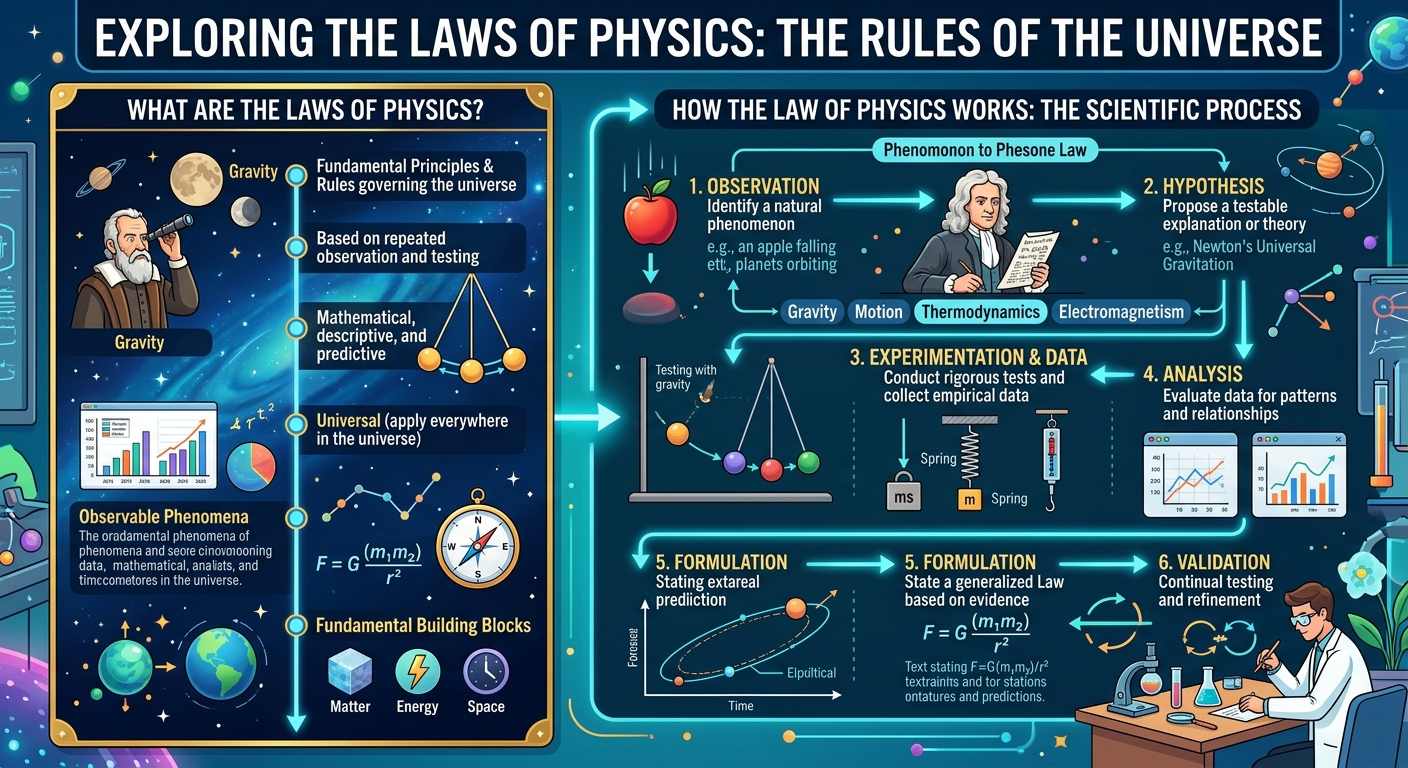
Physics is the systematic study of matter, energy, space, time, motion, forces, fields, waves, and the interactions between them. At the heart of physics are physical laws: mathematical and experimentally tested relationships that describe how nature behaves under specified conditions.
A law of physics does not mean that nature is being commanded to behave in a particular way. Rather, a physical law is a human description of a regular pattern that nature consistently exhibits. Newton’s laws describe motion, conservation laws describe quantities that remain constant, Maxwell’s equations describe electromagnetism, thermodynamic laws describe energy, heat and entropy, Einstein’s theories describe spacetime and gravity, and quantum mechanics describes matter and radiation at microscopic scales.
The remarkable feature of physics is that apparently different phenomena can often be explained using a relatively small number of fundamental principles. A falling apple, an orbiting Moon, an electrical motor, a radio transmitter, a semiconductor, a laser, a nuclear reactor and a galaxy can all be analyzed through mathematical laws.
1. What Is a Law of Physics?
A law of physics is a concise statement—usually mathematical—describing a reproducible relationship observed in nature.
For example, Newton’s second law can be written:
[
F_{\text{net}}=ma
]
where:
- (F_{\text{net}}) = net force
- (m) = mass
- (a) = acceleration
The equation says that when a net force acts on an object, its motion changes according to its mass.
But there is an important distinction:
The equation does not explain why the universe exists or why the fundamental laws have their particular form. It describes extremely accurately how physical quantities are related.
This distinction becomes especially important at the frontier of physics.
2. How Do Scientists Discover Physical Laws?
Physical laws are developed through a combination of:
- Observation
- Measurement
- Experiment
- Mathematical modelling
- Prediction
- Testing
- Repetition
- Independent verification
The process can be represented approximately as:
Nature → Observation → Measurement → Hypothesis → Mathematics → Prediction → Experiment → Verification → Physical theory/law
A scientist might observe that objects fall toward Earth. Measurements reveal that falling objects accelerate. Mathematical analysis produces relationships between distance, time and acceleration. Experiments then determine whether those relationships work repeatedly.
A successful law must make testable predictions.
3. Laws Are Not the Same as Theories
The words “law” and “theory” have different meanings in science.
A physical law
Usually describes what happens.
Example:
[
F=ma
]
A scientific theory
Provides a broader explanatory framework for how and why a large collection of observations fits together.
Examples include:
- Newtonian mechanics
- Electromagnetic theory
- Thermodynamic theory
- Quantum theory
- General relativity
- Evolutionary theory
A theory is not a “guess.” A mature scientific theory can be extraordinarily well supported by evidence.
4. The Mathematical Language of Physics
Physics depends heavily on mathematics because mathematics allows scientists to express relationships precisely.
Some important mathematical concepts include:
- arithmetic
- algebra
- geometry
- trigonometry
- calculus
- differential equations
- linear algebra
- probability
- statistics
- tensors
- complex numbers
- group theory
- differential geometry
For example, velocity is approximately represented by:
[
v=\frac{\Delta x}{\Delta t}
]
Acceleration is:
[
a=\frac{\Delta v}{\Delta t}
]
Calculus generalizes these ideas:
[
v=\frac{dx}{dt}
]
and
[
a=\frac{dv}{dt}=\frac{d^2x}{dt^2}
]
Thus mathematics becomes a language for describing change.
5. Newton’s Laws of Motion
Newtonian mechanics transformed our understanding of motion.
First Law — Inertia
An object remains at rest or continues moving at constant velocity unless acted upon by a net external force.
This is the principle of inertia.
For example, a spacecraft travelling through deep space does not require continuous engine thrust merely to maintain its velocity, assuming negligible external forces.
Second Law — Dynamics
genui{“physics_motion_forces_learning_block”:{“type_id”:”NEWTON_SECOND_LAW”}}
The familiar form is:
[
F_{\text{net}}=ma
]
This means that acceleration depends on:
- the net force
- the object’s mass
For a given mass, increasing net force increases acceleration.
For a given force, increasing mass reduces acceleration.
Example
If a 10 kg object experiences a net force of 50 N:
[
a=\frac{F}{m}
]
[
a=\frac{50}{10}=5,m/s^2
]
The object accelerates at (5,m/s^2).
6. Newton’s Third Law
Forces arise through interactions.
Newton’s third law is commonly expressed as:
[
F_{AB}=-F_{BA}
]
If object A exerts a force on object B, object B exerts an equal-magnitude force in the opposite direction on object A.
This principle explains many phenomena:
- walking
- swimming
- rocket propulsion
- recoil
- collisions
- pushing objects
- mechanical interactions
The forces act on different objects, which is why they do not simply cancel each other.
7. Newton’s Law of Universal Gravitation
Newton proposed that every mass attracts every other mass.
[
F=G\frac{m_1m_2}{r^2}
]
genui{“physics_motion_forces_learning_block”:{“type_id”:”NEWTONS_GRAVITATION_LAW”}}
Here:
- (F) = gravitational force
- (G) = gravitational constant
- (m_1,m_2) = masses
- (r) = separation between their centres of mass
The inverse-square relationship is crucial.
If distance doubles:
[
F\propto\frac{1}{2^2}
]
so the gravitational force becomes one-quarter as large.
8. Gravity: Newton Versus Einstein
Newton described gravity as a force between masses.
Einstein’s general relativity provided a deeper description.
According to general relativity:
Matter and energy influence the geometry of spacetime, and objects move according to that geometry.
A simplified conceptual chain is:
Mass-energy → spacetime geometry → motion of matter and light
This explains phenomena that Newtonian gravity cannot fully describe, particularly:
- Mercury’s orbital precession
- gravitational time dilation
- gravitational lensing
- black holes
- gravitational waves
- cosmological dynamics
Newtonian gravity remains extremely useful when gravitational fields are weak and speeds are much smaller than the speed of light.
9. Conservation Laws
Some of the most powerful laws in physics are conservation laws.
A conserved quantity remains constant within an appropriately isolated system.
Important examples include:
Conservation of energy
[
E_{\text{total}}=\text{constant}
]
Conservation of momentum
[
p_{\text{total}}=\text{constant}
]
Conservation of angular momentum
[
L_{\text{total}}=\text{constant}
]
Conservation of electric charge
[
Q_{\text{total}}=\text{constant}
]
Conservation laws are among the deepest organizing principles in physics.
10. Energy: The Central Accounting System of Physics
Energy is not simply “the ability to do work” in every context; more fundamentally, it is a conserved physical quantity associated with the dynamics of a system.
Common forms include:
- kinetic energy
- gravitational potential energy
- elastic energy
- thermal energy
- chemical energy
- electrical energy
- nuclear energy
- electromagnetic radiation
- rest energy
Kinetic energy is:
genui{“physics_energy_fluids_machines_materials_learning_block”:{“type_id”:”KINETIC_ENERGY”}}
[
KE=\frac12mv^2
]
Gravitational potential energy near Earth’s surface is approximately:
[
PE=mgh
]
genui{“physics_energy_fluids_machines_materials_learning_block”:{“type_id”:”POTENTIAL_ENERGY”}}
The key idea is that energy can change form while the total energy of an isolated system remains constant.
11. Work and Energy
Mechanical work transfers energy through forces acting over displacement.
[
W=Fd\cos\theta
]
For example, if a force acts in the same direction as motion, it transfers energy efficiently.
If the force is perpendicular to the motion, the mechanical work from that force is zero.
This is why circular motion provides an important example: the centripetal force can change the direction of velocity without necessarily changing the object’s kinetic energy.
12. Momentum
Momentum is:
[
p=mv
]
genui{“physics_motion_forces_learning_block”:{“type_id”:”MOMENTUM”}}
Momentum is especially important for collisions and interactions.
For an isolated system:
[
p_{\text{before}}=p_{\text{after}}
]
This principle helps explain:
- collisions
- rockets
- recoil
- particle interactions
- planetary motion
- astrophysical events
13. Angular Momentum
Rotational systems possess angular momentum.
In simplified cases:
[
L=I\omega
]
where:
- (L) = angular momentum
- (I) = moment of inertia
- (\omega) = angular velocity
When external torque is negligible, angular momentum is conserved.
This helps explain why:
- spinning skaters rotate faster when pulling their arms inward
- planets maintain orbital angular momentum
- rotating astronomical objects behave predictably
14. Electricity and Magnetism
Electricity and magnetism were once treated as separate phenomena.
During the nineteenth century, scientists including Michael Faraday and James Clerk Maxwell helped establish that they are deeply interconnected.
Maxwell’s equations describe the electromagnetic field.
They explain:
- electric fields
- magnetic fields
- electromagnetic induction
- electromagnetic waves
- radio
- light
- antennas
- motors
- generators
- transformers
- telecommunications
One of the extraordinary consequences of Maxwell’s theory is that electromagnetic disturbances propagate at the speed of light.
This led to the realization that:
Light is an electromagnetic phenomenon.
15. Electromagnetic Waves
Electromagnetic radiation includes:
- radio waves
- microwaves
- infrared
- visible light
- ultraviolet
- X-rays
- gamma rays
These are not fundamentally different kinds of “light”; they occupy different regions of the electromagnetic spectrum.
The wave relationship is:
[
v=f\lambda
]
genui{“physics_waves_optics_oscillations_earth_learning_block”:{“type_id”:”WAVE_SPEED”}}
For electromagnetic radiation in vacuum:
[
c=f\lambda
]
where (c) is the speed of light.
This relationship connects frequency and wavelength.
16. Frequency and Hertz
Frequency describes how many cycles occur per second.
The unit is the hertz (Hz):
[
1,Hz=1,cycle/second
]
Examples:
- (1,Hz) = one cycle per second
- (1,kHz) = (10^3) Hz
- (1,MHz) = (10^6) Hz
- (1,GHz) = (10^9) Hz
- (1,THz) = (10^{12}) Hz
Frequency is fundamental to:
- radio
- television
- radar
- Wi-Fi
- cellular communications
- sound
- electronics
- spectroscopy
- quantum physics
17. Thermodynamics
Thermodynamics deals with:
- energy
- heat
- temperature
- work
- entropy
- equilibrium
Its laws describe what transformations of energy are possible.
Zeroth Law
If system A is in thermal equilibrium with B, and B is in thermal equilibrium with C, then A is in thermal equilibrium with C.
This establishes the concept of temperature.
18. First Law of Thermodynamics
The first law is essentially conservation of energy applied to thermodynamic systems.
A common form is:
[
\Delta U=Q-W
]
where:
- (\Delta U) = change in internal energy
- (Q) = heat added
- (W) = work done by the system
Energy cannot simply disappear.
It can be transferred or transformed.
19. Second Law of Thermodynamics
The second law introduces entropy.
For an isolated system, entropy does not decrease:
[
\Delta S\geq0
]
in the usual macroscopic formulation.
This gives thermodynamics a direction of time.
Processes naturally proceed toward states that are statistically more probable.
Examples include:
- heat flowing from hotter objects to colder objects
- gases spreading through available space
- irreversible mixing
- friction converting organized mechanical energy into thermal energy
20. Third Law of Thermodynamics
As a system approaches absolute zero under appropriate conditions, its entropy approaches a limiting minimum.
Absolute zero is:
[
0,K
]
which corresponds to approximately:
[
-273.15^\circ C
]
The third law has profound implications for low-temperature physics.
21. The Laws of Fluid Mechanics
Physics also describes liquids and gases.
Important concepts include:
- pressure
- density
- viscosity
- buoyancy
- fluid flow
- turbulence
- pressure gradients
Pressure is:
genui{“physics_energy_fluids_machines_materials_learning_block”:{“type_id”:”PRESSURE”}}
[
P=\frac{F}{A}
]
This explains why the same force produces different pressures over different areas.
Fluid mechanics underlies:
- aircraft
- ships
- pumps
- water systems
- weather
- blood circulation
- turbines
- hydraulic machinery
22. Waves
A wave is a disturbance that propagates through space or a medium while transferring energy and information.
Important wave properties include:
- amplitude
- wavelength
- frequency
- period
- phase
- speed
The relationship is:
[
v=f\lambda
]
Waves include:
- sound
- water waves
- electromagnetic radiation
- seismic waves
- gravitational waves
- quantum wavefunctions, in a more abstract sense
23. Optics
Optics studies light.
Important laws include the law of reflection:
[
\theta_i=\theta_r
]
genui{“physics_waves_optics_oscillations_earth_learning_block”:{“type_id”:”LAW_OF_REFLECTION”}}
Refraction describes how light changes direction when moving between materials.
The basic relationship is represented by Snell’s law:
[
n_1\sin\theta_1=n_2\sin\theta_2
]
Optics is essential to:
- cameras
- microscopes
- telescopes
- fibre-optic communications
- lasers
- medical imaging
- semiconductor manufacturing
24. Special Relativity
Einstein’s special relativity is based on two central principles:
- The laws of physics are the same in all inertial reference frames.
- The speed of light in vacuum is invariant for inertial observers.
This leads to effects including:
- time dilation
- length contraction
- relativity of simultaneity
- mass-energy equivalence
The famous relationship is:
[
E=mc^2
]
More precisely, rest energy is:
[
E_0=mc^2
]
This means mass represents a form of energy.
25. Why Does Time Slow Down?
Time dilation is not simply an illusion.
Different observers moving relative to one another can measure different elapsed times between events.
The Lorentz factor is:
[
\gamma=\frac{1}{\sqrt{1-v^2/c^2}}
]
As (v) approaches (c), (\gamma) increases dramatically.
This becomes important for:
- high-energy particles
- particle accelerators
- precision clocks
- satellite navigation
26. General Relativity
General relativity extends relativity to gravity and accelerated frames.
The central idea is that spacetime has geometry and that matter and energy influence that geometry.
The theory is mathematically represented by Einstein’s field equations:
[
G_{\mu\nu}+\Lambda g_{\mu\nu}
\frac{8\pi G}{c^4}T_{\mu\nu}
]
This compact equation contains an enormous amount of physics.
Very roughly:
Spacetime geometry = matter-energy content
General relativity predicts:
- gravitational time dilation
- gravitational lensing
- black holes
- gravitational waves
- cosmological expansion
27. Quantum Mechanics
Classical physics works extraordinarily well at everyday scales, but microscopic systems require quantum mechanics.
Quantum mechanics describes:
- atoms
- electrons
- photons
- molecules
- quantum fields
- subatomic particles
A central equation is the Schrödinger equation:
[
i\hbar\frac{\partial\psi}{\partial t}
\hat H\psi
]
The wavefunction (\psi) encodes the quantum state.
Quantum physics introduces concepts that differ profoundly from classical intuition:
- quantization
- superposition
- interference
- uncertainty
- probability amplitudes
- entanglement
- measurement
28. The Uncertainty Principle
Heisenberg’s uncertainty principle can be expressed as:
[
\Delta x,\Delta p\geq\frac{\hbar}{2}
]
This is not simply a limitation of imperfect instruments.
It is a fundamental feature of quantum states.
Certain pairs of physical quantities cannot simultaneously possess arbitrarily precise values in the way classical intuition suggests.
29. Quantum Fields and the Standard Model
Modern particle physics goes beyond treating particles as tiny classical balls.
The Standard Model describes elementary particles through quantum fields.
Its major particle categories include:
Quarks
- up
- down
- charm
- strange
- top
- bottom
Leptons
- electron
- muon
- tau
- electron neutrino
- muon neutrino
- tau neutrino
Gauge bosons
- photon
- gluons
- W bosons
- Z boson
Higgs boson
The Higgs field is associated with the mechanism through which several elementary particles acquire mass.
The Standard Model successfully describes three fundamental interactions:
- electromagnetic
- weak nuclear
- strong nuclear
Gravity is not incorporated into the Standard Model in the same way.
30. The Four Fundamental Interactions
Modern physics commonly identifies four fundamental interactions:
| Interaction | What it governs | Important theory |
|---|---|---|
| Gravity | Mass-energy and spacetime | General relativity |
| Electromagnetism | Electric charge and electromagnetic fields | Quantum electrodynamics |
| Strong interaction | Quarks and nuclear binding | Quantum chromodynamics |
| Weak interaction | Certain particle transformations and radioactive processes | Electroweak theory |
These interactions provide much of the foundation for modern physical theory.
31. What Makes a Physical Law “Work”?
A physical law works because it captures a reproducible relationship in nature.
For example:
Force → acceleration
Mass-energy → spacetime curvature
Charge → electromagnetic interaction
Energy → conserved quantity
Temperature difference → heat transfer
Pressure difference → fluid movement
Frequency + wavelength → wave propagation
These are not isolated facts. They form interconnected mathematical structures.
32. Laws Work Together
One of the most important lessons in physics is that laws are rarely isolated.
Consider a hydroelectric power station.
Water possesses gravitational potential energy:
[
PE=mgh
]
The water moves downward.
Its potential energy becomes kinetic energy.
The moving water transfers energy to a turbine.
The turbine rotates.
Mechanical work is transferred to a generator.
The generator uses electromagnetic induction.
Electrical energy travels through transmission systems.
Transformers change voltage levels.
Electronic devices convert electrical energy into other forms.
Thus one system involves:
Gravity → mechanics → fluid dynamics → rotation → electromagnetism → electrical engineering → electronics
This illustrates the hierarchical nature of physics.
33. Symmetry and the Deep Structure of Physical Laws
One of the deepest ideas in modern physics is symmetry.
A symmetry means that some transformation leaves the fundamental description unchanged.
Examples include:
- spatial translation symmetry
- rotational symmetry
- time translation symmetry
- gauge symmetry
Noether’s theorem connects continuous symmetries to conservation laws.
In simplified terms:
Time-translation symmetry → conservation of energy
Spatial-translation symmetry → conservation of momentum
Rotational symmetry → conservation of angular momentum
This is one of the profound connections between mathematics and physical law.
34. Why Are Conservation Laws So Powerful?
Suppose scientists do not know every detail of a collision.
Conservation of momentum can still constrain the possible outcome.
Similarly, conservation of energy can rule out impossible processes.
Conservation laws therefore function almost like bookkeeping rules of nature.
They tell us what transformations are allowed and what transformations are forbidden.
35. Initial Conditions and Laws
A physical law alone is usually insufficient to predict a particular event.
We also need:
- the law
- the physical parameters
- initial conditions
- boundary conditions
For example, Newton’s second law tells us:
[
F=ma
]
But to calculate the future trajectory of an object, we also need to know:
- its starting position
- its starting velocity
- the forces acting on it
- the mass
- how those forces vary with position and time
Thus:
Law + initial conditions + boundary conditions → prediction
36. Determinism and Probability
Classical mechanics is often deterministic.
If the initial conditions and forces are sufficiently known, future motion can theoretically be calculated.
Quantum mechanics introduces a fundamentally probabilistic description of measurement outcomes.
This does not mean “anything can happen.”
Quantum theory provides extremely precise probabilities.
Thus modern physics combines:
- deterministic equations in many contexts
- probabilistic predictions in quantum mechanics
- statistical descriptions for enormous collections of particles
37. Scale Matters
Different physical theories are most useful at different scales.
Everyday scale
Newtonian mechanics is highly effective.
High speeds
Special relativity becomes necessary.
Strong gravitational fields
General relativity becomes important.
Atomic scale
Quantum mechanics is essential.
Particle scale
Quantum field theory and the Standard Model are essential.
Cosmological scale
General relativity, particle physics and cosmology interact.
A key lesson is:
A newer theory does not necessarily make an older theory useless.
Newtonian mechanics remains an extremely accurate approximation of relativistic mechanics when velocities are much smaller than the speed of light and gravitational fields are weak.
38. The Relationship Between Classical and Modern Physics
A useful conceptual hierarchy is:
Classical mechanics
↓
Electromagnetism
↓
Special relativity
↓
General relativity
and separately:
Quantum mechanics
↓
Quantum field theory
↓
Standard Model
Modern physics has therefore expanded rather than simply discarded classical physics.
39. Where Physics Laws Break Down
A law can have a domain of validity.
Newtonian gravity becomes inadequate for some strong-field situations.
Classical mechanics becomes inadequate at atomic scales.
Classical thermodynamics does not describe individual quantum states in the same way quantum statistical mechanics does.
General relativity and quantum mechanics are both extraordinarily successful, but we do not yet possess a universally accepted experimentally confirmed theory that completely unifies quantum mechanics with gravity.
This is one of the greatest unresolved problems in fundamental physics.
40. The Search for a Unified Theory
Physicists seek a deeper framework capable of describing:
Quantum physics + gravity
Several research programs explore this problem, including:
- string theory
- loop quantum gravity
- quantum gravity approaches
- other approaches to unification
However, these remain active areas of research, and no experimentally confirmed final theory of quantum gravity currently exists.
41. Physics and the Technology of Civilization
The laws of physics are not merely theoretical.
They underpin modern civilization.
Electricity
Electromagnetism.
Telecommunications
Electromagnetic waves, information theory, electronics and photonics.
Computers
Quantum mechanics, semiconductor physics and electromagnetism.
Satellites
Orbital mechanics and relativity.
GPS/GNSS
Orbital mechanics plus relativistic corrections.
Nuclear power
Nuclear physics and mass-energy relationships.
Solar panels
Quantum mechanics and semiconductor physics.
Fibre optics
Electromagnetic theory and optical physics.
MRI
Electromagnetism, nuclear magnetic resonance and quantum physics.
Lasers
Quantum mechanics and stimulated emission.
Modern semiconductor manufacturing
Quantum mechanics, materials science, electromagnetism and precision engineering.
42. The Scientific Method as a Control System
A useful way to understand physics is to think of science as a continuous feedback system:
Observation
↓
Model
↓
Mathematical prediction
↓
Experiment
↓
Measurement
↓
Comparison with prediction
↓
Agreement or disagreement
↓
Refine model
↓
New prediction
↓
New experiment
Physics advances because theories are exposed to reality.
A beautiful mathematical idea is not sufficient.
Nature has the final vote.
43. Measurement Is Fundamental
Physics depends upon measurable quantities.
Examples include:
- length
- time
- mass
- temperature
- electric current
- amount of substance
- luminous intensity
The International System of Units (SI) provides the modern framework for measurement.
Measurement allows physical laws to become quantitative.
Instead of saying:
“The object moves very quickly.”
Physics can say:
[
v=300,m/s
]
The second statement is mathematically testable.
44. Dimensional Analysis
Physics equations must have compatible dimensions.
For example:
[
v=\frac{d}{t}
]
Distance has units of metres.
Time has units of seconds.
Therefore:
[
[v]=m/s
]
Dimensional analysis is a powerful method for:
- checking equations
- identifying errors
- deriving approximate relationships
- understanding scaling
45. Approximation Is Essential
Real systems are complicated.
Physicists therefore simplify.
For example, when studying a falling object, we might initially ignore:
- air resistance
- Earth’s rotation
- variations in gravitational acceleration
- wind
- object deformation
This produces an idealized model.
The model can then be improved.
Physics therefore operates through a hierarchy:
Ideal model → more realistic model → highly detailed model
46. The Difference Between a Model and Reality
A physical model is not reality itself.
It is a mathematical or conceptual representation of selected aspects of reality.
For example, treating Earth as a point mass is not literally true.
But for calculating certain orbital motions, it can be extraordinarily useful.
The best model is not necessarily the most complicated one.
It is the one that:
- captures the important physics
- makes accurate predictions
- remains mathematically manageable
- applies within a defined domain
47. Why Mathematics Predicts New Physics
Sometimes mathematics predicts a phenomenon before it is directly observed.
Examples from the history of physics include predictions associated with:
- electromagnetic waves
- antimatter
- gravitational waves
- the Higgs boson
- black holes
This is one of the most remarkable features of theoretical physics.
Mathematics can reveal consequences that scientists have not yet directly observed.
48. Experimental Verification
A prediction becomes scientifically significant when experiments test it.
The cycle is:
[
\text{Theory}
\rightarrow
\text{Prediction}
\rightarrow
\text{Experiment}
\rightarrow
\text{Data}
\rightarrow
\text{Comparison}
]
If observations disagree with the theory, scientists investigate.
Possible outcomes include:
- experimental error
- incorrect assumptions
- incomplete theory
- new physical phenomenon
The history of physics contains many examples where discrepancies led to major discoveries.
49. The Hierarchy of Physical Description
A useful conceptual hierarchy is:
Level 1 — Observable phenomena
Things we measure:
- motion
- heat
- light
- electricity
- radiation
Level 2 — Physical quantities
- mass
- energy
- momentum
- charge
- angular momentum
Level 3 — Fields and particles
- electromagnetic fields
- gravitational fields
- quantum fields
- particles
Level 4 — Mathematical laws
- differential equations
- conservation laws
- field equations
- quantum equations
Level 5 — Deeper principles
- symmetry
- invariance
- locality in applicable theories
- conservation
- quantum principles
This hierarchy helps explain how physics moves from observation toward fundamental description.
50. The Most Important Physical Laws and Principles
A broad “map” of physics includes:
| Area | Major law/principle |
|---|---|
| Mechanics | Newton’s laws |
| Gravity | Newtonian gravitation |
| Relativity | Einstein’s relativity |
| Energy | Conservation of energy |
| Momentum | Conservation of momentum |
| Rotation | Conservation of angular momentum |
| Thermodynamics | Four laws of thermodynamics |
| Electromagnetism | Maxwell’s equations |
| Waves | Wave relationships |
| Optics | Reflection/refraction laws |
| Fluids | Fluid conservation equations |
| Quantum physics | Quantum postulates/equations |
| Particle physics | Standard Model |
| Nuclear physics | Nuclear interaction principles |
| Statistical physics | Statistical mechanics |
| Cosmology | Relativistic cosmological equations |
51. The Central Idea: Physics Is About Relationships
A beginner may see physics as thousands of separate formulas.
A more advanced understanding recognizes that the formulas are connected.
For example:
[
F=ma
]
connects force and motion.
[
W=Fd
]
connects force and energy transfer.
[
P=\frac{W}{t}
]
connects energy transfer and time.
[
E=mc^2
]
connects mass and energy.
[
E=h f
]
connects quantum energy and frequency.
[
c=f\lambda
]
connects electromagnetic frequency and wavelength.
These relationships create a network of physical knowledge.
52. From the Smallest Scales to the Universe
Physics attempts to understand an extraordinary range of scales.
Subatomic
Quarks and leptons.
Atomic
Electrons and nuclei.
Molecular
Chemical structures and interactions.
Human scale
Machines, buildings, biological systems.
Planetary
Earth, Moon and planets.
Stellar
Stars and stellar evolution.
Galactic
Galaxies and black holes.
Cosmological
The observable universe.
The same fundamental principles often appear in very different forms across these scales.
53. Why the Laws of Physics Are So Powerful
The power of physical laws comes from several characteristics:
Universality
The same fundamental laws apply across enormous regions of space and time.
Quantitative precision
They make numerical predictions.
Reproducibility
Experiments can be repeated.
Mathematical consistency
Different laws can fit together into larger theoretical frameworks.
Predictive capability
They can predict previously unknown phenomena.
Technological usefulness
Understanding the laws allows humanity to design machines and systems.
54. What Physics Does Not Yet Explain Completely
Despite enormous progress, major questions remain.
Scientists still investigate:
- What is dark matter?
- What is dark energy?
- Why does the universe contain more matter than antimatter?
- What is the complete quantum theory of gravity?
- What happens at the deepest level inside black holes?
- What are the ultimate foundations of spacetime?
- Why do the fundamental constants have their observed values?
- Why do the laws of physics have their particular mathematical structure?
- How did the earliest universe behave?
These questions demonstrate that physics is an unfinished human enterprise.
55. A Unified View of How Physical Laws Operate
We can summarize the functioning of physics as follows:
Step 1 — Nature contains physical systems
Matter, energy, fields and spacetime exist and interact.
Step 2 — Physical quantities describe those systems
Scientists measure:
[
m,;x,;v,;a,;E,;p,;Q,;T,;S,\ldots
]
Step 3 — Laws establish relationships
For example:
[
F=ma
]
Step 4 — Initial conditions specify a particular situation
The starting state is supplied.
Step 5 — Mathematics determines consequences
Equations are solved or approximated.
Step 6 — Predictions are produced
The theory predicts measurable outcomes.
Step 7 — Experiments test them
Measurements are compared with predictions.
Step 8 — The model is accepted, modified or rejected
This cycle continually improves our understanding.
56. A Grand Unified Conceptual Map
The structure of physics can be visualized conceptually as:
SPACE + TIME
↓
MATTER + ENERGY
↓
FIELDS + PARTICLES
↓
INTERACTIONS
↓
MOTION + TRANSFORMATION
↓
PHYSICAL LAWS
↓
MATHEMATICAL EQUATIONS
↓
PREDICTIONS
↓
EXPERIMENTAL MEASUREMENT
↓
TECHNOLOGY
↓
CIVILIZATION
This is why physics is foundational to engineering, computing, telecommunications, energy systems, transportation, astronomy, medicine and modern technology.
57. Final Conclusion
The laws of physics are mathematical descriptions of the regular behavior of nature. They do not operate like human legislation. Nature does not “obey” a law because somebody wrote it down. Rather, scientists discover persistent patterns in observations and formulate mathematical descriptions that successfully predict what happens.
From Newton’s description of motion to Maxwell’s electromagnetic theory, from thermodynamics to Einstein’s relativity, and from quantum mechanics to the Standard Model, physics has progressively revealed deeper layers of the natural world.
The central structure can be summarized as:
[
\boxed{
\text{Physical reality}
\rightarrow
\text{Observation}
\rightarrow
\text{Measurement}
\rightarrow
\text{Mathematical law}
\rightarrow
\text{Prediction}
\rightarrow
\text{Experiment}
}
]
At the everyday level, Newtonian mechanics explains motion.
At the electromagnetic level, Maxwell’s equations explain electricity, magnetism and light.
At the thermodynamic level, conservation and entropy explain energy transformations and irreversibility.
At high speeds, relativity explains the structure of space and time.
At microscopic scales, quantum mechanics explains the behavior of matter and radiation.
At the particle level, quantum field theory describes fundamental interactions.
The deepest lesson is therefore not simply that physics contains many laws. It is that these laws form an interconnected framework in which matter, energy, space, time, fields, particles, forces, probability, symmetry and conservation are mathematically related.
Physics is humanity’s most systematic attempt to answer a fundamental question:
Given the physical state of a system and the laws governing it, what can happen—and why?
And the extraordinary achievement of modern physics is that this question can be answered, with remarkable accuracy, from the scale of subatomic particles to the evolution of stars and galaxies.



Be First to Comment