
Introduction
Mathematics is often described as the universal language of science, engineering, economics, technology, architecture, astronomy, and everyday life. Yet mathematics does not exist only in the form of equations. It also depends on a remarkable human achievement: the ability to represent, interpret, communicate, and translate numbers.
A quantity can remain mathematically identical while its written representation changes dramatically. The number 25 can be written as XXV in Roman numerals, 11001₂ in binary, 31₈ in octal, 19₁₆ in hexadecimal, or in numerous historical numeral systems. The underlying quantity is the same, but its representation—and therefore the way humans or machines process it—changes.
This distinction between a number and a numeral is fundamental. A number is an abstract mathematical object or quantity; a numeral is a symbol or collection of symbols used to represent it. Modern mathematics, computing, commerce, science, and communication depend heavily on the ability to translate between these representations.
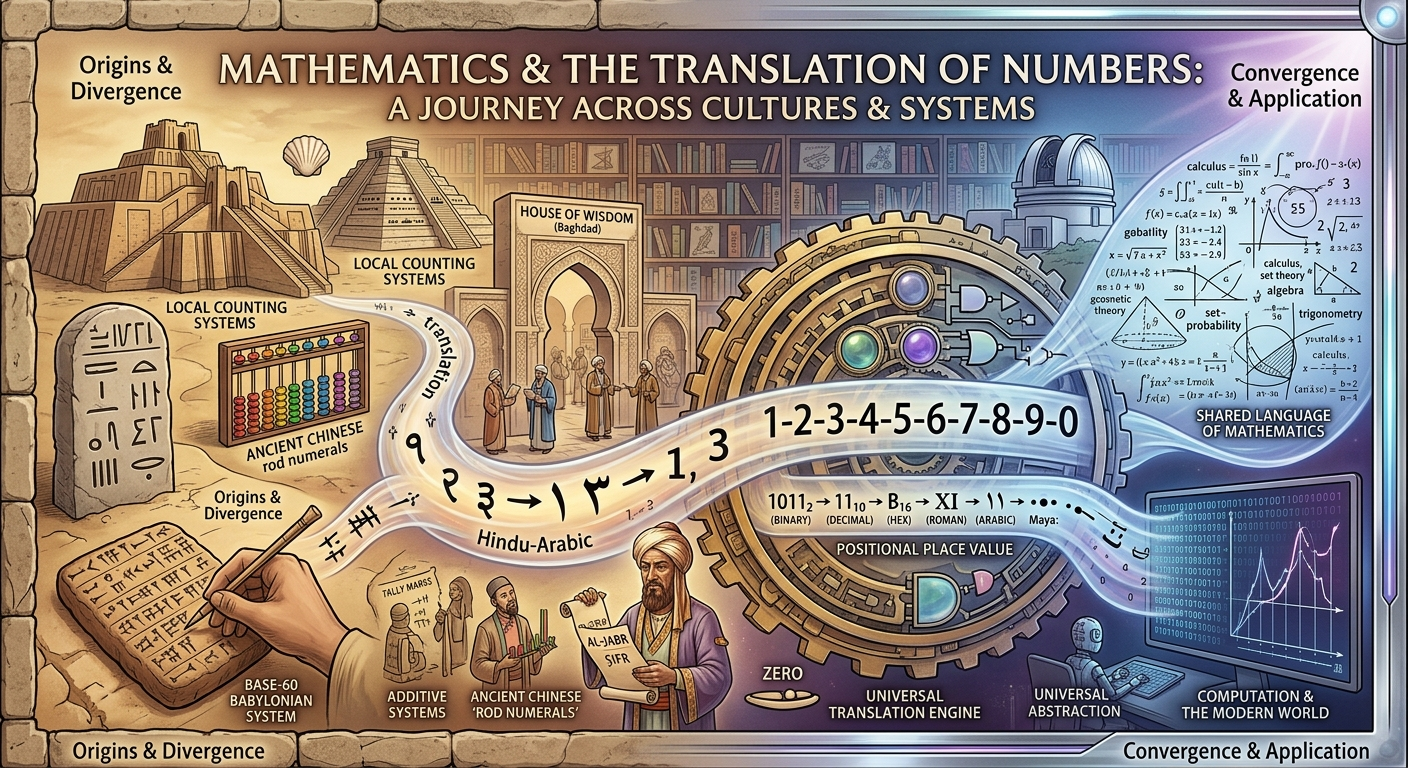
The history of numerical notation is consequently a history of human civilization itself. Early counting systems emerged from practical needs such as recording animals, goods, taxes, land, workers, astronomical observations, and trade. As societies became more complex, their numerical systems became more sophisticated. Ancient Mesopotamian cultures developed positional notation using base 60; India developed the decimal positional system that ultimately became the foundation of today’s globally dominant Hindu-Arabic numerals; scholars working in the Islamic world helped preserve, develop, and transmit mathematical knowledge; and European mathematicians eventually adopted the system extensively.
Today, numerical translation has expanded far beyond human writing. Computers constantly translate numbers between decimal, binary, hexadecimal, floating-point, scientific, encoded, and machine-readable forms. Understanding this process provides a bridge between ancient mathematics and modern computing.
1. Number, Numeral, Digit, and Numerical System
Before studying the translation of numbers, it is important to distinguish four related concepts.
1.1 Number
A number is an abstract mathematical entity.
For example:
Twenty-five
is a number.
It exists independently of whether we write it as:
- 25
- XXV
- 11001₂
- 31₈
- 19₁₆
- twenty-five
The mathematical quantity remains unchanged.
1.2 Numeral
A numeral is a representation of a number.
Thus:
25
is a decimal numeral representing the number twenty-five.
Similarly:
XXV
is a Roman numeral representing the same number.
1.3 Digit
A digit is an individual symbol used within a numeral system.
In the decimal system, the familiar digits are:
0, 1, 2, 3, 4, 5, 6, 7, 8, 9
The same concept can be represented with different symbols in different writing traditions.
1.4 Numeral system
A numeral system specifies how symbols are used to represent quantities.
A numeral system normally defines:
- its symbols;
- the values associated with those symbols;
- whether position affects value;
- its numerical base;
- rules for constructing larger numbers;
- how zero or an empty position is represented.
This distinction is central to understanding numerical translation.
2. Why Humans Needed Numbers
The earliest mathematical activity probably began with simple comparison and counting.
People needed to distinguish between:
- one animal and two animals;
- one tool and several tools;
- one person and many people;
- one harvest and another harvest;
- one day and several days.
Before sophisticated written mathematics existed, people could use physical objects, fingers, marks, stones, knots, or other physical representations to keep track of quantities.
As communities developed agriculture, trade, taxation, construction, government, and astronomy, informal counting became insufficient. More sophisticated systems were required.
Historical evidence shows that ancient civilizations developed different approaches to numerical representation. Early Mesopotamian numerical notation emerged thousands of years ago, while Egyptians, Greeks, Romans, Chinese, Maya, Indians, and many other cultures developed their own systems.
The development of numerical notation therefore followed a fundamental pattern:
Need to count → need to record → need to calculate → need to communicate → need to standardize.
3. Ancient Numerical Systems
There has never been only one way to write numbers.
Different civilizations developed different numerical languages.
3.1 Egyptian numerals
Ancient Egyptian mathematics used a decimal system based on separate symbols for powers of ten.
Different symbols represented quantities such as:
- 1
- 10
- 100
- 1,000
- 10,000
- 100,000
- 1,000,000
The system was largely additive. A number could therefore require several repeated symbols.
This approach was useful for recording quantities but was less convenient for performing complex written calculations than a positional system.
3.2 Babylonian numerals
Babylonian mathematics represents one of the most important developments in numerical history.
Babylonian mathematicians inherited a sexagesimal, or base-60, tradition and developed a positional system. The position of a numerical symbol could therefore change its value.
This is a profound idea because positional notation allows a relatively small collection of symbols to represent extremely large quantities.
The legacy of base 60 survives today in:
- 60 seconds per minute;
- 60 minutes per hour;
- 360 degrees in a circle.
Babylonian mathematics also supported sophisticated calculations involving arithmetic, geometry, and astronomy.
However, the Babylonian system did not initially possess a zero equivalent to the modern decimal zero. This could create ambiguity when a positional place was empty.
3.3 Greek numerals
Greek mathematicians used alphabetic numerical notation in which letters represented numerical values.
Greek mathematics made extraordinary contributions to:
- geometry;
- proof;
- number theory;
- astronomy;
- mathematical reasoning.
However, Greek numerical notation was not as convenient for ordinary written arithmetic as a mature positional decimal system.
3.4 Roman numerals
Roman numerals remain one of the most recognizable historical numerical systems.
Examples include:
| Roman | Decimal |
|---|---|
| I | 1 |
| V | 5 |
| X | 10 |
| L | 50 |
| C | 100 |
| D | 500 |
| M | 1,000 |
Thus:
XXV = 25
and
XL = 40.
Roman numerals are valuable for historical and cultural purposes, but they are inconvenient for many mathematical calculations.
A major advantage of a positional system is immediately apparent when comparing:
XXV
with:
25
The decimal representation is much more efficient for algorithmic arithmetic.
4. The Revolutionary Idea of Place Value
One of the greatest conceptual achievements in mathematical history is place value.
Consider:
555
The three digits are identical, but their values are different because of their positions:
- first 5 = 500;
- second 5 = 50;
- third 5 = 5.
Therefore:
555 = 5 × 100 + 5 × 10 + 5 × 1
or:
555 = 5 × 10² + 5 × 10¹ + 5 × 10⁰
This is positional notation.
The value of a digit depends on both:
digit × position.
This principle makes it possible to represent enormous quantities using only a small number of symbols.
5. The Decimal System
The modern decimal system is a base-10 positional numeral system.
It uses ten basic digits:
0–9
Every position represents a power of ten.
For example:
7,326
means:
7 × 10³ + 3 × 10² + 2 × 10¹ + 6 × 10⁰
Therefore:
7,326 = 7,000 + 300 + 20 + 6
The system’s extraordinary efficiency comes from combining:
- a small set of digits;
- positional notation;
- zero as a placeholder and number;
- standardized arithmetic operations.
The development of India’s positional numerical tradition was especially important in this history. Evidence indicates that Indian mathematicians were using positional notation centuries ago, with the system becoming increasingly recognizable as the ancestor of today’s decimal notation.
6. The Translation of Numbers
The phrase “translation of numbers” can mean several related things.
It can involve translating:
- one numeral system into another;
- one mathematical notation into another;
- numerical words into symbols;
- symbols into spoken language;
- human-readable numbers into machine-readable representations;
- measurements from one unit to another;
- numerical information between cultural or linguistic conventions.
The underlying principle is:
The representation changes while the mathematical meaning is preserved.
For example:
25₁₀ = 11001₂
The symbols change, but the underlying number does not.
7. Decimal to Binary Translation
Binary is a base-2 positional system.
It uses only:
0 and 1
The positions represent powers of two.
For example:
11001₂
means:
1 × 2⁴ + 1 × 2³ + 0 × 2² + 0 × 2¹ + 1 × 2⁰
Therefore:
16 + 8 + 0 + 0 + 1 = 25
So:
11001₂ = 25₁₀
This translation is fundamental to computing because digital electronic systems commonly represent information through two-state logic.
8. Binary to Decimal
The reverse process converts binary into decimal.
Consider:
101101₂
Its place values are:
| Position | Power | Contribution |
|---|---|---|
| 1 | 2⁵ | 32 |
| 0 | 2⁴ | 0 |
| 1 | 2³ | 8 |
| 1 | 2² | 4 |
| 0 | 2¹ | 0 |
| 1 | 2⁰ | 1 |
Therefore:
32 + 8 + 4 + 1 = 45
Thus:
101101₂ = 45₁₀
9. Decimal to Octal
Octal is a base-8 system.
Its digits are:
0, 1, 2, 3, 4, 5, 6, 7
For example:
25₁₀ = 31₈
because:
3 × 8 + 1 = 25
Octal has historically been useful in computing because three binary bits correspond neatly to one octal digit.
For example:
011 001₂
can be grouped into:
011 | 001
which corresponds to:
3 | 1
giving:
31₈
10. Decimal to Hexadecimal
Hexadecimal is a base-16 system.
It uses:
0–9
and:
A–F
where:
- A = 10
- B = 11
- C = 12
- D = 13
- E = 14
- F = 15
For example:
25₁₀ = 19₁₆
because:
1 × 16 + 9 = 25
Hexadecimal is extremely important in computing because one hexadecimal digit corresponds exactly to four binary bits.
For example:
1111₂ = F₁₆
and:
1010₂ = A₁₆
Therefore:
11111010₂ = FA₁₆
This makes hexadecimal a compact human-readable representation of binary information.
11. A Translation Ladder
The same number can be represented in many systems.
For example, the number 255 can be written as:
| System | Representation |
|---|---|
| Decimal | 255₁₀ |
| Binary | 11111111₂ |
| Octal | 377₈ |
| Hexadecimal | FF₁₆ |
| Roman | CCLV |
The quantity remains constant.
Only the representation changes.
This demonstrates an important principle of mathematics:
Representation is not the same thing as mathematical identity.
12. Zero: The Great Numerical Breakthrough
Zero deserves special attention because it transformed positional notation.
Consider:
105
The zero indicates that there are no tens.
Without some way of representing the empty position, distinguishing numbers such as 105 and 15 becomes much more difficult.
The history of zero is complex. Different civilizations developed concepts related to emptiness, placeholders, and zero at different times. Mesopotamian systems had placeholder practices, the Maya developed an independent zero symbol, and Indian mathematics played a particularly important role in developing zero as a number with arithmetic rules.
The Indian mathematician Brahmagupta, writing in the seventh century, is especially important because he treated zero mathematically and described operations involving it.
Zero therefore evolved from more than simply a symbol for “nothing.”
It became a mathematical object.
13. The Indian Contribution
The modern decimal numerical system has deep roots in Indian mathematics.
Indian mathematicians developed numerical notation and mathematical techniques that eventually became fundamental to the Hindu-Arabic numeral tradition. By around the sixth and seventh centuries, positional notation using a limited collection of digits was becoming highly developed.
The importance of this innovation cannot be overstated.
Instead of requiring a unique symbol for every large quantity, the system could represent numbers through:
digit + position + base
This allowed:
- efficient addition;
- efficient subtraction;
- multiplication;
- division;
- fractions;
- large-number representation;
- algebraic calculation.
14. The Islamic World’s Role in Numerical Translation
The history of numerical translation is not simply a journey from India directly to modern Europe.
Scholars working across the Islamic world played a major role in preserving, developing, translating, teaching, and transmitting mathematical knowledge.
Indian numerical methods entered Arabic mathematical scholarship, and works discussing Hindu numerals circulated through the Islamic intellectual world. The mathematician Muhammad ibn Musa al-Khwarizmi became particularly important in transmitting mathematical methods associated with Hindu numerals.
His name also became the source of the word algorithm through Latin transmission.
This is a striking example of mathematical translation operating at multiple levels:
Indian mathematics → Arabic mathematical scholarship → Latin translation → European mathematics → global mathematics
The process involved not merely translating symbols but translating mathematical concepts, algorithms, terminology, and methods of calculation.
15. Fibonacci and the European Transformation
Leonardo of Pisa, commonly known as Fibonacci, played an important role in introducing and advocating Hindu-Arabic arithmetic in medieval Europe through his Liber Abaci, first published in 1202.
The new system was especially useful to merchants because calculations involving prices, currencies, interest, weights, and measurements could be performed more efficiently.
The adoption was gradual rather than instantaneous. European societies continued using Roman numerals alongside the newer system for considerable periods.
Eventually, positional decimal notation became dominant because its computational advantages were enormous.
16. Mathematical Translation as a Cultural Process
Numbers are universal in one sense, but numerical notation is cultural.
Different civilizations have represented the same mathematical ideas using different:
- symbols;
- writing directions;
- bases;
- terminology;
- measurement units;
- calculation techniques.
For example, the quantity represented by 10 in modern decimal notation can be represented in binary as:
1010₂
In Roman notation:
X
In hexadecimal:
A₁₆
The mathematical quantity is identical.
This illustrates how mathematics can cross linguistic and cultural boundaries even when its notation changes.
17. Translation Between Number Words and Numerals
Numerical translation also occurs between language and mathematical symbols.
For example:
“one hundred twenty-five”
becomes:
125
In another language, the spoken expression may be completely different, while the mathematical quantity remains unchanged.
This distinction is increasingly important in:
- education;
- translation software;
- speech recognition;
- artificial intelligence;
- accounting;
- international commerce;
- data processing.
A computer system must understand that different linguistic expressions may refer to the same numerical quantity.
18. Units Are Another Form of Numerical Translation
Numbers are also translated between units.
For example:
1 metre = 100 centimetres
Therefore:
2.5 metres = 250 centimetres
The physical quantity remains unchanged; only its numerical representation changes because the unit changes.
This principle applies to:
- length;
- mass;
- temperature;
- time;
- energy;
- speed;
- volume;
- pressure;
- area.
Unit conversion is therefore another form of mathematical translation.
19. Fractions and Decimal Translation
A number can also move between fractional and decimal representations.
For example:
1/2 = 0.5
1/4 = 0.25
3/4 = 0.75
The fraction represents a relationship between quantities, while the decimal expresses the same value using powers of ten.
Some fractions produce repeating decimals.
For example:
1/3 = 0.333…
This demonstrates that a numerical value may have different representations depending on the chosen system.
20. Scientific Notation
Very large and very small numbers create another translation problem.
Consider:
300,000,000
Scientific notation expresses this as:
3 × 10⁸
Similarly:
0.000000001
can be written as:
1 × 10⁻⁹
Scientific notation allows scientists and engineers to communicate extreme magnitudes efficiently.
It is especially important in:
- physics;
- chemistry;
- astronomy;
- biology;
- engineering;
- computing;
- electronics.
21. Numbers and Computers
Modern computers have transformed numerical translation.
Humans generally prefer decimal notation.
Computers work fundamentally with digital states represented through binary logic.
Consequently, numerical information often passes through multiple representations:
Human decimal number
↓
Computer software representation
↓
Binary data
↓
Electronic states
↓
Machine calculations
↓
Binary result
↓
Software interpretation
↓
Human-readable decimal result
The user may see:
25
while the computer internally processes binary representations.
This separation between human-facing and machine-facing numerical representations is one of the foundations of modern computing.
22. Bits, Bytes, and Numerical Representation
A bit can represent two logical states, conventionally represented as:
0 or 1
Eight bits form a byte.
An eight-bit unsigned binary value can represent:
0 through 255
because there are:
2⁸ = 256
possible combinations.
Hexadecimal provides a convenient shorthand.
For example:
11111111₂ = FF₁₆ = 255₁₀
This is why hexadecimal appears frequently in:
- computer memory;
- machine-level programming;
- digital electronics;
- color codes;
- debugging;
- network addressing;
- software development.
23. Numerical Translation and Programming
Programming languages constantly translate numerical representations.
A programmer may write:
25
The compiler or interpreter converts that source representation into structures that the computer can execute.
At lower levels, numerical data becomes encoded as binary patterns.
Different data types can represent numbers differently, including:
- integers;
- unsigned integers;
- floating-point numbers;
- fixed-point numbers;
- arbitrary-precision integers.
Consequently, the phrase “number” in computing can involve both mathematical meaning and a specific storage representation.
24. Floating-Point Numbers
Computers often need to represent numbers containing fractions.
For example:
3.14159
Computers commonly use floating-point representations based on binary scientific notation.
Conceptually, this resembles:
sign × significand × base^exponent
but with binary rather than decimal as the underlying base in common standards.
This creates an important lesson:
A computer’s representation of a number may be an approximation rather than an exact mathematical representation.
For example, some decimal fractions cannot be represented exactly with a finite binary floating-point representation.
This matters in:
- scientific computing;
- finance;
- engineering;
- graphics;
- simulations;
- artificial intelligence.
25. The Translation of Numbers in Artificial Intelligence
Artificial intelligence depends heavily on numerical representation.
Modern AI systems convert information into numerical forms that computers can manipulate.
Text, images, audio, and other information can be transformed into numerical data.
For example:
word → token → numerical identifier → vector representation
An image can become a large array of numerical values.
Audio can become numerical samples.
These numerical representations can then be processed by mathematical algorithms.
Thus, numerical translation forms one of the foundations of AI.
26. Numbers in Data Science
Data science depends on converting real-world observations into numerical representations.
Suppose a dataset contains:
- age;
- temperature;
- income;
- distance;
- population;
- rainfall.
These measurements can be transformed into mathematical structures suitable for analysis.
A data scientist might then apply:
- averages;
- percentages;
- correlations;
- probability;
- regression;
- matrices;
- statistical models;
- machine-learning algorithms.
The process can be summarized as:
Reality → measurement → number → data structure → mathematical model → result
27. Numbers and Measurement
Measurement is essentially the process of assigning numerical values to properties according to defined rules.
For example:
temperature = 25 °C
contains:
- numerical value: 25;
- unit: degrees Celsius;
- measured property: temperature.
Changing the measurement system changes the numerical representation.
For example:
25 °C = 77 °F
The temperature has not physically changed merely because its numerical representation has changed.
This is another important example of translation preserving meaning.
28. Number Bases as Different Mathematical Languages
Number bases can be understood as different mathematical languages.
Base 2
Uses:
0–1
Base 8
Uses:
0–7
Base 10
Uses:
0–9
Base 16
Uses:
0–9 and A–F
The same quantity can be translated between them.
For example:
42₁₀ = 101010₂ = 52₈ = 2A₁₆
The representation changes.
The number remains the same.
29. Why Base 10 Became Dominant
The dominance of base 10 is closely associated with historical counting practices and the widespread use of human hands for counting.
Humans have ten fingers, making groups of ten intuitive.
However, there is nothing mathematically inevitable about base 10.
Other bases can be extremely useful.
Babylonian mathematics demonstrated the power of base 60, while computing demonstrates the usefulness of base 2 and base 16.
Therefore:
The choice of base is a representational decision, not a statement about the mathematical value itself.
30. The Mathematical Translation Pipeline
A general numerical translation process can be represented as:
Original quantity
↓
Numerical representation
↓
Interpretation
↓
Conversion rule
↓
New representation
↓
Verification
For example:
25₁₀
↓
identify base 10
↓
convert to base 2
↓
11001₂
↓
verify:
16 + 8 + 1 = 25
↓
translation confirmed.
The final verification step is essential in scientific and computational applications.
31. Common Errors in Numerical Translation
Numerical conversion can fail for several reasons.
31.1 Confusing a number with its representation
25 and 11001₂ look different, but they can represent the same number.
31.2 Ignoring the base
The expression:
101
means different quantities in different systems.
101₂ = 5
but:
101₁₀ = 101
and:
101₁₆ = 257₁₀
31.3 Misunderstanding zero
Zero may be:
- a number;
- a placeholder;
- an indicator of an empty position.
These roles must not be confused.
31.4 Losing units
100
by itself may be incomplete.
Is it:
- 100 metres?
- 100 kilograms?
- 100 seconds?
- 100 rand?
- 100 people?
A number often requires context.
32. The Philosophical Dimension of Numbers
Mathematics raises a deeper question:
Are numbers discovered or invented?
The physical world contains quantities and relationships, but humans created symbolic systems for describing them.
The number two can be represented by:
2
but the symbol itself is not the quantity.
This distinction between abstract mathematical objects and their representations has fascinated mathematicians and philosophers for centuries.
Mathematical notation is therefore a bridge between:
abstract thought
and
physical communication.
33. Mathematics as a Universal Translation System
Mathematics can cross linguistic boundaries with unusual efficiency.
A mathematical equation such as:
E = mc²
does not need to be translated into every human language before its mathematical structure can be recognized.
Similarly:
2 + 2 = 4
communicates a mathematical relationship across cultures.
However, mathematical notation is not completely universal. Different traditions have historically used different symbols, terminology, conventions, decimal separators, grouping separators, and writing directions.
Thus mathematics is simultaneously:
- universal in its underlying relationships;
- diverse in its representations.
34. Numerical Translation in Global Commerce
International commerce depends on numerical translation.
Businesses must translate:
- currencies;
- prices;
- weights;
- dimensions;
- tax rates;
- exchange rates;
- dates;
- quantities;
- accounting figures.
For example, an international company may receive:
1,000 kilograms
and convert it to:
1 metric tonne
or translate monetary values between currencies.
Without standardized numerical systems and conversion rules, global commerce would be extremely difficult.
35. Numerical Translation in Science
Science depends on translating measurements into common mathematical frameworks.
A scientist may measure:
- time in seconds;
- distance in metres;
- mass in kilograms;
- temperature in kelvin;
- electric current in amperes.
These measurements can then enter equations.
For example:
speed = distance ÷ time
A physical observation becomes a numerical quantity, which becomes part of a mathematical model.
This is one of the fundamental processes of scientific reasoning.
36. Numerical Translation in Engineering
Engineering requires numerical translation at almost every stage.
A physical design may begin as:
concept → dimensions → numerical model → simulation → engineering drawing → manufactured object
Computer-aided design systems translate geometric information into numerical coordinates.
Engineers then work with:
- vectors;
- matrices;
- differential equations;
- numerical simulations;
- tolerances;
- measurements.
Modern engineering would be impossible without reliable numerical representation.
37. Numerical Translation and Space
Coordinates provide another powerful numerical language.
A location can be represented using:
(x, y)
in two dimensions, or:
(x, y, z)
in three dimensions.
The same physical location can then be translated between coordinate systems.
For example:
- Cartesian coordinates;
- polar coordinates;
- cylindrical coordinates;
- spherical coordinates;
- geographic coordinates.
The physical location remains the same while its mathematical description changes.
38. Numerical Translation and Time
Time is also represented through different numerical systems.
For example:
90 seconds
can be translated into:
1 minute 30 seconds
or:
1.5 minutes
or:
0.025 hours
The duration is the same.
This resembles base conversion because a quantity is being represented using different numerical conventions.
39. Numerical Translation and Cryptography
Computing systems frequently translate numerical information into representations suitable for transmission and storage.
Digital systems may represent information using:
- binary;
- hexadecimal;
- encoded byte sequences;
- mathematical integers;
- modular arithmetic.
Cryptography uses mathematical transformations to manipulate numerical representations while preserving specific security properties.
This demonstrates how numerical translation can become part of sophisticated information systems.
40. From Clay Tablets to Digital Machines
The historical progression is remarkable:
Counting marks
↓
Written numerals
↓
Positional notation
↓
Zero
↓
Decimal arithmetic
↓
Algebraic notation
↓
Mechanical calculation
↓
Electronic computation
↓
Binary computing
↓
Digital information systems
↓
Artificial intelligence
The modern digital world therefore rests upon ideas whose roots extend deep into ancient mathematical history.
41. A Comparative View of Numerical Systems
| Civilization/System | Base | Major Characteristic |
|---|---|---|
| Egyptian | 10 | Mainly additive notation |
| Babylonian | 60 | Positional sexagesimal system |
| Roman | 10-related | Symbolic/additive-subtractive notation |
| Maya | 20 | Independent positional system with zero |
| Chinese traditions | Often decimal | Counting rods and place-value practices |
| Hindu-Arabic | 10 | Positional notation with zero |
| Binary | 2 | Foundation of digital computing |
| Octal | 8 | Compact binary representation |
| Hexadecimal | 16 | Compact digital representation |
Historical systems should not be judged simply as “primitive” or “advanced.” Each emerged within particular social, commercial, astronomical, administrative, and technological environments.
42. The Importance of Standardization
Numerical translation becomes especially powerful when societies agree on standards.
Modern standards define conventions for:
- units;
- numerical notation;
- measurement;
- computing;
- scientific communication;
- data interchange.
Standardization allows a measurement made in one country to be understood elsewhere.
It also allows computers manufactured by different companies to exchange numerical information.
Thus standardization transforms mathematics from an individual practice into an international infrastructure.
43. The Future of Numerical Translation
The future will likely expand numerical translation beyond traditional arithmetic.
Emerging technologies increasingly work with numerical representations of:
- language;
- images;
- sound;
- biological information;
- physical environments;
- financial systems;
- scientific models;
- artificial intelligence systems.
Computers can already translate enormous quantities of information into mathematical structures.
Future systems will increasingly move between:
human concepts → symbolic language → numerical representations → computational models → machine-generated results → human interpretation.
The ability to move accurately between these layers will become increasingly important.
44. Mathematics, Numbers, and Human Civilization
The history of numbers demonstrates that mathematics is not merely a collection of formulas taught in classrooms.
It is a civilization-scale technology.
Numbers have enabled humanity to:
- count populations;
- measure land;
- construct buildings;
- navigate oceans;
- calculate astronomical movements;
- conduct trade;
- develop financial systems;
- engineer machines;
- model physical phenomena;
- build computers;
- create artificial intelligence.
Every major numerical innovation increased humanity’s ability to represent reality.
45. Conclusion
Mathematics & the Translation of Numbers is ultimately a study of how humanity learned to convert quantities, relationships, measurements, and abstract mathematical ideas into symbols that can be communicated, manipulated, calculated, and eventually processed by machines.
The journey began with simple counting and developed through increasingly sophisticated numerical systems. Ancient Egyptians developed systematic decimal notation; Babylonians demonstrated the power of positional base-60 mathematics; Greeks developed rigorous mathematical reasoning; Romans created a durable numerical notation; Maya mathematicians independently developed sophisticated positional mathematics; and Indian mathematicians made decisive contributions to the decimal positional tradition and the mathematical treatment of zero. These ideas were subsequently transmitted, developed, and translated across the Islamic world and into Europe.
The modern decimal system ultimately became the dominant human numerical language, while binary became fundamental to electronic computing. Hexadecimal and octal then provided efficient human-facing representations of binary information.
The central lesson is simple but profound:
A number is not the same thing as the symbol used to represent it.
25, XXV, 11001₂, 31₈, and 19₁₆ can all represent the same mathematical quantity.
The symbols change.
The language changes.
The culture changes.
The technology changes.
But the underlying mathematical relationship can remain constant.
That ability to translate mathematical meaning from one representation into another is one of humanity’s most important intellectual achievements. It connects ancient counting systems to modern computers, scientific instruments, global commerce, engineering, data science, and artificial intelligence.
In this sense, the history of numerical translation is not simply the history of numbers.
It is the history of how human beings learned to make abstract quantities visible, communicable, calculable, and ultimately computable.





Be First to Comment