
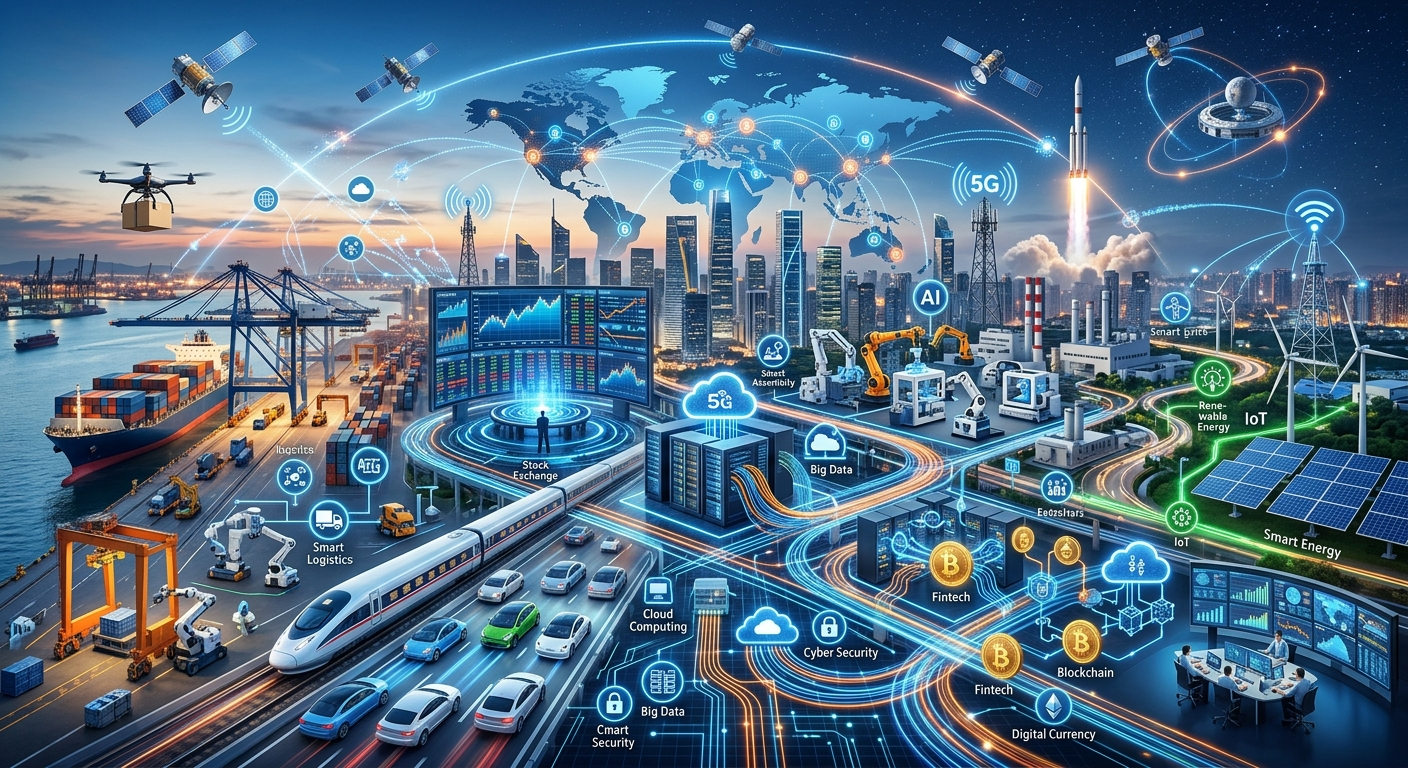
A Comprehensive Thesis on the Technologies That Build, Connect, Power and Transform the Modern Global Economy
Abstract
Technology is one of the fundamental forces behind the development of modern civilisation. From agriculture and metallurgy to electricity, engines, telecommunications, computers, artificial intelligence, biotechnology and advanced manufacturing, technological progress has continually changed how human beings produce goods, exchange information, travel, conduct business, provide healthcare, educate societies and organise economic activity.
The modern world economy is therefore not simply an economy of money, banks and businesses. It is a vast technological system consisting of physical infrastructure, energy networks, transportation systems, communication networks, computers, data centres, satellites, factories, financial technologies, scientific institutions, software, artificial intelligence and human knowledge.
The technological transformation currently taking place is particularly significant. Artificial intelligence, advanced semiconductors, cloud computing, robotics, biotechnology, renewable energy, electric mobility, advanced materials and quantum technologies are increasingly interacting with one another. UN Trade and Development describes frontier technologies as reshaping economies and societies, while emphasising that infrastructure, data and skills are crucial for countries seeking to benefit from AI.
The central argument of this thesis is that technology is the productive infrastructure of civilisation. Economic prosperity depends not merely on possessing technologies but on the ability to develop, manufacture, deploy, maintain, govern and continuously improve them.
1. Introduction
Human civilisation has always been technological.
The earliest humans used stone tools. Later societies developed agriculture, pottery, metallurgy, writing, sailing, roads, mathematics and mechanical devices. The Industrial Revolution introduced machines powered by steam and later electricity. The twentieth century introduced automobiles, aviation, telecommunications, radio, television, computers, nuclear technology and modern medicine.
The twenty-first century has added another layer: the digital economy.
Today, a smartphone can connect an individual to global financial markets, educational institutions, businesses, governments, satellites and billions of other people. A factory can contain robots controlled by software. A farmer can use satellites and sensors to monitor crops. A hospital can use advanced imaging and computer systems to assist diagnosis. A bank can process millions of transactions electronically. A logistics company can track products across continents in real time.
The economy has consequently become a combination of physical infrastructure and digital intelligence.
2. What Is Technology?
Technology can be defined broadly as the application of scientific knowledge, engineering principles, practical skills, tools and systems to solve problems and achieve human objectives.
Technology includes:
- machines;
- tools;
- buildings;
- electrical systems;
- computers;
- software;
- telecommunications;
- transportation;
- medical equipment;
- industrial processes;
- agricultural machinery;
- energy systems;
- financial systems;
- satellites;
- artificial intelligence;
- biotechnology;
- robotics;
- materials;
- scientific instruments.
Technology should therefore not be understood merely as electronic gadgets.
A railway is technology.
A power station is technology.
A semiconductor factory is technology.
A tractor is technology.
A telecommunications tower is technology.
A water-treatment plant is technology.
A mathematical algorithm is technology when implemented to perform useful work.
Technology is essentially organised human knowledge converted into useful capability.
3. Technology as the Foundation of Economic Production
Every economy requires four broad productive elements:
- Natural resources
- Human labour
- Capital
- Knowledge and technology
Technology connects the other three.
For example, a mineral deposit may have enormous economic value, but extracting it requires geological knowledge, machinery, electricity, transportation, engineering and financial capital.
Agricultural land becomes substantially more productive when combined with irrigation, machinery, improved seeds, fertilisation, weather information, storage and logistics.
A modern economy therefore increases its productive capacity by continually improving the technology through which resources, labour and capital are organised.
4. The Historical Evolution of Economic Technology
4.1 Stone Technology
Early human civilisation began with relatively simple technologies such as stone tools.
These technologies enabled humans to:
- hunt;
- cut materials;
- construct shelters;
- process food;
- defend themselves;
- manipulate their environment.
The important economic principle already existed: a tool allows one person to accomplish more work than could be accomplished with bare hands alone.
4.2 Agriculture Technology
The development of agriculture transformed human civilisation.
Important agricultural technologies included:
- irrigation;
- ploughs;
- animal traction;
- seed selection;
- crop rotation;
- grain storage;
- water management;
- agricultural calendars.
Agriculture created food surpluses, allowing some people to specialise in crafts, administration, trade, construction, science and other activities.
In this sense, agricultural technology helped create the foundations of complex civilisation.
4.3 Metallurgy
The discovery and development of copper, bronze and iron transformed tools, agriculture, construction and transportation.
Metal technology eventually produced:
- stronger agricultural implements;
- construction tools;
- machinery;
- weapons;
- transport components;
- industrial equipment.
Metallurgy remains central to the modern economy because contemporary infrastructure depends on steel, aluminium, copper and many other materials.
4.4 Writing and Information Technology
Writing was one of humanity’s earliest information technologies.
It enabled societies to preserve:
- laws;
- contracts;
- taxation records;
- scientific observations;
- commercial transactions;
- historical knowledge;
- administrative information.
Modern computing can be understood as an extraordinarily advanced continuation of this fundamental human objective: storing, processing and communicating information.
5. Industrial Technology
The Industrial Revolution dramatically increased productive capacity.
Steam engines transformed energy availability.
Factories transformed manufacturing.
Railways transformed transportation.
Mechanical engineering transformed production.
The industrial economy introduced the principle of large-scale mechanised production.
Instead of relying predominantly on human and animal physical labour, societies increasingly used machines to multiply human productivity.
6. Electricity: The Great Economic Platform
Electricity became one of the most important technologies in modern civilisation.
It enabled:
- lighting;
- electric motors;
- telecommunications;
- refrigeration;
- industrial machinery;
- computers;
- medical equipment;
- transportation systems;
- modern homes;
- data centres.
The importance of electricity extends far beyond household lighting.
Almost every modern economic sector depends upon reliable electrical power.
A semiconductor factory cannot operate without highly reliable electricity.
A telecommunications network cannot function without electricity.
A bank’s data centre cannot operate without electricity.
A hospital depends on electricity.
Water treatment depends on electricity.
Therefore, electricity is one of the foundational infrastructures of the modern economy.
7. Petroleum, Engines and Transportation
The development of internal-combustion engines transformed transportation and industrial activity.
Petroleum-powered technologies enabled:
- automobiles;
- trucks;
- tractors;
- ships;
- aircraft;
- construction machinery;
- mining equipment.
Transportation technology integrated national and international markets.
Raw materials could be transported to factories, manufactured products could be distributed to consumers, and agricultural products could reach distant markets.
The modern global economy is consequently inseparable from transportation technology.
8. Telecommunications Technology
Telecommunications revolutionised the speed of economic communication.
The progression included:
Telegraph → telephone → radio → television → satellites → fibre optics → mobile networks → Internet → cloud communication
Each generation reduced the time required to transfer information.
The Internet ultimately created a global information environment in which businesses, governments, universities and individuals can communicate almost instantaneously across national borders.
9. Semiconductor Technology
The semiconductor is one of the most important technologies underlying modern civilisation.
Semiconductors enable:
- processors;
- memory;
- smartphones;
- computers;
- vehicles;
- industrial controllers;
- telecommunications;
- satellites;
- medical equipment;
- artificial intelligence;
- robotics.
The semiconductor industry is therefore not merely a technology industry.
It is an enabling industry for almost every modern industry.
The global economy increasingly depends on advanced chips, manufacturing equipment, electronic components, software and semiconductor supply chains. UN Trade and Development identifies semiconductors alongside AI infrastructure, critical minerals and energy-transition technologies as strategically important areas reshaping global production.
10. Computer Technology
Computers transformed the economy by automating information processing.
The computer can:
- calculate;
- store information;
- retrieve information;
- communicate;
- simulate systems;
- control machines;
- analyse data;
- execute algorithms.
Computers changed business administration from predominantly paper-based processes into digital processes.
Accounting, engineering, banking, scientific research, manufacturing and government administration all became increasingly computerised.
11. Software: The Invisible Machinery of the Economy
Hardware provides physical computing capability.
Software provides instructions.
Modern economic activity increasingly depends upon software.
Examples include:
- operating systems;
- databases;
- websites;
- mobile applications;
- enterprise software;
- accounting systems;
- industrial control software;
- artificial intelligence;
- cybersecurity systems;
- navigation systems.
Software has become a form of economic infrastructure.
A modern bank without software cannot operate at contemporary scale.
A modern airline cannot efficiently coordinate millions of passengers without software.
A modern factory increasingly depends on software to coordinate machines and production.
12. The Internet Economy
The Internet transformed the structure of commerce.
It enabled:
- e-commerce;
- digital advertising;
- online banking;
- cloud computing;
- digital education;
- remote collaboration;
- online entertainment;
- software distribution;
- digital marketplaces.
The Internet also lowered the cost of communication and allowed small businesses to reach customers beyond their immediate geographic markets.
The modern digital economy increasingly combines physical products with digital services.
13. Mobile Technology
The smartphone is effectively a portable computer, communication device, camera, navigation system, payment interface and information terminal.
Mobile technology has enabled billions of people to participate in digital economic systems.
Mobile networks support:
- banking;
- commerce;
- communication;
- education;
- transportation;
- healthcare;
- government services;
- agriculture;
- employment.
For developing economies, mobile technology can sometimes provide access to services without requiring the same physical infrastructure historically required by wealthier economies.
14. Cloud Computing
Cloud computing changed how organisations obtain computing resources.
Instead of every organisation having to purchase and operate all computing infrastructure itself, computing resources can be delivered through large-scale data centres.
Cloud systems provide:
- computing;
- storage;
- databases;
- networking;
- software;
- artificial intelligence services.
This creates economies of scale.
A small business can access computing capabilities that would previously have required substantial capital investment.
15. Data Centres
Data centres are the physical foundations of the digital economy.
They contain:
- servers;
- processors;
- storage systems;
- networking equipment;
- cooling systems;
- power systems;
- security systems.
The world’s digital services depend on enormous amounts of physical infrastructure.
Consequently, the digital economy is not weightless.
It requires:
electricity + buildings + chips + networks + cooling + software + data + people.
16. Artificial Intelligence
Artificial intelligence represents one of the most important technological developments of the current era.
AI systems can analyse information, recognise patterns, generate content, assist decision-making, optimise processes and automate certain tasks.
AI is increasingly being applied to:
Agriculture
- crop monitoring;
- weather analysis;
- precision agriculture;
- disease detection;
- irrigation optimisation.
Manufacturing
- predictive maintenance;
- quality control;
- robotics;
- production optimisation.
Healthcare
- medical-image analysis;
- research;
- administrative automation;
- drug discovery.
Finance
- fraud detection;
- risk analysis;
- customer service;
- financial forecasting.
Logistics
- route optimisation;
- inventory management;
- demand forecasting.
UNCTAD’s 2025 Technology and Innovation Report identifies infrastructure, data and skills as three major leverage points for countries seeking to develop and adopt AI.
OECD research likewise finds that advanced digital technologies tend to build on enabling technologies and that human capital, ICT skills and firm-level digitalisation are important factors in successful adoption.
17. Robotics and Automation
Robotics combines:
mechanical engineering + electronics + sensors + software + control systems + increasingly AI.
Robots can perform repetitive, precise or physically demanding operations.
They are used in:
- automobile manufacturing;
- electronics;
- warehouses;
- agriculture;
- laboratories;
- logistics;
- construction;
- healthcare.
Automation can increase productivity, but it also changes the skills required from workers.
The future economy therefore requires both technological investment and continuous human skills development.
18. The Internet of Things
The Internet of Things, or IoT, connects physical objects to digital networks.
Examples include:
- industrial sensors;
- smart electricity meters;
- connected vehicles;
- agricultural sensors;
- smart buildings;
- environmental monitoring systems;
- industrial machinery.
IoT creates a bridge between the physical and digital economies.
A traditional machine simply performs a mechanical task.
An IoT-enabled machine can additionally:
sense → communicate → analyse → respond.
19. Blockchain and Distributed Systems
Blockchain introduced a different approach to maintaining digital records.
Its potential applications include:
- transaction records;
- asset tracking;
- supply-chain documentation;
- digital identity systems;
- certain financial applications;
- verification systems.
The broader technological importance of distributed systems lies in the possibility of coordinating information between multiple participants without relying entirely on a single central database.
20. Financial Technology
Financial technology, or fintech, applies digital technology to financial services.
It includes:
- electronic payments;
- mobile money;
- digital banking;
- automated financial services;
- payment platforms;
- financial-data systems;
- digital identity;
- cybersecurity.
Technology has made financial transactions faster and increasingly accessible.
However, digital finance also creates requirements for strong cybersecurity, consumer protection, privacy and financial regulation.
21. Biotechnology
Biotechnology applies biological knowledge to practical economic purposes.
Important areas include:
- pharmaceuticals;
- vaccines;
- agricultural biotechnology;
- genetic analysis;
- industrial biotechnology;
- fermentation;
- biomaterials;
- diagnostics.
Biotechnology is particularly important because it connects science with health, food production and industrial manufacturing.
22. Nanotechnology
Nanotechnology operates at extremely small scales.
It contributes to:
- electronics;
- medicine;
- materials;
- coatings;
- sensors;
- energy technologies.
Nanotechnology demonstrates an important principle of modern engineering: controlling matter at smaller scales can produce entirely new properties and capabilities.
23. Advanced Materials
Civilisation depends on materials.
Modern economies increasingly use:
- advanced steels;
- aluminium alloys;
- composites;
- ceramics;
- semiconductors;
- carbon-based materials;
- battery materials;
- specialised polymers.
Materials science enables improvements in aircraft, buildings, computers, batteries, vehicles and industrial machinery.
24. Energy Technology
No economy can function without energy.
The modern energy system includes:
- coal;
- natural gas;
- petroleum;
- nuclear energy;
- hydropower;
- solar energy;
- wind energy;
- geothermal energy;
- batteries;
- electricity grids.
The transition toward lower-carbon energy is creating new technological industries.
These include:
- solar panels;
- wind turbines;
- electric vehicles;
- batteries;
- grid-management technologies;
- energy-storage systems;
- green hydrogen technologies;
- carbon-management technologies.
UNCTAD notes that investment in energy-transition technologies is increasingly reshaping global production alongside investment in AI, semiconductors and critical minerals.
25. Electric Vehicles
Electric vehicles combine several technologies:
battery + electric motor + power electronics + software + sensors + communications.
The automobile is consequently becoming increasingly similar to a computer-controlled energy system.
Future vehicles are likely to become more connected, automated and software-defined.
26. Battery Technology
Batteries are strategically important because they allow electrical energy to be stored.
They support:
- smartphones;
- laptops;
- electric vehicles;
- renewable-energy systems;
- backup electricity;
- industrial applications.
Battery technology therefore connects transportation, electricity and digital technology.
27. Space Technology
Space technology has become an important component of the global economy.
Satellites support:
- navigation;
- telecommunications;
- weather forecasting;
- Earth observation;
- agriculture;
- mapping;
- scientific research;
- disaster monitoring.
Global Navigation Satellite Systems have become particularly important to transportation, logistics, agriculture, communications and financial timing.
28. Transportation Technology
Modern transportation consists of interconnected technological systems.
Road transport
Automobiles, trucks and buses.
Rail
High-speed rail, electric trains and freight systems.
Aviation
Aircraft, airports, navigation systems and air-traffic control.
Maritime transport
Ships, ports, navigation systems and logistics.
Space transport
Launch vehicles and satellite systems.
Together these systems create the physical circulation system of the world economy.
29. Logistics Technology
Global commerce requires products to move efficiently.
Modern logistics uses:
- warehouses;
- barcode systems;
- RFID;
- GPS;
- fleet-management systems;
- automated sorting;
- robotics;
- inventory software;
- AI forecasting.
The result is increasingly integrated supply-chain management.
30. Manufacturing Technology
Modern manufacturing combines:
- computer-aided design;
- automation;
- robotics;
- sensors;
- industrial software;
- artificial intelligence;
- additive manufacturing;
- advanced materials.
This has produced the concept commonly associated with Industry 4.0.
The factory of the future is increasingly:
connected + automated + sensor-driven + data-driven + intelligent.
31. 3D Printing
Additive manufacturing constructs objects layer by layer from digital designs.
It can reduce material waste in certain applications and enables production of complex shapes.
Applications include:
- aerospace;
- engineering;
- medical devices;
- prototypes;
- specialised manufacturing.
32. Agricultural Technology
Agriculture is becoming increasingly technological.
Modern agricultural technology includes:
- tractors;
- irrigation;
- satellite imagery;
- drones;
- sensors;
- weather systems;
- precision agriculture;
- automated machinery;
- improved seeds;
- agricultural databases;
- AI.
Technology can help farmers use water, land, fertiliser and labour more efficiently.
33. Water Technology
Water infrastructure is essential to civilisation.
Technology enables:
- water purification;
- desalination;
- wastewater treatment;
- irrigation;
- leak detection;
- water-quality monitoring;
- pumping.
Water technology will become increasingly important as cities grow and climate pressures affect water availability.
34. Construction Technology
Construction increasingly uses:
- computer-aided design;
- Building Information Modelling;
- advanced materials;
- prefabrication;
- robotics;
- surveying drones;
- digital project management;
- automated machinery.
Digital construction can improve planning and coordination between architects, engineers, contractors and suppliers.
35. Healthcare Technology
Healthcare is increasingly dependent on technology.
Important areas include:
- medical imaging;
- laboratory equipment;
- electronic health records;
- telemedicine;
- medical robotics;
- biotechnology;
- genomic technologies;
- diagnostic systems;
- AI-assisted analysis.
Technology has expanded humanity’s ability to detect, understand and treat disease.
36. Education Technology
Education technology includes:
- computers;
- Internet access;
- digital libraries;
- educational software;
- virtual classrooms;
- simulation;
- AI-assisted learning;
- digital assessment.
The challenge is ensuring that technology complements rather than replaces effective teaching and human development.
37. Cybersecurity
As economies become digital, cybersecurity becomes economic infrastructure.
Cybersecurity protects:
- financial systems;
- businesses;
- governments;
- hospitals;
- telecommunications;
- energy networks;
- personal information.
A technologically advanced economy must therefore also be a secure digital economy.
38. The Technology Supply Chain
Modern technologies depend on enormous international supply chains.
A smartphone, for example, may involve:
raw materials → mining → refining → chemicals → semiconductor manufacturing → chip design → component manufacturing → assembly → software → telecommunications → distribution → consumer.
This demonstrates that technology is not produced by a single company or country.
It is usually the product of a global ecosystem.
39. Critical Minerals
Many advanced technologies depend on specialised minerals.
These can be important for:
- batteries;
- electronics;
- renewable energy;
- electric vehicles;
- telecommunications;
- defence and aerospace;
- industrial equipment.
This makes mining, refining and materials processing strategically important to technological development.
40. Technology and International Trade
Technology has transformed international trade.
Physical goods still dominate enormous portions of world commerce, but digital services are increasingly important.
A company can now provide services across borders through:
- cloud platforms;
- software;
- telecommunications;
- digital media;
- online professional services.
Technology has therefore expanded the concept of what can be traded internationally.
41. Technology and Productivity
The ultimate economic purpose of many technologies is to increase productivity.
Productivity broadly asks:
How much economic output can be produced from a given quantity of inputs?
Technology can improve productivity by:
- reducing wasted resources;
- increasing production speed;
- improving accuracy;
- reducing downtime;
- improving communication;
- automating repetitive tasks;
- improving decision-making.
OECD research indicates that AI could become an important driver of productivity growth, although its effects differ considerably between countries depending on exposure, adoption and economic structure.
42. Technology and Employment
Technology does not simply destroy employment.
It changes the composition of employment.
Some occupations decline.
New occupations emerge.
Existing occupations change.
For example, the growth of computing created demand for:
- software engineers;
- data scientists;
- cybersecurity specialists;
- network engineers;
- cloud specialists;
- AI researchers.
The major economic challenge is therefore not simply technological automation but human adaptation.
Education and retraining become essential.
43. Technology and Human Capital
Technology cannot function independently of people.
Countries require:
- engineers;
- scientists;
- technicians;
- programmers;
- entrepreneurs;
- teachers;
- researchers;
- managers;
- skilled tradespeople.
UNCTAD specifically identifies skills as one of the three major foundations required for countries to benefit from AI, alongside infrastructure and data.
The most advanced machines in the world have limited economic value if a society lacks people capable of operating, maintaining, improving and governing them.
44. Technology and Economic Inequality
Technological development can create enormous wealth.
However, the benefits are not automatically distributed equally.
Countries with strong:
- universities;
- infrastructure;
- capital markets;
- research institutions;
- skilled labour;
- industrial capacity;
- digital networks
can often adopt new technologies faster.
UNCTAD warns that rapid technological change can deepen global divides if access to infrastructure, data and skills remains unequal.
Therefore, technological development must be accompanied by inclusive policies.
45. The Digital Divide
The digital divide refers to unequal access to digital technologies and capabilities.
It can exist between:
- countries;
- regions;
- urban and rural communities;
- businesses;
- schools;
- households;
- income groups.
Digital inclusion requires more than Internet access.
It also requires:
affordable connectivity + devices + electricity + digital skills + relevant services + cybersecurity + useful content.
46. Technology and Developing Economies
Developing countries face both challenges and opportunities.
They may lack:
- capital;
- infrastructure;
- research capacity;
- advanced manufacturing;
- skilled workers;
- reliable electricity.
However, digital technologies can enable leapfrogging.
Examples include:
- mobile banking;
- digital government;
- mobile communications;
- online education;
- digital marketplaces;
- satellite-based agriculture.
The objective should not merely be to consume imported technology.
Long-term development requires increasing the ability to adapt, manufacture, research and innovate.
47. Technology and Africa
Africa possesses enormous opportunities in:
- renewable energy;
- agriculture;
- telecommunications;
- digital services;
- mining;
- manufacturing;
- biotechnology;
- fintech;
- space technology;
- artificial intelligence.
The continent also possesses significant natural resources required by modern technological industries.
The strategic challenge is converting natural resources into higher-value economic activities through:
education + infrastructure + industrialisation + research + entrepreneurship + technology transfer.
48. South Africa and Technological Development
South Africa has important technological foundations in:
- mining;
- engineering;
- telecommunications;
- finance;
- automotive manufacturing;
- energy;
- scientific research;
- agriculture;
- higher education.
Its future technological development can benefit from combining existing industrial capabilities with newer fields such as:
- AI;
- advanced manufacturing;
- renewable energy;
- batteries;
- digital finance;
- robotics;
- biotechnology;
- space technology.
49. Technology and Environmental Sustainability
Technology has two sides.
It can increase environmental pressure through:
- resource extraction;
- energy consumption;
- electronic waste;
- industrial pollution.
But technology can also reduce environmental impact through:
- renewable energy;
- energy-efficient equipment;
- smart electricity grids;
- precision agriculture;
- electric transport;
- recycling technologies;
- water efficiency;
- carbon-management technologies.
The objective should therefore be sustainable technological development.
50. The Convergence of Technologies
The most important technological transformation may not be any single invention.
It is the convergence of multiple technologies.
For example:
AI + semiconductor + cloud + telecommunications + robotics + sensors
creates intelligent automated systems.
Similarly:
solar + batteries + power electronics + software + smart grids
creates increasingly sophisticated energy systems.
And:
biotechnology + computing + AI + advanced laboratory equipment
accelerates biological research.
The economic significance of the future therefore lies increasingly in technological ecosystems.
51. General-Purpose Technologies
Some technologies are especially powerful because they can be used across many industries.
Historically important examples include:
- steam power;
- electricity;
- internal-combustion engines;
- computers;
- the Internet.
AI is increasingly discussed as another potentially general-purpose technology because it can affect many economic activities. OECD research compares its potential importance with earlier general-purpose technologies while emphasising uncertainty concerning the scale and timing of future effects.
52. The Technology-Economy Feedback Loop
A powerful technological economy operates through a continuous cycle:
Science → invention → engineering → production → commercialisation → economic growth → investment → further research → new technology
For example:
- Scientists discover a principle.
- Engineers develop a practical technology.
- Businesses manufacture it.
- Consumers adopt it.
- Productivity increases.
- Profits and investment increase.
- More research becomes possible.
- New technologies emerge.
This feedback loop has driven much of modern economic development.
53. Research and Development
Research and development is the engine behind future technologies.
It includes:
Basic research
Understanding fundamental principles.
Applied research
Using scientific knowledge to solve practical problems.
Experimental development
Turning knowledge into products and systems.
Countries seeking technological leadership therefore need strong:
- universities;
- laboratories;
- industrial research;
- public research funding;
- private R&D;
- intellectual-property systems.
54. Technology and Entrepreneurship
Entrepreneurs transform technologies into economic products and services.
A scientific discovery has limited economic impact unless it can be transformed into something useful.
Entrepreneurship provides the bridge between:
knowledge → product → market → economic value.
Start-ups can be especially important because they often experiment with new business models and technologies.
55. Technology and Government
Governments influence technological development through:
- education;
- infrastructure;
- research funding;
- regulation;
- taxation;
- procurement;
- competition policy;
- industrial policy;
- digital policy.
Good policy does not necessarily mean government controls technology.
It means governments create conditions in which innovation can develop while protecting society from unacceptable risks.
56. Technology Governance
Powerful technologies require governance.
Important issues include:
- privacy;
- cybersecurity;
- AI safety;
- competition;
- intellectual property;
- consumer protection;
- data governance;
- algorithmic accountability;
- environmental sustainability.
Technology should therefore be governed according to principles that protect human welfare while preserving innovation.
57. Technology and National Competitiveness
In the twenty-first century, national economic competitiveness increasingly depends upon technological capability.
Important indicators include:
- research capacity;
- patenting;
- semiconductor capability;
- digital infrastructure;
- university quality;
- industrial capacity;
- AI skills;
- manufacturing capability;
- energy reliability.
Countries that consistently develop and adopt technology can improve productivity and economic resilience.
58. Technology and the Future of Work
The future workplace will increasingly combine:
humans + software + AI + machines + robots + data.
Human workers will remain essential, particularly for:
- creativity;
- leadership;
- communication;
- judgement;
- scientific research;
- interpersonal relationships;
- complex physical work;
- ethical decision-making.
The economic objective should therefore be to develop technologies that increase human capabilities rather than simply viewing workers as costs to be eliminated.
59. Major Technologies Likely to Shape the Coming Decades
Important technological fields include:
- Artificial intelligence
- Advanced semiconductors
- Quantum computing
- Robotics
- Biotechnology
- Genetic technologies
- Advanced materials
- Renewable energy
- Energy storage
- Electric transportation
- Autonomous systems
- Space technology
- Advanced telecommunications
- Cloud computing
- Edge computing
- Internet of Things
- Cybersecurity
- Advanced manufacturing
- Nanotechnology
- Synthetic biology
Their importance will come partly from their interaction rather than their isolated development.
60. The Emerging Intelligent Economy
The next stage of economic development may be characterised by increasingly intelligent infrastructure.
Consider a future industrial system:
Sensors collect information.
Networks transmit it.
Cloud or edge computers process it.
AI analyses it.
Robots respond.
Human specialists supervise the system.
The result is a continuous cycle:
Sense → Connect → Compute → Analyse → Decide → Act → Learn.
This architecture could become increasingly common across manufacturing, agriculture, logistics, energy and cities.
61. The Physical and Digital Economy Are Becoming One
The traditional distinction between the physical economy and digital economy is becoming less meaningful.
A modern automobile contains software.
A modern factory contains computers.
A modern farm uses digital information.
A modern bank depends on data centres.
A modern power grid depends on digital controls.
A modern logistics network depends on software.
The future economy will therefore be a cyber-physical economy: physical infrastructure controlled, optimised and coordinated through digital systems.
62. Challenges of Technological Civilisation
Technological progress creates major challenges.
62.1 Inequality
Benefits may be distributed unevenly.
62.2 Skills gaps
Workers may lack the skills required by new technologies.
62.3 Cybersecurity
Digital systems create new vulnerabilities.
62.4 Privacy
Large-scale data collection raises privacy concerns.
62.5 Environmental impact
Technology requires energy and materials.
62.6 Technological dependence
Countries may become dependent on foreign technologies.
62.7 Supply-chain disruption
Concentrated production can create vulnerabilities.
62.8 Regulation
Governments may struggle to regulate technologies that evolve rapidly.
OECD research highlights substantial differences in technology adoption between firms and sectors and emphasises the importance of technological and human capital for diffusion.
63. Principles for Building a Technologically Strong Economy
A country seeking technological development should consider a comprehensive strategy.
Principle 1: Educate the population
Mathematics, science, computing, engineering and technical education are foundational.
Principle 2: Build reliable infrastructure
Electricity, water, transport and telecommunications are prerequisites.
Principle 3: Develop digital infrastructure
Broadband, data centres, cloud services and digital public infrastructure are increasingly important.
Principle 4: Invest in research
Research creates the knowledge required for future industries.
Principle 5: Support entrepreneurship
Entrepreneurs transform ideas into products and services.
Principle 6: Develop manufacturing
Countries need capabilities to turn scientific knowledge into physical products.
Principle 7: Encourage technology transfer
International cooperation can accelerate development.
Principle 8: Develop local skills
Imported technology still requires local people who can operate and maintain it.
Principle 9: Protect cybersecurity
Economic infrastructure must be secure.
Principle 10: Govern technology responsibly
Innovation should advance alongside ethics, safety and public accountability.
64. A Technology Development Pyramid
The technological economy can be visualised as a pyramid.
Level 1 — Natural resources
Minerals, water, land and energy resources.
Level 2 — Basic infrastructure
Roads, railways, ports, electricity and water.
Level 3 — Industrial technology
Machines, factories and manufacturing.
Level 4 — Electronics
Semiconductors, sensors and electronic systems.
Level 5 — Digital infrastructure
Networks, computers, cloud and data centres.
Level 6 — Software
Applications, databases and operating systems.
Level 7 — Artificial intelligence
Machine learning, generative AI and intelligent automation.
Level 8 — Advanced science
Biotechnology, quantum technologies, advanced materials and other frontier technologies.
Level 9 — Integrated technological civilisation
Interconnected intelligent infrastructure operating across the economy.
65. The Central Role of Infrastructure
Technology cannot operate without infrastructure.
A country cannot build a major digital economy without:
electricity + telecommunications + transport + education + computing + institutions.
UNCTAD’s recent work stresses that AI development is inseparable from infrastructure, data and skills.
This principle applies beyond AI.
It applies to almost every advanced technology.
66. Technology as an Economic Multiplier
Technology can multiply the effectiveness of other economic resources.
For example:
Land + irrigation + agricultural technology → greater agricultural productivity
Labour + machines → greater manufacturing capacity
Scientists + computers → greater research capacity
Capital + software → scalable digital businesses
Renewable energy + storage + smart grids → more flexible electricity systems
This is why technology has such profound economic significance.
67. Technology and Civilisation
Civilisation can be understood as a system for organising human knowledge, resources and cooperation.
Technology gives civilisation physical capability.
Science explains natural phenomena.
Engineering converts knowledge into practical systems.
Economics allocates resources.
Business transforms technologies into products and services.
Government establishes institutions and rules.
Education transfers knowledge between generations.
Together these systems create technological civilisation.
68. The Ultimate Resource: Human Knowledge
Natural resources are finite.
Machines eventually become obsolete.
Software can be replaced.
But human knowledge can generate new technologies.
Knowledge allows society to discover alternatives when existing resources become scarce.
Consequently, one of the most important investments any economy can make is investment in:
human intelligence + education + scientific research + engineering capability.
69. Conclusion
The technologies of our civilised world economy constitute a vast interconnected system rather than a collection of isolated inventions.
Agriculture provides food.
Mining provides materials.
Energy powers the system.
Transportation moves people and goods.
Telecommunications moves information.
Semiconductors provide computational capability.
Computers process information.
Software coordinates activities.
Cloud infrastructure provides scalable computing.
Artificial intelligence increasingly provides analytical and generative capabilities.
Robotics connects digital intelligence to physical action.
Biotechnology extends technological capability into living systems.
Space technology extends human infrastructure beyond Earth.
Together, these technologies form the technological foundation of modern civilisation.
The greatest lesson is that technology does not exist independently of society. Its economic value depends upon people, institutions, infrastructure, education, investment, entrepreneurship and responsible governance.
The future will not be determined by artificial intelligence alone, nor by robots, quantum computers, biotechnology or any other single invention. It will be determined by how successfully humanity integrates many technologies into productive, sustainable and inclusive systems.
Current international research reinforces this integrated perspective. UNCTAD identifies AI, semiconductors, critical minerals and energy-transition technologies as major forces reshaping global production, while OECD research emphasises that technology adoption, skills and organisational capabilities strongly influence productivity outcomes.
The civilisation of the future will therefore depend upon a simple but profound equation:
Knowledge + Science + Engineering + Technology + Human Skills + Infrastructure + Capital + Entrepreneurship + Responsible Governance = Economic Development
Technology is not merely a collection of machines.
Technology is the accumulated practical intelligence of civilisation.
And the strength of a modern economy increasingly depends on its ability to transform that intelligence into productive capacity, better living standards, sustainable development and opportunities for future generations.
Selected Research References
- UN Trade and Development — Technology and Innovation Report 2025 — research on frontier technologies, AI, productivity, infrastructure, skills and development.
- OECD — Digital Technology Diffusion in the Age of AI — research on AI, big data, IoT, robotics, 3D printing and technology adoption.
- OECD — AI and the Global Productivity Divide — analysis of AI and productivity differences between economies.
- OECD — Macroeconomic Productivity Gains from Artificial Intelligence in G7 Economies — analysis of potential AI-related productivity gains.
- OECD — Digital Economy Outlook 2024 — overview of digital technology and its economic and societal transformation.


Be First to Comment