
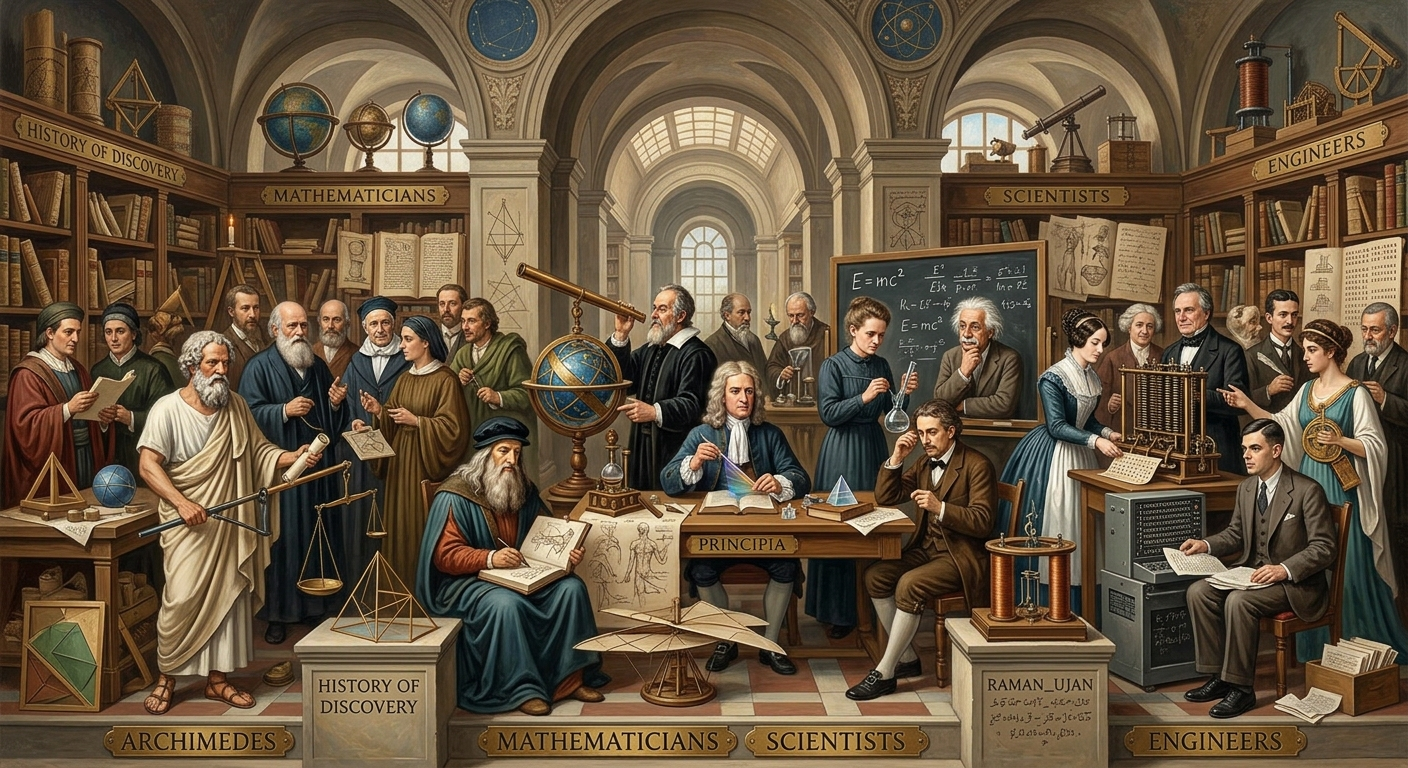
A Comprehensive Historical Thesis on the People Who Built the Intellectual Foundations of Modern Civilization
Abstract
Human civilization is the cumulative product of thousands of years of observation, experimentation, mathematical reasoning, engineering, medicine, astronomy, philosophy and scientific communication. From the earliest civilizations of Mesopotamia and Egypt to the scientific and technological world of 2026, generations of thinkers have progressively transformed humanity’s understanding of nature and its ability to construct complex societies.
This thesis traces that intellectual journey from approximately 3500 BC to 2026, highlighting important scientists, mathematicians, engineers, physicians, astronomers, philosophers and inventors. It includes figures such as Imhotep, Pythagoras, Hippocrates, Plato, Aristotle, Euclid, Archimedes, Aryabhata, Zhang Heng, Al-Khwarizmi, Ibn al-Haytham, Leonardo da Vinci, Nicolaus Copernicus, Galileo Galilei, Johannes Kepler, Isaac Newton, Michael Faraday, James Clerk Maxwell, Charles Darwin, Louis Pasteur, Nikola Tesla, Marie Curie, Max Planck, Albert Einstein, Alan Turing and many others.
Their achievements created the intellectual infrastructure underlying modern mathematics, medicine, engineering, electricity, telecommunications, computing, aviation, space exploration, nuclear physics, electronics, biotechnology, artificial intelligence and modern civilization.
1. Introduction: Civilization as a Cumulative Scientific Achievement
Modern civilization did not appear suddenly.
The smartphone, satellite, aircraft, computer, medical scanner, electrical grid, internet and artificial-intelligence system are the final products of an extraordinarily long chain of discoveries.
A modern computer, for example, depends upon:
mathematics → logic → electricity → electromagnetism → electronics → semiconductor physics → information theory → computer science → software engineering → artificial intelligence.
Likewise, modern medicine depends upon:
ancient observation → anatomy → physiology → microbiology → chemistry → genetics → molecular biology → medical imaging → biotechnology → computational medicine.
The history of science is therefore not simply a list of famous people. It is the history of humanity learning how to measure, reason, test, calculate, construct and communicate knowledge.
2. Before 3500 BC: The Foundations of Knowledge
Although this thesis begins around 3500 BC, scientific thinking is much older.
Early humans learned through observation:
- the movement of the Sun;
- phases of the Moon;
- seasonal changes;
- animal behaviour;
- medicinal properties of plants;
- fire;
- stone technology;
- agriculture;
- navigation;
- construction;
- food preservation.
The development of agriculture was especially important.
Once humans began cultivating crops and establishing permanent settlements, societies needed:
- calendars;
- measurement;
- land surveying;
- irrigation;
- architecture;
- accounting;
- taxation;
- astronomy;
- organized labour.
These requirements encouraged systematic mathematics and engineering.
3. Mesopotamia: The Birth of Written Mathematics and Administration
3.1 Sumerian civilization
By approximately 3500–3000 BC, Mesopotamian societies were developing writing, accounting and organized administration.
Cuneiform tablets recorded quantities of:
- grain;
- livestock;
- land;
- labour;
- taxes;
- trade goods.
This was an important transition from memory-based knowledge to recorded quantitative knowledge.
3.2 Babylonian mathematics
Babylonian scholars developed sophisticated numerical methods.
Their achievements included:
- place-value notation;
- multiplication and division procedures;
- fractions;
- geometry;
- algebraic problem-solving;
- astronomical calculations.
The Babylonian base-60 system eventually influenced humanity’s measurement of:
- 60 seconds per minute;
- 60 minutes per hour;
- 360 degrees in a circle.
Thus, ancient mathematical ideas remain embedded in everyday civilization.
4. Ancient Egypt: Mathematics, Medicine and Engineering
Egyptian civilization developed extensive practical knowledge.
Mathematics was necessary for:
- surveying;
- taxation;
- construction;
- architecture;
- astronomy;
- agriculture.
4.1 Imhotep
Imhotep, traditionally dated to approximately the 27th century BC, is one of the earliest named intellectual figures known from ancient history.
He is associated with:
- architecture;
- administration;
- medicine;
- religious scholarship.
He is particularly associated with the design of the Step Pyramid of Djoser at Saqqara.
Imhotep represents an important early combination of engineering, architecture, medicine and administration.
5. Ancient Greek Philosophy and the Search for Natural Laws
Greek thinkers transformed scientific thinking by increasingly asking:
What natural principles explain the world?
Instead of explaining every phenomenon exclusively through mythology, philosophers investigated nature through observation, logic, geometry and argument.
6. Pythagoras — Mathematics and Numerical Structure
Pythagoras (c. 570–495 BC) became associated with mathematical relationships, particularly the theorem concerning right-angled triangles.
The Pythagorean tradition helped establish the idea that physical relationships could be expressed mathematically.
Geometry later became fundamental to:
- architecture;
- surveying;
- engineering;
- astronomy;
- physics;
- computer graphics.
7. Hippocrates — Medicine
Hippocrates (c. 460–370 BC) became one of the most influential figures in ancient medicine.
The Hippocratic tradition encouraged physicians to interpret illness through natural causes rather than relying exclusively on supernatural explanations.
Its long-term importance lies in the development of:
- clinical observation;
- medical ethics;
- systematic diagnosis;
- careful recording of symptoms.
The famous Hippocratic Oath became associated with professional medical ethics.
8. Plato — Philosophy and Mathematical Reasoning
Plato (c. 428/427–348/347 BC) was primarily a philosopher rather than a scientist in the modern sense.
His importance to civilization lies in his influence on:
- logic;
- philosophy;
- education;
- mathematics;
- theories of knowledge.
His Academy helped establish the importance of systematic intellectual education.
9. Aristotle — Biology, Logic and Natural Philosophy
Aristotle (384–322 BC) produced an enormous body of work covering:
- biology;
- logic;
- physics;
- ethics;
- politics;
- philosophy;
- astronomy;
- zoology.
He classified living organisms and emphasized systematic observation.
Although many of his physical theories were later disproved, his methodology of organizing knowledge profoundly influenced European and Middle Eastern intellectual traditions.
10. Euclid — The Architecture of Geometry
Euclid (fl. c. 300 BC) authored Elements, one of the most influential mathematical works in history.
Euclidean geometry introduced a systematic structure involving:
definitions → axioms → propositions → proofs.
This proof-based approach became a model for mathematical reasoning.
Its influence extends to:
- engineering;
- architecture;
- physics;
- astronomy;
- navigation;
- computer graphics.
11. Archimedes — Mathematics, Physics and Engineering
Archimedes (c. 287–212 BC) was one of antiquity’s greatest mathematicians and engineers.
His contributions included:
- hydrostatics;
- mechanics;
- geometry;
- mathematical methods related to integration;
- the law of buoyancy;
- the lever principle.
Archimedes demonstrated that mathematics could explain physical behaviour.
His work represents an important bridge between:
mathematics → physics → engineering.
12. Eratosthenes — Measuring the Earth
Eratosthenes (c. 276–194 BC) calculated an estimate of Earth’s circumference using geometry and observations of shadows.
His achievement demonstrated a fundamental principle of science:
A large physical quantity can sometimes be determined indirectly through mathematical reasoning.
Modern Earth measurement, geodesy and satellite navigation depend on this general tradition.
13. Ancient Indian Mathematics and Science
Indian intellectual traditions made major contributions to mathematics and astronomy.
Aryabhata
Aryabhata (476–c. 550 AD) made important contributions to:
- astronomy;
- arithmetic;
- trigonometry;
- mathematical calculation.
He discussed Earth’s rotation and developed sophisticated astronomical calculations.
Brahmagupta
Brahmagupta (598–c. 668 AD) made important advances involving:
- zero;
- negative numbers;
- arithmetic;
- algebra.
The development and transmission of sophisticated numeral systems became essential to later global mathematics.
14. Chinese Science and Engineering
Chinese civilizations produced major innovations in:
- metallurgy;
- mechanical engineering;
- astronomy;
- printing;
- navigation;
- agriculture;
- civil engineering.
Zhang Heng
Zhang Heng (78–139 AD) was a Chinese polymath associated with:
- astronomy;
- mathematics;
- engineering;
- geography;
- mechanical devices.
He is particularly associated with an early seismoscope.
Chinese technological achievements such as papermaking, printing, the compass and gunpowder profoundly affected world history.
15. The Islamic Golden Age
Between approximately the eighth and fourteenth centuries, scholars working across the Islamic world preserved, translated, criticized and extended knowledge from Greek, Persian, Indian and other intellectual traditions.
Major areas included:
- mathematics;
- astronomy;
- medicine;
- optics;
- chemistry;
- geography;
- engineering.
This period became an essential bridge between ancient knowledge and the later scientific transformations of Europe.
16. Muhammad ibn Musa al-Khwarizmi — Father of Algebraic Tradition
Muhammad ibn Musa al-Khwarizmi (c. 780–850) was a Persian polymath whose work had enormous influence on mathematics.
His name contributed to the word algorithm, while the title of one of his mathematical works contributed to the term algebra.
His work helped develop systematic procedures for solving mathematical problems.
The concept of an algorithm eventually became foundational to:
- mathematics;
- computer science;
- programming;
- cryptography;
- artificial intelligence.
17. Ibn al-Haytham — Optics and Experimental Science
Ibn al-Haytham (c. 965–1040), known in Latin as Alhazen, made major contributions to:
- optics;
- mathematics;
- astronomy;
- experimental investigation.
His systematic investigation of vision and light became highly influential.
His work helped establish the importance of:
hypothesis → experiment → observation → analysis → conclusion.
18. Avicenna — Medicine
Ibn Sina (Avicenna) (980–1037) was a Persian polymath whose Canon of Medicine became an influential medical reference.
His work synthesized and organized medical knowledge concerning:
- diagnosis;
- diseases;
- medicines;
- anatomy;
- physiology.
His intellectual legacy influenced medical education for centuries.
19. Al-Biruni — Earth Science and Astronomy
Abu Rayhan al-Biruni (973–c. 1050) made important contributions to:
- astronomy;
- mathematics;
- geography;
- geodesy;
- mineralogy.
His quantitative approach to measuring the natural world represents an important stage in the development of scientific geography and Earth science.
20. Leonardo da Vinci — The Polymath Engineer
Leonardo da Vinci (1452–1519) combined:
- art;
- anatomy;
- mechanics;
- architecture;
- hydraulics;
- engineering;
- observation.
His notebooks contain studies of:
- machines;
- gears;
- bridges;
- flight;
- water;
- anatomy.
Leonardo demonstrated the power of combining artistic observation with engineering imagination.
21. Nicolaus Copernicus — The Solar System Reconsidered
Nicolaus Copernicus (1473–1543) proposed a heliocentric model in which Earth and other planets orbit the Sun.
This represented a major transformation in astronomy.
The Copernican revolution eventually contributed to the development of modern celestial mechanics.
22. Andreas Vesalius — Modern Anatomy
Andreas Vesalius (1514–1564) transformed anatomical science through detailed study of the human body.
His work challenged errors inherited from earlier anatomical traditions.
He demonstrated the importance of:
- direct observation;
- dissection;
- anatomical illustration;
- empirical evidence.
23. Galileo Galilei — The Experimental Scientific Revolution
Galileo Galilei (1564–1642) was a central figure in the Scientific Revolution.
He contributed to:
- astronomy;
- mechanics;
- experimental physics;
- mathematical descriptions of motion.
Using telescopic observations, Galileo studied:
- the Moon;
- Jupiter’s moons;
- phases of Venus;
- sunspots;
- stars.
His work strengthened the case for a new astronomical understanding of the universe.
24. Johannes Kepler — Planetary Motion
Johannes Kepler (1571–1630) discovered three fundamental laws describing planetary motion.
His work demonstrated that planets move in elliptical orbits rather than perfect circles.
Kepler’s mathematical astronomy became an essential bridge between observational astronomy and Newtonian physics.
25. William Harvey — Circulation of Blood
William Harvey (1578–1657) demonstrated the circulation of blood through the heart and blood vessels.
His work transformed physiology and showed how quantitative reasoning and anatomical observation could overturn longstanding assumptions.
26. René Descartes — Analytical Mathematics
René Descartes (1596–1650) made major contributions to:
- mathematics;
- philosophy;
- analytical geometry.
Cartesian coordinates created a powerful connection between algebra and geometry.
This became fundamental to:
- physics;
- engineering;
- computer graphics;
- navigation;
- modern mathematics.
27. Isaac Newton — The Mathematical Foundation of Classical Physics
Sir Isaac Newton (1643–1727) is one of history’s most influential scientists.
His contributions included:
- laws of motion;
- universal gravitation;
- calculus;
- optics;
- studies of light;
- reflecting telescopes.
Newton demonstrated that the same mathematical principles could describe terrestrial and celestial motion.
His work established a powerful framework:
force → acceleration → motion → mathematical prediction.
Newtonian mechanics became fundamental to engineering for centuries and remains highly useful today.
28. Gottfried Wilhelm Leibniz — Calculus and Logic
Gottfried Wilhelm Leibniz (1646–1716) independently developed calculus.
His notation became extremely influential.
He also made important contributions to:
- logic;
- philosophy;
- computation;
- binary arithmetic.
Binary mathematics later became fundamental to digital computing.
29. Carl Linnaeus — Classification of Life
Carl Linnaeus (1707–1778) developed the modern foundation of biological naming and classification.
His system helped organize the enormous diversity of living organisms.
Modern biology continues to use the hierarchical classification tradition he helped establish.
30. James Watt — Steam Engineering
James Watt (1736–1819) significantly improved the steam engine.
Improved steam technology helped accelerate the Industrial Revolution.
Steam power transformed:
- mining;
- manufacturing;
- transportation;
- agriculture;
- industrial production.
31. Antoine Lavoisier — Modern Chemistry
Antoine Lavoisier (1743–1794) helped establish modern quantitative chemistry.
He contributed to understanding:
- combustion;
- oxygen;
- chemical reactions;
- conservation of mass.
Chemistry consequently became increasingly quantitative and experimental.
32. Alessandro Volta — Electrical Science
Alessandro Volta (1745–1827) developed the voltaic pile, an early practical source of continuous electrical current.
His work helped launch experimental electrochemistry and electrical science.
The unit volt is named after him.
33. Michael Faraday — Electricity and Electromagnetism
Michael Faraday (1791–1867) made foundational discoveries involving:
- electromagnetic induction;
- electric motors;
- generators;
- electrochemistry;
- magnetic fields.
Electromagnetic induction became fundamental to electric power generation.
Modern electricity grids therefore owe an enormous intellectual debt to Faraday.
34. Charles Babbage — Mechanical Computing
Charles Babbage (1791–1871) designed concepts for programmable mechanical calculating machines, including the Difference Engine and Analytical Engine.
The Analytical Engine contained ideas resembling:
- memory;
- processing;
- control;
- programming.
Babbage therefore occupies an important position in the history leading toward modern computers.
35. Ada Lovelace — Early Computer Programming
Ada Lovelace (1815–1852) wrote an algorithm intended for Babbage’s Analytical Engine.
She is widely recognized as a foundational figure in the history of computer programming.
Her work illustrated a crucial insight:
A computing machine could manipulate symbols according to instructions, not merely perform arithmetic.
That idea is central to modern software.
36. James Clerk Maxwell — The Mathematical Unification of Electricity and Magnetism
James Clerk Maxwell (1831–1879) transformed physics by mathematically unifying electricity, magnetism and light.
Maxwell’s electromagnetic theory demonstrated that light is an electromagnetic phenomenon.
His equations became fundamental to:
- radio;
- radar;
- telecommunications;
- antennas;
- electrical engineering;
- optics;
- wireless communication.
Maxwell’s work also prepared the intellectual ground for Einstein’s special theory of relativity.
37. Charles Darwin — Evolution by Natural Selection
Charles Darwin (1809–1882) developed the theory of evolution by natural selection.
His work transformed biological science by providing a powerful explanation for the diversity and adaptation of living organisms.
Evolutionary theory became foundational to modern:
- biology;
- ecology;
- genetics;
- paleontology;
- medicine.
38. Louis Pasteur — Microbiology and Disease
Louis Pasteur (1822–1895) made major contributions to:
- microbiology;
- vaccination;
- fermentation;
- germ theory.
Pasteur’s research helped establish the importance of microorganisms in disease and food processes.
Modern public health, vaccination and food safety owe much to this scientific tradition.
39. Dmitri Mendeleev — The Periodic Table
Dmitri Mendeleev (1834–1907) developed a powerful periodic classification of chemical elements.
The periodic table became a central organizational framework for chemistry.
It helped scientists understand relationships among elements and anticipate undiscovered elements.
40. Nikola Tesla — Electrical Engineering
Nikola Tesla (1856–1943) made major contributions to alternating-current electrical systems, motors and electrical engineering.
His work was particularly important to the development of practical systems for generating and transmitting electrical power.
41. Thomas Edison — Industrial Electrical Technology
Thomas Edison (1847–1931) contributed to the development and commercialization of numerous electrical and recording technologies.
His work illustrates a major transition in science and engineering:
individual invention → laboratory research → industrial development → mass technology.
42. Heinrich Hertz — Electromagnetic Waves
Heinrich Hertz (1857–1894) experimentally demonstrated electromagnetic waves predicted by Maxwell’s theory.
His work helped establish the physical reality of electromagnetic radiation.
The unit of frequency, the hertz (Hz), is named after him.
43. Marie Curie — Radioactivity
Marie Curie (1867–1934) conducted pioneering research into radioactivity.
She discovered the elements:
- polonium;
- radium.
Her research contributed enormously to nuclear physics and medical applications of radiation.
She remains one of the most important scientists in the history of modern physics and chemistry.
44. Max Planck — Quantum Theory
Max Planck (1858–1947) introduced the quantum hypothesis to explain blackbody radiation.
Quantum theory ultimately transformed understanding of:
- atoms;
- electrons;
- photons;
- energy;
- matter.
It became the foundation for modern:
- electronics;
- lasers;
- semiconductors;
- quantum computing;
- nanotechnology.
45. Ernest Rutherford — The Atomic Nucleus
Ernest Rutherford (1871–1937) established the nuclear model of the atom through pioneering experiments.
He contributed to the understanding of:
- radioactivity;
- atomic structure;
- nuclear physics.
The concept of a compact atomic nucleus became fundamental to twentieth-century physics.
46. Niels Bohr — Quantum Atomic Structure
Niels Bohr (1885–1962) developed a model of atomic structure incorporating quantum ideas.
His work helped establish modern quantum theory and influenced generations of physicists.
47. Albert Einstein — A Transformation of Modern Physics
Albert Einstein (1879–1955) stands among the most influential scientists in human history.
His work transformed our understanding of:
- space;
- time;
- gravity;
- matter;
- energy;
- light;
- atoms;
- statistical physics.
Einstein’s 1905 publications included major contributions concerning the photoelectric effect, Brownian motion, special relativity and mass-energy equivalence. The Nobel Foundation records that his 1921 Nobel Prize in Physics, awarded in 1922, specifically recognized his theoretical-physics contributions and especially his explanation of the photoelectric effect.
48. Einstein’s Special Theory of Relativity
Einstein’s special relativity, published in 1905, fundamentally changed concepts of:
- time;
- space;
- simultaneity;
- motion;
- energy.
One of its most famous consequences is:
E = mc²
This relationship expresses the equivalence between mass and energy.
The significance is profound: mass itself represents an enormous amount of energy. The relationship subsequently became fundamental to nuclear physics and our understanding of stellar energy.
49. Einstein’s General Theory of Relativity
Einstein’s general theory of relativity extended relativity to gravity.
Instead of treating gravity simply as an ordinary force, general relativity describes gravity through the geometry of spacetime.
In simplified form:
matter and energy influence spacetime geometry, and spacetime geometry influences motion.
General relativity became fundamental to:
- cosmology;
- black-hole physics;
- gravitational physics;
- precision astronomy;
- satellite navigation.
The Nobel Foundation notes that Einstein presented general relativity in 1915 and that its predictions concerning phenomena such as the deflection of starlight became important tests of the theory.
50. Einstein and the Photoelectric Effect
Einstein proposed that electromagnetic radiation could be treated as discrete packets of energy.
These packets later became known as photons.
The energy relationship is:
E = hf
where:
- E = photon energy;
- h = Planck’s constant;
- f = frequency.
This work helped establish quantum physics.
The photoelectric effect is important technologically because related principles are used in technologies including light detectors, optical communication systems and solar cells.
51. Einstein and Brownian Motion
Einstein’s 1905 analysis of Brownian motion provided a theoretical explanation for the random movement of microscopic particles suspended in fluids.
This supplied important evidence for the physical reality of atoms and molecules.
It helped connect:
microscopic molecular motion → observable macroscopic behaviour.
52. Einstein and Quantum Physics
Einstein was one of the founders of quantum theory, even though he later disagreed with some interpretations of quantum mechanics.
He contributed to:
- quantum theory of light;
- statistical physics;
- atomic theory;
- stimulated emission;
- quantum statistics.
His work on stimulated emission later became part of the theoretical foundation underlying the laser.
53. Einstein’s Overall Scientific Contribution
Einstein’s legacy can be summarized through five major intellectual revolutions:
| Area | Einstein’s contribution |
|---|---|
| Space and time | Special relativity |
| Gravity | General relativity |
| Mass and energy | E = mc² |
| Light | Photon theory and photoelectric effect |
| Atomic phenomena | Brownian motion and statistical physics |
His importance is not merely that he produced famous equations.
His deeper contribution was changing the conceptual framework through which physicists understood nature.
54. Einstein’s Specific Contribution to Modern Civilization
Einstein did not personally invent the modern computer, internet, smartphone or nuclear reactor.
His importance is more fundamental.
Modern technology frequently depends on physics that developed partly from the scientific revolution in which Einstein was a central participant.
54.1 Nuclear physics
Mass-energy equivalence became fundamental to understanding nuclear reactions and stellar energy.
54.2 Solar technology
The physics of light and electrons underlying the photoelectric effect is important to photovoltaic and optical technologies.
54.3 GPS and precision timing
Modern satellite-navigation systems require extremely accurate clocks and relativistic corrections.
Thus relativity has moved from theoretical physics into practical engineering.
54.4 Lasers
Einstein’s theoretical work on stimulated emission contributed to the foundations of laser physics.
Lasers now support:
- telecommunications;
- medicine;
- manufacturing;
- measurement;
- optical storage;
- scientific instruments.
54.5 Astronomy and cosmology
General relativity provides the theoretical framework for understanding:
- black holes;
- gravitational waves;
- cosmological spacetime;
- gravitational lensing;
- relativistic astrophysics.
55. Alan Turing — The Mathematical Foundations of Computing
Alan Turing (1912–1954) made foundational contributions to:
- mathematical logic;
- computability;
- computer science;
- cryptanalysis;
- artificial intelligence.
The Turing machine became a theoretical model for computation.
His work helped answer a profound question:
What does it mean for a problem to be computable?
56. Claude Shannon — Information Theory
Claude Shannon (1916–2001) established the mathematical foundations of information theory.
His work introduced rigorous concepts concerning:
- information;
- communication;
- noise;
- data transmission;
- information capacity.
Modern telecommunications and digital communication depend heavily on this intellectual framework.
57. John von Neumann — Computer Architecture and Mathematical Physics
John von Neumann (1903–1957) contributed to:
- mathematics;
- quantum mechanics;
- computing;
- game theory;
- numerical computation.
The stored-program computer architecture associated with his work became extremely influential.
58. Katherine Johnson — Mathematics and Spaceflight
Katherine Johnson (1918–2020) performed mathematical calculations critical to American human spaceflight.
Her work illustrates the importance of mathematical modelling in:
- orbital mechanics;
- trajectory calculation;
- spacecraft navigation.
59. Dorothy Vaughan — Computing and Programming
Dorothy Vaughan (1910–2008) became a significant figure in the transition from human calculation to electronic computing at NASA.
Her career demonstrates how mathematical work evolved alongside computer technology.
60. Modern Genetics and Molecular Biology
The twentieth century also produced major advances in understanding life.
Important figures include:
Gregor Mendel
Established fundamental principles of inheritance through experiments with pea plants.
Thomas Hunt Morgan
Demonstrated important relationships between genes and chromosomes.
Rosalind Franklin
Produced crucial X-ray diffraction evidence concerning molecular structures, including DNA.
James Watson and Francis Crick
Developed the famous structural model of DNA, building upon extensive preceding research, including Franklin’s and others’ work.
Barbara McClintock
Discovered mobile genetic elements, transforming understanding of genome organization.
Together, these developments helped create modern genetics and biotechnology.
61. Computer and Semiconductor Revolution
Modern civilization underwent another fundamental transformation during the twentieth century.
Important contributors include:
- William Shockley
- John Bardeen
- Walter Brattain
- Jack Kilby
- Robert Noyce
- Gordon Moore
- Federico Faggin
- Claude Shannon
- Alan Turing
- John von Neumann
Their work contributed to the transition:
vacuum tubes → transistors → integrated circuits → microprocessors → computers → smartphones → cloud computing → artificial intelligence.
62. Space Science
The development of space technology depended upon centuries of accumulated knowledge.
The intellectual chain includes:
Copernicus → Kepler → Galileo → Newton → Einstein → rocket engineering → orbital mechanics → spacecraft engineering → satellite communications → modern space science.
Important modern contributors include:
- Konstantin Tsiolkovsky;
- Robert Goddard;
- Wernher von Braun;
- Sergei Korolev;
- Katherine Johnson;
- many thousands of engineers and scientists.
Humanity’s ability to place satellites into orbit is therefore the product of multiple scientific generations.
63. The Scientific Contribution of Engineers
Scientists discover and explain principles.
Engineers transform principles into functioning systems.
Civilization requires both.
Engineers have built:
- bridges;
- roads;
- dams;
- railways;
- electrical grids;
- aircraft;
- ships;
- factories;
- computers;
- telecommunications networks;
- satellites;
- spacecraft;
- medical instruments.
Engineering converts abstract knowledge into infrastructure.
64. The Relationship Between Mathematics, Science and Engineering
A useful model of civilization is:
Mathematics
↓ provides quantitative language
Science
↓ discovers natural principles
Engineering
↓ applies principles
Technology
↓ produces tools and systems
Infrastructure
↓ supports society
Civilization
↓ creates new problems and questions
Education and research
↓ generate new knowledge
The cycle then begins again.
65. A Chronological Intellectual Timeline
| Period | Major figures | Major contribution |
|---|---|---|
| c. 3500 BC onward | Mesopotamian scholars | Writing, accounting, mathematics |
| Ancient Egypt | Imhotep | Architecture, medicine, administration |
| 6th–5th c. BC | Pythagoras | Geometry and mathematical relationships |
| 5th c. BC | Hippocrates | Medicine and clinical tradition |
| 4th c. BC | Plato | Philosophy and education |
| 4th c. BC | Aristotle | Logic, biology, natural philosophy |
| c. 300 BC | Euclid | Geometry and proof |
| 3rd c. BC | Archimedes | Mechanics, hydrostatics, mathematics |
| 3rd–2nd c. BC | Eratosthenes | Geography and Earth’s measurement |
| 1st millennium | Indian mathematicians | Numeral systems, zero, astronomy |
| 2nd c. AD | Zhang Heng | Astronomy and engineering |
| 9th c. | Al-Khwarizmi | Algebra and algorithms |
| 10th–11th c. | Ibn al-Haytham | Optics and experimental science |
| 10th–11th c. | Avicenna | Medicine |
| 11th c. | Al-Biruni | Astronomy, geography and measurement |
| 15th–16th c. | Leonardo da Vinci | Engineering and anatomy |
| 16th c. | Copernicus | Heliocentric astronomy |
| 16th c. | Vesalius | Human anatomy |
| 17th c. | Galileo | Experimental physics and astronomy |
| 17th c. | Kepler | Planetary laws |
| 17th c. | Newton | Mechanics and gravity |
| 17th c. | Leibniz | Calculus and mathematical logic |
| 18th c. | Lavoisier | Modern chemistry |
| 18th c. | Watt | Steam engineering |
| 19th c. | Faraday | Electromagnetism |
| 19th c. | Babbage | Mechanical computing |
| 19th c. | Darwin | Evolution |
| 19th c. | Maxwell | Electromagnetic theory |
| 19th c. | Pasteur | Microbiology |
| 19th c. | Mendeleev | Periodic table |
| 19th–20th c. | Tesla | Electrical engineering |
| 19th–20th c. | Marie Curie | Radioactivity |
| 20th c. | Planck | Quantum theory |
| 20th c. | Rutherford | Nuclear physics |
| 20th c. | Einstein | Relativity and quantum theory |
| 20th c. | Turing | Computer science |
| 20th c. | Shannon | Information theory |
| 20th c. | von Neumann | Computing and mathematics |
| 20th–21st c. | Modern scientists | Genetics, computing, space science, AI |
66. From Ancient Mathematics to Artificial Intelligence
The technological civilization of 2026 can be interpreted as the accumulated result of several intellectual revolutions.
Revolution 1 — Writing
Human knowledge became recordable.
Revolution 2 — Mathematics
Nature and commerce became measurable.
Revolution 3 — Geometry
Space and construction became mathematically describable.
Revolution 4 — Scientific Observation
Nature became something that could be systematically investigated.
Revolution 5 — Experimental Science
Ideas could be tested against evidence.
Revolution 6 — Classical Physics
Motion and gravity became mathematically predictable.
Revolution 7 — Industrial Engineering
Scientific principles became machines and factories.
Revolution 8 — Electromagnetism
Electricity and communication became controllable technologies.
Revolution 9 — Relativity and Quantum Physics
Humanity discovered deeper structures of space, time, matter and energy.
Revolution 10 — Computing
Information became programmable.
Revolution 11 — Internet and Digital Networks
Information became globally connected.
Revolution 12 — Artificial Intelligence
Machines began performing increasingly sophisticated forms of prediction, generation, reasoning and pattern recognition.
67. Why No Scientist Built Civilization Alone
It is tempting to describe history through individual geniuses.
However, civilization is fundamentally collaborative.
Newton famously built upon the work of predecessors.
Einstein’s theories depended on earlier developments by:
- Newton;
- Maxwell;
- Lorentz;
- Poincaré;
- Planck;
- many others.
Likewise, modern AI depends upon:
- mathematics;
- statistics;
- logic;
- computer science;
- semiconductor engineering;
- telecommunications;
- data science;
- neuroscience;
- large-scale computing.
The correct historical picture is therefore:
individual genius + accumulated knowledge + institutions + education + engineering + experimentation + communication.
68. The Most Important Lesson of Scientific History
The history of science teaches that knowledge is cumulative.
A Babylonian mathematical method can eventually contribute to modern mathematics.
Greek geometry can influence physics.
Newtonian mechanics can influence engineering.
Faraday’s electromagnetic discoveries can lead to generators.
Maxwell’s equations can lead to radio.
Turing’s mathematical ideas can contribute to computing.
Shannon’s information theory can contribute to telecommunications.
Einstein’s physics can contribute to modern relativistic technologies.
Therefore:
Civilization advances when one generation preserves, tests, improves and extends the knowledge inherited from previous generations.
69. Summary Contribution Specifically of Albert Einstein
Albert Einstein’s contribution can be summarized as one of the greatest conceptual transformations in the history of physics.
1. Special Relativity
Einstein changed the understanding of space and time and showed that measurements of time and space depend on relative motion.
2. General Relativity
He transformed the theory of gravity by describing it through spacetime geometry.
3. Mass-Energy Equivalence
His famous relationship:
E = mc²
established the equivalence of mass and energy and became fundamental to modern physics.
4. Photon Theory
Einstein helped establish the quantum description of light, explaining the photoelectric effect. This was the principal work for which he received the 1921 Nobel Prize in Physics.
5. Brownian Motion
His theoretical explanation connected microscopic molecular motion with observable physical phenomena and strengthened the scientific case for atomic theory.
6. Quantum Physics
Einstein was an important founder of quantum theory, even though he challenged some later interpretations of quantum mechanics.
7. Cosmology
General relativity provided a mathematical framework for understanding the large-scale structure and evolution of the universe.
8. Modern Technology
Einstein’s physics ultimately became relevant to technologies involving:
- photovoltaic systems;
- photodetectors;
- lasers;
- precision timing;
- satellite navigation;
- nuclear physics;
- medical and scientific instrumentation.
The Nobel Foundation specifically notes that the photoelectric effect has applications in devices such as photodiodes, fibre-optic telecommunications, solar cells and imaging technologies.
9. Intellectual Legacy
Einstein’s greatest contribution may be broader than any individual invention.
He demonstrated that apparently ordinary concepts—such as time, distance, mass, energy and light—could require profound revision when evidence demanded it.
His career therefore represents an important principle of science:
Scientific progress occurs when human beings are willing to question established assumptions and replace them with explanations that better fit nature.
70. Conclusion
From the mathematical records of ancient Mesopotamia around 3500 BC to artificial intelligence and advanced computing in 2026, humanity’s technological civilization has been constructed through an enormous chain of intellectual achievements.
Imhotep contributed to early architecture and medicine.
Pythagoras, Euclid and Archimedes transformed mathematical reasoning.
Hippocrates helped establish systematic medical practice.
Plato and Aristotle shaped intellectual traditions.
Aryabhata and Brahmagupta advanced mathematics and astronomy.
Zhang Heng demonstrated sophisticated Chinese scientific and engineering knowledge.
Al-Khwarizmi helped establish the mathematical traditions of algebra and algorithms.
Ibn al-Haytham advanced optics and experimental investigation.
Avicenna organized medical knowledge.
Leonardo da Vinci united observation and engineering imagination.
Copernicus, Galileo and Kepler transformed astronomy.
Newton established a mathematical framework for classical physics.
Lavoisier transformed chemistry.
Faraday and Maxwell established the foundations of modern electromagnetic technology.
Darwin and Pasteur transformed biology and medicine.
Mendeleev organized chemical elements.
Curie, Rutherford, Planck and Bohr opened the atomic and quantum worlds.
Tesla and other electrical pioneers helped transform electricity into infrastructure.
Babbage, Lovelace, Turing, Shannon and von Neumann laid foundations for computing and information technology.
And Albert Einstein transformed humanity’s understanding of space, time, gravity, light, mass and energy.
The modern world is therefore not the product of a single civilization, country, race, institution or individual.
It is the result of a global, cumulative intellectual inheritance built over thousands of years.
The central story is:
Observation → Mathematics → Philosophy → Experiment → Science → Engineering → Technology → Infrastructure → Civilization → New Knowledge.
That cycle continues in 2026.
The scientists and engineers of the present are standing on the accumulated intellectual foundations of thousands of years. Their discoveries will, in turn, become the foundations upon which future generations build technologies and scientific theories that are currently impossible to imagine.
The history of science is therefore not simply the history of the past. It is the foundation of humanity’s future.
Selected authoritative reference
The Nobel Foundation’s historical record confirms Einstein’s 1905 work on the photoelectric effect, Brownian motion, special relativity and mass-energy equivalence, as well as his later general relativity work.



Be First to Comment