
Abstract
Gigahertz (GHz) is one of the most important units used to describe modern radio communication, radar, satellite systems, Wi-Fi, mobile networks, computer processors, astronomy, microwave engineering and many other technologies.
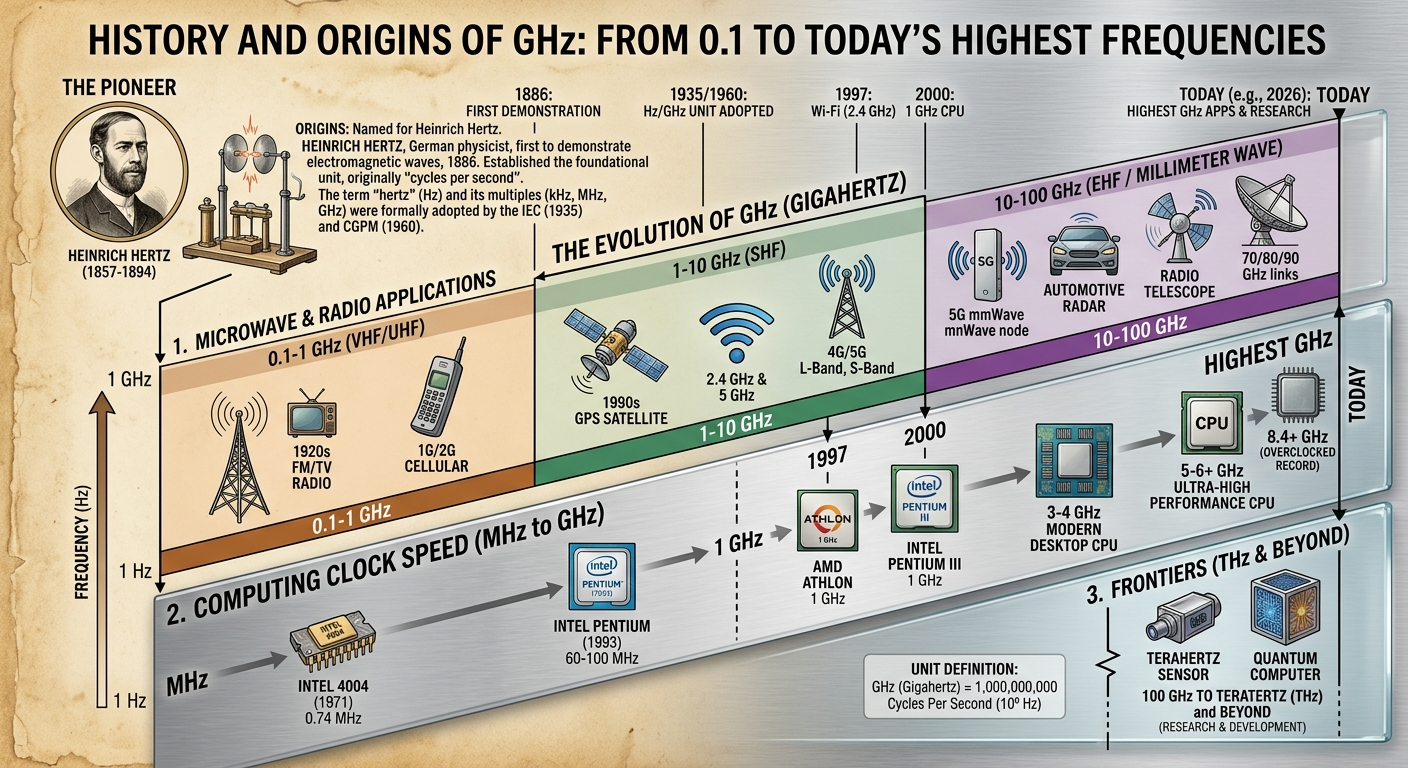
A crucial point, however, is that GHz itself was not invented by one person. It is a measurement unit derived from the SI unit hertz (Hz). The hertz was named after the German physicist Heinrich Rudolf Hertz (1857–1894), whose experiments in the 1880s provided the first convincing experimental demonstration of electromagnetic waves predicted by James Clerk Maxwell. The name “hertz” was adopted for the frequency unit in the twentieth century; it became an SI unit in 1960. (Wikipedia)
A gigahertz means one billion cycles per second:
1 GHz = 1,000,000,000 Hz = 10⁹ Hz.
The development from frequencies around 0.1 GHz (100 MHz) into the hundreds of GHz demonstrates one of the great technological transformations of modern civilization—from early radio experiments to radar, satellites, cellular networks, Wi-Fi, semiconductor processors and today’s submillimeter and terahertz research.
1. What Is Frequency?
Frequency describes how many complete cycles of a repeating phenomenon occur every second.
The fundamental SI unit is the hertz (Hz):
1 Hz = 1 cycle per second
Therefore:
| Unit | Frequency |
|---|---|
| 1 Hz | 1 cycle/s |
| 1 kHz | 1,000 Hz |
| 1 MHz | 1,000,000 Hz |
| 1 GHz | 1,000,000,000 Hz |
| 1 THz | 1,000,000,000,000 Hz |
| 1 PHz | 1,000,000,000,000,000 Hz |
| 1 EHz | 1,000,000,000,000,000,000 Hz |
NASA likewise defines 1 GHz as 10⁹ Hz and 1 THz as 10¹² Hz. (Planetary Data System)
Thus:
1 THz = 1,000 GHz
and:
0.1 GHz = 100 MHz.
2. Was GHz Invented?
No—GHz was not invented as a technology.
This distinction is important.
There are three different things:
- The physical phenomenon of frequency
- The unit hertz
- The prefix giga
The physical phenomenon existed long before humans measured it.
The hertz was named in honor of Heinrich Hertz.
The giga- prefix is part of the international system of decimal prefixes and means 10⁹.
Therefore, gigahertz is simply the combination of giga + hertz.
It does not have a single inventor.
3. Heinrich Hertz: The Scientist Behind “Hertz”
Heinrich Rudolf Hertz was born in Hamburg in 1857 and became one of the most important experimental physicists of the nineteenth century.
His importance came from experimental confirmation of James Clerk Maxwell’s electromagnetic theory.
Maxwell had theoretically predicted that changing electric and magnetic fields could propagate through space as electromagnetic waves.
Hertz subsequently demonstrated these waves experimentally.
His experiments in the late 1880s showed phenomena such as reflection, refraction, interference and polarization of radio waves, demonstrating their relationship to light as electromagnetic waves. (Wikipedia)
This was a foundational event in the development of:
- radio
- television
- radar
- wireless communication
- satellite communication
- Wi-Fi
- mobile telecommunications
- microwave engineering
- modern electromagnetic technology.
4. Maxwell: The Theoretical Foundation
Before Hertz, there was James Clerk Maxwell.
Maxwell developed the mathematical theory of electromagnetism during the nineteenth century.
His equations showed that electric and magnetic fields could propagate as waves.
This led to a remarkable prediction:
electricity + magnetism → electromagnetic waves
and ultimately established the theoretical relationship between electromagnetic radiation and light.
Hertz experimentally confirmed the existence of these waves.
The historical chain can therefore be simplified as:
Maxwell → electromagnetic-wave theory → Hertz → experimental confirmation → radio technology → microwave technology → GHz technology
This is one of the most important scientific chains in technological history.
5. Hertz’s Early High-Frequency Experiments
Interestingly, Hertz’s experiments already reached frequencies that today we would describe in the hundreds of MHz.
Historical accounts report Hertzian experiments involving approximately 50 MHz, 100 MHz and 430 MHz, with one transmitter operating around 430 MHz. (Wikipedia)
That means that nineteenth-century experimental physics had already entered territory approaching the modern microwave/UHF region.
However, Hertz did not build a modern GHz communication system.
His objective was primarily to demonstrate electromagnetic-wave phenomena and test Maxwell’s theory.
6. Jagadish Chandra Bose and the Move Toward GHz
One of the most fascinating developments occurred soon afterward.
The Indian physicist Jagadish Chandra Bose conducted pioneering experiments with extremely short electromagnetic waves.
Historical sources credit Bose with producing millimeter waves in the 1890s, including experiments around 60 GHz, corresponding to a wavelength of approximately 5 mm. (Wikipedia)
This is extremely significant.
A simplified chronology is:
Hertz → hundreds of MHz
↓
Bose → tens of GHz
↓
20th-century microwave engineering
↓
radar, telecommunications, satellites, computers and wireless networks
Bose’s work demonstrated that electromagnetic technology could extend far beyond the frequencies commonly associated with early radio.
7. Why 0.1 GHz Is Important
The user’s requested starting point of 0.1 GHz corresponds to:
0.1 GHz = 100 MHz.
This lies within the radio-frequency region.
At 100 MHz, electromagnetic waves have a wavelength of approximately:
3 metres
because electromagnetic waves in vacuum approximately obey:
[
c=f\lambda
]
where:
- (c) = speed of light
- (f) = frequency
- (\lambda) = wavelength.
Therefore:
[
\lambda=\frac{c}{f}
]
At 100 MHz:
[
\lambda \approx 3,m
]
As frequency increases, wavelength becomes shorter.
8. The GHz Ladder
Here is a useful progression from 0.1 GHz to 1 THz:
| Frequency | Equivalent | Approximate wavelength in vacuum | Example region/application |
|---|---|---|---|
| 0.1 GHz | 100 MHz | 3 m | VHF/UHF radio region |
| 0.3 GHz | 300 MHz | 1 m | UHF |
| 0.5 GHz | 500 MHz | 60 cm | UHF |
| 1 GHz | 1,000 MHz | 30 cm | Microwave |
| 2.4 GHz | 2,400 MHz | 12.5 cm | Wi-Fi/ISM |
| 5 GHz | 5,000 MHz | 6 cm | Wi-Fi |
| 10 GHz | 10,000 MHz | 3 cm | Radar/microwave |
| 24 GHz | 24,000 MHz | 1.25 cm | Radar/sensing |
| 28 GHz | 28,000 MHz | 10.7 mm | 5G/mmWave |
| 39 GHz | 39,000 MHz | 7.7 mm | mmWave communications |
| 60 GHz | 60,000 MHz | 5 mm | Short-range communications/research |
| 100 GHz | 100,000 MHz | 3 mm | Millimeter-wave research |
| 300 GHz | 300,000 MHz | 1 mm | Upper millimeter-wave |
| 1,000 GHz | 1 THz | 0.3 mm | Terahertz boundary |
Microwave engineering commonly divides the microwave spectrum into bands such as L, S, C, X, Ku, K and Ka, with millimeter-wave frequencies extending roughly from 40 to 300 GHz. (ScienceDirect)
9. 1 GHz — The Beginning of the Gigahertz Era
1 GHz = one billion cycles per second.
This is a major milestone because GHz frequencies became increasingly important in:
- microwave communications
- radar
- satellite systems
- wireless networking
- radio astronomy
- navigation
- semiconductor electronics.
At 1 GHz, the wavelength is approximately 30 centimetres.
This makes antennas and electromagnetic structures substantially smaller than at 100 MHz.
10. 2.4 GHz
2.4 GHz became one of the most recognizable frequencies in modern consumer technology.
It is associated with technologies including:
- Wi-Fi
- Bluetooth
- wireless peripherals
- industrial, scientific and medical applications.
Its wavelength is approximately 12.5 cm.
The importance of 2.4 GHz is not because it represents the highest frequency, but because it became one of the most widely deployed GHz ranges in everyday technology.
11. 5 GHz
The 5 GHz region became particularly important for wireless networking.
Modern Wi-Fi systems can operate in several frequency ranges, including approximately 2.4 GHz and 5 GHz.
At 5 GHz:
[
\lambda \approx 6,cm
]
The shorter wavelength allows different antenna and channel designs and can support substantially wider channels than older lower-frequency systems, depending on the specific technology and regulatory environment.
12. 10 GHz and Beyond
At around 10 GHz, electromagnetic waves have wavelengths of approximately:
3 centimetres.
This region has become important in:
- radar
- satellite communications
- scientific instruments
- microwave links
- remote sensing
- radio astronomy.
The development of microwave electronics made frequencies that once required specialized laboratory equipment increasingly practical.
13. 24 GHz, 28 GHz and 39 GHz
The higher GHz ranges became increasingly important in modern sensing and telecommunications.
24 GHz
Used extensively in radar and sensing applications.
28 GHz
An important millimeter-wave frequency associated with some 5G deployments and research.
39 GHz
Another important millimeter-wave cellular frequency.
At these frequencies, wavelengths are only around one centimetre or less.
This enables sophisticated antenna arrays with many individual antenna elements in relatively small physical areas.
14. 60 GHz — A Historic and Modern Frequency
60 GHz = 60 billion cycles per second.
It has an especially interesting history.
As noted earlier, Jagadish Chandra Bose conducted experiments around 60 GHz in the 1890s. (Wikipedia)
Today, 60 GHz is also technologically important in:
- millimeter-wave communications
- high-speed short-range wireless systems
- radar
- sensing
- scientific research.
Thus there is a remarkable historical connection:
1890s experimental physics → approximately 60 GHz
and more than a century later:
modern electronics → approximately 60 GHz communications and sensing.
15. 100 GHz
At:
100 GHz
the wavelength is approximately:
3 millimetres.
This is firmly within the millimeter-wave region.
At these frequencies, engineers encounter increasingly difficult challenges involving:
- semiconductor performance
- signal losses
- antenna design
- packaging
- transmission lines
- thermal management
- measurement accuracy.
Nevertheless, modern semiconductor and photonic technologies have pushed usable frequencies much higher.
16. 300 GHz
At 300 GHz, wavelength is approximately:
1 millimetre.
This represents the upper part of commonly discussed millimeter-wave frequencies.
Above this region, researchers increasingly use the term:
terahertz (THz).
The relationship is:
[
300,GHz = 0.3,THz
]
and:
[
1,THz = 1000,GHz.
]
17. The Transition From GHz to THz
The transition is purely mathematical:
999 GHz → still GHz
1,000 GHz → 1 THz
Therefore there isn’t a physical wall at 1,000 GHz.
It is simply a change of unit.
For example:
1,200 GHz = 1.2 THz
and:
5,000 GHz = 5 THz.
This is why asking for the “highest GHz” needs some qualification.
There is no universal highest GHz frequency.
Once frequencies exceed 1,000 GHz, scientists normally express them in THz rather than enormous GHz numbers.
18. How High Can Frequency Go?
The electromagnetic spectrum extends vastly beyond GHz.
A simplified hierarchy is:
Radio
→ MHz
→ GHz
→ hundreds of GHz
→ THz
→ infrared
→ visible light
→ ultraviolet
→ X-rays
→ gamma rays.
The hertz unit itself can describe all these frequencies, but scientists generally use appropriate prefixes.
For example:
| Frequency | Common unit |
|---|---|
| 100 MHz | MHz |
| 1 GHz | GHz |
| 100 GHz | GHz |
| 1 THz | THz |
| 100 THz | THz |
| 1 PHz | PHz |
| 1 EHz | EHz |
Radio frequencies are commonly expressed in kHz, MHz and GHz, while electromagnetic radiation at higher frequencies is commonly described using THz, PHz and EHz. (Wikipedia)
19. What Is the Highest GHz of Today?
This question requires distinguishing communication technology, electronic oscillators, scientific instruments and electromagnetic radiation.
There is no single worldwide “highest GHz.”
As of August 21, 2026, research and instrumentation already extend well into the hundreds of GHz.
For example, a 2026 research report describes an 850 GHz instrument module for the Fred Young Submillimeter Telescope/Prime-Cam system. The 850 GHz module is designed for submillimeter astronomical observations and is scheduled for deployment in 2027. (arXiv)
Therefore:
850 GHz = 0.85 THz
which is very close to the 1 THz boundary.
But this should not be interpreted as the highest frequency humans can generate or measure. Other scientific technologies operate at THz and far higher frequencies.
20. GHz in Computer Processors
GHz has another major meaning in computing.
A processor clock frequency describes how rapidly its clock signal cycles.
For example:
1 GHz = 1 billion clock cycles per second.
3 GHz = 3 billion clock cycles per second.
5 GHz = 5 billion clock cycles per second.
But an important modern engineering principle is:
Higher GHz does not automatically mean a faster computer.
Performance also depends on:
- processor architecture
- number of cores
- instructions per cycle
- cache
- memory subsystem
- parallelism
- accelerator architecture
- software optimization
- manufacturing technology.
Therefore a 4 GHz processor can outperform another processor running at a higher clock frequency.
21. GHz in Telecommunications
GHz became fundamental to telecommunications because higher frequencies can provide access to larger blocks of spectrum.
Applications include:
Mobile networks
- cellular radio
- 4G
- 5G
- future 6G research.
Wi-Fi
- 2.4 GHz
- 5 GHz
- 6 GHz
- higher-frequency research.
Satellite communications
Many satellite communication systems operate in GHz-frequency microwave bands.
Radar
GHz frequencies are widely used because their relatively short wavelengths allow practical antennas and high-resolution sensing.
Navigation
Satellite navigation systems use precisely controlled radio frequencies.
22. GHz and Radar
Radar is one of the most important technologies responsible for advancing microwave engineering.
Radar sends electromagnetic energy toward an object and analyzes the returning signal.
Higher frequencies can permit:
- smaller antennas
- narrower beams
- improved spatial resolution
- compact radar systems.
Modern automotive radar, for example, commonly operates in the tens of GHz.
23. GHz and Astronomy
GHz frequencies are also extremely important in astronomy.
Radio telescopes observe astronomical objects emitting radio-frequency radiation.
Astronomers use GHz observations to study:
- galaxies
- pulsars
- quasars
- cosmic magnetic fields
- star formation
- galaxy clusters
- cosmic synchrotron radiation.
Recent 2026 research, for example, reported MeerKAT observations at 1.28 GHz of a large-scale radio structure associated with a galaxy cluster. (arXiv)
This demonstrates that GHz technology is not merely a telecommunications technology—it is also an instrument for studying the universe.
24. The Technology Chain
The history can be represented as follows:
Stage 1 — Classical electricity
Faraday and others
↓
Stage 2 — Electromagnetic theory
James Clerk Maxwell
↓
Stage 3 — Experimental electromagnetic waves
Heinrich Hertz
↓
Stage 4 — Early wireless experimentation
Hertz, Bose, Marconi and others
↓
Stage 5 — Radio engineering
kHz → MHz
↓
Stage 6 — Microwave engineering
MHz → GHz
↓
Stage 7 — Radar and telecommunications
GHz
↓
Stage 8 — Semiconductor electronics
GHz processors and high-frequency circuits
↓
Stage 9 — Millimeter waves
30–300+ GHz
↓
Stage 10 — Terahertz technology
THz
↓
Stage 11 — Infrared, visible and higher-frequency electromagnetic radiation
THz → PHz → EHz and beyond
25. Major Historical Figures
| Scientist/engineer | Major contribution |
|---|---|
| Michael Faraday | Foundations of electromagnetic induction and field concepts |
| James Clerk Maxwell | Mathematical theory of electromagnetism |
| Heinrich Hertz | Experimental demonstration of electromagnetic waves |
| Jagadish Chandra Bose | Pioneering millimeter-wave experiments |
| Guglielmo Marconi | Development of practical wireless telegraphy |
| Nikola Tesla | Major contributions to high-frequency electrical systems and wireless concepts |
| Edwin Armstrong | Major radio engineering developments |
| John R. Pierce | Important contributions to microwave and communications engineering |
| Percy Spencer | Microwave technology development |
| Robert Watson-Watt | Major radar development |
| William Shockley | Semiconductor transistor development |
| John Bardeen | Transistor and semiconductor physics |
| Walter Brattain | Transistor development |
| Jack Kilby | Integrated circuit development |
| Robert Noyce | Integrated circuit development |
| Modern semiconductor engineers | Advancement of high-frequency integrated electronics |
No single person created today’s GHz technology. It emerged from more than a century of cumulative scientific and engineering work.
26. Why Frequencies Became Higher
The move from MHz toward GHz and THz was driven by several technological requirements.
26.1 More information
Higher-frequency spectrum can provide opportunities for wider communication channels.
26.2 Smaller antennas
For a given antenna design, shorter wavelengths permit physically smaller structures.
26.3 Better radar resolution
Shorter wavelengths can enable increasingly fine spatial measurements.
26.4 Higher-density electronics
Semiconductor manufacturing has allowed increasingly sophisticated high-frequency circuits.
26.5 Wireless connectivity
Modern societies require enormous quantities of wireless capacity.
26.6 Scientific observation
Higher-frequency radiation reveals physical phenomena that cannot be studied effectively at lower frequencies.
27. The Relationship Between Frequency and Wavelength
One of the most important equations in this subject is:
[
c=f\lambda
]
Therefore:
[
\lambda=\frac{c}{f}
]
where:
- (c) ≈ 299,792,458 m/s
- (f) = frequency
- (\lambda) = wavelength.
This means:
frequency increases → wavelength decreases
and:
frequency decreases → wavelength increases.
Examples:
| Frequency | Approximate wavelength |
|---|---|
| 0.1 GHz | 3 m |
| 1 GHz | 30 cm |
| 2.4 GHz | 12.5 cm |
| 5 GHz | 6 cm |
| 10 GHz | 3 cm |
| 30 GHz | 1 cm |
| 60 GHz | 5 mm |
| 100 GHz | 3 mm |
| 300 GHz | 1 mm |
| 1 THz | 0.3 mm |
28. GHz Is Not the Same Thing as “Speed”
A common misunderstanding is:
GHz = speed
This is not always correct.
GHz is a frequency.
Frequency tells us how many cycles occur per second.
In a processor, GHz can describe clock frequency.
In radio, GHz can describe carrier frequency.
In radar, GHz can describe electromagnetic-wave frequency.
In astronomy, GHz can describe the frequency of radiation being observed.
Thus, the meaning depends upon the application.
29. GHz and the Modern Digital Civilization
The significance of GHz goes far beyond the unit itself.
Modern civilization contains enormous numbers of GHz-frequency systems.
They are found in:
- smartphones
- Wi-Fi routers
- cellular base stations
- satellites
- aircraft
- radar
- navigation systems
- computers
- data centres
- automobiles
- scientific instruments
- radio telescopes
- wireless sensors
- telecommunications infrastructure.
GHz technology is therefore one of the invisible foundations of modern civilization.
30. From 0.1 GHz to 1 THz: The Great Technological Journey
The progression can be summarized:
0.1 GHz
100 MHz
Beginning of the user’s requested range.
↓
1 GHz
1 billion cycles/second
Microwave engineering becomes increasingly important.
↓
2.4 GHz
Major consumer wireless frequency.
↓
5 GHz
High-capacity wireless networking.
↓
10 GHz
Advanced microwave/radar applications.
↓
24–40 GHz
Millimeter-wave sensing and communications.
↓
60 GHz
Historic millimeter-wave research and modern high-frequency wireless applications.
↓
100 GHz
Advanced millimeter-wave electronics.
↓
300 GHz
Upper millimeter-wave region.
↓
1,000 GHz
1 THz
Transition from gigahertz to terahertz notation.
↓
>1 THz
Terahertz and infrared technologies.
31. The Most Important Historical Insight
It would be incorrect to say:
“Heinrich Hertz invented GHz.”
A more scientifically accurate statement is:
Heinrich Hertz did not invent gigahertz; he provided the experimental foundation for electromagnetic-wave science, and the unit hertz was later named in his honor. Gigahertz is a decimal multiple of the hertz, equal to one billion cycles per second.
The history is therefore:
Maxwell predicted electromagnetic waves
→ Hertz experimentally demonstrated them
→ the unit hertz was named after Hertz
→ the SI prefix giga represents 10⁹
→ gigahertz means 10⁹ hertz
→ engineers progressively developed technology capable of generating, transmitting, detecting and processing GHz signals
→ modern technology now extends into hundreds of GHz and beyond into THz.
The SI system formally adopted the name hertz as part of the modern SI framework in 1960, while the name had been established earlier in the twentieth century. (Wikipedia)
32. Conclusion
The history of GHz is really the history of humanity learning to control increasingly rapid electromagnetic phenomena.
The journey began theoretically with James Clerk Maxwell, who unified electricity and magnetism mathematically. It moved experimentally through Heinrich Hertz, who demonstrated electromagnetic waves. Jagadish Chandra Bose subsequently pushed experimental work into the millimeter-wave region, including frequencies around 60 GHz. (Wikipedia)
Over the twentieth and twenty-first centuries, generations of scientists and engineers transformed these discoveries into:
radio → television → radar → satellites → computers → cellular networks → Wi-Fi → 5G → millimeter-wave systems → terahertz research.
Today, 1 GHz means one billion cycles per second, while 1 THz equals 1,000 GHz. Modern science has already reached hundreds of GHz in sophisticated instrumentation; an example reported in 2026 is an 850 GHz astronomical instrument module, demonstrating how close advanced scientific instrumentation has moved toward the terahertz boundary. (arXiv)
So there is no single “highest GHz of today.” GHz is a unit, not a technological ceiling. Frequencies continue beyond 1,000 GHz, where THz, PHz and EHz become more convenient units.
The fundamental historical lesson is therefore:
GHz was not invented by one person. It is the product of the development of frequency measurement, the hertz unit named after Heinrich Hertz, the SI decimal prefix giga, Maxwell’s electromagnetic theory, Hertz’s experiments, Bose’s millimeter-wave work, and more than a century of subsequent radio, microwave, semiconductor and telecommunications engineering.
Key reference facts
- 0.1 GHz = 100 MHz
- 1 GHz = 1 billion Hz
- 10 GHz = 10 billion Hz
- 100 GHz = 100 billion Hz
- 300 GHz = 0.3 THz
- 1,000 GHz = 1 THz
- Heinrich Hertz = namesake of Hz
- James Clerk Maxwell = theoretical foundation of electromagnetic waves
- Jagadish Chandra Bose = pioneer of millimeter-wave experimentation
- 850 GHz = 0.85 THz, an example of a very-high-frequency scientific instrument reported in 2026. (arXiv)




Be First to Comment