
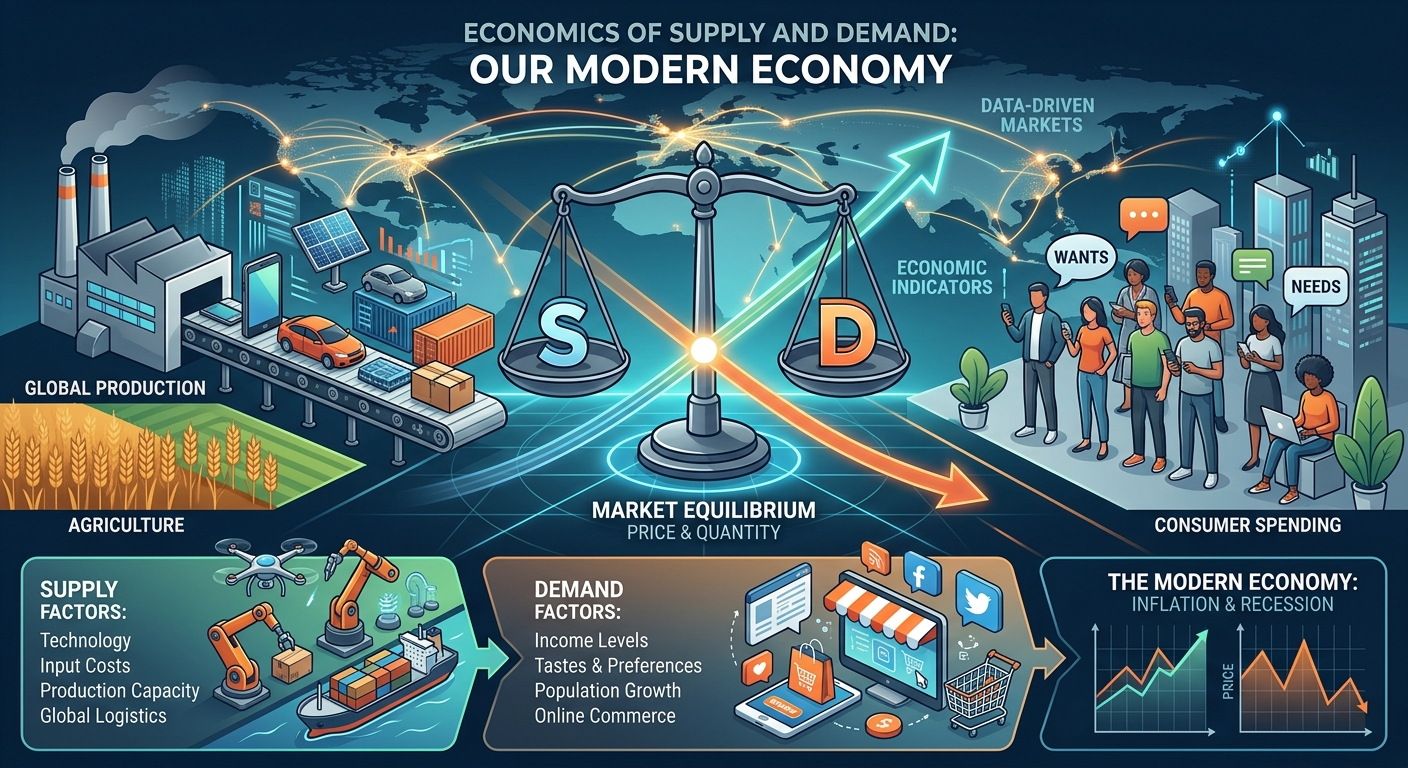
A Theoretical and Empirical Study of Market Equilibrium, Economic Adjustment, and Policy
Proposed research title: Supply and Demand in the Modern Economy: A Theoretical and Empirical Analysis of Market Equilibrium, Price Adjustment, and Economic Policy
Research area: Economics
Suggested level: Advanced undergraduate / postgraduate introductory thesis
Geographical scope: Global economy, with selected applications to South Africa
Proposed research period: 2010–2026, subject to data availability
Abstract
This thesis investigates the role of supply and demand in explaining the allocation of scarce resources, the formation of prices, and the adjustment of markets in the modern economy. It examines the theoretical foundations of consumer demand, producer supply, market equilibrium, elasticity, market power, technological change, global supply chains, and government intervention.
The study proposes that supply and demand remain fundamental analytical tools, but that their explanatory power depends on the institutional, technological, and macroeconomic conditions in which markets operate. In particular, the thesis examines how changes in income, production costs, technology, expectations, and government policy influence market outcomes.
A mixed-methods research design is proposed, combining economic theory, literature review, descriptive statistics, and econometric analysis. The empirical component would estimate demand and supply relationships using selected market data, with attention to the identification problem: observed prices and quantities are jointly determined, making it difficult to distinguish demand shifts from supply shifts without appropriate assumptions or instruments. (Cowles Foundation)
The thesis concludes that supply and demand should be understood not merely as two curves, but as part of a broader system of economic coordination involving prices, institutions, technology, expectations, and productive capacity.
Keywords: Supply, demand, equilibrium, elasticity, market structure, econometrics, inflation, economic development, South Africa.
Chapter 1: Introduction
1.1 Background of the Study
Modern economies coordinate millions of decisions concerning production, consumption, investment, employment, and trade. Supply and demand provide a foundational framework for analysing these decisions.
In its simplest form, demand represents the quantities consumers are willing and able to purchase, while supply represents the quantities producers are willing and able to sell. Their interaction helps explain market prices and quantities.
However, real markets do not operate in isolation. A change in electricity prices can affect manufacturing costs; manufacturing costs can affect product prices; product prices can affect household budgets; and household spending can affect business revenue.
The modern economy is therefore a system of interconnected markets.
The traditional supply-and-demand model remains useful, but it must be interpreted carefully. Economic research has shown that empirical demand estimation is central to analysing market power, taxation, mergers, product choice, and consumer welfare. (Cowles Foundation)
1.2 Problem Statement
Although supply and demand are widely taught, several important problems remain:
- Many explanations treat markets as isolated rather than interconnected.
- Price changes are often confused with shifts in demand or supply.
- The role of technology and infrastructure is sometimes underestimated.
- Market power can prevent prices from behaving as predicted by competitive models.
- Observed prices and quantities do not automatically reveal the underlying demand and supply curves.
- Efficient market outcomes do not necessarily guarantee equitable distribution.
The central research problem is therefore:
How effectively can supply-and-demand theory explain modern market outcomes when technological, institutional, macroeconomic, and social factors are incorporated into the analysis?
1.3 Aim of the Study
The aim is to develop and evaluate a comprehensive theoretical and empirical framework for understanding supply and demand in the modern economy.
1.4 Objectives of the Study
The study seeks to:
- Explain the theoretical foundations of supply and demand.
- Analyse the determinants of market equilibrium.
- Examine price and income elasticities.
- Investigate the effects of technology and production costs.
- Analyse the role of market structure and market power.
- Examine the relationship between microeconomic markets and macroeconomic outcomes.
- Develop an empirical framework for estimating demand and supply.
- Evaluate the implications for businesses and public policy.
- Apply selected concepts to South African economic conditions.
- Identify the limitations of conventional supply-and-demand models.
1.5 Research Questions
Main Research Question
How do supply and demand interact to determine market outcomes in the modern economy, and how are these outcomes affected by technology, institutions, and economic policy?
Specific Research Questions
- What are the theoretical foundations of supply and demand?
- What factors determine consumer demand?
- What factors determine producer supply?
- How do prices adjust toward equilibrium?
- How does elasticity influence market outcomes?
- How does technology affect supply and productivity?
- How do market power and imperfect competition affect prices?
- How do global supply chains influence supply shocks?
- How do government policies affect market equilibrium?
- How can supply and demand be empirically estimated?
- What are the implications for South African economic development?
1.6 Research Hypotheses
The following hypotheses are proposed for empirical testing.
H1: Price and Demand
H₀: Price changes have no statistically significant effect on quantity demanded.
H₁: Higher prices are associated with lower quantity demanded, holding other relevant factors constant.
H2: Income and Demand
H₀: Income has no statistically significant effect on demand.
H₁: Income significantly affects demand, with the direction depending on whether the good is normal or inferior.
H3: Production Costs and Supply
H₀: Production costs have no statistically significant effect on supply.
H₁: Higher production costs reduce supply, holding other relevant factors constant.
H4: Technology and Supply
H₀: Technological improvement has no statistically significant effect on productive capacity.
H₁: Technological improvement increases productive capacity and may reduce unit production costs.
H5: Market Power
H₀: Market concentration has no significant relationship with price-cost margins.
H₁: Greater market power is associated with higher price-cost margins, subject to market conditions.
H6: Policy Intervention
H₀: Government intervention has no significant effect on market outcomes.
H₁: Taxes, subsidies, regulations, or other interventions significantly affect prices, quantities, or welfare.
1.7 Significance of the Study
The study is relevant to:
- Students: Understanding economic theory.
- Businesses: Pricing, production, investment, and market strategy.
- Farmers: Production planning and agricultural markets.
- Government: Economic policy and infrastructure planning.
- Investors: Assessing demand growth and market risks.
- Researchers: Developing empirical models.
- Society: Understanding affordability, employment, and resource allocation.
1.8 Scope and Delimitations
The thesis focuses on market-based economies and selected applications to South Africa. It does not attempt to model every market in the economy.
The proposed empirical analysis would focus on selected sectors such as:
- Food
- Electricity
- Housing
- Labour
- Telecommunications
- Digital services
The final selection would depend on data availability.
Chapter 2: Literature Review
2.1 Classical Foundations
The study of markets has a long intellectual history.
Adam Smith examined the division of labour, exchange, and the coordination of economic activity.
David Ricardo developed important ideas concerning distribution, comparative advantage, and economic value.
Alfred Marshall helped establish the modern graphical framework of supply and demand, including equilibrium analysis and elasticity.
Marshallian analysis remains central to introductory and intermediate economics, although its assumptions and interpretation have been debated in the academic literature. (Taylor & Francis Online)
2.2 Neoclassical Economics
Neoclassical economics developed a formal framework for analysing:
- Consumer choice
- Producer behaviour
- Marginal utility
- Marginal cost
- Equilibrium
- Resource allocation
The central idea is that consumers and producers respond to incentives, subject to constraints.
2.3 Keynesian Economics
John Maynard Keynes emphasised the importance of aggregate demand in determining output, employment, and economic fluctuations.
This perspective is especially important when analysing recessions, unemployment, and insufficient demand.
2.4 Supply-Side Economics
Supply-side economics focuses on productive capacity, incentives, technology, labour markets, investment, and production costs.
A South African supply-side modelling study, for example, examined production, investment, labour demand, wages, prices, and unemployment as interconnected components of economic performance. (UP Repository)
2.5 Industrial Organisation
Industrial organisation studies how market structure affects economic outcomes.
Important topics include:
- Monopoly
- Oligopoly
- Product differentiation
- Entry barriers
- Price discrimination
- Market concentration
- Market power
Empirical demand estimation is particularly important because it helps researchers assess how consumers respond to prices and product characteristics. (Cowles Foundation)
2.6 Behavioural Economics
Behavioural economics challenges the assumption that consumers always make perfectly rational decisions.
It examines:
- Bounded rationality
- Biases
- Habits
- Loss aversion
- Social preferences
- Incomplete information
This suggests that demand may depend not only on prices and income, but also on how consumers perceive choices.
2.7 Institutional Economics
Institutional economics emphasises the role of:
- Laws
- Property rights
- Contracts
- Governance
- Trust
- Political institutions
- Social norms
Markets function within institutions. Poor infrastructure or weak institutions can prevent supply from responding effectively to demand.
2.8 Research Gap
The literature demonstrates that supply and demand are powerful analytical tools, but several questions remain important:
- How should supply and demand be integrated with technology?
- How do market power and institutions affect equilibrium?
- How can empirical models distinguish demand shifts from supply shifts?
- How should market efficiency be evaluated alongside equity?
This thesis addresses these questions through an integrated theoretical and empirical framework.
Chapter 3: Theoretical Framework
3.1 The Economic Problem
The economy faces three fundamental questions:
- What should be produced?
- How should it be produced?
- For whom should it be produced?
Supply and demand help explain the first two questions, while income distribution, institutions, and public policy are especially important for the third.
3.2 Demand Function
A general demand function can be written as:
Where:
- = Quantity demanded
- = Price of the good
- = Income
- = Price of substitutes
- = Price of complements
- = Preferences
- = Expectations
- = Population or number of consumers
A simplified linear demand function is:
Where:
- = Demand intercept
- = Responsiveness of demand to price
The negative relationship between price and quantity demanded is a central assumption of the basic model.
3.3 Supply Function
A general supply function can be written as:
Where:
- = Quantity supplied
- = Price
- = Wages
- = Raw material costs
- = Technology
- = Taxes and subsidies
- = Number of firms
A simplified linear supply function is:
Where:
- = Supply intercept
- = Responsiveness of supply to price
3.4 Market Equilibrium
Equilibrium occurs when:
Using the linear functions:
Rearranging:
Therefore:
The equilibrium quantity is:
Interpretation
The equilibrium price depends on:
- The position of demand
- The position of supply
- The responsiveness of buyers
- The responsiveness of sellers
3.5 Comparative Statics
Comparative statics examines how equilibrium changes when an economic variable changes.
Demand increase
If demand increases:
The equilibrium price and quantity generally rise, assuming supply slopes upward.
Supply decrease
If supply decreases:
The equilibrium price generally rises while equilibrium quantity falls.
Diagram: Market Adjustment
Price
  |
  |        S₁
  |       /
  |  S₀  /
  |     /
  |    /
  |---●------●------ D₁
  |  / \    /
  | /   \  /
  |/     \/
  +---------------- Quantity
Note: A properly drawn supply-and-demand graph should show the original and shifted curves, equilibrium points, and price and quantity changes.
Chapter 4: Mathematical Models of Supply and Demand
4.1 Linear Demand and Supply Model
Consider:
At equilibrium:
Substituting:
Therefore:
- Equilibrium price = 20
- Equilibrium quantity = 60
4.2 Demand Shock
Suppose demand increases:
Supply remains:
Then:
The demand increase raises both equilibrium price and quantity.
4.3 Supply Shock
Suppose supply decreases:
Demand remains:
Then:
This example illustrates that the direction and magnitude of price and quantity changes depend on the specific supply and demand functions.
4.4 Elasticity Model
Price elasticity of demand is:
For a linear demand function:
The point elasticity is:
This means elasticity changes along a linear demand curve.
4.5 Consumer Utility Model
A simplified consumer choice problem is:
Subject to:
Where:
- = Utility
- = Quantities of goods
- = Prices
- = Income
The consumer chooses the combination of goods that maximises satisfaction subject to the budget constraint.
4.6 Producer Profit Maximisation
A firm may choose output to maximise profit:
Where:
- = Profit
- = Revenue
- = Total cost
The first-order condition is:
Where:
- = Marginal revenue
- = Marginal cost
Under perfect competition:
This helps explain why firms respond to market prices.
4.7 Production Function
A common production function is:
Where:
- = Output
- = Technology
- = Capital
- = Labour
- = Output elasticities
Technology is important because improvements in productivity can increase output without requiring proportional increases in inputs.
4.8 Cobb-Douglas Interpretation
If:
The production function exhibits constant returns to scale.
If:
It exhibits increasing returns to scale.
If:
It exhibits decreasing returns to scale.
Chapter 5: Research Methodology
5.1 Research Philosophy
The study adopts a pragmatic research philosophy, combining theoretical economic analysis with empirical investigation.
The objective is not only to explain economic relationships, but also to evaluate whether those relationships are supported by evidence.
5.2 Research Approach
The study uses a mixed-methods approach:
Quantitative component
- Economic data
- Statistical analysis
- Econometric estimation
- Elasticity calculations
- Model testing
Qualitative component
- Literature review
- Policy analysis
- Institutional analysis
- Interpretation of market mechanisms
5.3 Research Design
The proposed design is:
- Literature review
- Theoretical model development
- Data collection
- Descriptive analysis
- Econometric estimation
- Hypothesis testing
- Interpretation
- Policy recommendations
5.4 Data Sources
Potential data sources include:
- Statistics South Africa
- South African Reserve Bank
- World Bank
- International Monetary Fund
- OECD
- UN agencies
- Industry associations
- Company reports
- Academic databases
The choice of datasets would depend on the selected market and the availability of consistent observations.
5.5 Variables
| Variable | Symbol | Measurement |
|---|---|---|
| Quantity demanded | Units sold or consumed | |
| Quantity supplied | Units produced or supplied | |
| Price | Price index or market price | |
| Income | Real income or GDP per capita | |
| Production cost | Input cost index | |
| Technology | Productivity or technology proxy | |
| Population | Number of consumers | |
| Interest rate | Policy or market interest rate | |
| Exchange rate | Currency exchange rate | |
| Market concentration | / HHI | Industry concentration |
5.6 Econometric Demand Model
A basic demand model could be:
Where:
- = Market or product
- = Time period
- = Other explanatory variables
- = Error term
Expected signs
For a normal good:
If substitutes become more expensive, demand for the good may increase.
For complements:
5.7 Econometric Supply Model
A basic supply model could be:
Expected signs:
5.8 The Identification Problem
A major challenge is that price and quantity are jointly determined.
For example, an increase in price could result from:
- Increased demand
- Reduced supply
- Both
- Other market changes
Therefore, simply regressing quantity on price may produce biased estimates.
This is known as the identification problem.
Economic research discusses several approaches, including instrumental variables, recursive structures, and restrictions on the model. (Springer Link)
5.9 Instrumental Variables
An instrumental variable should:
- Be correlated with price.
- Affect quantity demanded only through price, conditional on the model.
A simplified two-stage least squares framework is:
First stage
Second stage
Where:
- = Instrument
- = Predicted price
The validity of instruments must be carefully justified.
5.10 Time-Series Analysis
If the study uses monthly or quarterly data, it may examine:
- Stationarity
- Autocorrelation
- Seasonality
- Structural breaks
- Long-run relationships
Possible methods include:
- OLS
- ARDL
- VAR
- VECM
- Cointegration analysis
The appropriate method depends on the data and research question.
5.11 Panel Data Analysis
If data are available across multiple markets or regions, panel methods may be useful:
Where:
- = Market-specific effect
Panel models can help control for unobserved differences between markets.
5.12 Reliability and Validity
The study should assess:
- Data consistency
- Measurement accuracy
- Model specification
- Statistical significance
- Robustness
- External validity
5.13 Ethical Considerations
The study should:
- Use reliable data sources.
- Avoid fabricating results.
- Clearly distinguish assumptions from findings.
- Acknowledge limitations.
- Cite all academic sources.
- Protect confidential information where applicable.
5.14 Limitations
Potential limitations include:
- Data availability
- Measurement errors
- Endogeneity
- Model misspecification
- Structural changes
- Unobserved variables
- Difficulty measuring technology
- Difficulty estimating informal-market activity
Chapter 6: Supply and Demand in the Modern Economy
6.1 Technology and Productivity
Technology can change the supply curve by increasing productivity.
Examples include:
- Automation
- Artificial intelligence
- Digital platforms
- Precision agriculture
- Advanced manufacturing
- Renewable energy
- Logistics software
A technological improvement may allow firms to produce more at the same cost.
However, technology can also increase demand for complementary inputs such as electricity, chips, data, and skilled labour.
6.2 Globalisation
Globalisation connects markets through trade, finance, production, and logistics.
A supply shock in one country may affect prices in another.
For example:
Raw materials → Manufacturing → Shipping → Retail → Consumers
This creates interdependence between national economies.
6.3 Digital Markets
Digital markets often have:
- Low marginal reproduction costs
- Network effects
- Data advantages
- Product differentiation
- High fixed costs
These features can produce strong economies of scale.
6.4 Market Power
Market power allows firms to influence prices.
A simplified monopoly model is:
The profit-maximising condition is:
Unlike perfect competition, the monopolist generally chooses:
This may result in higher prices and lower output than under competitive conditions.
6.5 Labour Markets
Labour demand depends on productivity and the demand for goods and services.
Labour supply depends on wages, education, population, and working conditions.
Technology may:
- Increase productivity
- Replace some tasks
- Create new tasks
- Change skill requirements
Therefore, technological change does not have a single universal effect on employment.
6.6 Housing Markets
Housing supply is often slow to adjust because construction requires:
- Land
- Planning
- Infrastructure
- Finance
- Labour
- Materials
- Time
If demand grows faster than supply, prices may rise.
6.7 Agricultural Markets
Agriculture is influenced by:
- Weather
- Water
- Soil
- Input costs
- Seasonal production
- Storage
- Transport
- International trade
Agricultural markets demonstrate why supply may be relatively inelastic in the short run.
6.8 Energy Markets
Energy markets are essential to production and consumption.
Electricity supply depends on:
- Generation capacity
- Transmission
- Distribution
- Maintenance
- Fuel availability
- Investment
Energy shortages can affect the supply of goods and services throughout the economy.
Chapter 7: Government Policy and Market Intervention
7.1 Taxes
A tax can create a wedge between the price paid by consumers and the price received by producers.
A simplified tax model is:
Where:
- = Consumer price
- = Producer price
- = Tax per unit
7.2 Subsidies
A subsidy may reduce production costs or encourage consumption.
A simplified subsidy model is:
Where:
- = Subsidy per unit
7.3 Price Ceilings
A price ceiling is a legal maximum price.
If set below equilibrium, it may create a shortage.
7.4 Price Floors
A price floor is a legal minimum price.
If set above equilibrium, it may create a surplus.
7.5 Competition Policy
Competition policy seeks to prevent harmful market power and promote competitive markets.
Possible instruments include:
- Merger regulation
- Anti-cartel enforcement
- Abuse-of-dominance rules
- Market investigations
- Consumer protection
7.6 Infrastructure Policy
Infrastructure can affect supply by reducing production and distribution costs.
Examples include:
- Roads
- Ports
- Electricity
- Water
- Telecommunications
- Railways
7.7 Monetary Policy
Interest rates can influence:
- Consumption
- Investment
- Housing demand
- Exchange rates
- Credit conditions
- Inflation
7.8 Fiscal Policy
Government spending and taxation influence aggregate demand.
Fiscal policy may also affect aggregate supply through infrastructure, education, and public services.
Chapter 8: Supply and Demand in South Africa
8.1 Agricultural Markets
South African agriculture provides an important example of supply constraints.
Production depends on:
- Rainfall
- Irrigation
- Fertiliser
- Electricity
- Transport
- Storage
- Agricultural finance
8.2 Electricity
Electricity supply affects households, businesses, and industrial production.
Supply constraints can increase production costs and reduce economic activity.
8.3 Housing
Urbanisation, employment, income, and household formation influence housing demand.
Supply depends on land, construction, infrastructure, and financing.
8.4 Labour Markets
South Africa’s labour market is influenced by:
- Skills
- Education
- Investment
- Wages
- Labour regulations
- Business conditions
- Economic growth
8.5 Mining
Mining is influenced by global demand, commodity prices, investment, infrastructure, and international trade.
8.6 Digital Economy
Digital services depend on:
- Internet access
- Devices
- Electricity
- Data centres
- Software
- Digital skills
- Consumer purchasing power
8.7 Policy Implications
A supply-and-demand framework can help analyse:
- Infrastructure investment
- Food security
- Electricity reliability
- Housing affordability
- Employment
- Competition
- Digital inclusion
Chapter 9: Discussion of the Proposed Hypotheses
Because this is a proposed thesis, no empirical results are claimed here.
The expected relationships are:
| Hypothesis | Expected relationship | Economic reasoning |
|---|---|---|
| H1 | Price ↑ → Demand ↓ | Law of demand |
| H2 | Income ↑ → Demand ↑ for normal goods | Purchasing power |
| H3 | Costs ↑ → Supply ↓ | Lower profitability |
| H4 | Technology ↑ → Supply ↑ | Higher productivity |
| H5 | Market power ↑ → Price-cost margin ↑ | Reduced competitive pressure |
| H6 | Policy intervention → Market outcomes change | Taxes, subsidies, regulations |
The final thesis would test these relationships using actual data.
Chapter 10: Conclusions and Recommendations
10.1 Conclusion
Supply and demand remain fundamental to understanding economic activity.
They explain how consumers and producers respond to incentives, how prices adjust, and how resources are allocated.
However, modern economies require a broader framework.
Markets are influenced by:
- Technology
- Institutions
- Infrastructure
- Global trade
- Expectations
- Market power
- Government policy
- Environmental conditions
The central conclusion is:
Supply and demand are necessary foundations for economic analysis, but they are not sufficient by themselves to explain every modern economic outcome.
10.2 Recommendations
For Businesses
Businesses should:
- Monitor demand trends.
- Analyse production costs.
- Estimate price elasticity.
- Invest in productivity.
- Study competitors.
- Manage supply-chain risks.
For Government
Government should:
- Improve infrastructure.
- Support productive investment.
- Promote competition.
- Improve data collection.
- Reduce unnecessary barriers to production.
- Consider affordability and equity.
- Support sustainable economic development.
For Researchers
Researchers should:
- Use reliable data.
- Address identification problems.
- Test alternative model specifications.
- Distinguish correlation from causation.
- Consider institutional and technological factors.
Proposed Research Model
                 EXTERNAL ENVIRONMENT
      Technology | Policy | Global Trade | Institutions
                           |
                           v
       +-----------------------------------------+
       |             MARKET CONDITIONS           |
       |  Income | Costs | Expectations | Firms   |
       +-----------------------------------------+
                    /                 \
                   v                   v
          +----------------+   +----------------+
          |     DEMAND     |   |     SUPPLY     |
          | Consumers      |   | Producers      |
          | Income         |   | Costs          |
          | Preferences    |   | Technology     |
          | Prices         |   | Capacity       |
          +----------------+   +----------------+
                   \                   /
                    \                 /
                     v               v
                    +----------------+
                    |    EQUILIBRIUM |
                    |  Price & Qty   |
                    +----------------+
                           |
                           v
              ECONOMIC OUTCOMES
       Production | Employment | Welfare
       Inflation | Investment | Development
Full Academic Bibliography
The following references provide a strong foundation for the proposed thesis. They include foundational books, peer-reviewed research, and methodological sources.
A. Foundational Economics
Smith, A. (1776). An Inquiry into the Nature and Causes of the Wealth of Nations. London: W. Strahan and T. Cadell.
Ricardo, D. (1817). On the Principles of Political Economy and Taxation. London: John Murray.
Marshall, A. (1890). Principles of Economics. London: Macmillan.
Keynes, J. M. (1936). The General Theory of Employment, Interest and Money. London: Macmillan.
Samuelson, P. A., & Nordhaus, W. D. (2010). Economics (19th ed.). New York: McGraw-Hill.
Mankiw, N. G. (2021). Principles of Economics (9th ed.). Boston: Cengage Learning.
B. Consumer Demand and Elasticity
Deaton, A., & Muellbauer, J. (1980). Economics and Consumer Behavior. Cambridge: Cambridge University Press.
Deaton, A., & Muellbauer, J. (1980). An almost ideal demand system. The American Economic Review, 70(3), 312–326. (MIT OpenCourseWare)
Berry, S., & Haile, P. A. (2021). Foundations of Demand Estimation. Cowles Foundation Discussion Paper No. 2301. (Cowles Foundation)
Nevo, A. (2000). A practitioner’s guide to estimation of random-coefficients logit models of demand. Journal of Economics & Management Strategy, 9(4), 513–548. (MIT OpenCourseWare)
C. Supply, Production, and Firms
Varian, H. R. (2014). Intermediate Microeconomics: A Modern Approach (9th ed.). New York: W. W. Norton.
Tirole, J. (1988). The Theory of Industrial Organization. Cambridge, MA: MIT Press.
Pindyck, R. S., & Rubinfeld, D. L. (2018). Microeconomics (9th ed.). Harlow: Pearson.
Chambers, R. G. (1988). Applied Production Analysis: A Dual Approach. Cambridge: Cambridge University Press.
Sickles, R. C., & Zelenyuk, V. (2019). Measurement of Productivity and Efficiency: Theory and Practice. Cambridge: Cambridge University Press.
D. Industrial Organisation and Market Power
Bain, J. S. (1956). Barriers to New Competition. Cambridge, MA: Harvard University Press.
Bresnahan, T. F. (1982). The oligopoly solution concept is identified. Economics Letters, 10(1–2), 87–92. (MIT OpenCourseWare)
Bresnahan, T. F. (1989). Empirical studies of industries with market power. In R. Schmalensee & R. D. Willig (Eds.), Handbook of Industrial Organization (Vol. 2, pp. 101–195). Amsterdam: Elsevier. (MIT OpenCourseWare)
Berry, S. (1994). Estimating discrete-choice models of product differentiation. The RAND Journal of Economics, 25(2), 242–262. (MIT OpenCourseWare)
Berry, S., Levinsohn, J., & Pakes, A. (1995). Automobile prices in market equilibrium. Econometrica, 63(4), 841–890. (MIT OpenCourseWare)
E. Econometrics and Identification
Wooldridge, J. M. (2010). Econometric Analysis of Cross Section and Panel Data (2nd ed.). Cambridge, MA: MIT Press.
Wooldridge, J. M. (2020). Introductory Econometrics: A Modern Approach (7th ed.). Boston: Cengage Learning.
Greene, W. H. (2018). Econometric Analysis (8th ed.). New York: Pearson.
Stock, J. H., & Watson, M. W. (2020). Introduction to Econometrics (4th ed.). Harlow: Pearson.
Santeramo, F. G. (2015). A cursory review of the identification strategies. Agricultural and Food Economics, 3, Article 24. (Springer Link)
Amemiya, T. (1983). Nonlinear Regression Models. In Handbook of Econometrics. Amsterdam: North-Holland. (ScienceDirect)
F. Macroeconomics and Economic Development
Solow, R. M. (1956). A contribution to the theory of economic growth. The Quarterly Journal of Economics, 70(1), 65–94.
Romer, P. M. (1990). Endogenous technological change. Journal of Political Economy, 98(5, Part 2), S71–S102.
Acemoglu, D. (2009). Introduction to Modern Economic Growth. Princeton: Princeton University Press.
Stiglitz, J. E., & Walsh, C. E. (2006). Economics (4th ed.). New York: W. W. Norton.
G. Behavioural and Institutional Economics
Kahneman, D. (2011). Thinking, Fast and Slow. New York: Farrar, Straus and Giroux.
North, D. C. (1990). Institutions, Institutional Change and Economic Performance. Cambridge: Cambridge University Press.
Williamson, O. E. (1985). The Economic Institutions of Capitalism. New York: Free Press.
H. South African and Policy-Oriented Research
Van der Merwe, T. (2006). Alignment of the Supply and Demand within a Supply-Side Model of the South African Economy. University of Pretoria. (UP Repository)
University of Pretoria. (1998). Supply Response, Demand and Stocks. Agricultural Economics research publication. (University of Pretoria)
South African Reserve Bank. Annual Reports and Monetary Policy Statements. Pretoria: SARB.
Statistics South Africa. Annual Economic and Social Statistics. Pretoria: Stats SA.
World Bank. World Development Indicators. Washington, DC: World Bank.
International Monetary Fund. World Economic Outlook. Washington, DC: IMF.





Be First to Comment