
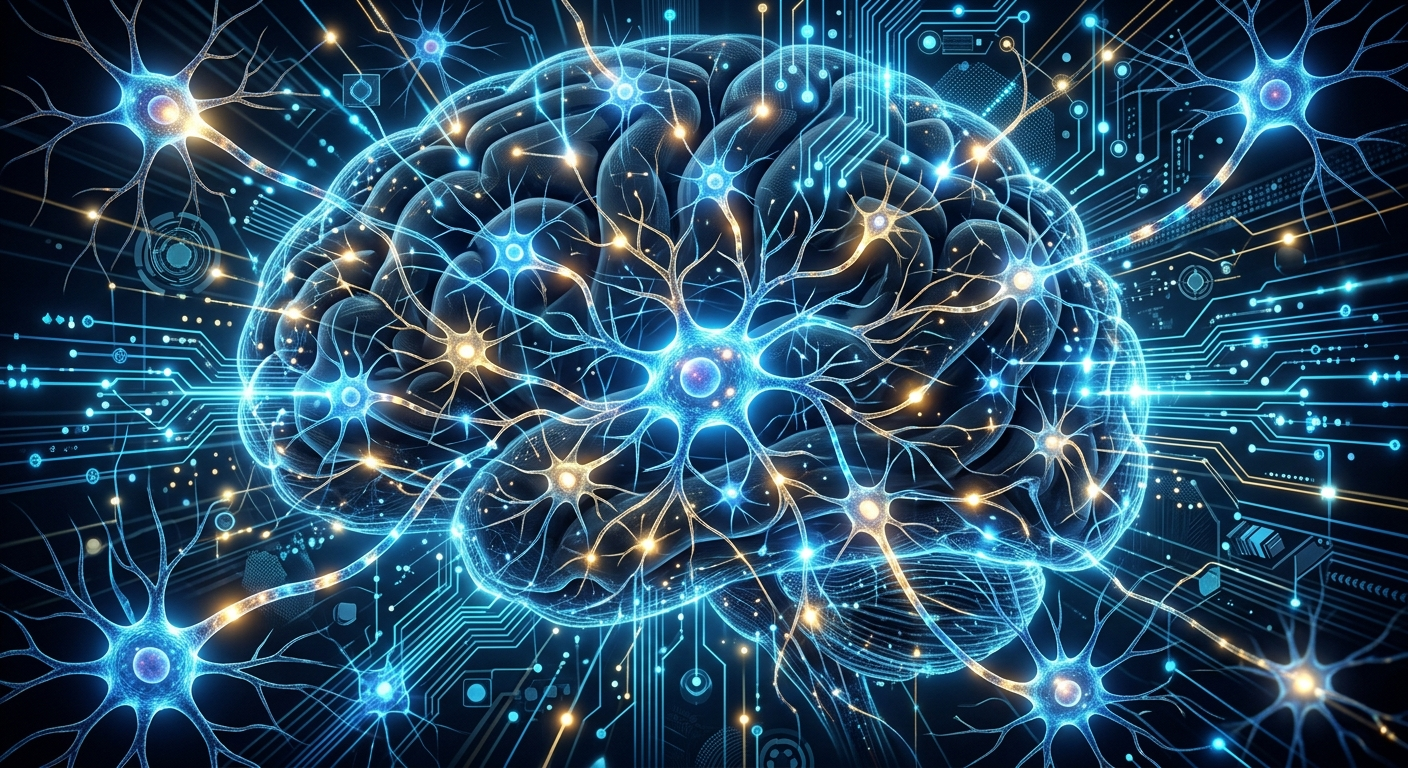
A Comprehensive Thesis on the Architecture of the Human Brain and Its Relationship to Digital Systems
Abstract
The human brain is one of the most complex information-processing systems known to science. It contains approximately 86 billion neurons, interconnected through an enormous network of synapses. These cells receive information, transform it into electrical and chemical signals, communicate with other cells, and continuously adapt their connections through learning.
This thesis examines the architecture of brain neurons from the cellular level to the whole-brain network. It explains how neurons communicate, how information travels through the nervous system, how memory and learning emerge from changing connections, and how these biological principles have influenced digital computing, artificial intelligence, and network engineering.
The central argument is that the brain is not simply a biological computer. It is a living, adaptive, energy-efficient system in which computation, communication, memory, perception, movement, and biological regulation are deeply interconnected.
1. Introduction: The Brain as a Living Information Network
Every moment of human life involves information processing.
When a person sees a tree, hears music, remembers a name, moves a hand, or makes a decision, the brain is receiving, transforming, storing, and transmitting information.
The brain performs these activities through specialized cells called neurons, supported by other cells known collectively as glia.
A simplified information pathway is:
Environment → Sensory receptors → Neurons → Brain networks → Interpretation → Decision → Motor commands → Action
For example:
Light → Retina → Optic nerve → Visual brain regions → Recognition of a tree → Decision to look closer → Eye and head movement
This process is not a single electrical signal traveling through one wire. It is a coordinated activity involving many interconnected neurons.
The central research question
How can billions of living cells, each following relatively simple biological rules, produce perception, memory, intelligence, language, and conscious experience?
There is no complete answer yet. However, neuroscience has established many important principles that help explain the architecture of this extraordinary system.
2. What Is a Neuron?
A neuron is a specialized cell that receives, processes, and transmits information.
Neurons are the principal signaling cells of the nervous system. They communicate using:
- Electrical signals within the cell.
- Chemical signals between many cells.
- Specialized connections that determine how information flows.
- Changing connection strengths that support learning.
A neuron is not merely a wire. It is a living cell with a membrane, metabolism, internal structures, and mechanisms for maintaining its electrical state.
Basic neuron architecture
A typical neuron contains:
- Dendrites
- Cell body (soma)
- Axon hillock and initial segment
- Axon
- Axon terminals
- Synapses
A simplified diagram:
                 DENDRITES
              /      |      \
             /       |       \
            /        |        \
       ┌─────────────────────────┐
       │       CELL BODY         │
       │         SOMA            │
       │       Nucleus           │
       └────────────┬────────────┘
                    │
             AXON INITIAL
               SEGMENT
                    │
                    │  AXON
                    ├───────────────────────────────┐
                    │                               │
                    │                               │
                    ▼                               ▼
             AXON TERMINAL                    AXON TERMINAL
                    │                               │
                 SYNAPSE                         SYNAPSE
                    │                               │
                 Next neuron                    Next neuron
This is a simplified representation. Real neurons have many different shapes and branching patterns.
3. The Main Parts of a Neuron
3.1 Dendrites: The Receiving Architecture
Dendrites are branching structures that receive signals from other neurons and, in some cases, from sensory receptors.
They can be compared to the input ports of a biological information system.
A neuron may receive signals from thousands of other neurons. These signals can be:
- Excitatory: increasing the likelihood that the neuron will generate a signal.
- Inhibitory: decreasing that likelihood.
- Modulatory: changing how the neuron responds to other signals.
Dendrites are not passive cables. They can perform local electrical computations and contain specialized molecular machinery.
Digital analogy
A dendritic tree resembles a complex input-processing structure:
Many inputs → Local integration → Combined signal → Cell body
However, unlike a simple digital input port, dendrites operate continuously and are influenced by the cell’s biological state.
3.2 The Cell Body: The Metabolic and Computational Center
The soma, or cell body, contains the nucleus and most of the structures required to maintain the neuron.
Its functions include:
- Producing proteins.
- Maintaining cellular metabolism.
- Supporting repair and growth.
- Integrating signals arriving from dendrites.
- Maintaining the cell’s electrical and chemical environment.
The nucleus contains DNA, which provides instructions for producing proteins. These proteins help construct and maintain the neuron, including its receptors, ion channels, and synapses.
Important distinction
The nucleus does not function like a computer’s central processing unit in a simple one-to-one sense. Many neuronal computations occur across the cell membrane, dendrites, axon, and synapses.
3.3 The Axon: The Long-Distance Communication Channel
The axon is a specialized projection that carries electrical signals away from the cell body.
Some axons are extremely short. Others extend over long distances in the body.
For example:
- Motor neurons can extend from the spinal cord to muscles.
- Sensory neurons can carry information from the body toward the spinal cord.
- Brain neurons can connect distant regions of the cerebral cortex.
The axon is therefore comparable to a communication cable, but it is a living structure that actively maintains its electrical properties.
3.4 The Axon Initial Segment: The Signal-Generation Region
The axon initial segment is a specialized region near the beginning of the axon.
It is an important site where electrical inputs are integrated and, when conditions are appropriate, an action potential is initiated.
A useful simplified model is:
Dendritic inputs → Soma and initial segment → Action potential → Axon
The action potential is the main long-distance electrical signal used by many neurons.
3.5 Axon Terminals: The Output Interface
At the end of an axon, the neuron may branch into many terminals.
Each terminal can communicate with another neuron, a muscle cell, or a gland cell.
This creates a fundamental architectural principle:
One neuron can distribute information to many targets.
In digital networking, this resembles multicast or broadcast communication, although biological signaling is more complex and usually involves specific connections.
3.6 Synapses: The Communication Junctions
A synapse is a specialized junction where one neuron communicates with another cell.
The neuron sending the signal is called the presynaptic cell. The receiving cell is called the postsynaptic cell.
Most synapses in the brain are chemical synapses.
A simplified chemical synapse:
Presynaptic neuron
       │
       ▼
  Electrical signal
       │
       ▼
Axon terminal
       │
       ▼
Neurotransmitter release
       │
       ▼
Synaptic cleft
       │
       ▼
Receptors on receiving cell
       │
       ▼
Postsynaptic electrical response
The synapse is not simply a gap. It is a highly organized biological communication system.
4. Electrical Communication: How Neurons Generate Signals
Neurons maintain a difference in electrical charge across their cell membranes.
This is called the membrane potential.
The membrane potential exists because of:
- Differences in ion concentrations inside and outside the cell.
- Selective membrane permeability.
- Ion channels.
- Active transport mechanisms.
Important ions include:
- Sodium (Na⁺)
- Potassium (K⁺)
- Calcium (Ca²⁺)
- Chloride (Cl⁻)
The sodium-potassium pump helps maintain ion gradients by using cellular energy.
A simplified electrical model
The neuron can be represented as:
Ion gradients + Membrane channels → Membrane potential
When inputs change the membrane potential sufficiently, the neuron may generate an action potential.
4.1 Action Potentials: Biological Digital-Like Signals
An action potential is a rapid, temporary change in membrane voltage that travels along the axon.
It is often described as an all-or-none event:
- If the membrane reaches the required threshold, an action potential is generated.
- If it does not, that particular action potential is not generated.
This creates a useful analogy with digital signaling.
Digital analogy
Binary computer:
0 → 1 → 0 → 1
Neuron:
Resting state → Action potential → Recovery → Resting state
However, the analogy has limits. Neurons do not communicate only in binary. Information is also represented through:
- Timing.
- Frequency.
- Patterns of activity.
- Which neurons are active.
- Strength of synaptic connections.
- Network-wide activity.
Thus, the brain uses a mixture of discrete electrical events and continuous biological dynamics.
4.2 The Myelin Sheath: Increasing Signal Efficiency
Some axons are surrounded by a fatty insulating structure called myelin.
Myelin is produced by:
- Oligodendrocytes in the central nervous system.
- Schwann cells in the peripheral nervous system.
Myelin helps electrical signals travel more efficiently along many axons.
The gaps between myelin segments are called nodes of Ranvier.
A simplified structure:
Axon:
───────[ Myelin ]───[ Myelin ]───[ Myelin ]───────
              ↑             ↑
          Node of        Node of
           Ranvier        Ranvier
Electrical signals can effectively move between nodes in a process called saltatory conduction.
Engineering analogy
Myelin resembles electrical insulation around a cable.
But biological insulation is more sophisticated: it is produced and maintained by living cells and can change during development and learning.
5. Chemical Communication: Neurotransmitters
At many synapses, an electrical signal causes the release of chemical messengers called neurotransmitters.
Examples include:
- Glutamate
- GABA
- Acetylcholine
- Dopamine
- Serotonin
- Norepinephrine
These chemicals bind to receptors on the receiving cell.
Different neurotransmitters and receptors can produce different effects.
Example
Glutamate is a major excitatory neurotransmitter in the brain.
GABA is a major inhibitory neurotransmitter.
The balance between excitation and inhibition is essential for stable brain function.
5.1 Excitation and Inhibition
A neuron receives thousands of inputs, some increasing activity and others reducing it.
A simplified model:
Excitatory inputs:  + + + + +
Inhibitory inputs:  - - -
                    │
                    ▼
              Integrated result
                    │
                    ▼
          Action potential or no action potential
This is similar to a computational system that combines multiple signals before making a decision.
However, biological neurons are not simple arithmetic calculators. Their behavior depends on membrane properties, timing, location of inputs, and many other factors.
6. The Brain’s Cellular Architecture
The brain is not made of neurons alone.
It contains several major classes of cells.
6.1 Neurons
Neurons are specialized for electrical and chemical communication.
6.2 Astrocytes
Astrocytes are important support cells that help:
- Maintain the chemical environment around neurons.
- Support metabolism.
- Regulate neurotransmitter levels.
- Contribute to the blood-brain barrier.
- Participate in synaptic function.
They are increasingly understood as active participants in brain communication, not merely passive support structures.
6.3 Oligodendrocytes
These cells produce myelin in the central nervous system.
6.4 Microglia
Microglia are immune-related cells that help monitor the brain’s environment and participate in responses to injury and disease.
6.5 Ependymal Cells
These cells line parts of the brain’s fluid-filled cavities and are involved in the organization of the ventricular system.
The biological network
Neurons ↔ Synapses ↔ Neurons
   ↑                      ↑
   │                      │
Astrocytes            Oligodendrocytes
   │                      │
   └──────────┬───────────┘
              │
           Microglia
              │
       Biological environment
The brain is therefore a multicellular information-processing system.
7. The Architecture of the Human Nervous System
The nervous system is organized into two major divisions:
- Central nervous system (CNS)
- Peripheral nervous system (PNS)
7.1 Central Nervous System
The CNS consists of:
- The brain.
- The spinal cord.
It processes information and coordinates many body functions.
7.2 Peripheral Nervous System
The PNS includes nerves and structures outside the brain and spinal cord.
It connects the CNS with:
- Muscles.
- Skin.
- Internal organs.
- Sensory receptors.
- Glands.
A simplified architecture:
                    CENTRAL NERVOUS SYSTEM
                    ┌─────────────────────┐
                    │        BRAIN        │
                    └──────────┬──────────┘
                               │
                    ┌──────────▼──────────┐
                    │    SPINAL CORD     │
                    └──────────┬──────────┘
                               │
             ┌─────────────────┼─────────────────┐
             ▼                 ▼                 ▼
        Sensory nerves    Motor nerves     Autonomic nerves
             │                 │                 │
             ▼                 ▼                 ▼
        Sensory organs      Muscles       Internal organs
This resembles a large distributed communication network, but the nervous system is also integrated with the body’s chemical and hormonal systems.
8. Brain Regions and Their Functions
The brain contains many specialized regions, but no region works entirely alone.
8.1 Cerebral Cortex
The cerebral cortex is the outer layer of the cerebrum.
It is involved in:
- Perception.
- Voluntary movement.
- Language.
- Memory.
- Planning.
- Reasoning.
- Decision-making.
It is divided into two hemispheres and several major lobes.
Frontal lobe
Important for:
- Planning.
- Decision-making.
- Voluntary movement.
- Working memory.
- Aspects of language and behavior.
Parietal lobe
Important for:
- Touch and body sensation.
- Spatial processing.
- Integration of sensory information.
Temporal lobe
Important for:
- Hearing.
- Memory.
- Language comprehension.
- Recognition of objects and sounds.
Occipital lobe
Important for:
- Visual processing.
8.2 Cerebellum
The cerebellum is involved in:
- Movement coordination.
- Balance.
- Motor learning.
- Timing and precision of movement.
It contains a very large number of neurons relative to its size.
8.3 Brainstem
The brainstem connects the brain with the spinal cord and contains important systems involved in:
- Breathing.
- Heart regulation.
- Arousal.
- Sleep-wake functions.
- Communication between brain regions and the body.
8.4 Thalamus
The thalamus acts as an important relay and processing structure for many types of information.
It is involved in:
- Sensory processing.
- Motor circuits.
- Attention.
- Communication between brain regions.
8.5 Hypothalamus
The hypothalamus helps regulate:
- Temperature.
- Hunger.
- Thirst.
- Hormonal functions.
- Circadian rhythms.
- Many aspects of internal balance.
8.6 Hippocampal Formation
The hippocampal formation is important for certain forms of memory, particularly the formation and organization of new memories.
It is not the only structure involved in memory. Memory depends on distributed networks across the brain.
8.7 Basal Ganglia
The basal ganglia are involved in:
- Movement selection.
- Motor learning.
- Habit-related processes.
- Reward-related learning.
8.8 Amygdala
The amygdala participates in:
- Emotional processing.
- Learning about significant events.
- Threat-related responses.
- Social and motivational processing.
The amygdala does not simply represent a single emotion. It is part of a broader network involved in evaluating the significance of information.
9. Brain Architecture: From Cells to Networks
The brain can be studied at several levels.
Level 1: Molecular
Genes, proteins, ion channels, neurotransmitters.
Level 2: Cellular
Neurons, glia, dendrites, axons, synapses.
Level 3: Local circuits
Small groups of interconnected neurons.
Level 4: Brain regions
Specialized areas involved in particular functions.
Level 5: Large-scale networks
Communication between distant brain regions.
Level 6: Whole organism
Brain, body, environment, and behavior.
A useful hierarchy:
Molecules
    ↓
Neurons and glia
    ↓
Synapses
    ↓
Local circuits
    ↓
Brain regions
    ↓
Large-scale networks
    ↓
Brain–body interaction
    ↓
Behavior and cognition
This hierarchy is not strictly linear. Information flows in multiple directions, and higher-level activity can influence lower-level processing.
10. Neural Networks: The Brain’s Communication Architecture
A neural network is a group of interconnected neurons.
Neural networks can be:
- Small local circuits.
- Long-distance pathways.
- Distributed networks involving many brain regions.
The brain contains both specialized pathways and highly interconnected networks.
Example: Visual processing
A simplified visual pathway is:
Light → Retina → Optic nerve → Thalamus → Visual cortex → Other visual and cognitive regions
But visual perception is not simply a one-way pipeline. The brain also uses feedback, attention, memory, and expectations.
Example: Movement
Intention → Motor planning → Motor cortex → Spinal cord → Muscles → Sensory feedback → Brain
This is a closed-loop control system.
The brain continuously compares intended movement with sensory feedback and adjusts its actions.
11. Digital Connections: Comparing Neurons with Computers
The brain and digital computers both process information, but they do so differently.
| Feature | Biological Brain | Digital Computer |
|---|---|---|
| Basic units | Neurons and synapses | Transistors and logic circuits |
| Main signals | Electrical and chemical | Electrical |
| Memory | Distributed and adaptive | Often stored in defined memory structures |
| Learning | Changes synaptic connections and network activity | Changes software, parameters, or stored data |
| Communication | Spikes, neurotransmitters, network activity | Binary signals and encoded data |
| Energy use | Highly energy-efficient for many biological tasks | Depends on architecture and workload |
| Timing | Often asynchronous and variable | Often clocked, though not always |
| Repair | Biological maintenance and limited regeneration | Hardware/software repair or replacement |
| Architecture | Massively interconnected and adaptive | Designed according to engineering specifications |
Important conclusion
The brain is not simply a computer made of biological parts.
It is better understood as a living, adaptive information network.
12. The Digital Neuron: A Simplified Mathematical Model
Scientists and engineers often use mathematical models to represent neurons.
One of the simplest is the integrate-and-fire model.
The basic idea is:
- Inputs arrive.
- The neuron integrates them.
- The internal voltage changes.
- If a threshold is reached, the neuron generates a spike.
- The voltage resets.
A simplified equation is:
Where:
- = membrane voltage.
- = resting voltage.
- = input current.
- = effective resistance.
- = membrane time constant.
When reaches a threshold:
The model generates a spike.
This model is useful because it captures an important feature of neuronal computation: inputs are integrated over time.
However, real neurons are more complex. They may contain many types of ion channels, dendritic computations, and chemical modulation.
13. Artificial Neural Networks
Artificial neural networks were inspired partly by biological neurons.
A simple artificial neuron can be represented as:
Where:
- = input values.
- = weights.
- = bias.
- = activation function.
- = output.
The architecture is:
Input 1 ──┐
Input 2 ──┼──► Weighted sum ──► Activation ──► Output
Input 3 ──┘
This resembles a simplified neuron, but it is not a complete biological model.
Artificial neural network layers
Input Layer → Hidden Layers → Output Layer
For example:
Image pixels → Feature processing → Object classification
Modern AI systems may contain many layers and billions of parameters.
14. Biological Learning and Artificial Learning
14.1 Biological Learning
Learning involves changes in the nervous system.
One important mechanism is synaptic plasticity.
Synaptic plasticity means that the strength or effectiveness of connections between neurons can change.
A simplified principle is:
Repeated or coordinated activity → Changes in synaptic strength → Altered network behavior
Important forms include:
- Long-term potentiation.
- Long-term depression.
- Changes in receptor activity.
- Changes in synaptic structure.
- Changes in network connectivity.
Learning is not simply the storage of a file in one location. Memories are represented through patterns of activity and changes across networks.
14.2 Artificial Learning
Artificial neural networks learn by adjusting their weights.
A simplified process:
Input → Prediction → Error calculation → Weight adjustment → Improved prediction
This is different from the brain’s many learning mechanisms, but it is inspired by the idea that changing connections can change behavior.
Key difference
Biological learning involves:
- Synapses.
- Neuromodulators.
- Cellular metabolism.
- Development.
- Sensory experience.
- Body state.
- Complex feedback.
Artificial learning usually involves mathematical optimization over a defined objective.
15. Memory: Biological Storage and Retrieval
Memory is not stored in one simple location.
Different forms of memory involve different systems.
Examples
- Working memory: Temporary maintenance and manipulation of information.
- Episodic memory: Memory of events.
- Semantic memory: Knowledge and facts.
- Procedural memory: Skills and habits.
- Emotional memory: Learning associated with significant experiences.
Memory involves interactions between:
- The hippocampal formation.
- Cerebral cortex.
- Basal ganglia.
- Amygdala.
- Other brain networks.
Digital analogy
A computer may store a document as a defined sequence of bits.
The brain’s memory is more distributed and dynamic. Remembering something involves reactivating patterns of activity across neural networks.
This is why memory can be:
- Reconstructed.
- Influenced by context.
- Strengthened through practice.
- Altered by new experiences.
16. Brain Connectivity: The Connectome
The connectome is a description of the connections within a nervous system.
A connectome may describe:
- Which neurons connect to which other neurons.
- The strength of connections.
- The direction of communication.
- The organization of larger brain networks.
There are different levels of connectome research:
- Microscopic connectomics: Detailed connections between individual neurons.
- Mesoscopic connectivity: Connections between groups or regions.
- Macroscopic connectivity: Large-scale pathways across the brain.
A simplified network representation:
Neuron A ──► Neuron B ──► Neuron C
    │             ▲
    ▼             │
Neuron D ─────────┘
The brain’s connectivity is not fixed. Connections can change through development, learning, and biological processes.
17. Information Flow: Feedforward and Feedback
Digital systems often use a pipeline:
Input → Processing → Output
The brain uses both feedforward and feedback communication.
Feedforward
Information travels from one processing stage to another.
Feedback
Information from later stages influences earlier processing.
A simplified example:
Sensory input
     ↓
Early processing
     ↓
Higher-level interpretation
     ↓
Feedback to earlier processing
Feedback helps the brain use:
- Context.
- Expectations.
- Attention.
- Previous experience.
- Goals.
This is one reason perception is more than simply receiving raw sensory data.
18. The Brain as a Distributed Computing System
A major feature of the brain is distributed processing.
Many functions depend on networks rather than a single location.
For example:
Language involves multiple interacting regions.
Vision involves several stages of processing.
Memory involves distributed systems.
Decision-making involves interactions between cognitive, emotional, motivational, and sensory systems.
This resembles distributed computing, where multiple processing units cooperate.
However, the brain is more tightly integrated with the body’s biological state than most engineered computing systems.
19. The Brain and the Internet: Similarities and Differences
The brain and the Internet can both be described as networks.
Similarities
- Nodes communicate with other nodes.
- Information travels through connections.
- Networks can be highly distributed.
- Multiple pathways may exist.
- Communication can be affected by connection strength and network structure.
Differences
| Brain | Internet |
|---|---|
| Living biological system | Engineered communication system |
| Neurons and synapses | Computers, routers, cables, and wireless links |
| Chemical and electrical signaling | Digital data transmission |
| Adaptive biological connections | Network configurations and protocols |
| Integrated with body regulation | Usually separate from the biological body |
| Learns through biological mechanisms | Learns through software and data systems |
The analogy is useful, but it should not be taken literally.
20. Digital Architecture Inspired by the Brain
Several important computing ideas have been influenced by neuroscience.
20.1 Artificial Neural Networks
These use interconnected mathematical units to process information.
20.2 Deep Learning
Deep learning uses multiple layers of artificial computation.
20.3 Neuromorphic Computing
Neuromorphic computing attempts to build hardware inspired by aspects of biological neural systems.
Some neuromorphic systems use spiking neural networks, which represent information through discrete electrical-like events.
20.4 Event-Driven Computing
Instead of continuously processing every possible signal, some systems process information when events occur.
This resembles the event-driven nature of many neuronal signals.
20.5 Brain–Computer Interfaces
Brain–computer interfaces attempt to measure neural activity and translate it into useful commands.
Examples include research systems for:
- Movement control.
- Communication assistance.
- Neuroscience research.
- Medical rehabilitation.
These systems are still developing and have important technical and ethical limitations.
21. Energy Efficiency: Why the Brain Is Remarkable
The human brain operates using a relatively small amount of power compared with many modern computing systems.
Yet it performs complex tasks involving:
- Vision.
- Hearing.
- Language.
- Movement.
- Memory.
- Decision-making.
- Continuous interaction with the environment.
The brain’s efficiency is related to its architecture, including:
- Sparse activity in many neural systems.
- Specialized circuits.
- Parallel processing.
- Local computation.
- Adaptive connections.
- Efficient communication mechanisms.
However, the brain’s efficiency should not be reduced to a single number. Its energy use varies with activity, and comparing it directly with computers requires careful consideration of what tasks are being measured.
22. Brain Development: Building the Network
The brain’s architecture develops over time.
Important processes include:
- Neuron production.
- Neuron migration.
- Axon growth.
- Synapse formation.
- Synapse elimination.
- Myelination.
- Network refinement.
During development, the nervous system forms many connections. Experience and biological processes help refine these networks.
Simplified developmental sequence
Genetic instructions
        ↓
Cell production
        ↓
Neuron migration
        ↓
Axon and dendrite growth
        ↓
Synapse formation
        ↓
Experience and network refinement
        ↓
Mature neural architecture
This process demonstrates that the brain is not simply manufactured as a finished machine. It develops through an interaction between biology and experience.
23. Neuroplasticity: The Brain’s Ability to Change
Neuroplasticity refers to the nervous system’s ability to change its structure or function.
Examples include:
- Changes in synaptic strength.
- Changes in dendritic structure.
- Changes in network activity.
- Changes in how brain regions cooperate.
- Adaptation after learning or injury.
Plasticity is important for:
- Learning.
- Memory.
- Skill development.
- Adaptation.
- Rehabilitation.
It does not mean that the brain can change without limits. Biological constraints, development, health, and the nature of the experience all matter.
24. The Brain–Body Connection
The brain does not operate independently of the body.
It continuously receives information from:
- Muscles.
- Skin.
- Internal organs.
- Hormonal systems.
- The cardiovascular system.
- The digestive system.
The brain also regulates many body functions.
This creates a continuous loop:
Brain → Body → Sensory feedback → Brain → Body
This is important for:
- Movement.
- Balance.
- Emotion.
- Motivation.
- Internal regulation.
- Decision-making.
The brain is therefore part of a brain–body–environment system.
25. Consciousness and Neural Activity
Consciousness remains one of the most difficult questions in neuroscience.
Researchers study how neural activity relates to:
- Awareness.
- Perception.
- Attention.
- Memory.
- Self-related processing.
- Wakefulness.
There is no universally accepted complete explanation of consciousness.
Several theories attempt to explain it, including theories emphasizing:
- Global information availability.
- Integrated information.
- Recurrent processing.
- Large-scale neural coordination.
These theories are active areas of scientific research.
Important distinction
Neural activity is essential to brain function, but explaining how neural activity relates to subjective experience remains an open scientific and philosophical problem.
26. Brain Disorders as Architecture Problems
Many neurological and psychiatric conditions involve changes in neural systems.
Examples include:
- Alzheimer’s disease.
- Parkinson’s disease.
- Epilepsy.
- Stroke.
- Multiple sclerosis.
- Certain forms of brain injury.
These conditions can affect:
- Neurons.
- Synapses.
- Myelin.
- Blood supply.
- Neurotransmitter systems.
- Network connectivity.
Understanding brain architecture helps researchers develop treatments and rehabilitation strategies.
However, brain disorders are complex and should not be reduced to a single faulty component.
27. A Unified Model: Brain as a Living Digital-Like Network
A useful conceptual model is:
                    ENVIRONMENT
                         │
                         ▼
                  SENSORY SYSTEMS
                         │
                         ▼
                  NEURAL INPUTS
                         │
                         ▼
              LOCAL NEURAL CIRCUITS
                         │
                         ▼
                BRAIN NETWORKS
                         │
             ┌───────────┼───────────┐
             ▼           ▼           ▼
          Memory      Planning    Emotion
             │           │           │
             └───────────┼───────────┘
                         ▼
                   DECISION-MAKING
                         │
                         ▼
                   MOTOR SYSTEMS
                         │
                         ▼
                       ACTION
                         │
                         ▼
                    FEEDBACK
                         │
                         └──────────────► Brain
This model shows that the brain is not a simple input-output machine. It is a recurrent, adaptive, multi-layered system.
28. Why the Brain Is Different from Artificial Intelligence
Artificial intelligence can perform remarkable tasks, but biological intelligence has characteristics that remain difficult to reproduce fully.
The brain:
- Learns from relatively limited experience in many situations.
- Integrates sensory information with body state.
- Uses biological motivation and regulation.
- Operates continuously in a changing environment.
- Repairs and maintains itself biologically.
- Develops through interaction with the world.
- Uses many forms of memory and learning.
Modern AI systems may outperform humans in specific tasks, but this does not mean they reproduce the full architecture of the human brain.
The central difference
Artificial intelligence is engineered intelligence.
Biological intelligence is evolved, embodied, living intelligence.
Both can process information, but they are not the same kind of system.
29. The Future of Brain-Inspired Computing
Research into brain-inspired computing may contribute to:
- More energy-efficient AI.
- Adaptive robotics.
- Advanced sensory systems.
- Brain–computer interfaces.
- Medical neuroscience.
- New computing architectures.
- Better models of learning and memory.
However, future progress will require combining knowledge from:
- Neuroscience.
- Biology.
- Mathematics.
- Computer science.
- Physics.
- Engineering.
- Medicine.
- Ethics.
The brain is too complex to be understood through one discipline alone.
30. Conclusion
The human brain is a living information-processing network built from neurons, glial cells, synapses, and large-scale communication pathways.
Its architecture begins with molecular processes and extends through individual neurons, local circuits, brain regions, and distributed networks.
Neurons communicate through electrical and chemical signals. Synapses allow information to move between cells. Plasticity allows connections to change. Large-scale networks support perception, movement, memory, language, and decision-making.
Digital technology has learned important principles from the brain, particularly the ideas of interconnected processing, adaptive connections, parallel computation, and event-driven communication.
Yet the brain is not simply a biological computer. It is a living system that develops, learns, regulates the body, and interacts continuously with the environment.
The most important lesson is this:
The brain demonstrates that intelligence is not merely the movement of information. It is the organized activity of a living, adaptive network that connects perception, memory, computation, action, and biological existence.
Understanding this architecture may help humanity develop better medical treatments, more efficient computing systems, and a deeper understanding of intelligence itself.
Summary of the Main Connections
| Biological Concept | Digital/Engineering Analogy | Important Limitation |
|---|---|---|
| Neuron | Processing unit | A neuron is a living cell, not a transistor |
| Dendrites | Input network | Dendrites perform complex biological processing |
| Axon | Communication cable | Axons actively maintain electrical signals |
| Synapse | Communication junction | Synapses are chemical and adaptive |
| Action potential | Digital-like signal | Information is also represented through timing and patterns |
| Myelin | Electrical insulation | Myelin is produced and maintained biologically |
| Neural network | Distributed computing network | Brain networks are adaptive and embodied |
| Synaptic plasticity | Learning algorithm | Biological learning involves many mechanisms |
| Brain regions | Specialized processors | Most functions depend on interacting networks |
| Connectome | Network topology | Brain connections change over time |
| Brain–body loop | Feedback control system | The brain is integrated with living physiology |
| Consciousness | Information-processing problem | Its full explanation remains unresolved |
Final Perspective
The architecture of the brain provides one of the most important scientific lessons of the modern world:
Complex intelligence can emerge from the organized interaction of many smaller systems.
This principle connects neuroscience with computing, telecommunications, artificial intelligence, robotics, mathematics, and the future of technology.





Be First to Comment