
Abstract
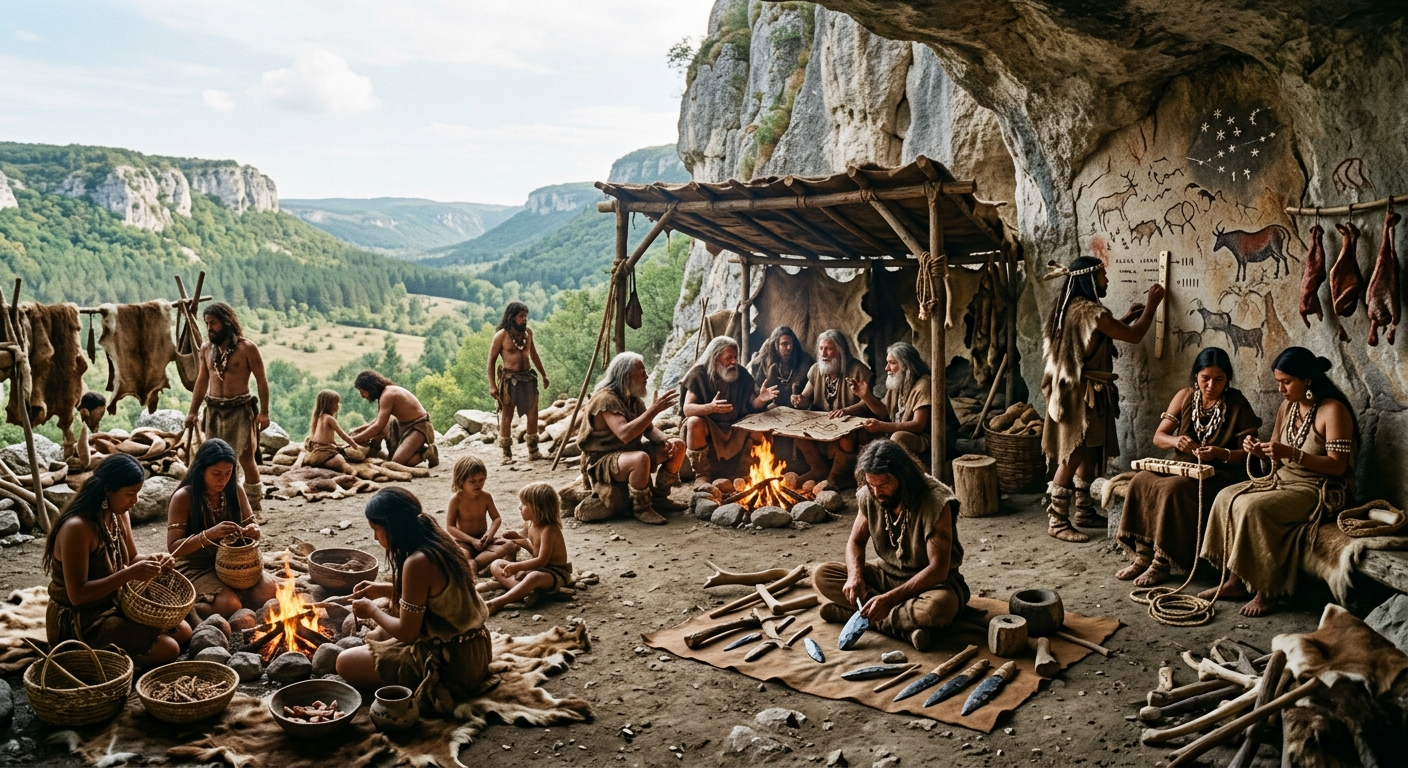
The Stone Age was the longest major period of human history, beginning with the earliest known stone-tool technologies more than 3 million years ago and ending at different times in different regions as societies adopted metalworking and other technologies. It is traditionally divided into the Palaeolithic (Old Stone Age), Mesolithic (Middle Stone Age), and Neolithic (New Stone Age), although these divisions are not equally applicable everywhere.
During this period, human beings developed practical science, sophisticated toolmaking, systems of cooperation, food production, trade, symbolic communication, and increasingly complex forms of social organisation. They did not possess modern laboratories, written accounting, formal political constitutions, or electronic technology, but they solved many difficult problems through observation, experimentation, memory, measurement, and collective learning.
This thesis examines the Stone Age not as a primitive prelude to “real” history, but as a period in which the essential foundations of later civilisation were established.
1. Introduction: What Was the Stone Age Really?
The Stone Age was a period when stone was one of the most important materials used for tools, especially cutting, scraping, hunting, processing food, and working other materials.
However, “Stone Age” does not mean that people used only stone. Stone Age communities also used:
- Wood
- Bone
- Antler
- Hide
- Fibre
- Shell
- Clay
- Plant materials
- Ochre and other minerals
Many of these materials have not survived well in the archaeological record, so the surviving evidence gives an incomplete picture of their technological abilities.
The Stone Age was not one single civilisation. It included thousands of societies living across Africa, Asia, Europe, Australia, and the Americas at different times.
There was no single Stone Age lifestyle. A hunter-gatherer living in Africa 100,000 years ago, a farming community in the Near East 9,000 years ago, and a coastal community in southern Africa 20,000 years ago could have had very different economies, technologies, and social structures.
A broad timeline
| Period | Approximate dates | Major developments |
|---|---|---|
| Early Stone Age / Lower Palaeolithic | More than 3 million years ago to roughly 300,000 years ago | Early stone tools, controlled use of fire, expanding cooperation |
| Middle Stone Age / Middle Palaeolithic | Roughly 300,000 to 50,000 years ago, with regional variation | More advanced tools, hunting strategies, symbolic behaviour, long-distance material exchange |
| Later Stone Age / Upper Palaeolithic | Roughly 50,000 to 12,000 years ago, with regional variation | Greater technological diversity, art, ornaments, specialised hunting and gathering |
| Mesolithic / regional Middle Stone Age traditions | After the last Ice Age in some regions | Adaptation to changing environments, fishing, intensive gathering, semi-sedentary life |
| Neolithic / New Stone Age | Beginning at different times, often after about 10,000 BCE | Farming, herding, permanent settlements, pottery, weaving, new forms of property and administration |
Important: These dates are approximate. Africa, including southern Africa, followed its own technological and cultural pathways. The term “Neolithic” should not be treated as a universal stage that every society passed through in exactly the same order.
2. The Stone Age as the Beginning of Scientific Thinking
2.1 What is science?
Modern science is a formal system of investigation involving:
- Observation
- Questions
- Hypotheses
- Experiments
- Evidence
- Explanation
- Repeated testing
Stone Age people did not have scientific journals or universities, but they regularly used observation, testing, and practical reasoning.
For example, a person making a stone tool had to understand:
- Which stone breaks predictably
- Which edge is sharp
- How much force is needed
- Where to strike
- How the shape of the stone affects its usefulness
- How to repair or replace a tool
This is a form of experimental knowledge.
A person who learned that a particular plant was edible, medicinal, poisonous, or useful for fibre was also developing knowledge through observation and experience.
The scientific principle
“If I change this action, what happens?”
That question is one of the foundations of science.
2.2 Early physics: Force, motion, and materials
Stone Age toolmaking required practical knowledge of physical forces.
A toolmaker had to understand, even without mathematical formulas, that:
- A sharp edge cuts more effectively than a blunt one.
- A narrow point concentrates force.
- A heavy hammerstone can fracture another stone.
- The angle of a strike affects the resulting flake.
- Different materials have different hardness and fracture properties.
This is practical knowledge of mechanics and materials science.
Example: Making a stone axe
A simplified process might involve:
- Selecting a suitable stone.
- Testing its shape and quality.
- Striking it with another stone.
- Removing unwanted flakes.
- Creating a cutting edge.
- Attaching it to a handle, where appropriate.
- Testing it on wood or other materials.
- Repairing or reshaping it.
The process resembles a modern engineering cycle:
Design → Manufacture → Test → Improve → Use
The difference is that the Stone Age engineer worked mainly with natural materials and learned through generations of experience.
2.3 Fire: A major scientific and technological achievement
The controlled use of fire was one of the most important developments in human history.
Fire provided:
- Heat
- Light
- Protection from some predators
- A way to cook food
- A means of processing certain materials
- A gathering place for social interaction
Cooking changed the relationship between humans and food. It made many foods easier to digest and helped people obtain energy from them.
Fire also introduced a deeper understanding of transformation:
- Raw food becomes cooked food.
- Wood becomes charcoal and ash.
- Clay can become hardened pottery.
- Certain stones can be altered by heat.
- Animal hides can be processed using heat and other techniques.
These are early forms of chemical and materials knowledge.
Fire and the development of human society
Fire was not merely a tool. It became a social centre.
Around a fire, people could:
- Share food
- Teach children
- Repair tools
- Exchange stories
- Plan activities
- Strengthen relationships
Thus, fire contributed to both technology and social development.
2.4 Biology, ecology, and environmental knowledge
Stone Age communities depended directly on their environments. Their survival required detailed knowledge of:
- Animal behaviour
- Plant seasons
- Water sources
- Weather patterns
- Soil conditions
- Migration routes
- Reproductive cycles
- Dangerous animals
- Useful materials
A hunter had to understand how animals moved and responded to danger.
A gatherer had to recognise plants at different stages of growth.
A coastal community had to understand tides, shellfish habitats, and seasonal changes.
This knowledge can be described as traditional ecological knowledge.
It was often transmitted through:
- Demonstration
- Imitation
- Oral teaching
- Repeated practice
- Stories and cultural traditions
Modern ecology studies relationships between organisms and their environments. Stone Age people did not use that terminology, but many communities possessed highly detailed ecological understanding.
3. Mathematics, Counting, and the Origins of Accounting
3.1 Did Stone Age people have mathematics?
Yes, in the sense that they used quantities, comparisons, patterns, and practical measurement.
However, mathematics did not begin as modern algebra or calculus. It developed from practical needs.
People needed to know:
- How many animals were present?
- How much food had been collected?
- How many tools were available?
- How long until a seasonal event?
- How much material was needed?
- How many people could share a resource?
These questions encouraged counting and measurement.
3.2 The difference between counting and accounting
Counting means identifying how many things exist.
Accounting means systematically recording, organising, or managing quantities and transactions.
Modern accounting usually involves:
- Records
- Categories
- Assets
- Liabilities
- Income
- Expenses
- Ownership
- Auditing
- Financial statements
Stone Age societies did not generally have this formal system.
But they may have used early forms of quantitative management, such as:
- Remembering quantities of stored food
- Comparing the size of catches
- Distributing food among group members
- Tracking seasonal resources
- Counting animals
- Using marks or notches to represent quantities
Some archaeological objects have been interpreted as possible counting devices, but their exact meanings are often uncertain.
A simple example
Imagine a community collecting 20 baskets of grain.
A modern accountant might record:
| Item | Quantity |
|---|---|
| Grain collected | 20 baskets |
| Grain consumed | 8 baskets |
| Grain stored | 12 baskets |
A Stone Age community might not have written these figures, but it could still have had a practical understanding of:
Collected → Consumed → Stored → Shared
That is an important foundation of economic organisation.
3.3 Measurement and time
Stone Age people needed to understand time through natural cycles:
- Day and night
- Lunar phases
- Seasons
- Animal migrations
- Plant growth
- Weather patterns
They could observe that certain events occurred repeatedly.
This helped them plan:
- Hunting
- Gathering
- Fishing
- Travel
- Shelter construction
- Food storage
- Ceremonial activities
The earliest forms of calendars developed from the need to understand and predict recurring natural events.
From natural cycles to civilisation
Observation of seasons → Planning → Food production → Storage → Larger settlements
This chain became extremely important during the Neolithic period.
4. Social Development: How Human Communities Changed
4.1 Why humans lived in groups
Human beings are highly social animals. Cooperation increased the chances of survival.
Groups could:
- Share food
- Protect vulnerable members
- Care for children
- Defend territory
- Teach skills
- Hunt cooperatively
- Support injured or elderly members
This does not mean every Stone Age society was peaceful or equal. Human communities could experience conflict, competition, inequality, and violence.
But cooperation was one of the most important forces in human development.
4.2 Family, kinship, and social relationships
Stone Age societies probably organised many relationships through:
- Family
- Kinship
- Marriage or partnership systems
- Age groups
- Shared residence
- Ritual relationships
- Cooperation between neighbouring groups
The exact forms varied enormously.
There was no single universal Stone Age family structure.
Some communities may have lived in small mobile bands. Others later developed larger settlements with more permanent houses and more complex social relationships.
4.3 Language and communication
Language was one of the greatest achievements of human development.
Although spoken language leaves little direct archaeological evidence, humans clearly developed increasingly sophisticated ways to communicate.
Communication allowed people to:
- Teach toolmaking
- Coordinate hunting
- Warn of danger
- Explain landscapes
- Share memories
- Organise cooperation
- Transmit cultural knowledge
A toolmaking technique could survive for generations because people could teach it to others.
This is called cultural transmission.
Biological inheritance versus cultural inheritance
Biological inheritance passes characteristics through genes.
Cultural inheritance passes knowledge through learning.
For example:
A child learns how to make a tool from an experienced adult.
That knowledge can spread through a community without requiring genetic change.
This was a major reason human technology could develop so rapidly.
4.4 Education before schools
Stone Age societies did not have modern schools, but they had education.
Children learned through:
- Watching adults
- Imitating actions
- Practising skills
- Listening to stories
- Participating in daily work
- Receiving correction
- Gradually taking responsibility
This was often apprenticeship-based education.
A young person might learn:
- How to identify plants
- How to track animals
- How to make tools
- How to build shelter
- How to prepare food
- How to navigate the landscape
- How to participate in social ceremonies
Education was essential because survival depended on knowledge.
5. Politics: Power, Leadership, and Decision-Making
5.1 Did politics exist in the Stone Age?
Yes, if politics is understood as the organisation of power, authority, cooperation, conflict, and collective decisions.
However, Stone Age politics was not the same as modern politics.
There were no modern nation-states, parliaments, political parties, or written constitutions in the early Stone Age.
But people still had to decide:
- Where to move
- Who participates in a hunt
- How resources are shared
- Who leads a particular activity
- How disputes are resolved
- Whether to cooperate with another group
- How to respond to threats
These are political questions.
5.2 Leadership in mobile societies
Many hunter-gatherer societies appear to have had relatively flexible leadership.
A person might be respected because of:
- Hunting ability
- Knowledge
- Experience
- Generosity
- Social connections
- Skill in resolving disputes
- Religious or ceremonial authority
Leadership could be situational.
For example:
- An experienced hunter might lead a hunt.
- A knowledgeable elder might guide seasonal decisions.
- A skilled craftsperson might teach toolmaking.
- A respected person might help resolve a disagreement.
This is different from a modern government in which authority is usually attached to formal institutions.
5.3 Equality and inequality
It is important not to romanticise Stone Age societies as perfectly equal.
Some communities may have had relatively limited differences in wealth or power, especially where people moved frequently and could not easily accumulate large stores of possessions.
But inequality could develop when societies began to have:
- Permanent settlements
- Stored food
- Livestock
- Land claims
- Specialised occupations
- Long-distance trade
- Hereditary leadership
- Unequal access to resources
The Neolithic period therefore saw important changes in the relationship between property, power, and social status.
5.4 The rise of more complex political organisation
As some communities became larger and more settled, they needed more coordination.
This could involve:
- Organising irrigation or water access
- Managing food storage
- Defending settlements
- Coordinating labour
- Organising ceremonies
- Resolving disputes
- Managing trade
- Maintaining shared infrastructure
These developments helped create the conditions for later villages, chiefdoms, cities, and states.
However, the Stone Age did not automatically lead to civilisation everywhere. Different societies followed different paths, and some remained mobile or village-based for very long periods.
6. Technology: The Great Stone Age Engineering Revolution
6.1 Technology was more than stone tools
Technology means the practical use of knowledge to solve problems.
Stone Age technology included:
- Stone tools
- Wooden tools
- Bone tools
- Hunting weapons
- Fire
- Shelters
- Clothing
- Fishing equipment
- Boats and watercraft in some regions
- Food-processing tools
- Pottery
- Weaving
- Grinding stones
- Storage systems
The Stone Age was a period of continuous technological innovation.
6.2 The evolution of stone tools
Early stone tools were relatively simple, but later technologies became increasingly specialised.
Early tools
Some early tools were used for:
- Cutting
- Breaking bones
- Processing plants
- Scraping hides
- Working wood
Later technologies
Later Stone Age traditions included more specialised tools such as:
- Points
- Blades
- Scrapers
- Burins
- Microliths
- Composite tools
- Grinding stones
A composite tool combines multiple materials, such as a stone point attached to a wooden shaft.
This represents an important engineering idea:
Different materials can perform different functions in one system.
That principle is still used in modern technology.
6.3 Clothing and textiles
Clothing was important for protection from cold, wind, and environmental conditions.
Stone Age people used materials such as:
- Animal skins
- Fur
- Plant fibres
- Bone needles
- Sinew or other binding materials
The development of needles and fibre technologies shows that people were not only making tools for hunting. They were also developing technologies for comfort, protection, and social expression.
6.4 Shelter and architecture
Stone Age shelters ranged from temporary camps to more permanent structures.
People used:
- Caves
- Rock shelters
- Branches
- Grass
- Hides
- Wood
- Stone
- Clay
Later communities built more substantial houses and settlements.
Architecture required knowledge of:
- Load-bearing structures
- Materials
- Weather
- Wind
- Water drainage
- Heat
- Space organisation
This was early civil engineering and architectural design.
6.5 Food technology
Food processing was one of the most important areas of Stone Age innovation.
Technologies included:
- Cooking
- Drying
- Grinding
- Cutting
- Crushing
- Storage
- Fermentation in some later contexts
- Pottery for processing or storage
Grinding stones were particularly important in many agricultural societies because they allowed people to process grains and other plant foods.
This connected technology directly to nutrition, economy, and settlement.
7. The Agricultural Revolution: A Major Turning Point
7.1 What changed during the Neolithic?
In some regions, people began increasingly relying on:
- Cultivated plants
- Domesticated animals
- Permanent or semi-permanent settlements
- Food storage
- Pottery
- Weaving
- More specialised tools
This is often called the Neolithic Revolution.
However, the word “revolution” can be misleading because the transition was usually gradual.
People did not suddenly stop hunting and gathering everywhere.
Many communities continued combining:
Hunting + Gathering + Fishing + Farming + Herding
for long periods.
7.2 Why did agriculture develop?
There was no single universal cause.
Possible factors included:
- Climate change after the last Ice Age
- Population growth
- Increasing knowledge of plants and animals
- Local environmental opportunities
- The advantages of food production
- Social competition
- Changes in settlement patterns
- The need for more predictable food supplies
Different regions developed agriculture independently or through different historical processes.
7.3 Agriculture and the transformation of society
Agriculture changed the relationship between people and land.
A mobile group could move when resources became scarce.
A farming community had to consider:
- Fields
- Water
- Seeds
- Harvests
- Storage
- Livestock
- Land use
- Labour
This encouraged more permanent settlements.
The agricultural chain
Plant knowledge → Cultivation → Harvest → Storage → Population growth → Larger settlements → More complex administration
This was one of the most important pathways toward later civilisation.
8. Trade, Exchange, and the Early Economy
8.1 Did Stone Age people trade?
Yes. Archaeological evidence shows that materials sometimes travelled considerable distances.
Examples include:
- Stone
- Shells
- Ochre
- Pigments
- Decorative objects
- Other valuable materials
Long-distance exchange suggests that people had:
- Knowledge of distant resources
- Social connections
- Trust or negotiated relationships
- Transport methods
- An understanding of value
8.2 What was the economy like?
The Stone Age economy was mainly based on subsistence: obtaining the food and materials needed for life.
Different communities used different combinations of:
- Hunting
- Gathering
- Fishing
- Herding
- Farming
- Craft production
- Exchange
There was no universal Stone Age economic system.
Some communities were highly mobile. Others stored food and developed more permanent settlements.
8.3 Was there money?
There is no evidence that early Stone Age societies used money in the modern sense of coins or banknotes.
However, exchange could involve:
- Direct sharing
- Reciprocity
- Gift exchange
- Barter-like transactions
- Social obligations
- Redistribution within communities
Gift exchange can be economically important even when money does not exist.
For example, one person may provide food today, while another provides assistance or resources later.
This creates relationships of obligation and cooperation.
9. Religion, Art, and Human Consciousness
9.1 Symbolic behaviour
Stone Age people produced objects and activities that suggest symbolic thinking.
These include:
- Personal ornaments
- Pigments
- Engravings
- Rock art
- Burials
- Special treatment of objects
- Ceremonial spaces
Symbolic behaviour means using an object, image, or action to represent something beyond its immediate practical function.
For example, an ornament may communicate:
- Identity
- Social belonging
- Status
- Personal expression
- Cultural tradition
9.2 Art and communication
Rock art and other artistic traditions show that some Stone Age people created images and symbols.
Art may have served several purposes:
- Storytelling
- Teaching
- Ritual
- Social identity
- Memory
- Communication
- Personal expression
We should be cautious about assigning modern meanings to ancient images. Archaeologists often cannot know exactly what a particular image meant.
But the existence of symbolic art demonstrates that human beings were capable of complex imagination and communication.
9.3 Burials and the treatment of the dead
Some Stone Age burials suggest that people had developed meaningful practices concerning death.
These practices may indicate:
- Social relationships
- Ritual behaviour
- Respect for the dead
- Ideas about identity
- Emotional bonds
- Beliefs about existence
The exact beliefs of ancient people cannot always be reconstructed.
Nevertheless, burial practices show that human societies were concerned with questions beyond immediate survival.
10. Africa and the Stone Age: A Central Part of Human History
10.1 Africa was not a side chapter
Africa is central to the history of the Stone Age.
The earliest known evidence of stone-tool technology comes from Africa, and the continent contains some of the most important archaeological evidence for human evolution.
The Stone Age in Africa was not a single uniform period. Different regions developed different technologies and lifeways.
10.2 Southern Africa
Southern Africa has a particularly important archaeological record.
The region provides evidence of:
- Early stone-tool technologies
- Middle Stone Age technologies
- Later Stone Age communities
- Coastal resource use
- Hunting and gathering
- Symbolic behaviour
- Long-distance material exchange
- Adaptation to changing environments
The Middle Stone Age is especially important in African prehistory because it includes major developments in technology and behaviour associated with the evolution of modern humans.
10.3 Human origins and migration
Modern humans evolved in Africa.
Over long periods, some human populations migrated into other parts of the world.
These migrations involved:
- Adaptation to new environments
- New food sources
- Different climates
- New technologies
- Interaction with other human populations
The history of humanity is therefore deeply connected to Africa’s Stone Age.
11. What Stone Age People Understood About Their World
It is useful to summarise their knowledge in modern terms.
| Modern field | Stone Age knowledge and practice |
|---|---|
| Physics | Force, motion, fracture, balance, heat |
| Chemistry | Cooking, fire, pigments, material transformation |
| Biology | Plants, animals, reproduction, food sources |
| Ecology | Seasons, habitats, migration, resource management |
| Medicine | Practical knowledge of injuries, plants, and care |
| Engineering | Toolmaking, shelters, weapons, transport |
| Mathematics | Counting, comparison, patterns, measurement |
| Accounting | Practical management of food, tools, and resources |
| Economics | Subsistence, exchange, sharing, storage |
| Politics | Leadership, cooperation, conflict resolution |
| Education | Apprenticeship, imitation, oral teaching |
| Architecture | Shelter construction and settlement design |
| Art | Symbolic expression, communication, identity |
| Geography | Landscape knowledge, routes, water, resources |
| Astronomy | Observation of celestial cycles and seasons |
The important point is that modern academic disciplines did not yet exist as separate institutions, but many of their practical foundations were already present.
12. What Was Still Missing?
The Stone Age also had major limitations compared with later civilisations.
Most societies did not yet possess:
- Writing systems
- Formal schools
- Universities
- Modern scientific institutions
- Industrial machinery
- Electrical systems
- Modern medicine
- Large-scale bureaucratic states
- Modern accounting standards
- Coin-based monetary systems
- Mass production
- Modern transportation networks
However, the absence of these institutions does not mean the absence of intelligence.
It means that knowledge was organised differently.
A Stone Age society could possess excellent knowledge of its environment while having no written scientific theory.
13. The Stone Age and the Birth of Civilisation
The Stone Age laid the foundations for later developments in several connected ways.
1. Toolmaking
Tools → Greater productivity → Better survival → More specialised activities
2. Fire
Fire → Cooking → Better food processing → Social gathering → Material transformation
3. Language
Language → Teaching → Cultural transmission → Cumulative knowledge
4. Agriculture
Cultivation → Food production → Storage → Permanent settlements
5. Storage
Storage → Resource management → Population growth → Administration
6. Trade
Exchange → Social networks → Specialisation → Economic complexity
7. Social organisation
Cooperation → Leadership → Collective decisions → More complex political systems
8. Symbolic behaviour
Symbols → Shared identity → Ritual → Cultural continuity
These developments did not happen in one straight line. They interacted with one another.
14. A Modern Interpretation: The Stone Age as a Human Operating System
A useful way to understand the Stone Age is to compare it with the development of a technological system.
The Stone Age “system”
Environment
↓
Human observation
↓
Knowledge
↓
Tools and technology
↓
Food and resource production
↓
Social cooperation
↓
Communication and culture
↓
Settlement and administration
↓
More complex civilisation
This is not a literal computer system, but it illustrates how human societies developed through interconnected systems.
The key lesson
Civilisation did not begin when humans suddenly became intelligent.
Civilisation developed because human beings gradually learned to organise intelligence collectively.
15. Conclusion
The Stone Age was one of the most important periods in human history.
It was a time of:
- Scientific observation
- Practical engineering
- Mathematical thinking
- Resource management
- Social cooperation
- Political organisation
- Technological innovation
- Symbolic communication
- Economic exchange
- Environmental adaptation
Stone Age people did not have modern science, accounting, politics, or technology in their present forms. But they developed many of the underlying abilities and systems from which those fields later emerged.
The greatest achievement of the Stone Age was not simply the invention of stone tools.
It was the development of a human way of life in which knowledge could be learned, shared, improved, and passed from one generation to the next.
That is the foundation of civilisation.
Final Summary
Science: People observed nature and learned through practical experimentation.
Accounting: They developed counting, measurement, resource management, and exchange, although formal accounting came much later.
Social development: Cooperation, language, education, family relationships, and cultural traditions shaped human communities.
Politics: Leadership, decision-making, conflict resolution, and social authority existed before modern governments.
Technology: Stone tools, fire, shelters, clothing, food processing, and later farming transformed human life.
Historical significance: The Stone Age created the foundations upon which later agriculture, cities, states, writing, science, and industry were built.



Be First to Comment