
Abstract
Karl Marx’s Das Kapital is one of the most influential works in the history of economic thought. Its central question is: How does a capitalist economy organise production, distribute wealth, and generate profit—and why does it repeatedly produce inequality, competition, and economic crises?
Published in the nineteenth century, Das Kapital developed a critical analysis of capitalism based on labour, commodities, money, capital accumulation, and the relationship between workers and owners of the means of production. Marx’s argument was not simply that some people become rich while others remain poor. He sought to explain the economic mechanisms through which wealth is produced, appropriated, accumulated, and reproduced.
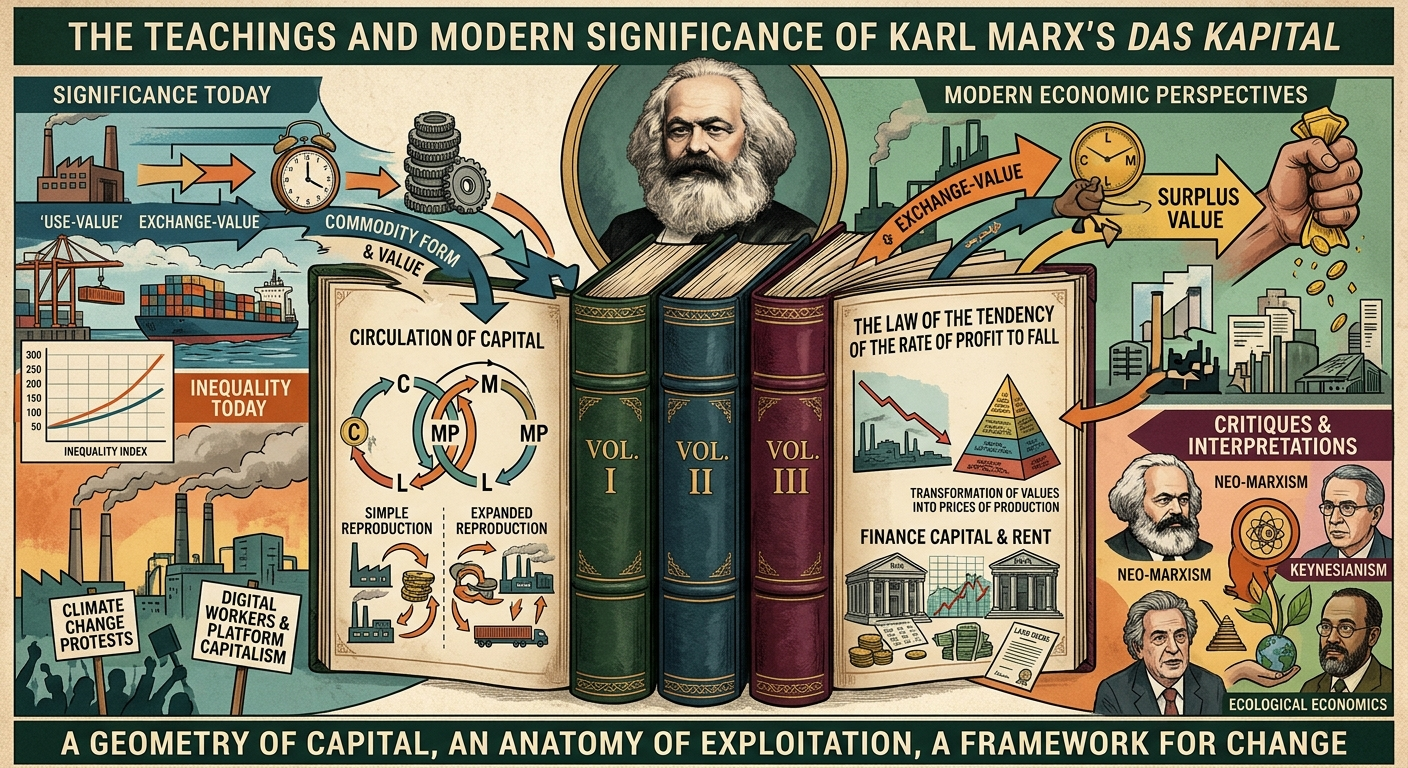
The work consists of three volumes. Volume I, published in 1867, examines the production of capital. Volume II, published posthumously in 1885, examines the circulation of capital. Volume III, published posthumously in 1894, examines the overall process of capitalist production, including profit, competition, credit, and the division of surplus value among different groups of capitalists.
Together, the volumes provide a theory of capitalism as a historical economic system rather than a natural or permanent form of social organisation. Their significance extends beyond Marxist economics into economic history, sociology, political economy, labour studies, development studies, and contemporary debates about automation, inequality, globalisation, financialisation, and the future of work.
1. Introduction: Who Was Karl Marx?
Karl Marx (1818–1883) was a German philosopher, economist, historian, and political theorist whose work profoundly influenced modern social science. He studied philosophy, law, history, and political economy, and developed a critical approach to understanding society through its material conditions.
Marx lived during the Industrial Revolution, a period in which factories, mechanised production, urbanisation, and wage labour expanded rapidly. Industrial capitalism created extraordinary productive capacity, but it also produced severe working conditions, insecurity, child labour, and large differences in wealth.
Marx’s major intellectual project was to understand the structure of this new economic system.
His question was not merely:
Why are some individuals wealthy?
It was more fundamentally:
What social and economic relationships make the production of wealth possible, and how do those relationships shape the lives of workers, businesses, and societies?
This question became the foundation of Das Kapital.
1.1 The meaning of Das Kapital
The German title Das Kapital means “Capital.” The complete title of Volume I is Capital: Critique of Political Economy.
The word capital does not simply mean money. In Marx’s analysis, capital is value that is used to generate more value through a particular social process of production.
For example:
Money → Production → Commodities → Sale → More Money
A business invests money in machinery, buildings, materials, and labour, produces goods or services, sells them, and seeks to obtain more money than it originally invested.
Marx’s central concern was:
Where does this additional value come from?
His answer is developed primarily in Volume I.
2. Historical Background: Why Marx Wrote Das Kapital
2.1 The Industrial Revolution
During the eighteenth and nineteenth centuries, Britain and parts of Europe experienced major industrial transformation.
Production moved increasingly from:
- Small workshops
- Household production
- Agricultural communities
- Craft-based manufacturing
toward:
- Factories
- Mechanised production
- Wage labour
- Large-scale markets
- Industrial cities
This transformation increased productivity and expanded the production of goods. However, it also changed the relationship between workers and the owners of productive resources.
A factory owner might own:
- Land
- Buildings
- Machines
- Raw materials
- Money for investment
A worker might possess primarily their ability to work, which they sell to the employer for a wage.
Marx wanted to understand the economic consequences of this relationship.
2.2 Classical political economy
Marx developed his analysis partly through a critical engagement with earlier economists, especially:
- Adam Smith
- David Ricardo
- Thomas Malthus
- William Petty
These economists had already examined production, labour, prices, rent, profit, and economic growth.
Marx adopted some of their insights but challenged their explanations of capitalism.
He argued that economics should not study only prices and markets. It should also examine:
- Who owns productive resources?
- Who controls production?
- Who performs the labour?
- Who receives the income?
- How is surplus distributed?
- Why do economic crises occur?
- How does one economic system become historically dominant?
3. The Structure of the Three Volumes
| Volume | Main subject | Central question |
|---|---|---|
| Volume I | Production of capital | How is surplus value produced? |
| Volume II | Circulation of capital | How does capital move through production, sale, and reproduction? |
| Volume III | Overall process of capitalist production | How does surplus value become profit, and how do competition and finance shape capitalism? |
The three volumes should be understood as parts of one analytical project.
Volume I: The factory and the production process
Volume II: The movement of capital through the economy
Volume III: The economy as a whole
4. Volume I: The Production of Capital
4.1 The commodity
Marx begins with the commodity, because capitalism is an economy in which products are predominantly produced for exchange.
A commodity has two important aspects:
Use-value
Use-value refers to the usefulness of a product.
Examples:
- Food provides nourishment.
- Clothing provides protection.
- A computer provides computing services.
- A house provides shelter.
Exchange-value
Exchange-value refers to the proportion in which one commodity exchanges for another.
For example:
A certain quantity of wheat may exchange for a certain quantity of cloth.
Marx argued that commodities have different physical properties, yet they can be compared economically because they represent human labour under particular social conditions.
The labour theory of value
Marx developed a theory in which the value of commodities is related to socially necessary labour time.
This means the labour time required, under average conditions of production and with average skill and technology, to produce a commodity.
For example, if technological improvements allow a shirt to be produced in half the time, the socially necessary labour time may fall.
This does not mean that every commodity’s market price always equals its labour value. Prices can fluctuate because of supply, demand, competition, scarcity, taxation, and other factors.
Marx’s purpose was to investigate the underlying economic relationships that make exchange possible.
4.2 Money
Money develops as a universal means of exchange.
It performs several functions:
- Measure of value
- Medium of exchange
- Means of payment
- Store of value
- International means of payment
In ordinary commodity exchange:
Commodity → Money → Commodity
A person sells something in order to buy something else.
Marx represented this as:
C–M–C
where:
- C = Commodity
- M = Money
Capitalist circulation follows a different objective:
M–C–M′
where:
- M = Money initially invested
- C = Commodities purchased or produced
- M′ = More money received after sale
The difference between M and M′ is the central problem of capitalist accumulation.
4.3 Labour-power
One of Marx’s most important concepts is labour-power.
Labour-power means the human capacity to work.
Under capitalism, workers generally sell their labour-power to an employer for a wage.
The employer does not simply purchase a finished product. The employer purchases the worker’s capacity to perform labour during a specified period.
Marx argued that labour-power is unusual because its use can create more value than the value required to maintain it.
This is the foundation of his theory of surplus value.
4.4 Necessary labour and surplus labour
Marx divides the working day into two analytical parts.
Necessary labour time
This is the portion of the working day during which the worker produces value equivalent to the value of their wage.
Surplus labour time
This is the portion of the working day during which the worker produces additional value beyond that equivalent.
For example, imagine a simplified eight-hour working day:
- 4 hours: value equivalent to the worker’s wage
- 4 hours: additional value produced for the enterprise
The example is analytical rather than a literal calculation of every modern workplace.
Marx calls the additional value surplus value.
The basic relationship
Value produced by labour − Value of labour-power = Surplus value
Marx argued that surplus value is the foundation of capitalist profit.
4.5 Constant capital and variable capital
Marx distinguishes between two major forms of capital.
Constant capital
Constant capital includes:
- Machinery
- Buildings
- Tools
- Raw materials
- Energy
- Equipment
These inputs transfer their existing value to the product through production.
Variable capital
Variable capital is the capital invested in labour-power.
Marx calls it “variable” because labour-power can create new value.
This distinction is central to his explanation of profit.
4.6 Absolute and relative surplus value
Marx identifies two major ways of increasing surplus value.
Absolute surplus value
This is obtained by increasing surplus labour time.
Methods may include:
- Extending the working day
- Increasing the intensity of work
- Reducing interruptions
- Changing work schedules
Relative surplus value
This is obtained by reducing the amount of labour time required to produce the worker’s means of subsistence.
Methods may include:
- Improved machinery
- Better organisation
- Technological innovation
- Increased productivity
If productivity rises, the goods required to maintain workers may become cheaper, allowing a larger portion of the working day to produce surplus value.
Modern relevance
This distinction remains useful when analysing:
- Automation
- Productivity growth
- Digital platforms
- Workplace monitoring
- Artificial intelligence
- Gig work
- Labour-saving technologies
A company may increase output without proportionally increasing wages, creating debates about who receives the benefits of technological progress.
4.7 The working day
Marx devoted considerable attention to the struggle over the length and conditions of the working day.
He examined the conflict between:
- Employers seeking greater production
- Workers seeking time for health, family, education, and rest
The working day is therefore not merely a technical issue. It is also a social and political question.
Modern debates about:
- Maximum working hours
- Overtime
- Paid leave
- Workplace safety
- Flexible work
- Four-day workweeks
can be understood partly through this framework.
4.8 Machinery and modern industry
Marx analysed machinery as a means of increasing productivity and transforming labour.
He recognised that machinery can:
- Increase production
- Reduce the time required to make goods
- Change skill requirements
- Displace certain tasks
- Create new forms of employment
- Increase the scale of production
However, he argued that machinery does not automatically liberate workers.
Its effects depend on how it is organised and who controls it.
Modern interpretation
In the twenty-first century, this argument can be applied to:
- Industrial robots
- Artificial intelligence
- Autonomous systems
- Cloud computing
- Algorithmic management
- Digital manufacturing
The important question is not simply:
“Does technology increase productivity?”
It is also:
“Who owns the technology, who controls its use, and how are its benefits distributed?”
4.9 Primitive accumulation
Marx uses the concept of primitive accumulation to explain the historical formation of capitalism.
He argues that capitalism required the separation of many producers from direct access to land, tools, and other means of production.
This created a population that increasingly depended on wage labour.
Primitive accumulation includes processes such as:
- Enclosure of land
- Displacement of producers
- Expansion of commercial agriculture
- Colonial extraction
- Development of financial institutions
- Concentration of productive resources
Marx’s analysis connects the emergence of capitalism to historical changes in property, labour, and political power.
5. Volume II: The Circulation of Capital
Volume II was edited and published after Marx’s death by Friedrich Engels in 1885.
While Volume I focuses on production, Volume II examines how capital moves through the economy.
5.1 The circulation of capital
Capital does not remain permanently inside a factory.
It moves through several stages:
Money capital → Productive capital → Commodity capital → Money capital
In simplified form:
M–C … P … C′–M′
where:
- M = Money
- C = Inputs purchased
- P = Production
- C′ = Commodities containing newly produced value
- M′ = Money received after sale
Capital must complete this movement if the business is to continue operating.
5.2 The three forms of capital
Marx distinguishes three forms.
Money capital
Money used to purchase labour-power and means of production.
Productive capital
Capital engaged in the production process.
Commodity capital
Finished goods awaiting sale.
A business may have valuable machinery and products but still experience financial difficulty if it cannot sell its goods or obtain sufficient cash.
5.3 Turnover time
Capital turnover refers to the time required for invested capital to return to its original form.
Turnover is influenced by:
- Production time
- Transport
- Storage
- Sales
- Payment systems
- Credit
- Supply chains
Modern relevance
This concept helps explain why businesses care about:
- Inventory management
- Cash flow
- Delivery speed
- Working capital
- Supply-chain efficiency
- Payment delays
- E-commerce logistics
A company may be profitable on paper but face difficulties if money is tied up in unsold inventory or unpaid invoices.
5.4 Fixed capital and circulating capital
Marx distinguishes between capital that remains involved in production over many cycles and capital that is used up or transformed more quickly.
Fixed capital
Examples:
- Buildings
- Machinery
- Industrial equipment
- Long-term infrastructure
Circulating capital
Examples:
- Raw materials
- Fuel
- Components
- Certain operating expenses
This distinction is useful for understanding investment planning and the economic importance of infrastructure.
5.5 Social reproduction
One of Volume II’s major contributions is the analysis of reproduction.
Reproduction means the continuous renewal of the economic system.
For capitalism to continue:
- Workers must be able to return to work.
- Businesses must replace used equipment.
- Raw materials must be replenished.
- Goods must be sold.
- Income must circulate.
- Production must resume.
Marx distinguishes between:
- Simple reproduction: production continues at approximately the same scale.
- Expanded reproduction: production expands through accumulation.
Modern significance
This framework can be applied to:
- National supply chains
- Food systems
- Energy systems
- Healthcare
- Education
- Transport
- Digital infrastructure
- Global manufacturing
It shows that an economy depends not only on factories and markets, but also on the continuous reproduction of the conditions that make production possible.
6. Volume III: The Overall Process of Capitalist Production
Volume III was edited and published by Engels in 1894.
It examines how the underlying production of surplus value appears in the everyday economy as profit, interest, rent, and other forms of income.
6.1 From surplus value to profit
In Volume I, Marx analyses surplus value in relation to labour.
In Volume III, he examines how surplus value is distributed among different forms of capital.
Businesses invest in:
- Machinery
- Buildings
- Raw materials
- Labour-power
Different industries may use different proportions of these inputs.
Yet competition tends to create pressures toward an average rate of profit.
Marx therefore distinguishes between:
- Surplus value: the underlying additional value produced in his theoretical framework.
- Profit: the form in which surplus value appears to the capitalist.
This distinction is central to his explanation of capitalist competition.
6.2 The transformation problem
One of the most debated issues in Marxist economics is the relationship between values and prices of production.
Marx’s analysis raises the question:
How do commodities that embody different amounts of labour come to exchange at market prices that reflect competition and average profit?
This is often called the transformation problem.
It has generated extensive debate among economists about:
- Labour values
- Production prices
- Profit rates
- Capital composition
- The relationship between abstract theory and observable prices
The debate demonstrates that Das Kapital is not a simple textbook with universally accepted conclusions. It is a major theoretical work that continues to be interpreted and criticised.
6.3 Competition
Marx argues that capitalism is not controlled by one single capitalist acting alone.
Businesses compete with one another.
Competition encourages:
- Cost reduction
- Technological innovation
- Productivity improvements
- Expansion
- Market concentration
- Investment
A business that fails to adapt may lose market share or disappear.
Modern relevance
This can be observed in industries such as:
- Automotive manufacturing
- Telecommunications
- Semiconductor production
- E-commerce
- Artificial intelligence
- Banking
- Agriculture
Competition can stimulate innovation, but it can also encourage cost-cutting, consolidation, and pressure on workers.
6.4 The tendency of the rate of profit to fall
One of Marx’s most famous and controversial arguments is the tendency of the rate of profit to fall.
The basic idea is that capitalist firms continually invest in machinery and technology to increase productivity. If the amount of capital invested in machinery grows faster than the labour that produces new value, this can create pressure on the rate of profit.
However, Marx also identifies counteracting influences, including:
- Increased productivity
- Expansion of markets
- Lower costs of production
- Technological change
- International trade
- Changes in wages
- Increased intensity of production
Important qualification
Marx did not present this as a simple claim that profit must always fall continuously.
It is a theory of a tendency within capitalism, not a prediction that every business or every economy must experience permanently declining profits.
Economists continue to debate its theoretical meaning and empirical validity.
6.5 Commercial capital
Commercial capital is involved in buying and selling commodities.
Examples include:
- Wholesalers
- Retailers
- Distributors
- Trading companies
- E-commerce businesses
Marx examines how commercial capital participates in the circulation of commodities and receives a share of the total surplus generated in the economy.
Modern relevance
This is useful for understanding:
- Retail margins
- Distribution networks
- Logistics
- Online marketplaces
- Global trade
- Platform businesses
6.6 Interest-bearing capital
Marx analyses money that is lent in expectation of receiving more money.
For example:
Money → Loan → Interest → More money
Interest-bearing capital is central to modern financial systems.
It helps explain the economic significance of:
- Banks
- Loans
- Bonds
- Credit
- Debt
- Interest rates
- Financial investment
Marx also warns that financial claims can appear to generate wealth independently of production, even though the repayment of interest ultimately depends on income generated elsewhere in the economy.
6.7 Fictitious capital
Marx uses the concept of fictitious capital to describe financial claims on future income.
Examples include:
- Shares
- Bonds
- Certain forms of debt
- Financial assets whose prices reflect expected future earnings
The term does not mean that these assets are imaginary or necessarily worthless. It means that their value is based on claims to future income rather than directly representing a physical productive asset.
Modern relevance
This concept is especially important in analysing:
- Stock markets
- Property markets
- Financial bubbles
- Public debt
- Investment funds
- Asset-price inflation
- Financial crises
6.8 Rent
Marx examines how landowners receive rent.
He distinguishes between different forms of rent, including:
- Differential rent
- Absolute rent
Land can generate income because of differences in fertility, location, productivity, and ownership conditions.
Modern relevance
This framework helps explain:
- Urban land prices
- Agricultural land
- Housing markets
- Commercial property
- Natural resources
- Infrastructure locations
7. The Central Teachings of Das Kapital
7.1 Capitalism is a historical system
Marx argued that capitalism is not the only possible economic system.
It developed historically through changes in:
- Property relations
- Labour
- Markets
- Technology
- Trade
- Political institutions
This perspective encourages economists to ask how economic systems emerge, change, and eventually transform.
7.2 Labour is central to production
Marx places labour at the centre of the production of value.
He argues that workers are not merely a cost of doing business. Their labour is a fundamental source of productive activity.
This perspective influenced later debates about:
- Labour rights
- Wages
- Working conditions
- Productivity
- Automation
- The distribution of income
7.3 Surplus value and exploitation
Marx’s concept of exploitation refers to a structural relationship in which workers produce more value than the value represented by their wages.
In his theory, this difference is appropriated as surplus value.
This does not mean that every employer is personally immoral or that every worker is treated identically. It is a theory about the organisation of production under capitalism.
7.4 Accumulation and concentration of capital
Marx argues that capitalists must continually reinvest to remain competitive.
This creates a process of accumulation.
Accumulation can lead to:
- Larger enterprises
- Greater productivity
- Technological development
- Market expansion
- Concentration of ownership
- Increased economic power
Modern relevance
This is visible in industries where large firms possess substantial advantages in:
- Capital
- Data
- Technology
- Infrastructure
- Distribution
- Research and development
7.5 Capitalism contains contradictions
Marx argues that capitalism can generate both extraordinary productive power and serious instability.
Some of the contradictions he examines include:
- Production for profit versus social needs
- Competition versus concentration
- Technological progress versus labour displacement
- Wealth creation versus unequal distribution
- Expansion of production versus limits of demand
- Private ownership versus collective production
These contradictions form the basis of his theory of capitalist crises.
8. Marx’s Theory of Economic Crisis
Marx did not provide one single, universally accepted crisis theory. Instead, Das Kapital contains several interconnected explanations.
8.1 Overproduction
Capitalists produce goods in expectation of profitable sales.
However, if production expands faster than effective demand, businesses may face:
- Unsold goods
- Falling prices
- Reduced investment
- Layoffs
- Business failures
This is often called overproduction.
8.2 Underconsumption
Some Marxist interpretations emphasise the possibility that workers cannot purchase all the goods produced because wages may not rise sufficiently with productivity.
This can create difficulties for the realisation of surplus value.
However, Marx’s own analysis is broader than a simple underconsumption theory.
8.3 Credit and financial instability
Credit allows businesses and consumers to expand spending beyond immediately available income.
This can support growth, but excessive borrowing can create fragility.
When confidence declines, debt repayment becomes difficult and financial problems can spread through the economy.
8.4 The falling rate of profit
The tendency of the rate of profit to fall is another possible source of crisis pressure.
If firms expect lower returns, they may reduce investment, contributing to economic slowdown.
8.5 Modern economic interpretation
Marx’s crisis theories remain influential, but they are not accepted as a complete explanation of all economic downturns.
Modern economics also examines:
- Monetary policy
- Banking regulation
- Fiscal policy
- Consumer expectations
- International trade
- Financial contagion
- Supply shocks
- Institutional failures
A balanced perspective recognises that Marx offers important structural insights, while other economic theories explain additional mechanisms.
9. The Significance of Das Kapital in Modern Economics
9.1 Understanding inequality
One of the most important modern applications of Marx’s work is the study of inequality.
Marx encourages us to examine:
- Who owns productive assets?
- Who receives profits?
- Who receives wages?
- Who owns land?
- Who controls financial capital?
- How is wealth inherited?
- How does technology affect income distribution?
Modern inequality research uses many methods beyond Marx, but his framework remains influential in asking these questions.
9.2 Globalisation
Marx’s analysis of capital accumulation and expanding markets provides a useful framework for understanding globalisation.
Capital increasingly crosses national borders through:
- International trade
- Foreign investment
- Global supply chains
- Multinational corporations
- Financial markets
- Digital platforms
Modern example
A smartphone may involve:
- Mineral extraction in one country
- Semiconductor design in another
- Manufacturing in another
- Software development elsewhere
- Global distribution and sales
Marx’s framework encourages analysis of how value is created and distributed across these relationships.
9.3 Technology and automation
Marx’s analysis of machinery is highly relevant to modern technological change.
Artificial intelligence, robotics, and automation can increase productivity while changing the demand for labour.
Important questions include:
- Will productivity gains increase wages?
- Will some jobs disappear?
- Will new occupations emerge?
- Who owns the technology?
- Who benefits from increased output?
- How should education respond?
Marx does not provide a complete modern theory of AI, but his concepts help frame these questions.
9.4 Digital capitalism
Modern digital businesses have introduced new forms of capital accumulation.
Examples include:
- Data
- Software
- Cloud infrastructure
- Digital platforms
- Algorithms
- Online advertising
- Subscription services
Marx’s framework can be used to examine how these businesses generate revenue, organise labour, and accumulate economic power.
However, digital capitalism also requires concepts from modern economics, information economics, and technology studies.
9.5 Financialisation
Financialisation refers broadly to the increasing importance of financial markets, financial institutions, and financial motives in economic activity.
Marx’s analysis of interest-bearing and fictitious capital is relevant to debates about:
- Rising debt
- Asset-price inflation
- Speculation
- Financial crises
- Corporate share buybacks
- Housing markets
- Investment funds
His work helps distinguish between the production of goods and services and the financial claims built around them.
9.6 Environmental economics
Marx did not develop modern climate economics, but his analysis contains important ideas about the relationship between production and nature.
He examined the relationship between human labour and natural conditions of production.
Modern scholars have developed these ideas into approaches sometimes called ecological Marxism or the metabolic rift.
These approaches investigate how capitalist production can disrupt ecological systems through:
- Soil depletion
- Resource extraction
- Pollution
- Industrial agriculture
- Fossil-fuel dependence
- Waste accumulation
Modern environmental economics also uses ecological science, climate modelling, and resource economics.
10. Marx and the Modern World Economy
10.1 Capitalism today is different from nineteenth-century capitalism
Modern capitalism includes:
- Advanced financial systems
- Central banks
- Welfare states
- International institutions
- Digital technology
- Global supply chains
- Large service sectors
- Public corporations
- Modern labour law
Therefore, Das Kapital should not be treated as a complete description of every feature of the twenty-first-century economy.
Its value lies in providing a framework for analysing:
- Ownership
- Accumulation
- Labour
- Competition
- Profit
- Crisis
- Economic power
10.2 The rise of the service economy
Marx wrote during the expansion of industrial manufacturing.
Today, many economies depend heavily on:
- Healthcare
- Education
- Finance
- Information technology
- Telecommunications
- Tourism
- Professional services
- Digital services
Marx’s concepts can still be applied to service work, but they require careful interpretation because services differ from physical manufacturing.
10.3 Artificial intelligence and automation
AI creates new questions about the relationship between labour and capital.
For example:
- AI systems require computing infrastructure.
- Computing infrastructure requires investment.
- AI companies compete through capital, data, and technical expertise.
- Workers may use AI to increase productivity.
- Some tasks may become automated.
- New forms of labour may emerge.
A Marxist analysis would ask:
Who owns the AI systems, and who receives the economic benefits of their productivity?
A broader economic analysis would also examine:
- Innovation incentives
- Competition
- Consumer benefits
- Skills
- Labour-market transitions
- Regulation
10.4 Africa and developing economies
Marx’s work is relevant to the study of African economies, particularly questions of:
- Land ownership
- Natural resources
- Labour
- Colonial history
- Industrialisation
- Global trade
- Infrastructure
- Foreign investment
- Economic inequality
However, African economies cannot be understood through Marx alone.
They also require attention to:
- Colonial and postcolonial institutions
- Local economic systems
- Informal economies
- Agriculture
- Demography
- Governance
- Regional integration
- Development economics
A useful approach is to combine Marxist political economy with African economic history and modern development research.
11. Strengths of Marx’s Analysis
11.1 It connects economics with society
Marx shows that economic activity is not separate from social relationships.
Production involves:
- Ownership
- Labour
- Authority
- Cooperation
- Conflict
- Institutions
11.2 It explains the importance of accumulation
Marx helps explain why businesses continually seek:
- Investment
- Expansion
- Productivity
- Market growth
- Technological improvement
11.3 It highlights distribution
His work asks who receives the benefits of economic growth.
This remains central to debates about:
- Wages
- Profits
- Wealth
- Rent
- Interest
- Public policy
11.4 It provides a theory of economic change
Marx does not treat capitalism as a permanent or unchanging system.
He analyses how economic systems develop through historical processes.
11.5 It influenced many academic disciplines
Das Kapital influenced:
- Economics
- Sociology
- History
- Political science
- Geography
- Anthropology
- Labour studies
- Development studies
- Cultural studies
12. Criticisms and Limitations
A comprehensive thesis must also examine the limitations of Marx’s work.
12.1 The labour theory of value is controversial
Many modern economists do not accept Marx’s labour theory of value as a complete explanation of market prices.
Modern price theory also considers:
- Supply
- Demand
- Scarcity
- Consumer preferences
- Marginal productivity
- Competition
- Institutions
12.2 The rate of profit theory is debated
Economists disagree about:
- Whether the rate of profit tends to fall in the way Marx described
- How to measure it
- What counteracting forces are most important
- Whether the theory explains actual economic crises
12.3 Capitalism has shown adaptability
Capitalist economies have developed institutions that Marx did not fully anticipate, including:
- Social insurance
- Labour protections
- Public education
- Central banking
- Macroeconomic management
- Mixed economies
These institutions can modify the effects of capitalism without necessarily eliminating its underlying structure.
12.4 Marx did not provide a complete modern economic policy system
Das Kapital is primarily a critique and analysis of capitalism.
It is not a detailed manual for:
- Central-bank policy
- Modern taxation
- Digital regulation
- Climate policy
- Contemporary industrial policy
- Public-sector management
Those questions require additional economic and political research.
12.5 Historical predictions remain debated
Some interpretations of Marx predicted the inevitable collapse of capitalism or the disappearance of certain social classes.
However, capitalism has demonstrated considerable adaptability.
Modern scholars therefore distinguish between:
- Marx’s analytical concepts
- Later Marxist interpretations
- Historical predictions
- Empirical evidence
This distinction is essential for serious study.
13. Marx Compared with Other Economic Perspectives
| Perspective | Main focus | View of capitalism |
|---|---|---|
| Marxist political economy | Class, labour, accumulation, exploitation | Historically specific and internally contradictory |
| Classical economics | Production, labour, distribution, growth | Examines the foundations of market economies |
| Neoclassical economics | Prices, incentives, marginal decisions, allocation | Studies how markets coordinate scarce resources |
| Keynesian economics | Demand, employment, investment, instability | Emphasises macroeconomic fluctuations and policy |
| Institutional economics | Laws, organisations, social rules | Economic outcomes depend on institutions |
| Development economics | Structural transformation, poverty, productivity | Studies how economies grow and develop |
| Ecological economics | Environmental limits and sustainability | Emphasises the relationship between economy and nature |
These perspectives can be compared rather than treated as mutually exclusive.
14. Practical Lessons for Business and Economic Development
Although Das Kapital is a critical work, it contains useful lessons for understanding modern business.
14.1 Productivity matters
Businesses must improve productivity to remain competitive.
This may involve:
- Better machinery
- Improved skills
- Efficient logistics
- Digital systems
- Research and development
- Better organisation
14.2 Ownership matters
Economic outcomes depend partly on who owns:
- Land
- Machines
- Technology
- Infrastructure
- Financial assets
- Intellectual property
14.3 Labour matters
Workers are not merely an expense.
They possess:
- Skills
- Knowledge
- Experience
- Creativity
- Organisational capacity
Modern businesses increasingly recognise that human capital is essential to productivity.
14.4 Circulation matters
A business must not only produce goods. It must also:
- Obtain inputs
- Manage inventory
- Sell products
- Collect payments
- Finance operations
- Maintain cash flow
This is one of the most practical insights of Volume II.
14.5 Economic crises matter
Businesses must understand that economic conditions can change through:
- Falling demand
- Rising costs
- Financial instability
- Supply-chain disruption
- Technological change
- Competition
15. The Three Volumes as One Economic System
The three volumes can be understood through a simplified model.
Volume I: Production
Inputs + Labour → Commodities + Surplus Value
Volume II: Circulation
Commodities → Sale → Money → Reinvestment
Volume III: Distribution and Competition
Surplus Value → Profit + Interest + Rent + Other Forms of Income
Together:
Production → Circulation → Distribution → Accumulation → Expanded Production
This is the central movement of Marx’s analysis of capitalism.
16. Conclusion
Karl Marx’s Das Kapital remains one of the most important works in the history of economic thought because it asks fundamental questions about how wealth is produced, how economic power is organised, and how capitalism changes over time.
Volume I explains the production of capital and the concept of surplus value.
Volume II explains the circulation of capital and the reproduction of the economy.
Volume III explains how surplus value appears as profit, interest, rent, and other forms of income within the competitive capitalist system.
The work’s modern significance lies in its ability to illuminate questions that remain central today:
- Why does wealth accumulate?
- Why does inequality persist?
- How does technology change labour?
- Why do businesses compete and expand?
- Why do financial crises occur?
- How do global supply chains distribute value?
- Who benefits from economic growth?
- What is the relationship between production and nature?
At the same time, Das Kapital should be studied critically. Its theories are debated, its historical predictions are not universally accepted, and modern economics has developed many additional explanations.
The most productive way to read Marx is therefore neither to accept every claim uncritically nor to dismiss the work as outdated. It is to use Das Kapital as a powerful analytical framework alongside modern economic theory, historical evidence, and contemporary research.
Its enduring lesson is that an economy is not merely a collection of prices and transactions. It is a system of production, ownership, labour, technology, institutions, and social relationships that shapes the development of human society.



Be First to Comment