
Exploring the Best AI Tools for Smart Conversations
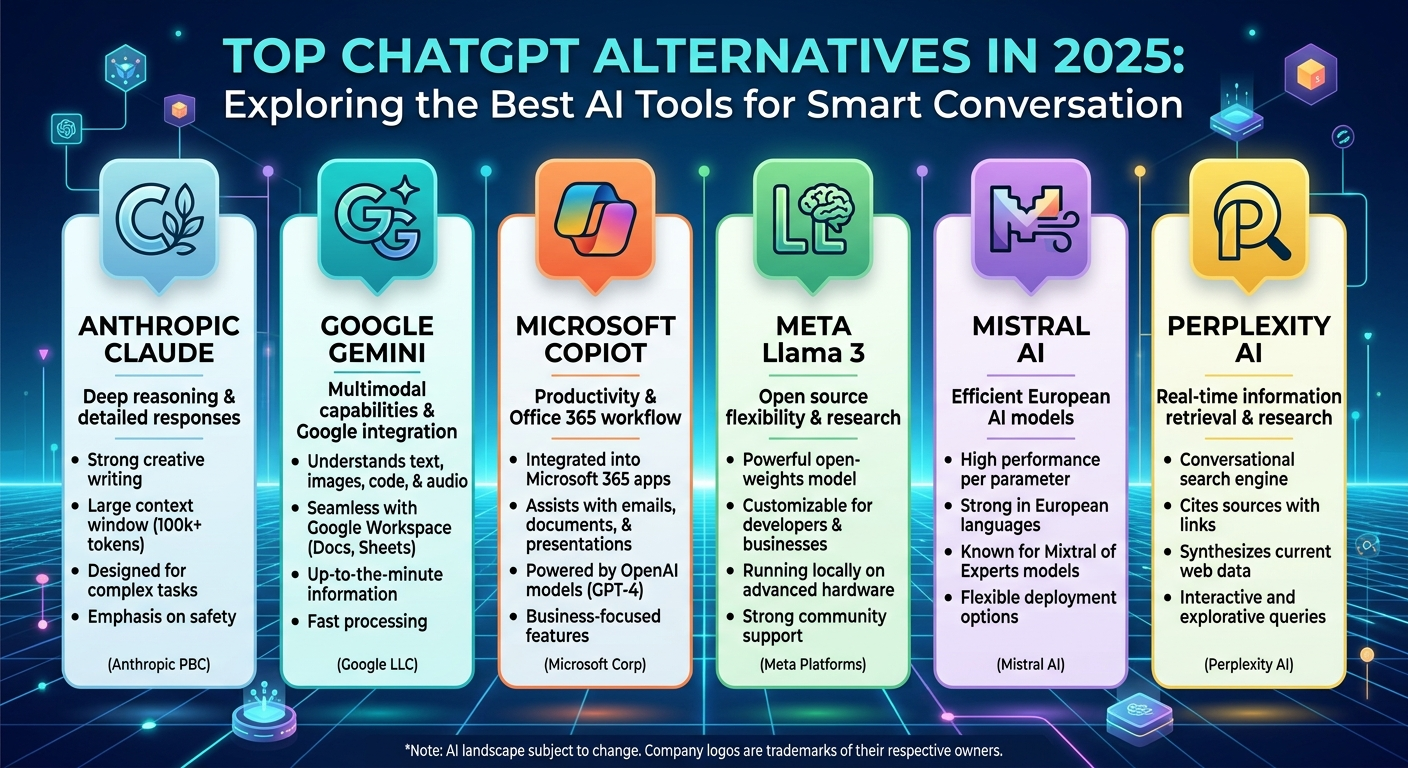
Artificial intelligence entered a new phase with the rapid adoption of conversational AI. Since ChatGPT became widely available, the market has expanded into a competitive ecosystem containing general-purpose assistants, AI search engines, coding copilots, productivity assistants, research tools, creative platforms, and specialized enterprise systems.
By 2025, users no longer had to ask simply, “What is the best AI chatbot?” A better question became: “Which AI system is best suited to the task I need to accomplish?” Contemporary comparisons consistently show that different platforms have different strengths—for example, Claude for professional writing, Gemini for Google integration, Perplexity for web research, DeepSeek for reasoning, Microsoft Copilot for Microsoft workflows, Meta AI for social integration, and Grok for its connection to X. (Zapier)
Important: AI products change rapidly. The article below is specifically a 2025 market overview, rather than a claim about which platform is best in 2026.
1. What Is a ChatGPT Alternative?
A ChatGPT alternative is an AI-powered conversational system that can perform some or many of the same functions as ChatGPT.
Depending on the platform, this can include:
- answering questions;
- explaining difficult subjects;
- summarizing documents;
- writing and editing;
- programming;
- mathematics and reasoning;
- web searching;
- research assistance;
- generating or analyzing images;
- translating languages;
- brainstorming;
- business productivity;
- creating structured reports;
- interacting with other applications.
However, “alternative” does not necessarily mean “replacement.”
Some systems are designed to complement general-purpose AI rather than compete with it directly.
For example, an AI search engine may be better for finding and citing current sources, while a general-purpose chatbot may be better for transforming those sources into a detailed article.
2. Why Did the AI-Assistant Market Become So Competitive?
The emergence of large language models (LLMs) created a new software category.
Traditional software generally required users to learn menus, commands and workflows. Conversational AI introduced another interface:
Human language → AI model → generated response/action
This dramatically lowered the barrier to interacting with sophisticated computing systems.
By 2025, the major competition was no longer only about language generation. Companies were competing across several dimensions:
- reasoning;
- context length;
- multimodal capabilities;
- search;
- coding;
- document analysis;
- image generation;
- voice interaction;
- enterprise integration;
- personalization;
- AI agents;
- speed and cost.
This explains why the AI market became increasingly fragmented.
3. The Major ChatGPT Alternatives of 2025
The most important alternatives included:
| Platform | Company | Particularly strong in |
|---|---|---|
| Claude | Anthropic | Writing, analysis, coding |
| Gemini | Google ecosystem, multimodal AI | |
| Microsoft Copilot | Microsoft | Microsoft productivity |
| Perplexity | Perplexity AI | Research and AI-powered search |
| DeepSeek | DeepSeek | Reasoning and cost-efficient AI |
| Meta AI | Meta | Social and consumer AI |
| Grok | xAI | Conversational AI and X integration |
| Poe | Quora | Accessing multiple AI models |
| GitHub Copilot | GitHub/Microsoft | Software development |
| Jasper | Jasper | Marketing and content workflows |
Contemporary 2025 comparisons repeatedly identified Claude, Gemini, Copilot, DeepSeek, Perplexity, Meta AI and Grok among the major alternatives. (Exploding Topics)
4. Claude — Anthropic’s Major Competitor
Anthropic developed Claude as a family of conversational AI models.
Claude became particularly prominent among professionals who wanted assistance with:
- long-form writing;
- document analysis;
- programming;
- reasoning;
- summarization;
- brainstorming;
- business documents;
- research-oriented tasks.
2025 comparisons frequently positioned Claude as one of the strongest alternatives for professional users and natural-language work. (Zapier)
Major strength
Claude’s major attraction is its emphasis on careful language generation and sophisticated analysis.
For example, a user could provide a long technical document and ask the system to:
Summarize → identify major arguments → find weaknesses → reorganize → produce recommendations.
That makes it useful beyond ordinary question-and-answer interaction.
Best suited for
Professionals, writers, researchers, programmers and users working with lengthy documents.
Limitation
No AI system should automatically be treated as authoritative. Claude, like other generative AI systems, can produce incorrect information and should be checked for important factual claims.
5. Google Gemini — The Google Ecosystem Competitor
Google developed Gemini as its major AI model family and assistant ecosystem.
One of Gemini’s greatest strategic advantages is its relationship with Google’s enormous software ecosystem.
This creates the possibility of AI being integrated into workflows involving:
- Search;
- Gmail;
- Google Docs;
- Google Drive;
- YouTube;
- Android;
- other Google services.
2025 comparisons frequently highlighted Gemini for Google integration and multimodal capabilities. (Tom’s Guide)
Why Gemini matters
Google possesses enormous expertise in:
- search;
- data infrastructure;
- machine learning;
- cloud computing;
- mobile operating systems;
- advertising;
- video;
- mapping;
- productivity software.
Consequently, Gemini is more than a chatbot.
It represents Google’s attempt to build an AI layer across its ecosystem.
Best suited for
Students, researchers, Android users and people already deeply invested in Google services.
6. Microsoft Copilot — AI Inside the Productivity Ecosystem
Microsoft developed Copilot as a family of AI assistants integrated across Microsoft’s ecosystem.
Its significance comes from Microsoft’s enormous presence in business computing.
Copilot can be associated with environments involving:
- Word;
- Excel;
- PowerPoint;
- Outlook;
- Teams;
- Windows;
- Microsoft 365;
- software development.
The fundamental idea is different from simply opening a chatbot.
Instead of:
Open AI chatbot → copy information → paste into Word
the longer-term vision is:
AI directly inside the software where the work occurs.
2025 comparisons commonly identified Copilot as particularly useful for Microsoft-oriented productivity workflows. (Zapier)
Best suited for
Businesses, office workers, Microsoft 365 users and organizations already invested in Microsoft’s ecosystem.
7. Perplexity — The AI Search Alternative
Perplexity occupies a somewhat different position.
Rather than presenting itself simply as another conversational chatbot, it combines conversational AI with search and source discovery.
Its major attraction is that answers can be accompanied by sources that users can investigate.
This makes it particularly useful for:
- research;
- fact checking;
- current information;
- source discovery;
- comparative research;
- technical investigation.
2025 evaluations frequently positioned Perplexity as one of the strongest choices for AI-powered web research. (Exploding Topics)
Traditional search
Question → search results → websites → user reads → user synthesizes
AI search
Question → AI searches sources → synthesizes information → provides answer and references
That distinction is important.
Perplexity therefore competes partly with search engines, not merely with chatbots.
Best suited for
Researchers, students, journalists and users who want source-backed information.
8. DeepSeek — A Major Disruptor
DeepSeek became one of the most closely watched AI developments of 2025.
Its importance extended beyond the chatbot itself because it contributed to a broader debate about:
- AI model efficiency;
- inference costs;
- computing requirements;
- open models;
- reasoning models;
- AI competition;
- access to advanced AI.
2025 comparisons frequently highlighted DeepSeek for reasoning, mathematics, coding and cost efficiency. (Exploding Topics)
Its rapid rise demonstrated an important principle:
AI progress is not determined exclusively by the company with the largest consumer brand.
Model architecture, training methodology, optimization and inference efficiency can significantly influence competitiveness.
Best suited for
Users interested in reasoning, mathematics, programming and experimenting with alternative AI models.
Important consideration
Users should independently review the privacy, data-handling and governance policies of any AI service before entering sensitive information.
9. Meta AI
Meta Platforms entered conversational AI through Meta AI and its broader Llama ecosystem.
Meta possesses an unusual distribution advantage because it operates major consumer platforms including:
- Facebook;
- Instagram;
- WhatsApp;
- Messenger.
This means AI can be brought directly into environments where billions of people already communicate.
2025 comparisons commonly identified Meta AI with social and messaging integration. (Zapier)
Strategic significance
The important question is not merely:
“How good is Meta AI?”
It is also:
“How many people can Meta put AI in front of without requiring them to adopt a completely new platform?”
That is a major competitive advantage.
10. Grok — xAI’s Conversational AI
xAI developed Grok.
One of Grok’s distinguishing characteristics in 2025 was its close relationship with X, formerly Twitter.
That creates a potentially valuable connection to rapidly changing social and news-related information.
Grok was also marketed with a more informal conversational personality than some competitors.
2025 comparisons identified Grok as particularly relevant for users interested in X integration and real-time social information. (Zapier)
Best suited for
Users who spend significant time in the X ecosystem and want conversational access to current social information.
11. GitHub Copilot — The Programmer’s Alternative
Not every ChatGPT alternative is designed primarily for general conversation.
GitHub Copilot is a good example.
Its central purpose is software development assistance.
It can help developers with:
- code completion;
- code generation;
- debugging;
- explaining code;
- refactoring;
- development workflows.
This demonstrates an important change in AI:
General chatbot → specialized AI assistant
Instead of asking:
“What can AI do?”
developers increasingly ask:
“How can AI become part of my programming environment?”
12. Poe — A Multi-Model AI Platform
Poe, developed by Quora, takes another approach.
Rather than relying on only one AI model, the platform has offered users access to multiple models.
This creates a model-selection environment.
A user can potentially compare different AI systems for the same question.
For example:
Question
↓
Model A
Model B
Model C
Model D
↓
Compare responses
This is useful for people who want to understand how different models behave.
13. Jasper — Specialized AI for Marketing
Jasper represents another important trend: vertical AI.
Instead of attempting to be the best general-purpose chatbot, Jasper has concentrated on business and marketing-oriented workflows.
Typical applications include:
- marketing content;
- campaigns;
- brand communication;
- advertising copy;
- content workflows;
- marketing teams.
This illustrates a major lesson in the AI industry:
The future may not belong exclusively to one giant chatbot.
There is room for thousands of specialized AI applications built on top of foundation models.
14. Comparison by Use Case
| Requirement | Strong candidates |
|---|---|
| General conversation | ChatGPT, Claude, Gemini |
| Professional writing | Claude |
| Google ecosystem | Gemini |
| Microsoft ecosystem | Copilot |
| Web research | Perplexity |
| Reasoning/math | DeepSeek and other reasoning models |
| Social integration | Meta AI, Grok |
| Programming | Claude, GitHub Copilot, DeepSeek |
| Marketing | Jasper |
| Multiple AI models | Poe |
| Research with citations | Perplexity |
These are use-case-oriented observations, not absolute rankings. AI performance changes quickly, and the best choice can depend on the exact prompt, model version, subscription level and task. (Zapier)
15. Chatbot vs AI Search Engine
One of the most important distinctions is between a chatbot and an AI search system.
Chatbot model
User:
“Explain quantum computing.”
AI:
generates an explanation from its learned knowledge and available tools.
AI search model
User:
“What happened in quantum computing research this month?”
AI:
searches current information → retrieves sources → synthesizes information → cites sources.
For historical and educational questions, either approach may work.
For rapidly changing information, source-based search becomes especially important.
16. The Importance of Multimodal AI
Another major development was the transition from text-only AI to multimodal systems.
Modern AI can increasingly work with combinations of:
Text + Images + Audio + Video + Documents + Code
This changes the definition of a chatbot.
Imagine uploading a photograph of a machine and asking an AI to explain its visible components.
Or uploading a spreadsheet and asking for an analysis.
Or providing a programming project and asking the AI to identify errors.
The AI assistant becomes a general-purpose information interface rather than simply a text generator.
17. AI Coding Assistants
Coding became one of the most important applications of generative AI.
AI coding assistants can help with:
- generating functions;
- explaining unfamiliar code;
- finding bugs;
- converting code between languages;
- writing tests;
- documenting software;
- refactoring;
- creating prototypes.
This has produced a new development model:
Human developer + AI coding assistant
rather than:
Human developer alone
However, AI-generated code still requires human review, testing and security checking.
18. AI for Research
AI research assistants can dramatically reduce the time required for information discovery.
A conventional research process might look like:
Question → search engine → dozens of websites → PDFs → notes → comparison → report
An AI-assisted process can become:
Question → AI search → source discovery → summarization → comparison → human verification → report
The human remains particularly important because an AI-generated summary can contain:
- factual errors;
- missing context;
- outdated information;
- incorrect interpretations;
- unreliable sources.
Therefore:
AI research ≠ automatic truth.
It is better understood as research acceleration.
19. The Problem of Hallucination
One of the biggest weaknesses shared by generative AI systems is hallucination.
An AI model can produce an answer that sounds highly convincing but is factually incorrect.
For example, it might:
- invent a citation;
- misidentify a historical figure;
- provide an incorrect statistic;
- confuse two companies;
- attribute a discovery to the wrong scientist;
- fabricate a book;
- misunderstand a technical specification.
The danger is not necessarily that the AI sounds uncertain.
The danger is that it can sometimes sound very confident while being wrong.
Therefore, users should verify important information using reliable primary or authoritative sources.
20. Privacy and Data Governance
AI assistants process user inputs through complex infrastructure.
Before using any AI platform for sensitive information, users should understand:
- what data is collected;
- how conversations are stored;
- whether conversations may be used for model improvement;
- enterprise data controls;
- retention policies;
- account security;
- regional data requirements.
This becomes particularly important for:
- businesses;
- governments;
- schools;
- researchers;
- healthcare organizations;
- financial institutions.
A useful principle is:
Never assume that because an AI service is convenient, every type of information is appropriate to enter into it.
21. Open-Weight vs Closed AI Models
Another major distinction is between AI models that are openly available for developers to download or modify and proprietary systems delivered primarily through controlled services.
Closed/proprietary approach
The company controls:
- model weights;
- infrastructure;
- updates;
- access;
- safety systems;
- product experience.
Open-weight approach
Developers may have greater ability to:
- download models;
- run them locally;
- customize them;
- fine-tune them;
- integrate them into their own applications.
The open-versus-closed debate is therefore not simply technical.
It involves:
innovation + cost + control + security + transparency + governance.
22. Why There Will Probably Not Be One Permanent Winner
It is tempting to ask:
“Which AI is number one?”
But this is increasingly difficult to answer meaningfully.
Consider:
Best for Google users: Gemini
Best for Microsoft users: Copilot
Best for source-oriented research: Perplexity
Best for professional writing: Claude
Best for programming: specialized coding assistants
Best for social integration: Meta AI or Grok
Best for experimenting with multiple models: Poe
Best for reasoning-oriented experimentation: DeepSeek
Therefore, the AI market increasingly resembles the smartphone and software industries.
There may be several leaders simultaneously.
23. The Emerging AI Stack
The 2025 AI ecosystem can be represented as a hierarchy:
Layer 1 — Hardware
GPUs, TPUs, AI accelerators, memory and data centers
↓
Layer 2 — Infrastructure
Cloud computing, networking and storage
↓
Layer 3 — Foundation Models
Large language models and multimodal models
↓
Layer 4 — AI Assistants
ChatGPT, Claude, Gemini, Copilot, Grok and others
↓
Layer 5 — Specialized AI Applications
Coding, research, marketing, education, design and productivity
↓
Layer 6 — AI Agents
Systems capable of performing sequences of actions
↓
Layer 7 — Human Organizations
Businesses, governments, schools, researchers and consumers
This is perhaps the most important development.
The competition is no longer simply between chatbots.
It is increasingly a competition between AI ecosystems.
24. From Chatbots to AI Agents
The next major stage is AI agents.
A conventional chatbot primarily responds to instructions.
An agent can potentially:
Understand → plan → use tools → execute → evaluate → continue
For example:
Human objective
↓
AI understands task
↓
AI creates plan
↓
AI searches information
↓
AI interacts with software
↓
AI produces result
↓
Human reviews
This could transform:
- administration;
- programming;
- research;
- customer service;
- education;
- business operations;
- data analysis.
Consequently, the future competition may be less about:
“Which chatbot writes the best answer?”
and more about:
“Which AI can safely accomplish the most useful work?”
25. How to Choose an AI Alternative
Instead of choosing an AI based purely on popularity, users should ask six questions.
Question 1: What is my primary task?
Writing?
Research?
Coding?
Business?
Education?
Search?
Question 2: Do I need current information?
If yes, prioritize systems with strong search/retrieval capabilities.
Question 3: Do I work inside an existing ecosystem?
Google → Gemini may be particularly attractive.
Microsoft → Copilot may be particularly attractive.
Social/messaging → Meta AI may be attractive.
Question 4: Do I need long documents?
Consider platforms designed for substantial context and document analysis.
Question 5: Do I need specialized tools?
Programming → coding assistant.
Research → AI search.
Marketing → marketing AI.
Question 6: What are my privacy requirements?
This is especially important for organizations.
26. A Practical Multi-AI Strategy
Instead of trying to find one perfect AI, advanced users can use several systems.
For example:
Stage 1 — Discovery
Use an AI search system to find sources.
↓
Stage 2 — Research
Collect primary and authoritative material.
↓
Stage 3 — Analysis
Use a strong reasoning model to compare information.
↓
Stage 4 — Writing
Use a language-focused assistant to organize the material.
↓
Stage 5 — Verification
Check important claims against original sources.
↓
Stage 6 — Final production
Human reviews and publishes the result.
This creates a powerful human + multiple AI systems workflow.
27. Advantages of Having Multiple AI Platforms
Using several AI systems can provide:
Diversity of reasoning
Different models can interpret the same question differently.
Cross-checking
One AI’s answer can be compared against another.
Specialization
A coding assistant can be used for programming while a research assistant handles sources.
Resilience
If one service is unavailable, another can handle the task.
Cost optimization
Free or lower-cost systems can be used for simpler tasks while premium systems are reserved for complex work.
28. The Risks of Using Multiple AI Systems
The multi-AI strategy also creates challenges.
Information inconsistency
Different models can provide contradictory answers.
Privacy exposure
Sending the same sensitive material to multiple providers increases exposure.
Verification burden
More AI-generated information means more information to check.
Subscription costs
Using several premium services can become expensive.
Automation dependency
Users may gradually stop developing their own critical-thinking skills.
Therefore, AI should remain a tool, not an unquestioned authority.
29. The Educational Impact
AI alternatives are already changing education.
Students can use AI systems to:
- explain difficult concepts;
- create practice questions;
- summarize lessons;
- explore historical topics;
- understand mathematical procedures;
- receive programming explanations;
- brainstorm projects.
But there is an important distinction:
Using AI to learn ≠ using AI to avoid learning.
The strongest educational use is:
Question → explanation → student attempts problem → feedback → correction → deeper understanding
rather than simply:
Question → copy answer → submit.
30. The Business Impact
Businesses can apply conversational AI to:
- customer support;
- marketing;
- research;
- documentation;
- programming;
- data analysis;
- internal knowledge systems;
- employee productivity;
- workflow automation.
The greatest opportunity may not be replacing entire jobs.
It may be augmenting individual workers.
One employee equipped with good AI tools can potentially perform tasks that previously required several disconnected software systems.
31. The AI Competition Is Becoming an Ecosystem Competition
The major players increasingly compete across entire technology stacks.
| Company | AI ecosystem advantage |
|---|---|
| OpenAI | General-purpose AI ecosystem |
| Search + Android + Workspace + Cloud | |
| Microsoft | Windows + Microsoft 365 + Azure + GitHub |
| Anthropic | Enterprise-oriented AI and Claude |
| Meta | Social networks + messaging + open-weight models |
| xAI | X/social-data ecosystem |
| DeepSeek | Competitive reasoning and model efficiency |
| Perplexity | AI search and research |
The strategic lesson is profound:
The strongest AI company may not simply have the strongest model. It may have the strongest combination of model + infrastructure + distribution + applications + users.
32. What 2025 Taught Us About AI
The 2025 AI landscape demonstrated several important lessons.
Lesson 1
There is no universally superior AI assistant.
Lesson 2
Specialization is increasingly important.
Lesson 3
Search and retrieval are becoming as important as text generation.
Lesson 4
AI models are becoming multimodal.
Lesson 5
AI coding is becoming a mainstream productivity category.
Lesson 6
Open and proprietary approaches will continue competing.
Lesson 7
AI agents are becoming the next major frontier.
Lesson 8
Human verification remains essential.
33. Final Ranking by Purpose Rather Than Popularity
Rather than declaring one absolute winner, a more useful 2025 classification is:
Best professional alternative: Claude
Best Google-oriented alternative: Gemini
Best Microsoft-oriented alternative: Copilot
Best research/search alternative: Perplexity
Best reasoning-focused challenger: DeepSeek
Best social-platform alternative: Meta AI
Best X-oriented conversational alternative: Grok
Best multi-model platform: Poe
Best coding-focused assistant: GitHub Copilot
Best marketing-focused AI: Jasper
These classifications reflect the strengths commonly identified in 2025 comparisons, rather than an absolute benchmark ranking. (Exploding Topics)
Conclusion: The Age of AI Choice
The emergence of ChatGPT fundamentally changed how people interact with computers. But the most important development after ChatGPT was not the creation of one more chatbot—it was the emergence of an entire AI ecosystem.
Claude, Gemini, Copilot, Perplexity, DeepSeek, Meta AI, Grok, GitHub Copilot, Poe and specialized AI platforms demonstrate different approaches to the same fundamental question:
How can artificial intelligence become a useful interface between humans, information, software and machines?
The answer increasingly depends on the task.
A researcher may prefer Perplexity.
A Google user may prefer Gemini.
A Microsoft employee may prefer Copilot.
A professional writer may prefer Claude.
A programmer may prefer GitHub Copilot.
A user interested in alternative reasoning models may explore DeepSeek.
A social-media user may prefer Meta AI or Grok.
The future therefore is unlikely to be a simple “ChatGPT versus everyone else” contest.
Instead, the industry is moving toward a world of multiple AI models, specialized assistants, multimodal systems, AI agents and interconnected AI ecosystems.
The real winner may ultimately be the user who understands which AI tool to use for which problem—and how to combine AI assistance with human judgment, verification and creativity.5




Be First to Comment