
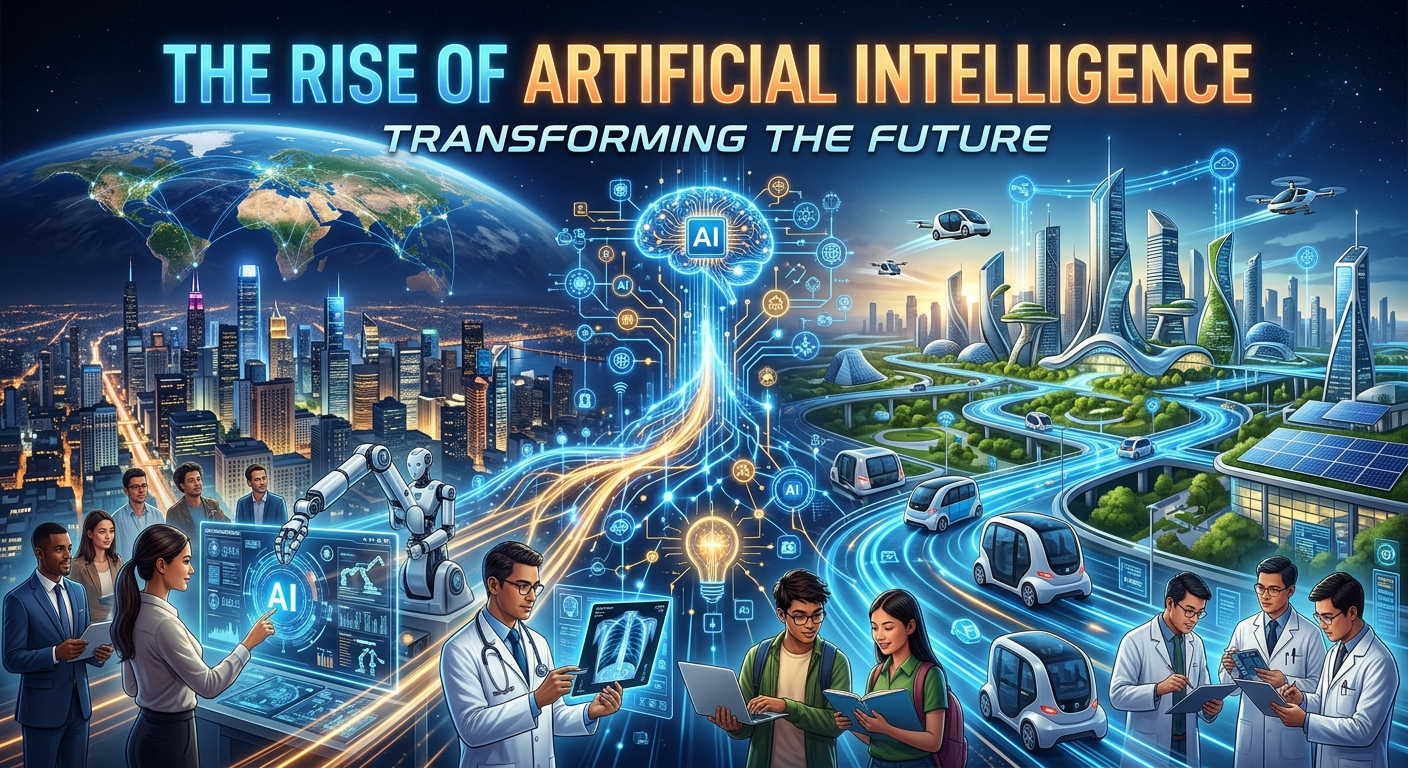
Transforming the Future
Abstract
Artificial intelligence (AI) has evolved from a theoretical idea about machine intelligence into one of the most consequential technological developments of the modern era. What began with mathematical theories of computation, symbolic reasoning and early experiments in machine learning has developed into a global ecosystem involving advanced processors, enormous datasets, cloud and edge computing, neural networks, foundation models, generative AI, robotics and increasingly autonomous software systems.
By 2026, AI is no longer confined to research laboratories. It is being incorporated into education, healthcare, scientific research, manufacturing, agriculture, finance, telecommunications, transportation, cybersecurity, entertainment and public administration. Stanford’s 2026 AI Index reports that organizational AI adoption reached 88%, while generative AI reached 53% population adoption within three years—an unusually rapid diffusion compared with earlier general-purpose technologies. (Stanford HAI)
The rise of AI therefore represents more than the emergence of another software category. It is a transformation of the relationship between humans, information, machines and economic production. At the same time, AI creates significant questions concerning employment, privacy, misinformation, bias, security, intellectual property, energy consumption, accountability and the distribution of technological power.
This article examines the historical development of AI, its technical foundations, major applications, economic consequences, societal implications, infrastructure requirements, governance challenges and possible future trajectories.
1. Introduction: What Is Artificial Intelligence?
Artificial intelligence is the broad field of creating computational systems capable of performing tasks that normally require aspects of human intelligence.
These tasks can include:
- recognizing patterns;
- understanding or generating language;
- interpreting images and sounds;
- making predictions;
- solving problems;
- planning;
- learning from data;
- recommending actions;
- controlling machines;
- generating text, images, audio or video; and
- assisting humans in complex decisions.
NIST describes an AI system as an engineered or machine-based system that can generate outputs such as predictions, recommendations or decisions for specified objectives, with varying levels of autonomy. (NIST Publications)
AI should therefore not be understood as a single machine or application. It is an enormous technological field containing many approaches.
A simplified hierarchy is:
Artificial Intelligence → Machine Learning → Deep Learning → Foundation Models → Generative AI → AI Agents
These categories overlap rather than forming a perfectly strict hierarchy.
2. Why the Rise of AI Matters
The significance of AI comes from its ability to combine three powerful capabilities:
Data + Computation + Algorithms
When these three components improve simultaneously, machines can perform increasingly sophisticated tasks.
Modern AI additionally depends on:
Data → Algorithms → Models → Compute → Training → Inference → Applications → Users
This creates an entire technological stack.
At the infrastructure level are:
- electricity;
- semiconductor manufacturing;
- GPUs and other accelerators;
- memory;
- networking;
- data centers;
- cloud computing;
- storage.
Above the infrastructure are:
- datasets;
- machine-learning algorithms;
- neural networks;
- foundation models;
- application programming interfaces;
- AI software.
At the top are:
- chatbots;
- search systems;
- coding assistants;
- scientific systems;
- medical applications;
- autonomous systems;
- business applications;
- robots.
The result is an ecosystem rather than a single invention.
3. The Historical Origins of Artificial Intelligence
The history of AI extends far beyond modern chatbots.
Humanity has attempted to understand reasoning and automate calculation for centuries.
3.1 Ancient Foundations
Ancient civilizations developed mathematical systems, logical reasoning and mechanical devices.
Important foundations included:
- Egyptian mathematics;
- Babylonian mathematics;
- Greek logic;
- Indian mathematics;
- Chinese computational traditions;
- Islamic Golden Age mathematics;
- European mechanical calculation.
These developments did not constitute AI, but they established an important idea:
Human reasoning can be represented through formal systems.
That idea eventually became central to computer science.
4. Logic, Mathematics and the Birth of Computation
Modern AI required a mathematical theory of computation.
Important intellectual contributors included:
- George Boole;
- Gottlob Frege;
- David Hilbert;
- Kurt Gödel;
- Alonzo Church;
- Alan Turing;
- Claude Shannon;
- John von Neumann.
Boolean algebra, formal logic, computability theory and information theory provided foundations for machines capable of manipulating symbols and information.
Alan Turing’s work was particularly influential because it helped establish the theoretical foundations of general-purpose computation.
His famous question—whether machines could exhibit intelligent behavior—became one of the intellectual foundations of AI research.
5. The Birth of AI as a Formal Research Field
The term artificial intelligence became associated with the Dartmouth research project of 1956.
Researchers including John McCarthy, Marvin Minsky, Claude Shannon and Nathaniel Rochester helped establish AI as a formal research discipline.
The early vision was ambitious.
Researchers believed that many aspects of intelligence could eventually be described sufficiently precisely that computers could simulate them.
Early AI research concentrated heavily on:
- symbolic reasoning;
- mathematical problem solving;
- theorem proving;
- game playing;
- search;
- planning;
- language processing.
This became known as symbolic AI.
6. The Early Optimism—and the AI Winters
Early AI generated enormous optimism.
Researchers achieved impressive demonstrations in restricted environments. However, many early systems struggled with the complexity and uncertainty of the real world.
Computers lacked:
- sufficient processing power;
- sufficient memory;
- enormous datasets;
- modern optimization techniques;
- sophisticated neural networks;
- today’s specialized AI hardware.
Expectations therefore frequently exceeded technological capabilities.
Periods of declining funding and interest became known as AI winters.
These periods were important because they demonstrated a recurring lesson:
Artificial intelligence progresses not simply through ideas, but through the interaction of algorithms, data, hardware, funding and practical applications.
7. The Rise of Machine Learning
A major transformation occurred when researchers increasingly shifted from explicitly programming every rule toward systems capable of learning patterns from data.
This is machine learning.
Traditional programming can be simplified as:
Rules + Data → Output
Machine learning can be represented as:
Data + Desired Outcomes → Learned Model
The model then receives new information and produces predictions or classifications.
Examples include:
- spam detection;
- recommendation systems;
- fraud detection;
- image recognition;
- speech recognition;
- demand forecasting.
Machine learning fundamentally changed the AI paradigm.
Instead of telling the computer every rule, developers could provide data and allow algorithms to learn statistical relationships.
8. The Deep Learning Revolution
Deep learning uses multi-layer neural networks to learn increasingly complex representations of information.
A simplified neural network contains:
Input Layer → Hidden Layers → Output Layer
Deep networks may contain many computational layers.
The development of modern deep learning was accelerated by:
- large datasets;
- improved algorithms;
- GPUs;
- distributed computing;
- better training techniques.
A particularly important breakthrough came from the use of deep neural networks for image recognition, speech recognition and natural-language processing.
9. The Transformer Revolution
One of the most important developments in modern AI was the Transformer architecture.
Transformers became particularly influential in natural-language processing because they can model relationships between elements of a sequence using attention mechanisms.
This architecture helped enable modern large language models.
The resulting development pathway can be simplified as:
Neural Networks → Deep Learning → Transformers → Foundation Models → Generative AI
Transformers subsequently expanded beyond language into:
- images;
- audio;
- video;
- multimodal systems;
- scientific applications;
- robotics.
10. Large Language Models
Large language models, or LLMs, are AI systems trained on enormous quantities of data to learn statistical patterns in language.
At a simplified level, an LLM learns to predict tokens based on context.
A token may correspond to:
- a word;
- part of a word;
- punctuation;
- another text fragment.
During training, the model adjusts billions or potentially far more parameters so that its predictions become increasingly useful.
An important distinction is:
Training: learning patterns from large datasets.
Inference: using the trained model to generate an output.
This distinction explains why AI companies require enormous computational infrastructure during development and also substantial infrastructure when millions of people use their models.
11. Generative AI
Generative AI represents one of the most visible stages in the current AI revolution.
Instead of merely classifying information, generative systems can produce new content.
They can generate:
- text;
- computer code;
- images;
- audio;
- music;
- video;
- synthetic data;
- structured information.
This fundamentally changes how people interact with computers.
Traditional software often requires users to learn interfaces.
Generative AI increasingly allows people to communicate with software through natural language.
The interface becomes:
Human language → AI model → Software capability
That is one reason generative AI has spread so quickly.
12. Multimodal Artificial Intelligence
The next major transformation is multimodality.
Human intelligence does not operate exclusively through written language.
Humans simultaneously process:
- vision;
- sound;
- language;
- spatial information;
- movement;
- context.
Multimodal AI attempts to integrate multiple forms of information.
A multimodal system can potentially process:
Text + Image + Audio + Video + Data + Sensor Information
This creates applications such as:
- visual assistants;
- document analysis;
- voice-based AI;
- medical-image assistance;
- video understanding;
- robotics;
- industrial inspection.
Stanford’s 2026 AI Index reports significant progress across language, image, video, speech, reasoning, robotics and agentic systems. (Stanford HAI)
13. AI Agents
A major emerging development is the movement from AI that simply answers questions toward AI systems capable of performing sequences of tasks.
An AI agent can be conceptualized as:
Goal → Planning → Tool Use → Action → Observation → Adjustment
For example, an agent could potentially:
- understand an objective;
- break it into subtasks;
- search information;
- use software tools;
- analyze results;
- make decisions;
- execute actions;
- evaluate the outcome.
This represents a transition from:
AI as assistant
toward:
AI as software operator.
Agentic AI is still developing, and reliability remains an important challenge.
14. The AI Infrastructure Revolution
AI’s visible interface can make the technology appear simple.
Behind a modern AI application is an enormous infrastructure ecosystem.
The AI infrastructure stack
Electricity
↓
Data Centers
↓
Cooling Systems
↓
Networking
↓
Semiconductors
↓
AI Accelerators
↓
Memory & Storage
↓
Distributed Computing
↓
Training Frameworks
↓
AI Models
↓
APIs and Applications
↓
Users
This means the AI revolution is simultaneously:
- a software revolution;
- a semiconductor revolution;
- a data-center revolution;
- an electricity revolution;
- a networking revolution.
Stanford’s 2026 AI Index estimates global AI compute capacity at 17.1 million H100-equivalents and reports that compute capacity has grown rapidly since 2022. (Stanford HAI)
15. Semiconductors: The Physical Foundation of AI
AI ultimately runs on physical machines.
Modern AI depends heavily on advanced semiconductor technology.
Important components include:
- CPUs;
- GPUs;
- AI accelerators;
- high-bandwidth memory;
- networking chips;
- storage systems.
GPUs became especially important because they can perform enormous numbers of parallel mathematical operations.
Modern AI training involves large-scale matrix operations, making parallel processors extremely valuable.
The semiconductor supply chain therefore has become strategically important to the AI economy.
Stanford reports that the majority of leading AI chips are fabricated by TSMC, highlighting the concentration of advanced semiconductor manufacturing. (Stanford HAI)
16. Data: The Fuel of Modern AI
AI systems depend heavily on data.
Sources may include:
- books;
- websites;
- scientific papers;
- public datasets;
- images;
- audio;
- video;
- code;
- sensor information;
- enterprise databases;
- human-generated examples.
However, more data does not automatically mean better AI.
Data quality matters.
Important characteristics include:
- accuracy;
- diversity;
- relevance;
- freshness;
- licensing;
- representativeness;
- cleanliness.
Consequently, modern AI development increasingly emphasizes data quality and curation, not simply data quantity. Stanford’s 2026 AI Index notes that data quality and post-training techniques are becoming increasingly important. (Stanford HAI)
17. AI in Healthcare
Healthcare is one of AI’s most consequential application areas.
Potential applications include:
- medical-image analysis;
- drug discovery;
- clinical decision support;
- patient monitoring;
- medical documentation;
- personalized treatment research;
- biomedical research;
- disease prediction.
AI can process enormous quantities of scientific and medical information much faster than humans can manually analyze it.
However, healthcare AI requires particularly strong safeguards because errors can affect human lives.
AI should therefore generally be viewed as a tool supporting qualified professionals rather than as an automatic replacement for medical expertise.
Stanford’s 2026 AI Index identifies medicine and scientific discovery as major areas of expanding AI activity. (Stanford HAI)
18. AI in Science
AI is increasingly becoming an instrument of scientific discovery.
Applications include:
Biology
Protein analysis, molecular modeling and biological prediction.
Chemistry
Molecular discovery and reaction prediction.
Physics
Simulation and analysis of complex physical systems.
Astronomy
Processing enormous astronomical datasets.
Climate science
Modeling environmental systems and forecasting.
Stanford reports that AI-related scientific publications continue to grow and that AI is increasingly integrated into natural-science research. (Stanford HAI)
This could eventually change scientific research from a predominantly human-driven discovery process into a human-machine collaboration.
19. AI in Agriculture
Agriculture is another important frontier.
AI can assist with:
- crop monitoring;
- disease detection;
- irrigation optimization;
- weather analysis;
- yield prediction;
- soil analysis;
- livestock monitoring;
- farm automation;
- agricultural robotics.
Combined with IoT sensors, drones and satellite imagery, AI can transform farms into data-driven production systems.
The broader architecture becomes:
Sensors → Data → AI Model → Decision → Farm Equipment → Feedback
This creates the foundation for increasingly autonomous agriculture.
20. AI in Manufacturing
Manufacturing is particularly suitable for AI because factories generate large quantities of structured data.
AI can support:
- predictive maintenance;
- quality control;
- machine vision;
- production optimization;
- robotics;
- supply-chain forecasting;
- energy optimization.
Instead of waiting for a machine to fail, predictive systems can identify patterns associated with future failures.
This can reduce downtime and improve operational efficiency.
21. AI in Finance
Financial institutions use AI for areas such as:
- fraud detection;
- transaction monitoring;
- customer service;
- risk analysis;
- document processing;
- forecasting;
- cybersecurity;
- compliance assistance.
However, financial AI must be carefully controlled because automated decisions can have significant consequences for individuals and organizations.
22. AI in Telecommunications
Telecommunications networks are becoming increasingly intelligent.
AI can assist with:
- network optimization;
- traffic prediction;
- fault detection;
- cybersecurity;
- energy management;
- customer support;
- network planning.
The future of telecommunications is therefore likely to combine:
5G/6G + Edge Computing + IoT + AI
This creates networks capable not merely of transmitting information but of continuously analyzing and optimizing themselves.
23. AI and Education
AI is transforming education by providing increasingly personalized learning assistance.
Potential applications include:
- tutoring;
- language learning;
- educational content generation;
- personalized exercises;
- feedback;
- accessibility tools;
- teacher assistance;
- research support.
However, education must avoid turning AI into a substitute for learning.
The objective should be:
AI-assisted learning rather than AI-dependent learning.
Students still need:
- critical thinking;
- mathematics;
- science;
- communication;
- creativity;
- research skills;
- judgment.
AI should amplify these capabilities rather than eliminate them.
24. AI and the Future of Work
One of the largest questions surrounding AI is employment.
AI may:
- automate repetitive tasks;
- augment professional workers;
- create new occupations;
- change existing occupations;
- increase productivity;
- reduce demand for some specific tasks.
The important distinction is between jobs and tasks.
Many occupations consist of numerous tasks.
AI may automate some tasks while leaving other responsibilities to humans.
For example, an employee may spend less time:
- searching documents;
- writing routine reports;
- entering data;
and more time:
- supervising;
- communicating;
- making decisions;
- solving unusual problems;
- interacting with customers.
Stanford’s 2026 AI Index reports rapid organizational adoption while emphasizing that AI’s labor-market effects remain an important area of analysis. (Stanford HAI)
25. The Emergence of the AI Economy
AI is creating a new economic layer.
It includes:
- AI model companies;
- semiconductor manufacturers;
- cloud providers;
- data-center operators;
- AI software companies;
- AI application startups;
- robotics companies;
- consulting firms;
- AI infrastructure providers.
The economic ecosystem increasingly resembles a pyramid:
Energy
↓
Semiconductors
↓
Data Centers
↓
Cloud & Compute
↓
Foundation Models
↓
AI Platforms
↓
Applications
↓
Businesses & Consumers
This structure helps explain why AI investment extends far beyond chatbot companies.
26. Global AI Competition
AI has become a major area of international technological competition.
The United States, China, Europe, South Korea, Japan, India, Canada, the United Kingdom, Singapore, the United Arab Emirates and many other countries are investing in AI research and infrastructure.
According to Stanford’s 2026 AI Index, the United States continues to lead in notable frontier-model development and private AI investment, while China leads in publication volume, citations and patent grants. (Stanford HAI)
The competitive landscape is therefore multidimensional.
A country may lead in:
- research;
- patents;
- models;
- chips;
- data centers;
- talent;
- investment;
- robotics;
- applications.
There is no single measure of AI leadership.
27. Africa and the AI Revolution
Africa has an important opportunity to use AI to address development challenges.
Potential applications include:
- agricultural intelligence;
- healthcare assistance;
- education;
- financial inclusion;
- language technologies;
- government services;
- climate monitoring;
- logistics;
- telecommunications;
- small-business automation.
However, Africa also faces structural challenges:
- limited computing infrastructure;
- expensive connectivity;
- shortages of specialized AI talent;
- limited datasets in African languages;
- energy constraints;
- uneven digital access.
African AI strategies should therefore emphasize local capability, not merely importing foreign AI products.
28. South Africa’s AI Opportunity
South Africa has several advantages:
- established universities;
- financial institutions;
- telecommunications infrastructure;
- technology companies;
- research communities;
- relatively developed digital markets.
AI opportunities include:
- mining;
- agriculture;
- healthcare;
- finance;
- education;
- telecommunications;
- government services;
- energy management.
The country’s future AI competitiveness will depend on education, infrastructure, investment, research capacity and responsible governance.
Stanford’s 2026 AI Index also identifies South Africa among countries where AI engineering skills are growing rapidly. (Stanford HAI)
29. The Dark Side of Artificial Intelligence
AI’s benefits come with significant risks.
Major concerns include:
Bias
AI can reproduce or amplify biases contained in data or development processes.
Hallucination
Generative systems can produce confident but incorrect information.
Privacy
AI systems can process enormous quantities of personal information.
Security
AI can introduce new cybersecurity vulnerabilities.
Misinformation
Generative systems can make the production of convincing false content easier.
Employment disruption
Some tasks and occupations may become less economically valuable.
Concentration of power
Advanced AI requires enormous resources, potentially concentrating capabilities among a relatively small number of organizations.
Environmental impact
Large AI systems require substantial computing infrastructure and energy.
Stanford reports that documented AI incidents increased from 233 in 2024 to 362 in 2025, illustrating the importance of responsible-AI practices. (Stanford HAI)
30. AI and Energy
AI requires electricity.
Large-scale AI data centers consume energy for:
- computing;
- cooling;
- networking;
- storage;
- backup systems.
As AI adoption expands, energy becomes a strategic component of the AI economy.
The future therefore involves a growing relationship between:
AI + Data Centers + Electricity + Renewable Energy + Grid Infrastructure
Stanford’s 2026 AI Index reports rapidly increasing AI data-center power requirements and growing environmental concerns involving energy, water and emissions. (Stanford HAI)
31. Responsible AI
The future of AI cannot be determined solely by technical performance.
AI systems must also be:
- safe;
- reliable;
- transparent where appropriate;
- secure;
- accountable;
- fair;
- privacy-conscious.
NIST’s AI Risk Management Framework organizes risk-management activities around four core functions:
Govern → Map → Measure → Manage. (NIST AI Resource Center)
These principles emphasize that AI risk management should continue throughout the AI system lifecycle.
32. AI Governance
Governments around the world are developing AI policies and regulations.
Important governance questions include:
- Who is responsible when an AI system causes harm?
- How should high-risk AI systems be tested?
- What information should developers disclose?
- How should personal data be protected?
- How should copyright and intellectual property be handled?
- How should AI-generated content be identified?
- What standards should apply to autonomous systems?
- How can innovation be encouraged without ignoring safety?
The OECD’s AI principles emphasize inclusive growth, human rights, transparency, robustness, security and accountability. (OECD)
33. Human Intelligence and Artificial Intelligence
AI should not necessarily be understood as a simple competition between humans and machines.
A more useful model is:
Human Intelligence + Artificial Intelligence = Augmented Intelligence
Humans provide:
- goals;
- values;
- judgment;
- responsibility;
- social understanding;
- lived experience.
AI provides:
- computational scale;
- rapid information processing;
- pattern recognition;
- automation;
- statistical prediction;
- content generation.
The strongest systems may therefore be those that combine both.
34. From Automation to Augmentation
The first phase of computerization largely focused on automation.
The emerging AI era increasingly emphasizes augmentation.
Traditional automation:
Machine performs predefined task.
AI augmentation:
Human + AI collaborate on complex task.
Agentic automation:
AI plans and performs sequences of tasks under defined objectives and controls.
This progression may reshape the organization of work.
35. The Future of AI
The next decade could bring several major developments.
35.1 More capable reasoning systems
AI systems are likely to improve at:
- mathematics;
- science;
- coding;
- planning;
- research;
- complex reasoning.
35.2 AI agents
AI will increasingly interact with software and digital services rather than simply generating responses.
35.3 Robotics
AI models are increasingly moving from digital environments into physical environments.
35.4 Smaller AI models
Not every AI application will require enormous frontier models.
Smaller specialized models can provide:
- lower costs;
- lower latency;
- greater privacy;
- edge deployment.
35.5 Edge AI
AI computation will increasingly occur on:
- smartphones;
- vehicles;
- industrial machines;
- cameras;
- IoT devices;
- robots.
35.6 Scientific AI
AI could become an increasingly important scientific instrument.
35.7 AI-native businesses
Some future companies may be designed around AI from their inception rather than adding AI to existing workflows.
36. Artificial General Intelligence
Artificial General Intelligence, commonly abbreviated AGI, refers broadly to hypothetical AI systems capable of performing a very wide range of intellectual tasks at a level comparable with or beyond humans.
There is no universally accepted technical definition or agreed threshold for AGI.
Therefore, claims that AGI has definitively arrived should be treated carefully.
Current AI systems can demonstrate extraordinary capabilities while still exhibiting important limitations involving:
- reliability;
- factual accuracy;
- long-horizon planning;
- physical-world understanding;
- causal reasoning;
- robustness;
- autonomous judgment.
The development of increasingly capable AI does not automatically establish the achievement of AGI.
37. The Long-Term Possibilities
The long-term AI future could develop along several paths.
Scenario A: AI as a productivity multiplier
AI becomes an everyday tool that increases human productivity.
Scenario B: AI-native economy
Businesses restructure around AI agents and automated workflows.
Scenario C: Human-machine collaboration
AI becomes deeply integrated into scientific, educational and professional work.
Scenario D: Autonomous machine ecosystems
AI-powered robots, vehicles, factories and infrastructure increasingly operate with limited human intervention.
Scenario E: Governance struggle
AI advances faster than institutions can adapt.
The actual future may combine elements of all five.
38. The Central Question: Who Controls AI?
The AI revolution ultimately raises a question deeper than technological capability:
Who controls the intelligence infrastructure of the future?
Control can exist at multiple levels:
Chip manufacturers
→ control computing hardware.
Cloud providers
→ control computing infrastructure.
Model developers
→ control foundation models.
Data owners
→ control important information resources.
Application companies
→ control user interfaces.
Governments
→ establish legal and strategic frameworks.
Users
→ determine how AI is ultimately employed.
This makes AI simultaneously a technological, economic, political and social phenomenon.
39. The AI Transformation in One Framework
The evolution can be summarized as:
Mechanical Calculation
↓
Electronic Computing
↓
Programmable Computers
↓
Symbolic AI
↓
Machine Learning
↓
Deep Learning
↓
Transformers
↓
Foundation Models
↓
Generative AI
↓
Multimodal AI
↓
AI Agents
↓
Robotics & Autonomous Systems
↓
AI-Integrated Society
This is not necessarily a straight line. Technologies overlap and continue to coexist.
40. What the AI Revolution Really Represents
The rise of AI is not merely the invention of smarter software.
It represents the convergence of several technological revolutions:
Semiconductors
Computing
Cloud Infrastructure
Big Data
Machine Learning
Neural Networks
Natural Language Processing
Robotics
Telecommunications
Automation
=
Artificial Intelligence Revolution
This convergence is what gives AI its extraordinary potential.
41. Conclusion
Artificial intelligence has moved from philosophical speculation and experimental computer science into a central component of the global technological economy.
Its development has passed through several major stages: symbolic AI, expert systems, machine learning, deep learning, neural networks, transformers, foundation models, generative AI and increasingly agentic systems.
The 2026 evidence shows that this transformation is accelerating rather than simply plateauing. AI capability, organizational adoption, investment and infrastructure are all expanding rapidly. (Stanford HAI)
Yet technological capability alone does not determine whether the AI revolution will benefit humanity.
The future will depend on how societies address:
- education;
- infrastructure;
- employment;
- privacy;
- cybersecurity;
- misinformation;
- environmental sustainability;
- scientific integrity;
- accountability;
- equitable access;
- international cooperation.
The most important lesson is therefore that AI is neither inherently a utopia nor inherently a catastrophe. It is a powerful general-purpose technology whose consequences will depend substantially on how humans design, deploy, regulate and use it.
The defining challenge of the coming decades will not simply be teaching machines to become more intelligent.
It will be learning how to build a society capable of using increasingly powerful machine intelligence wisely, safely, creatively and humanely.
The future can be summarized in one equation:
Human Intelligence + Artificial Intelligence + Responsible Governance + Education + Infrastructure = Sustainable AI-Powered Civilization
Selected authoritative references
- Stanford Institute for Human-Centered Artificial Intelligence, 2026 AI Index Report — a comprehensive assessment of AI research, technical performance, responsible AI, economics, science, medicine, education, policy and public opinion. (Stanford HAI)
- National Institute of Standards and Technology, AI Risk Management Framework — a framework for managing AI risks and promoting trustworthy AI systems. (NIST Publications)
- OECD, Principles on Artificial Intelligence — international principles emphasizing trustworthy, human-centered and accountable AI. (OECD)
- Stanford HAI, Research and Development — current evidence on AI models, compute, data, semiconductors, open-source development and global AI talent. (Stanford HAI)



Be First to Comment