
Abstract
The modern artificial-intelligence industry is fundamentally a data-and-compute industry as much as it is a model-development industry. The capabilities of systems such as GPT, Gemini, Claude, Llama, Grok, DeepSeek, Qwen, Mistral and Phi emerge from the interaction of enormous training datasets, increasingly sophisticated neural-network architectures, large-scale computing infrastructure, human and machine-generated feedback, reinforcement learning, synthetic data, retrieval systems and continuous post-training.
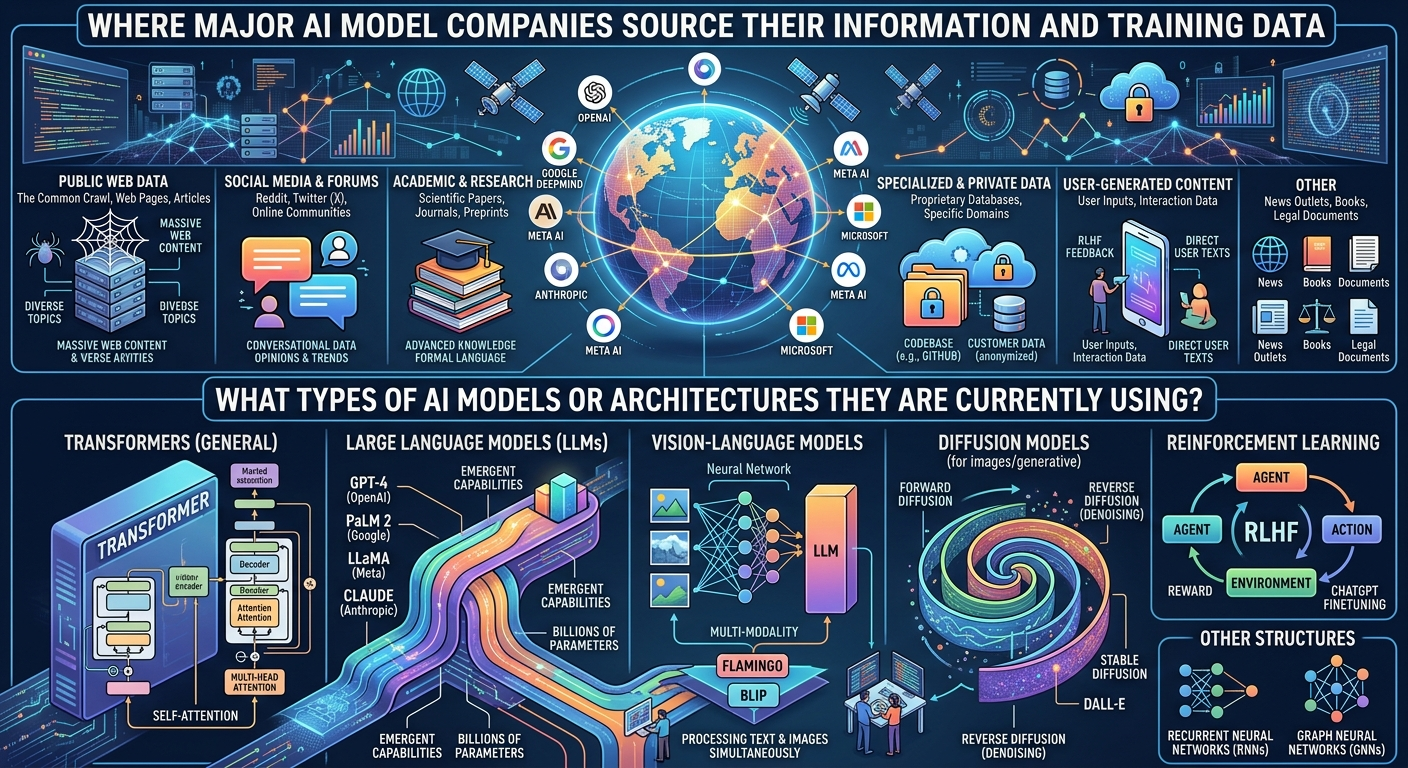
Yet the exact contents of frontier-model training datasets are rarely disclosed in full. Public documentation generally identifies broad categories—such as publicly available Internet information, licensed material, human-generated examples, contractor data and synthetic data—without publishing a complete list of every website, book, image collection, database or document used. OpenAI, for example, identifies three primary information categories: public Internet information, third-party-accessed information, and information supplied or generated by users, human trainers and researchers. It also states that synthetic data is used in model development.
This thesis examines the information ecosystem behind major AI-model companies, explains the distinction between training data, post-training data, retrieval data and user-context data, and compares the principal architectures currently used across the industry. It argues that the competitive frontier is moving away from the simplistic idea that “the company with the most data wins.” Instead, advantage increasingly depends on data quality, data rights, synthetic-data generation, reasoning-oriented post-training, multimodality, mixture-of-experts architectures, reinforcement learning, inference-time computation and agentic systems.
1. Introduction
Artificial intelligence models are often described as if they were primarily algorithms. In reality, a modern foundation model is the product of several interconnected layers:
- Data
- Data acquisition
- Data cleaning and filtering
- Tokenization or multimodal representation
- Pre-training
- Post-training
- Human or AI feedback
- Reinforcement learning
- Evaluation
- Inference infrastructure
- Retrieval and external tools
- Continuous model improvement
The central question is therefore not simply:
“What model architecture does an AI company use?”
It is also:
“What information does the company have legal or practical access to, how does it transform that information into training material, and how does the resulting model learn from it?”
This distinction is particularly important because the largest AI companies increasingly treat their data recipes as proprietary intellectual property.
Mistral AI, for example, explicitly states that it does not disclose the datasets used to train its models and considers training datasets, training logic and the resources required to produce its models proprietary.
Consequently, any serious comparison must distinguish between confirmed disclosures, partial disclosures and reasonable technical inference.
2. The AI Training Data Supply Chain
A useful way to understand modern AI is to imagine a data supply chain.
Raw information
↓
Data acquisition
↓
Rights/licensing assessment
↓
Cleaning and deduplication
↓
Quality classification
↓
Safety filtering
↓
Tokenization / multimodal processing
↓
Pre-training dataset
↓
Foundation model
↓
Supervised fine-tuning
↓
Preference / reinforcement data
↓
Synthetic data
↓
Evaluation
↓
Production model
↓
User interaction and feedback
This pipeline demonstrates an important fact: the training dataset is not the same thing as the information the AI can access after deployment.
A model may be trained on historical Internet information but subsequently use search engines, databases, APIs, enterprise documents or other tools during inference.
3. The Major Categories of AI Training Information
3.1 Publicly Available Internet Information
The public Internet remains one of the most important sources of large-scale training material.
It can include:
- Web pages
- Documentation
- Encyclopedic material
- Educational resources
- Public discussions
- Public-domain material
- Public code repositories
- News and articles
- Scientific information
- Technical documentation
- Publicly available images
- Other multimedia
OpenAI identifies publicly available Internet information as one of the three primary categories used to develop its foundation models.
Anthropic similarly states that Claude models have been trained using a proprietary mixture that includes publicly available Internet information.
xAI says Grok has primarily been pretrained on publicly available information, including webpage data, metadata extracts and Internet text.
DeepSeek’s disclosure likewise identifies publicly available Internet information as a major pre-training source.
4. Licensed and Third-Party Data
Public Internet information is only one component of the modern training ecosystem.
Companies increasingly acquire additional material through:
- Commercial licensing
- Data providers
- Institutional partnerships
- Publishers
- Specialist databases
- Enterprise partnerships
- Human-data contractors
- Research organizations
OpenAI states that its models also use information obtained through partnerships with third parties.
Anthropic reports using non-public data from third parties as well as data generated by labeling services and paid contractors.
DeepSeek explicitly describes a two-part pre-training data strategy involving public information and licensed proprietary datasets obtained through third-party agreements.
This illustrates an important industry transition:
The future training-data market is increasingly becoming a commercial data market.
5. Human-Generated Training Data
Large models require more than raw Internet information.
A webpage can tell a model what words and concepts exist, but it does not necessarily teach the model:
- How to follow instructions
- How to reason through a problem
- How to refuse unsafe requests
- How to communicate clearly
- How to prioritize competing instructions
- How to produce useful code
- How to evaluate an answer
Consequently, AI laboratories employ human researchers, contractors, domain specialists and evaluators to create or assess training examples.
Human-generated information may include:
- Question-and-answer pairs
- Demonstrations
- Corrections
- Preference rankings
- Safety examples
- Coding examples
- Reasoning examples
- Evaluation datasets
- Domain-specific annotations
Anthropic reports using data provided by labeling services and paid contractors.
OpenAI similarly identifies human trainers and researchers as sources of information used in model development.
6. Synthetic Data: The New Training-Data Factory
One of the most important developments in AI is the rise of synthetic data.
Synthetic data is information generated by AI systems or other computational processes rather than directly collected from humans or the physical world.
It can include:
- Artificial question-answer pairs
- Generated mathematics problems
- Synthetic programming problems
- Generated reasoning chains
- Artificial conversations
- Simulated environments
- Automatically generated explanations
- Critiques of AI-generated answers
- Machine-generated preference data
Microsoft’s Phi-4 research is a particularly clear example. Microsoft describes Phi-4 as a 14-billion-parameter model whose training recipe places unusual emphasis on data quality and strategically incorporates synthetic data throughout training.
Meta’s Llama 3.1 training methodology also describes iterative post-training involving supervised fine-tuning, direct preference optimization and synthetic data generation.
Qwen3 provides another example: Alibaba reports using models such as Qwen2.5-Math and Qwen2.5-Coder to generate synthetic mathematics, textbooks, question-answer pairs and code-related material.
This changes the economics of AI.
The industry is gradually moving from:
“Collect as much human-generated information as possible”
toward:
“Collect high-quality information and use models to generate additional high-quality training environments.”
7. User Data and Feedback
User interactions can occupy a complicated position in the AI-development lifecycle.
A crucial distinction must be made between:
A. Information used to train the foundation model
and
B. Information temporarily supplied to a model during inference.
These are not automatically the same.
OpenAI says information supplied by users can form part of model development, subject to its policies and controls.
Anthropic says commercial-product inputs and outputs are not used for training by default, while specific feedback or explicit opt-in can permit use for training.
xAI states that consumer interactions may be used for training and provides controls allowing users to opt out; it also says business and enterprise customer data is not used to improve its models.
Mistral’s current policies similarly distinguish between consumer and enterprise use and provide controls concerning model training.
Therefore, the phrase “AI trains on everything users type” is an oversimplification.
The actual situation depends on:
- Product
- Subscription type
- Privacy settings
- Enterprise agreement
- Feedback mechanism
- Applicable law
- Company’s current policy
8. OpenAI
8.1 Data Sources
OpenAI publicly identifies three major information categories:
- Publicly available Internet information
- Information accessed through third-party partnerships
- Information supplied or generated by users, human trainers and researchers
OpenAI additionally reports the use of synthetic data. Its current training-data summary says its systems are developed using datasets containing trillions of tokens spanning textual, image, audio and audiovisual content.
OpenAI also notes that its datasets can contain material protected by copyright as well as public-domain material.
The company applies processing and filtering techniques intended to improve data quality, accuracy, privacy and safety.
8.2 Architecture
OpenAI does not publicly disclose every architectural detail of its current frontier systems.
Historically, GPT systems have been based on Transformer-derived architectures, but modern frontier models should not be thought of simply as “a Transformer.”
The contemporary architecture stack may include:
- Transformer components
- Large-scale attention mechanisms
- Specialized routing
- Multimodal encoders
- Reasoning-oriented computation
- Tool-use systems
- Retrieval
- Reinforcement learning
- Distillation
- Synthetic-data pipelines
- Agentic orchestration
The exact internal architecture of current proprietary frontier models remains substantially undisclosed.
9. Google DeepMind and Gemini
Google has a unique position because it combines:
- Search
- YouTube
- Android
- Cloud
- Books
- Maps
- Scientific research
- DeepMind
- Large-scale computing
- Extensive multimodal infrastructure
This does not mean that all Google user information is automatically used to train Gemini. Data access and training use remain governed by product policies, technical controls and legal requirements.
Gemini represents a particularly important development in AI architecture because Google has pursued models designed from the beginning for multimodality.
Rather than treating text as the only fundamental information format, modern Gemini systems are designed to work across combinations of:
- Text
- Images
- Audio
- Video
- Code
- Documents
The strategic significance is enormous.
Traditional LLM:
Text → tokens → Transformer → text
Multimodal foundation model:
Text + image + audio + video + code + other representations → shared model system → multimodal output
Google’s AI ecosystem therefore illustrates the transition from language models toward general-purpose multimodal models.
10. Anthropic and Claude
Anthropic’s Claude models represent another major branch of frontier AI.
Anthropic reports that Claude Opus 4 and Sonnet 4 were pretrained on large, diverse datasets and subsequently subjected to post-training involving human feedback and Constitutional AI.
Its disclosed training-data categories include:
- Public Internet information
- Non-public third-party data
- Data from labeling services
- Paid-contractor data
- Opted-in user data
- Internally generated data
Constitutional AI
One of Anthropic’s distinguishing contributions is Constitutional AI.
Instead of depending exclusively on human preference labels, the methodology uses explicit principles to help guide model behavior.
Conceptually:
Base model
↓
Principles
↓
Self-critique
↓
Improved responses
↓
Preference / reinforcement training
↓
Aligned model
Anthropic therefore demonstrates that training-data strategy is not merely about accumulating more documents. It is also about generating behavioral supervision.
11. Meta and Llama
Meta’s Llama family has become one of the most important open-weight model ecosystems.
Llama 3 provides unusually informative public documentation.
Meta states that Llama 3 was pretrained on more than 15 trillion tokens collected from publicly available sources, with the dataset seven times larger than Llama 2’s and containing four times more code.
Meta also describes:
- A 128K-token vocabulary
- Decoder-only Transformer architecture
- Grouped-query attention
- Extensive data filtering
- Quality classifiers
- Multilingual data
Llama 3.1 continued this philosophy.
Meta describes its 405-billion-parameter model as a standard decoder-only Transformer with adaptations rather than a mixture-of-experts architecture, emphasizing training stability.
This is important because it demonstrates that larger parameter count does not automatically require MoE.
12. xAI and Grok
xAI’s Grok family represents another important frontier.
The original Grok-1 was an autoregressive Transformer-based language model trained using next-token prediction and subsequently fine-tuned using human and model-generated feedback.
xAI later disclosed Grok-1 as a 314-billion-parameter Mixture-of-Experts model, with approximately 25% of its parameters active for an individual token.
Grok’s disclosed data ecosystem includes:
- Public Internet information
- Third-party generated data
- User data
- Contractor data
- Internally generated data
Its Grok 4 model card also describes reinforcement learning involving human feedback, verifiable rewards and model grading.
xAI’s later framework states that it uses synthetic data in reinforcement learning, fine-tuning and post-training.
Grok therefore illustrates the evolution toward:
Internet data + synthetic data + reinforcement learning + verification + agentic capability.
13. DeepSeek
DeepSeek has become particularly influential because it demonstrated that efficient architectures and training methodologies can dramatically reduce the cost of achieving high capability.
DeepSeek-V3 was reported as having:
- 671 billion total parameters
- Approximately 37 billion activated parameters
- 14.8 trillion training tokens
Its architecture is based on a Mixture-of-Experts approach.
DeepSeek’s own model disclosure identifies public Internet data and licensed third-party data as major pre-training sources. It also describes filtering, human and algorithmic review, synthetic or automatically constructed question-answer data, and safety-oriented training.
DeepSeek’s importance therefore extends beyond its model itself.
It demonstrates the strategic value of:
- Sparse computation
- Efficient expert routing
- High-quality datasets
- Synthetic data
- Reinforcement learning
- Open technical publication
14. Alibaba Qwen
Qwen illustrates another major development: massive multilingual and multimodal training combined with synthetic data generation.
Qwen3 reportedly expanded pre-training to approximately 36 trillion tokens, covering 119 languages and dialects. Alibaba says the data included Web material and PDF-like documents and that models were used to extract and improve information from documents.
The Qwen training ecosystem also generated synthetic mathematics and coding data using specialized models.
This represents an important architectural principle:
A model can become part of the machinery used to create the training data for the next model.
That creates a feedback loop:
Model A
→ generates data
→ Model B training
→ improves reasoning
→ generates better data
→ Model C
This is increasingly important in frontier AI.
15. Mistral AI
Mistral has contributed significantly to the development of open and efficient model architectures.
Its Mixtral family is especially important because it demonstrates the power of Sparse Mixture-of-Experts architectures.
Mixtral 8×7B consists of eight expert groups with routing that selects two experts for each token. Mistral explains that this increases total model capacity while activating only a fraction of the parameters for each token.
Mixtral 8×22B continued the strategy, with 141 billion total parameters but approximately 39 billion active parameters.
However, Mistral is considerably less transparent about the exact datasets underlying its proprietary models.
The company explicitly states that its training datasets remain undisclosed proprietary assets.
This demonstrates a fundamental industry tension:
Open model weights do not necessarily mean open training data.
16. Microsoft Phi
Microsoft’s Phi family demonstrates a different philosophy.
Instead of relying primarily on gigantic model size, Microsoft has emphasized high-quality training data, synthetic data and efficient small models.
Phi-4 contains approximately 14 billion parameters and was designed with a strong emphasis on data quality. Microsoft reports that synthetic data plays a significant role throughout the training process.
The significance is profound.
A smaller model trained on exceptionally good data can outperform a larger model trained on lower-quality data for particular tasks.
This leads to a broader principle:
Parameter count is not a complete measure of intelligence.
17. Comparing Major Companies
| Company / Family | Major disclosed data categories | Architecture direction | Openness |
|---|---|---|---|
| OpenAI / GPT | Public Internet, third-party data, user/human/researcher data, synthetic data | Proprietary frontier architecture; Transformer-derived ecosystem | Mostly closed |
| Google / Gemini | Large-scale multimodal and Google/third-party information ecosystem | Multimodal frontier architecture | Mostly closed |
| Anthropic / Claude | Public Internet, third-party, contractors, opt-in users, internal data | Proprietary Transformer-derived frontier systems | Closed |
| Meta / Llama | Publicly available sources, extensive code and multilingual data | Decoder-only Transformer; GQA; large dense models in disclosed Llama generations | Open-weight |
| xAI / Grok | Public Internet, third-party, user/contractor and internal data, synthetic data | Transformer + MoE in disclosed Grok generations | Mixed |
| DeepSeek | Public Internet + licensed data + generated optimization data | MoE and efficiency-oriented architectures | Relatively open |
| Alibaba / Qwen | Web, documents, synthetic math/code data | Dense and MoE variants; multilingual/multimodal | Open-weight for many models |
| Mistral | Not publicly disclosed in full | Dense and sparse MoE architectures | Mixed/open-weight |
| Microsoft / Phi | Organic data plus extensive synthetic data | Compact Transformer-derived models | Open-weight for several releases |
The table should be interpreted carefully: companies frequently have multiple model families, and the architecture of one generation cannot automatically be assigned to every current model.
18. The Transformer Remains the Foundation
Despite enormous innovation, the Transformer remains the dominant foundation for modern generative AI.
The basic Transformer contains mechanisms that allow the model to process relationships among tokens.
At a simplified level:
Input
↓
Tokenization
↓
Embeddings
↓
Attention
↓
Feed-forward computation
↓
Repeated layers
↓
Output probabilities
↓
Next token
The original Transformer architecture has evolved substantially.
Modern systems may incorporate:
- Multi-head attention
- Grouped-query attention
- Multi-query attention
- Rotary positional representations
- Mixture-of-experts
- Long-context mechanisms
- Multimodal encoders
- Retrieval systems
- Tool calling
- Reasoning-time computation
- Reinforcement learning
Thus, saying that a model is “a Transformer” is technically correct but increasingly incomplete.
19. Mixture-of-Experts Architecture
Mixture-of-Experts, or MoE, is one of the most important architectural developments.
A dense model activates essentially the same major parameter pathway for each token.
An MoE model contains multiple expert networks.
Conceptually:
Token
↓
Router
↙ ↓ ↘
Expert A | Expert B | Expert C
↓
Selected expert outputs
↓
Combined representation
↓
Next layer
The key advantage is that a model can contain enormous total parameter capacity while activating only a fraction of that capacity for each token.
DeepSeek-V3, Grok-1 and Mixtral are prominent examples of the MoE direction.
20. Dense Models
Dense models activate their primary parameters for each token.
Advantages can include:
- Simpler architecture
- Predictable computation
- Straightforward scaling
- Stable training characteristics
Meta’s disclosed Llama 3.1 405B architecture is a notable example of a large decoder-only Transformer that did not adopt MoE.
Dense architecture therefore remains highly relevant.
21. Multimodal Models
The next generation of AI is increasingly multimodal.
Instead of:
Text → Text
the system becomes:
Text + Image + Audio + Video + Code + Documents
↓
Unified or coordinated representation
↓
Reasoning
↓
Text / Image / Audio / Action
This is particularly important for systems intended to operate as general-purpose assistants.
A multimodal model can potentially:
- Read documents
- Interpret diagrams
- Analyze images
- Understand speech
- Process video
- Write software
- Generate images
- Reason over multiple information formats
The architecture becomes less like a traditional language model and more like a general information-processing system.
22. Retrieval-Augmented Generation
Another important distinction is between training and retrieval.
A model does not necessarily need to memorize every piece of information it uses.
A retrieval system can work as follows:
User question
↓
Search / retrieval
↓
Relevant documents
↓
Context window
↓
AI model
↓
Answer
This is called Retrieval-Augmented Generation (RAG).
RAG is particularly important for:
- Enterprise databases
- Legal information
- Scientific literature
- Corporate documents
- Product manuals
- Internal knowledge
- Frequently changing information
It allows organizations to connect a foundation model to current information without retraining the entire model every time the underlying information changes.
23. AI Agents
The frontier is increasingly moving beyond standalone chatbots.
An AI agent can combine:
- Foundation model
- Memory
- Retrieval
- Planning
- Tools
- APIs
- Code execution
- Browser/search capability
- External databases
- Feedback loops
The conceptual architecture becomes:
User
↓
Agent
↓
Reasoning model
↙ ↓ ↘
Search | Code | Database
↘ ↓ ↙
Observation
↓
Reasoning
↓
Action
↓
Result
This changes what “AI training data” means.
The model itself may have been trained on historical data, while the agent obtains current information through external systems.
24. Reinforcement Learning
Modern frontier systems increasingly use reinforcement learning or related preference-optimization techniques.
The basic concept is:
Model generates answer
↓
Answer evaluated
↓
Reward / preference signal
↓
Model parameters updated
↓
Better future behavior
The reward can come from:
- Humans
- AI evaluators
- Verifiable mathematical answers
- Coding tests
- Simulated environments
- Safety classifiers
- Rule-based systems
xAI explicitly reports human feedback, verifiable rewards and model grading in its Grok 4 training methodology.
Anthropic describes human feedback and Constitutional AI in Claude’s post-training process.
25. The Rise of Verifiable Training
One of the most significant developments is the shift toward tasks where correctness can be automatically checked.
Examples include:
- Mathematics
- Programming
- Formal logic
- Some scientific problems
- Games
- Simulated environments
For these tasks, the system can receive a reward based on whether the answer actually works.
For example:
AI writes code
↓
Compiler executes code
↓
Tests run
↓
Tests pass
↓
Positive reward
This creates a much stronger learning signal than simply asking a human whether the response “looks good.”
26. Data Quality Versus Data Quantity
The early AI race emphasized enormous datasets.
Modern research increasingly emphasizes data quality.
A high-quality dataset can contain:
- Correct information
- Diverse examples
- High-value reasoning
- Strong code
- Verified mathematics
- Accurate scientific material
- Good instructional examples
- Carefully selected multilingual information
Low-quality data can contain:
- Duplicates
- Spam
- Incorrect information
- SEO-generated pages
- Toxic material
- Machine-generated repetition
- Poor translations
- Contradictions
Therefore:
More tokens ≠ automatically better intelligence.
The modern equation is closer to:
Capability = data quality × data diversity × architecture × compute × optimization × post-training
27. The Problem of Data Contamination
As AI-generated content spreads across the Internet, a major problem emerges.
Suppose:
AI Model A
generates millions of webpages.
Those webpages are later scraped by:
AI Model B
Model B is therefore learning from information originally generated by Model A.
If this continues repeatedly, training datasets can become increasingly synthetic and repetitive.
This creates concerns about:
- Information degradation
- Error propagation
- Model collapse
- Reduced diversity
- Circular knowledge
- Hidden bias amplification
Consequently, future AI laboratories will need increasingly sophisticated systems for identifying:
Human-generated data
versus
Machine-generated data.
28. Copyright and Data Rights
One of the largest unresolved issues surrounding AI concerns the legal status of training data.
Training datasets may contain:
- Copyrighted works
- Public-domain works
- Licensed material
- User-generated content
- Public personal information
- Commercial databases
Different jurisdictions have different rules concerning:
- Copyright
- Text and data mining
- Fair use
- Licensing
- Privacy
- Database rights
- Opt-out mechanisms
OpenAI explicitly acknowledges that its training datasets may contain copyright-protected material.
The future AI economy will therefore involve an expanding market for legally licensed training information.
29. Privacy
Privacy is another major dimension.
A large training dataset may inadvertently contain:
- Names
- Addresses
- Telephone numbers
- Public profiles
- Personal documents
- Sensitive information
Companies therefore employ:
- Filtering
- Deduplication
- Redaction
- Classification
- Data minimization
- Privacy controls
DeepSeek states that it attempts to remove sensitive and identifying information from training datasets and uses filtering and testing procedures.
Anthropic similarly describes processes addressing personal data within training information.
30. Why AI Companies Do Not Publish Everything
There are several reasons.
30.1 Competitive advantage
The dataset itself can be valuable intellectual property.
30.2 Legal uncertainty
Publishing a complete dataset inventory could expose companies to additional disputes.
30.3 Security
Detailed disclosure can reveal weaknesses in filtering or safety systems.
30.4 Cost
Large datasets may involve expensive licensing agreements.
30.5 Privacy
Publishing data sources at excessive granularity could expose sensitive information.
30.6 Strategic secrecy
Knowing the exact data recipe can help competitors reproduce a model.
Thus, the modern AI industry often publishes categories and methodologies rather than complete datasets.
31. Open-Weight Does Not Mean Open-Source Everything
This distinction is critical.
An AI company can release:
Model weights
without releasing:
- Original training datasets
- Data licenses
- Filtering systems
- Training infrastructure
- Proprietary evaluation datasets
- Complete post-training data
- Internal research methods
Meta, DeepSeek, Mistral and other companies demonstrate different points along this openness spectrum.
Consequently, the AI industry contains several levels of openness:
Closed model
↓
Open API
↓
Open technical paper
↓
Open weights
↓
Open architecture
↓
Open training methodology
↓
Open datasets
↓
Fully reproducible system
Very few frontier systems are completely open across all layers.
32. The New Strategic Resource: Data Generation
An important development is that leading AI companies increasingly possess systems capable of creating their own training material.
This produces a powerful cycle:
Human data
↓
Foundation model
↓
Synthetic-data generator
↓
Higher-quality training data
↓
Improved model
↓
Better synthetic-data generator
↓
Even better model
This could eventually reduce dependence on raw Internet data.
The critical challenge becomes determining:
How do we verify that synthetic information is actually better than the information from which it was generated?
33. AI Models Are Becoming Training Ecosystems
A modern AI company is therefore not simply building one neural network.
It is building an ecosystem:
Layer 1 — Data
Public, licensed, proprietary and synthetic information.
Layer 2 — Data engineering
Cleaning, filtering, deduplication and classification.
Layer 3 — Foundation model
Transformer, MoE, multimodal or other neural architecture.
Layer 4 — Post-training
Supervised fine-tuning and preference optimization.
Layer 5 — Reinforcement learning
Human, AI or verifiable rewards.
Layer 6 — Evaluation
Benchmarks, adversarial testing and real-world evaluation.
Layer 7 — Retrieval
Search and databases.
Layer 8 — Tools
Code execution, APIs and external systems.
Layer 9 — Agent
Planning and autonomous task execution.
Layer 10 — Product
Chatbots, coding assistants, enterprise systems, robotics and other applications.
The model is therefore only one component.
34. The Emerging Architecture of Frontier AI
A useful conceptual model of the modern frontier system is:
                    HUMAN KNOWLEDGE
                           │
        ┌──────────────────┼──────────────────┐
        │                  │                  │
   PUBLIC WEB          LICENSED DATA     HUMAN DATA
        │                  │                  │
        └──────────────────┼──────────────────┘
                           ↓
                    DATA PROCESSING
                           ↓
              FILTERING + DEDUPLICATION
                           ↓
                    PRE-TRAINING
                           ↓
                 FOUNDATION MODEL
                           ↓
        ┌──────────────────┼──────────────────┐
        │                  │                  │
   FINE-TUNING        RL / PREFERENCE    SYNTHETIC DATA
        │                  │                  │
        └──────────────────┼──────────────────┘
                           ↓
                       REASONING
                           ↓
                 RETRIEVAL + TOOLS
                           ↓
                        AGENT
                           ↓
                    USER / WORLD
                           │
                           ↓
                    FEEDBACK LOOP
                           │
                           └──────→ FUTURE TRAINING
This architecture captures the fundamental transformation taking place in AI.
35. What Each Major Company Appears to Optimize
A simplified strategic interpretation is useful.
OpenAI
Focus:
- Frontier capability
- Multimodal intelligence
- Reasoning
- Agents
- Large-scale deployment
Google DeepMind
Focus:
- Multimodality
- Scientific AI
- Search integration
- Large-scale infrastructure
- General intelligence research
Anthropic
Focus:
- Reasoning
- Coding
- Reliability
- Safety
- Constitutional alignment
- Enterprise use
Meta
Focus:
- Open-weight ecosystem
- Large-scale models
- Developer adoption
- AI infrastructure
- Consumer AI
xAI
Focus:
- Frontier models
- Real-time information
- Reasoning
- Coding
- Agentic systems
DeepSeek
Focus:
- Efficient training
- MoE
- Reasoning
- Open models
- Cost efficiency
Alibaba/Qwen
Focus:
- Multilingual AI
- Reasoning
- Coding
- Multimodal systems
- Open model ecosystem
Mistral
Focus:
- Efficient models
- Open-weight systems
- Enterprise AI
- European AI sovereignty
- Specialized models
Microsoft/Phi
Focus:
- Small efficient models
- Synthetic data
- On-device AI
- Efficient reasoning
36. The AI Data Race Is Becoming a Data-Quality Race
The industry’s competitive structure is changing.
The first phase was:
More Internet data
The second phase:
More compute
The third phase:
Bigger models
The fourth phase:
Better post-training
The emerging phase is:
Better information + synthetic data + reasoning + efficient architectures + inference-time computation.
This means the next generation of AI companies may not win by merely possessing the largest raw dataset.
They may win through the ability to transform mediocre information into high-value learning experiences.
37. The Importance of Specialized Data
General Internet information is useful for general intelligence.
But specialized applications require specialized data.
Examples:
Medicine
- Clinical literature
- Medical textbooks
- Structured medical data
- Carefully validated expert examples
Engineering
- Technical specifications
- CAD information
- Engineering standards
- Simulation results
Law
- Legislation
- Regulations
- Court decisions
- Legal commentary
Agriculture
- Crop data
- Weather
- Soil information
- Satellite imagery
- Agricultural research
Finance
- Market information
- Economic statistics
- Company filings
- Financial reports
Science
- Scientific publications
- Experimental results
- Databases
- Simulations
This explains why enterprise-specific AI training is becoming increasingly important.
Mistral’s Forge initiative is explicitly aimed at allowing enterprises to build models grounded in proprietary organizational knowledge, with partnerships involving organizations such as ASML, Ericsson, the European Space Agency and others.
38. The Future of Training Data
The next decade is likely to produce several major trends.
38.1 More licensed data
Companies will increasingly negotiate explicit rights to high-value datasets.
38.2 More synthetic data
AI will increasingly manufacture specialized training examples.
38.3 More verified data
Mathematics, code and scientific reasoning will benefit from automatically verifiable training.
38.4 More multimodal data
Text alone will no longer dominate the foundation-model ecosystem.
38.5 More private enterprise data
Companies will build AI around internal knowledge.
38.6 More regional datasets
African, Asian, Latin American and other underrepresented languages and cultural contexts will become strategically important.
38.7 More continual data pipelines
AI systems will increasingly interact with continuously updated information rather than relying exclusively on static training datasets.
39. Africa and the Training-Data Opportunity
Africa represents an important underdeveloped AI-data opportunity.
Many African languages remain significantly underrepresented in major datasets.
Potential training resources include:
- African language corpora
- Local literature
- Educational material
- Agricultural knowledge
- Government documents
- Historical archives
- Indigenous knowledge where appropriate and legally permissible
- African scientific research
- Local business information
- Geospatial data
The challenge is not simply collecting the information.
It is ensuring:
- Consent
- Ownership
- Cultural respect
- Linguistic quality
- Compensation
- Privacy
- Data sovereignty
African AI development therefore presents an opportunity to move from being primarily a consumer of imported AI to becoming a producer of globally valuable AI data and models.
40. The Fundamental Difference Between Knowledge and Intelligence
An important conceptual conclusion emerges from studying these companies.
A model can have enormous quantities of information without possessing reliable reasoning.
Therefore:
Knowledge ≠ intelligence.
A modern AI system needs:
Knowledge
Representation
Reasoning
Planning
Verification
Memory
Tools
Feedback
The evolution of frontier AI is therefore moving from simply teaching models more facts toward creating systems capable of using knowledge effectively.
41. Major Findings
This thesis produces several central findings.
Finding 1
There is no single universal source of AI training data.
Finding 2
Public Internet information remains fundamental, but it is increasingly supplemented by licensed, proprietary, human-generated and synthetic information.
Finding 3
Exact datasets are often proprietary.
Finding 4
Open model weights do not necessarily mean open datasets.
Finding 5
Synthetic data has become a major component of modern AI development.
Finding 6
The Transformer remains the dominant foundational architecture.
Finding 7
Mixture-of-Experts is increasingly important because it allows large parameter capacity with sparse computation.
Finding 8
Multimodal AI is replacing text-only thinking about foundation models.
Finding 9
Post-training and reinforcement learning are increasingly as important as pre-training.
Finding 10
Retrieval, tools and agents extend the capabilities of foundation models beyond their static training data.
Finding 11
Data quality is increasingly more important than raw data quantity.
Finding 12
The competitive frontier is moving toward reasoning, verification, agents and inference-time computation.
42. Conclusion
The question “Where do AI companies get their information?” has no simple one-line answer.
The modern AI training ecosystem is a combination of:
public information + licensed information + human-generated information + proprietary information + synthetic data + feedback + reinforcement signals.
The second question—“What architectures do they use?”—is equally complex.
The dominant foundation remains the Transformer, but the modern AI architecture has evolved into a much broader system incorporating:
Transformers + Mixture-of-Experts + multimodality + reinforcement learning + synthetic data + retrieval + tools + agents + inference-time reasoning.
OpenAI, Google DeepMind, Anthropic, Meta, xAI, DeepSeek, Alibaba and Mistral are pursuing different combinations of these technologies. Meta provides unusually detailed public information about Llama’s training data and architecture; DeepSeek has emphasized efficient MoE systems and open technical disclosure; Anthropic emphasizes human feedback and Constitutional AI; Microsoft demonstrates the power of synthetic-data-centered small models; Mistral has pioneered efficient sparse MoE models; Qwen demonstrates enormous multilingual and synthetic-data pipelines; and xAI combines large-scale Internet data with reinforcement-learning and synthetic-data strategies.
The deeper lesson is that the foundation model itself is no longer the entire AI system.
The emerging AI machine is better understood as:
Data → Model → Post-training → Reasoning → Retrieval → Tools → Agent → Feedback → New Data.
That creates a self-improving technological ecosystem in which data produces models, models produce synthetic data, synthetic data improves models, and increasingly capable models interact with the external world through tools and agents.
The great strategic question of the coming AI era may therefore not simply be who has the largest model, but rather:
Who can build the most effective closed-loop system for acquiring, governing, generating, learning from, verifying and deploying information?
That is likely to be one of the defining competitive advantages of the next generation of artificial intelligence.
Selected Sources and Further Reading
- OpenAI — How ChatGPT and foundation models are developed
- OpenAI — Training Data Summary
- Anthropic — Transparency Hub
- Meta — Introducing Llama 3
- Meta — Introducing Llama 3.1
- DeepSeek — Model Mechanism and Training Methods
- DeepSeek — DeepSeek-V3
- Qwen — Qwen3 Technical Overview
- Mistral AI — Mixtral of Experts
- Mistral AI — Training Dataset Disclosure
- Microsoft Research — Phi-4 Technical Report
- xAI — Grok 4 Model Card
- xAI — Grok-1 Architecture and Release
Research note: Exact training-data inventories for leading proprietary models are generally unavailable publicly. Where companies disclose only broad categories, this thesis deliberately avoids presenting speculation as fact. Architecture descriptions likewise distinguish publicly documented architectures from proprietary systems whose complete internal designs have not been released.



Be First to Comment