
Introduction
Artificial intelligence has traditionally depended heavily on powerful centralized computers and cloud data centers. A device such as a camera, vehicle, industrial machine, smartphone, or sensor would collect information, transmit it across a network, and wait for a remote computer to analyze it.
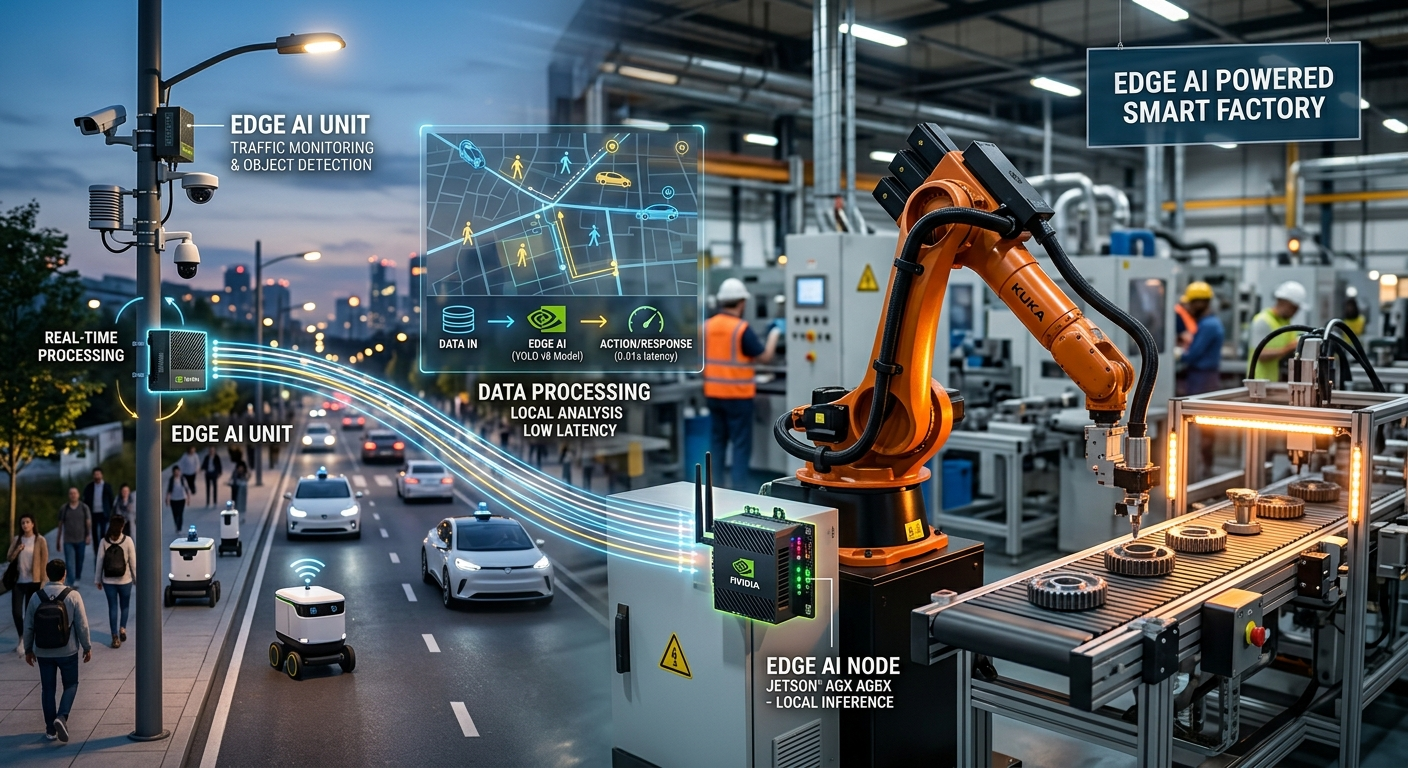
Edge AI changes this architecture by bringing AI processing closer to where data is generated and where decisions need to be made.
Edge AI combines artificial intelligence with edge computing, allowing AI models to run directly on, or close to, devices at the edge of a network. Instead of sending every piece of data to a distant cloud, an edge system can analyze information locally and respond immediately.
This seemingly simple architectural change has major implications for computing, telecommunications, robotics, manufacturing, healthcare, transportation, agriculture, smart cities, consumer electronics and the future of autonomous systems.
1. The Basic Meaning of Edge AI
Edge AI is the deployment and execution of AI models close to the physical location where data is produced.
The “edge” can be:
- A smartphone
- A security camera
- A vehicle
- A factory machine
- A robot
- A medical device
- A smart appliance
- An agricultural sensor
- A telecommunications base station
- An industrial gateway
- A local edge server
- An IoT device
IBM describes edge AI as the combination of edge computing and AI, with machine-learning tasks performed on interconnected edge devices rather than relying continuously on centralized cloud infrastructure.
A simplified architecture is:
Physical world → Sensors → Edge device → AI inference → Immediate action
while a traditional cloud architecture might be:
Physical world → Sensors → Internet → Cloud/data center → AI inference → Internet → Device/action
The first architecture can significantly reduce the distance that data must travel.
2. Understanding the “Edge”
To understand Edge AI, it is important to understand the word edge.
In computing, the edge is not necessarily one particular location. It means a point in the computing and communications system that is relatively close to the user, machine, sensor or physical process generating the data.
For example, consider a factory.
A conventional architecture could send camera footage from the factory to a centralized cloud data center for analysis.
An edge architecture could place an AI computer inside the factory. The camera sends its video to the nearby AI computer, which analyzes the footage locally.
The result might be produced immediately:
Camera → Edge AI computer → Detection → Factory system
Only selected information may subsequently be sent to the cloud.
Edge computing generally brings computing resources closer to data sources to improve response times and reduce unnecessary data transmission.
3. Edge AI Versus Cloud AI
The distinction can be understood through the location of computation.
| Characteristic | Cloud AI | Edge AI |
|---|---|---|
| Main processing location | Centralized cloud/data center | Device or nearby edge infrastructure |
| Data movement | Usually more extensive | Usually reduced |
| Response time | Can depend on network conditions | Often very low latency |
| Internet dependence | Frequently significant | Can operate locally |
| Bandwidth requirement | Potentially high | Potentially lower |
| Local autonomy | Lower | Higher |
| Centralized management | Strong | More distributed |
| Device requirements | Lower | Higher |
| Fleet management | Easier centrally | More complex |
| Suitable applications | Large-scale analysis, training | Real-time local inference |
The two approaches are not competitors in every situation. In many sophisticated systems, cloud AI and Edge AI work together.
The cloud may perform model training, centralized analytics and fleet management, while edge devices perform rapid inference and local decision-making.
4. The Most Important Concept: Training Versus Inference
One of the most important ideas in Edge AI is the difference between training and inference.
Training
Training is the process through which an AI model learns patterns from data.
Large models can require enormous amounts of:
- Data
- Computing power
- Memory
- Storage
- Time
- Specialized processors
Training therefore commonly occurs in powerful data centers or cloud environments.
Inference
Inference occurs when an already-trained model receives new information and produces an answer.
For example:
A camera sees an object → the model analyzes the image → the model determines what it is.
That is inference.
Edge AI is especially concerned with making this inference process happen locally.
A simplified lifecycle is:
Data collection → Model training → Model optimization → Edge deployment → Local inference → Feedback → Model improvement
NVIDIA similarly describes an architecture in which models can be trained centrally and then deployed as inference engines on devices operating in factories, hospitals, vehicles and other environments.
5. Anatomy of an Edge AI System
A complete Edge AI system can contain several layers.
Layer 1: Physical Environment
This is where events occur.
Examples include:
- Roads
- Farms
- Factories
- Hospitals
- Homes
- Warehouses
- Shops
- Power infrastructure
- Telecommunications networks
Layer 2: Sensors
Sensors convert physical events into digital information.
Examples include:
- Cameras
- Microphones
- Temperature sensors
- Pressure sensors
- Motion sensors
- Radar
- LiDAR
- GPS
- Accelerometers
- Industrial monitoring sensors
Layer 3: Edge Device
The edge device receives the sensor information.
It could be:
- A smartphone
- Camera
- Robot
- Vehicle computer
- Industrial controller
- Embedded computer
- IoT device
Layer 4: AI Accelerator
AI workloads can be accelerated by specialized processors.
Examples include:
- CPUs
- GPUs
- NPUs
- AI accelerators
- Specialized inference processors
Modern edge platforms increasingly combine general-purpose computing with specialized AI acceleration to obtain useful AI performance within power and thermal constraints.
Layer 5: AI Model
The model interprets the incoming information.
It could perform:
- Image classification
- Object detection
- Speech recognition
- Anomaly detection
- Predictive maintenance
- Sensor analysis
- Natural-language processing
- Forecasting
Layer 6: Decision Engine
The system determines what should happen next.
For example:
Sensor detects abnormal condition → AI identifies anomaly → software generates alert → machine-control system responds.
Layer 7: Network and Cloud
The edge system can communicate with:
- Local networks
- 4G/5G networks
- Private networks
- Enterprise systems
- Cloud platforms
- Central data centers
The cloud can provide model updates, centralized monitoring, long-term storage and additional computation.
6. How Edge AI Works
A typical Edge AI workflow looks like this:
Step 1: Data is generated
A sensor observes the physical environment.
For example, a camera continuously produces images or video.
Step 2: Data reaches the edge processor
Instead of automatically sending everything to a remote cloud, the local system receives the information.
Step 3: Preprocessing occurs
The system may:
- Resize an image
- Remove noise
- Transform sensor readings
- Extract useful features
- Compress information
Step 4: AI inference occurs
The AI model analyzes the information.
For example:
Image → neural network → object detection
Step 5: A local decision is produced
The system could:
- Trigger an alert
- Adjust machinery
- Activate a process
- Display information
- Record an event
- Request human attention
Step 6: Selected information can go to the cloud
The system does not necessarily need to send the complete raw dataset.
It might send:
- AI results
- Alerts
- Statistical summaries
- Selected images
- Anomalies
- Model-performance information
This can significantly reduce network traffic.
7. Why Latency Matters
One of the strongest arguments for Edge AI is latency.
Latency is the delay between an event occurring and the system responding.
Consider an autonomous machine.
If every decision requires:
Sensor → network → distant data center → computation → network → machine
the response can be affected by network conditions.
An edge system can instead perform:
Sensor → local processor → AI inference → action
Reducing communication distance can improve response times and make real-time applications more practical.
This is especially valuable when milliseconds can matter to system performance.
8. Bandwidth Reduction
Modern cameras and sensors can generate enormous quantities of information.
Imagine thousands of cameras continuously transmitting high-resolution video to a centralized data center.
The network requirements could become enormous.
Edge AI can analyze the information locally.
Instead of transmitting everything, a camera might transmit only:
“An event detected.”
or:
“Object detected at 14:32.”
This transforms the network from a constant transporter of raw information into a system that selectively transports meaningful information.
9. Privacy and Data Governance
Edge AI can also provide privacy advantages because information can be processed locally.
For example, a smart device could analyze audio or images locally and transmit only the resulting information.
This does not automatically make a system secure or private. Poorly designed edge devices can still contain vulnerabilities.
However, local processing can reduce the amount of sensitive raw data that needs to leave its original environment.
Security therefore remains a complete-system responsibility involving:
- Device security
- Encryption
- Authentication
- Secure boot
- Software updates
- Access control
- Network security
- Model protection
- Monitoring
- Physical security
10. Edge AI and Offline Operation
One major advantage of Edge AI is that some applications can continue operating even when connectivity is poor or temporarily unavailable.
For example:
Sensor → Edge AI → Local decision
does not necessarily require an active connection to a distant cloud.
This can be valuable in:
- Rural areas
- Mines
- Agricultural environments
- Remote infrastructure
- Ships
- Aircraft
- Industrial facilities
- Emergency situations
Cloud connectivity can still be valuable for synchronization, updates and centralized analytics.
Thus, the strongest architecture is often not “edge instead of cloud,” but edge plus cloud.
11. Edge AI Hardware
Edge AI requires a different hardware philosophy from large centralized AI data centers.
A data center can accommodate:
- Large power systems
- Cooling infrastructure
- Large GPUs
- Large memory systems
- High-speed networking
- Extensive storage
A small edge device may have:
- A few watts of power
- Limited memory
- Limited storage
- Limited cooling
- Small physical dimensions
Therefore, edge AI hardware must balance:
Performance + power + heat + size + cost + reliability
This is why specialized AI processors are increasingly important.
12. CPUs, GPUs and NPUs
CPU
The Central Processing Unit is a general-purpose processor.
It is flexible and useful for:
- Operating systems
- Application logic
- Control functions
- General computation
GPU
A Graphics Processing Unit contains many parallel processing elements and can accelerate many AI workloads.
GPUs are particularly useful when large numbers of mathematical operations must be performed simultaneously.
NPU
A Neural Processing Unit is designed specifically to accelerate neural-network workloads.
NPUs are increasingly integrated into:
- Smartphones
- PCs
- Embedded systems
- Cameras
- Vehicles
- IoT devices
The emergence of NPUs is important because they can provide AI acceleration while operating within the power constraints of mobile and embedded systems.
13. AI Model Optimization for the Edge
A model designed for a massive data center may not be suitable for a small edge device.
Edge deployment therefore often requires optimization.
Common techniques include:
Quantization
Reducing the numerical precision used by the model.
For example, a model may use lower-precision representations to reduce memory and computation requirements.
Pruning
Removing less important parts of a neural network.
Knowledge distillation
A smaller model can learn from a larger model.
The objective is to create a smaller model that retains useful performance.
Model compression
Reducing the overall computational and memory requirements.
Hardware acceleration
Designing the inference pipeline to use specialized processors efficiently.
These techniques help move increasingly sophisticated AI capabilities onto constrained devices.
14. Edge AI and Small Language Models
The development of smaller AI models is expanding the possibilities of local AI.
Large language models can require substantial computational resources.
Smaller language models can be designed to perform narrower tasks with lower resource requirements.
This creates possibilities such as:
- Local voice assistants
- On-device summarization
- Offline language processing
- Intelligent search
- Local document analysis
- Embedded conversational systems
IBM notes that advances in small language models are helping expand what edge devices can accomplish locally.
15. Edge AI Applications
Edge AI is not limited to one industry.
Healthcare
Potential applications include:
- Medical-device analysis
- Medical imaging assistance
- Patient monitoring
- Wearable-device intelligence
- Hospital equipment monitoring
Healthcare systems can benefit from rapid local analysis, although medical AI requires rigorous validation, safety controls and appropriate professional oversight.
Manufacturing
Factories can use Edge AI for:
- Quality inspection
- Machine monitoring
- Predictive maintenance
- Robotics
- Production optimization
- Safety monitoring
A camera can inspect products locally rather than sending every frame to a remote server.
Transportation
Edge AI can support:
- Driver-assistance systems
- Traffic analysis
- Vehicle perception
- Fleet monitoring
- Railway monitoring
- Logistics optimization
Agriculture
Edge AI can analyze:
- Crop images
- Soil sensors
- Weather information
- Irrigation systems
- Farm machinery
- Livestock monitoring
This can be particularly valuable where internet connectivity is limited.
Retail
Applications can include:
- Smart checkout systems
- Inventory monitoring
- Shelf analysis
- Customer-flow analysis
- Local recommendation systems
Smart Cities
Edge AI can help analyze:
- Traffic
- Infrastructure
- Environmental sensors
- Public transport
- Energy systems
- Urban operations
Energy
Applications include:
- Grid monitoring
- Equipment inspection
- Fault detection
- Renewable-energy optimization
- Industrial energy management
16. Edge AI in Robotics
Robotics is one of the most important areas for Edge AI.
A robot interacts directly with the physical world.
It must:
- Sense its environment.
- Interpret sensor information.
- Understand its situation.
- Make decisions.
- Control movement.
- Respond to changing conditions.
Sending every sensor reading to a distant data center could introduce unacceptable delays for some robotic applications.
Edge computing therefore gives robots local computational capability.
The emerging combination of AI, robotics and real-time edge computing is increasingly associated with physical AI—systems capable of interpreting and acting within the physical world.
17. Edge AI and 5G
5G and Edge AI are complementary technologies.
5G can provide:
- High bandwidth
- Low network latency
- Large numbers of connected devices
- More flexible network architectures
Edge AI provides:
- Local intelligence
- Local inference
- Reduced data movement
- Faster responses
Together they can support architectures such as:
Sensor → 5G → nearby edge server → AI → application
However, Edge AI does not require 5G. Many edge systems operate through wired networks, Wi-Fi, private networks or entirely offline connections.
18. Edge AI and IoT
The Internet of Things creates enormous quantities of data.
Traditional IoT often follows:
Sensor → Network → Cloud
Intelligent IoT increasingly follows:
Sensor → Edge AI → Decision → Cloud synchronization
This changes IoT from merely connected devices into potentially intelligent devices.
A sensor does not simply report:
“Temperature = X.”
An intelligent edge system can potentially interpret:
“The temperature pattern indicates an abnormal condition.”
That is the difference between data collection and intelligent interpretation.
19. Edge AI in Industrial Systems
Industrial environments are especially suitable for edge intelligence because they contain large numbers of sensors and machines.
A factory could deploy:
Cameras + sensors + PLCs + robots + edge AI computer + local network + cloud
The edge system can analyze production information continuously.
For example:
Camera → AI inspection → defective product detected → production system receives signal
The cloud can then maintain:
- Historical records
- Performance dashboards
- Model versions
- Analytics
- Centralized monitoring
This creates a hybrid industrial architecture.
20. The Advantages of Edge AI
1. Lower latency
Processing occurs close to the source.
2. Reduced bandwidth requirements
Less raw data needs to travel to centralized systems.
3. Better local availability
Some applications can continue working during connectivity interruptions.
4. Potential privacy benefits
More processing can remain within the local environment.
5. Faster decision-making
Local inference can support rapid responses.
6. Reduced network costs
Less data transmission can reduce network requirements.
7. Greater autonomy
Devices can perform intelligent tasks without constantly depending on a cloud service.
These benefits are among the main reasons organizations are exploring edge AI architectures.
21. The Disadvantages and Challenges
Edge AI is not a universal replacement for cloud computing.
Limited resources
Small devices may have limited:
- CPU capacity
- GPU/NPU capacity
- RAM
- Storage
- Battery
- Cooling
Distributed management
An organization might have thousands or millions of edge devices.
Managing them becomes complicated.
Security
Every connected edge device potentially becomes another security boundary.
Model updates
AI models need maintenance and updates.
Hardware diversity
Different devices can use different processors and operating systems.
Physical exposure
Edge equipment may operate outside controlled data centers.
Monitoring
Organizations need visibility into device health, software versions, model performance and security.
IBM identifies large-scale device management, limited compute resources and connectivity issues among important edge-computing challenges.
22. The Edge AI Security Problem
Edge AI expands the number of places where computation occurs.
Instead of protecting only a few centralized servers, an organization might need to protect:
1 data center + 10 cloud services + 10,000 edge devices
The security architecture therefore becomes much more distributed.
Important security measures include:
- Secure hardware
- Secure boot
- Strong authentication
- Encryption
- Signed software
- Signed AI models
- Remote patching
- Device identity
- Network segmentation
- Continuous monitoring
- Access control
A secure edge architecture should assume that individual devices can eventually encounter failures or attacks.
23. Edge AI Lifecycle Management
Deploying an AI model is only the beginning.
A complete lifecycle includes:
Development → Training → Testing → Optimization → Deployment → Monitoring → Updating → Retirement
This is sometimes called an MLOps lifecycle when applied to machine-learning operations.
For Edge AI, lifecycle management becomes more difficult because the models are distributed across physical devices.
Organizations therefore need systems capable of:
- Device provisioning
- Model deployment
- Version management
- Performance monitoring
- Security updates
- Rollbacks
- Diagnostics
- Remote management
NVIDIA’s deployment guidance similarly emphasizes use-case selection, data requirements, infrastructure planning, proof-of-concept testing and scaled deployment.
24. Edge AI Versus Edge Computing
These concepts are related but not identical.
Edge computing means moving computing closer to where data is generated.
Edge AI means running AI/ML workloads within that edge architecture.
Therefore:
Edge computing = location of computation
Edge AI = intelligence performed at that location
An edge server could run ordinary databases or applications without AI.
Conversely, Edge AI specifically involves AI models performing tasks near the data source.
25. Edge AI Versus Distributed AI
Distributed AI spreads AI workloads across multiple computing resources.
Edge AI focuses particularly on placing intelligence near the source of data and physical action.
The two approaches can overlap.
For example:
Cloud AI → regional edge server → factory edge computer → smart machine
Each layer performs a different part of the overall workload.
IBM describes distributed AI as useful for coordinating AI workloads across many locations while Edge AI handles local processing and decision-making.
26. The Three-Layer AI Infrastructure Model
A useful way to understand the modern AI infrastructure landscape is through three layers.
Layer 1 — Cloud/Data Center AI
Best suited to:
- Large-scale training
- Massive datasets
- Foundation models
- Centralized analytics
- Long-term storage
Layer 2 — Regional/Network Edge AI
Best suited to:
- Regional processing
- Multi-device coordination
- Low-latency services
- Enterprise workloads
- 5G applications
Layer 3 — Device Edge AI
Best suited to:
- Immediate inference
- Sensor processing
- Robotics
- Smartphones
- Vehicles
- Cameras
- Embedded intelligence
Together:
Cloud → Edge Server → Edge Device → Physical World
This increasingly resembles a distributed AI nervous system.
27. Edge AI as the “Nervous System” of Machines
A useful conceptual analogy is the human nervous system.
The human body does not send every tiny sensory event to the brain before producing every reflex.
Some responses occur locally and rapidly.
Similarly, intelligent machines can increasingly contain layers of local computation.
Sensors = senses
Edge processors = local nervous-system processing
Cloud/data centers = centralized intelligence and memory
Actuators = muscles
This analogy is not a biological equivalence, but it provides a useful way of understanding why local intelligence matters in physical systems.
28. Edge AI and Autonomous Systems
Autonomous systems require increasingly sophisticated local intelligence.
Examples include:
- Robots
- Autonomous vehicles
- Drones
- Industrial machines
- Smart appliances
- Agricultural machinery
The general architecture is:
Perception → Understanding → Decision → Action → Feedback
Edge AI can support this loop by keeping computation close to the machine.
The shorter the perception-to-action cycle, the more responsive the system can potentially become.
29. Edge AI and Generative AI
Generative AI has historically been associated with large centralized models.
However, a growing ecosystem of smaller and optimized models makes local generative AI increasingly practical.
Potential examples include:
- On-device assistants
- Local speech recognition
- Local translation
- Smart cameras with natural-language interfaces
- Embedded copilots
- Offline document processing
The key engineering challenge is finding the correct balance between:
Model capability + model size + memory + power + latency
A massive model may provide excellent capabilities but be impractical on a small device.
A smaller model may be faster and cheaper but more limited.
30. Edge AI and Data Centers Are Partners
It is tempting to imagine that Edge AI will eliminate data centers.
That is unlikely.
Instead, Edge AI is likely to change what data centers do.
A mature architecture could look like:
Data center
- Train models
- Store massive datasets
- Perform large-scale analytics
- Manage fleets
↓
Regional edge
- Adapt workloads
- Coordinate devices
- Provide low-latency services
↓
Device edge
- Sense
- Infer
- Decide
- Act
This creates a hierarchical computing ecosystem.
31. Economic Importance of Edge AI
Edge AI can potentially reduce the amount of data that organizations need to move continuously across expensive networks.
It can also create new products.
Instead of selling only:
“A sensor”
companies can offer:
“An intelligent sensor.”
Instead of:
“A camera”
they can offer:
“An AI-enabled vision system.”
Instead of:
“A machine”
they can offer:
“An intelligent autonomous machine.”
This transforms AI from a centralized software service into a capability embedded throughout physical infrastructure.
32. Edge AI and Africa
Edge AI has particular potential in environments where connectivity can be inconsistent or expensive.
Potential applications include:
Agriculture
Local AI systems could analyze crops and environmental sensors.
Mining
Edge systems could monitor equipment and industrial processes.
Telecommunications
Local computing could support network optimization and intelligent infrastructure.
Healthcare
Edge-enabled devices could support local analysis where centralized connectivity is limited.
Energy
Edge intelligence could support distributed renewable-energy systems and infrastructure monitoring.
Education
Local AI systems could potentially provide computational services without requiring every interaction to travel to a distant data center.
For African infrastructure, the combination of edge computing, telecommunications, renewable energy and AI could become particularly significant.
33. A Simple Edge AI Example
Consider a smart agricultural irrigation system.
Traditional approach
Soil sensor → Internet → Cloud → Analysis → Internet → Irrigation controller
Edge AI approach
Soil sensor → Local AI controller → Irrigation decision
The local system could combine:
- Soil moisture
- Temperature
- Weather information
- Historical patterns
- Crop requirements
and make a local decision.
The cloud could still store historical data and provide model updates.
Thus:
Edge = immediate intelligence
Cloud = centralized intelligence and long-term learning
34. How to Design an Edge AI Project
A sensible Edge AI project begins with the problem rather than the technology.
Step 1: Identify the problem
Ask:
Does this application actually require local AI?
Step 2: Determine the data
Identify:
- Data sources
- Data volume
- Data frequency
- Data quality
- Data sensitivity
Step 3: Determine latency requirements
Ask:
How quickly must the system respond?
Step 4: Select hardware
Determine:
- CPU
- GPU
- NPU
- Memory
- Storage
- Power
- Cooling
Step 5: Select the AI model
Consider:
- Accuracy
- Size
- Latency
- Power consumption
- Hardware compatibility
Step 6: Optimize
Use appropriate model-compression and acceleration techniques.
Step 7: Test locally
Conduct a proof of concept under realistic conditions.
Step 8: Deploy
Move from one device to a controlled production environment.
Step 9: Monitor
Measure:
- Accuracy
- Latency
- Reliability
- Energy consumption
- Security
- Model drift
Step 10: Maintain
Update:
- Firmware
- Software
- Models
- Security controls
This staged approach is consistent with established Edge AI deployment guidance.
35. The Future of Edge AI
The future of Edge AI is likely to involve increasingly intelligent physical devices.
Several trends are particularly important:
Smaller AI models
Models will increasingly be optimized for local devices.
More powerful NPUs
AI acceleration will become a standard component of many processors.
AI PCs and smartphones
More AI functions will operate locally.
Intelligent vehicles
Vehicles will contain increasingly sophisticated perception and decision systems.
Robotics
Robots will gain more local perception and reasoning capabilities.
Industrial AI
Factories will increasingly incorporate AI into machines and production systems.
Intelligent IoT
Sensors will evolve from passive data collectors into intelligent processing nodes.
Hybrid AI
Cloud, regional edge and device edge computing will work together.
36. The Emerging Edge AI Architecture
A future intelligent infrastructure may resemble:
Physical World
↓
Sensors and IoT
↓
Edge AI Devices
↓
Local Edge Servers
↓
5G/Advanced Networks
↓
Regional Data Centers
↓
Hyperscale AI Data Centers
↓
Foundation Models and Global AI Services
Information will flow in both directions.
Models and software will move downward:
Cloud → Edge
while information and insights will move upward:
Edge → Cloud
This creates a continuous AI feedback ecosystem.
37. The Central Strategic Question
The most important question is not:
“Should we use Edge AI?”
A better question is:
“Which part of our AI workload should happen at the edge, and which part should happen in the cloud?”
Some workloads benefit from local processing.
Others require centralized computing.
The best architecture depends on:
- Latency
- Cost
- Data volume
- Privacy
- Connectivity
- AI model size
- Device capabilities
- Reliability
- Security
- Regulatory requirements
Edge AI therefore should be considered an architectural choice, not simply a hardware product.
Conclusion
Edge AI is the convergence of artificial intelligence and edge computing, bringing AI inference closer to the physical world where data is generated and decisions are required.
Its importance comes from a simple architectural principle:
Do not move every piece of data to intelligence; increasingly, move intelligence toward the data.
Cloud data centers remain extremely important for AI training, large-scale computation, centralized management and enormous datasets. But edge devices provide something the cloud cannot always provide as efficiently: immediate local intelligence.
The resulting architecture is not necessarily:
Cloud versus Edge
but:
Cloud + Regional Edge + Device Edge.
The cloud provides scale.
The edge provides proximity.
AI provides intelligence.
Sensors provide perception.
Networks provide connectivity.
Actuators and machines provide action.
Together, these technologies are creating an increasingly intelligent digital-physical infrastructure in which computers are no longer confined to data centers. Intelligence can increasingly exist in cameras, vehicles, factories, farms, robots, phones, medical equipment, telecommunications networks and countless other objects.
That is the deeper significance of Edge AI: it is turning the physical world itself into a distributed computing environment.
Key Takeaways
- Edge AI places AI inference near the source of data.
- Edge computing and AI are complementary technologies.
- Cloud systems remain important for training and centralized intelligence.
- Edge processing can reduce latency and bandwidth requirements.
- Local processing can provide privacy and availability advantages, but does not eliminate security risks.
- NPUs, GPUs and specialized accelerators are important to edge AI hardware.
- Small and optimized AI models are expanding local AI capabilities.
- Robotics, manufacturing, healthcare, vehicles, agriculture and smart cities are major application areas.
- 5G can complement Edge AI but is not required for it.
- The future is likely to be a hierarchical AI ecosystem connecting cloud, regional edge and intelligent devices.
Suggested Conceptual Architecture
Physical World
↓
Sensors / Cameras / IoT
↓
Edge AI Processor
↓
AI Model / Inference Engine
↓
Local Decision
↓
Machine / Robot / Application
↓
Edge Network
↓
Cloud / Data Center
↓
Training, Analytics, Model Updates
↓
Improved AI Model → Edge
This feedback loop represents one of the fundamental architectures of modern intelligent computing.
In simple terms: Edge AI means putting intelligence where the action happens.




Be First to Comment