
Introduction
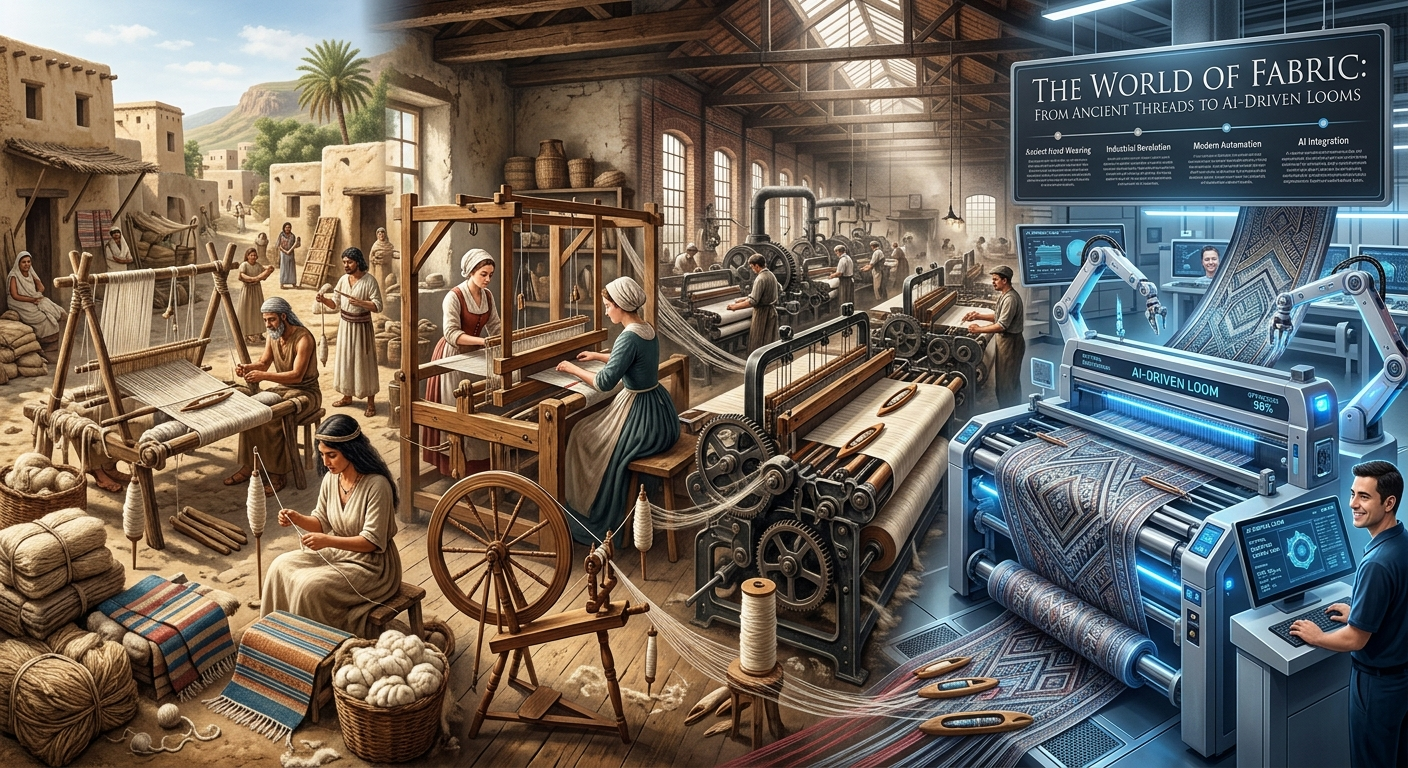
Fabric is one of humanity’s oldest technologies. Long before computers, factories, artificial intelligence, and automated machines transformed industry, human beings were already manipulating natural fibers to create clothing, shelter, fishing equipment, ropes, household objects, ceremonial materials, and eventually highly sophisticated industrial textiles.
The history of fabric is therefore much more than a story about clothing. It is a story about human ingenuity, agriculture, chemistry, trade, engineering, mathematics, industrialization, and now artificial intelligence. The simple act of twisting fibers into thread eventually developed into spinning wheels, looms, mechanical weaving machines, textile factories, synthetic polymers, computer-controlled production systems, smart textiles, and increasingly intelligent manufacturing environments.
Today, the textile industry is entering another major technological transition. Modern weaving and knitting machines can operate at extremely high speeds while sensors continuously monitor thousands of production variables. Computer vision can inspect fabrics for defects. Artificial intelligence can analyze production data, forecast equipment failures, optimize designs, reduce waste, improve quality control, and assist designers in developing new textile structures.
The journey from an ancient hand-spun fiber to an AI-assisted industrial loom represents thousands of years of technological evolution.
1. What Is Fabric?
Fabric is a material made by arranging fibers, yarns, filaments, or other textile elements into a coherent structure.
The word fabric is often associated with woven cloth, but textiles can be produced through several different methods. The principal categories include:
- Woven textiles, produced by interlacing yarns.
- Knitted textiles, produced by forming interconnected loops.
- Nonwoven textiles, produced by bonding, entangling, pressing, or otherwise assembling fibers without traditional weaving or knitting.
- Braided textiles, produced through the interlacing of multiple strands.
- Composite and technical textiles, in which textile structures are combined with polymers, metals, ceramics, electronics, or other materials.
The characteristics of a fabric depend on its raw materials, fiber dimensions, yarn construction, production method, density, finishing processes, and intended application.
A lightweight cotton shirt and a high-strength industrial fiber used in aerospace applications may both be called textiles, yet their structures and purposes are radically different.
2. The Earliest Human Relationship With Fiber
The origins of textile technology are deeply ancient.
Early human communities needed protection from weather, insects, rough environments, and changes in temperature. Natural materials such as animal skins, plant fibers, grasses, bark, reeds, and leaves could be transformed into useful coverings and cords.
At first, humans probably used fibers in relatively simple forms. Plants could be twisted into primitive cords, while animal materials could be stitched together. Over time, people learned that individual fibers could be processed, aligned, twisted, and combined into stronger continuous strands.
This was a crucial technological breakthrough.
Fiber by itself can be weak and difficult to handle. A properly manufactured yarn, however, can become stronger, more flexible, and easier to manipulate.
Thus emerged one of the fundamental principles of textile engineering:
fiber → yarn → textile structure
That seemingly simple sequence became the foundation of one of humanity’s largest technological industries.
3. Ancient Fibers
Different civilizations discovered and cultivated different sources of textile fibers.
3.1 Flax
Flax is among the oldest important textile plants. Its fibers can be processed into linen, a durable material with valuable qualities in warm climates.
Ancient Egyptian civilization became especially associated with linen. The material was used for clothing, household textiles, religious objects, and burial practices.
3.2 Wool
Wool comes primarily from sheep and became extraordinarily important in regions where animal husbandry was widespread.
Wool possesses useful insulating properties and can be spun, woven, felted, and dyed.
Its significance extends beyond clothing. Wool became an economic resource that supported trade, taxation, political power, and industrial development.
3.3 Cotton
Cotton eventually became one of the world’s dominant textile fibers.
Cotton fibers develop around the seeds of the cotton plant. After harvesting, they can be separated, cleaned, spun into yarn, and woven or knitted into fabric.
Cotton became particularly important because of its softness, breathability, versatility, and suitability for large-scale manufacturing.
3.4 Silk
Silk represents one of the most remarkable achievements in traditional textile production.
Produced from the cocoons of silkworms, silk combines strength, smoothness, luster, and extraordinary fineness.
Ancient Chinese civilization developed highly sophisticated sericulture techniques, and silk became a major commodity in long-distance trade.
The historical Silk Roads were not merely routes for transporting cloth. They were channels through which technologies, religions, languages, agricultural products, scientific knowledge, and cultural practices also moved.
4. The Discovery of Spinning
One of the great early inventions in textile history was spinning.
Spinning transforms loose fibers into continuous yarn by twisting and organizing them.
Without spinning, many short natural fibers would be difficult to weave into durable material.
Hand spinning could be performed with simple tools such as:
- spindle-based devices,
- distaffs,
- hand spindles,
- later, spinning wheels.
The spindle represents one of the oldest mechanical technologies associated with textile manufacturing.
Its principle is remarkably simple:
fiber is drafted → fiber is twisted → twist creates yarn
However, producing yarn consistently requires skill. The spinner must control fiber supply, twisting speed, thickness, tension, and continuity.
This explains why spinning remained highly skilled manual work for thousands of years.
5. The Birth of Weaving
Weaving is the process of interlacing two principal sets of yarns.
The lengthwise yarns are called the warp, while the crosswise yarns are called the weft or filling.
A simplified weaving sequence is:
warp preparation → opening the shed → inserting weft → beating the weft → repeating
This basic process can create astonishingly sophisticated materials.
Different arrangements of yarn produce different textile structures.
Three fundamental woven structures are especially important:
Plain weave
The simplest structure, in which each weft yarn alternates over and under successive warp yarns.
Twill weave
A structure that creates characteristic diagonal patterns.
Satin weave
A structure designed to minimize visible interlacing points, often producing a smoother and more lustrous surface.
From these basic structures, textile manufacturers have developed thousands of variations.
6. The Loom: One of Civilization’s Great Machines
The loom is the machine that makes controlled weaving possible.
Early looms varied enormously between civilizations. They included ground looms, vertical looms, horizontal looms, and more sophisticated mechanical systems.
The fundamental purpose of the loom is to control the relationship between warp and weft.
Even a simple loom therefore represents an early information-processing machine.
The loom must determine:
- which warp threads move,
- which remain stationary,
- where the weft should pass,
- how tightly the yarns are positioned,
- how the completed structure is advanced.
In this sense, weaving contains an important technological idea: a physical structure can encode instructions.
This concept became extraordinarily important centuries later during the development of programmable machines.
7. Pattern, Mathematics, and Textile Design
Textiles have always been closely connected to mathematics.
Patterns require repetition, symmetry, proportions, spacing, geometry, and counting.
Traditional weavers often developed sophisticated methods for representing patterns using symbols, grids, color arrangements, and thread counts.
A complex textile design can effectively be treated as a structured sequence of instructions.
For example, a weaving plan may specify:
- warp positions,
- weft positions,
- lift sequences,
- color changes,
- yarn densities,
- repeated motifs.
This means weaving naturally evolved toward a form of procedural thinking.
The textile industry therefore contains an important historical link between craft knowledge and computational logic.
8. Ancient Textile Centers and Global Trade
As textile production became more sophisticated, certain regions developed reputations for particular materials and techniques.
India became historically important for cotton textiles, dyeing, printing, embroidery, and sophisticated weaving traditions.
China became renowned for silk production and weaving technologies.
The Islamic world played a major role in the development and transmission of textile technologies, dyeing techniques, patterns, and luxury fabrics.
Europe developed major wool and linen industries and later became a center of mechanized textile manufacturing.
Africa developed numerous distinctive weaving, dyeing, basketry, embroidery, and textile traditions, including highly specialized regional techniques.
Textile production was therefore never confined to a single civilization.
Instead, it developed through continuous interaction between societies.
9. Natural Dyes and the Science of Color
Ancient textile production also required mastery of chemistry.
Before synthetic dyes existed, people obtained colors from:
- plants,
- roots,
- leaves,
- flowers,
- bark,
- insects,
- minerals,
- shells,
- and other natural materials.
Indigo, madder, saffron, cochineal, and other natural color sources became economically important.
Producing consistent colors was not easy.
The final shade could depend on:
- water chemistry,
- temperature,
- concentration,
- fiber type,
- processing time,
- mordants,
- oxidation,
- and environmental conditions.
Traditional dyers therefore possessed practical chemical knowledge, even though they did not describe it using modern chemistry.
10. The Industrial Revolution Changes Everything
The textile industry became one of the major engines of the Industrial Revolution.
During the 18th and 19th centuries, mechanization transformed spinning and weaving from predominantly manual activities into increasingly automated factory processes.
Important innovations included improved spinning machinery, mechanized looms, steam power, and factory organization.
Machines could now perform repetitive operations faster and more consistently than individual workers.
This fundamentally changed the economics of textile production.
Instead of a household producing cloth on a small scale, factories could manufacture enormous quantities of standardized textiles.
The consequences were enormous:
- textile prices fell,
- production volumes increased,
- international trade expanded,
- factory employment grew,
- urbanization accelerated,
- supply chains became more complex,
- and textile manufacturing became a major industrial sector.
11. The Flying Shuttle and Faster Weaving
One key innovation in weaving was the development of mechanisms that allowed the weft shuttle to travel more rapidly across the warp.
This dramatically increased weaving productivity.
Once faster weaving was possible, spinning technology also needed to improve because the looms could consume yarn more rapidly than traditional spinners could supply it.
This created an important principle in industrial systems:
improving one stage of a production process can create pressure on every other stage.
Textile industrialization therefore evolved as an interconnected system rather than through isolated inventions.
12. The Spinning Revolution
A series of mechanical spinning inventions dramatically increased yarn production.
Machines such as the spinning jenny, water frame, and spinning mule transformed the economics of yarn manufacturing.
Large-scale spinning factories could produce yarn at volumes that were impossible for individual hand spinners.
The result was a new industrial relationship:
mechanized spinning → greater yarn availability → faster weaving → mass textile production
This relationship helped establish the factory system.
13. The Jacquard Loom and Programmable Machines
One of the most fascinating developments in textile history was the Jacquard loom.
Developed in the early 19th century, the machine used punched cards to control complex weaving patterns.
The importance of this invention extends beyond textiles.
A pattern could effectively be represented as a sequence of encoded instructions.
This provided an early example of machine-controlled information processing.
The historical connection between punched-card textile machinery and later computing is significant. Charles Babbage and other pioneers of mechanical computation were influenced by the idea that machines could follow encoded instructions.
Ada Lovelace also recognized the broader potential of programmable machines.
Thus, an innovation designed for decorative weaving became part of the intellectual history of computing.
14. Textile Technology and the Development of Computing
The relationship between textiles and computation is deeper than it first appears.
A complicated textile pattern requires a sequence of decisions.
A computerized loom performs a similar conceptual process:
input instructions → interpret pattern → control machine → produce structure
This is fundamentally a form of automation.
Modern computers have expanded this principle enormously.
Instead of controlling only a loom, software can now control:
- spinning machines,
- dyeing systems,
- knitting machines,
- cutting robots,
- inspection cameras,
- warehouse systems,
- supply chains,
- digital design platforms,
- and entire textile factories.
The loom has therefore evolved from a mechanical tool into a digitally controlled manufacturing platform.
15. The Rise of Synthetic Fibers
The textile revolution did not stop with mechanical automation.
Chemistry produced an entirely new generation of fibers.
Synthetic fibers such as nylon, polyester, acrylic, and elastane changed the textile industry.
These materials are generally produced from chemical feedstocks and engineered to provide specific properties.
Synthetic fibers can be designed for characteristics such as:
- strength,
- elasticity,
- durability,
- resistance to moisture,
- resistance to chemicals,
- thermal performance,
- low weight,
- rapid drying,
- and controlled texture.
This represents a fundamental transition:
traditional textiles were largely adapted from nature; modern textiles can increasingly be engineered by design.
16. From Clothing to Technical Textiles
Modern textiles are no longer primarily about fashion.
Textile engineering now produces materials for highly specialized environments.
Technical textiles are used in:
- construction,
- automotive manufacturing,
- aerospace,
- medicine,
- agriculture,
- filtration,
- energy systems,
- protective equipment,
- transportation,
- sports,
- and industrial manufacturing.
Examples include:
- geotextiles for soil stabilization,
- filtration fabrics,
- medical dressings,
- high-strength composite reinforcement,
- fire-resistant fabrics,
- ballistic-resistant materials,
- protective workwear,
- industrial conveyor fabrics,
- and architectural membranes.
The textile has evolved from a basic covering into an engineered functional material.
17. The Textile Industry Enters the Digital Age
Computerization changed textile production dramatically during the late 20th and early 21st centuries.
Computer-aided design enabled textile designers to work digitally.
Computer-controlled weaving and knitting machines enabled greater precision and repeatability.
Enterprise software linked manufacturing to purchasing, inventories, logistics, quality control, and sales.
Digital printing made it possible to place highly detailed images and patterns directly onto textile substrates.
Sensors began monitoring machinery in real time.
The textile factory became increasingly connected.
18. Computer-Aided Textile Design
Modern designers can create textiles digitally before a physical sample is produced.
Design software allows researchers and manufacturers to simulate:
- color,
- pattern,
- texture,
- geometry,
- yarn arrangement,
- fabric drape,
- garment construction,
- and surface appearance.
This greatly reduces the need for physical prototypes.
A designer can create multiple alternatives digitally, test them, and manufacture only the most promising version.
This supports a more efficient product-development cycle.
19. The Smart Factory
The modern textile factory increasingly resembles a data-processing system.
A smart textile factory may contain:
- connected machines,
- industrial sensors,
- production databases,
- machine vision,
- automated material handling,
- robotics,
- cloud software,
- predictive maintenance,
- digital twins,
- manufacturing execution systems,
- and AI algorithms.
The factory continuously generates data.
For example, a spinning machine can record:
- speed,
- vibration,
- temperature,
- power consumption,
- yarn tension,
- production rate,
- and defect information.
A weaving machine can similarly report production conditions in real time.
The challenge is no longer simply collecting data.
The challenge is transforming data into useful decisions.
That is where artificial intelligence becomes increasingly important.
20. Artificial Intelligence Enters Textile Manufacturing
Artificial intelligence refers to computational systems capable of performing tasks that normally require forms of human intelligence, such as pattern recognition, prediction, classification, optimization, and decision support.
In textiles, AI can be applied across the entire manufacturing chain.
AI can assist with:
- demand forecasting,
- material planning,
- design generation,
- quality inspection,
- equipment monitoring,
- predictive maintenance,
- energy optimization,
- production scheduling,
- inventory management,
- supply-chain optimization,
- and waste reduction.
This changes the role of the textile machine.
The traditional machine performs predetermined actions.
The AI-enhanced machine can analyze information and help determine what should happen next.
21. AI-Driven Looms
The phrase AI-driven loom describes a broader transformation rather than one specific machine.
A modern intelligent loom may combine:
mechanical weaving + sensors + software + computer vision + industrial control + machine learning
The system can continuously monitor production conditions.
For example, cameras can inspect the surface of fabric while it is being woven.
Algorithms can detect anomalies such as:
- broken threads,
- missing yarn,
- irregular density,
- holes,
- contamination,
- pattern errors,
- and other visual defects.
The system may alert operators immediately or automatically adjust production parameters where appropriate.
This creates a closed-loop concept:
sense → analyze → decide → act → measure again
That is one of the foundations of intelligent manufacturing.
22. Computer Vision and Fabric Inspection
Human inspectors can detect many textile defects, but continuous manual inspection is difficult.
Computer vision provides a different approach.
High-speed cameras can observe fabric as it moves through production.
AI algorithms can compare observed patterns against expected patterns.
The system can identify anomalies at production speed and maintain digital records of detected defects.
This can produce several benefits:
- faster inspection,
- greater consistency,
- earlier defect detection,
- reduced waste,
- improved traceability,
- and better quality documentation.
Machine vision is especially valuable in factories where fabrics move continuously at high speed.
23. Predictive Maintenance
Textile machinery contains many moving parts.
Bearings, motors, belts, rollers, shafts, sensors, and control systems can degrade over time.
Traditional maintenance often follows a schedule.
For example:
inspect machine every X months
AI-supported predictive maintenance changes the question.
Instead of asking:
When should the machine be serviced?
the system asks:
Does the machine’s behavior indicate that a failure is becoming more likely?
Algorithms can analyze vibration, temperature, electrical consumption, operating hours, and other signals.
This can help maintenance teams identify developing problems before catastrophic failure.
The economic benefit can be significant because unplanned downtime can disrupt entire production lines.
24. AI in Textile Design
AI is also transforming the creative side of textiles.
Generative systems can assist designers in creating:
- repeating patterns,
- color combinations,
- surface textures,
- geometric designs,
- prints,
- conceptual collections,
- and experimental textile structures.
Instead of starting from a blank screen, designers can generate many alternatives and then refine the best concepts.
This does not necessarily eliminate the designer.
Instead, it changes the designer’s role from manually producing every possibility to directing, evaluating, selecting, and improving machine-generated possibilities.
Human creativity therefore remains important, but the creative workflow becomes increasingly computational.
25. Generative AI and Fashion
Generative AI can also influence the broader fashion ecosystem.
A designer might use AI to explore:
theme → visual concepts → textile pattern → garment concept → digital sample → manufacturing specification
AI can assist in analyzing consumer preferences, historical trends, color data, and market signals.
However, responsible use requires attention to intellectual property, cultural ownership, originality, and human creative judgment.
AI can generate designs rapidly, but creativity in textiles is also deeply cultural.
A textile pattern may represent history, identity, community, symbolism, or craftsmanship.
Technology should therefore augment cultural knowledge rather than simply treating all patterns as interchangeable digital data.
26. AI and Demand Forecasting
One of the textile industry’s major challenges is uncertainty.
Manufacturers must decide:
- how much fabric to produce,
- which colors will be demanded,
- what raw materials to purchase,
- how much inventory to hold,
- and when products should be manufactured.
AI models can analyze historical sales, seasonal demand, market trends, and other signals.
Better forecasting can reduce both:
overproduction
and
stock shortages
This has major economic and environmental implications.
Producing textiles that never reach consumers wastes:
- fiber,
- water,
- energy,
- labor,
- transportation,
- packaging,
- and capital.
27. AI and the Problem of Textile Waste
Textile production produces waste at multiple stages.
Waste may come from:
- fiber preparation,
- yarn production,
- cutting,
- weaving,
- knitting,
- dyeing,
- finishing,
- rejected products,
- excess inventory,
- and discarded garments.
AI can help reduce waste by optimizing:
- material usage,
- production settings,
- cutting layouts,
- inventory,
- machine conditions,
- and quality control.
In a highly optimized factory, fewer defective meters of fabric need to be discarded.
Thus artificial intelligence may become an important tool for improving resource efficiency.
28. Digital Twins of Textile Factories
A digital twin is a digital representation of a physical system.
A textile factory digital twin could represent:
- machines,
- production lines,
- energy usage,
- material flow,
- maintenance conditions,
- production schedules,
- and quality performance.
Managers could use the digital model to examine potential changes before implementing them physically.
For example, they could simulate the effects of:
- increasing machine speed,
- changing production schedules,
- introducing new equipment,
- modifying energy use,
- or changing material flows.
This can reduce experimentation costs and improve operational planning.
29. Robotics in Textile Manufacturing
Textiles are challenging for robots because fabrics are flexible, deformable, and difficult to manipulate compared with rigid components.
Nevertheless, robotics is advancing.
Robotic systems can assist with:
- material handling,
- warehouse operations,
- packaging,
- cutting,
- sewing,
- inspection,
- palletizing,
- and repetitive manufacturing tasks.
The combination of robotics and AI is particularly important.
A robot without intelligent perception may struggle when materials vary.
A robot equipped with cameras and machine-learning systems can potentially adapt better to changing conditions.
30. The Emergence of Smart Textiles
The evolution of fabric does not stop at intelligent manufacturing.
The fabric itself can become intelligent.
Smart textiles are textiles capable of interacting with environmental conditions, electronics, sensors, or electrical systems.
Some smart textile technologies may incorporate:
- conductive fibers,
- embedded sensors,
- optical materials,
- flexible electronics,
- heating elements,
- monitoring systems,
- or responsive materials.
Potential applications include:
- sports monitoring,
- healthcare,
- protective clothing,
- military and industrial applications,
- wearable electronics,
- rehabilitation,
- and human-machine interfaces.
The traditional boundary between fabric and electronic device is becoming less clear.
31. Electronic Textiles
Electronic textiles, often called e-textiles, integrate electrical functionality into textile systems.
Conductive threads can sometimes carry electrical signals.
Textile-based structures can potentially support:
- sensors,
- communication,
- lighting,
- heating,
- data collection,
- and wearable interfaces.
This creates an emerging technological category in which clothing is not merely worn on the body but becomes part of a computing environment.
The long-term significance is enormous.
Historically:
fabric protected the body.
Modern technology increasingly allows:
fabric to sense, communicate, respond, and compute.
32. Sustainable Textiles
The future of textiles cannot be separated from environmental sustainability.
The textile industry depends on enormous quantities of:
- raw materials,
- water,
- energy,
- chemicals,
- transportation,
- and packaging.
Environmental concerns have therefore encouraged research into:
- recycled fibers,
- biodegradable materials,
- low-impact dyeing,
- water-efficient manufacturing,
- renewable energy,
- circular production,
- fiber recovery,
- and improved product durability.
AI can contribute by optimizing production and identifying inefficiencies, but AI itself is not automatically sustainable.
The environmental performance of technology depends on how it is designed and deployed.
33. Recycling and the Circular Textile Economy
Traditional manufacturing often follows a linear model:
extract → manufacture → sell → use → discard
A circular textile economy seeks a different model:
design → manufacture → use → repair → reuse → recover → recycle → manufacture again
This approach treats textile waste as a potential resource.
Advanced sorting technologies can use computer vision, spectroscopy, and machine learning to distinguish different materials.
That can improve the recovery of recyclable fibers.
However, textile recycling remains technically difficult because fabrics may contain fiber blends, dyes, finishes, coatings, buttons, zippers, and other materials.
The solution will require cooperation between design, chemistry, manufacturing, retail, waste management, and recycling systems.
34. Biotechnology and the Future of Fibers
The next generation of textiles may come increasingly from biotechnology.
Researchers are exploring biological approaches to producing fibers, dyes, coatings, and other textile materials.
Examples of emerging directions include:
- bio-based polymers,
- engineered cellulose,
- fermentation-derived materials,
- protein-based fibers,
- laboratory-produced structural materials,
- and biologically derived colorants.
This suggests that the future textile industry may combine:
agriculture + chemistry + biotechnology + engineering + artificial intelligence
The textile factory of the future may therefore look very different from the textile factories of the Industrial Revolution.
35. Advanced Materials
Modern textile research also explores materials with highly specialized properties.
Researchers investigate fibers and structures that are:
- extremely strong,
- lightweight,
- electrically conductive,
- thermally responsive,
- fire resistant,
- chemically resistant,
- highly elastic,
- or capable of changing their properties.
Some advanced materials are designed specifically for aerospace, medical, energy, or defense applications.
This demonstrates that textiles are increasingly becoming a branch of advanced materials engineering.
36. AI-Optimized Material Discovery
Artificial intelligence can accelerate materials research.
Traditional materials discovery may require researchers to test many combinations experimentally.
AI systems can analyze existing scientific information and search through large spaces of possible material compositions or structures.
In textile research, this could support the development of:
- stronger fibers,
- more sustainable polymers,
- better dyes,
- improved coatings,
- multifunctional fabrics,
- and energy-efficient manufacturing processes.
The combination of computational prediction and laboratory experimentation could significantly shorten development cycles.
37. The Future Factory: From Loom to Intelligent Production Network
The factory of the future may no longer resemble a conventional textile mill.
Imagine a facility in which:
- AI predicts market demand.
- Software generates or adapts textile designs.
- Digital systems translate designs into machine instructions.
- Automated systems order raw materials.
- Intelligent machines manufacture yarn and fabric.
- Cameras continuously inspect products.
- AI identifies quality problems.
- Predictive maintenance systems monitor equipment.
- Robots transport materials.
- Digital twins simulate production scenarios.
- Energy systems optimize electricity consumption.
- Production data flows continuously into management systems.
This would be an integrated cyber-physical textile ecosystem.
38. Human Workers in the AI Textile Industry
Automation raises an important question:
What happens to human workers?
Technology can reduce some repetitive tasks, but it also creates demand for new capabilities.
Future textile workers may increasingly need knowledge in:
- industrial automation,
- machine maintenance,
- programming,
- data analysis,
- AI supervision,
- quality engineering,
- textile chemistry,
- materials science,
- robotics,
- and digital design.
Traditional craftsmanship may also remain valuable.
Highly specialized artisans possess knowledge that cannot always be reduced to machine instructions.
The future is therefore likely to contain both:
highly automated factories
and
high-value human craftsmanship.
39. Preserving Traditional Textile Knowledge
Technological progress should not be confused with cultural replacement.
Traditional textiles contain knowledge accumulated over generations.
Examples include:
- indigenous weaving systems,
- natural dyeing methods,
- embroidery traditions,
- hand-spinning techniques,
- ceremonial textiles,
- regional patterns,
- and culturally significant garments.
Digitization can help document and preserve these traditions.
High-resolution imaging, digital archives, databases, and AI-assisted pattern analysis can potentially support cultural preservation.
However, communities should retain control over culturally sensitive knowledge and intellectual property.
Technology should support cultural continuity rather than encouraging unauthorized commercial appropriation.
40. Africa and the Future of Textiles
Africa has an important place in the global textile story.
Across the continent, communities have developed rich traditions involving:
- weaving,
- dyeing,
- embroidery,
- beadwork,
- basketry,
- clothing,
- and decorative textiles.
The continent also possesses opportunities for modern textile industrialization.
Africa’s future textile sector could potentially combine:
- local raw materials,
- agricultural production,
- traditional skills,
- modern factories,
- digital design,
- AI,
- renewable energy,
- and regional markets.
Developing textile value chains could create employment and reduce dependence on importing finished textile products.
The opportunity is not simply to produce inexpensive clothing.
It is to build complete industrial ecosystems involving:
fiber → yarn → fabric → design → manufacturing → branding → logistics → retail → recycling
41. South Africa and Textile Technology
South Africa possesses a diverse industrial base, research institutions, universities, manufacturing capabilities, and agricultural resources that can support advanced textile development.
The future opportunity extends beyond traditional apparel.
Potential areas include:
- technical textiles,
- protective clothing,
- medical textiles,
- filtration materials,
- industrial fabrics,
- automotive textiles,
- smart textiles,
- sustainable materials,
- and digitally enabled manufacturing.
Artificial intelligence can strengthen these capabilities by improving planning, quality control, research, and automation.
42. Challenges Facing AI-Driven Textile Manufacturing
Despite the enormous opportunities, AI-driven textile production faces important challenges.
Data quality
AI requires useful data. Poor sensor calibration, incomplete records, inconsistent labels, or inaccurate measurements can reduce system performance.
Cost
Advanced machinery, sensors, robotics, software, and AI systems may require substantial investment.
Skills
Factories may lack workers capable of operating, maintaining, and governing sophisticated digital systems.
Cybersecurity
Connected factories can become targets for cyberattacks.
Employment disruption
Automation can change job requirements and potentially eliminate some repetitive roles.
Environmental concerns
Digitalization does not automatically reduce environmental damage.
Supply-chain dependence
Modern textile factories may depend on global suppliers for machinery, software, fibers, chemicals, electronics, and energy.
These challenges require strategic planning rather than simply purchasing new machines.
43. Cybersecurity for the Intelligent Textile Factory
The connected textile factory is increasingly a cyber-physical system.
A cyberattack could potentially affect:
- production schedules,
- machine settings,
- inventory records,
- customer information,
- quality systems,
- logistics,
- or factory operations.
Therefore industrial cybersecurity becomes an essential component of modern textile engineering.
Factories increasingly need:
- network segmentation,
- secure access controls,
- software updates,
- monitoring,
- backups,
- authentication,
- incident-response planning,
- and employee cybersecurity awareness.
The more intelligent a factory becomes, the more important its digital protection becomes.
44. Energy Efficiency and Intelligent Manufacturing
Textile manufacturing consumes energy through:
- motors,
- heating,
- drying,
- spinning,
- weaving,
- knitting,
- dyeing,
- finishing,
- compressed air,
- lighting,
- and building systems.
AI can help identify energy-intensive processes and optimize machine operation.
An intelligent facility could potentially analyze:
production volume + machine state + energy prices + environmental conditions
and use those variables to improve operational efficiency.
This can reduce costs while potentially lowering environmental impact.
45. Textile Manufacturing as a Global Ecosystem
The final fabric sold to a consumer may represent a surprisingly long chain.
A simplified example might be:
seed or raw material → farm → fiber processing → spinning → yarn → dyeing → weaving/knitting → finishing → garment manufacturing → packaging → shipping → retail → consumer → reuse/recycling
Every stage involves infrastructure, knowledge, energy, labor, transportation, finance, and information.
AI increasingly connects these stages through digital systems.
The future textile industry may therefore become less like a collection of separate factories and more like a continuously connected global network.
46. From Mechanical Automation to Cognitive Automation
Traditional industrial automation is primarily rule-based.
A machine is programmed:
when condition A occurs, perform action B.
AI introduces more flexible forms of decision support.
A system can potentially identify patterns in large quantities of information and estimate what is likely to happen.
This creates a progression:
manual craftsmanship → mechanical automation → computer control → connected automation → AI-assisted manufacturing
The evolution is not necessarily a complete replacement of one stage by another.
Instead, older technologies remain embedded within newer systems.
A modern AI-controlled loom still depends on mechanical engineering, yarn science, textile physics, electronics, sensors, and control theory.
47. The Deep Meaning of the Loom
The loom is one of the most important machines in technological history because it demonstrates how a physical process can be governed by information.
A loom transforms a sequence of instructions into a physical structure.
That concept is remarkably close to a general principle of computing:
information can control physical operations.
This relationship explains why textile technology repeatedly intersects with the history of computing.
The ancient loom was therefore not merely a machine for making cloth.
It was an early example of programmable technological behavior.
48. Fabric as a Platform for Human Civilization
Fabric has accompanied humanity through almost every major stage of civilization.
It has been:
- clothing,
- shelter,
- currency,
- cultural identity,
- religious symbolism,
- trade commodity,
- industrial product,
- engineering material,
- and now potentially an electronic platform.
Textiles can represent wealth, social position, cultural identity, technological capability, and national economic development.
Few other materials have remained so central to everyday life while simultaneously evolving into advanced industrial technologies.
49. The Future: AI-Driven Looms and Beyond
The future of textile technology is likely to involve greater convergence.
The next generation of textile systems may combine:
artificial intelligence
with
robotics
advanced materials
biotechnology
computer vision
digital twins
Internet of Things technologies
renewable energy
smart textiles
and
circular manufacturing
A future loom may not simply weave a predetermined design.
It could operate as one part of an intelligent production system that understands production goals, monitors material conditions, identifies defects, optimizes resource consumption, and communicates with other machines.
The loom could become a node in a larger industrial intelligence network.
50. A Possible Textile Manufacturing Architecture of the Future
A highly advanced textile production system could be organized into several layers.
Layer 1: Raw Materials
Cotton, wool, flax, silk, recycled fibers, bio-based fibers, synthetic fibers, and advanced engineered materials.
Layer 2: Fiber Processing
Cleaning, separation, preparation, blending, and quality assessment.
Layer 3: Spinning and Yarn Engineering
Fiber alignment, twisting, winding, sizing, and automated quality measurement.
Layer 4: Intelligent Weaving and Knitting
Computer-controlled machinery using sensors, cameras, robotics, and machine-learning systems.
Layer 5: Chemical and Surface Engineering
Dyeing, finishing, coating, treatment, printing, and performance enhancement.
Layer 6: AI Quality Control
Real-time inspection, anomaly detection, defect classification, and traceability.
Layer 7: Digital Supply Chain
Inventory, transportation, demand forecasting, purchasing, warehousing, and distribution.
Layer 8: Smart Textiles
Integration of sensors, conductive materials, electronics, and responsive structures.
Layer 9: Circular Economy
Repair, reuse, sorting, recycling, and recovery.
Layer 10: Human Intelligence
Design, craftsmanship, strategic decisions, ethics, cultural knowledge, and innovation.
This architecture illustrates that the future textile industry is not simply about smarter looms.
It is about smarter ecosystems.
51. The Economic Importance of Textile Innovation
Textiles remain economically significant because they connect agriculture, manufacturing, retail, logistics, chemistry, engineering, technology, and consumer markets.
A country that develops advanced textile capabilities can potentially create value across multiple stages of production.
The highest-value opportunities increasingly occur in areas such as:
- advanced materials,
- branded design,
- technical textiles,
- smart fabrics,
- medical textiles,
- digital manufacturing,
- sustainable materials,
- automation,
- and intelligent supply chains.
This means textile development can be part of a broader industrialization strategy.
52. Education for the Future Textile Industry
The next generation of textile professionals will require interdisciplinary education.
A modern textile curriculum could combine:
Textile Science + Mechanical Engineering + Electrical Engineering + Computer Science + AI + Chemistry + Materials Science + Business + Sustainability + Design
Students could learn both the traditional principles of fiber and fabric formation and the digital technologies controlling modern factories.
Such an education would bridge the historical textile artisan and the future industrial data scientist.
53. From Ancient Hands to Machine Intelligence
The history of textiles can be summarized as a long sequence of increasingly sophisticated control systems.
First, humans controlled fibers directly with their hands.
Then simple tools improved their capabilities.
Looms introduced mechanical organization.
Industrial machines introduced mechanical power.
Computers introduced digital control.
Sensors introduced real-time observation.
Artificial intelligence introduced advanced analysis and prediction.
Thus the trajectory can be described as:
hand control → tool control → machine control → computer control → connected control → intelligent control
This is one of the clearest examples of how human technological civilization evolves.
Conclusion
The history of fabric is a history of human intelligence expressed through material technology.
From the earliest use of plant fibers and animal materials, humans discovered how to transform fragile strands into useful structures. Spinning created yarn. Weaving created cloth. Looms converted patterns into physical materials. Industrial machinery multiplied production. Synthetic chemistry expanded the available materials. Computers transformed design and control. Sensors connected machines to information systems. Artificial intelligence is now helping transform the textile factory into an increasingly intelligent manufacturing environment.
The story does not end with the AI-driven loom.
The future of fabric is likely to extend far beyond clothing. Textiles may become sensing surfaces, medical technologies, structural materials, electronic interfaces, energy-related components, environmental technologies, and intelligent products.
The most important transformation may therefore be conceptual.
For thousands of years, fabric was primarily viewed as something humans made.
Modern technology increasingly allows fabric to become something humans engineer.
And the emerging generation of AI, robotics, biotechnology, advanced materials, and digital manufacturing suggests an even more remarkable possibility: fabric may eventually become a material that not only has physical structure, but also contains intelligence, sensing capability, connectivity, and adaptive behavior.
From an ancient hand-spun thread to an AI-assisted loom, the journey of textiles demonstrates a fundamental truth about civilization:
human beings continuously transform simple materials into increasingly sophisticated technologies.
The thread was never just a thread.
It was the beginning of a technological system that eventually connected agriculture, chemistry, mechanical engineering, computing, artificial intelligence, and human creativity.
The future fabric industry will therefore not merely produce cloth.
It will produce an increasingly intelligent class of materials for an increasingly technological civilization.



Be First to Comment