
Abstract
The convergence of Artificial Intelligence (AI) and the Internet of Things (IoT) is creating a new technological paradigm often described as the Artificial Intelligence of Things (AIoT). IoT gives machines the ability to sense, communicate, and collect information from the physical world, while AI provides the analytical and decision-making capabilities needed to transform that information into useful predictions, recommendations, and automated actions.
The significance of this convergence is that AI and IoT are no longer merely complementary technologies. Together, they form increasingly intelligent cyber-physical systems capable of observing conditions, interpreting data, predicting outcomes, and responding to changing circumstances. Recent research identifies prediction, object and event recognition, and operational decision-making among the most common AI functions within IoT systems, with applications spanning healthcare, farming, transportation, buildings, energy, and industry.
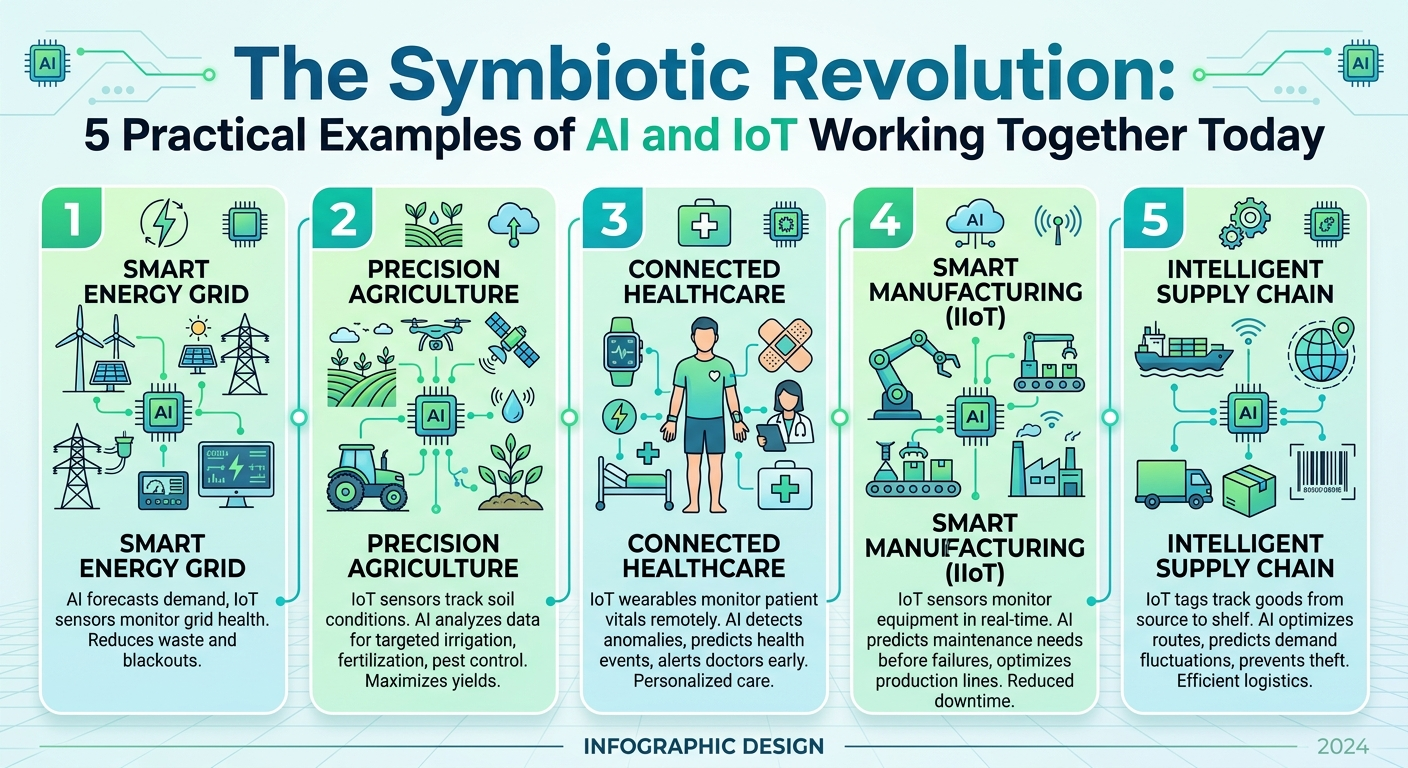
This thesis examines five practical examples of this symbiotic relationship: smart agriculture, predictive maintenance in manufacturing, intelligent healthcare monitoring, smart buildings and energy management, and intelligent transportation and connected mobility. It explains the technological architecture behind each application, the roles of sensors and connectivity, the contribution of AI, the resulting feedback loops, benefits, limitations, cybersecurity considerations, and future implications.
1. Introduction: From Connected Things to Intelligent Things
The first major revolution of the IoT era was connectivity.
Sensors could measure temperature, pressure, humidity, vibration, location, energy consumption, movement, images, sound, and numerous other physical conditions. Devices could then transmit these measurements through wired or wireless networks to gateways, servers, cloud platforms, or applications.
But connectivity alone does not necessarily create intelligence.
A temperature sensor may report that a machine has reached 82°C. A camera may record thousands of images. A soil sensor may report declining moisture. A smart meter may report increasing electricity consumption.
The important question becomes:
What should the system do with all this information?
This is where AI becomes powerful.
AI can identify patterns in IoT-generated data, detect anomalies, classify objects, predict future conditions, optimize decisions, and sometimes initiate automated responses. The result is a closed technological loop:
Physical world → Sensors → Connectivity → Data → AI → Decision → Action → Physical world
That loop represents the essence of the AIoT revolution.
Research on AIoT increasingly describes the field through three fundamental technological dimensions: sensing, computing, and networking/communication.
2. Understanding the Symbiosis Between AI and IoT
2.1 What IoT contributes
The Internet of Things provides the physical infrastructure through which digital systems observe the real world.
An IoT ecosystem may contain:
- Sensors
- Cameras
- Microcontrollers
- Actuators
- RFID devices
- GPS receivers
- Smart meters
- Industrial machines
- Wearable devices
- Environmental monitors
- Connected vehicles
- Network gateways
- Edge computers
IoT therefore acts primarily as the sensory and communication layer.
It answers questions such as:
- What is happening?
- Where is it happening?
- When did it happen?
- How frequently is it happening?
- What physical conditions are changing?
2.2 What AI contributes
AI transforms data into intelligence.
Depending on the application, AI may perform:
- Classification
- Prediction
- Anomaly detection
- Computer vision
- Pattern recognition
- Forecasting
- Optimization
- Natural-language interaction
- Decision support
- Autonomous control
AI therefore functions as the interpretation and decision layer.
2.3 Why neither technology is sufficient by itself
An AI system without appropriate real-world data may have limited awareness of changing physical conditions.
An IoT system without intelligence may generate enormous amounts of data without being able to understand what the data means.
Together they become substantially more capable.
For example:
IoT:
“Soil moisture is 18%.”
AI:
“Based on soil moisture, weather forecasts, crop growth stage, and historical irrigation patterns, the field is likely to require irrigation within the next six hours.”
IoT + AI + actuator:
“Activate irrigation for the required zone.”
This transformation—from measurement to prediction to action—is the central principle of AIoT.
3. The AIoT Architecture
A typical AIoT system can be understood through several interconnected layers.
Layer 1: Physical environment
This is the real world:
- Farms
- Factories
- Hospitals
- Buildings
- Roads
- Vehicles
- Energy systems
Layer 2: Sensing
Sensors and connected devices collect information.
Layer 3: Connectivity
Networks transfer information using technologies such as:
- Ethernet
- Wi-Fi
- Bluetooth
- Cellular networks
- LPWAN technologies
- Industrial networks
- Satellite connectivity
Layer 4: Edge computing
Some processing occurs close to the source of the data.
This reduces latency and can decrease the amount of information that must be transmitted to centralized infrastructure.
Layer 5: Cloud and data platforms
Large-scale storage, analytics, model training, fleet management, and centralized applications may operate in cloud infrastructure.
Layer 6: Artificial intelligence
AI models interpret the data and produce predictions or decisions.
Layer 7: Application and control
The resulting intelligence is presented to people or used to control machines.
Layer 8: Feedback
The consequences of decisions generate new sensor data, allowing the system to learn from changing conditions.
This creates a continuous cycle:
Sense → Connect → Compute → Understand → Decide → Act → Measure again
4. Practical Example One: AI + IoT in Smart Agriculture
Agriculture is one of the clearest examples of AI and IoT working together.
Traditional farming depends heavily on human observation, experience, scheduled irrigation, weather knowledge, and periodic inspection.
AIoT introduces continuous measurement and data-driven decision-making.
Research published in 2025 highlights applications including smart irrigation, nutrient management, and crop disease management through interconnected sensors, edge/cloud computing, and AI algorithms.
4.1 How the system works
A smart farm may deploy:
- Soil-moisture sensors
- Temperature sensors
- Humidity sensors
- Weather stations
- Cameras
- Drones
- Water-flow meters
- GPS equipment
- Livestock sensors
- Automated irrigation controllers
These devices continuously generate information.
AI can combine the information with:
- Historical weather
- Crop growth stages
- Soil characteristics
- Irrigation history
- Weather forecasts
- Images
- Satellite observations
The AI system can then estimate conditions and recommend or initiate actions.
4.2 Example: intelligent irrigation
Consider a farm divided into several irrigation zones.
A conventional irrigation system might water all zones according to a fixed schedule.
An AIoT system can instead ask:
- How wet is each zone?
- What crop is growing there?
- What is the expected temperature?
- Is rain likely?
- How much water has already been applied?
- How quickly is moisture declining?
The AI model can estimate water requirements.
The system can then adjust irrigation accordingly.
Basic feedback loop
Soil sensor → Network → AI model → Water requirement prediction → Irrigation controller → Pump/valve → Soil
The resulting water conditions are measured again, closing the loop.
4.3 Crop disease detection
Cameras can capture images of plants.
AI-based computer vision can examine those images for patterns associated with disease, pest damage, or nutritional stress.
Instead of a farmer manually examining every plant, an AI system can help identify areas requiring closer inspection.
This creates the possibility of:
Observe → Detect → Predict → Target intervention
rather than treating an entire field identically.
4.4 Why this matters
AIoT agriculture can potentially improve:
- Water efficiency
- Crop monitoring
- Disease detection
- Fertilizer management
- Labour efficiency
- Yield management
- Environmental sustainability
However, implementation is not automatically successful. Research identifies issues including sensor energy requirements, infrastructure limitations, implementation costs, interoperability, privacy, and real-time processing.
5. Practical Example Two: AI + IoT in Smart Manufacturing
Manufacturing provides one of the most important industrial applications of AIoT.
Factories contain large numbers of machines producing continuous streams of operational information.
Sensors can measure:
- Vibration
- Temperature
- Pressure
- Electrical current
- Rotation
- Acoustic signals
- Production rates
- Machine states
AI can then analyze these measurements.
5.1 Predictive maintenance
One of the most important applications is predictive maintenance.
Traditional maintenance can follow a fixed schedule:
“Service the machine every six months.”
Another approach is reactive:
“Repair the machine after it fails.”
AIoT enables a third approach:
“Identify signs that the machine may be developing a problem and intervene before failure.”
5.2 Example
Imagine an industrial motor.
IoT sensors continuously monitor vibration and temperature.
Over time, the system learns what normal operation looks like.
Suppose the motor begins producing a subtle vibration pattern.
A human operator might not immediately notice it.
An AI model can compare the new pattern with historical operating data and identify an anomaly.
The system could generate an alert:
“Abnormal vibration detected. Inspection recommended.”
The maintenance team can investigate before a major failure occurs.
5.3 Beyond maintenance
AIoT can also support:
- Quality inspection
- Production optimization
- Energy management
- Worker safety
- Supply-chain coordination
- Automated process control
- Defect detection
- Production forecasting
Research on AIoT in sustainable manufacturing identifies improvements in efficiency, waste reduction, safety, predictive maintenance, product quality, and energy management as important application areas.
5.4 The factory becomes a learning system
The deeper transformation is not simply automation.
The factory begins to learn from its own operational history.
Every machine cycle can produce information.
Every fault provides additional information.
Every maintenance intervention creates another data point.
Every production batch contributes to the system’s knowledge base.
The factory therefore becomes increasingly data-driven.
6. Practical Example Three: AI + IoT in Healthcare
Healthcare is another major AIoT application area.
A systematic mapping study found healthcare to be the most prominent application domain for AI within IoT research.
The combination is particularly important because healthcare involves continuous monitoring of people and complex patterns in physiological data.
6.1 Wearable and connected devices
IoT-enabled healthcare devices can include:
- Wearable monitors
- Connected medical devices
- Remote monitoring systems
- Environmental sensors
- Smart medical equipment
- Connected diagnostic devices
These systems can generate streams of physiological or contextual information.
6.2 AI interpretation
AI can examine patterns in collected data.
For example, an AI system could monitor changes over time and identify patterns that warrant attention.
Instead of simply saying:
“Heart rate = X.”
An intelligent system can potentially determine:
“This pattern is unusual relative to the patient’s historical measurements.”
The distinction is important.
IoT supplies observation.
AI supplies interpretation.
Healthcare professionals remain essential for clinical assessment and decisions.
6.3 Remote patient monitoring
AIoT can support remote monitoring by transmitting relevant measurements from connected devices to healthcare systems.
A simplified process is:
Patient → Sensor → Connectivity → Data platform → AI analysis → Alert/clinical decision support
This can help healthcare providers focus attention where it may be most needed.
Recent research into AIoT healthcare architectures has examined combinations of IoT, AI, edge computing, and cloud services for applications such as risk assessment and early detection.
6.4 Important limitation
Healthcare AI must be treated differently from many ordinary consumer applications.
Incorrect predictions can have serious consequences.
Therefore, AIoT healthcare systems require:
- Data quality controls
- Clinical validation
- Privacy protections
- Cybersecurity
- Human oversight
- Transparent evaluation
- Appropriate regulatory compliance
The goal should not be to replace healthcare professionals but to provide better information and decision support.
7. Practical Example Four: AI + IoT in Smart Buildings and Energy
Buildings are becoming increasingly instrumented.
A modern building may contain sensors monitoring:
- Temperature
- Humidity
- Occupancy
- Lighting
- Air quality
- Electricity consumption
- Equipment performance
- Access conditions
IoT provides the information.
AI can determine how the building should respond.
7.1 Intelligent heating and cooling
A conventional HVAC system might operate according to a fixed schedule.
An AIoT building can consider:
- Current occupancy
- Historical occupancy
- Weather
- Indoor temperature
- Outdoor temperature
- Electricity demand
- Building characteristics
AI can then estimate the required heating or cooling level.
The building-management system can adjust equipment accordingly.
7.2 Energy optimization
Suppose electricity consumption suddenly increases.
An AI system can compare the current consumption pattern against historical patterns.
It may identify:
- An unusual load
- Equipment operating outside normal conditions
- Unexpected occupancy
- Potential equipment inefficiency
The system can then alert building managers or adjust controllable systems.
7.3 Smart buildings as cyber-physical systems
The building becomes a dynamic system:
Environment → Sensors → AI → Building controls → Environment
This creates a feedback loop.
The building senses its environment, interprets the information, responds, and then measures the consequences.
8. Practical Example Five: AI + IoT in Transportation and Connected Mobility
Transportation is another major AIoT domain.
Connected vehicles and transportation infrastructure can collect information about:
- Vehicle position
- Speed
- Traffic conditions
- Road conditions
- Vehicle performance
- Energy consumption
- Driver or passenger interactions
- Environmental conditions
AI can interpret this information.
8.1 Intelligent traffic management
Consider a city intersection.
IoT cameras and sensors can monitor traffic flows.
AI can analyze:
- Vehicle volumes
- Traffic queues
- Congestion patterns
- Time-of-day trends
- Road incidents
Traffic-management systems can then adapt signal strategies or provide information to transportation operators.
8.2 Vehicle health monitoring
Connected vehicles can also monitor their own systems.
Sensors can observe vehicle components and operational conditions.
AI can identify unusual patterns that could indicate a maintenance requirement.
The result is another predictive-maintenance model:
Vehicle → Sensors → Data → AI → Warning → Maintenance
8.3 Fleet optimization
For buses, delivery vehicles, logistics fleets, and other commercial transportation systems, AIoT can support:
- Route optimization
- Fleet monitoring
- Maintenance forecasting
- Fuel/energy management
- Demand prediction
- Vehicle utilization
This turns individual connected vehicles into components of an intelligent transportation network.
9. The Five Examples Compared
| Application | IoT contribution | AI contribution | Possible action |
|---|---|---|---|
| Agriculture | Soil, weather and crop sensing | Prediction and optimization | Irrigation or targeted intervention |
| Manufacturing | Machine monitoring | Anomaly detection and prediction | Maintenance or process adjustment |
| Healthcare | Patient/device monitoring | Pattern recognition and risk analysis | Alert or decision support |
| Buildings | Environmental and energy sensing | Optimization and forecasting | HVAC/energy adjustment |
| Transportation | Vehicle and traffic sensing | Prediction and optimization | Routing, alerts or traffic management |
The common principle is striking:
IoT observes. AI interprets. Systems act.
10. The Symbiotic Feedback Loop
The most important feature of AIoT is not simply the presence of AI and IoT.
It is the feedback loop connecting them.
Stage 1 — Sense
Sensors collect information from the physical environment.
Stage 2 — Connect
Networks transfer the information.
Stage 3 — Process
Edge or cloud computing prepares the data.
Stage 4 — Understand
AI identifies patterns.
Stage 5 — Predict
AI estimates what may happen next.
Stage 6 — Decide
The system selects an appropriate response.
Stage 7 — Act
An actuator, machine, software system, or human performs the response.
Stage 8 — Learn
New measurements reveal whether the response worked.
The cycle begins again.
This is what makes AIoT fundamentally different from a simple sensor network.
11. Edge AI and the Changing Architecture of AIoT
Historically, IoT systems often transmitted large quantities of information to centralized cloud systems.
Increasingly, AI processing can occur closer to where data is generated.
This is called edge AI.
For example, a camera may process video locally rather than transmitting every frame to a remote server.
An industrial sensor may detect an anomaly locally.
A connected agricultural controller may make rapid decisions using local models.
11.1 Why edge processing matters
Advantages can include:
- Lower latency
- Reduced bandwidth requirements
- Greater operational resilience
- Faster responses
- Potentially improved privacy
- Reduced dependence on continuous cloud connectivity
However, edge devices often have limitations involving:
- Computing power
- Memory
- Battery capacity
- Model size
- Software maintenance
- Security
Therefore, modern AIoT architectures increasingly require intelligent allocation of workloads between device, edge, and cloud.
12. The Role of Data
Data is the fuel of AIoT.
IoT devices can generate enormous quantities of information, but raw data is not automatically useful.
A successful AIoT system must address the entire data lifecycle:
Collection → Transmission → Storage → Cleaning → Labeling → Analysis → Modeling → Decision → Feedback
Poor-quality data can produce poor AI outcomes.
Common data problems include:
- Missing measurements
- Sensor drift
- Noise
- Incorrect timestamps
- Inconsistent formats
- Duplicate information
- Communication failures
- Biased datasets
Consequently, AIoT is as much a data engineering challenge as it is an AI challenge.
13. AI Models Used in AIoT
Different AI tasks require different model families.
13.1 Classification
Used when a system must place an observation into a category.
Example:
Normal machine / abnormal machine
13.2 Regression
Used when predicting numerical quantities.
Example:
Expected energy consumption tomorrow
13.3 Time-series forecasting
Used when historical measurements help predict future conditions.
Examples include:
- Energy demand
- Crop water requirements
- Machine temperatures
- Traffic volume
13.4 Computer vision
Used when cameras or images are involved.
Examples include:
- Crop inspection
- Industrial quality control
- Traffic monitoring
- Object recognition
13.5 Anomaly detection
Used to identify unusual behavior.
This is particularly valuable for:
- Machines
- Buildings
- Networks
- Vehicles
- Industrial systems
A 2025 systematic review identified prediction, object/event recognition, and operational decision-making among the most frequent AI tasks in IoT systems. It also found that supervised learning and convolutional neural networks were prominent in the reviewed literature.
14. Cybersecurity: The Hidden Side of AIoT
The more connected a system becomes, the greater the importance of security.
AIoT systems combine:
- Physical devices
- Networks
- Software
- Data
- AI models
- Cloud platforms
- Human users
Each component can introduce security risks.
Potential concerns include:
- Unauthorized device access
- Compromised sensors
- Manipulated data
- Stolen credentials
- Insecure communication
- Cloud vulnerabilities
- Model manipulation
- Privacy breaches
An AI model can only make reliable decisions if the information entering the system can be trusted.
Therefore:
AIoT security is fundamentally also a data-integrity problem.
15. Privacy and Responsible AIoT
Some AIoT systems collect extremely sensitive information.
Healthcare systems may process personal health information.
Connected vehicles may generate location information.
Smart buildings can reveal occupancy patterns.
Agricultural systems may contain commercially sensitive production information.
Consequently, AIoT development should incorporate:
- Data minimization
- Encryption
- Access controls
- Secure device identities
- Strong authentication
- Auditability
- Privacy-preserving technologies
- Human oversight
- Appropriate governance
The objective is not simply to make systems intelligent.
They must also be trustworthy.
16. Interoperability: The Challenge of Getting Things to Work Together
AIoT ecosystems often involve equipment from many manufacturers.
One farm may contain sensors from multiple vendors.
One factory may contain machines from different generations.
One building may contain several control systems.
One city may operate multiple transportation platforms.
If these systems cannot communicate effectively, the value of AIoT decreases.
Interoperability therefore becomes a fundamental requirement.
Standards, APIs, common data models, device-management platforms, and secure communication protocols can help address the problem.
Research continues to identify interoperability as one of the important barriers to broader AIoT adoption.
17. The Human Being Remains Part of the Loop
A common misconception is that AIoT means removing humans from systems.
In many high-value applications, the opposite is more appropriate.
AI can provide:
Observation + analysis + prediction
Humans provide:
Context + judgment + responsibility + accountability
A doctor may evaluate an AI-generated healthcare alert.
An engineer may inspect a machine after a predictive-maintenance warning.
A farmer may decide whether an AI recommendation is appropriate for a particular field.
A building manager may override an automated control.
The strongest architecture is often therefore:
Human + AI + IoT
rather than:
AI + IoT without humans.
18. Economic Significance of AIoT
The economic value of AIoT comes from converting physical activity into measurable, optimizable information.
Businesses can potentially reduce:
- Downtime
- Waste
- Energy consumption
- Water consumption
- Maintenance costs
- Inefficient labour
- Production defects
They can potentially improve:
- Productivity
- Quality
- Asset utilization
- Forecasting
- Customer service
- Safety
- Resource efficiency
AIoT therefore represents not simply a technological upgrade but a transformation in how organizations operate.
19. Environmental Significance
AIoT can also support sustainability.
Examples include:
Agriculture
Better irrigation can reduce unnecessary water use.
Manufacturing
Predictive systems can reduce waste and improve machine efficiency.
Buildings
Intelligent energy management can reduce unnecessary consumption.
Transportation
Optimization can improve fleet efficiency.
Environmental monitoring
Connected sensors can continuously monitor air, water, and ecological conditions.
The technology is not automatically sustainable, however. IoT devices themselves require energy, materials, networks, computing infrastructure, maintenance, and eventual disposal.
Sustainability must therefore be evaluated across the entire lifecycle.
20. AIoT and Africa
AIoT has particular potential in developing and emerging economies because many challenges involve physical infrastructure.
Potential applications include:
- Smart agriculture
- Water monitoring
- Energy management
- Rural healthcare
- Infrastructure monitoring
- Environmental sensing
- Smart logistics
- Connected education infrastructure
Research initiatives focused on Africa are already examining AIoT applications in water security, agriculture, energy, climate-sensitive infrastructure, healthcare, cybersecurity, and smart cities.
For African countries, the most valuable AIoT applications may not necessarily be the most technologically sophisticated.
The priority should be systems that solve significant practical problems.
For example:
A low-cost water-leak detection system that prevents substantial water loss may create greater social value than an expensive experimental smart-city platform.
21. Challenges to Large-Scale AIoT Adoption
Despite its promise, AIoT faces substantial challenges.
21.1 Cost
Sensors, networking, edge computers, cloud infrastructure, maintenance, and AI development all require investment.
21.2 Connectivity
Rural and remote areas may lack reliable connectivity.
21.3 Energy
Battery-powered sensors require efficient hardware and software.
21.4 Data quality
Bad sensor data can undermine AI predictions.
21.5 Cybersecurity
More connected devices create more potential attack surfaces.
21.6 Interoperability
Devices from different manufacturers may not integrate easily.
21.7 AI explainability
Users may need to understand why an AI system produced a particular recommendation.
21.8 Skills
Organizations need people who understand:
- IoT
- AI
- networking
- cybersecurity
- cloud computing
- data engineering
- domain-specific operations
The convergence therefore creates a demand for multidisciplinary expertise.
22. From Automation to Autonomy
There is a major distinction between automation and autonomy.
Automation
A system follows predefined rules.
If temperature exceeds threshold → turn fan on.
AI-based automation
A system uses learned patterns.
Based on historical and current conditions → predict cooling requirement.
Increasing autonomy
The system continuously observes conditions, predicts outcomes, selects actions, evaluates results, and adapts.
This represents a progression:
Manual → Automated → Intelligent → Adaptive → Increasingly autonomous
AIoT is helping move physical infrastructure along this spectrum.
23. The Future of the Symbiotic Revolution
The future of AIoT is likely to involve increasingly distributed intelligence.
Instead of one centralized AI system controlling everything, intelligence may be distributed across:
- Sensors
- Devices
- Edge gateways
- Vehicles
- Robots
- Local servers
- Data centers
- Cloud platforms
This creates a distributed intelligence architecture.
AI models may increasingly become smaller, more efficient, specialized, and capable of operating directly on connected devices.
At the same time, large cloud models can provide more sophisticated reasoning and centralized learning.
The future architecture may therefore look like:
Tiny AI at the sensor → Edge AI near the machine → Cloud AI for large-scale intelligence
24. AIoT as a Foundation for Physical AI
One of the most important long-term implications is the connection between AIoT and physical AI.
Traditional software AI operates primarily inside digital environments.
Physical AI interacts with the physical world.
For a physical AI system to operate effectively, it requires:
- Sensors to perceive the environment.
- Connectivity to exchange information.
- AI to interpret conditions.
- Computing to process information.
- Actuators to perform actions.
- Feedback to evaluate results.
This is precisely the infrastructure that AIoT provides.
Consequently, AIoT may become one of the technological foundations for future:
- Robots
- Intelligent factories
- Smart agricultural equipment
- Autonomous machines
- Intelligent buildings
- Connected transportation
- Environmental systems
25. A Unified Model of the Five Examples
The five practical applications examined in this thesis appear different, but their underlying architecture is remarkably similar.
Agriculture
Sense soil → Analyze conditions → Predict water requirement → Irrigate
Manufacturing
Sense machine → Analyze vibration → Predict failure → Schedule maintenance
Healthcare
Sense patient → Analyze physiological patterns → Identify risk → Alert professional
Buildings
Sense environment → Analyze demand → Predict requirements → Adjust systems
Transportation
Sense vehicles/traffic → Analyze movement → Predict congestion → Optimize operations
The domain changes.
The architecture remains remarkably consistent.
26. The Central Thesis
The deepest significance of the AIoT revolution is that it changes the relationship between the digital and physical worlds.
IoT creates digital visibility of physical reality.
AI creates meaning from that digital representation.
Actuators and automated systems transform intelligence back into physical action.
Therefore:
AI turns IoT from a network of connected objects into a potentially intelligent system of perception, prediction, and action.
This is the essence of the symbiotic revolution.
27. Conclusion
The convergence of Artificial Intelligence and the Internet of Things represents one of the most important technological developments of the modern digital era.
IoT provides the eyes, ears, sensors, communication networks, and physical interfaces through which machines observe the world.
AI provides the analytical capability to interpret what those systems observe.
Together, they create systems capable of moving beyond simple connectivity toward prediction, optimization, decision support, and increasingly autonomous action.
The five examples examined—agriculture, manufacturing, healthcare, smart buildings, and transportation—demonstrate that AIoT is not merely a futuristic concept. It is already being investigated and deployed across multiple real-world domains. Research literature shows particularly strong activity in healthcare, farming, transportation, buildings, energy, and industrial systems.
However, the success of AIoT will depend on much more than better algorithms.
It will require:
- Reliable sensors
- Affordable connectivity
- Quality data
- Efficient computing
- Secure infrastructure
- Interoperable systems
- Responsible AI
- Privacy protection
- Human oversight
- Skilled professionals
- Sustainable deployment models
The ultimate objective should not be to connect everything simply because it can be connected.
The objective should be to create useful intelligence that improves real-world outcomes.
The symbiotic revolution is therefore not fundamentally about machines becoming smarter.
It is about creating a continuous relationship between sensing, intelligence, action, and learning.
The technological equation can be summarized as:
IoT = Sense + Connect
AI = Understand + Predict
AIoT = Sense + Connect + Understand + Predict + Act + Learn
That final combination represents a major step toward a world in which physical infrastructure is increasingly capable of observing its environment, learning from experience, responding intelligently, and working alongside humans to solve complex problems.
Selected Research Basis
- Research on AIoT identifies sensing, computing, and networking as core dimensions of the emerging field.
- A systematic mapping study found healthcare to be a leading AI-in-IoT application domain and identified applications across buildings, energy, farming, industry, transportation, and other sectors.
- A 2025 systematic review of AIoT systems identified prediction, object/event recognition, and operational decision-making among the most frequent AI tasks.
- Research into AIoT agriculture highlights smart irrigation, nutrient management, disease management, and the use of sensor networks combined with edge/cloud computing and AI.
- Research on AIoT in manufacturing identifies applications in efficiency, waste reduction, safety, predictive maintenance, quality, and energy management.
- Research into AIoT healthcare demonstrates the growing combination of IoT, AI, edge computing, and cloud systems for intelligent healthcare applications.
- Research continues to identify interoperability, energy, cost, privacy, and real-time processing as important AIoT implementation challenges.

Be First to Comment