
Introduction
The convergence of 5G, artificial intelligence (AI), robotics, Internet of Things (IoT), edge computing, cloud computing, satellites, digital twins, autonomous machinery and advanced sensing is creating a new technological foundation for agriculture.
Agriculture has traditionally depended heavily on physical labour, machinery, weather knowledge and accumulated farming experience. Digital agriculture is changing this model by connecting farms to continuous streams of information and increasingly enabling machines to interpret information and act on it.
5G is particularly important because it can provide high-bandwidth communications, lower latency and support for large numbers of connected devices. These characteristics make it potentially useful for agricultural robots, autonomous machinery, drones, real-time sensor networks, machine vision and remote equipment control. Research reviews have identified autonomous tractors, spraying drones, robotics and increasingly autonomous farms as important applications of advanced connectivity in agriculture.
However, 5G alone does not create an autonomous farm. The real transformation occurs when telecommunications infrastructure is combined with AI, sensors, positioning systems, robotics, edge computing, agricultural science, cloud platforms and reliable energy.
The result is best understood as an emerging connected agricultural operating system.
1. What Is 5G Automation?
5G automation refers to the use of 5G-connected systems to monitor, coordinate and increasingly control machines, industrial processes and physical environments.
In agriculture, this can involve:
- connected tractors;
- autonomous harvesting machines;
- agricultural robots;
- intelligent irrigation;
- crop-monitoring drones;
- livestock monitoring;
- soil sensors;
- weather stations;
- machine-vision systems;
- automated greenhouses;
- robotic spraying;
- remote equipment management;
- predictive maintenance;
- digital twins;
- AI-based farm management;
- automated logistics.
A simplified architecture looks like this:
Sensors → 5G/Local Network → Edge Computing → AI → Decision → Machine Control → Farm Operation → New Data
This creates a continuous feedback loop.
For example, a soil sensor can detect moisture conditions. The information can reach an edge computer or cloud platform. AI can analyse the data together with weather forecasts and crop requirements. An irrigation system can then adjust watering automatically.
The important development is therefore not simply faster connectivity. It is the movement from connected agriculture to intelligent and automated agriculture.
2. Why 5G Matters to Agriculture
Traditional mobile networks were not designed specifically for highly automated farms.
Agricultural environments can contain thousands of sensors and machines spread across large areas. Some applications require large amounts of data, while others require rapid communication.
A 5G-enabled agricultural environment can potentially support:
High-volume data transmission
Modern agricultural cameras can generate large quantities of imagery. AI systems can analyse images of:
- crops;
- weeds;
- fruits;
- animals;
- soil;
- irrigation systems;
- machinery.
Low-latency communication
Some robotic and remote-control applications benefit from rapid communication between machines and operators.
Massive IoT connectivity
A large farm can contain many sensors monitoring:
- temperature;
- humidity;
- soil moisture;
- nutrient conditions;
- machinery;
- livestock;
- water systems;
- weather.
Network management
5G technologies can support differentiated connectivity requirements for different applications.
A crop-monitoring sensor does not necessarily have the same communication requirements as an autonomous machine.
3. The Five Layers of 5G Smart Agriculture
A useful way of understanding the emerging agricultural technology stack is to divide it into five layers.
Layer 1: Physical Agriculture
This is the real farm:
- soil;
- crops;
- livestock;
- irrigation;
- tractors;
- greenhouses;
- storage;
- roads;
- workers;
- water;
- energy.
Layer 2: Sensing
Sensors convert the physical farm into digital information.
Examples include:
- soil sensors;
- cameras;
- weather stations;
- GPS/GNSS;
- LiDAR;
- multispectral cameras;
- thermal cameras;
- livestock sensors.
Layer 3: Connectivity
Information moves through:
- 5G;
- 4G;
- Wi-Fi;
- private cellular networks;
- fibre;
- satellite;
- LoRaWAN and other IoT technologies;
- local mesh networks.
Importantly, future rural connectivity will probably not depend on 5G alone. European research published in 2026 emphasizes complementary terrestrial and satellite connectivity, together with systems capable of operating offline and synchronizing information when connectivity returns.
Layer 4: Intelligence
AI transforms raw data into decisions.
Machine-learning systems can identify:
- diseases;
- weeds;
- irrigation requirements;
- crop stress;
- abnormal animal behaviour;
- equipment failures;
- yield patterns.
Layer 5: Automation
The final layer converts decisions into physical action.
Machines can potentially:
- irrigate;
- plant;
- spray;
- weed;
- harvest;
- transport;
- inspect;
- sort;
- monitor.
This is where agriculture begins moving from precision farming toward autonomous farming.
4. From Precision Agriculture to Autonomous Agriculture
Agricultural technology has developed through several major stages.
Agriculture 1.0 — Human and animal labour
Production depended primarily on human labour and animals.
Agriculture 2.0 — Mechanization
Tractors, mechanical harvesters and industrial machinery transformed productivity.
Agriculture 3.0 — Digitalization
GPS, farm-management software, electronic machinery and satellite imagery introduced digital decision-making.
Agriculture 4.0 — Connected agriculture
IoT, cloud computing, drones, AI, robotics and advanced connectivity connect agricultural processes.
Emerging Agriculture 5.0
The emerging model combines:
AI + robotics + autonomous systems + biotechnology + advanced connectivity + human expertise.
The objective is not necessarily to remove people from agriculture. Instead, it is to move people toward higher-value activities while machines handle repetitive, dangerous, physically demanding or highly repetitive operations.
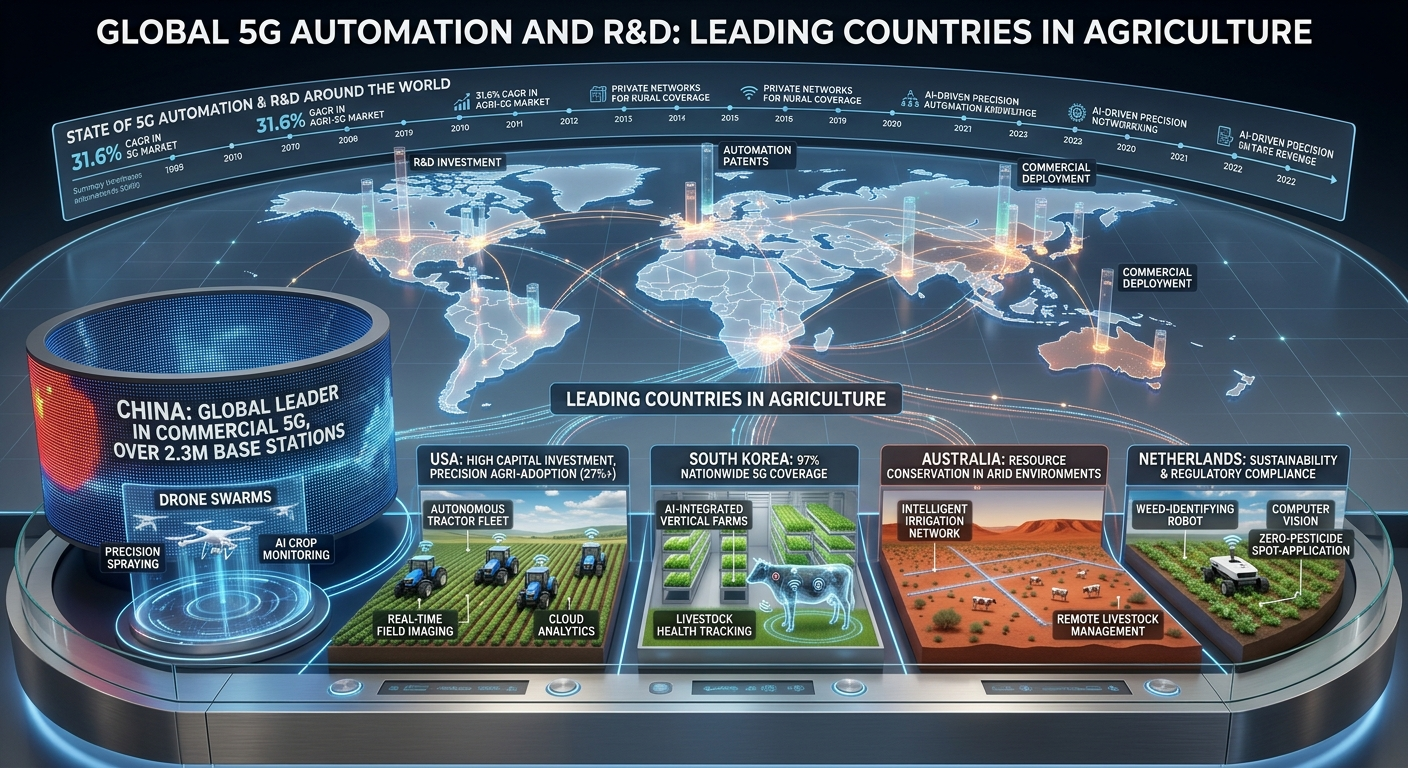
5. Global State of 5G Automation R&D
There is no universally accepted single ranking of countries for “5G agricultural automation R&D.” Leadership depends on what is being measured.
A country can be strong in:
- 5G infrastructure;
- telecommunications research;
- AI;
- robotics;
- agricultural science;
- autonomous machinery;
- semiconductor technology;
- agricultural commercialization.
Consequently, the global landscape is better understood as a network of technological leaders.
Among the most significant countries and regions are:
- China
- United States
- South Korea
- Japan
- Germany
- United Kingdom
- Netherlands
- France and other European Union countries
- Israel
- Australia
- Brazil
- India
The precise order changes according to the indicator being measured.
6. China: A Major Force in 5G Agricultural Automation
China is one of the most important countries in the development of large-scale 5G infrastructure, industrial automation and digital agriculture.
Its advantage comes from the combination of:
- telecommunications companies;
- large technology manufacturers;
- government-supported digital infrastructure;
- AI research;
- robotics;
- agricultural universities;
- large agricultural regions;
- smart-city and smart-industry programs.
One particularly important example involves 5G-enabled automated rice production.
GSMA documents a project involving ZTE and China Mobile using 5G connectivity to automate rice production across approximately 12,000 acres of marginal land in Jilin Province. The project combines intelligent irrigation, remotely controlled machinery and drones.
This is significant because it demonstrates the difference between a laboratory experiment and a large agricultural deployment.
China is also developing a broad robotics ecosystem. Recent research reviewing agricultural robotics identifies China as a rapidly expanding robotics market and highlights applications including crop planting, watering, harvesting and crop-health monitoring.
China’s major advantages
China’s agricultural automation ecosystem benefits from:
- enormous agricultural land areas;
- large manufacturing capacity;
- telecommunications infrastructure;
- robotics production;
- AI development;
- drone manufacturing;
- government-backed technology programs;
- substantial domestic markets.
China is therefore particularly strong in scaling technology from prototype to mass deployment.
7. United States: AI, Autonomous Machinery and Agricultural R&D
The United States is another major agricultural technology power.
Its strength is particularly visible in:
- agricultural research;
- AI;
- autonomous vehicles;
- robotics;
- cloud computing;
- satellite technology;
- precision agriculture;
- agricultural machinery;
- biotechnology;
- venture capital.
The United States has a large ecosystem of agricultural universities, technology companies, machinery manufacturers and agricultural technology startups.
One of the country’s major advantages is the combination of enormous commercial farms with sophisticated technology companies.
This creates an environment where autonomous machinery can be tested in real agricultural conditions.
US research is also moving beyond conventional cellular networks. Recent work has investigated the use of low-Earth-orbit satellite networks for highly reliable remote control of agricultural vehicles, illustrating how future farm automation may combine terrestrial 5G with satellite connectivity.
The American model is therefore strongly associated with:
AI + autonomous machinery + precision agriculture + cloud computing + satellite technology.
8. South Korea: Advanced 5G and Smart Farming
South Korea is one of the world’s most technologically advanced telecommunications countries.
Its strengths include:
- 5G;
- semiconductors;
- electronics;
- robotics;
- AI;
- smart factories;
- telecommunications research;
- connected infrastructure.
These capabilities naturally extend into agriculture.
South Korea has been identified among the countries with notable 5G agricultural use cases, including applications involving smart farms and connected agricultural environments.
The country’s importance is not primarily its agricultural land area. Instead, it demonstrates how advanced telecommunications and automation technology can be transferred into controlled agricultural environments, particularly smart greenhouses and high-value crop production.
9. Japan: Robotics, Sensors and Precision Agriculture
Japan has decades of experience in:
- industrial robotics;
- electronics;
- machine vision;
- automation;
- agricultural machinery;
- precision engineering.
Japanese agricultural automation is especially relevant because the country faces demographic and labour challenges.
Robotics can therefore address specific agricultural tasks where labour availability is limited.
Japan’s broader robotics ecosystem also provides technologies applicable to:
- harvesting;
- greenhouse automation;
- crop monitoring;
- autonomous machinery;
- agricultural logistics.
The Japanese model demonstrates an important principle:
Agricultural automation is not only about increasing production; it can also address labour shortages and demographic change.
10. Germany and Europe: Engineering, Standards and Industrial Automation
Germany is a major force in:
- industrial automation;
- robotics;
- automotive engineering;
- sensors;
- machinery;
- industrial software;
- telecommunications research.
Germany’s agricultural technology ecosystem benefits from its industrial engineering base.
More broadly, the European Union is investing heavily in digital agriculture, rural connectivity and agricultural automation.
Recent European research highlights an important problem: agricultural automation requires reliable connectivity in rural areas, and future systems may need combinations of terrestrial networks, satellites and offline-capable digital systems rather than dependence on one network technology.
Europe is also important in standards, regulation, data governance and interoperability.
This matters because the future agricultural ecosystem will involve machines and software from many manufacturers.
Without common standards, farmers could become trapped inside incompatible technology ecosystems.
11. United Kingdom: Connected Agriculture and Research
The United Kingdom has developed significant research activity around:
- agricultural robotics;
- autonomous systems;
- AI;
- IoT;
- precision agriculture;
- connected farms;
- agricultural drones.
The UK has also appeared among the countries identified in research on 5G-enabled agricultural use cases.
Its particular strength is the combination of university research, technology startups, agricultural research organizations and advanced telecommunications.
12. The Netherlands: A Small Country With an Outsized Agricultural Technology Role
The Netherlands is one of the world’s most important agricultural technology countries despite its relatively small geographical size.
Its strengths include:
- greenhouse agriculture;
- horticulture;
- precision farming;
- agricultural robotics;
- sensors;
- controlled environments;
- logistics;
- agricultural research.
The Dutch agricultural model is particularly interesting because high productivity is achieved through intensive use of:
data + automation + controlled environments + scientific agriculture.
Research on 5G in agri-food has identified the Netherlands as one of the countries where notable 5G agricultural use cases have emerged.
The Netherlands therefore demonstrates that agricultural leadership does not necessarily depend on having enormous quantities of farmland.
13. Israel: Water, Sensors and Agricultural Intelligence
Israel is particularly influential in:
- irrigation;
- water management;
- agricultural sensors;
- greenhouse technology;
- agricultural software;
- remote sensing;
- agricultural innovation.
Its environmental conditions have encouraged technological development focused on producing more agricultural value with limited water resources.
The lessons from Israel are especially relevant to countries facing:
- drought;
- water scarcity;
- climate variability;
- soil degradation.
5G can potentially become another communication layer connecting intelligent irrigation, sensors and AI-based agricultural management.
14. Australia: Large Farms and Remote Connectivity
Australia presents a different agricultural technology challenge.
Its agricultural operations can cover enormous geographical areas, creating connectivity problems that are very different from those faced by compact European farms.
Consequently, Australian agricultural automation increasingly requires combinations of:
- satellite connectivity;
- cellular networks;
- IoT;
- autonomous machinery;
- GPS;
- remote sensing.
Australia has been identified as part of the international 5G agricultural ecosystem in academic reviews.
Its experience illustrates a critical lesson:
The best agricultural connectivity system is not necessarily one technology.
A farm may need 5G in one location, satellite connectivity in another, and local wireless networks elsewhere.
15. Brazil: Agricultural Scale Meets Digital Technology
Brazil is one of the world’s major agricultural powers.
Its agricultural technology requirements are enormous because of:
- extensive cropland;
- large-scale soybean production;
- sugarcane;
- livestock;
- forestry;
- remote agricultural regions.
Brazil has also been identified in research examining practical 5G agricultural use cases.
The Brazilian opportunity is particularly significant because connectivity can improve the management of enormous agricultural territories.
Applications include:
- autonomous machinery;
- crop monitoring;
- precision spraying;
- livestock monitoring;
- remote sensing;
- logistics.
16. India: The Potential of Digital Agriculture at Massive Scale
India represents another major agricultural technology opportunity.
Its agricultural system includes millions of farmers, diverse climatic conditions and highly variable farm sizes.
The challenge is different from the large-scale commercial-farm model found in parts of the United States or Brazil.
India needs technologies that can work economically across:
- small farms;
- villages;
- cooperatives;
- irrigation systems;
- agricultural marketplaces.
AI, smartphones, IoT, drones and increasingly advanced mobile networks can potentially democratize agricultural information.
However, affordability remains critical.
A technologically sophisticated solution that is too expensive for small farmers cannot achieve broad agricultural transformation.
17. The Most Important Agricultural 5G Applications
17.1 Autonomous Tractors
Autonomous tractors can combine:
- GPS/GNSS;
- cameras;
- radar;
- LiDAR;
- AI;
- machine control;
- connectivity.
The objective is to allow machinery to navigate fields while optimizing agricultural operations.
17.2 Agricultural Drones
Drones can collect high-resolution information about fields.
They can identify:
- stressed plants;
- irrigation problems;
- weeds;
- crop disease;
- pest patterns.
5G can potentially improve real-time transmission and coordination of drone operations.
17.3 Robotic Weeding
AI-powered agricultural robots can distinguish crops from weeds using computer vision.
This can potentially reduce unnecessary chemical application and enable more precise agricultural management.
17.4 Intelligent Irrigation
An intelligent irrigation system can combine:
soil moisture + weather + crop requirements + water availability + AI
to determine when and where irrigation is required.
This is particularly important in water-stressed agricultural regions.
17.5 Smart Greenhouses
Greenhouses can become highly automated environments.
Sensors continuously measure:
- temperature;
- humidity;
- CO₂;
- light;
- soil conditions;
- plant growth.
AI can then control:
- ventilation;
- irrigation;
- lighting;
- heating;
- cooling.
South Korea, Japan, the Netherlands and other technologically advanced agricultural economies are particularly relevant to this model.
18. AI + 5G + Robotics: The Real Automation Stack
The most important development is not 5G by itself.
The real architecture is:
5G
Provides connectivity.
IoT
Provides environmental information.
AI
Interprets the information.
Edge Computing
Processes time-sensitive information close to the machine.
Cloud Computing
Provides large-scale data storage and computation.
Robotics
Performs physical tasks.
Digital Twins
Create digital representations of farms, machines or agricultural systems.
Satellite Systems
Provide remote sensing and connectivity across large geographical areas.
Together, these technologies form a much more powerful system than any individual component.
19. Why Edge AI Is Important
Sending every piece of agricultural information to a distant data center is not always efficient.
A robotic machine may need to make a decision immediately.
Edge AI moves some computation closer to the machine.
For example:
Camera → Edge AI → Weed detected → Robot responds
rather than:
Camera → Cellular network → Cloud → AI → Cloud → Network → Robot
The second architecture can still be useful for many applications, but edge processing can reduce dependence on continuous cloud communication.
This becomes especially important when network coverage is weak.
20. 5G Private Networks on Farms
Large farms, agricultural research centers and industrial agricultural facilities may increasingly use private cellular networks.
A private network can provide controlled connectivity within a defined agricultural environment.
Potential applications include:
- autonomous machinery;
- connected sensors;
- drones;
- robotic systems;
- farm cameras;
- warehouses;
- processing facilities.
This creates a transition from a farm being simply a physical property to becoming a connected industrial environment.
21. Digital Twins of Farms
A digital twin is a digital representation of a physical system.
A future farm digital twin could contain:
- field maps;
- soil information;
- crop information;
- weather;
- machinery;
- irrigation;
- historical yields;
- sensor information;
- satellite imagery.
AI could use this information to simulate possible decisions.
For example:
What happens if irrigation is increased?
What happens if fertilizer is reduced?
Which field requires attention first?
Which machine should be deployed to which location?
The digital twin becomes a planning and optimization layer.
22. 5G and Agricultural Robotics
Agricultural robots need several forms of information.
They need to understand:
- where they are;
- what surrounds them;
- what they are supposed to do;
- whether conditions have changed;
- whether another machine is nearby.
Connectivity can help coordinate multiple machines.
A future farm could therefore contain:
Robot A — planting
Robot B — monitoring
Robot C — weeding
Robot D — harvesting
Drone E — aerial inspection
AI Platform — coordinating the entire system
This resembles an industrial production system, except that the factory is an agricultural landscape.
23. The Role of 6G
Although 5G remains important, research is already moving toward 6G.
The future telecommunications environment is expected to increasingly integrate:
- AI-native networking;
- sensing;
- satellite systems;
- edge computing;
- intelligent network management;
- autonomous network control.
Recent research is examining AI agents and large language models for autonomous control and management of future 5G/6G networks.
Agriculture could eventually become one of the major environments for this technology.
A future agricultural network could potentially detect changing conditions and dynamically allocate communication resources to the machines and sensors that need them.
24. The Role of Standards
Technology cannot scale globally without interoperability.
Agricultural equipment from different companies must eventually communicate with:
- farm-management systems;
- sensors;
- cloud platforms;
- mobile networks;
- AI systems;
- machinery;
- supply chains.
The International Telecommunication Union and Food and Agriculture Organization have already been working on digital-agriculture standards, terminology, use cases, data issues and ethical considerations.
The ITU’s current work programme also explicitly addresses digital agriculture across production, processing, distribution and consumption, incorporating IoT, AI, robotics, digital twins and intelligent automation.
This standards work may ultimately be just as important as the underlying hardware.
25. The Major Problems Facing 5G Agriculture
Despite the enormous potential, 5G agriculture has substantial obstacles.
Infrastructure Cost
Deploying advanced networks across rural areas can be expensive.
Rural Coverage
Agricultural land is often geographically dispersed.
Electricity
Sensors, base stations, edge computers and machines require reliable energy.
Device Cost
Small farmers may not be able to purchase sophisticated robotic equipment.
Cybersecurity
Connected agricultural machinery creates new cybersecurity risks.
Data Ownership
Farmers need clarity regarding who owns and controls agricultural data.
Interoperability
Different agricultural systems need to communicate with one another.
Skills
Farmers and agricultural workers increasingly need digital and technical skills.
Maintenance
Robots, sensors and networks require technical support.
Environmental Conditions
Dust, heat, humidity, rain and mechanical vibration can affect electronic equipment.
A 2025 review specifically identifies infrastructure costs, privacy and security among the major challenges associated with 5G-enabled agriculture.
26. The Digital Divide
One of the most important questions is whether agricultural automation will benefit only wealthy farmers.
A highly automated farm could require:
- expensive machinery;
- broadband connectivity;
- AI software;
- cloud subscriptions;
- sensors;
- technical specialists.
Smallholders could be excluded if these technologies are designed only for large commercial operations.
This creates a major policy challenge.
The future of agricultural technology should therefore include:
affordable connectivity + shared infrastructure + cooperative ownership + open standards + accessible AI.
27. Agriculture and Climate Change
5G-enabled agriculture is also connected to climate adaptation.
Digital systems can help farmers respond to:
- drought;
- extreme heat;
- flooding;
- changing rainfall;
- pests;
- plant diseases;
- water scarcity.
The purpose is not to eliminate climate risk.
Instead, technology can help agricultural systems detect and respond to changing conditions faster.
The ITU and FAO emphasize the potential of AI, IoT, drones and robotics to improve precision, productivity and sustainability in agriculture.
28. Agriculture as a Cyber-Physical System
The deepest transformation is that agriculture is becoming a cyber-physical system.
A cyber-physical system combines:
Physical world → sensors → digital information → computation → decision → physical action
Agriculture fits this model extremely well.
A plant grows physically.
Sensors observe it.
AI analyses it.
A machine receives instructions.
The machine performs an operation.
Sensors observe the result.
The system learns from the new information.
This creates a continuous digital feedback loop.
29. The Emerging Global Leadership Map
Rather than declaring one country the absolute leader, the global landscape can be summarized by technological specialization.
| Country/Region | Major Strength |
|---|---|
| China | 5G scale, telecommunications, robotics, drones, smart agriculture |
| United States | AI, autonomous machinery, agricultural science, cloud and satellite technology |
| South Korea | 5G, electronics, AI, smart farms and robotics |
| Japan | Robotics, sensors, precision engineering and agricultural machinery |
| Germany | Industrial automation, engineering and robotics |
| Netherlands | Greenhouses, horticulture, precision agriculture and agricultural technology |
| United Kingdom | Research, AI, robotics and connected agriculture |
| Israel | Irrigation, water technology, sensors and agricultural innovation |
| Australia | Remote agriculture, autonomous machinery and satellite connectivity |
| Brazil | Large-scale agriculture and digital farming |
| India | Large-scale digital agriculture and affordable technology potential |
| European Union | Standards, agricultural research, connectivity and digital policy |
This should be viewed as a technology landscape rather than a definitive league table.
30. What the Future Farm May Look Like
The farm of the future could operate as an integrated network.
Imagine a large agricultural operation at sunrise.
Sensors begin collecting information.
Satellites provide updated imagery.
Weather systems provide forecasts.
The farm’s AI system analyses:
- soil moisture;
- crop condition;
- weather;
- machinery availability;
- irrigation requirements;
- disease probability.
The system creates a daily operational plan.
Autonomous machinery begins work.
Drones inspect selected fields.
Robots identify weeds.
Irrigation equipment responds to soil conditions.
Farm managers receive alerts on their devices.
The system continuously updates itself.
This is the transition from:
Farm Management
to
Farm Intelligence
and ultimately toward:
Farm Autonomy.
31. The Importance of Human Farmers
Automation should not be interpreted as the disappearance of farmers.
Agriculture is extraordinarily complex.
Farmers understand:
- local soil;
- weather;
- livestock;
- markets;
- crops;
- local ecosystems;
- machinery;
- community conditions.
AI can process enormous quantities of information, but agricultural decisions still require human judgment.
The likely future is therefore:
Human intelligence + artificial intelligence + machine intelligence.
Farmers increasingly become managers of technological ecosystems rather than simply operators of individual machines.
32. What Developing Countries Can Learn
Developing countries do not necessarily need to reproduce the infrastructure models of the richest economies.
They can adopt a layered strategy.
Stage 1
Improve basic rural connectivity.
Stage 2
Deploy affordable IoT sensors.
Stage 3
Use smartphones and cloud-based agricultural services.
Stage 4
Introduce AI decision-support systems.
Stage 5
Develop shared agricultural robotics.
Stage 6
Introduce private 5G networks where economically justified.
Stage 7
Integrate autonomous machinery.
Stage 8
Develop national digital-agriculture platforms.
This approach avoids trying to build a fully autonomous farm immediately.
33. Implications for Africa
Africa has a particularly important opportunity.
Many African agricultural systems face:
- limited rural connectivity;
- water scarcity;
- fragmented farms;
- limited mechanization;
- climate risks;
- post-harvest losses;
- limited access to agricultural information.
5G and AI could potentially help address several of these problems.
However, Africa should avoid treating 5G as the objective.
The objective should be:
productive, affordable, resilient and sustainable agriculture.
5G is one possible infrastructure layer supporting that objective.
In some rural areas, fibre, 4G, Wi-Fi, low-power IoT networks or satellite systems may be more economically appropriate.
34. South Africa’s Opportunity
South Africa is particularly interesting because it combines:
- sophisticated telecommunications infrastructure;
- commercial agriculture;
- agricultural research;
- mining and industrial automation expertise;
- large geographical areas;
- emerging technology ecosystems.
The country could develop agricultural technology around:
- precision irrigation;
- autonomous tractors;
- livestock monitoring;
- crop analytics;
- agricultural drones;
- AI-based disease detection;
- connected cold chains;
- smart greenhouses;
- agricultural logistics.
There is also potential to develop technology for neighbouring African agricultural markets.
South Africa could therefore become an important regional hub for African digital agriculture.
35. The Economics of Agricultural Automation
Automation has several potential economic effects.
Productivity
Machines can operate for longer periods and perform repetitive operations consistently.
Labour
Automation can reduce dependence on labour for certain repetitive tasks while increasing demand for technical skills.
Inputs
Precision systems can potentially reduce unnecessary use of:
- water;
- fertilizer;
- pesticides;
- fuel.
Yield
Better monitoring and decision-making can potentially improve agricultural productivity.
Risk
Early detection can reduce losses from disease, pests and environmental stress.
But these benefits must be measured against:
- capital costs;
- maintenance;
- connectivity;
- software;
- training;
- cybersecurity.
36. Research Priorities for the Next Decade
The next generation of research should focus on several areas.
1. Low-cost agricultural robots
Robotics must become economically accessible.
2. AI at the edge
Machines should increasingly make decisions locally.
3. Rural 5G
Networks must become more affordable and energy efficient.
4. Satellite-cellular integration
Remote farms require connectivity beyond conventional terrestrial networks.
5. Digital twins
Entire farms should become digitally modelled.
6. Agricultural foundation models
AI models specifically trained on agricultural data could become increasingly important.
7. Interoperability
Different machines and platforms need common communication standards.
8. Cybersecurity
Agricultural infrastructure must be protected against digital threats.
9. Sustainable electronics
Sensors and robotic systems need longer lifetimes and lower energy requirements.
10. Human-AI collaboration
Technology must be designed around farmers rather than simply around machines.
37. The Next Evolution: Autonomous Agricultural Networks
The most advanced concept is not merely the autonomous tractor.
It is the autonomous agricultural network.
In this model:
Sensors
↓
5G / Satellite / Local Networks
↓
Edge AI
↓
Farm Cloud
↓
Digital Twin
↓
AI Decision Engine
↓
Robots and Machinery
↓
Agricultural Operations
↓
New Data
↓
Continuous Optimization
The farm becomes a continuously learning system.
38. Conclusion
The global state of 5G automation and agricultural R&D is moving rapidly from experimentation toward practical deployment.
China is demonstrating large-scale integration of 5G, machinery, drones and intelligent irrigation. The United States combines agricultural scale with AI, autonomous machinery and satellite technologies. South Korea demonstrates the convergence of advanced 5G and smart-farm systems. Japan contributes world-class robotics and precision engineering. Germany and Europe contribute industrial automation, research, standards and regulation. The Netherlands demonstrates the extraordinary power of highly automated horticulture. Israel contributes advanced irrigation and agricultural intelligence, while Australia and Brazil illustrate the challenges and opportunities of geographically large agricultural systems.
The most important conclusion, however, is that 5G is only one component of the agricultural transformation.
The real revolution comes from the convergence of:
5G + AI + IoT + Edge Computing + Robotics + Drones + Satellite Systems + Digital Twins + Agricultural Science + Renewable Energy + Data Platforms.
Research already shows that this convergence can support real-time monitoring, autonomous machinery, robotics, UAV operations, predictive maintenance and intelligent agricultural decision-making.
At the same time, the European connectivity assessment published in July 2026 demonstrates that reliable rural connectivity remains a fundamental challenge and that future agriculture will probably require a mixture of terrestrial, satellite and offline-capable technologies.
The future therefore will not be a simple story of 5G replacing older networks.
It will be a story of multiple technologies becoming one intelligent agricultural infrastructure.
The ultimate objective is not to create farms filled with machines merely because automation is possible.
The objective is to create agricultural systems capable of producing more food, using resources more efficiently, responding faster to environmental change, reducing waste, improving farmer decision-making and supporting food security.
In that sense, the global race in agricultural technology is no longer simply a race to build faster networks.
It is a race to build the intelligent farm.
And the countries most likely to lead will be those that can successfully combine telecommunications, AI, robotics, agricultural science, infrastructure, research, capital, standards and practical farming knowledge into a single ecosystem.
Selected Research and Institutional Sources
- International Telecommunication Union and Food and Agriculture Organization — Digital Agriculture: A Standards Snapshot.
- ITU-T — Digital agriculture work programme for 2025–2028.
- Wageningen University & Research — 5G in agri-food: A review on current status, opportunities and challenges.
- Computers and Electronics in Agriculture — review of 5G applications, opportunities and challenges in agriculture.
- GSMA — 5G automated farming case study involving China Mobile and ZTE.
- European Commission — 2026 assessment of connectivity requirements for precision farming.
- Energy Nexus — 2025 comprehensive review of 5G and sustainable agriculture.



Be First to Comment