
Abstract
Trees are among the most remarkable living structures on Earth. They can begin life as seeds smaller than a fingernail and eventually develop into enormous organisms with extensive root systems, massive trunks, complex canopies, and lifespans measured in decades, centuries, or, for some species, thousands of years. Although trees appear stationary and silent, they are dynamic biological systems continuously exchanging water, gases, nutrients, energy, and information with their surroundings.
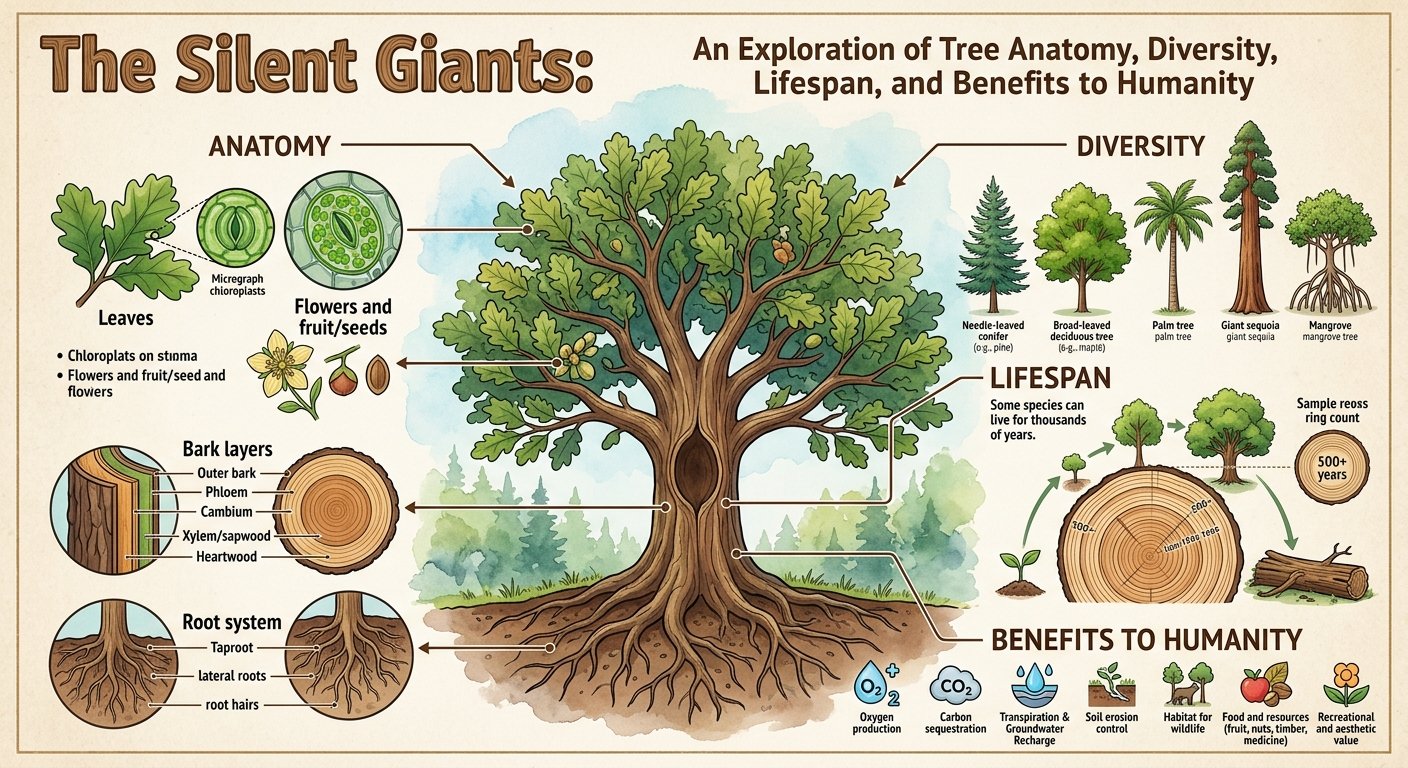
This article examines trees from four interconnected perspectives: anatomy, diversity, lifespan, and benefits to humanity. It explains how roots, trunks, bark, wood, vascular tissues, leaves, branches, flowers, fruits, and seeds work together; examines the extraordinary diversity of tree forms and adaptations; considers why different species live for dramatically different periods; and explores the ecological, economic, social, cultural, scientific, and health-related services trees provide.
Forests currently cover roughly 31% of the world’s land surface and contain much of Earth’s terrestrial biodiversity. They provide food, fibre, fuel, shelter, livelihoods, water regulation, soil protection, carbon storage, and numerous other ecosystem services.
The central argument of this article is that trees should not be understood merely as sources of timber or decorative elements in landscapes. They are foundational components of Earth’s life-support systems. Protecting tree diversity, maintaining healthy forests, and planting appropriate trees in appropriate places are therefore important components of environmental stewardship and human development.
1. Introduction: The Silent Giants
A tree may appear to be one of the simplest objects in a landscape: a trunk rising from the ground, branches extending outward, and leaves moving in the wind. Scientifically, however, a mature tree is an extraordinarily sophisticated biological system.
It has a structural framework capable of supporting enormous masses against gravity. It possesses vascular networks that transport water and dissolved minerals upward and distribute sugars throughout the organism. Its roots explore soil for water and nutrients. Its leaves capture solar energy. Its flowers and reproductive structures ensure the continuation of its species.
Trees also exist as members of larger ecological communities. A single tree may provide habitat for insects, birds, mammals, fungi, microorganisms, lichens and other plants. Its roots influence soil structure, while fallen leaves become part of nutrient cycles.
At the landscape level, groups of trees form woodlands and forests. These ecosystems influence water movement, soil stability, climate, biodiversity and human economies. The U.S. Forest Service describes forests as providing services including soil stabilization, erosion prevention, water-resource management, climate regulation, air-quality improvement, habitat, recreation, food, fuel and wood products.
This makes the tree one of nature’s most important examples of biological engineering.
2. What Is a Tree?
A tree is generally defined as a perennial woody plant possessing a relatively tall, self-supporting stem or trunk and a branching crown. However, there is no single universal biological boundary separating every tree from every shrub.
Some plants can grow as either shrubs or trees depending on environmental conditions. Some tree species have multiple trunks, while others develop unusual growth forms adapted to deserts, wetlands, mountains or tropical forests.
The essential characteristics are therefore more useful than a rigid definition:
- Perennial life — trees normally survive for multiple growing seasons.
- Woody structure — their stems develop substantial secondary growth.
- Vascular transport — specialized tissues move water, minerals and organic compounds.
- Persistent structural framework — trunks and branches support leaves and reproductive structures.
- Root systems — roots anchor the plant and acquire water and minerals.
- Photosynthetic foliage — leaves or other green tissues capture solar energy in most tree species.
Trees belong to many different evolutionary groups. They are not one single biological lineage. Conifers, flowering trees, cycads and other woody plants demonstrate that the tree growth form has evolved repeatedly.
3. The Anatomy of a Tree
Understanding tree anatomy is essential for understanding almost everything a tree does.
A mature tree can be divided into several major systems:
- Roots
- Root crown
- Trunk
- Bark
- Vascular tissues
- Wood
- Branches
- Leaves
- Flowers and reproductive structures
- Fruits and seeds
These structures operate as an integrated system rather than as isolated components.
3.1 Roots: The Underground Foundation
Roots perform several essential functions.
Anchorage
Roots hold the tree in the soil and help it resist wind and gravity.
Water absorption
Fine roots and associated structures absorb water from soil.
Mineral acquisition
Roots acquire nutrients required for metabolism and growth, including nitrogen, phosphorus, potassium and various micronutrients.
Storage
Some trees store carbohydrates and other resources in their roots.
Ecological relationships
Tree roots interact extensively with microorganisms. Mycorrhizal fungi, for example, can form associations with roots and influence nutrient and water acquisition.
The underground portion of a tree is therefore not simply an anchoring mechanism. It is a biologically active interface between the tree and the soil ecosystem.
4. The Trunk: The Tree’s Structural Column
The trunk is simultaneously a structural component and a transportation system.
It must support:
- branches,
- leaves,
- flowers,
- fruits,
- snow or rain loads,
- wind forces,
- and the tree’s own weight.
At the same time, the trunk contains tissues responsible for transporting water and organic compounds.
The trunk’s architecture is one of nature’s most impressive compromises between strength, flexibility, weight and biological activity.
5. Bark: The Protective Skin
Bark forms the tree’s outer protective system.
It helps protect internal tissues from:
- physical injury,
- drying,
- temperature extremes,
- pathogens,
- insects,
- and environmental stress.
Bark differs enormously between species.
Some trees have:
- smooth bark,
- deeply fissured bark,
- peeling bark,
- thick cork-like bark,
- fibrous bark,
- or highly textured surfaces.
These differences are not merely aesthetic. Bark characteristics can represent adaptations to particular environmental conditions.
For example, thick protective bark can contribute to the survival of some trees exposed to recurring fire.
6. Wood: A Biological Engineering Material
Wood is one of humanity’s most important natural materials.
Biologically, wood consists largely of secondary xylem produced by the vascular cambium. It provides mechanical support while also participating in water transport.
Wood contains specialized cells arranged into structures that differ among species.
Hardwoods and softwoods are commonly distinguished in forestry and woodworking, although these terms can be misleading if interpreted simply as “hard” versus “soft.” Hardwoods generally come from flowering plants, while softwoods generally come from gymnosperms such as conifers.
Wood has remarkable engineering properties because it combines:
- relatively low density,
- structural strength,
- directional properties,
- renewable production,
- and biological degradability.
Human civilizations have used wood for buildings, furniture, tools, transport, paper, musical instruments and countless other applications.
7. The Vascular System: The Tree’s Transport Network
Trees possess specialized vascular tissues.
Xylem
Xylem primarily transports water and dissolved minerals from roots toward stems and leaves.
Phloem
Phloem transports sugars and other organic compounds produced or distributed by the plant.
Together, these tissues form a biological transportation network extending throughout the tree.
The scale of this network can be enormous. A mature tree effectively contains an interconnected distribution system reaching from microscopic roots to the highest leaves.
8. Leaves: Solar Energy Factories
Leaves are among the most important structures in a tree.
Through photosynthesis, green tissues use:
- sunlight,
- carbon dioxide,
- and water
to manufacture carbohydrates while releasing oxygen as a by-product.
Simplified:
Solar energy + carbon dioxide + water → chemical energy + oxygen
Photosynthesis allows trees to transform solar energy into stored chemical energy.
This energy supports:
- growth,
- maintenance,
- reproduction,
- defense,
- root activity,
- and interactions with other organisms.
Leaves therefore represent biological solar-energy systems operating continuously during suitable environmental conditions.
9. Branches and Canopy Architecture
Branches distribute leaves through three-dimensional space.
The arrangement of branches determines how efficiently a tree can:
- intercept sunlight,
- exchange gases,
- shed water,
- withstand wind,
- produce flowers and fruits,
- and occupy ecological space.
Different species have radically different canopy architectures.
Some develop:
- narrow crowns,
- broad spreading crowns,
- umbrella shapes,
- columnar forms,
- layered canopies,
- or irregular branching patterns.
In forests, canopy architecture also determines how species divide sunlight and space.
10. Flowers, Fruits and Seeds
Flowering trees reproduce through flowers and associated reproductive structures.
Flowers may attract:
- bees,
- butterflies,
- moths,
- birds,
- bats,
- and other organisms.
After successful reproduction, fruits may develop and protect or assist the dispersal of seeds.
Seeds can be transported by:
- wind,
- water,
- animals,
- gravity,
- or human activity.
This creates a remarkable ecological partnership between trees and other organisms.
A fruit-producing tree, for example, may simultaneously reproduce itself and provide food for animals that disperse its seeds.
11. Tree Diversity: A Planet of Different Designs
Tree diversity is one of the most remarkable features of Earth’s terrestrial ecosystems.
Trees inhabit environments ranging from:
- tropical rainforests,
- savannas,
- temperate forests,
- Mediterranean landscapes,
- mountains,
- wetlands,
- river valleys,
- deserts,
- and high-latitude environments.
FAO notes that forests cover about 31% of the world’s land surface and contain the majority of Earth’s terrestrial biodiversity.
Earlier global assessments estimated approximately 80,000–100,000 tree species, illustrating the enormous scale of tree diversity, although estimates vary according to definitions, inventories and scientific discoveries.
12. Tropical Trees
Tropical forests contain extraordinary biological diversity.
Competition for:
- sunlight,
- water,
- nutrients,
- pollinators,
- and space
has produced complex ecological communities.
Tropical trees may occupy different vertical layers, including:
- forest floor,
- understory,
- lower canopy,
- main canopy,
- and emergent layer.
Some emergent trees rise dramatically above surrounding vegetation to capture sunlight.
13. Temperate Trees
Temperate forests experience substantial seasonal variation.
Many deciduous trees respond to seasonal temperature and daylight changes by:
- growing during favorable seasons,
- producing leaves,
- storing resources,
- changing leaf chemistry,
- and shedding leaves during unfavorable periods.
Leaf fall reduces water loss and allows trees to survive cold or dry seasons.
14. Conifers
Conifers include familiar trees such as:
- pines,
- firs,
- spruces,
- cedars,
- cypresses,
- and related groups.
Many possess needle-like or scale-like leaves that can reduce water loss and withstand cold environments.
Some conifers achieve extraordinary ages and dimensions.
Their evolutionary success demonstrates how different anatomical strategies can solve the same fundamental problems of survival, growth and reproduction.
15. Trees of Dry Environments
Trees in dry environments must solve the problem of limited water.
Adaptations can include:
- deep roots,
- extensive lateral roots,
- reduced leaves,
- waxy surfaces,
- water storage,
- seasonal dormancy,
- and specialized photosynthetic strategies.
The baobab is a famous example of a tree adapted to seasonal water availability, with a distinctive swollen trunk and unusual architecture.
Such trees demonstrate that “tree” does not necessarily mean a single physical design.
16. Trees in Wetlands
Wetland trees must tolerate conditions that may restrict oxygen availability around their roots.
Some species develop specialized root structures that help them survive waterlogged soils.
Mangrove ecosystems provide an especially important example.
Mangrove trees tolerate saline or brackish environments and create complex coastal habitats.
They contribute to:
- shoreline stabilization,
- habitat formation,
- carbon storage,
- fisheries,
- and protection from some coastal disturbances.
17. Trees and Evolution
Trees are products of evolutionary history.
Their characteristics reflect long-term interaction among:
- genetic variation,
- natural selection,
- climate,
- soil,
- competition,
- herbivory,
- disease,
- fire,
- pollination,
- and disturbance.
Tree diversity is therefore not simply a collection of different shapes.
It is the visible expression of millions of years of evolutionary experimentation.
Genetic diversity is especially important because it provides the raw material for adaptation. FAO emphasizes that genetic diversity allows forest trees to survive, adapt and evolve under changing environmental conditions.
18. How Long Can Trees Live?
Tree lifespan varies enormously.
Some fast-growing species may live only a few decades, while others can survive for centuries or, under suitable circumstances, for thousands of years.
Lifespan depends on:
- genetics,
- species characteristics,
- climate,
- disease,
- insects,
- fire,
- drought,
- competition,
- physical damage,
- soil conditions,
- and human disturbance.
A tree’s maximum potential lifespan should not be confused with the average lifespan of individuals in nature.
19. Why Some Trees Live for Centuries
Long-lived trees possess combinations of characteristics that allow them to survive repeated environmental challenges.
These may include:
- strong structural architecture,
- effective compartmentalization of injuries,
- protective bark,
- resistance to particular pests,
- capacity to regenerate damaged tissues,
- extensive root systems,
- and physiological adaptations to environmental stress.
Importantly, longevity does not mean that every part of a tree remains unchanged.
A very old tree can continuously replace tissues while retaining its overall identity and structure.
20. Ancient Trees as Living Archives
Old trees can serve as biological records.
Their growth patterns can preserve information about environmental conditions.
Tree rings, where present and interpretable, can reveal variations associated with:
- rainfall,
- temperature,
- drought,
- disturbance,
- and other environmental factors.
This field, known as dendrochronology, allows scientists to reconstruct aspects of past environmental conditions.
Ancient trees can therefore function as living archives of ecological history.
21. Trees as Carbon Systems
Trees absorb atmospheric carbon dioxide through photosynthesis.
Some of the resulting carbon becomes incorporated into:
- trunks,
- branches,
- roots,
- leaves,
- and surrounding soil.
Forests therefore represent major carbon reservoirs.
FAO reports that forests store enormous quantities of carbon and play an important role in climate mitigation.
However, carbon storage is only one part of the forest-climate relationship. Forest ecosystems also influence water cycles, surface conditions, biodiversity and energy exchanges.
22. Trees and Oxygen
Trees are often described simply as “oxygen producers.”
This is broadly true in the context of photosynthesis, but the complete ecological picture is more complicated.
Trees produce oxygen during photosynthesis, while organisms throughout ecosystems consume oxygen through respiration. Dead organic matter is also decomposed by microorganisms.
Therefore, the importance of trees cannot be reduced to oxygen production alone.
Their larger significance includes:
- carbon cycling,
- climate regulation,
- water cycling,
- habitat,
- soil protection,
- food production,
- and biodiversity.
23. Trees and Water
Trees influence water movement through ecosystems.
Their canopies intercept rainfall.
Roots help stabilize soil and can influence infiltration.
Forest soils can store and gradually release water.
Vegetation also returns water to the atmosphere through transpiration.
Together, evaporation and transpiration form evapotranspiration, an important component of the water cycle.
Forest ecosystems can therefore influence:
- streamflow,
- groundwater recharge,
- soil moisture,
- atmospheric humidity,
- and watershed behavior.
The precise effects vary greatly with forest type, climate, soil and land-use conditions.
24. Trees and Soil Protection
Tree roots help hold soil in place.
This is especially important on:
- slopes,
- riverbanks,
- agricultural landscapes,
- and degraded land.
Tree litter also contributes organic matter to soil.
As leaves and branches decompose, nutrients return to the ecosystem.
Forests consequently participate in the long-term formation and maintenance of productive soils.
25. Trees and Biodiversity
A single mature tree can become a miniature ecosystem.
Its:
- bark,
- branches,
- leaves,
- flowers,
- fruits,
- cavities,
- roots,
- and surrounding soil
can support many organisms.
Birds may nest in branches.
Insects may feed on leaves.
Fungi may associate with roots.
Mammals may eat fruits.
Microorganisms participate in decomposition and nutrient cycling.
Consequently, tree diversity contributes directly to broader biodiversity.
Research synthesized by the U.S. Forest Service emphasizes that biodiversity is integral to ecosystem processes and contributes to ecosystem services.
26. Trees as Providers of Food
Trees contribute directly to human nutrition.
Examples include trees producing:
- fruits,
- nuts,
- seeds,
- edible leaves,
- oils,
- spices,
- beverages,
- and other food products.
Forests also provide foods gathered from wild plants and ecosystems.
The relationship between trees and food systems is therefore much broader than commercial fruit orchards.
Research on forest food systems highlights contributions to nutrition, health, income and cultural practices.
27. Trees and Medicine
Human societies have used plants for medicinal purposes for thousands of years.
Trees have provided compounds and raw materials that have contributed to traditional medicine and modern pharmacological research.
Their importance lies not simply in individual remedies but in the enormous chemical diversity produced by plants.
Tree biodiversity is therefore also a potential biological library.
Destroying species before their biological properties are understood can eliminate opportunities for future scientific discovery.
28. Trees and Human Settlements
Trees have always been closely associated with human settlement.
They provide:
- shade,
- wind protection,
- materials,
- food,
- fuel,
- visual beauty,
- and places for recreation.
Urban trees can also contribute to environmental quality.
Research reviewed by the U.S. Forest Service identifies effects of urban trees on environmental quality and human well-being, including air quality and other aspects of urban environments.
29. Trees and Cities
Urbanization creates distinctive environmental challenges.
Cities commonly contain:
- concrete,
- asphalt,
- buildings,
- vehicles,
- limited soil,
- and large amounts of waste heat.
Trees can help modify urban environments through:
- shade,
- evapotranspiration,
- interception of rainfall,
- air-pollution removal,
- and habitat creation.
Urban forestry therefore represents an important intersection between environmental science, public planning, engineering and human well-being.
Strategic tree planting can also contribute to energy conservation and stormwater management, although species selection and maintenance are essential.
30. Trees and the Economy
The global tree economy is enormous.
Tree-derived products include:
- timber,
- paper,
- packaging,
- furniture,
- construction materials,
- fibres,
- oils,
- fruits,
- nuts,
- medicines,
- chemicals,
- and renewable energy products.
Forests also support:
- tourism,
- recreation,
- employment,
- local enterprises,
- and rural livelihoods.
FAO identifies forests as sources of food, fibre, fuel and fodder and as important contributors to livelihoods and economic development.
31. Trees and Construction
Wood remains one of the most important renewable structural materials.
Modern engineering has expanded the potential of wood through products such as:
- engineered timber,
- laminated wood products,
- structural panels,
- and advanced composite wood materials.
When forests are sustainably managed and materials are responsibly sourced, wood can form part of lower-carbon construction strategies.
However, sustainability depends on the entire system—from forest management and harvesting to processing, transport, construction, maintenance and eventual reuse.
32. Trees and Culture
Trees have deep cultural significance.
Across societies, particular trees have become symbols of:
- life,
- ancestry,
- wisdom,
- strength,
- peace,
- community,
- renewal,
- and continuity.
Large old trees may become landmarks.
Sacred groves and culturally protected forests demonstrate that conservation can be supported not only by scientific knowledge but also by cultural traditions.
33. Trees and Human Well-Being
Trees contribute to the quality of human environments.
Natural landscapes can provide opportunities for:
- recreation,
- walking,
- education,
- observation,
- relaxation,
- and connection with nature.
The relationship between vegetation and human well-being is increasingly studied through environmental health and urban planning research.
Trees therefore possess values that cannot be fully represented by the market price of timber.
34. The Hidden Economic Value of Trees
Many tree benefits are not bought and sold.
A tree may:
- reduce erosion,
- store carbon,
- provide shade,
- support biodiversity,
- intercept rainfall,
- improve local environmental conditions,
- or provide habitat.
No conventional timber transaction necessarily captures these services.
Research has demonstrated that non-market ecosystem services can represent enormous economic value. A study of U.S. trees estimated that five major ecosystem services generated approximately $114 billion per year in value, with carbon storage and air-pollution removal exceeding the commercial value of wood products and food crops in that analysis.
This illustrates a fundamental economic lesson:
The market price of a tree is not the same thing as the total value of a tree.
35. Forests as Natural Infrastructure
Infrastructure is usually associated with roads, bridges, dams, power systems and telecommunications.
But forests also function as a form of natural infrastructure.
They can help:
- stabilize slopes,
- protect watersheds,
- reduce erosion,
- regulate water movement,
- store carbon,
- provide habitat,
- and support livelihoods.
In some circumstances, maintaining or restoring ecosystems can complement engineered infrastructure.
This concept is increasingly important in sustainable development.
36. Threats Facing Trees
Trees face numerous threats.
Major pressures include:
Deforestation
Forest conversion to agriculture, infrastructure and other land uses can permanently remove tree habitats.
Forest degradation
Even when forests remain standing, excessive extraction, fragmentation, fire and other disturbances can reduce ecological integrity.
Climate change
Changing temperatures, rainfall patterns, drought conditions and extreme events can alter tree survival and distribution.
Invasive species
Introduced organisms can disrupt native ecosystems.
Pests and diseases
Insects, fungi, bacteria and other pathogens can cause substantial mortality.
Fire
Fire is a natural ecological process in many ecosystems, but altered fire regimes can become destructive.
Habitat fragmentation
Breaking continuous forests into smaller isolated patches can reduce biodiversity and disrupt ecological processes.
FAO identifies deforestation, degradation, invasive species, fires, pests and diseases among major pressures on forest biodiversity.
37. Climate Change and Tree Survival
Climate change creates a complex challenge.
Trees cannot simply move to a new climate overnight.
A species may require:
- suitable soil,
- appropriate temperatures,
- sufficient water,
- compatible pollinators,
- seed dispersers,
- and connected habitats.
When environmental conditions change faster than populations can adapt or migrate, tree mortality may increase.
At the same time, genetic diversity can provide populations with greater capacity to respond to changing conditions.
This makes conservation of both species diversity and genetic diversity important.
38. Tree Diseases
Trees can be affected by numerous pathogens.
Diseases can interfere with:
- roots,
- vascular tissues,
- leaves,
- bark,
- reproductive structures,
- and overall growth.
A healthy forest is therefore not simply one containing many trees.
Forest health requires functional ecological relationships among trees, soil organisms, insects, fungi, animals and environmental conditions.
39. The Importance of Tree Diversity
Planting or conserving one tree species everywhere may appear efficient, but ecological systems often benefit from diversity.
Different species possess different:
- drought tolerances,
- growth rates,
- root architectures,
- flowering periods,
- nutrient requirements,
- disease susceptibilities,
- and responses to disturbance.
A diverse forest may therefore have greater ecological resilience than a simplified system, although the relationship between diversity and resilience depends on context.
Forest biodiversity is strongly connected to ecosystem functioning and the delivery of ecosystem services.
40. Conservation: Protecting Existing Trees
The first principle of tree conservation is straightforward:
A mature tree that already exists is often more valuable ecologically than a newly planted tree of the same species.
A mature tree has already accumulated:
- biomass,
- roots,
- habitat complexity,
- carbon,
- soil interactions,
- and ecological relationships.
Planting new trees is valuable, but planting should complement—not automatically replace—the protection of existing forests and mature trees.
41. Reforestation and Restoration
Reforestation involves restoring trees to areas where forests have been removed or substantially reduced.
Restoration goes further.
A successful restoration project may seek to rebuild:
- native species diversity,
- soil function,
- hydrological processes,
- habitat,
- ecological connectivity,
- and natural regeneration.
The objective should not always be maximum tree numbers.
The better question is:
What functioning ecosystem should exist in this location?
42. Planting the Right Tree in the Right Place
Tree planting is most successful when ecological conditions are considered.
Important factors include:
- climate,
- rainfall,
- soil,
- available space,
- root growth,
- mature size,
- local biodiversity,
- water requirements,
- surrounding infrastructure,
- and future maintenance.
A tree suitable for a rural landscape may be unsuitable beneath power lines or beside underground infrastructure.
Good forestry and urban forestry therefore require planning rather than simply planting as many trees as possible.
43. Sustainable Forestry
Sustainable forestry seeks to balance multiple objectives.
These may include:
- timber production,
- biodiversity conservation,
- watershed protection,
- carbon management,
- recreation,
- livelihoods,
- cultural values,
- and long-term forest health.
FAO’s forestry approach explicitly recognizes the need to balance economic, social and environmental objectives.
The challenge is not necessarily to eliminate all human use of forests.
It is to ensure that human use does not destroy the ecological systems upon which future generations depend.
44. Trees as Teachers of Engineering
Trees can inspire technological innovation.
Their biological structures demonstrate solutions to problems involving:
- lightweight strength,
- fluid transport,
- self-repair,
- modular growth,
- branching networks,
- energy capture,
- environmental adaptation,
- and resource efficiency.
This field of inspiration from biological systems is often called biomimicry.
Tree architecture can therefore influence thinking in engineering, architecture, materials science and network design.
45. Trees and Modern Science
Trees are now studied using technologies far beyond traditional field observation.
Modern researchers use:
- satellite imagery,
- drones,
- LiDAR,
- geographic information systems,
- genetic sequencing,
- ecological modelling,
- automated sensors,
- and machine learning.
These tools allow scientists to study forest structure at scales ranging from individual leaves to entire continents.
FAO’s Global Forest Resources Assessment 2025 is based on official national data and provides a major global reference for understanding long-term forest trends.
46. Trees and Artificial Intelligence
Artificial intelligence is increasingly relevant to forest science.
AI can assist with:
- tree detection,
- species classification,
- forest mapping,
- disease identification,
- wildfire monitoring,
- biomass estimation,
- land-use analysis,
- and satellite-image interpretation.
Machine-learning systems can process enormous quantities of environmental data that would be difficult to analyze manually.
The combination of forestry + remote sensing + AI + environmental science is becoming an important component of modern forest management.
47. The Tree as a Complete System
A tree should never be considered only as a trunk.
A more accurate model is:
Tree = roots + vascular system + trunk + branches + leaves + reproductive structures + microorganisms + soil interactions + climate + ecological community
This systems perspective explains why cutting a tree affects more than the individual organism.
Removing a mature tree can change:
- shade,
- soil moisture,
- habitat,
- carbon storage,
- nutrient cycling,
- water movement,
- and local microclimate.
48. The Forest as a Super-System
The forest is even more complex.
A forest contains interactions among:
Trees → fungi → microorganisms → insects → birds → mammals → soil → water → atmosphere → climate
Each component affects others.
For example:
- Trees capture sunlight.
- Photosynthesis produces organic matter.
- Leaves and roots contribute organic material.
- Microorganisms decompose material.
- Nutrients return to the soil.
- Roots absorb nutrients.
- Herbivores consume plants.
- Predators interact with herbivores.
- Dead organisms return material to the ecosystem.
The forest therefore behaves as a dynamic network rather than a collection of independent trees.
49. Why Humanity Cannot Easily Replace Forests
Modern engineering can reproduce some individual forest functions.
We can build:
- water-treatment plants,
- air-filtration systems,
- flood-control structures,
- carbon-storage technologies,
- agricultural systems,
- and manufactured materials.
But reproducing the entire combination of services delivered simultaneously by a functioning forest is vastly more complicated.
A forest performs many processes at once.
This is why ecological conservation can be more efficient than attempting to replace every natural function after ecosystems have been destroyed.
50. The Future of Trees
The future of trees will depend on decisions made at several levels:
Individual level
People can protect mature trees, avoid unnecessary damage and plant suitable species.
Community level
Communities can develop urban forests, protect local woodlands and restore degraded areas.
National level
Governments can establish effective forest policies, protected areas and sustainable forestry systems.
Global level
Countries can cooperate on climate change, biodiversity, deforestation and sustainable supply chains.
Scientific level
Researchers can improve knowledge of tree genetics, ecology, diseases, carbon cycles and climate adaptation.
51. A New Philosophy of Trees
The conventional view often treats a tree as a resource.
A more complete philosophy recognizes three identities simultaneously:
Tree as organism
It is a living individual with its own biological processes.
Tree as ecosystem
It supports numerous other organisms and participates in ecological networks.
Tree as infrastructure
It performs environmental functions that benefit human societies.
These three perspectives should be considered together.
52. Conclusion
Trees are among the greatest biological achievements on Earth.
Their apparent simplicity conceals extraordinary complexity.
Below ground, roots explore soil and interact with microorganisms. Within the trunk, vascular tissues transport water and organic compounds. Wood provides structural strength. Bark provides protection. Branches position leaves for sunlight. Leaves convert solar energy into chemical energy. Flowers, fruits and seeds ensure reproduction.
Beyond the individual tree lies an even greater system.
Trees form forests, and forests regulate ecological processes that influence biodiversity, water, soil, climate and human livelihoods. FAO describes forests as fundamental to life on the planet and emphasizes their roles in biodiversity, food, income, shelter, energy and climate regulation.
Their value to humanity extends far beyond timber.
Trees provide food, materials, medicines, shade, recreation, cultural meaning, habitat, carbon storage, soil protection and numerous other ecosystem services. Some of these benefits can be measured financially, while others are difficult or impossible to price.
The greatest lesson is therefore simple:
A tree is never merely a tree.
It is a living structure, a biological machine, a habitat, a carbon store, a water-cycle participant, a soil protector, an economic resource, a cultural symbol and a component of Earth’s life-support system.
The “silent giants” may not speak in human language, but their presence communicates an essential message about the relationship between civilization and nature: human prosperity ultimately depends upon functioning living systems.
Protecting trees is therefore not simply an act of environmental conservation. It is an investment in biodiversity, scientific discovery, economic resilience, healthy communities and the ecological foundations of future generations.
Selected References and Further Reading
- Food and Agriculture Organization of the United Nations (FAO), Forests and Forestry Resources.
- FAO, Global Forest Resources Assessment 2025.
- U.S. Department of Agriculture Forest Service, Forest-related Ecosystem Services.
- U.S. Forest Service, Forest Biodiversity and the Delivery of Ecosystem Goods and Services.
- U.S. Forest Service, Quantifying and Valuing the Role of Trees and Forests on Environmental Quality and Human Health.
- Cavender-Bares et al., The Hidden Value of Trees.
- FAO, Global Action Plan for the Conservation, Sustainable Use and Development of Forest Genetic Resources.
- U.S. Forest Service, The Structure, Distribution, and Biomass of the World’s Forests.
Suggested research themes for expanding this article
- Tree anatomy and plant physiology
- Forest genetics and evolution
- Ancient and exceptionally long-lived trees
- Tropical rainforest biodiversity
- African tree species and ecosystems
- Urban forestry and sustainable cities
- Trees and climate change
- Forest carbon cycles
- Indigenous knowledge and tree conservation
- Forest restoration
- Agroforestry and food security
- AI and satellite monitoring of forests
- The economics of ecosystem services
- Wood science and advanced timber engineering
- Forest diseases and biosecurity
- The future of global forests





Be First to Comment