
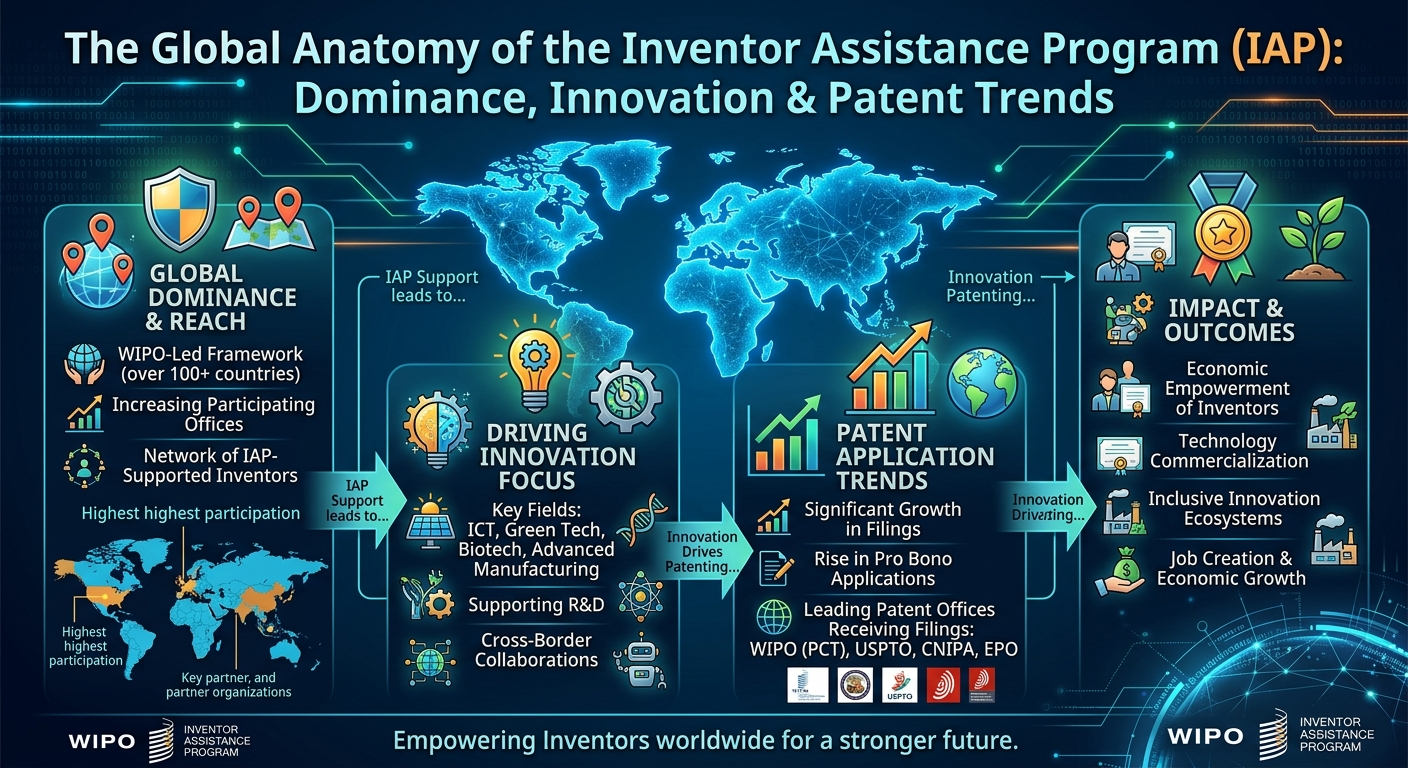
Abstract
The Inventor Assistance Program (IAP) is an international intellectual-property initiative led by the World Intellectual Property Organization (WIPO) that seeks to reduce one of the most persistent barriers facing innovators: the inability to afford professional assistance in navigating the patent system. Its fundamental premise is straightforward but economically important—an invention has limited commercial value if its creator cannot effectively protect it.
The IAP connects qualifying individual inventors and small businesses with volunteer patent professionals who provide professional assistance without charging the beneficiary for their services. The program therefore addresses an important gap between invention, intellectual-property protection, and commercialization.
Since its pilot phase in 2015 involving Colombia, Morocco and the Philippines, the IAP has expanded to ten participating countries: Chile, Colombia, Ecuador, Kenya, Morocco, Pakistan, Peru, the Philippines, Singapore and South Africa. WIPO reports that the program has assisted more than 300 beneficiaries, facilitated more than 130 patent applications and contributed to more than 75 granted patents.
The IAP should not, however, be confused with a global patent-funding program. It principally supplies professional expertise and navigation of the patent system, while official filing fees, translation expenses and other costs generally remain the responsibility of beneficiaries.
This thesis examines the anatomy of the IAP, its governance model, participating-country structure, relationship with global patenting trends, the concentration of worldwide inventive activity, the role of developing economies, the importance of volunteer patent professionals, commercialization challenges, and the strategic opportunities for expanding inclusive innovation.
1. Introduction
Innovation is frequently described as the process of transforming an idea into a useful product, service, technology or process. In practice, however, innovation involves several interconnected stages:
Idea → Research → Prototype → Invention → Intellectual Property → Patent → Commercialization → Market Impact
The transition between these stages is not automatic.
An inventor may possess an excellent technical idea but lack:
- patent knowledge;
- professional patent-drafting skills;
- knowledge of prior art;
- understanding of filing procedures;
- resources for international protection;
- commercialization expertise;
- access to intellectual-property professionals.
This creates what can be called the innovation protection gap.
The IAP was created to address part of this gap.
WIPO describes the program as a mechanism connecting under-resourced inventors and small businesses with qualified professionals who provide patent-related assistance without charging professional fees.
The significance of the program becomes clearer when viewed against the scale of global patent activity.
In 2024, approximately 3.7 million patent applications were filed worldwide, representing a 4.9% increase from 2023 and the fifth consecutive year of growth.
Yet patent activity is highly concentrated geographically.
China, the United States, Japan, the Republic of Korea and Germany are among the world’s largest origins of patent applications, while China alone accounted for approximately 1.8 million applications by applicants based there in 2024.
This creates an important question:
How can talented inventors outside the world’s dominant innovation centers participate more effectively in the global intellectual-property economy?
The IAP represents one answer.
2. Understanding the Anatomy of the IAP
The IAP can be understood as an ecosystem rather than simply a legal-assistance service.
Its principal components are:
- Inventors
- Small businesses
- National intellectual-property authorities
- WIPO
- Volunteer patent professionals
- National Screening Boards
- Sponsors
- Innovation-support organizations
- Commercialization networks
- The IAP Online Platform
These components form an interconnected system.
The basic architecture
Inventor
↓
Application
↓
National Screening Process
↓
Selection
↓
Patent Professional Matching
↓
Patent Strategy
↓
Drafting and Filing
↓
Patent Examination
↓
Grant or Further Prosecution
↓
Potential International Protection
↓
Commercialization
The IAP’s importance lies in connecting these stages.
3. Historical Development of the Program
The IAP originated from the recognition that many developing economies possessed innovative people but lacked sufficient access to professional patent services.
The program began as a pilot in 2015, initially involving Colombia, Morocco and the Philippines. WIPO officially unveiled the IAP in October 2016.
Its evolution can be summarized in several phases.
Phase 1: Concept Development
The initial objective was to address the professional-access problem confronting under-resourced inventors.
Phase 2: Pilot Implementation
The pilot countries provided an opportunity to test whether patent professionals could systematically provide pro bono assistance to qualified inventors.
Phase 3: International Expansion
Additional countries joined as the model demonstrated potential value for national innovation ecosystems.
Phase 4: Institutionalization
The IAP developed formal governance, national screening structures, volunteer networks and an online platform.
Phase 5: Ecosystem Integration
The program increasingly connected patent assistance with commercialization, innovation agencies, technology-transfer networks and international patent strategies.
By 2025, WIPO described the program as having operated for a decade and reported more than 260 beneficiaries, including 61 SMEs, more than 250 volunteers and more than 70 beneficiaries who had secured at least one patent.
WIPO’s current IAP overview reports more than 300 beneficiaries, more than 130 patent applications filed and more than 75 patents granted, indicating continued growth after the decade milestone.
4. Global Geography of the IAP
The current participating countries are:
| Region | Participating countries |
|---|---|
| Africa | Kenya, Morocco, South Africa |
| Asia | Pakistan, Philippines, Singapore |
| Latin America | Chile, Colombia, Ecuador, Peru |
WIPO currently lists 10 participating countries.
This geographic distribution is significant.
The program does not attempt to duplicate the world’s largest patent offices. Instead, it targets countries where increasing the effective participation of local innovators in the patent system can strengthen the innovation ecosystem.
WIPO indicates that countries considering participation should generally have:
- an established culture of innovation;
- relatively low patent filing by local innovators;
- limited success rates among local innovators using the patent system; and
- an established local patent profession.
Therefore, IAP participation is not simply a ranking of countries by technological capability.
It is a response to a specific structural problem:
high innovation potential + insufficient access to patent expertise.
5. The IAP and the Global Patent Economy
To understand the IAP, it is necessary to examine the wider patent landscape.
Global patent applications reached approximately 3.7 million in 2024, up 4.9% from 2023.
The distribution is highly unequal.
According to WIPO’s 2024 statistics, applicants based in:
- China filed approximately 1.797 million applications;
- the United States filed approximately 503,000;
- Japan approximately 421,000;
- the Republic of Korea approximately 296,000; and
- Germany approximately 134,000.
This concentration illustrates the global innovation-power hierarchy.
The world’s leading innovation economies possess:
- large R&D budgets;
- universities;
- corporate laboratories;
- technology-transfer offices;
- venture capital;
- patent professionals;
- manufacturing ecosystems;
- sophisticated intellectual-property strategies.
The IAP operates at a different layer.
It attempts to ensure that innovators who do not have access to these resources are not automatically excluded from the patent system.
6. Patent Dominance: China, the United States, Japan and Korea
6.1 China
China has become the world’s dominant source of patent applications.
Applicants based in China filed approximately 1.8 million patent applications worldwide in 2024, far ahead of other origins.
China’s domestic patent ecosystem is supported by:
- extensive manufacturing;
- large corporate R&D organizations;
- government innovation programs;
- universities;
- technology companies;
- industrial research;
- rapidly expanding digital industries.
WIPO reported that China’s IP office received approximately 1.8 million invention-patent applications in 2024 and that China’s share of worldwide patent-office filings has increased substantially over the past decade.
China therefore demonstrates how patent activity can become a component of national industrial strategy.
7. The United States
The United States remains one of the world’s most influential patent economies.
US-based applicants filed more than 500,000 patent applications worldwide in 2024.
The US innovation ecosystem is characterized by strong connections among:
- universities;
- venture capital;
- technology companies;
- research laboratories;
- startups;
- patent attorneys;
- government research agencies.
The American model illustrates an important point:
Patent dominance is not produced by patent offices alone.
It emerges from an ecosystem connecting research, capital, entrepreneurship, legal expertise and commercialization.
8. Japan
Japan remains one of the world’s major patent origins.
Japanese applicants filed approximately 421,000 patent applications worldwide in 2024.
Japan’s innovation ecosystem is particularly strong in:
- electronics;
- automobiles;
- robotics;
- precision engineering;
- materials;
- manufacturing;
- chemistry.
Japan illustrates the relationship between industrial specialization and long-term patent activity.
9. Republic of Korea
The Republic of Korea is another major patent power.
Applicants based there filed approximately 296,000 patent applications worldwide in 2024.
Korea’s technology-intensive economy demonstrates how national industrial strategy, corporate R&D and export-oriented manufacturing can reinforce patent activity.
Its international patent activity is particularly visible in:
- semiconductors;
- electronics;
- telecommunications;
- batteries;
- displays;
- artificial intelligence;
- advanced manufacturing.
10. Germany and the European Innovation System
Germany remains a major patent origin, with approximately 134,000 applications from German applicants in 2024.
Its strength is closely connected with:
- automotive engineering;
- industrial machinery;
- chemicals;
- manufacturing;
- electrical engineering;
- industrial automation.
Europe adds another layer through the European Patent Office and European patent system.
This demonstrates that innovation geography operates at several levels:
national → regional → international.
11. India: A Major Emerging Patent Power
India deserves special attention because its patent growth illustrates the emergence of a major innovation economy.
Patent applications by India-based applicants increased approximately 19% in 2024, continuing a long period of rapid growth.
This growth is important because India combines:
- a large population;
- expanding universities;
- technology startups;
- information technology;
- pharmaceutical research;
- engineering;
- digital public infrastructure;
- growing R&D activity.
India illustrates how a developing or middle-income economy can rapidly increase participation in global patenting.
12. The African Patent Context
Africa remains significantly underrepresented in global patenting.
WIPO’s 2024 country-origin data place South Africa among the more significant African patent origins, but its global volume remains far below that of the world’s largest patent economies.
This makes the IAP particularly relevant to African innovation ecosystems.
Africa possesses substantial innovative capacity in areas including:
- agriculture;
- renewable energy;
- financial technology;
- telecommunications;
- healthcare technologies;
- water management;
- mining technologies;
- climate adaptation;
- logistics;
- educational technology.
The challenge is frequently not the absence of ideas.
The challenge is converting ideas into:
protectable intellectual property + investment + production + markets.
13. South Africa’s Strategic Position
South Africa is especially important to the IAP because it is currently one of the participating countries.
Its participation creates an institutional bridge between:
- inventors;
- universities;
- technology entrepreneurs;
- intellectual-property professionals;
- innovation agencies;
- research institutions;
- commercial enterprises.
WIPO notes that South Africa’s National Screening Board includes local innovation agencies, providing broader perspectives and connections to other innovation-support programs.
This is strategically significant because patent protection should not operate in isolation.
An inventor may require not only patent assistance but also:
- prototyping;
- testing;
- financing;
- manufacturing;
- market research;
- business development;
- technology transfer.
14. The IAP’s Core Problem: The Patent Access Gap
The patent system can be technically open while economically difficult to access.
Consider two inventors:
Inventor A
Has:
- funding;
- patent counsel;
- research facilities;
- university support;
- investors;
- commercialization specialists.
Inventor B
Has:
- an invention;
- limited income;
- little patent knowledge;
- no patent attorney;
- no commercialization network.
Both may possess valuable inventions.
Yet Inventor A is structurally better positioned to transform the invention into protected intellectual property.
This is the patent access gap.
The IAP attempts to reduce this asymmetry.
15. The Role of Volunteer Patent Professionals
Volunteer professionals are the central operational resource of the IAP.
They can provide services including:
- patent drafting;
- filing;
- prosecution;
- amendments;
- responses to patent-office communications;
- requests for examination;
- certain international filing support.
The IAP Online Platform describes professional assistance as covering significant portions of the patent application and prosecution process.
This creates a powerful social model:
Professional expertise → donated time → stronger intellectual property → increased innovation opportunity.
The program therefore transforms professional knowledge into an innovation-development resource.
16. The National Screening Board
The National Screening Board provides another important institutional layer.
Its function is to assess applicants according to national eligibility rules.
WIPO explains that participating countries determine their own selection criteria, including economic and invention-related considerations.
This decentralized model is important because economic conditions differ substantially between countries.
A standardized global threshold would not necessarily produce equitable outcomes.
Instead:
Global framework + national adaptation
forms the IAP model.
17. The IAP Online Platform
Digital infrastructure is increasingly important to the program.
The IAP Online Platform supports:
- inventor applications;
- volunteer applications;
- matchmaking;
- country dashboards;
- workflow management;
- search;
- communication across program participants.
WIPO describes the platform as multilingual and available to IAP participants without charge.
The platform can therefore be considered the digital nervous system of the IAP.
It connects the human components of the program.
18. From Invention to Patent
The IAP process can be represented as:
1. Invention
↓
2. Application
↓
3. Eligibility review
↓
4. National Screening Board
↓
5. Selection
↓
6. Volunteer matching
↓
7. Patent strategy
↓
8. Patent drafting
↓
9. Filing
↓
10. Examination
↓
11. Grant or further prosecution
↓
12. Potential international protection
WIPO indicates that initial application review commonly takes several weeks, while application-to-matching can take several months depending on the country and volunteer availability.
19. International Patent Protection
A patent is generally territorial.
An inventor seeking protection outside the home country therefore faces additional complexity.
The IAP can help selected beneficiaries explore international protection, including through the Patent Cooperation Treaty (PCT).
WIPO recommends that inventors discuss international filing strategy with their assigned volunteer and consider a PCT application within 12 months of the initial filing where appropriate.
The PCT is important because it provides a coordinated international filing framework.
In 2024, there were approximately 273,900 PCT applications, with China, the United States, Japan, the Republic of Korea and Germany among the leading origins.
This demonstrates another layer of global patent dominance.
20. The Technology Dimension
Patent activity increasingly reflects the transformation of the global economy.
WIPO reports that computer technology was the most frequently featured technology field in published patent applications worldwide in 2023, accounting for 13.2% of the global total.
This reflects the rise of:
- artificial intelligence;
- cloud computing;
- semiconductors;
- telecommunications;
- cybersecurity;
- robotics;
- software-related technologies;
- data processing.
The IAP therefore operates at a time when technological complexity is increasing.
Future beneficiaries may increasingly work in:
AI + robotics + biotechnology + energy + materials + telecommunications + agriculture + digital infrastructure.
21. Patent Trends and the Rise of AI
Artificial intelligence creates a particularly important challenge.
AI technologies can generate inventions involving:
- machine-learning architectures;
- hardware;
- semiconductor design;
- data processing;
- robotics;
- computer vision;
- optimization;
- industrial automation.
At the same time, AI increases the complexity of prior-art research and patent drafting.
This means future inventor-assistance systems may need to combine:
human patent expertise + advanced search tools + AI-assisted analysis.
AI should not simply replace patent professionals.
Rather, it can potentially increase the productivity of professionals serving under-resourced inventors.
22. The Difference Between Patenting and Innovation
A central analytical point is that patent numbers are not equivalent to innovation quality.
A country may have millions of applications while another has fewer applications but highly influential technologies.
Patent statistics should therefore be interpreted alongside:
- patent quality;
- citations;
- commercialization;
- R&D expenditure;
- university-industry collaboration;
- exports;
- startup formation;
- technology transfer;
- productivity.
The IAP’s objective should similarly not be measured solely by the number of applications.
A stronger measurement system should ask:
How many supported inventions become economically or socially useful technologies?
23. The Commercialization Challenge
Obtaining a patent is not the end of innovation.
The sequence is:
Invention → Protection → Validation → Financing → Manufacturing → Marketing → Sales → Scale
The IAP provides patent assistance and can provide commercialization guidance, but it does not function as a general financing institution. WIPO explicitly states that direct financial assistance is not provided and that beneficiaries remain responsible for official fees and other out-of-pocket expenses.
This creates a major policy opportunity.
Patent assistance should increasingly connect inventors to:
- venture capital;
- government grants;
- incubators;
- accelerators;
- manufacturing partners;
- technology-transfer offices;
- corporate innovation programs;
- export agencies.
24. The IAP as an Innovation-Ecosystem Intervention
The deepest significance of the IAP is therefore broader than patent law.
It is an intervention in the innovation ecosystem.
The ecosystem can be represented as:
Education
↓
Research
↓
Invention
↓
Intellectual Property
↓
Finance
↓
Manufacturing
↓
Commercialization
↓
Exports
↓
Economic Development
If the intellectual-property stage fails, an inventor may struggle to attract investment because the invention is insufficiently protected.
Consequently, patent assistance can have downstream effects on entrepreneurship.
25. Measuring IAP Performance
A mature evaluation framework should use several indicators.
Input indicators
- number of volunteers;
- number of participating countries;
- number of sponsors;
- professional hours donated;
- number of applications received.
Process indicators
- application-processing time;
- matching time;
- patent-drafting time;
- examination response time.
Output indicators
- applications filed;
- patents granted;
- international applications;
- SMEs supported.
Outcome indicators
- licensing agreements;
- investment obtained;
- companies created;
- products commercialized;
- jobs created;
- export revenues.
Long-term impact indicators
- inventor survival;
- business growth;
- technology diffusion;
- local R&D capacity;
- increased domestic patent participation.
This distinction is critical.
Applications are outputs.
Economic and social impact are outcomes.
26. Strengths of the IAP
26.1 Reduces professional barriers
The program gives qualified inventors access to professional expertise that might otherwise be unaffordable.
26.2 Builds local capacity
Participation encourages development of local patent professionals and innovation institutions.
26.3 Encourages inclusive innovation
The program creates opportunities for inventors who lack financial resources.
26.4 Strengthens patent quality
Professional assistance can improve patent applications.
26.5 Creates international connections
The global volunteer network can support international patent strategies.
26.6 Encourages pro bono culture
The program demonstrates how professional expertise can be deployed as a public-interest resource.
27. Structural Limitations
The IAP cannot solve every innovation problem.
Limitation 1: Limited geographic coverage
Only ten countries currently participate.
Limitation 2: Volunteer capacity
Demand can exceed the availability of qualified volunteers.
Limitation 3: Official costs remain
Professional assistance may be free while patent-related government fees and other costs remain payable.
Limitation 4: Commercialization remains difficult
A patent does not automatically create a profitable business.
Limitation 5: Patent quality varies
A patent may have limited commercial significance even if legally granted.
Limitation 6: Innovation ecosystems differ
Countries have different levels of:
- R&D;
- finance;
- manufacturing;
- legal expertise;
- university-industry collaboration.
Therefore, IAP implementation cannot be identical everywhere.
28. Dominance Versus Inclusion
The global patent landscape reveals a fundamental contradiction.
The countries with the largest innovation ecosystems are already capable of generating enormous patent volumes.
Meanwhile, talented innovators in less-developed ecosystems may struggle to secure even one high-quality patent.
The IAP therefore addresses the distribution of innovation opportunity, rather than simply the quantity of patents.
This distinction is important.
The objective is not necessarily to make every country produce millions of patents.
The objective is to ensure that valuable inventions are not lost merely because their creators lack access to professional assistance.
29. A Global Innovation Hierarchy
The contemporary innovation economy can be conceptually divided into several layers.
Tier 1: Global innovation superpowers
Examples include:
- China;
- United States;
- Japan;
- Republic of Korea.
Tier 2: Major industrial and research economies
Examples include:
- Germany;
- France;
- United Kingdom;
- Switzerland;
- Netherlands.
Tier 3: Rapidly expanding innovation economies
Examples include:
- India;
- Türkiye;
- selected Southeast Asian economies.
Tier 4: Emerging innovation ecosystems
Many African, Latin American and other developing economies fall into this broad category.
The IAP is especially relevant to the fourth and parts of the third category.
30. The Strategic Importance of South-South Innovation
One of the IAP’s most interesting possibilities is increasing innovation exchange among developing economies.
An African invention does not necessarily need to target Europe, North America or East Asia first.
It may solve problems shared by:
- African countries;
- South Asian countries;
- Latin American countries;
- Southeast Asian countries.
Examples could include technologies addressing:
- water scarcity;
- agricultural productivity;
- affordable energy;
- transportation;
- healthcare access;
- financial inclusion.
The IAP could therefore become part of a larger South-South technology-transfer architecture.
31. The Future of the IAP
The next decade could transform the program substantially.
Potential development areas include:
31.1 Expansion of participating countries
More countries could establish national IAP structures.
31.2 AI-assisted patent support
AI could assist professionals with:
- prior-art discovery;
- document organization;
- technical terminology;
- patent landscape analysis.
31.3 Stronger commercialization networks
IAP beneficiaries could be connected more systematically to investors and manufacturers.
31.4 University integration
Universities could become major sources of IAP applicants.
31.5 Youth innovation
Countries could develop stronger pathways for young adult innovators and student entrepreneurs, subject to national eligibility requirements.
31.6 African expansion
Additional African countries could potentially benefit from the model if they develop suitable national structures and are admitted under IAP governance requirements.
32. A Proposed Future IAP 2.0 Model
A future model could be organized into seven layers.
Layer 1 — Discovery
Identify promising inventors.
Layer 2 — Education
Teach:
- patent fundamentals;
- prior-art research;
- intellectual-property strategy;
- commercialization.
Layer 3 — Professional Assistance
Match inventors with patent professionals.
Layer 4 — Protection
Support:
- national filings;
- PCT strategy;
- international protection.
Layer 5 — Financing
Connect inventors with:
- grants;
- investors;
- innovation funds.
Layer 6 — Commercialization
Connect inventors with:
- manufacturers;
- licensees;
- distributors;
- technology-transfer organizations.
Layer 7 — Global Scaling
Help successful inventions reach international markets.
This would transform the IAP from an assistance program into a broader innovation acceleration network.
33. The Economic Logic of Patent Assistance
Patent assistance can be understood economically as an investment in reducing transaction costs.
Without assistance:
Inventor → High legal complexity → High cost → Possible abandonment
With assistance:
Inventor → Professional guidance → Better application → Higher probability of protection
If the protected technology subsequently becomes commercialized:
Patent → Investment → Production → Employment → Revenue → Taxation → Economic development
The IAP therefore potentially creates a multiplier effect.
34. Patent Assistance and Sustainable Development
Many inventions supported through programs such as the IAP may address practical development challenges.
Potential areas include:
- clean energy;
- agriculture;
- medical technologies;
- water systems;
- environmental technologies;
- mobility;
- manufacturing;
- digital services.
Intellectual property can therefore contribute to sustainable-development objectives when combined with appropriate commercialization and access strategies.
35. The IAP and the Future African Innovation Economy
For Africa, the long-term question is not merely:
How many patents does Africa produce?
A more meaningful question is:
How effectively can African knowledge be transformed into protected technologies, businesses and productive capacity?
This requires an ecosystem connecting:
Schools → Universities → Research → Inventors → Patent Offices → IAP → Finance → Industry → Markets
Africa’s innovation future will depend increasingly on the strength of these connections.
36. Policy Recommendations
Recommendation 1: Expand participation
WIPO and interested governments should continue evaluating countries where the IAP could address significant patent-access gaps.
Recommendation 2: Build local patent expertise
Patent-drafting education should be expanded.
Recommendation 3: Integrate universities
Universities should identify promising inventions before researchers lose patent opportunities.
Recommendation 4: Strengthen commercialization
Patent support should be connected to business development.
Recommendation 5: Create funding bridges
Beneficiaries should be connected to appropriate funding sources for official patent and commercialization costs.
Recommendation 6: Develop AI-assisted workflows
AI could reduce administrative workloads while maintaining professional human oversight.
Recommendation 7: Improve impact measurement
Programs should track commercialization and economic outcomes, not only patent applications.
Recommendation 8: Strengthen African networks
African IAP participants and innovation agencies could exchange knowledge and professional resources.
37. A New Model of Global Innovation Equity
The IAP represents an important philosophical idea:
Innovation should not be determined solely by the wealth of the inventor.
A person with limited financial resources can possess an invention with enormous social value.
The challenge is building mechanisms that allow that invention to enter the formal innovation system.
This is why professional patent assistance matters.
The IAP does not eliminate every barrier.
But it attacks one particularly important barrier: access to intellectual-property expertise.
38. Conclusion
The global anatomy of the Inventor Assistance Program reveals a program operating at the intersection of law, technology, entrepreneurship, economic development and innovation policy.
The world’s patent system is highly unequal.
In 2024, global patenting reached approximately 3.7 million applications. China alone accounted for roughly 1.8 million applications by applicants based there, while the United States, Japan, the Republic of Korea and Germany remained major global patent origins.
This concentration reflects differences in:
- R&D investment;
- industrial capacity;
- universities;
- finance;
- professional expertise;
- commercialization infrastructure.
The IAP operates within this unequal landscape by addressing a specific but consequential problem: talented inventors and small businesses can possess valuable inventions without having affordable access to professional patent expertise.
Its model is based on collaboration among WIPO, governments, patent offices, volunteers, sponsors, inventors and innovation-support institutions.
The program has already evolved from a three-country pilot into a ten-country international network, with hundreds of beneficiaries and growing numbers of patent applications and grants.
Its future significance may be even greater.
The next generation of innovation will be shaped by artificial intelligence, robotics, biotechnology, advanced materials, clean energy, telecommunications, semiconductors and other increasingly sophisticated technologies. Access to professional intellectual-property knowledge will consequently become more—not less—important.
The ultimate measure of the IAP should therefore not be the number of applications it helps produce.
Its deeper measure should be:
How many valuable ideas are prevented from disappearing because their inventors received the knowledge, professional assistance and institutional connections necessary to protect and develop them?
In this sense, the IAP is more than a patent-assistance mechanism.
It is an experiment in global innovation equity.
Its central principle is simple:
A lack of money should not automatically become a lack of opportunity to protect valuable innovation.
If the program can combine professional patent assistance with stronger commercialization networks, financing pathways, university partnerships, AI-enabled tools and broader geographical participation, it could evolve into one of the world’s most important institutional mechanisms for converting under-resourced invention into protected intellectual property and, ultimately, economic and social value.
Selected Sources and Further Reading
- WIPO Inventor Assistance Program — Official overview of the IAP, participating countries, services and program statistics.
- WIPO IAP Participating Countries — Country-level implementation, eligibility and governance information.
- WIPO Inventor Assistance Program Beneficiaries — Application process, beneficiary requirements and program support.
- WIPO World Intellectual Property Indicators 2025 — Global patent statistics and country trends.
- WIPO PCT Yearly Review 2026 — International patent filing trends.




Be First to Comment