
Introduction
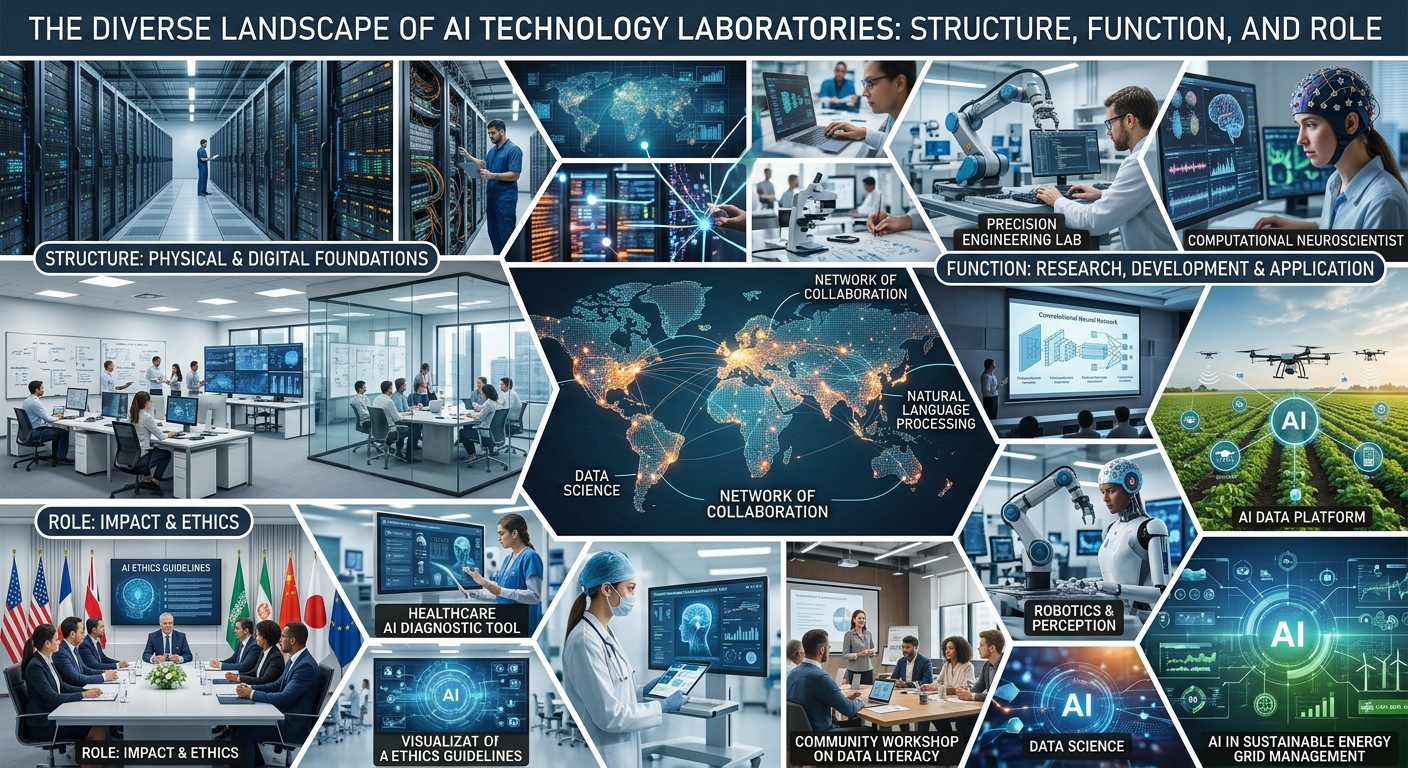
Artificial intelligence has evolved from a specialized academic discipline into one of the most important technological fields of the modern economy. Behind this transformation stands a diverse global ecosystem of AI technology laboratories—organizations and research environments where scientists, engineers, mathematicians, computer scientists, domain experts, and product developers investigate how machines can learn, reason, perceive, generate content, interact with humans, and solve increasingly complex problems.
An AI laboratory is much more than a room filled with computers. At its most advanced level, it is an integrated research and engineering system containing people, algorithms, datasets, computing infrastructure, software platforms, experimentation environments, evaluation systems, safety processes, and management structures. Some laboratories concentrate on fundamental scientific questions, while others develop commercial products, specialized industrial systems, robotics, medical technologies, autonomous systems, or large foundation models.
The modern AI laboratory therefore exists at the intersection of science, engineering, mathematics, computing, economics, and society.
The importance of these laboratories is reflected in the changing balance between academia and industry. Stanford’s 2025 AI Index reported that nearly 90% of notable AI models released in 2024 originated from industry, while academia remained a leading source of highly cited AI research. This illustrates a fundamental characteristic of contemporary AI: scientific knowledge may originate in universities and public research institutions, while the development of the largest models increasingly requires industrial-scale computing, data, engineering teams, and capital.
1. What Is an AI Technology Laboratory?
An AI technology laboratory is an organized environment dedicated to the research, development, testing, evaluation, deployment, or study of artificial intelligence technologies.
The word “laboratory” should not be interpreted narrowly. An AI laboratory may occupy:
- a university research department;
- a corporate research center;
- a government research institution;
- a specialized robotics facility;
- a medical or pharmaceutical research organization;
- a semiconductor or hardware laboratory;
- a cloud-computing research center;
- an independent nonprofit research institute;
- a startup’s research organization;
- or a distributed network of researchers and computing facilities.
The common characteristic is the systematic pursuit of knowledge or technological capability through experimentation.
A simplified AI laboratory can be understood as:
Research questions → Data → Algorithms → Computing → Experiments → Evaluation → Knowledge → Models → Applications
The most advanced laboratories add another continuous cycle:
Deployment → Monitoring → Feedback → New data → New experiments → Improved systems
This makes AI research an iterative process rather than a single linear activity.
2. Why AI Laboratories Matter
AI laboratories perform several strategic functions simultaneously.
2.1 Discovery
Researchers investigate fundamental questions such as:
- How can machines learn from limited data?
- How can models reason?
- How can AI understand language?
- How can machines perceive the physical world?
- How can AI plan sequences of actions?
- How can models become more reliable?
- How can humans and AI systems collaborate?
These questions form the scientific foundation of AI.
2.2 Engineering
Scientific ideas must eventually become functioning systems.
Engineers transform algorithms into:
- software;
- machine-learning models;
- inference systems;
- robotics systems;
- recommendation engines;
- language systems;
- computer-vision platforms;
- scientific-computing applications;
- and other technological products.
2.3 Evaluation
AI laboratories must determine whether a system actually works.
Evaluation may examine:
- accuracy;
- reliability;
- robustness;
- efficiency;
- latency;
- reasoning ability;
- generalization;
- safety;
- fairness;
- security;
- energy consumption;
- and performance in real-world environments.
2.4 Technology Transfer
Research becomes economically and socially valuable when knowledge can move from laboratories into practical applications.
This process is often called technology transfer.
For example:
University research → prototype → industrial research → product development → commercial deployment
AI laboratories can therefore function as bridges between scientific discovery and practical innovation.
3. The Major Types of AI Laboratories
There is no single model for an AI laboratory. The global landscape can be divided into several broad categories.
3.1 University AI Laboratories
University laboratories traditionally play a central role in fundamental research.
They commonly investigate:
- machine learning;
- computer vision;
- natural-language processing;
- robotics;
- optimization;
- reinforcement learning;
- computational neuroscience;
- AI theory;
- human-computer interaction;
- and AI ethics.
Their major strength is their connection to education and fundamental scientific research.
Students can work alongside professors and researchers, creating a pipeline of future scientists and engineers.
Universities also tend to encourage publication and open scientific debate.
3.2 Corporate AI Research Laboratories
Large technology companies have established substantial AI research organizations.
Corporate laboratories generally have access to:
- large datasets;
- specialized computing infrastructure;
- experienced engineering teams;
- substantial research budgets;
- production environments;
- and large user populations.
This combination allows corporate laboratories to conduct experiments at a scale that can be difficult for smaller academic groups to reproduce.
Stanford’s AI Index found that industry produced nearly 90% of notable AI models in 2024, demonstrating the increasing importance of corporate laboratories in frontier AI development.
Corporate laboratories may focus simultaneously on basic research and commercial objectives.
3.3 Government AI Laboratories
Governments establish AI laboratories for scientific, economic, infrastructure, public-service, and national research objectives.
Government laboratories may investigate:
- scientific computing;
- healthcare;
- climate modelling;
- public administration;
- transportation;
- agriculture;
- cybersecurity;
- language technologies;
- advanced computing;
- and other strategic applications.
Their role is particularly important when research requires infrastructure or timescales that are difficult to support through ordinary commercial investment.
Government laboratories can also provide research opportunities for universities and industry.
3.4 Independent and Nonprofit AI Laboratories
Independent research organizations occupy another important part of the ecosystem.
Their objectives may include:
- fundamental AI research;
- responsible AI;
- safety research;
- open scientific resources;
- benchmarking;
- public-interest technology;
- and policy research.
Their independence can allow them to investigate subjects that do not immediately produce commercial revenue.
3.5 Startup AI Laboratories
A startup may begin with only a small research team but develop into a major AI organization.
Startup laboratories generally emphasize:
- rapid experimentation;
- focused research objectives;
- product-market fit;
- efficient use of computing resources;
- specialized models;
- and fast commercialization.
Their advantage is often organizational flexibility.
Instead of maintaining hundreds of research programs, a startup may concentrate on one technological problem.
3.6 Specialized Industrial AI Laboratories
Some laboratories are designed around particular industries.
Examples include AI research for:
- medicine;
- pharmaceuticals;
- manufacturing;
- agriculture;
- financial services;
- energy;
- telecommunications;
- transportation;
- mining;
- materials science;
- and logistics.
This form of laboratory combines AI expertise with specialized domain knowledge.
For example, pharmaceutical AI research may combine machine learning with chemistry, biology, clinical research, and drug-development expertise. Recent research has specifically examined how organizations structure AI capabilities and technology transfer within pharmaceutical innovation laboratories.
4. The Internal Structure of an AI Laboratory
A sophisticated AI laboratory normally contains several interconnected functions.
A simplified organizational architecture is:
Laboratory Leadership
↓
Research Strategy
↓
Scientific Research | Engineering | Data | Computing | Evaluation | Safety
↓
Models and Prototypes
↓
Applications and Technology Transfer
This structure can vary enormously according to the laboratory’s mission.
4.1 Laboratory Leadership
Leadership determines:
- research priorities;
- funding allocation;
- staffing;
- infrastructure strategy;
- partnerships;
- intellectual-property policy;
- publication policy;
- safety procedures;
- and long-term objectives.
The laboratory director or research leadership team must balance scientific ambition with available resources.
4.2 Research Scientists
Research scientists formulate hypotheses and develop new methods.
Their work can include:
- mathematical modelling;
- algorithm development;
- experimental design;
- scientific publications;
- theoretical analysis;
- benchmark development;
- and collaboration with other disciplines.
They are responsible for asking the fundamental question:
What new capability or knowledge are we trying to discover?
4.3 Machine-Learning Engineers
Machine-learning engineers transform research concepts into operational systems.
They work on:
- model implementation;
- training pipelines;
- optimization;
- distributed computing;
- inference systems;
- performance engineering;
- and integration with software platforms.
They often serve as the bridge between research and production.
4.4 Data Scientists and Data Engineers
AI systems depend heavily on data.
Data teams may manage:
- collection;
- cleaning;
- transformation;
- annotation;
- storage;
- quality control;
- dataset documentation;
- data pipelines;
- and data governance.
A powerful algorithm cannot compensate indefinitely for poor-quality or inappropriate data.
Thus:
Data quality + model quality + computing + evaluation = AI system capability
4.5 Infrastructure Engineers
Modern AI laboratories require substantial computational infrastructure.
Infrastructure teams manage:
- servers;
- accelerators;
- networking;
- storage;
- distributed training;
- cloud infrastructure;
- scheduling systems;
- monitoring;
- and energy efficiency.
At the frontier, computing infrastructure can become one of the laboratory’s most important strategic assets.
Stanford’s AI Index reports that training compute for notable AI models has been growing extremely rapidly, while model development is becoming increasingly computationally demanding and energy intensive.
5. The Computing Layer
The computational layer is the physical foundation of modern AI research.
It can include:
Processing
- CPUs;
- GPUs;
- TPUs;
- AI accelerators;
- specialized inference processors.
Memory
- high-bandwidth memory;
- system RAM;
- accelerator memory;
- caching systems.
Storage
- high-performance SSDs;
- large data-storage systems;
- distributed file systems;
- archival storage.
Networking
- high-speed interconnects;
- data-center networking;
- accelerator-to-accelerator communication;
- storage networking.
Software
- operating systems;
- machine-learning frameworks;
- distributed-training systems;
- model libraries;
- experiment-management platforms;
- monitoring tools.
This produces a fundamental relationship:
AI research capability = algorithms × data × compute × engineering
None of these components operates independently.
6. The Data Laboratory
Data is often described as the fuel of AI, although the analogy is incomplete.
A modern AI organization must consider the entire data lifecycle:
Collection → Filtering → Cleaning → Annotation → Storage → Training → Evaluation → Monitoring → Updating
Data may originate from:
- public datasets;
- scientific instruments;
- sensors;
- simulations;
- licensed sources;
- human-generated examples;
- synthetic-data systems;
- organizational databases;
- or other permitted sources.
The laboratory must also consider data provenance, quality, privacy, copyright, representativeness, and governance.
7. The Model Development Laboratory
The model-development environment is where researchers transform data and algorithms into trained systems.
A simplified process is:
Step 1: Define the problem
Researchers establish what the AI system must accomplish.
Step 2: Select data
Appropriate datasets are identified and prepared.
Step 3: Select an architecture
Researchers determine the model structure appropriate to the problem.
Step 4: Train
The model processes large quantities of examples using computational resources.
Step 5: Evaluate
Researchers test performance against predefined criteria.
Step 6: Improve
Weaknesses are identified and the system is modified.
Step 7: Validate
The model is tested under increasingly realistic conditions.
Step 8: Deploy or publish
The resulting knowledge, model, or application may be released according to the laboratory’s objectives.
8. Foundation-Model Laboratories
One of the most important developments in contemporary AI laboratories is the emergence of foundation-model research.
A foundation model is trained on broad data and can subsequently be adapted for many tasks.
Examples of capabilities may include:
- language generation;
- image understanding;
- audio processing;
- video understanding;
- multimodal reasoning;
- coding;
- scientific analysis;
- and tool use.
Foundation-model laboratories require an unusually broad combination of capabilities:
large datasets + advanced architectures + massive computing + distributed engineering + evaluation + safety
This explains why frontier AI research increasingly concentrates in organizations capable of supporting large-scale infrastructure.
9. Computer Vision Laboratories
Computer-vision laboratories specialize in enabling machines to interpret visual information.
Research areas include:
- image classification;
- object detection;
- image segmentation;
- facial analysis;
- 3D perception;
- video understanding;
- medical imaging;
- satellite imagery;
- industrial inspection;
- and robotics perception.
A vision laboratory may combine AI with cameras, sensors, robotics platforms, and simulation environments.
10. Natural-Language and Speech Laboratories
Language laboratories investigate how machines process human language.
Research can include:
- natural-language processing;
- machine translation;
- speech recognition;
- speech synthesis;
- information retrieval;
- dialogue systems;
- language modelling;
- summarization;
- and multilingual AI.
Modern language laboratories increasingly operate within multimodal environments where language, images, audio, video, and other information types are processed together.
11. Robotics AI Laboratories
Robotics laboratories connect artificial intelligence with the physical world.
A robotics system may contain:
Sensors → Perception → World Model → Planning → Control → Physical Action
Robotics research therefore requires knowledge from multiple fields:
- AI;
- mechanical engineering;
- electrical engineering;
- control systems;
- computer vision;
- physics;
- materials;
- and human-machine interaction.
The laboratory may use physical robots, simulation environments, or both.
12. Scientific AI Laboratories
AI is increasingly being integrated into scientific research.
Scientific AI laboratories may work on:
- protein structures;
- drug discovery;
- materials discovery;
- climate modelling;
- astronomy;
- particle physics;
- mathematics;
- chemistry;
- biology;
- and computational fluid dynamics.
Here AI is not merely a commercial software technology. It becomes a scientific instrument.
This creates a new research cycle:
Scientific observation → Data → AI model → Prediction → Scientific experiment → New knowledge
AI can therefore accelerate parts of the scientific discovery process.
13. AI Safety and Evaluation Laboratories
As AI capabilities become more powerful, evaluation has become a major laboratory function.
Safety and evaluation teams may investigate:
- reliability;
- robustness;
- harmful failure modes;
- model behavior;
- security;
- misuse resistance;
- interpretability;
- bias;
- and alignment between system behavior and intended objectives.
The objective is not simply to make AI more capable.
It is to answer another question:
Can the system be trusted to behave appropriately under the conditions in which it will be used?
The importance of governance and responsible AI research has increased alongside the rapid expansion of AI capabilities. Stanford’s AI Index separately tracks responsible AI, policy, governance, and technical development because these dimensions increasingly interact.
14. The Evaluation Laboratory
An AI model can appear impressive while still failing important tests.
Evaluation laboratories therefore construct controlled experiments.
They may measure:
| Dimension | Central question |
|---|---|
| Accuracy | Does the model produce correct results? |
| Robustness | Does it remain reliable under changed conditions? |
| Generalization | Can it handle unfamiliar examples? |
| Efficiency | How much computing does it require? |
| Latency | How quickly can it respond? |
| Reliability | Does performance remain consistent? |
| Safety | Does it avoid unacceptable behavior? |
| Interpretability | Can researchers understand important aspects of its operation? |
| Scalability | Can it operate at larger workloads? |
Evaluation transforms vague claims of “intelligence” into measurable performance.
15. AI Hardware Laboratories
AI development is increasingly connected to semiconductor technology.
Hardware laboratories investigate:
- processor architecture;
- AI accelerators;
- memory systems;
- high-bandwidth interconnects;
- energy efficiency;
- chip design;
- packaging;
- and specialized computing architectures.
The relationship is circular:
Better algorithms → demand for better hardware
and:
Better hardware → enables larger and more sophisticated algorithms
Stanford’s AI Index reports continuing improvements in machine-learning hardware performance, price-performance, and energy efficiency.
16. The AI Data-Center Laboratory
At large scale, an AI laboratory can become closely connected to a data-center ecosystem.
Such infrastructure can contain:
- computing clusters;
- accelerator servers;
- storage systems;
- networking equipment;
- cooling;
- electrical distribution;
- backup systems;
- monitoring;
- security;
- and specialized software.
Consequently, frontier AI research is partly a physical infrastructure problem.
An algorithm may exist mathematically, but developing it at scale requires physical machines, electricity, cooling, networks, buildings, and operational expertise.
17. The Software Stack of an AI Laboratory
A modern AI laboratory operates across multiple software layers.
Layer 1 — Hardware
Processors, memory, storage and networking.
Layer 2 — Systems software
Operating systems, drivers and resource-management systems.
Layer 3 — AI frameworks
Tools used to build and train machine-learning models.
Layer 4 — Data systems
Pipelines for acquiring, processing, storing and serving data.
Layer 5 — Model layer
Neural networks, foundation models and specialized models.
Layer 6 — Evaluation
Benchmarks, testing environments and monitoring.
Layer 7 — Applications
User-facing systems and industrial applications.
Layer 8 — Governance
Security, privacy, compliance, safety and operational controls.
This layered architecture resembles other major technology infrastructures, but AI adds an unusually strong interaction between data, algorithms and computing.
18. The Human Capital of AI Laboratories
The most sophisticated AI laboratory ultimately depends on people.
A multidisciplinary laboratory may include:
- mathematicians;
- computer scientists;
- software engineers;
- machine-learning researchers;
- electrical engineers;
- hardware engineers;
- data scientists;
- statisticians;
- physicists;
- biologists;
- linguists;
- psychologists;
- economists;
- ethicists;
- product specialists;
- policy experts;
- and project managers.
This diversity is necessary because AI problems increasingly cross traditional academic boundaries.
19. The Economics of AI Laboratories
AI research has become increasingly capital intensive.
Stanford’s 2026 AI Index reports that global private AI investment rose dramatically in 2025, with the United States accounting for approximately $285.9 billion in private AI investment, compared with $12.4 billion in China and $5.9 billion in the United Kingdom.
These figures help explain why the structure of AI laboratories is changing.
The frontier laboratory increasingly requires:
Capital → Compute → Researchers → Data → Experiments → Models → Products → Revenue or scientific impact
This creates an important distinction between ordinary software research and frontier AI research.
A small software project can sometimes be developed with a modest computer and a few developers. Training extremely large AI systems may require substantial clusters, specialized infrastructure, large engineering teams, and significant operating expenditure.
20. The Relationship Between Academia and Industry
The AI ecosystem is not divided cleanly between universities and companies.
There is a continuous flow:
University research
↓
Scientific publication
↓
Industry research
↓
Engineering development
↓
Commercial technology
↓
New scientific questions
The relationship works in the opposite direction as well.
Industry creates new tools and infrastructure that researchers can use, while universities educate the scientists and engineers who later enter industry.
The growing importance of industry does not mean universities have become irrelevant. Stanford’s research shows precisely the opposite: academia continues to play an important role in highly cited AI research even as industry dominates notable model development.
21. The Global Distribution of AI Laboratories
AI laboratories are distributed across major technology ecosystems around the world.
Important centers include:
- North America;
- Europe;
- China;
- Japan;
- South Korea;
- India;
- Singapore;
- Israel;
- the Middle East;
- Australia;
- and emerging African technology ecosystems.
However, the distribution of laboratories is not equal.
Capital, advanced semiconductor access, cloud infrastructure, research universities, talent, electricity, data, venture capital, and technology companies all influence where major laboratories develop.
Stanford’s 2026 AI Index shows that private AI investment remained highly concentrated geographically in 2025, with the United States far ahead of other individual countries.
22. AI Laboratories in Africa
Africa has an important opportunity to develop AI research capacity suited to its own needs.
Potential research priorities include:
- agriculture;
- healthcare;
- education;
- telecommunications;
- financial inclusion;
- mining;
- climate adaptation;
- local-language technologies;
- public administration;
- transportation;
- and environmental monitoring.
African laboratories face infrastructure challenges, including access to advanced computing, reliable electricity, high-speed connectivity, research funding, and specialized talent.
However, laboratories do not necessarily have to compete directly with the largest frontier-model organizations.
A country or region can develop significant AI capability through specialization.
For example:
Agriculture + AI + African datasets
could become a distinctive research field.
Similarly:
African languages + speech AI + language models
could create globally valuable knowledge while addressing local needs.
23. The AI Laboratory as an Innovation Pipeline
A successful laboratory can be understood as a pipeline:
Stage 1 — Question
Identify an important problem.
Stage 2 — Hypothesis
Propose a possible solution.
Stage 3 — Research
Develop mathematical and computational methods.
Stage 4 — Experiment
Test the methods.
Stage 5 — Prototype
Build a working system.
Stage 6 — Evaluation
Measure performance.
Stage 7 — Engineering
Make the system reliable and scalable.
Stage 8 — Deployment
Place the technology into practical use.
Stage 9 — Monitoring
Observe real-world performance.
Stage 10 — Learning
Use results to improve the next generation.
This creates a continuous innovation loop.
24. Intellectual Property and Scientific Publication
AI laboratories must decide how knowledge should be shared.
Possible outputs include:
- academic papers;
- patents;
- open-source software;
- datasets;
- model releases;
- technical reports;
- commercial products;
- APIs;
- or confidential research.
Universities traditionally emphasize publication and scientific dissemination.
Companies may balance publication against:
- intellectual property;
- competitive advantage;
- security;
- commercialization;
- and strategic interests.
This tension is becoming increasingly important as AI research becomes economically valuable.
25. Responsible AI Governance
An advanced AI laboratory needs governance alongside research.
Governance can address:
- data rights;
- privacy;
- intellectual property;
- model evaluation;
- security;
- human oversight;
- documentation;
- accountability;
- transparency;
- and regulatory compliance.
AI laboratories increasingly operate within a broader policy environment. Stanford’s AI Index has documented substantial growth in government attention to AI regulation and investment.
The laboratory of the future therefore cannot be purely technical.
It must also understand law, society, economics, and public policy.
26. The Difference Between an AI Lab and an AI Factory
The distinction between a research laboratory and an AI production environment is useful.
AI laboratory
Primary objective:
Discover and test new knowledge or capabilities.
Characteristics:
- experimentation;
- uncertainty;
- prototypes;
- research papers;
- hypotheses;
- benchmarks.
AI factory
Primary objective:
Produce reliable AI capabilities at scale.
Characteristics:
- automation;
- repeatability;
- infrastructure;
- monitoring;
- deployment;
- operational efficiency.
Modern frontier organizations increasingly contain both.
The laboratory discovers.
The engineering organization industrializes.
27. The Future AI Laboratory
The AI laboratory of the future is likely to become increasingly integrated.
Instead of separate departments for every stage, advanced organizations may connect:
Data + Models + Compute + Simulation + Robotics + Science + Safety + Applications
A future research environment could allow a scientist to formulate a question, generate an experiment, allocate computing resources, train a model, evaluate the results, run simulations, and repeat the process with substantial automation.
This does not eliminate human researchers.
Instead, it changes their role.
Researchers may increasingly spend more time defining important problems, designing experiments, interpreting results, and making scientific judgments.
28. AI Agents Inside AI Laboratories
Another emerging development is the use of AI systems themselves as research assistants.
AI systems can potentially support:
- literature analysis;
- code generation;
- experiment planning;
- data analysis;
- simulation;
- documentation;
- hypothesis generation;
- and research workflow automation.
This introduces a new possibility:
AI laboratory + AI researcher = partially automated research environment
The important limitation is that automated systems still require appropriate evaluation and human oversight, particularly where experimental results influence important scientific or real-world decisions.
29. The Strategic Importance of AI Laboratories
AI laboratories are becoming strategic assets for:
Companies
They provide technological differentiation.
Universities
They support research and education.
Governments
They contribute to scientific capability and technological competitiveness.
Industries
They provide specialized innovation.
Society
They can address major challenges in health, education, environment, agriculture, transportation, and scientific discovery.
The laboratory therefore represents more than an organizational unit.
It is an institutional mechanism for converting knowledge into technological capability.
30. Major Challenges Facing AI Laboratories
Despite their enormous potential, AI laboratories face serious challenges.
30.1 Compute Costs
Advanced research can require substantial computational resources.
30.2 Energy Consumption
Large-scale computing requires electricity and cooling infrastructure.
30.3 Talent Competition
Highly skilled researchers and engineers are in strong demand.
30.4 Data Limitations
High-quality, legally usable and representative datasets are difficult to obtain.
30.5 Reproducibility
Some AI experiments can be difficult to reproduce because of differences in data, computing resources and training procedures.
30.6 Safety
Increasing capabilities require increasingly sophisticated evaluation.
30.7 Concentration
Research capacity can become concentrated among a small number of wealthy organizations.
30.8 Governance
AI development increasingly intersects with regulation, intellectual property and public policy.
30.9 Environmental Pressure
Computational growth creates questions concerning electricity, water, hardware production and electronic waste.
31. How to Build a National AI Laboratory Ecosystem
A country does not necessarily need to build the world’s largest AI laboratory to develop strong AI capabilities.
A national ecosystem can be constructed through several layers.
Layer 1 — Education
Develop mathematics, computer science, engineering and scientific education.
Layer 2 — Universities
Create AI research groups and postgraduate programs.
Layer 3 — Public infrastructure
Provide research computing and high-speed connectivity.
Layer 4 — Industry partnerships
Connect research with companies.
Layer 5 — Specialized laboratories
Focus on nationally important problems.
Layer 6 — Entrepreneurship
Help researchers convert ideas into companies and products.
Layer 7 — Governance
Develop responsible AI standards and oversight.
Layer 8 — International collaboration
Connect local researchers with global research networks.
This creates a sustainable AI ecosystem rather than a single isolated laboratory.
32. A Model Architecture for a Modern AI Laboratory
A comprehensive laboratory can be represented conceptually as follows:
1. Leadership
↓
2. Research Strategy
↓
3. Scientific Research
↓
4. Data Infrastructure
↓
5. Computing Infrastructure
↓
6. Model Development
↓
7. Evaluation and Safety
↓
8. Engineering
↓
9. Applications
↓
10. Deployment
↓
11. Monitoring
↓
12. New Research
The final stage feeds back into the beginning.
Thus, the laboratory becomes a continuous learning organization.
33. Measuring the Success of an AI Laboratory
The success of an AI laboratory should not be measured solely by the number of models it produces.
A broader scorecard might include:
| Category | Possible indicators |
|---|---|
| Scientific | Publications, discoveries, citations |
| Technical | Model performance and reliability |
| Engineering | Scalability and efficiency |
| Economic | Products, licensing and revenue |
| Educational | Researchers and graduates trained |
| Social | Public benefits |
| Safety | Evaluation quality and incident reduction |
| Innovation | Patents and new technologies |
| Collaboration | University and industry partnerships |
| Sustainability | Energy and resource efficiency |
A laboratory that produces fewer models but generates major scientific discoveries may be more valuable than one that produces many commercial systems.
34. The Larger Meaning of the AI Laboratory
The AI laboratory represents one of the most important organizational forms of the emerging digital economy.
Historically, laboratories enabled humanity to transform scientific knowledge into:
- electricity;
- chemistry;
- pharmaceuticals;
- telecommunications;
- computing;
- aerospace;
- and biotechnology.
AI laboratories are continuing this tradition.
Their distinctive feature is that their subject of research is partly intelligence itself.
They investigate how information can be represented, learned, predicted, generated, reasoned about, and transformed into action.
That makes AI laboratories simultaneously:
- scientific institutions;
- engineering organizations;
- computing centers;
- data organizations;
- educational environments;
- innovation engines;
- and increasingly important economic institutions.
Conclusion
The diverse landscape of AI technology laboratories reflects the extraordinary breadth of artificial intelligence itself. There is no single form of AI laboratory. Instead, there is a global network consisting of university laboratories, corporate research centers, government institutions, independent research organizations, startups, specialized industrial laboratories, robotics facilities, scientific AI centers, hardware research groups, and safety-evaluation organizations.
Their internal structures vary, but the essential components are remarkably consistent:
People + Research + Data + Algorithms + Compute + Engineering + Evaluation + Governance
The modern AI laboratory transforms these components into knowledge and technological capability.
The direction of the industry shows why this structure is becoming increasingly important. Industry has become dominant in the development of notable frontier models, while academia continues to make major contributions to influential research. At the same time, investment and computational requirements are expanding rapidly.
The next generation of AI laboratories will therefore likely be more multidisciplinary, computationally intensive, automated, globally connected, and closely integrated with scientific research and industrial infrastructure.
Ultimately, the AI laboratory is not simply a place where algorithms are programmed. It is an ecosystem for discovering, engineering, testing, governing, and deploying machine intelligence.
Its greatest contribution may be measured not by the number of computers it contains or models it trains, but by its ability to convert human curiosity into reliable knowledge and useful technology.



Be First to Comment