
Introduction
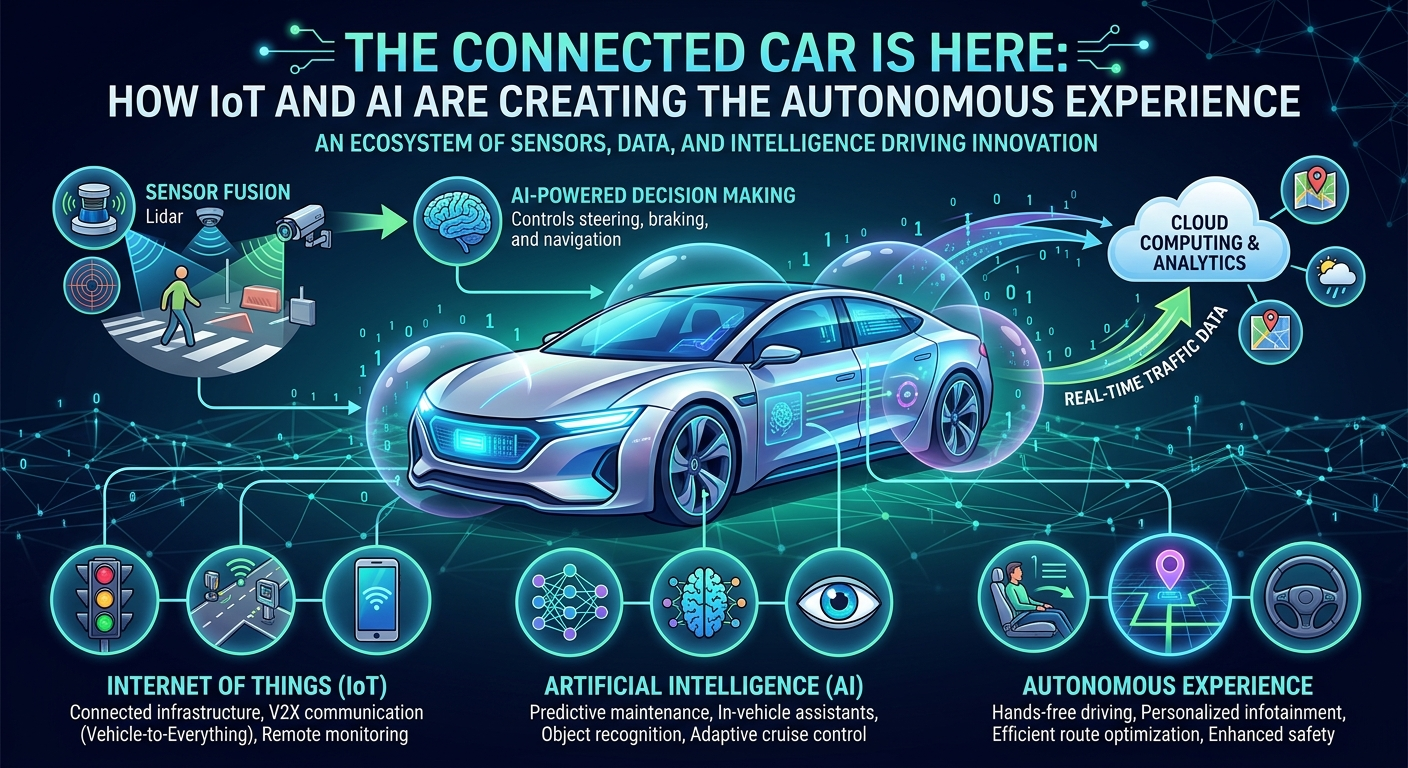
The automobile is undergoing one of the most significant technological transformations since the invention of the internal-combustion engine. A modern vehicle is no longer simply a mechanical machine designed to transport people from one location to another. It is increasingly becoming a connected computing platform—a cyber-physical system containing sensors, processors, software, wireless communications, artificial intelligence, cloud services, and increasingly sophisticated automated-driving capabilities.
This transformation is being driven by the convergence of two major technologies: the Internet of Things (IoT) and artificial intelligence (AI).
IoT gives the vehicle the ability to communicate with its surroundings. AI gives it the ability to interpret information, recognize patterns, make predictions, and support increasingly complex decisions.
Together, they are creating what can be called the autonomous experience: an automotive environment in which the vehicle can continuously sense its surroundings, communicate with digital services, understand the driver’s needs, assist with driving, manage vehicle functions, receive software improvements, and potentially perform increasingly large portions of the driving task.
However, an important distinction must be made. A connected vehicle is not automatically an autonomous vehicle. Connectivity allows a vehicle to communicate; automation allows it to perform driving functions. Today’s consumer vehicles commonly contain advanced driver-assistance systems, while fully automated driving remains a developing technology. NHTSA describes automated driving systems as technologies intended eventually to perform the complete driving task in appropriate circumstances, while noting that consumer availability of fully automated vehicles remains a future development.
The connected car therefore represents not a single invention, but the convergence of multiple technological layers.
1. From Automobile to Intelligent Machine
For most of automotive history, the basic architecture of a car was relatively straightforward:
Driver → Mechanical controls → Engine → Transmission → Wheels
Electronics gradually transformed this architecture.
Engine-control computers appeared. Electronic braking systems emerged. Airbags gained electronic control. Navigation systems became digital. Infotainment systems became computers. Sensors multiplied.
The architecture increasingly became:
Driver → Electronic control systems → Sensors → Actuators → Mechanical systems
The connected vehicle takes another major step:
Driver + Vehicle + Sensors + AI + Connectivity + Cloud + Infrastructure + Other Vehicles
The car is therefore becoming part of a larger digital ecosystem.
A connected vehicle can exchange information with:
- smartphones;
- cellular networks;
- cloud platforms;
- navigation services;
- charging infrastructure;
- traffic-management systems;
- other vehicles;
- roadside infrastructure;
- manufacturers;
- fleet-management platforms;
- emergency services;
- digital assistants.
This creates an automobile that is no longer technologically isolated.
2. What Is a Connected Car?
A connected car is a vehicle capable of communicating with external systems through digital networks.
Connectivity may include:
- cellular communication;
- Wi-Fi;
- Bluetooth;
- satellite positioning;
- vehicle-to-vehicle communication;
- vehicle-to-infrastructure communication;
- vehicle-to-cloud communication;
- smartphone integration;
- wireless software updates.
The connected vehicle can transmit information and receive information.
For example, a vehicle might communicate:
Vehicle → Cloud
- location;
- diagnostic information;
- battery status;
- charging status;
- driving information;
- software information.
And the cloud can communicate:
Cloud → Vehicle
- navigation information;
- traffic information;
- software updates;
- service notifications;
- configuration changes;
- security updates.
This creates a continuous information loop.
3. IoT: Giving the Car a Digital Nervous System
The Internet of Things refers broadly to networks of physical objects equipped with sensors, computing capabilities, software and communications.
The connected car is essentially an IoT device on wheels—although considerably more complex than a typical smart-home device because it is a safety-critical cyber-physical system.
A vehicle may contain hundreds or thousands of electronic components and numerous sensors.
These can monitor:
- speed;
- acceleration;
- steering angle;
- wheel rotation;
- engine or motor conditions;
- battery temperature;
- tire pressure;
- cabin temperature;
- road conditions;
- surrounding objects;
- driver interaction;
- vehicle position.
The result resembles a nervous system.
The comparison
Human body
- Eyes → visual information
- Ears → sound
- Brain → interpretation
- Nerves → communication
- Muscles → physical action
Intelligent vehicle
- Cameras/radar/lidar → environmental perception
- Microphones → audio information
- AI processors → interpretation
- Automotive networks → communication
- Motors/brakes/steering → physical action
The comparison is not exact, but it provides a useful conceptual model.
4. The Sensor Layer
Sensors are the vehicle’s primary source of information about the physical world.
Cameras
Cameras can detect and interpret visual information such as:
- road markings;
- traffic signs;
- traffic lights;
- vehicles;
- pedestrians;
- bicycles;
- road boundaries;
- obstacles.
AI-based computer vision can transform camera images into machine-readable information.
Radar
Radar systems use radio waves to estimate properties such as:
- distance;
- relative speed;
- object position.
Radar can be particularly valuable in conditions where visual perception is difficult.
LiDAR
LiDAR uses laser pulses to construct detailed measurements of the surrounding environment.
It can help create three-dimensional representations of nearby objects and road structures.
Ultrasonic sensors
These are commonly used for shorter-range applications such as parking assistance and detecting nearby objects.
Positioning systems
GPS and other positioning technologies provide geographical information that can be combined with digital maps and other sensors.
5. Sensor Fusion: Combining Multiple Sources of Reality
No individual sensor is perfect.
A camera can provide rich visual information but may be affected by lighting conditions.
Radar can provide useful distance and velocity information but generally provides less visual detail.
LiDAR can produce detailed three-dimensional information but has its own engineering and environmental considerations.
AI systems can combine multiple sensor streams.
This is known as sensor fusion.
Conceptually:
Camera + Radar + LiDAR + GPS + Maps + Vehicle Sensors → Combined Environmental Model
The objective is to construct a more reliable representation of the vehicle’s surroundings than any individual sensor could provide.
6. AI: Turning Data Into Understanding
IoT generates enormous quantities of information.
AI provides mechanisms for interpreting that information.
Consider a camera observing a road.
The camera produces pixels.
Pixels alone do not mean much to a vehicle.
AI can transform those pixels into concepts:
Pixels → Features → Objects → Relationships → Situational interpretation
For example:
Object detected → pedestrian
Position → roadside
Movement → approaching roadway
Vehicle state → moving forward
Prediction → possible crossing
Response → alert or appropriate vehicle-control action
This is one of the central roles of AI in modern vehicles.
7. Machine Learning in the Vehicle
Machine learning enables computers to identify patterns from data rather than relying entirely on manually programmed rules.
Automotive AI can be used in areas including:
- object detection;
- image classification;
- driver monitoring;
- predictive maintenance;
- traffic prediction;
- route optimization;
- voice recognition;
- anomaly detection;
- energy management;
- parking assistance;
- automated-driving perception.
The vehicle therefore becomes increasingly software-defined.
8. The Vehicle as a Computer
The modern automobile increasingly resembles a distributed computer.
Instead of one central computer doing everything, different electronic control units and computing platforms may manage different functions.
These can include:
- powertrain;
- braking;
- steering;
- body electronics;
- infotainment;
- driver assistance;
- battery management;
- connectivity.
Newer software-defined architectures increasingly consolidate computing functions into more powerful centralized or zonal architectures.
This transition has enormous consequences.
Software can become a major differentiator between vehicles.
Two cars may have similar mechanical capabilities while offering completely different digital experiences.
9. The Software-Defined Vehicle
A software-defined vehicle is designed so that software increasingly determines vehicle functionality and user experience.
This creates possibilities such as:
- over-the-air software updates;
- new digital features;
- improved driver assistance;
- revised user interfaces;
- improved energy management;
- remote diagnostics;
- cybersecurity updates.
Instead of a vehicle remaining technologically unchanged after leaving the factory, software can allow aspects of its functionality to evolve.
The vehicle begins to resemble a continuously updated computing platform.
10. Cloud Computing and the Connected Vehicle
Not every computational task needs to occur inside the vehicle.
Some information can be processed in cloud infrastructure.
A simplified architecture is:
Vehicle → Cellular Network → Cloud → AI/Analytics → Vehicle
The cloud can support:
- fleet analytics;
- map updates;
- vehicle diagnostics;
- software distribution;
- large-scale machine-learning development;
- traffic analysis;
- customer services;
- predictive maintenance.
However, safety-critical decisions often require very low latency and therefore cannot depend entirely on remote cloud processing.
This creates a hybrid architecture:
Edge AI + Vehicle Computing + Cloud AI
11. Edge AI: Intelligence Inside the Vehicle
Edge AI refers to AI processing performed close to where data is generated.
In a vehicle, edge computing can reduce dependence on remote servers.
This matters because driving decisions may require rapid responses.
A simplified model is:
Sensor → Local processor → AI inference → Vehicle response
rather than:
Sensor → Internet → Cloud → Internet → Vehicle response
The second architecture can introduce network latency and connectivity dependencies.
Therefore, modern intelligent vehicles increasingly combine local and cloud computing.
12. Connectivity: The Vehicle’s Communication Layer
Connectivity allows the car to participate in a broader transportation network.
Important communication technologies include:
Cellular networks
Cellular connectivity can support:
- emergency communication;
- navigation;
- cloud services;
- diagnostics;
- remote vehicle services;
- software updates.
Wi-Fi
Wi-Fi can support local connectivity and passenger services.
Bluetooth
Bluetooth enables communication with smartphones and other nearby devices.
Vehicle-to-Vehicle Communication
V2V communication allows vehicles to exchange information.
Conceptually:
Vehicle A ↔ Vehicle B
Information might include information relevant to traffic and safety applications.
Vehicle-to-Infrastructure Communication
V2I enables communication between vehicles and infrastructure.
For example:
Vehicle ↔ Roadside Infrastructure
This could support information relating to traffic signals, road conditions or transportation management.
13. The Autonomous Experience
Autonomy should not be understood simply as:
“The car drives itself.”
The broader autonomous experience includes many forms of intelligence.
The vehicle may increasingly understand:
- where you are going;
- what route is appropriate;
- traffic conditions;
- charging requirements;
- vehicle condition;
- driver preferences;
- cabin conditions;
- surrounding hazards.
The experience can therefore become increasingly proactive.
Instead of the driver constantly commanding the machine, the machine increasingly anticipates needs and assists the driver.
14. Advanced Driver-Assistance Systems
Before fully autonomous driving, the industry has developed advanced driver-assistance systems, or ADAS.
Examples include:
- adaptive cruise control;
- lane-departure warning;
- lane-centering assistance;
- automatic emergency braking;
- blind-spot monitoring;
- parking assistance;
- forward-collision warning.
These technologies represent different degrees of assistance.
They should not automatically be interpreted as fully autonomous driving.
NHTSA distinguishes current driver-assistance technologies from higher levels of automated driving, emphasizing that automated driving systems capable of taking over the complete driving task are still a developing technology.
15. The Road Toward Autonomous Driving
Automotive automation is commonly described using SAE driving-automation levels.
Level 0 — No Driving Automation
The human performs the driving task.
Level 1 — Driver Assistance
The system can assist with a limited driving function.
Level 2 — Partial Driving Automation
The vehicle can assist with steering and acceleration/braking under defined conditions, while the human driver remains responsible for supervision.
Level 3 — Conditional Driving Automation
The automated system performs the driving task under defined conditions, with the human expected to respond appropriately when requested.
Level 4 — High Driving Automation
The system can perform the driving task within a defined operational domain without requiring human control.
Level 5 — Full Driving Automation
The system is designed to perform the driving task under conditions comparable to human driving across essentially all roadway environments.
The important lesson is that automation is a spectrum, not a simple switch between “manual” and “self-driving.”
16. AI Perception
Perception is one of the most difficult parts of automated driving.
The system must interpret a constantly changing environment.
It may need to recognize:
- vehicles;
- pedestrians;
- cyclists;
- road markings;
- traffic signals;
- construction zones;
- road obstacles;
- intersections;
- changing traffic patterns.
The AI must also estimate relationships:
Where is the object?
How fast is it moving?
What direction is it moving?
What might it do next?
This moves AI from simple recognition toward prediction.
17. Prediction
Recognizing an object is only one part of driving.
An autonomous system also needs to estimate what other road users might do.
For example:
Detection: pedestrian identified.
Tracking: pedestrian moving toward crossing.
Prediction: pedestrian may enter vehicle path.
Planning: vehicle determines an appropriate response.
This makes autonomous driving a problem of perception, prediction, planning and control.
18. Planning and Decision-Making
Once the vehicle understands its surroundings, it must determine what to do.
A simplified architecture is:
Perception → Prediction → Planning → Control
Planning may involve:
- route selection;
- lane selection;
- speed selection;
- following distance;
- intersection behavior;
- obstacle avoidance.
Control converts decisions into physical actions.
Plan → Steering + Braking + Acceleration
This is where AI and conventional control engineering work together.
19. Human-Machine Interaction
The autonomous vehicle is not simply a machine; it is also an interface between human and computer.
The human may interact through:
- touchscreens;
- physical controls;
- voice commands;
- instrument displays;
- augmented-reality displays;
- steering-wheel controls;
- driver-monitoring systems.
As automation increases, the vehicle must clearly communicate:
- what it is doing;
- what it can do;
- what it cannot do;
- when the driver must intervene.
NHTSA identifies human-machine interface, driver education, system safety and fallback behavior among important considerations for automated driving systems.
20. The Intelligent Cabin
Connectivity and AI extend beyond driving.
The cabin itself can become intelligent.
Possible functions include:
- voice assistants;
- personalized settings;
- climate optimization;
- entertainment;
- navigation;
- driver attention monitoring;
- passenger recognition;
- personalized interfaces.
The vehicle becomes simultaneously:
Transportation platform + Computer + Communication device + Living space
This changes how people may perceive automobiles.
21. Predictive Maintenance
IoT can transform vehicle maintenance from scheduled servicing toward condition-based maintenance.
Traditional approach:
Time/mileage → Service
Connected approach:
Sensor data → Condition analysis → Prediction → Service recommendation
Sensors can provide information about vehicle systems.
Analytics can identify patterns associated with potential problems.
The objective is to detect issues earlier and reduce unexpected failures.
22. Electric Vehicles and Connected Intelligence
The transition to electric vehicles further strengthens the connection between automotive technology and computing.
Electric vehicles contain sophisticated electronic systems for:
- battery management;
- power electronics;
- motor control;
- charging;
- thermal management;
- energy optimization.
The connected EV can also communicate with charging infrastructure and cloud services.
This creates a new ecosystem:
Vehicle ↔ Charger ↔ Grid ↔ Cloud
Future transportation systems can therefore become increasingly interconnected with electrical infrastructure.
23. AI and Energy Management
AI can help optimize energy use.
A vehicle can potentially consider:
- traffic;
- terrain;
- temperature;
- battery condition;
- route length;
- charging availability;
- driving patterns.
The system can then estimate energy requirements.
For example:
Destination → Route → Traffic → Energy prediction → Charging strategy
This becomes particularly important for electric vehicles.
24. Maps Become More Than Maps
Traditional maps tell humans where roads are.
Autonomous systems require much richer environmental information.
Digital maps can contain information about:
- road geometry;
- intersections;
- speed limits;
- lane configurations;
- road features;
- geographic positioning.
AI and sensor data can complement map information.
The vehicle can therefore operate using a combination of:
Map knowledge + Live sensor perception + Real-time connectivity
25. Vehicle-to-Everything: V2X
The concept of V2X expands connectivity beyond the vehicle.
It can include:
- V2V — vehicle to vehicle;
- V2I — vehicle to infrastructure;
- V2P — vehicle to pedestrian;
- V2N — vehicle to network.
The broader idea is that transportation becomes a connected system rather than a collection of isolated vehicles.
A future intelligent road could therefore contain:
Vehicles + Traffic signals + Road sensors + Cloud services + Emergency systems + Pedestrians + Public transport
This could create a transportation information network.
26. Smart Cities and Connected Vehicles
Connected vehicles may become important components of smart-city infrastructure.
Cities could potentially integrate:
- traffic management;
- public transportation;
- parking;
- road monitoring;
- emergency response;
- charging networks;
- environmental monitoring.
The vehicle becomes one node within a much larger urban information system.
This could enable transportation systems to respond dynamically to congestion and changing conditions.
27. The Data Economy of the Automobile
Connected vehicles generate enormous quantities of data.
This creates economic opportunities around:
- mobility services;
- insurance;
- fleet management;
- predictive maintenance;
- navigation;
- charging;
- logistics;
- vehicle software;
- digital services.
The automobile is consequently becoming part of the broader data economy.
But data creates responsibilities.
Vehicle data can potentially reveal highly sensitive information such as location, travel patterns and interactions with connected devices. NHTSA specifically recognizes privacy concerns around information such as real-time geolocation and data associated with connected mobile devices.
28. Cybersecurity: The Great Challenge
Connectivity creates enormous benefits, but it also creates additional security challenges.
A traditional mechanical vehicle had comparatively limited digital attack surfaces.
A connected vehicle can contain:
- cellular interfaces;
- Wi-Fi;
- Bluetooth;
- USB connections;
- cloud services;
- mobile applications;
- software-update systems;
- internal networks;
- electronic control systems.
Every additional connection must be protected.
NHTSA describes vehicle cybersecurity as the protection of automotive electronic systems, communication networks, control algorithms, software, users and data from malicious access or manipulation.
29. The Vehicle as a Cyber-Physical System
One of the most important concepts in automotive technology is cyber-physical integration.
The cyber world contains:
- software;
- algorithms;
- data;
- networks;
- AI.
The physical world contains:
- wheels;
- brakes;
- steering;
- motors;
- batteries;
- roads;
- passengers.
The two worlds are increasingly connected.
Digital decision → Physical action
That makes cybersecurity a safety issue, not merely an IT issue.
NHTSA emphasizes that vehicles are cyber-physical systems and that cybersecurity vulnerabilities can potentially affect safety.
30. Software Updates and Over-the-Air Technology
Connected vehicles can receive software updates remotely.
This can allow manufacturers to improve:
- functionality;
- security;
- infotainment;
- vehicle control software;
- navigation;
- driver-assistance features.
The traditional model was:
Vehicle → Dealership → Software update
The connected model can become:
Vehicle → Secure network → Manufacturer platform → Software update
This creates tremendous convenience but also requires rigorous security and update-management systems.
31. Functional Safety
Cybersecurity is not the only challenge.
The vehicle must also behave safely when:
- sensors malfunction;
- software fails;
- communication is interrupted;
- computing systems experience faults;
- environmental conditions change;
- unexpected objects appear.
Autonomous systems therefore require redundancy, validation, fault detection and fallback strategies.
NHTSA’s automated-driving guidance includes system safety, operational design domain, object and event detection and response, fallback/minimal-risk conditions, validation, cybersecurity and data recording among its safety considerations.
32. The Importance of the Operational Design Domain
Autonomous systems do not necessarily operate everywhere.
An automated system may be designed for a particular:
- geographic region;
- road type;
- speed range;
- weather condition;
- lighting condition;
- traffic environment.
This defined environment is known as an operational design domain, or ODD.
For example, a system could be designed to operate only under specific conditions.
This is important because autonomy is not simply about whether a vehicle can drive; it is about where, when and under what conditions the automation is designed to function.
33. Why Fully Autonomous Driving Is Difficult
Driving requires extraordinary environmental intelligence.
Road environments are unpredictable.
A vehicle may encounter:
- unusual road layouts;
- construction;
- poor weather;
- unusual human behavior;
- animals;
- emergency vehicles;
- temporary signs;
- unexpected obstacles.
The challenge is not simply recognizing normal situations.
It is handling rare and unusual situations safely.
This is one reason automated driving requires extensive testing, validation and safety engineering.
34. Artificial Intelligence Is Not the Entire Solution
It is tempting to think:
“Add enough AI and the car becomes autonomous.”
Reality is much more complicated.
Autonomous vehicles require an integrated technology stack:
Sensors
↓
Perception
↓
Localization
↓
Prediction
↓
Planning
↓
Control
↓
Actuators
↓
Vehicle
And around the entire system:
Safety + Cybersecurity + Connectivity + Testing + Human Factors + Regulation
AI is therefore one critical component of a much larger engineering architecture.
35. The Role of High-Performance Automotive Computing
Advanced AI requires substantial computing power.
Modern vehicles increasingly require processors capable of handling:
- computer vision;
- sensor fusion;
- neural-network inference;
- vehicle control;
- infotainment;
- connectivity;
- cybersecurity.
This creates demand for specialized automotive semiconductor technologies.
The vehicle increasingly resembles a mobile data-processing platform.
This connects automotive technology to the semiconductor industry.
36. Automotive Chips
Modern intelligent vehicles may contain processors and specialized accelerators for:
- CPUs;
- GPUs;
- AI accelerators;
- neural-processing units;
- image processors;
- microcontrollers;
- networking;
- power management.
The automobile is therefore becoming an important computing market.
This is one reason the future of transportation is increasingly linked to:
Semiconductors + AI + software + communications + energy
37. Cloud-to-Car and Car-to-Cloud Architecture
The modern connected vehicle increasingly participates in a continuous digital loop.
Vehicle-to-cloud
The vehicle sends:
- telemetry;
- diagnostics;
- sensor-derived information;
- location;
- battery information.
Cloud-to-vehicle
The cloud sends:
- software;
- maps;
- traffic information;
- services;
- security updates.
The resulting architecture is:
Vehicle ↔ Network ↔ Cloud ↔ AI/Data Platforms
This creates a continuously connected transportation ecosystem.
38. Fleet Intelligence
For commercial fleets, connected vehicles can provide even greater value.
Fleet operators can monitor:
- vehicle locations;
- utilization;
- maintenance;
- energy consumption;
- route performance;
- driving patterns;
- operational efficiency.
AI can analyze the fleet as a collective system rather than treating each vehicle independently.
This can benefit:
- logistics;
- public transportation;
- delivery services;
- emergency services;
- industrial transportation.
39. Autonomous Mobility Services
The long-term vision goes beyond privately owned cars.
Autonomous technology could support:
- robotaxis;
- autonomous shuttles;
- delivery vehicles;
- logistics systems;
- specialized transportation services.
Recent regulatory developments show that automated-vehicle deployment is moving from research toward increasingly real-world commercial experimentation in some markets. For example, NHTSA announced in July 2026 that it was allowing Zoox to commercially deploy robotaxis under a temporary exemption while also pursuing automated-vehicle safety standards.
This illustrates an important transition:
Research → Testing → Limited deployment → Commercialization → Regulation
40. The Connected Car and Insurance
Connected vehicle data could also transform insurance.
Traditional insurance models rely heavily on:
- driver history;
- vehicle characteristics;
- location;
- age;
- claims history.
Connected systems may allow insurers to analyze additional driving information, subject to applicable laws and privacy requirements.
This could contribute to models based more strongly on actual vehicle usage and driving behavior.
However, this also raises important questions about:
- data ownership;
- consent;
- privacy;
- fairness;
- transparency.
41. Personalization
AI allows vehicles to become increasingly personalized.
A vehicle could learn preferences concerning:
- seating;
- climate;
- navigation;
- entertainment;
- cabin settings;
- frequently visited destinations.
The automobile consequently begins to resemble a personalized digital assistant.
The key transition is:
Car as machine → Car as personalized computing environment
42. Voice and Conversational AI
Voice interaction can make vehicle interfaces more natural.
Instead of navigating menus manually, users may communicate through conversational systems.
Possible interactions include:
- navigation requests;
- vehicle-information questions;
- climate commands;
- entertainment requests;
- scheduling;
- general assistance.
As conversational AI improves, the vehicle’s interface may increasingly resemble a digital conversation rather than a collection of buttons and menus.
43. Privacy and Data Governance
The more intelligent the car becomes, the more information it may collect.
Potential categories include:
- location;
- driving patterns;
- vehicle condition;
- connected-device information;
- cabin interactions;
- user preferences.
This creates a central question:
Who owns the vehicle’s data?
Possible stakeholders include:
- vehicle owners;
- manufacturers;
- software providers;
- suppliers;
- insurers;
- fleet operators;
- governments.
A responsible connected-car ecosystem therefore requires strong data governance.
44. Cybersecurity Must Be Designed In
Cybersecurity cannot simply be added after the vehicle has been developed.
It must be incorporated throughout the lifecycle:
Design → Development → Testing → Manufacturing → Deployment → Monitoring → Updating → Retirement
NHTSA recommends a layered approach that addresses safety-critical systems, detection and response, cyber resilience and recovery.
This is particularly important because modern vehicles contain many interconnected systems.
45. Supply-Chain Security
The connected vehicle depends on an enormous global supply chain.
Components may come from:
- semiconductor manufacturers;
- software developers;
- sensor suppliers;
- communications companies;
- battery manufacturers;
- cloud providers;
- automotive suppliers.
Cybersecurity and quality therefore extend beyond the vehicle manufacturer itself.
A vulnerability in one component can potentially become part of a larger system risk.
46. Regulation
Technology develops faster than laws and standards can sometimes evolve.
Governments must consider questions such as:
- Who is responsible when an automated system makes a mistake?
- How should automated vehicles be tested?
- What cybersecurity requirements should apply?
- How should software updates be regulated?
- How should data privacy be protected?
- What safety standards should apply?
- How should vehicles interact with human-driven vehicles?
NHTSA’s automated-driving framework highlights the importance of system safety, testing, cybersecurity, data recording, human factors and legal considerations.
47. Human Responsibility in the Age of Automation
One of the greatest misunderstandings about driver-assistance technology is assuming that assistance means the human no longer has responsibilities.
Different automation levels impose different responsibilities.
A system designed to assist the driver is fundamentally different from a system designed to perform the entire driving task within a defined environment.
Therefore:
Automation capability ≠ permission to stop paying attention
Human-machine design must make these boundaries clear.
48. Safety as the Central Objective
The ultimate purpose of automotive automation should not simply be technological sophistication.
It should be safer transportation.
NHTSA identifies safety as a central potential benefit of vehicle automation, while also emphasizing that significant development and validation work remains necessary for higher levels of automated driving.
The industry therefore faces a difficult balance:
Innovation + Safety + Reliability + Public Trust
49. Environmental Benefits and Challenges
Connected and automated transportation could potentially improve efficiency through:
- optimized routing;
- reduced unnecessary idling;
- better traffic management;
- improved fleet utilization;
- energy optimization.
However, intelligent vehicles also require significant computing infrastructure.
That means energy consumption exists across the entire system:
Vehicle computing + Networks + Data centers + Manufacturing + Batteries + Charging
The environmental impact of connected transportation therefore needs to be evaluated across its entire lifecycle.
50. The Future Transportation Architecture
The ultimate connected-car ecosystem could look like this:
Human
↓
AI Assistant
↓
Vehicle Computer
↓
Sensors + Cameras + Radar + LiDAR
↓
AI Perception
↓
Prediction
↓
Planning
↓
Vehicle Control
↓
Electric/Mechanical Systems
And simultaneously:
Vehicle ↔ Cloud
Vehicle ↔ Other Vehicles
Vehicle ↔ Road Infrastructure
Vehicle ↔ Charging Infrastructure
Vehicle ↔ Smartphone
Vehicle ↔ Smart City
This represents a transformation from the automobile as an isolated machine to the automobile as a networked intelligent node.
51. The Connected Car as a Platform
The automobile is increasingly becoming a platform upon which other technologies can operate.
This platform can combine:
- computing;
- communications;
- AI;
- sensors;
- software;
- energy;
- entertainment;
- navigation;
- commerce;
- mobility services.
This resembles the transformation experienced by smartphones.
The smartphone evolved from a communication device into a general-purpose computing platform.
The connected vehicle is undergoing a comparable transformation:
Car → Connected Car → Software-Defined Car → Intelligent Vehicle → Increasingly Automated Mobility Platform
52. What the Autonomous Experience Could Eventually Mean
The autonomous experience is broader than taking one’s hands off a steering wheel.
It could mean a vehicle that:
- understands its environment;
- understands its passengers;
- understands its own condition;
- understands traffic conditions;
- communicates with infrastructure;
- predicts maintenance requirements;
- optimizes energy;
- continuously receives software improvements;
- assists with navigation;
- performs increasingly sophisticated driving tasks where permitted and technically capable.
The automobile becomes a participant in a digital transportation ecosystem.
53. The Remaining Technical Challenges
Several major challenges remain.
Perception
Machines must reliably interpret complex environments.
Prediction
Systems must anticipate unpredictable human behavior.
Reliability
Safety-critical systems must operate reliably.
Cybersecurity
Connected systems must resist attacks and recover from incidents.
Privacy
Vehicle-generated information must be handled responsibly.
Computing
Vehicles need increasingly powerful but energy-efficient processors.
Connectivity
Network-dependent functions require resilient communications.
Regulation
Legal frameworks must evolve with technology.
Public trust
People must understand what automated systems can and cannot do.
Infrastructure
Roads, charging systems and communications infrastructure must evolve alongside vehicles.
54. The New Automotive Value Chain
The traditional automotive industry was dominated by:
Engine + Transmission + Chassis + Manufacturing
The emerging automotive ecosystem increasingly adds:
Semiconductors + AI + Software + Cloud + Connectivity + Cybersecurity + Data
This changes the competitive landscape.
The future automotive leaders may not simply be the companies with the best mechanical engineering.
They may also be the organizations capable of integrating:
Hardware + Software + AI + Data + Energy + Connectivity
55. The Automobile as a Moving Data Center
The comparison should not be taken literally, but modern vehicles increasingly perform functions associated with computing infrastructure.
They contain:
- processors;
- memory;
- networking;
- sensors;
- software;
- cybersecurity systems;
- data storage;
- AI workloads.
The difference is that all of this computing equipment moves through a physical environment while carrying people.
That makes automotive computing particularly demanding.
56. From Mechanical Engineering to Systems Engineering
The connected car requires multiple engineering disciplines to work together.
Mechanical engineering
Provides:
- chassis;
- suspension;
- steering;
- brakes;
- body structures.
Electrical engineering
Provides:
- electronics;
- power systems;
- wiring;
- sensors;
- motors.
Computer engineering
Provides:
- processors;
- embedded systems;
- networks.
Software engineering
Provides:
- operating systems;
- applications;
- vehicle-control software.
AI engineering
Provides:
- perception;
- prediction;
- machine learning.
Telecommunications engineering
Provides:
- wireless connectivity;
- vehicle networking.
Cybersecurity engineering
Protects the digital ecosystem.
Systems engineering
Integrates everything.
The connected vehicle is therefore one of the clearest examples of multidisciplinary engineering.
57. A New Definition of the Automobile
For more than a century, the fundamental definition of a car was:
A machine that transports people.
The emerging definition is broader:
An intelligent, connected, software-defined cyber-physical platform capable of sensing, computing, communicating and increasingly assisting or performing transportation tasks.
This is a profound technological change.
58. Conclusion
The connected car represents the convergence of some of the most important technologies of the digital era.
IoT provides connectivity.
Sensors provide perception.
AI provides interpretation and prediction.
Computing provides processing power.
Software provides functionality.
Cloud platforms provide large-scale intelligence and services.
Telecommunications provide communication.
Cybersecurity protects the ecosystem.
Electric power systems provide increasingly sophisticated energy architectures.
Autonomous-driving technology brings these components together to automate parts of the driving task.
The result is not simply a smarter automobile.
It is the emergence of an entirely new technological category.
The vehicle is becoming a mobile intelligent computing system that participates in a much larger network of roads, vehicles, people, infrastructure, cloud platforms and energy systems.
Yet the most important point is that connectivity and autonomy are not synonymous. A connected car can communicate without being autonomous, while an automated-driving system requires much more than an internet connection. It requires perception, prediction, planning, control, safety engineering, validation and carefully defined operating conditions.
The autonomous experience will therefore emerge gradually.
The path is likely to progress from:
Connected vehicle
→ Digitally assisted vehicle
→ Software-defined vehicle
→ AI-assisted vehicle
→ Increasingly automated vehicle
→ Highly automated mobility services
The future automobile is consequently not merely a vehicle that takes us from point A to point B.
It is becoming a networked intelligent machine that can understand its environment, communicate with the digital world, learn from data, assist its occupants and increasingly participate in the automated transportation systems of the future.
The connected car is therefore not just coming.
Its technological foundation is already here—and the next stage is the transformation of connectivity into increasingly intelligent mobility.
Selected authoritative references
- NHTSA, Automated Driving Systems — overview of automated-driving development, safety elements and automation levels.
- NHTSA, Automated Vehicle Safety — current status, potential benefits and safety considerations for automated vehicles.
- NHTSA, Vehicle Cybersecurity — cybersecurity principles for increasingly connected and automated vehicles.
- NHTSA, Automotive Cybersecurity — definition and scope of cybersecurity for modern road vehicles.
- NHTSA, Cybersecurity Best Practices for the Safety of Modern Vehicles — risk-based cybersecurity guidance for automotive systems.
- NHTSA, 2026 automated-vehicle policy announcement — recent developments in commercial automated-vehicle deployment and safety standards.


Be First to Comment