
Abstract
Artificial intelligence is transforming the design and economics of modern data centers. Traditional data centers were largely designed around enterprise applications, web services, databases, storage, and conventional cloud computing. AI workloads introduce a substantially different infrastructure profile: very high computing density, intensive accelerator utilization, large data flows between processors, demanding cooling requirements, substantial electrical loads, and rapidly changing technology requirements.
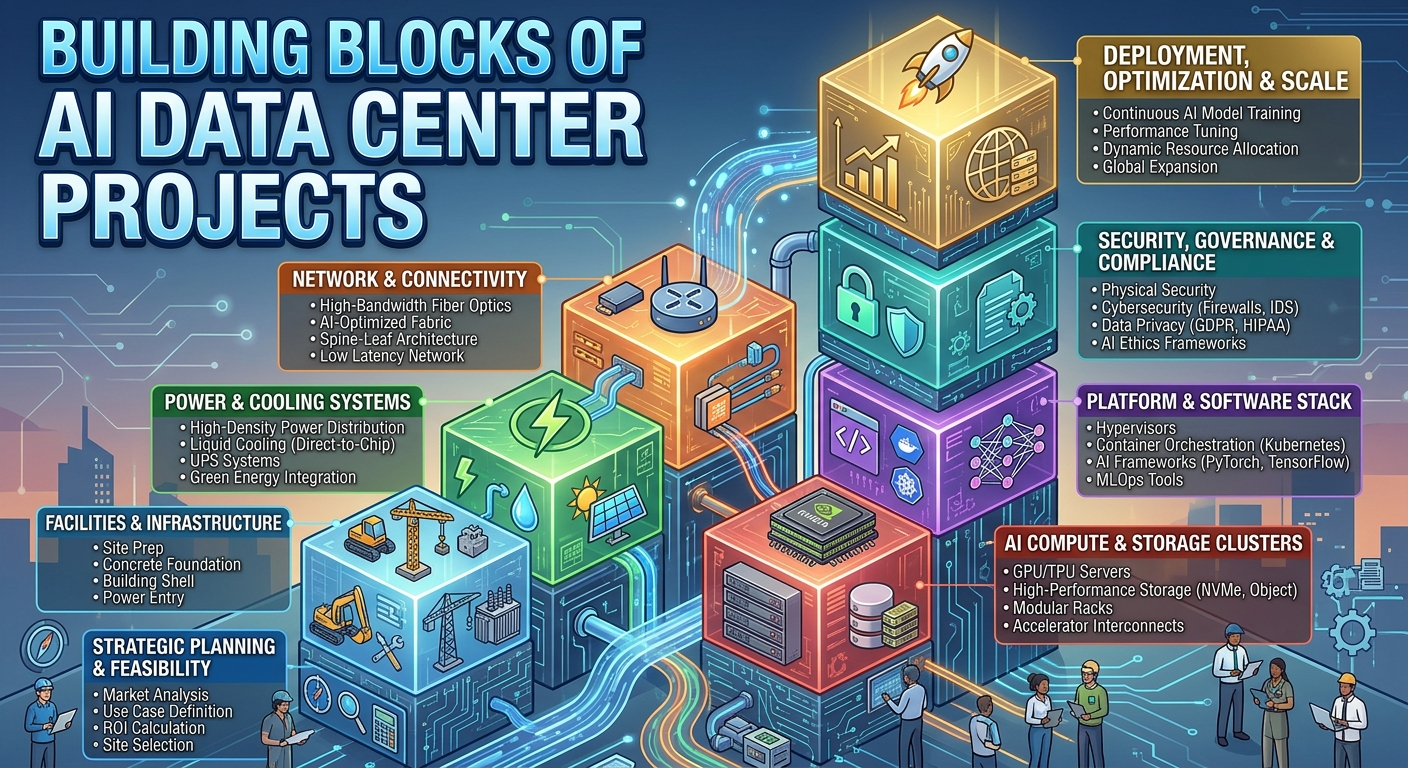
An AI data center should therefore be understood not simply as a building containing servers, but as an integrated industrial system in which land, electricity, power distribution, computing hardware, networking, cooling, buildings, software, security, data, operations, and telecommunications must function together.
Recent industry evidence illustrates the scale of this transition. The International Energy Agency reported that global data-center electricity consumption increased by 17% in 2025, while electricity use by AI-focused data centers increased by approximately 50%. The IEA expects global data-center electricity consumption to continue rising substantially toward 2030.
This thesis examines the principal building blocks of AI data-center projects, explains their interdependence, identifies major project risks, and proposes a structured lifecycle for planning, financing, designing, constructing, commissioning, operating, and expanding AI infrastructure.
1. Introduction
The modern AI revolution depends on physical infrastructure.
Large language models, computer-vision systems, scientific models, recommendation engines, autonomous systems, generative media, robotics applications, and AI agents all require computational resources. Behind the software interface is an extensive physical ecosystem containing semiconductor processors, servers, racks, networks, power systems, cooling systems, buildings, fiber-optic connections, storage platforms, monitoring systems, and skilled personnel.
The AI data center is consequently becoming one of the most important infrastructure projects of the digital economy.
The fundamental architecture can be expressed as:
Energy → Electrical Infrastructure → Compute → Memory → Networking → Storage → Data → AI Models → Applications → Users
However, the relationship is not purely linear. Each layer affects the others.
For example:
- More powerful processors increase electricity demand.
- Higher electricity consumption increases heat generation.
- Higher heat generation requires more capable cooling.
- Larger AI clusters require faster networking.
- Faster networking increases the importance of fiber, switches and optical systems.
- Larger clusters increase capital expenditure.
- Greater complexity increases commissioning and operational requirements.
- More intensive workloads increase requirements for software optimization.
The successful AI data center is therefore a systems-engineering project rather than simply an IT installation.
2. What Is an AI Data Center?
An AI data center is a specialized computing facility designed to train, fine-tune, serve, and operate artificial-intelligence models at scale.
Its major functions can include:
- AI model training
- Model fine-tuning
- AI inference
- High-performance computing
- Data processing
- Data storage
- Distributed computing
- AI-agent execution
- Enterprise AI services
- Research and scientific computing
Traditional data centers may contain a mixture of relatively low-density enterprise servers. AI facilities increasingly contain highly concentrated computing clusters.
Uptime Institute describes AI infrastructure as creating specific requirements around power density, cooling architectures, power profiles and operational readiness.
This means that an AI facility must be designed around the characteristics of the intended workload rather than simply selecting a building and filling it with servers.
3. The Fundamental Building Blocks
A complete AI data-center project can be divided into approximately fifteen major building blocks:
- Strategic objectives
- Site and land
- Electricity supply
- Electrical distribution
- Computing hardware
- Memory and storage
- High-performance networking
- Cooling
- Data and software infrastructure
- Building and physical infrastructure
- Security
- Telecommunications
- Operations and maintenance
- Sustainability
- Finance, governance and risk management
These components form an interconnected architecture.
4. Strategic Planning
Before construction begins, the project owner must define what the facility is intended to accomplish.
Important questions include:
- What AI workloads will be supported?
- Will the facility primarily train models or run inference?
- Who are the customers?
- What computing capacity is required?
- What geographic markets will be served?
- What availability level is required?
- How rapidly must the facility scale?
- What power capacity will eventually be required?
- What cooling technology is appropriate?
- What regulatory approvals are necessary?
- What is the project’s investment budget?
- What is the expected operational life?
A major mistake is beginning with the physical building rather than the computational requirement.
The correct sequence is generally:
Business Requirement → AI Workload → Compute Requirement → Power Requirement → Cooling Requirement → Facility Design
5. Site Selection and Land
Site selection is one of the most consequential decisions in an AI data-center project.
A suitable site requires much more than inexpensive land.
The project team should examine:
5.1 Electricity availability
The proximity and capacity of electrical infrastructure can determine whether a project is commercially viable.
5.2 Grid connection
The availability of transmission and distribution infrastructure is critical.
5.3 Fiber connectivity
AI facilities require high-capacity telecommunications connections.
5.4 Water availability
Depending on the cooling architecture, water availability and environmental restrictions may become important.
5.5 Climate
Temperature and humidity affect cooling requirements and operating economics.
5.6 Natural hazards
Flooding, earthquakes, storms, wildfire risk and other environmental conditions should be assessed.
5.7 Regulatory environment
Planning permissions, environmental approvals, construction requirements and energy regulations can significantly influence project schedules.
5.8 Workforce
Large facilities require engineers, technicians, security personnel, operators and maintenance specialists.
6. Electrical Power: The Foundation of AI Computing
Electricity is arguably the most fundamental resource in an AI data center.
The IEA emphasizes that AI cannot operate without electricity because data centers provide the physical infrastructure required to train and run AI models.
The electrical architecture may contain:
Utility Grid → Substation → Transformers → Switchgear → UPS → Distribution → Power Distribution Units → Server/Rack Power
Additional components may include:
- generators
- batteries
- energy-storage systems
- automatic transfer systems
- power-conditioning equipment
- protection systems
- monitoring equipment
- renewable-energy systems
The design objective is not merely to provide enough electricity. It must provide electricity with the required capacity, reliability, quality and redundancy.
7. Power Density
AI computing is changing the physical meaning of a data-center rack.
AI accelerators can consume considerably more power than many conventional enterprise processors. As computing becomes more concentrated, rack-level power density becomes a critical engineering variable.
The IEA reports that AI server power density increased dramatically between 2020 and 2025 and expects further increases. It also notes that future high-density AI racks could create electrical demands comparable to those of many households.
This creates a chain reaction:
More Compute → More Electricity → More Heat → More Cooling → More Infrastructure
Consequently, power planning must occur simultaneously with cooling planning.
8. Computing Hardware
The computational layer is the heart of the AI data center.
A modern AI cluster can contain:
- CPUs
- GPUs
- AI accelerators
- high-bandwidth memory
- server motherboards
- network interface controllers
- accelerator interconnects
- storage controllers
- power supplies
- rack systems
AI training often depends on thousands of processors operating collectively rather than one computer operating independently.
The computational architecture therefore resembles a distributed supercomputer.
Recent developments demonstrate how quickly this field is evolving. For example, Cerebras announced a new AI server architecture in August 2026 designed specifically to accelerate AI inference workloads.
This illustrates an important planning principle:
AI data centers must be designed for technological change.
A facility expected to operate for 15–25 years cannot assume that today’s processor architecture will remain dominant throughout its lifetime.
9. Memory
AI systems require enormous quantities of data to be accessed rapidly.
Memory infrastructure includes:
- processor cache
- system RAM
- high-bandwidth memory
- local accelerator memory
- distributed memory
- storage caches
High-bandwidth memory is particularly important for many AI accelerators because model computation requires rapid movement of data between memory and processing units.
Therefore:
Compute capacity without sufficient memory bandwidth can become underutilized compute capacity.
10. Storage Infrastructure
AI data centers require storage for:
- training datasets
- model checkpoints
- model weights
- application data
- logs
- telemetry
- databases
- backups
- archives
Storage systems may combine:
- NVMe storage
- SSDs
- hard-disk drives
- distributed file systems
- object storage
- parallel file systems
- backup repositories
AI training frequently involves moving enormous datasets between storage and compute clusters.
Therefore, storage performance should be evaluated together with networking rather than as an isolated subsystem.
11. High-Speed Networking
Networking is one of the defining characteristics of large AI clusters.
Traditional enterprise applications may tolerate relatively modest network traffic between servers. Distributed AI training can require extremely high-speed communication among processors.
The network may contain:
- Ethernet switches
- InfiniBand or other high-performance interconnects
- optical transceivers
- network interface cards
- fiber-optic cables
- routers
- load balancers
- network security systems
Google has described AI-era networking as imposing novel requirements because AI workloads create fundamentally different demands on compute and network infrastructure.
A useful conceptual relationship is:
AI Performance = Compute Capability + Memory Capability + Network Capability + Software Efficiency
A powerful accelerator cluster can perform poorly if its communication architecture becomes a bottleneck.
12. Cooling Infrastructure
Every watt of electrical energy consumed by computing equipment ultimately produces heat that must be managed.
Cooling therefore becomes a central engineering system.
Traditional facilities commonly depend heavily on air cooling. High-density AI infrastructure increasingly encourages the use of liquid-based approaches.
Possible technologies include:
Air cooling
Air is circulated through servers and heat is removed through cooling systems.
Direct-to-chip liquid cooling
Liquid is circulated through cold plates attached to high-power processors.
Rear-door heat exchangers
Heat is removed from server exhaust through specialized heat exchangers.
Immersion cooling
Computing equipment can be immersed in specialized cooling fluids.
Uptime Institute notes that AI workloads are accelerating interest in cold-plate and immersion cooling because of increasing chip power and rack density.
13. Cooling and Power Must Be Designed Together
A common misconception is to treat cooling as a secondary building service.
In AI facilities it is a core computational infrastructure system.
The relationship can be expressed as:
Compute → Electrical Consumption → Heat → Cooling Capacity
If cooling capacity is inadequate, computing capacity cannot be safely deployed.
Consequently, AI data-center designs should establish:
- rack power density
- heat load
- coolant requirements
- cooling redundancy
- pumping requirements
- heat rejection
- environmental conditions
- maintenance requirements
during the early design stages.
14. Building Infrastructure
The physical building must accommodate the entire technical ecosystem.
Important components include:
- foundations
- structural systems
- raised floors where appropriate
- equipment rooms
- electrical rooms
- mechanical rooms
- server halls
- loading areas
- maintenance areas
- offices
- security facilities
- fire protection
- drainage
- access control
The building should also provide adequate pathways for future expansion.
A data center that is technologically excellent but physically impossible to expand can become obsolete prematurely.
15. Telecommunications Infrastructure
AI facilities depend on telecommunications at multiple levels.
Internal connectivity
Connects processors, servers, storage and switches.
External connectivity
Connects the facility to:
- cloud platforms
- customers
- internet exchanges
- telecommunications networks
- other data centers
- research institutions
Inter-data-center connectivity
Large AI organizations may distribute workloads across multiple facilities.
This requires high-capacity fiber networks and carefully engineered latency characteristics.
16. Data Infrastructure
AI is fundamentally data-driven.
The data layer includes:
- data acquisition
- data ingestion
- data cleaning
- data labeling
- data transformation
- data storage
- data governance
- data security
- data pipelines
The quality of the AI system depends heavily on the quality, relevance, legality and integrity of its data.
Thus:
AI Infrastructure = Compute Infrastructure + Data Infrastructure
Neither is sufficient independently.
17. Software Infrastructure
The physical data center requires a software layer capable of managing thousands or millions of computational resources.
Important software components include:
- operating systems
- container platforms
- orchestration systems
- cluster managers
- AI frameworks
- scheduling systems
- distributed training software
- model-serving platforms
- monitoring platforms
- cybersecurity systems
Software determines how effectively hardware resources are utilized.
Two data centers with identical hardware can achieve different performance because of differences in software architecture and workload optimization.
18. AI Model Layer
The model layer sits above the infrastructure.
Examples include:
- large language models
- vision models
- speech models
- multimodal models
- scientific models
- recommendation models
- forecasting systems
- robotics models
Training requires enormous computational resources, while inference requires highly available systems capable of responding to users or applications.
Therefore, training and inference should not automatically be assumed to require identical architectures.
19. Security
Security must be designed into the facility from the beginning.
Physical security
Includes:
- perimeter protection
- controlled entrances
- surveillance
- visitor management
- restricted server areas
- equipment tracking
Cybersecurity
Includes:
- network segmentation
- identity management
- encryption
- vulnerability management
- security monitoring
- incident response
- backup protection
Supply-chain security
AI facilities also depend on complex international supply chains involving processors, servers, networking equipment, electrical components, cooling equipment and construction materials.
Supply-chain resilience has therefore become a strategic consideration.
Uptime Institute’s 2026 survey identifies supply-chain limitations, power availability and staffing among the growing challenges facing data-center operators.
20. Reliability and Redundancy
AI services can support critical business, scientific and governmental functions.
Infrastructure must therefore be designed around an appropriate reliability target.
Potential redundancy strategies include:
- redundant power paths
- multiple transformers
- redundant UPS systems
- standby generation
- redundant cooling systems
- multiple network connections
- geographically distributed facilities
- replicated storage
- backup systems
Uptime Institute’s Tier framework evaluates data-center topology and operational performance according to defined availability and fault-tolerance objectives.
The correct reliability level should be selected according to business requirements rather than automatically choosing the most expensive configuration.
21. Fire Protection and Life Safety
AI data centers require comprehensive life-safety systems.
These can include:
- fire detection
- alarm systems
- suppression systems
- emergency lighting
- evacuation systems
- smoke detection
- electrical protection
- equipment isolation
- emergency response procedures
Fire protection must be coordinated with electrical, mechanical and IT infrastructure.
22. Water and Environmental Management
Cooling can create environmental considerations involving:
- water consumption
- wastewater
- heat rejection
- chemical treatment
- local water availability
The optimal cooling strategy depends on geography, climate, facility design and environmental objectives.
Where water availability is limited, alternative cooling approaches may become increasingly important.
23. Renewable Energy and Sustainability
The energy requirements of AI make sustainability a major strategic issue.
Potential energy sources include:
- solar
- wind
- hydroelectricity
- nuclear power
- natural gas
- grid electricity
- energy-storage systems
The IEA projects that electricity generation serving data centers could rise from approximately 460 TWh in 2024 to more than 1,000 TWh by 2030 in its base case, with renewables supplying a significant share of additional demand.
Sustainability therefore involves more than purchasing renewable-energy certificates. A comprehensive strategy considers:
Energy Source + Efficiency + Cooling + Water + Equipment Lifecycle + Carbon + Grid Impact
24. Power Usage Effectiveness
Power Usage Effectiveness, or PUE, is commonly expressed as:
PUE = Total Facility Energy / IT Equipment Energy
A lower PUE generally indicates that a greater proportion of facility energy is being delivered directly to IT equipment.
However, PUE should not be treated as the only measure of efficiency.
An AI facility should also examine:
- computing performance per unit of energy
- workload efficiency
- water usage
- carbon intensity
- utilization
- cooling efficiency
- equipment lifecycle
The ultimate goal is not merely to minimize facility energy but to maximize useful computational output.
25. Construction and Project Delivery
AI data-center projects require coordination among numerous disciplines.
Major participants can include:
- project owners
- architects
- civil engineers
- structural engineers
- electrical engineers
- mechanical engineers
- network engineers
- IT architects
- AI specialists
- cybersecurity specialists
- construction companies
- equipment manufacturers
- utilities
- regulators
- financiers
- commissioning specialists
The project lifecycle generally follows:
Concept → Feasibility → Site Selection → Design → Permitting → Financing → Procurement → Construction → Installation → Testing → Commissioning → Operations → Expansion
26. Procurement
Procurement is increasingly important because AI data centers depend on sophisticated hardware and infrastructure.
Long-lead items may include:
- AI processors
- servers
- networking equipment
- transformers
- switchgear
- generators
- UPS systems
- cooling equipment
- electrical cables
- optical components
The IEA has highlighted supply-chain constraints involving transformers, gas turbines, advanced chips and other components as potential bottlenecks to data-center expansion.
Therefore, procurement planning must begin early.
27. Commissioning
Commissioning verifies that the completed facility performs according to its design.
Testing should cover:
Electrical systems
- normal operation
- backup operation
- transfer systems
- failure scenarios
Cooling systems
- temperature control
- flow
- redundancy
- failure scenarios
Networking
- bandwidth
- latency
- redundancy
- failover
Computing
- processor operation
- accelerator performance
- cluster communication
- workload scheduling
Security
- access control
- monitoring
- incident procedures
Commissioning is particularly important for AI infrastructure because complex interactions between power, cooling, networking and computing can produce failures that are not obvious when systems are tested individually.
28. Operations and Maintenance
After commissioning, the facility enters its longest phase: operations.
Operational teams monitor:
- power
- temperature
- humidity
- cooling
- network performance
- processor utilization
- storage capacity
- hardware failures
- security events
- energy consumption
Predictive maintenance can use telemetry and AI itself to identify potential equipment problems before they cause failures.
29. Artificial Intelligence for Data-Center Operations
An important development is the use of AI to operate AI infrastructure.
AI can potentially assist with:
- cooling optimization
- workload scheduling
- predictive maintenance
- energy forecasting
- capacity planning
- anomaly detection
- cybersecurity
- equipment diagnostics
This creates a feedback loop:
AI Infrastructure → AI Workloads → Operational Data → AI Optimization → More Efficient Infrastructure
Thus, the data center can become an intelligent infrastructure system.
30. Financial Architecture
AI data centers require enormous capital investment.
Financial planning should include:
Capital expenditure
- land
- construction
- electrical infrastructure
- cooling
- servers
- networking
- storage
- security
- telecommunications
Operating expenditure
- electricity
- cooling
- maintenance
- personnel
- telecommunications
- software
- insurance
- security
- equipment replacement
The financial model should also account for technology depreciation and rapid hardware evolution.
A facility may have a long physical life while its computing equipment has a much shorter economic life.
31. The AI Data Center as an Energy-Compute System
One of the most important conclusions of modern AI infrastructure planning is that the data center cannot be separated from the energy system.
The architecture increasingly resembles:
Energy Generation
↓
Transmission and Grid
↓
Data-Center Substation
↓
Power Distribution
↓
AI Computing
↓
Heat
↓
Cooling
↓
Heat Rejection
↓
Environmental System
This means future AI infrastructure will increasingly involve collaboration between technology companies, utilities, energy developers, construction companies and governments.
32. Major Project Risks
AI data-center projects face numerous risks.
| Risk | Potential consequence | Strategic response |
|---|---|---|
| Insufficient grid capacity | Delayed deployment | Early utility engagement |
| Transformer shortage | Construction delay | Advance procurement |
| Processor shortage | Reduced computing capacity | Multi-vendor planning |
| Cooling limitations | Restricted rack density | Early thermal engineering |
| Fiber limitations | Poor connectivity | Multiple network routes |
| Construction delays | Lost revenue | Integrated project management |
| Cost escalation | Reduced project returns | Contingency planning |
| Technology obsolescence | Stranded assets | Modular architecture |
| Water restrictions | Cooling constraints | Water-efficient designs |
| Cyberattack | Operational disruption | Defense-in-depth security |
| Skills shortage | Operational risk | Workforce development |
| Regulatory delays | Schedule uncertainty | Early permitting |
| Energy-price increases | Higher operating costs | Long-term energy strategy |
33. Modular Design
Modularity is increasingly important.
Instead of constructing one enormous facility simultaneously, developers can create standardized modules containing:
- power capacity
- cooling
- racks
- networking
- computing
The facility can then expand incrementally.
Advantages include:
- faster deployment
- reduced construction risk
- easier replication
- simpler maintenance
- flexible capacity planning
34. Edge AI Data Centers
Not every AI workload must operate in a massive hyperscale facility.
Smaller AI facilities can be located closer to users.
These may support:
- industrial AI
- telecommunications
- smart cities
- healthcare systems
- autonomous systems
- financial services
- regional cloud services
The future may therefore contain a hierarchy:
Hyperscale AI Centers → Regional AI Centers → Edge AI Facilities → Local AI Systems
35. AI Data Centers in Developing Economies
AI infrastructure presents both challenges and opportunities for developing countries.
Challenges include:
- limited electricity capacity
- expensive capital
- inadequate fiber
- skills shortages
- imported equipment
- regulatory uncertainty
- water constraints
Opportunities include:
- digital transformation
- local cloud services
- AI education
- scientific computing
- job creation
- telecommunications development
- regional data sovereignty
- new technology industries
For countries such as South Africa and other African economies, AI data centers could become part of broader digital infrastructure strategies.
The key is to avoid building isolated computing facilities without developing the surrounding ecosystem of energy, fiber, skills, research, cloud services and digital businesses.
36. The African Opportunity
Africa’s AI infrastructure development can potentially be built around several interconnected pillars:
Renewable Energy
↓
Reliable Electricity
↓
Fiber Networks
↓
Regional Data Centers
↓
Cloud Infrastructure
↓
AI Compute
↓
Universities and Research
↓
Entrepreneurship
↓
Digital Economy
This creates an infrastructure-development cycle in which investment in data centers stimulates complementary investment in power, telecommunications, education and technology.
37. A Reference Architecture
A simplified AI data-center architecture can be represented as follows:
                    AI APPLICATIONS
                          │
                    AI SERVICES
                          │
                  MODEL / INFERENCE
                          │
                 AI SOFTWARE PLATFORM
                          │
              ┌───────────┴───────────┐
              │                       │
          COMPUTE                  STORAGE
              │                       │
        GPU / CPU / TPU          SSD / HDD / Object
              │                       │
              └───────────┬───────────┘
                          │
                     HIGH-SPEED
                      NETWORK
                          │
              ┌───────────┴───────────┐
              │                       │
           POWER                   COOLING
              │                       │
         UPS / GRID /              Liquid /
         GENERATION                Air Systems
              │                       │
              └───────────┬───────────┘
                          │
                  PHYSICAL FACILITY
                          │
                 SECURITY / SAFETY
                          │
                 LAND + UTILITIES
The critical lesson is that no layer exists independently.
38. Key Performance Indicators
A mature AI data-center project should monitor multiple performance indicators.
Infrastructure
- availability
- power capacity
- cooling capacity
- PUE
- water usage
Computing
- accelerator utilization
- training throughput
- inference throughput
- computational efficiency
Network
- bandwidth
- latency
- packet loss
- network utilization
Business
- revenue per MW
- cost per computational unit
- utilization rate
- capital efficiency
Sustainability
- carbon intensity
- renewable-energy percentage
- water consumption
- equipment reuse and recycling
39. Future Evolution
AI data centers are likely to evolve in several directions.
Higher density
More computing will be concentrated into smaller physical spaces.
Greater liquid cooling
Liquid cooling will become increasingly important for high-density systems.
More specialized processors
Instead of relying exclusively on general-purpose processors, AI infrastructure will increasingly incorporate specialized accelerators.
Advanced optical networking
As data movement becomes increasingly important, optical technologies will become more significant.
Energy co-location
Large AI facilities may increasingly locate near abundant electricity resources.
Modular infrastructure
Facilities will increasingly be designed for rapid expansion.
Greater automation
AI will increasingly monitor and optimize the infrastructure itself.
More distributed architectures
AI computing will operate across hyperscale, regional and edge facilities.
40. The Central Strategic Principle
The most important principle for an AI data-center project is:
Design the energy, compute, networking, cooling and software systems as one integrated architecture.
A project should not begin with the question:
“How many servers can we put into this building?”
Instead, it should begin with:
“What AI workloads must we support, how much useful computation do they require, and what integrated infrastructure can deliver that computation reliably, economically and sustainably?”
This changes the entire project-development methodology.
41. Comprehensive AI Data-Center Project Framework
A practical framework can be summarized as:
Phase 1 — Strategy
Define:
- AI use cases
- customers
- capacity
- business model
- geographic market
Phase 2 — Feasibility
Evaluate:
- land
- electricity
- fiber
- water
- regulations
- capital
- workforce
Phase 3 — Architecture
Design:
- compute
- network
- storage
- power
- cooling
- building
- security
Phase 4 — Financing
Secure:
- equity
- debt
- energy contracts
- customer commitments
- equipment financing
Phase 5 — Procurement
Secure long-lead:
- transformers
- electrical equipment
- cooling systems
- processors
- servers
- network equipment
Phase 6 — Construction
Build:
- site infrastructure
- electrical systems
- mechanical systems
- server halls
- telecommunications
- security systems
Phase 7 — Commissioning
Test:
- power
- cooling
- network
- compute
- safety
- security
- failover
Phase 8 — Operations
Monitor:
- energy
- computing
- cooling
- network
- security
- maintenance
Phase 9 — Expansion
Increase:
- power
- racks
- compute
- storage
- network
- cooling
without unnecessarily rebuilding the entire facility.
42. Conclusion
AI data centers represent the physical foundation of the artificial-intelligence economy. They combine technologies traditionally treated as separate disciplines: electrical engineering, mechanical engineering, civil construction, semiconductor technology, computer architecture, telecommunications, cloud computing, cybersecurity, energy systems and software engineering.
The rapid growth of AI is making these connections more visible. Electricity demand from data centers increased strongly in 2025, while AI-focused facilities grew even faster. At the same time, operators face constraints involving power availability, grid reliability, supply chains, cooling, costs and skilled personnel.
The central lesson is that AI compute is not merely a software problem. It is an infrastructure problem.
A successful AI data center requires a carefully integrated chain:
Land → Energy → Grid → Power → Compute → Memory → Storage → Network → Cooling → Software → Data → Security → Operations → Users
The strongest projects will therefore be those that treat the data center as an integrated ecosystem rather than a collection of independent systems.
The future AI infrastructure platform will increasingly resemble a combination of power station, telecommunications network, supercomputer, industrial cooling plant, secure facility and software platform.
As AI models become larger, AI agents become more capable, and inference becomes more widespread, the strategic importance of this infrastructure will continue to increase. The countries, companies and institutions capable of developing reliable, affordable and sustainable AI infrastructure will possess an important foundation for participation in the next generation of the digital economy.
Selected References and Further Reading
- International Energy Agency, Energy and AI. The IEA provides extensive analysis of electricity demand, energy supply, data centers and AI.
- International Energy Agency, Key Questions on Energy and AI. The 2026 analysis examines accelerating AI-related electricity demand and infrastructure bottlenecks.
- Uptime Institute, Global Data Center Survey 2026. The report examines current data-center expansion, power constraints, supply chains, staffing and AI-related workloads.
- Uptime Institute, AI Infrastructure Advisory. Provides an industry perspective on high-density AI infrastructure, power, cooling, design, construction and operations.
- Uptime Institute, Tier Certification. Provides a framework for data-center topology, availability and fault-tolerance considerations.
- Google Cloud, Data Center and Global Networks Built for the AI Era. Discusses the changing networking and infrastructure requirements created by AI workloads.
Final Thesis Statement
The AI data center is becoming a strategic infrastructure platform in which electricity, computing, networking, cooling, data and software converge. Its success depends not on any single technology, but on the disciplined integration of every layer into a reliable, scalable, secure, economically viable and sustainable system.


Be First to Comment