
Abstract
Color is one of the most familiar features of the world and, at the same time, one of the most scientifically complex. We see color in the sky, plants, animals, minerals, buildings, screens, clothing, paintings and countless technological systems. Yet color is not simply a property that exists independently inside an object. It emerges from an interaction among light, matter, the human visual system, the brain, and the conditions under which observation occurs.
This thesis examines the anatomy of color from its physical foundations to human perception and technological applications. It explores electromagnetic radiation, wavelength, frequency, photons, spectral composition, reflection, absorption, transmission, scattering, diffraction and fluorescence. It then examines the biological architecture of color vision, including the retina, cone photoreceptors, neural pathways and the brain’s interpretation of visual signals.
The study also distinguishes major color concepts such as hue, saturation, brightness, lightness, chroma and color temperature. It examines additive and subtractive color systems, RGB and CMYK, digital displays, printing, photography, lighting, pigments, dyes and industrial color measurement. Particular attention is given to modern colorimetry and standardized color spaces. The International Commission on Illumination (CIE) has established internationally recognized systems involving tristimulus values, chromaticity coordinates, standard observers, standard illuminants and color spaces such as CIELAB and CIELUV.
Ultimately, the anatomy of color is best understood as a complete information chain:
light → interaction with matter → optical signal → eye → retina → neural processing → brain → perceived color → measurement → technological representation.
1. Introduction
Color is among the most powerful forms of information available to human beings.
It helps us distinguish objects, recognize food, identify plants and animals, interpret signs, navigate environments, appreciate art and communicate visually. Modern civilization has also transformed color into an engineering discipline used in displays, cameras, semiconductor manufacturing, printing, medicine, transportation, architecture, advertising and scientific measurement.
Despite its everyday familiarity, color is not as simple as saying that an object “has” a particular color.
A red apple, for example, interacts with illumination. Some wavelengths of the incident light are absorbed more strongly than others, while other wavelengths are reflected toward the observer. Light enters the eye and stimulates photoreceptors in the retina. The resulting electrical signals are processed through neural pathways and eventually interpreted by the brain as a particular visual experience.
Consequently, color can be studied through several interconnected disciplines:
- Physics
- Chemistry
- Biology
- Neuroscience
- Psychology
- Mathematics
- Optics
- Materials science
- Computer science
- Engineering
- Art and design
- Industrial measurement
This multidisciplinary character explains why a complete “anatomy of colors” cannot be reduced to a simple color wheel.
2. What Is Color?
Color can be described in two complementary ways.
Physical description
Physically, color is associated with the spectral characteristics of electromagnetic radiation within the visible region and with how materials modify that radiation.
Perceptual description
Perceptually, color is a visual sensation produced when the human visual system receives and processes light.
These descriptions are related but not identical.
A particular spectral distribution can produce a similar perceived color to a different spectral distribution. This phenomenon is known as metamerism and is an important reason why physical measurement and human perception must both be considered in color science. Colorimetry specifically attempts to quantify color stimuli in ways related to human visual perception.
Thus:
Color is neither purely an object property nor purely a wavelength. It is the result of an interaction between physical radiation, matter, an observer and viewing conditions.
3. The First Layer: Electromagnetic Radiation
The physical foundation of color begins with electromagnetic radiation.
Electromagnetic radiation consists of oscillating electric and magnetic fields that propagate through space.
The electromagnetic spectrum includes:
- Radio waves
- Microwaves
- Infrared radiation
- Visible radiation
- Ultraviolet radiation
- X-rays
- Gamma rays
Human color vision occupies only a small portion of the electromagnetic spectrum.
The visible region is approximately associated with wavelengths from about 380 to 700 nanometres, although the boundaries are not sharply defined and vary with observer and conditions.
A nanometre is:
[
1,nm = 10^{-9},m
]
The relationship between wavelength and frequency is:
[
c = \lambda f
]
where:
- (c) = speed of light
- (\lambda) = wavelength
- (f) = frequency
Therefore, shorter wavelengths correspond to higher frequencies, while longer wavelengths correspond to lower frequencies.
4. Wavelength and Spectral Composition
It is common to associate different visible wavelengths with familiar color names.
Broadly:
| Region | Approximate association |
|---|---|
| Short wavelength | Violet/blue |
| Short-to-medium | Blue |
| Medium | Green |
| Medium-to-long | Yellow |
| Long | Orange |
| Longer | Red |
However, the visible spectrum is continuous.
Nature does not contain isolated boundaries saying “this wavelength ends and another color begins.” Color names are human categories imposed upon a continuous physical spectrum.
Furthermore, many colors cannot be represented by one wavelength.
For example, white light is generally a combination of many wavelengths rather than a single wavelength.
Purple and magenta provide another important example: they are not simply represented by one location in the ordinary visible spectrum in the same way as spectral colors. They arise from combinations of signals that the visual system interprets as particular hues.
5. The Photon Perspective
Electromagnetic radiation can also be understood through quantum physics.
Light can be described in terms of photons, whose energy is:
[
E = hf
]
where:
- (E) is photon energy,
- (h) is Planck’s constant,
- (f) is frequency.
Since:
[
c=\lambda f
]
we obtain:
[
E=\frac{hc}{\lambda}
]
Therefore, shorter wavelengths correspond to higher-energy photons and longer wavelengths to lower-energy photons.
This quantum description becomes particularly important when studying how light interacts with molecules, atoms, pigments and electronic materials.
6. The Second Layer: Matter
Color becomes visible because matter interacts with light.
When light reaches an object, several things may happen:
- Reflection
- Absorption
- Transmission
- Scattering
- Refraction
- Diffraction
- Fluorescence
- Other wavelength-dependent interactions
The resulting light reaching the eye determines much of the object’s perceived appearance.
7. Absorption
Absorption occurs when matter takes up energy from incident electromagnetic radiation.
Atoms and molecules have particular electronic, vibrational and rotational energy structures. Certain wavelengths may therefore interact more strongly with a material than others.
A pigment can appear colored because it selectively absorbs some portions of visible light while reflecting or transmitting others.
For example, a material perceived as green may preferentially absorb portions of the spectrum while returning light that produces a strong green-related response in the observer.
Thus the apparent color of an object is closely related to its spectral reflectance.
8. Reflection
Reflection is fundamental to the appearance of opaque objects.
When illumination strikes an opaque colored surface, some of the incoming radiation is reflected.
The reflected spectrum depends on:
- Material composition
- Surface structure
- Pigments
- Texture
- Illumination
- Viewing geometry
A smooth surface can produce strong directional reflection, while a rough surface can scatter light in many directions.
This is why the same material can appear different under different lighting conditions.
9. Transmission
Transparent and translucent materials allow some light to pass through them.
Glass, water, plastics and certain crystals can selectively transmit wavelengths.
A material that transmits some wavelengths more efficiently than others can therefore appear colored.
Transmission is particularly important in:
- Colored glass
- Optical filters
- Liquid solutions
- Laboratory instruments
- Camera filters
- Display technologies
10. Scattering
Scattering occurs when light is redirected by particles or structures.
Atmospheric scattering provides one of the most famous examples.
The appearance of the sky depends on how sunlight interacts with molecules and particles in Earth’s atmosphere.
Scattering also influences:
- Clouds
- Haze
- Fog
- Water
- Snow
- Biological tissues
- Paints
- Nanomaterials
The color of the sky therefore illustrates a fundamental principle:
Color can arise not only from pigments but also from the physical structure of a medium and its interaction with light.
11. Structural Color
Not every color is produced by pigments.
Some colors arise from microscopic or nanoscale structures.
This is known as structural coloration.
Examples include:
- Butterfly wings
- Peacock feathers
- Certain beetles
- Opals
- Some bird feathers
- Thin films
- Photonic materials
In these systems, microscopic structures can produce interference, diffraction or selective scattering.
Structural color is particularly important to modern materials science because engineers can design surfaces that manipulate light without relying entirely on conventional pigments.
12. Pigments and Dyes
Pigments and dyes are important sources of color.
Pigments
Pigments are generally insoluble particles incorporated into materials such as:
- Paint
- Plastic
- Ink
- Cosmetics
- Construction materials
Dyes
Dyes are generally soluble or molecularly dispersed substances used to color materials such as:
- Textiles
- Paper
- Food in regulated applications
- Biological specimens
- Industrial products
Their color depends on molecular structures that interact selectively with particular wavelengths.
13. The Chemistry of Color
Color chemistry involves the relationship between molecular structure and optical absorption.
Many colored compounds contain molecular systems capable of absorbing visible radiation.
Organic colorants often contain structures involving extended conjugation, in which electrons can interact with light over molecular systems.
Inorganic materials can also produce color through:
- Transition-metal ions
- Crystal structures
- Defects
- Band structures
- Charge-transfer processes
Consequently, chemistry provides a bridge between molecular structure and optical appearance.
14. The Human Eye: The Biological Color Sensor
The human eye is the primary optical instrument through which color enters the biological visual system.
Its major components include:
- Cornea
- Iris
- Pupil
- Lens
- Retina
- Optic nerve
Light passes through the cornea and pupil, is focused by the lens and reaches the retina.
The retina contains specialized light-sensitive cells known as photoreceptors.
Two major classes are:
- Rods
- Cones
Rods are especially important for low-light vision, while cones are central to color vision under typical daylight or brighter conditions.
15. Cone Photoreceptors
Human color vision depends heavily on three broad classes of cone photoreceptors.
They are commonly designated:
- S cones
- M cones
- L cones
These correspond approximately to sensitivity toward shorter-, medium- and longer-wavelength regions.
Importantly, the cones do not operate as three simple “blue, green and red detectors.”
Their spectral sensitivities overlap substantially.
The brain compares the relative responses of these cone populations.
This is a crucial principle in understanding color.
16. Trichromatic Vision
The three-cone system is called trichromatic vision.
Suppose light entering the eye produces responses:
[
S,\ M,\ L
]
The nervous system can compare these signals to generate information about color.
A simplified conceptual model is:
[
Color \approx F(S,M,L)
]
where (F) represents complex neural processing rather than a simple mathematical formula.
This three-channel principle is one reason that many colors can be reproduced using combinations of three appropriately selected primary stimuli.
17. From Retina to Brain
Color perception does not end in the eye.
Photoreceptors convert optical energy into biological signals. These signals are processed by retinal neural circuits and transmitted through the optic nerve.
The visual pathway includes several important structures before information reaches higher visual areas of the brain.
The brain then combines signals relating to:
- Wavelength composition
- Brightness
- Contrast
- Spatial relationships
- Surrounding colors
- Previous visual information
- Illumination
The result is conscious visual perception.
Thus the “anatomy” of color extends beyond the eyeball into the nervous system.
18. Color Is Context-Dependent
A color does not always look the same in every environment.
Perceived appearance can change according to:
- Illumination
- Background
- Surrounding colors
- Contrast
- Adaptation
- Object size
- Viewing angle
- Texture
- Distance
- Observer characteristics
This explains why two physically identical color samples can sometimes appear different when placed in different surroundings.
19. Color Constancy
One remarkable property of human vision is color constancy.
Objects can often appear to retain approximately stable colors despite major changes in illumination.
For example, a familiar object may continue to appear roughly the same color under daylight and indoor illumination even though the physical spectrum reaching the eye has changed.
The visual system therefore performs a sophisticated form of environmental interpretation.
Color perception is consequently not a simple measurement of incoming wavelength.
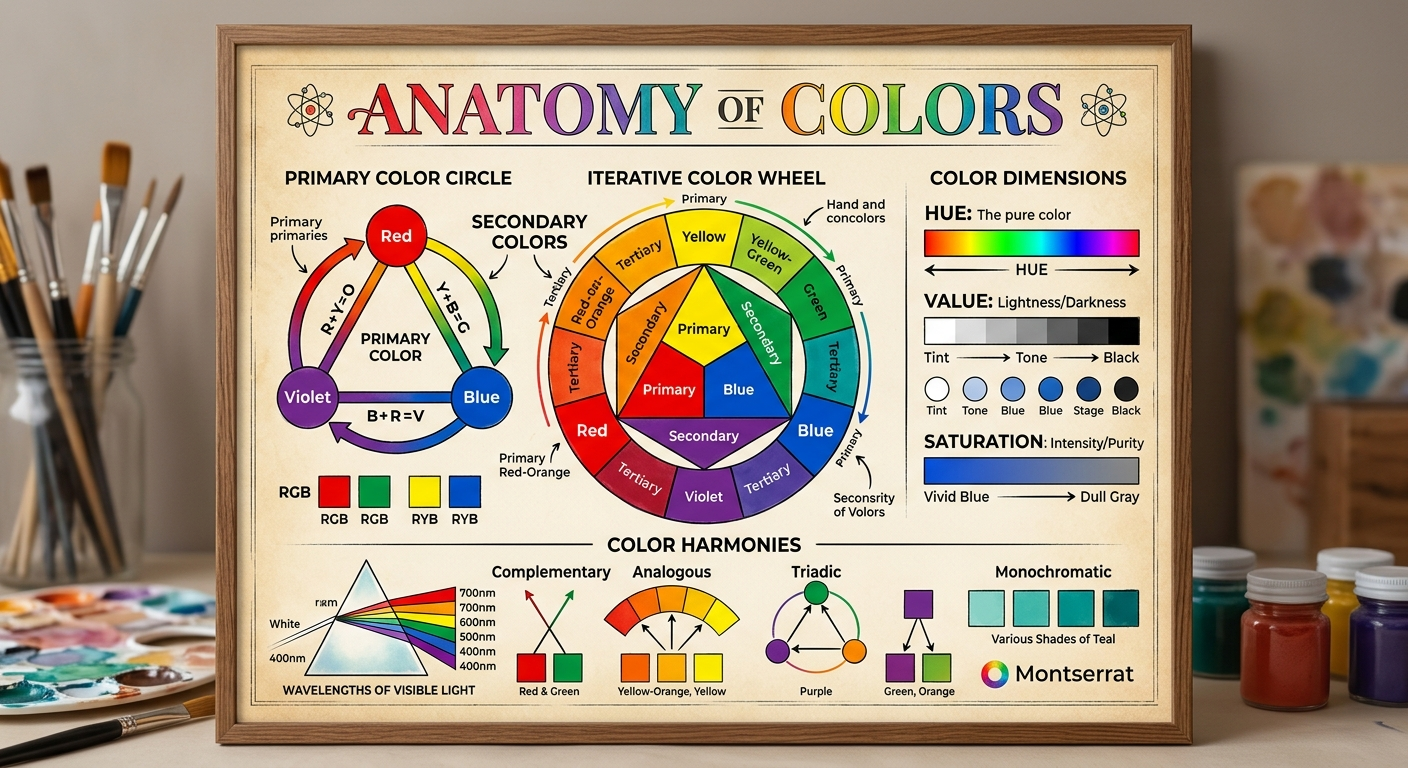
20. Hue, Saturation, Brightness and Related Concepts
Several terms are commonly used to describe color.
Hue
Hue refers to the dominant perceptual category associated with a color, such as:
- Red
- Yellow
- Green
- Blue
- Purple
Saturation
Saturation describes the degree to which a color appears relatively vivid or muted.
Brightness
Brightness is a perceptual correlate associated with the apparent intensity of a visual stimulus.
Lightness
Lightness concerns how light or dark an object appears relative to a reference white.
Chroma
Chroma represents the strength of colorfulness relative to a reference brightness level in certain color appearance frameworks.
These terms should not be treated as perfect synonyms.
21. The Color Wheel
The color wheel is primarily an educational and artistic model.
It organizes hues around a circular representation.
Common concepts include:
- Primary colors
- Secondary colors
- Tertiary colors
- Complementary colors
- Analogous colors
- Warm colors
- Cool colors
The color wheel is useful for design and art, but it should not be confused with the complete scientific structure of human color perception.
22. Additive Color
Additive color concerns light sources.
When colored light is combined, the resulting stimulus can become brighter.
The familiar RGB system uses:
- Red
- Green
- Blue
as primary channels.
Digital displays exploit this principle.
A display pixel can contain or control multiple light-emitting components, allowing different intensities to be combined to generate a wide range of perceived colors.
23. Subtractive Color
Subtractive color is primarily associated with materials that absorb portions of illumination.
Printing is a major example.
A common four-channel printing system is:
- Cyan
- Magenta
- Yellow
- Black
This is commonly called CMYK.
Whereas RGB primarily describes controlled light emission, CMYK describes the modification of reflected light by inks.
This distinction is fundamental to digital imaging and printing.
24. RGB and the Digital World
RGB has become one of the foundational representations of digital imagery.
A pixel can be represented conceptually as:
[
(R,G,B)
]
Each channel is assigned a numerical intensity.
For example, in an 8-bit-per-channel system:
[
0 \leq R,G,B \leq 255
]
This permits:
[
256^3 = 16,777,216
]
possible channel combinations.
These numerical combinations are not identical to 16.7 million independently distinguishable human colors; rather, they represent encoded digital states that can produce a very large range of display stimuli.
25. Color in Computer Graphics
Computer graphics transform mathematical information into visual stimuli.
A typical digital color pipeline can involve:
Scene → rendering → color representation → encoding → display processing → pixels → light → eye → perception
Modern graphics systems may additionally incorporate:
- HDR
- Wide color gamuts
- Color management
- Transfer functions
- Display calibration
- Different RGB primaries
- Image compression
Color has therefore become a computational object.
26. Color Spaces
A color space provides a mathematical method for representing color.
Important systems include:
- RGB
- XYZ
- xyY
- CIELAB
- CIELUV
- HSV
- HSL
- CMYK
Each serves different purposes.
The CIE system is particularly important for scientific color measurement. CIE colorimetry uses standardized observers, illuminants, tristimulus values, chromaticity coordinates and color spaces.
27. CIE XYZ
The CIE 1931 system introduced a standardized framework based on tristimulus values.
The three values are conventionally represented as:
[
X,\ Y,\ Z
]
From these, chromaticity coordinates can be calculated.
For example:
[
x=\frac{X}{X+Y+Z}
]
[
y=\frac{Y}{X+Y+Z}
]
The resulting chromaticity representation helps describe the chromatic characteristics of a stimulus independently of some aspects of absolute intensity.
28. CIELAB
CIELAB was developed to provide a color space that is more perceptually organized than basic XYZ coordinates.
Its principal coordinates are:
- (L^*): lightness
- (a^*): approximately green–red axis
- (b^*): approximately blue–yellow axis
CIE describes CIELAB as a three-dimensional space incorporating correlates of lightness, chroma and hue, and provides methods for representing perceived color differences.
This makes CIELAB useful in:
- Printing
- Paint manufacturing
- Textiles
- Quality control
- Photography
- Industrial color matching
29. CIELUV
CIELUV is another CIE color space designed to provide a more perceptually useful representation of color.
The CIE’s current colorimetry framework includes CIELUV alongside CIELAB and other standardized representations.
Modern standards specify methods for calculating CIELUV coordinates and related chromaticity representations, including (u’) and (v’).
30. Color Difference
Industrial systems frequently need to determine whether two colors are sufficiently similar.
This requires a numerical representation of color difference.
A basic concept is:
[
\Delta E
]
where a color-difference formula estimates the perceptual or standardized distance between two color samples.
CIE has developed several color-difference methods, including CIEDE2000.
This is extremely important for manufacturing because a product may need to maintain consistent color across:
- Production batches
- Factories
- Suppliers
- Materials
- Printing processes
- Lighting conditions
31. Illumination and Color
Color cannot be properly understood without considering the light source.
An object does not have one universally fixed visible spectrum under every illumination condition.
Different light sources have different spectral power distributions.
CIE therefore defines standard illuminants for colorimetric work. For example, CIE Illuminant A represents typical incandescent/tungsten lighting, while D65 represents average daylight conditions.
This is why a color sample can look different under:
- Sunlight
- Incandescent lighting
- Fluorescent lighting
- LED lighting
- Computer displays
32. Color Temperature
Color temperature is commonly expressed in kelvins.
The concept originates from the color characteristics of thermal radiation.
In practical lighting, correlated color temperature (CCT) is often used to describe the appearance of white light.
Examples commonly include:
- Warm white
- Neutral white
- Cool white
Color temperature is particularly important in:
- Photography
- Cinematography
- Architecture
- Interior lighting
- Displays
- Industrial illumination
33. The Anatomy of a Rainbow
A rainbow demonstrates several principles simultaneously.
Sunlight contains a broad distribution of visible wavelengths.
When sunlight enters water droplets, optical processes including refraction, internal reflection and dispersion separate the components spatially.
Different wavelengths are refracted by slightly different amounts.
The observer therefore sees an organized sequence of spectral colors.
The rainbow is an excellent natural demonstration that color can emerge from the interaction between:
light + matter + geometry + observer position.
34. Why the Sky Is Blue
The blue appearance of the daytime sky is associated with preferential scattering of shorter visible wavelengths by molecules in Earth’s atmosphere.
The scattered light reaches observers from many directions.
This demonstrates another important principle:
The color we see does not necessarily originate from a colored object.
In this case, atmospheric molecules and the geometry of illumination create the visual phenomenon.
35. Why Plants Are Green
Plants contain pigments such as chlorophyll that interact selectively with visible radiation.
Chlorophyll absorbs strongly in portions of the visible spectrum used in photosynthesis while reflecting or transmitting more of other wavelengths.
The resulting reflected light contributes strongly to the green appearance of many leaves.
Color therefore becomes connected to biological energy conversion.
36. Animal Coloration
Animals use color for many purposes.
Coloration can contribute to:
- Camouflage
- Communication
- Mate recognition
- Warning
- Mimicry
- Temperature regulation
- Species identification
Animal coloration may result from:
- Pigments
- Structural coloration
- Both mechanisms together
This makes color an important evolutionary and ecological system.
37. Color in Human Communication
Humans use color symbolically and practically.
Color can communicate:
- Danger
- Direction
- Categorization
- Status
- Identity
- Information
- Emotion
- Emphasis
Traffic signals are an example of engineered color communication.
Maps, charts, dashboards and scientific visualizations also use color to encode information.
However, effective information design requires consideration of accessibility and differences in color perception.
38. Color Vision Variation
Not every person perceives colors in exactly the same way.
Color vision varies because of differences in:
- Photoreceptor biology
- Genetics
- Age
- Eye health
- Neural processing
- Illumination
- Adaptation
Some people have forms of color vision deficiency that alter their ability to distinguish certain color combinations.
Therefore, systems that depend heavily on color should ideally provide additional information through:
- Text
- Shapes
- Patterns
- Labels
- Position
- Contrast
39. Color in Photography
Photography converts scenes into measurable or encoded signals.
A camera typically contains:
- Lens
- Aperture
- Shutter or electronic exposure system
- Image sensor
- Color filters or pixel-level spectral responses
- Image processor
- Digital encoding
The sensor does not simply “see” colors in the same way humans do.
Instead, it measures light through spectral response functions and reconstructs color information computationally.
40. Color in Displays
Modern displays represent color through controlled emission of light.
Major technologies include:
- LCD
- OLED
- MicroLED
- Quantum-dot-enhanced displays
Display engineering involves:
- Pixel architecture
- Primary colors
- Brightness
- Contrast
- Gamut
- White point
- Calibration
- Color management
The physical display therefore forms another layer in the anatomy of digital color.
41. Color in Printing
Printing reverses many aspects of the digital display problem.
A display emits light.
A printed page primarily modifies reflected light.
Consequently, printers must control:
- Ink chemistry
- Dot placement
- Paper properties
- Illumination
- Density
- Color profiles
- Calibration
Professional printing therefore relies heavily on color measurement and management.
42. Color Measurement Instruments
Modern color science uses specialized instruments.
Important examples include:
Spectroradiometer
Measures spectral characteristics of emitted or received radiation.
Spectrophotometer
Measures wavelength-dependent optical properties such as reflectance or transmission.
Colorimeter
Uses defined spectral response functions to provide numerical color measurements.
NIST describes practical color measurement using instruments such as spectroreflectometers, spectroradiometers and tristimulus colorimeters, together with calibration and uncertainty analysis.
43. Color Calibration
A color system must be calibrated if accurate reproduction is required.
Calibration can involve:
- Measuring a known reference
- Establishing instrument response
- Correcting deviations
- Creating profiles
- Monitoring environmental conditions
Without calibration, two devices may receive the same numerical RGB values but produce visibly different colors.
This is one of the central challenges of digital color management.
44. Metamerism
Metamerism occurs when different physical spectral distributions produce similar color perceptions under particular viewing conditions.
Two materials can therefore appear to match under one light source but differ under another.
This is extremely important in:
- Textile manufacturing
- Automotive painting
- Printing
- Retail products
- Paint matching
- Industrial quality control
The phenomenon demonstrates again that color cannot be reduced to a single wavelength.
45. Color Gamut
A color gamut represents the range of colors that a particular device or system can reproduce.
Different devices have different gamuts.
For example:
- A camera may capture colors outside a particular display’s gamut.
- A printer may reproduce colors that differ from those available on a monitor.
- One display technology may reproduce a wider range than another.
Color management attempts to map colors between these systems while minimizing undesirable changes.
46. Color as Information
Color is more than decoration.
It can function as a data channel.
A graph might use color to encode:
- Temperature
- Elevation
- Population
- Risk
- Density
- Probability
- Time
In scientific visualization, however, the choice of color scale matters.
A poor color scale can distort interpretation.
A well-designed color scale can reveal patterns that are difficult to see in numerical tables.
47. Color in Medicine and Biology
Color is extensively used in biological observation.
Examples include:
- Histological staining
- Medical imaging
- Microscopy
- Dermatological observation
- Blood analysis
- Fluorescence imaging
In these applications, color can be qualitative or quantitative.
Modern imaging increasingly transforms color into numerical information that can be processed computationally.
48. Color and Artificial Intelligence
Artificial intelligence has created new approaches to color analysis.
AI systems can process:
- Images
- Spectral data
- Color distributions
- Object appearance
- Image segmentation
- Color classification
Machine-learning systems can learn relationships between numerical image data and color categories.
Applications include:
- Automated quality control
- Medical image analysis
- Agricultural monitoring
- Remote sensing
- Computer vision
- Digital photography
- Manufacturing
Color therefore represents an important bridge between physical reality and machine perception.
49. Color and Remote Sensing
Satellites and aircraft measure electromagnetic radiation across different spectral bands.
Some sensors extend beyond ordinary visible color into:
- Near-infrared
- Shortwave infrared
- Other spectral regions
This allows researchers to infer information about:
- Vegetation
- Water
- Soil
- Urban development
- Atmospheric conditions
- Agricultural health
Humans see only a small portion of the electromagnetic spectrum, whereas technological instruments can extend our “vision” far beyond ordinary color perception.
50. Color as a Data Pipeline
A modern color system can be represented as a layered architecture:
Layer 1 — Physical radiation
Electromagnetic energy is generated or reflected.
Layer 2 — Material interaction
Matter absorbs, reflects, transmits or scatters radiation.
Layer 3 — Optical propagation
The resulting radiation travels toward an observer or sensor.
Layer 4 — Sensor
An eye, camera or scientific instrument detects radiation.
Layer 5 — Signal conversion
The sensor converts optical information into electrical or numerical signals.
Layer 6 — Processing
Signals are transformed through biological or computational systems.
Layer 7 — Interpretation
The system produces a representation of color.
Layer 8 — Communication
Color becomes information for humans or machines.
This eight-layer architecture is a useful modern definition of the anatomy of color.
51. The Mathematical Anatomy of Color
Color science combines physics and mathematics.
Important mathematical concepts include:
- Wavelength
- Frequency
- Spectral power distribution
- Tristimulus values
- Chromaticity coordinates
- Vector spaces
- Euclidean distances
- Transformation matrices
- Probability
- Signal processing
- Statistical measurement
A color can therefore be treated as a multidimensional numerical object.
For example:
[
\mathbf{C} =
\begin{bmatrix}
R\
G\
B
\end{bmatrix}
]
or:
[
\mathbf{C} =
\begin{bmatrix}
X\
Y\
Z
\end{bmatrix}
]
Different representations are useful for different purposes.
52. The Anatomy of a Single Color
A useful way to understand any particular color is to examine it through multiple questions:
1. What light illuminates the object?
This determines the incoming spectral distribution.
2. What material receives the light?
Material composition determines how the spectrum is modified.
3. What happens to the light?
It may be absorbed, reflected, transmitted or scattered.
4. What reaches the eye?
The observer receives the resulting spectral distribution.
5. How do the photoreceptors respond?
Cone responses provide overlapping spectral signals.
6. How does the nervous system process the signals?
Neural circuits transform the raw responses.
7. How does the brain interpret the result?
The brain generates a perceptual experience.
8. How can technology measure it?
Colorimetry converts optical information into standardized numerical descriptions.
This is the true anatomy of color.
53. Why Color Is Not Absolute
One of the most important conclusions of color science is that color is conditional.
The apparent color depends on:
[
Color = f(Light,\ Material,\ Observer,\ Context)
]
This simplified relationship emphasizes four major variables:
- Illumination
- Material
- Observer
- Environment
Change any one of these and the perceived result can change.
54. The CIE Framework and International Standardization
Color measurement would be extremely difficult if every laboratory used completely different definitions.
The International Commission on Illumination has therefore developed internationally recognized colorimetric systems.
The current CIE colorimetry framework includes standardized observers, illuminants, tristimulus calculations, color spaces and color-difference procedures.
CIE publications also show the continuing evolution of color science. Its recent work includes topics such as human skin color measurement, visual fields, color rendition and cone-fundamental approaches to colorimetry.
This demonstrates that color science remains an active research field rather than a finished discipline.
55. The Future of Color Science
The future of color technology is likely to involve increasingly precise control over light and perception.
Important areas include:
- Computational color science
- AI-based color management
- Spectral imaging
- Advanced display technologies
- Metamaterials
- Nanophotonics
- Quantum optical technologies
- Digital twins of physical materials
- Automated industrial color matching
- Extended-reality displays
- Human-machine visual interfaces
The boundary between physical color and computational color is becoming increasingly sophisticated.
56. A Unified Model of Color
The complete system can be represented as:
SOURCE
↓
Light generation
↓
SPECTRUM
Wavelength + frequency + energy
↓
MATTER
Absorption + reflection + transmission + scattering
↓
OPTICAL FIELD
Spatial and spectral distribution
↓
SENSOR
Eye / camera / scientific instrument
↓
BIOLOGICAL OR ELECTRONIC SIGNAL
Electrical representation
↓
PROCESSING
Neural computation / digital computation
↓
PERCEPTION OR DATA
Human color experience / numerical color representation
↓
APPLICATION
Art + science + manufacturing + communication + technology
This model connects the physical, biological and technological dimensions of color.
57. Major Principles of Color
The anatomy of color can be summarized through several fundamental principles.
Principle 1: Color depends on light
Without appropriate electromagnetic radiation reaching an observer, ordinary visible color cannot be perceived.
Principle 2: Matter modifies light
Materials selectively absorb, reflect, transmit and scatter radiation.
Principle 3: The eye is a biological sensor
The retina converts optical information into neural signals.
Principle 4: The brain constructs perception
Color perception is the result of neural processing rather than a simple wavelength detector.
Principle 5: Context matters
Surrounding colors and illumination influence perceived appearance.
Principle 6: Color can be quantified
Colorimetry provides mathematical systems for measuring and communicating color.
Principle 7: Different systems require different color models
RGB, CMYK, XYZ, CIELAB and other spaces serve different purposes.
Principle 8: Color can carry information
Color is a major communication and data-visualization channel.
58. Conclusion
The anatomy of colors is ultimately the anatomy of an interaction.
Color begins with electromagnetic radiation, but it does not end with wavelength. Light encounters matter, and matter selectively modifies the incoming radiation. The resulting optical signal reaches the eye, where photoreceptors transform it into neural information. The nervous system processes that information, and the brain constructs the experience we call color.
Technology has extended this natural process.
Cameras convert light into digital measurements. Displays transform numerical signals into emitted light. Printers transform digital descriptions into material patterns that modify reflected light. Spectrophotometers and colorimeters quantify optical properties. Color-management systems translate between devices. Artificial intelligence can analyze enormous quantities of visual and spectral information.
Modern color science therefore sits at the intersection of physics, chemistry, biology, neuroscience, mathematics, engineering and computing.
The deepest lesson is that an object does not simply carry an isolated color like a permanent label. Its perceived color emerges from a system:
[
\boxed{
\text{Light}
\rightarrow
\text{Matter}
\rightarrow
\text{Optical Signal}
\rightarrow
\text{Eye}
\rightarrow
\text{Neural Processing}
\rightarrow
\text{Brain}
\rightarrow
\text{Perceived Color}
}
]
And when technology becomes involved:
[
\boxed{
\text{Physical World}
\rightarrow
\text{Measurement}
\rightarrow
\text{Numerical Representation}
\rightarrow
\text{Computation}
\rightarrow
\text{Display or Material}
\rightarrow
\text{Human Perception}
}
]
This is why color is simultaneously a property of light, a consequence of matter, a biological sensation, a psychological experience, a mathematical quantity and a technological language.
The anatomy of color is therefore not merely the study of red, green, blue, yellow, orange or violet. It is the study of how the universe’s electromagnetic radiation becomes meaningful visual information inside the human mind and increasingly inside machines.
Selected References
- International Commission on Illumination (CIE), Colorimetry, 4th Edition (CIE 015:2018). The publication covers standard observers, standard illuminants, tristimulus values, chromaticity coordinates, color spaces and color differences.
- International Commission on Illumination, ISO/CIE 11664-4:2019 — CIE 1976 Lab Colour Space.*
- International Commission on Illumination, ISO/CIE 11664-5:2024 — CIE 1976 Luv Colour Space and u′,v′ Uniform Chromaticity Scale Diagram.*
- National Institute of Standards and Technology, Yoshi Ohno, CIE Fundamentals for Color Measurements.
- International Commission on Illumination, CIE Standard Illuminants for Colorimetry.
- International Commission on Illumination, Division 1 publications on colour and vision.





Be First to Comment