
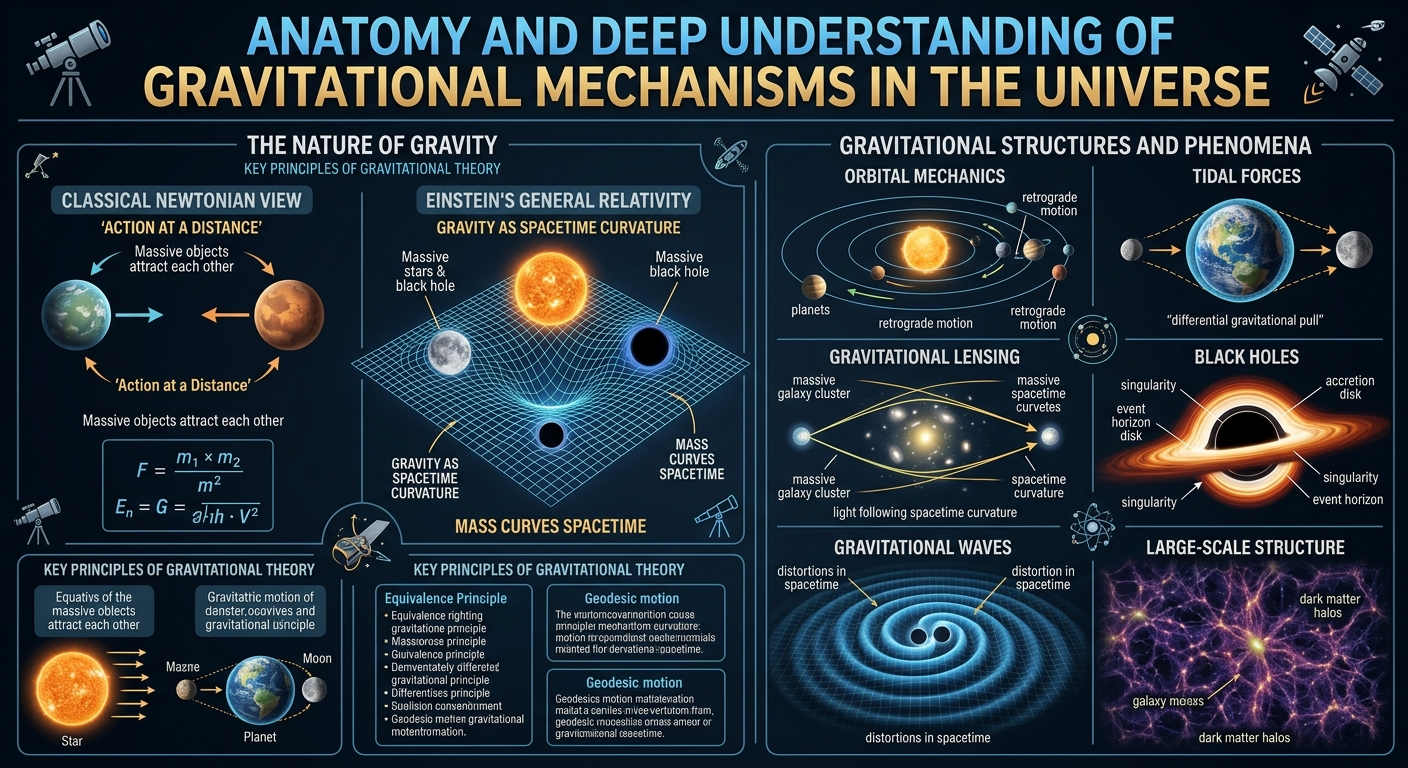
A Comprehensive Thesis on Gravity, Spacetime, Matter, Energy, and Cosmic Structure
Abstract
Gravity is one of the most familiar phenomena in human experience and one of the deepest unsolved subjects in fundamental physics. It keeps people and oceans attached to Earth, governs the motion of the Moon and planets, organizes stars into galaxies, controls the behavior of neutron stars and black holes, and influences the large-scale evolution of the Universe.
Yet gravity is considerably more profound than the everyday statement that “objects fall.” In Newtonian physics, gravity is described as an attractive force between masses. Einstein’s general theory of relativity transformed this understanding: gravity is fundamentally associated with the geometry and dynamics of spacetime. Matter and energy influence spacetime, while the resulting spacetime geometry determines how matter and light move. The equivalence principle provides one of the conceptual foundations of this description.
This thesis develops a systematic understanding of the anatomy of gravitational mechanisms—from mass and energy, gravitational fields and potential, orbital motion and tidal effects to curved spacetime, gravitational waves, black holes, cosmology, dark matter, dark energy, and the unresolved problem of quantum gravity. It also explains why gravity is simultaneously extremely weak at the particle scale and overwhelmingly important at astronomical scales.
Modern gravitational-wave observations provide especially powerful tests of Einstein’s theory in environments of extraordinarily strong and rapidly changing gravity. The LIGO-Virgo-KAGRA collaboration’s 2026 analyses continue to find gravitational-wave observations consistent with general relativity, while increasingly constraining possible alternatives.
1. Introduction: What Is Gravity?
Gravity is the universal phenomenon through which matter, energy, and spacetime participate in the organization of physical systems.
At its simplest level:
Gravity governs how objects move in response to mass-energy and how mass-energy influences the structure of spacetime.
This statement contains two complementary perspectives.
Newtonian perspective
Newton described gravity as a force:
[
F = G\frac{m_1m_2}{r^2}
]
where:
- (F) = gravitational force
- (G) = gravitational constant
- (m_1,m_2) = masses
- (r) = separation between their centers of mass.
This equation remains extraordinarily useful for planets, satellites, engineering, astronomy, and many everyday applications.
Einsteinian perspective
General relativity goes deeper. Instead of treating gravity simply as a force acting through space, Einstein described gravitational phenomena through the geometry of spacetime.
The central idea can be summarized as:
Matter and energy influence spacetime geometry; spacetime geometry influences the motion of matter and light.
This geometric description is particularly important in strong gravitational environments such as black holes and neutron-star mergers.
2. The Historical Anatomy of Gravity
Understanding modern gravity requires understanding how the concept evolved.
2.1 Aristotle and the Ancient World
Ancient philosophers attempted to explain why objects move toward Earth and why celestial objects move across the heavens.
For centuries, terrestrial and celestial motion were treated as fundamentally different.
2.2 Galileo
Galileo Galilei challenged traditional ideas about falling bodies and demonstrated the importance of systematic experimentation.
His work helped establish the principle that gravitational motion should be investigated quantitatively rather than explained only through philosophical categories.
2.3 Newton
Isaac Newton unified terrestrial and celestial mechanics.
The same gravitational law could explain:
- falling objects,
- the Moon’s orbit,
- planetary motion,
- tides,
- comet trajectories,
- and other astronomical phenomena.
This was one of the greatest unifications in scientific history.
2.4 Einstein
Albert Einstein eventually demonstrated that Newton’s theory was not the final description of gravity.
General relativity, developed in the early twentieth century, replaced the concept of gravity as merely a force with a geometric theory of spacetime.
Einstein’s equivalence principle was central to this conceptual transition. A freely falling observer locally experiences physics as though gravity has disappeared, providing a bridge between accelerated motion and gravitation.
3. The Fundamental Components of Gravitational Anatomy
Gravity can be understood as a system containing several interconnected components.
3.1 Mass
Mass measures inertia and, in gravitational physics, contributes to gravitational influence.
A more massive object generally produces stronger gravitational effects.
3.2 Energy
General relativity goes beyond mass alone.
Energy, momentum, pressure, stress, and other properties of matter contribute to spacetime curvature.
Consequently, gravity is not simply a relationship between isolated masses.
3.3 Spacetime
Einstein combined three spatial dimensions with time into four-dimensional spacetime.
Rather than imagining objects moving through an absolutely fixed stage, general relativity treats spacetime itself as dynamical.
3.4 Gravitational Field
In Newtonian physics, the gravitational field around a mass can be represented approximately as:
[
\vec{g}=-\frac{GM}{r^2}\hat{r}
]
The field points toward the source mass.
3.5 Gravitational Potential
For a spherical mass:
[
\Phi=-\frac{GM}{r}
]
The gravitational potential provides a useful way of understanding gravitational energy and orbital motion.
3.6 Spacetime Curvature
In general relativity, the gravitational field becomes associated with spacetime geometry.
Curvature is not merely a visual deformation. It is mathematically represented by geometric quantities describing how distances, times, and trajectories behave.
4. Gravity as Geometry
One of the most important conceptual changes introduced by Einstein is that gravity is not necessarily best understood as a conventional force.
Imagine a spacecraft orbiting Earth.
Newton’s description says Earth continuously attracts the spacecraft through gravity.
General relativity describes the spacecraft as following a natural path—called a geodesic—through curved spacetime.
The spacecraft is not necessarily “being pulled” in the ordinary mechanical sense. Instead, its trajectory is determined by spacetime geometry.
This is why astronauts in orbit experience apparent weightlessness even though Earth’s gravitational field remains substantial.
5. The Equivalence Principle
The equivalence principle is one of the conceptual foundations of general relativity.
Consider an observer inside a freely falling elevator.
For a sufficiently small region, objects inside appear to float as though gravity has disappeared.
Einstein recognized that locally, free fall and inertial motion can be closely connected.
This principle led toward the geometric interpretation of gravity. Einstein Online describes the equivalence principle as the idea that a freely falling observer does not locally feel gravity in the ordinary sense.
The importance of this idea cannot be overstated.
It connects:
- gravity,
- acceleration,
- free fall,
- inertial frames,
- spacetime,
- and relativity.
6. The Anatomy of an Orbit
An orbit is not simply an object “floating around” another object.
An orbit results from the interaction between:
- initial velocity,
- gravitational influence,
- spacetime geometry,
- angular momentum,
- energy.
For a simplified circular orbit in Newtonian mechanics:
[
v=\sqrt{\frac{GM}{r}}
]
where (v) is orbital speed.
The object continuously changes direction because its trajectory is curved.
Earth therefore does not simply fall toward the Sun and miss it by accident. Its orbital velocity and the Sun’s gravitational influence combine to produce a persistent orbital trajectory.
7. Why the Moon Does Not Fall Directly to Earth
The Moon is continuously falling toward Earth in the Newtonian sense.
However, it also has sideways velocity.
Consequently, while gravity curves its trajectory toward Earth, its forward motion carries it around Earth.
The result is an orbit.
The same basic principle operates throughout the Universe:
orbital motion emerges from the combination of gravitational influence and motion.
8. Tidal Gravity
Gravity is not always uniform across an object.
Suppose an extended object approaches a massive body.
The side closer to the massive body experiences a stronger gravitational influence than the far side.
The difference produces a tidal effect.
Tidal gravity explains:
- ocean tides,
- tidal deformation of moons,
- stellar deformation,
- tidal disruption events,
- extreme stretching near compact massive objects.
Tidal forces are particularly important near black holes because the gravitational gradient can become enormous.
9. Escape Velocity
Escape velocity represents the minimum speed required, in a simplified Newtonian treatment, to escape the gravitational influence of an object without additional propulsion:
[
v_e=\sqrt{\frac{2GM}{R}}
]
For Earth, the escape velocity is approximately:
[
11.2\text{ km/s}
]
This concept is useful for understanding rockets, planetary systems, stars, and the transition toward black-hole physics.
10. Gravity and Light
One of the most revolutionary consequences of general relativity is that gravity affects light.
Although photons have zero rest mass, light travels through spacetime geometry.
Consequently, massive objects can bend the apparent path of light.
This phenomenon is called gravitational lensing.
A massive galaxy cluster, for example, can distort and magnify light from more distant galaxies.
Gravitational lensing has become an important astronomical tool for studying:
- galaxies,
- galaxy clusters,
- dark matter,
- distant objects,
- cosmological parameters.
11. Gravitational Time Dilation
Gravity affects time.
Clocks located deeper in a gravitational field run differently from clocks located farther away.
This phenomenon is known as gravitational time dilation.
It is not merely theoretical.
Modern precision clocks can measure differences associated with gravitational potential.
The effect is also important in satellite navigation systems, where relativistic corrections must be incorporated into accurate timing.
Thus gravity influences not only trajectories but also the measurement of time itself.
12. Gravity and the Passage of Time
This leads to a profound conclusion:
Gravity is connected to the structure of time.
In Newtonian physics, time is treated as universal.
In relativity, time depends on the observer’s state of motion and gravitational environment.
Therefore, the Universe does not possess one universal cosmic clock that ticks identically everywhere.
Instead, different observers can experience different elapsed times.
13. The Einstein Field Equations
The mathematical heart of general relativity is the Einstein field equation:
[
G_{\mu\nu}+\Lambda g_{\mu\nu}
\frac{8\pi G}{c^4}T_{\mu\nu}
]
This equation is enormously compact but conceptually profound.
Its major components include:
- (G_{\mu\nu}): spacetime curvature
- (g_{\mu\nu}): spacetime metric
- (\Lambda): cosmological constant
- (T_{\mu\nu}): stress-energy tensor
- (G): gravitational constant
- (c): speed of light.
The equation expresses the relationship between geometry and physical content.
A popular conceptual interpretation is:
geometry responds to matter-energy, and matter-energy moves within that geometry.
14. The Stress-Energy Tensor
The stress-energy tensor is crucial because general relativity does not treat gravity as being sourced only by mass.
It incorporates information such as:
- energy density,
- momentum density,
- energy flux,
- pressure,
- stresses.
This means pressure can contribute to gravitational behavior.
Under extreme conditions, such as those found in neutron stars or the early Universe, these effects become particularly important.
15. Weak Gravity Versus Strong Gravity
Most everyday gravitational environments are weak-field environments.
Examples include:
- Earth,
- ordinary spacecraft,
- planets,
- many binary stars.
Strong-field gravity becomes important around:
- neutron stars,
- black holes,
- merging compact objects.
Gravitational-wave astronomy has opened an extraordinary observational window into strong-field gravity. The LIGO-Virgo-KAGRA collaboration reports that observations from compact-object mergers continue to agree closely with general relativity.
16. Gravitational Waves
General relativity predicts that rapidly changing asymmetric distributions of mass-energy can generate gravitational waves.
These waves are propagating disturbances in spacetime geometry.
A simplified analogy is a ripple traveling across a pond, although gravitational waves are not ordinary water waves.
They travel through spacetime and can carry information about violent cosmic events.
Sources include:
- merging black holes,
- merging neutron stars,
- some other compact-object systems.
The first direct detection, GW150914, came from merging black holes and provided unprecedented access to strong, dynamic gravity.
17. The Anatomy of a Black Hole
A black hole is not simply an extremely dense object.
It is a region of spacetime bounded by an event horizon, beyond which signals cannot escape to distant observers.
Important concepts include:
Event horizon
The boundary beyond which outward escape is impossible according to classical general relativity.
Singularity
Classical general relativity predicts a region where curvature becomes singular in certain black-hole solutions.
However, the physical meaning of singularities is one of the places where physicists expect a deeper theory may be required.
Accretion disk
Material orbiting and falling toward a black hole can form a hot, luminous disk.
Relativistic effects
Black holes produce extreme:
- gravitational time dilation,
- light bending,
- orbital effects,
- tidal effects,
- frame-dragging phenomena around rotating black holes.
18. The Schwarzschild Radius
For a non-rotating spherical object, the characteristic Schwarzschild radius is:
[
r_s=\frac{2GM}{c^2}
]
If sufficient mass is compressed within this characteristic radius, classical general relativity predicts the formation of a black hole.
This equation demonstrates the connection between:
- mass,
- gravity,
- geometry,
- and the speed of light.
19. Rotating Black Holes
Real astrophysical black holes can rotate.
The relevant mathematical solution is the Kerr solution.
Rotation creates additional effects, including frame dragging.
Frame dragging refers to the way rotating mass affects the surrounding spacetime geometry.
This means that near a rapidly rotating compact object, spacetime itself participates in the rotational structure of the system.
20. Neutron Stars: Gravity at Extreme Density
Neutron stars are among the densest known astrophysical objects.
They are formed from the remnants of massive stars after catastrophic stellar evolution.
Their gravity is so strong that relativistic effects become essential.
Binary neutron-star mergers provide a particularly valuable laboratory because the gravitational interaction occurs in the presence of matter, unlike idealized vacuum black-hole mergers.
The GW170817 event provided important tests of general relativity involving neutron-star matter and found results consistent with Einstein’s theory.
21. Gravity and Stellar Evolution
Gravity is central to the entire life cycle of stars.
A star begins when gravity causes a sufficiently dense region of gas to collapse.
As matter contracts:
- density increases,
- temperature increases,
- pressure changes,
- nuclear reactions can eventually begin.
During much of a star’s life, gravitational contraction is balanced by pressure and energy generation.
When nuclear fuel is exhausted, gravity again becomes dominant in determining the star’s final fate.
Depending on mass and evolutionary history, the remnant may become:
- a white dwarf,
- a neutron star,
- or a black hole.
22. Gravity and Galaxies
Gravity binds stars into galaxies.
A galaxy is a vast gravitational system containing combinations of:
- stars,
- gas,
- dust,
- compact objects,
- dark matter,
- and other components.
Gravity determines orbital motion within galaxies and contributes to the formation of large-scale structures.
23. Dark Matter and Gravity
Observations of galaxies and galaxy clusters indicate gravitational effects that cannot be fully explained by the visible matter alone under the standard cosmological model.
This led to the dark-matter hypothesis.
Dark matter is not directly observed through ordinary electromagnetic light, but its gravitational influence is inferred from phenomena such as:
- galaxy rotation,
- gravitational lensing,
- galaxy-cluster dynamics,
- large-scale cosmic structure.
The dark-matter problem therefore represents one of the major questions in gravitational cosmology.
24. Gravity and the Expansion of the Universe
Gravity operates on an expanding Universe.
Modern cosmology describes a Universe whose large-scale geometry and expansion are governed by general relativity.
The Universe is not simply a collection of galaxies moving through static space.
Rather, cosmic expansion involves the evolution of spacetime itself.
This distinction is fundamental.
25. The Cosmological Constant and Dark Energy
Einstein’s equations permit a cosmological constant, represented by:
[
\Lambda
]
Modern cosmology associates accelerated cosmic expansion with what is broadly called dark energy.
The precise physical nature of dark energy remains unknown.
Several possibilities have been investigated, including:
- a cosmological constant,
- evolving fields,
- modifications of gravity,
- other cosmological mechanisms.
This illustrates an important point:
our understanding of gravity is extremely successful, but the complete cosmic picture remains unfinished.
26. Gravity and the Cosmic Web
On the largest scales, gravity helps organize matter into a vast cosmic network.
The Universe contains structures including:
- galaxies,
- galaxy groups,
- galaxy clusters,
- filaments,
- voids.
Dark matter provides an important gravitational framework for the development of this structure in the standard cosmological model.
Over billions of years, gravity amplifies small density differences into increasingly complex structures.
27. Gravity as a Cosmic Architect
Gravity can therefore be regarded as one of the Universe’s principal organizing mechanisms.
It contributes to:
Gas clouds → stars → planetary systems → galaxies → galaxy clusters → cosmic structure
At each scale, gravity interacts with other physical processes.
Gravity alone does not explain everything.
It works together with:
- electromagnetism,
- nuclear physics,
- thermodynamics,
- fluid dynamics,
- radiation,
- quantum physics.
28. Why Gravity Is So Weak
One of the great mysteries of physics is the relative weakness of gravity compared with the other fundamental interactions at particle scales.
A small magnet can overcome the gravitational attraction of the entire Earth on a paperclip.
This illustrates the extraordinary weakness of gravity at microscopic scales.
Yet gravity dominates astronomy.
Why?
Because gravity is universally attractive and accumulates with enormous quantities of matter.
Positive and negative electric charges can cancel one another.
There is no known gravitational equivalent of positive and negative gravitational mass that routinely cancels gravitational influence.
Therefore, on sufficiently large scales, gravity becomes dominant.
29. Gravity and the Four Fundamental Interactions
Modern physics identifies four fundamental interactions:
- gravity,
- electromagnetism,
- strong nuclear interaction,
- weak nuclear interaction.
The first three of the latter categories are successfully described within quantum field theory frameworks, while gravity is described extraordinarily successfully by general relativity on macroscopic scales.
The lack of a complete experimentally confirmed quantum theory of gravity is one of modern physics’ greatest challenges.
30. The Quantum Gravity Problem
General relativity describes gravity through spacetime geometry.
Quantum mechanics describes nature at microscopic scales through quantum principles.
Both theories are extraordinarily successful within their domains.
The problem arises when we try to describe situations where:
- gravity is extremely strong,
- distances become extremely small,
- quantum effects cannot be ignored.
Examples include the deepest interior of black holes and conditions associated with the earliest Universe.
A complete theory of quantum gravity would need to reconcile these frameworks.
Candidate approaches include:
- string theory,
- loop quantum gravity,
- asymptotic safety,
- causal dynamical triangulations,
- emergent-gravity approaches.
None has yet become an experimentally confirmed final theory.
31. The Information Problem
Black holes have generated another profound question: what happens to information associated with matter that falls into a black hole?
This is known as the black-hole information problem.
The issue emerges from the tension between:
- general relativity,
- quantum mechanics,
- black-hole thermodynamics,
- information conservation.
It has stimulated decades of theoretical research.
32. Gravity and Thermodynamics
Black holes possess thermodynamic properties.
They have:
- entropy,
- temperature,
- energy,
- horizon area.
A remarkable relationship exists between black-hole entropy and horizon area.
This has suggested that gravity, spacetime, thermodynamics, and information may be deeply connected.
It is one of the strongest clues that our current description of gravity may not be fundamental at the deepest level.
33. Gravity as Information?
Some modern theoretical approaches investigate whether spacetime and gravity could emerge from deeper microscopic structures involving:
- quantum information,
- entanglement,
- thermodynamics,
- statistical mechanics.
These ideas remain areas of active research rather than established conclusions.
The important lesson is that gravitational physics may eventually turn out to be an emergent phenomenon rather than a fundamental interaction in the conventional sense.
34. Experimental Tests of Gravity
Gravity has been tested in many environments.
Tests include:
- planetary motion,
- binary pulsars,
- gravitational lensing,
- gravitational redshift,
- precision clocks,
- satellite experiments,
- black-hole observations,
- neutron-star observations,
- gravitational waves.
Modern gravitational-wave experiments are especially valuable because they test general relativity in strong and dynamic gravitational regimes.
Recent LVK analyses using the growing gravitational-wave catalog continue to find no evidence requiring departures from general relativity.
35. Gravitational-Wave Anatomy
A gravitational-wave signal from a compact binary merger can be conceptually divided into three major stages:
Inspiral
Two compact objects orbit each other while losing energy through gravitational radiation.
Merger
The objects undergo their final coalescence.
Ringdown
The resulting black hole settles toward a stable state, emitting characteristic gravitational radiation.
This three-stage structure provides a powerful test of general relativity.
The latest LIGO-Virgo-KAGRA analyses use these stages to test whether the observed signals agree with Einstein’s predictions.
36. GW250114 and Modern Tests of Gravity
GW250114, observed on January 14, 2025, became an exceptionally strong gravitational-wave event.
LIGO reports that it was approximately three times louder than the first gravitational-wave detection of 2015 and enabled particularly precise tests of black-hole physics and general relativity.
This illustrates how gravitational-wave astronomy has evolved from detecting a historic signal into a precision-testing discipline.
37. Gravity and the Speed of Light
General relativity predicts that gravitational waves propagate at the speed of light in vacuum.
The neutron-star merger GW170817, together with its electromagnetic counterpart, provided an especially important observational test of this relationship.
The observations found no evidence of significant deviations in gravitational-wave propagation from the relativistic prediction.
38. Gravity and Causality
Relativity imposes a fundamental causal structure.
Information cannot propagate arbitrarily fast through ordinary spacetime.
The speed of light establishes the causal boundary known as the light cone.
Gravity therefore operates within the relativistic structure of spacetime rather than acting instantaneously across the Universe as Newton’s original formulation suggested.
39. Gravitational Redshift
Light escaping a gravitational field can experience a change in frequency.
For a distant observer, light climbing out of a gravitational potential is generally shifted toward lower frequencies.
This is called gravitational redshift.
It provides another observational manifestation of the relationship between gravity, light, and time.
40. Frame Dragging
Rotating masses can influence the orientation of nearby inertial frames.
This phenomenon, called frame dragging, is a distinctive prediction of general relativity.
It becomes particularly important around rapidly rotating objects.
Frame dragging illustrates that spacetime is not simply curved but can possess dynamical rotational structure.
41. The Gravitational Field of Earth
Earth’s gravitational environment is not perfectly uniform.
It varies because Earth:
- rotates,
- is not a perfect sphere,
- contains mountains and oceans,
- has variations in internal density,
- interacts gravitationally with the Moon and Sun.
Consequently, Earth’s gravitational field can be mapped with extremely high precision.
Such measurements have applications in:
- geophysics,
- oceanography,
- climate studies,
- resource exploration,
- satellite navigation.
42. Gravity and Engineering
Gravitational understanding is fundamental to:
- bridge design,
- buildings,
- spacecraft,
- satellites,
- aviation,
- navigation,
- planetary missions,
- geodesy.
Engineers often use Newtonian mechanics because relativistic corrections are unnecessary for many ordinary applications.
However, high-precision systems increasingly require relativistic physics.
43. Gravity and Space Exploration
Every spacecraft trajectory is fundamentally a gravitational problem.
Mission designers calculate:
- planetary orbits,
- transfer trajectories,
- escape trajectories,
- gravity assists,
- orbital insertion,
- re-entry paths.
A gravity-assist maneuver allows a spacecraft to exchange energy and momentum with a moving planet.
This can dramatically alter spacecraft velocity without requiring the same amount of onboard propulsion.
44. Gravity Assist: A Cosmic Slingshot
A spacecraft approaching a moving planet can leave with a different velocity relative to the Sun.
The planet does not simply “pull” the spacecraft forward.
The spacecraft exchanges a tiny amount of momentum and energy with the planet’s orbital motion.
Because the planet is enormously more massive than the spacecraft, its own change is negligible while the spacecraft’s change can be significant.
Gravity therefore becomes an engineering resource.
45. Gravity and Planet Formation
Gravity is also essential to planetary formation.
A young planetary system contains dust and gas.
Small particles collide and accumulate.
As objects grow, their gravitational influence becomes stronger.
Eventually, gravitational accretion can produce:
- planetesimals,
- protoplanets,
- planets,
- moons.
Gravity therefore participates in the transformation from microscopic particles to planetary-scale bodies.
46. Gravity and the Solar System
The Solar System is a complex gravitational system.
The Sun contains most of its mass and therefore dominates the overall gravitational structure.
However, planets also influence one another.
Their mutual gravitational interactions can produce:
- orbital resonances,
- perturbations,
- long-term changes,
- asteroid deflections,
- cometary trajectories.
The Solar System is therefore not a collection of perfectly isolated two-body systems.
47. Gravity and Binary Systems
Binary stars provide another important gravitational laboratory.
Two stars orbit their common center of mass.
Their motion can reveal:
- stellar masses,
- orbital parameters,
- stellar evolution,
- gravitational radiation.
Compact binary systems become especially important because they can generate detectable gravitational waves.
48. Gravity and Black-Hole Mergers
When two black holes orbit one another, they emit gravitational radiation.
Energy is carried away.
The orbital separation decreases.
The orbital frequency increases.
The objects eventually merge.
The resulting black hole undergoes a ringdown phase.
The gravitational-wave signal therefore contains information about:
- masses,
- spins,
- orbital dynamics,
- strong-field gravity,
- final black-hole properties.
This provides a remarkable way of testing the geometry of spacetime itself.
49. Gravity as a Feedback System
Gravitational systems often involve feedback.
For example:
Matter distribution → gravitational field → motion → redistribution of matter → new gravitational field
This can lead to complex structures.
In cosmology:
small density fluctuations → gravitational amplification → halos → galaxies → larger structures
Thus gravity is not merely a static force. It participates in long-term cosmic evolution.
50. Gravity Across Different Scales
Gravity operates across an extraordinary range of scales.
Human scale
Objects fall toward Earth.
Planetary scale
Moons and planets orbit larger bodies.
Stellar scale
Gravity shapes stars.
Galactic scale
Gravity organizes stars and dark matter.
Cosmological scale
Gravity influences the evolution of cosmic structure and spacetime.
Extreme scale
Black holes and neutron stars expose gravity under extreme conditions.
This scale independence is one reason gravity is central to astronomy.
51. The Mathematical Anatomy of Gravity
Several mathematical frameworks are particularly important.
Newtonian mechanics
[
F=ma
]
combined with Newton’s gravitational law.
Potential theory
[
\nabla^2\Phi=4\pi G\rho
]
for appropriate Newtonian systems.
General relativity
[
G_{\mu\nu}+\Lambda g_{\mu\nu}
\frac{8\pi G}{c^4}T_{\mu\nu}
]
Geodesic equation
In simplified notation:
[
\frac{d^2x^\mu}{d\tau^2}
+
\Gamma^\mu_{\alpha\beta}
\frac{dx^\alpha}{d\tau}
\frac{dx^\beta}{d\tau}
=0
]
This describes free-fall motion through curved spacetime.
These equations form different levels of the gravitational description.
52. Newtonian Gravity as an Approximation
Newton’s theory is not “wrong” in everyday circumstances.
Rather, it is an extremely accurate approximation to general relativity when:
- gravitational fields are weak,
- velocities are much smaller than the speed of light,
- spacetime curvature is modest.
This is why Newtonian physics remains indispensable in engineering and astronomy.
General relativity provides the deeper framework.
53. The Hierarchy of Gravitational Understanding
A useful conceptual hierarchy is:
Falling objects
↓
Newtonian force
↓
Gravitational field
↓
Potential and orbital mechanics
↓
Spacetime
↓
Curvature
↓
General relativity
↓
Black holes and gravitational waves
↓
Quantum gravity
This represents an increasing depth of theoretical description rather than a simple replacement of one theory by another.
54. Common Misconceptions About Gravity
Misconception 1: Gravity is only attraction
Gravity can produce highly complex geometry, orbital motion, tidal effects, lensing, waves, and relativistic time effects.
Misconception 2: Gravity requires air
Gravity operates in vacuum.
Misconception 3: Heavy objects necessarily fall faster
In idealized free fall, objects accelerate similarly regardless of mass when air resistance is neglected.
Misconception 4: There is no gravity in orbit
Gravity remains important in orbit. Astronauts experience apparent weightlessness because they are in continuous free fall.
Misconception 5: Black holes suck everything in from unlimited distances
A black hole’s gravitational influence at large distances follows the same basic gravitational principles as other objects of equivalent mass.
Misconception 6: General relativity means everything is literally a rubber sheet
The rubber-sheet analogy is useful pedagogically but incomplete. Actual spacetime is four-dimensional, and curvature is mathematically richer than a two-dimensional sheet bending into an external space.
55. The Deepest Conceptual Insight
Perhaps the most important lesson from modern gravitational physics is that space and time are physical participants in the Universe.
They are not merely an empty stage.
Spacetime can:
- curve,
- stretch,
- evolve,
- carry gravitational waves,
- influence clocks,
- influence light,
- determine free-fall trajectories.
This is one of the great conceptual revolutions of modern science.
56. The Remaining Mysteries
Despite the extraordinary success of general relativity, major questions remain.
What is the quantum structure of gravity?
Unknown.
What happens at a classical singularity?
Unknown within current theory.
What is dark matter?
Unknown.
What is dark energy?
Unknown.
Why is gravity so weak compared with other fundamental interactions?
Not fully understood.
Is spacetime fundamental or emergent?
Unknown.
Can gravity be unified with quantum physics?
No experimentally confirmed complete theory currently exists.
57. The Future of Gravitational Science
Future research will increasingly combine:
- gravitational-wave astronomy,
- electromagnetic astronomy,
- neutrino astronomy,
- precision atomic clocks,
- satellite measurements,
- black-hole observations,
- neutron-star observations,
- particle physics,
- cosmology,
- quantum information.
This interdisciplinary approach may reveal whether general relativity is the final description of gravity or an extraordinarily successful approximation to a deeper theory.
58. A Unified Model of Gravitational Mechanisms
The Universe can be conceptually represented as:
Mass + Energy
↓
Stress-Energy Distribution
↓
Spacetime Geometry
↓
Curvature
↓
Geodesic Motion
↓
Orbital and Dynamical Systems
↓
Stars, Planets, Galaxies and Black Holes
↓
Large-Scale Cosmic Structure
↓
Gravitational Waves and Observable Signatures
This chain demonstrates why gravity should not be understood as a single isolated force.
It is a complete physical framework connecting matter, energy, geometry, motion, time, and cosmic evolution.
59. Gravity as the Architecture of the Universe
Gravity can be described metaphorically as one of the Universe’s great architectural systems.
It helps determine:
- where matter gathers,
- how stars form,
- how planets orbit,
- how galaxies assemble,
- how black holes develop,
- how spacetime responds to energy,
- how cosmic structures evolve.
Yet gravity does not operate alone.
The architecture of the Universe emerges from interactions among gravity, quantum physics, electromagnetism, nuclear forces, thermodynamics, and cosmic expansion.
60. Conclusion
The anatomy of gravity begins with a simple observation: objects fall.
It eventually leads to one of the deepest ideas in modern science—that the geometry of spacetime is dynamically connected to matter and energy.
Newton provided humanity with a universal law of gravitational attraction. Einstein subsequently revealed a deeper structure in which gravity is intimately associated with spacetime geometry. The equivalence principle provided an essential conceptual bridge between free fall, acceleration, and gravitation.
Today, gravity is studied from laboratory-scale precision experiments to the largest structures in the observable Universe.
It governs planetary systems, stellar evolution, galaxies, black holes, neutron stars, gravitational waves, and cosmological structure.
The continuing success of general relativity is remarkable. Modern gravitational-wave observations, including the increasingly extensive LIGO-Virgo-KAGRA catalog, continue to find signals consistent with Einstein’s predictions while placing tighter limits on possible deviations.
But success does not mean completion.
The deepest questions remain at the boundary between gravity and quantum mechanics, inside black holes, and in our attempts to understand dark matter and dark energy.
Therefore, the scientific story of gravity is not finished.
It has evolved from:
falling objects
to
Newtonian force
to
gravitational fields
to
curved spacetime
to
black holes and gravitational waves
and perhaps ultimately toward:
a deeper quantum description of spacetime itself.
Gravity is consequently more than a force that keeps our feet on Earth. It is one of the principal mechanisms through which the Universe organizes matter, energy, motion, time, and structure across almost unimaginable scales.
Selected Scientific Sources
- Einstein Online, Max Planck Institute for Gravitational Physics — foundational explanations of general relativity and the equivalence principle.
- LIGO Scientific Collaboration — tests of general relativity using gravitational waves from compact-object mergers.
- LIGO-Virgo-KAGRA Collaboration — 2026 tests using the fourth observing run and expanded gravitational-wave datasets.
- LIGO Scientific Collaboration — tests of general relativity using the binary neutron-star merger GW170817.
- LIGO Scientific Collaboration — GW250114 and precision black-hole spectroscopy.
Final Perspective
Gravity is the study of how matter, energy, motion, space, and time participate in the structure of reality. Understanding its anatomy is therefore not simply understanding why objects fall; it is an attempt to understand how the Universe itself is constructed and how its largest structures evolve.


Be First to Comment